


200+
Job offers received

1100+
Internships received

1000+
Freelance assignments received through the course

LawSikho Learners' Advantage
14000+
Number of Freelance assignments secured through LawSikho

3000+
Number of lawyers placed in jobs by LawSikho

11000+
Number of internships secured till date through LawSikho

17
Law Firms started by lawsikho learners

1500+
Recruiters who hired our learners


84000 USD (International)
Highest package secured


You get to learn from the best


Shreya Sharma
BA LLB (Hons) from IPU Delhi & LLM in Corporate Law and Cyber Law from Kalinga University, Raipur
Legal professional with over 8 years of experience in the fields of Civil Law, Consumer Law, Real Estate Disputes, Company Law, Arbitration, Matrimonial Disputes, Benami Law, Customs matters and Environment Law. Former Legal Consultant for Ministry of Environment, Forest and Climate Change, Govt of India and Former Law Researcher of Justice R. K. Agarwal, Retd. Supreme Court Judge and President, NCDRC.

Deepali Suri
B.A. (Political Science), Shaheed Bhagat Singh College, Delhi University; LL.B., (Amity University); LL.M. (Criminal Law), Amity University
Experienced litigation lawyer with over 5 years of practice, represented government departments such as the Central Reserve Police Force, Border Security Force, and the Ministry of Urban Development before the Delhi High Court. Also represented the State Bank of India, the Archaeological Survey of India, and public sector undertakings including ONGC and GAIL in legal matters before the Supreme Court and Delhi High Court.


Shraddha Mishra

I have completed a course from Lawsikho, last year & currently pursuing another. The rapid responsiveness of their teams is truly commendable. I am highly impressed by the quality of their employees, who are professional & dedicated. The courses provided invaluable insights, and the study material is comprehensive. Highly recommended.
Narmada Singh
I had a freelance session with Manyata, from LawSikho. I am totally impressed with the session hosted by her. She has a very friendly approach and she helped me set up freelance profile end to end. She went above and beyond and provided me with my 1st gig offer within 3 days of setting up my profile. I am grateful and thankful for the commitment she showed.
Alamnoor Singh
LawSikho offers impressive, well-structured legal courses with up-to-date materials and a strong focus on practical training. Their commitment to skill-building sets them apart, and their placement services are highly regarded. I would recommend LawSikho for anyone seeking to enhance their legal knowledge and career prospects.
Ssangeeta Sharma
Law Sikho is a very good platform for knowledge of law and gives practical insights. It's a good portal for both amateurs as well professionals. Keep it up Law Sikho.. Your name itself is inspiring.
What do you get inside the course
45+
hr.
live practical sessions with industry experts
100+
hr.
simulation oriented practice through highly empirical assignments
15+
hr.
personalised coaching catering to students’ specific needs and desired outcomes.
15+
hr.
training to facilitate a successful career through freelancing
20+
hr.
assistance to help students build immaculate track records

Exposure to growing areas of law
It is a lot easier to find clients and get jobs in areas of law practice that are growing now rather than those that have stagnated. Lawsikho courses are designed to prepare you for the industry with skills & knowledge that are in demand by the market.

Learn & master real skills by doing
Gain real legal skills through hands-on practice. One hour of daily practice ensures expertise in the field. Our practical approach enables you to handle complex legal challenges confidently, preparing you for a rewarding and impactful career in the industry.

Knowledge & mentors for success
Our expert-designed courses guarantee a thriving legal career. Get unparalleled access to a wealth of knowledge and mentors who will guide you through every step, ensuring you acquire the necessary skills and insights to excel in the dynamic legal landscape.

Build an unmatched track record
Establish a strong online presence, publish articles, and connect with industry experts for your dream job. Leverage our guidance to build a formidable track record that showcases your expertise, helping you stand out from the competition and secure top-tier opportunities.

Find global jobs & freelance work
Our dedicated placement team and US subsidiary help you secure jobs, internships, and freelance projects worldwide. Expand your horizons, work with diverse clients, and gain exposure to international legal practices, propelling your career to new heights.

Ride in the remote work revolution
Earn more, work flexibly, and explore limitless opportunities in international remote work with LawSikho. Embrace the future of legal practice without restricting yourself to your city or town, and seize the chance to shape a successful and fulfilling legal career on a global scale.
We are building a world where lawyers can work across borders, learn any skills they want very rapidly and don’t burn out from overwork
Remote work means better opportunities for you
Break free from low-paying, dead-end jobs & exploitative seniors. Work with international clients and earn in dollars. Give us just 2 hrs a day and turn your career around.
Learn high-demand skills and specialise for immediate growth
What are the areas of law that are seeing massive growth in work and clients but not enough lawyers with relevant skills? Regulation of emerging tech, data protection and privacy laws, international trade & taxation, M&A and investment laws, banking and finance, contracts, arbitration - there are many areas of law that are seeing huge growth. Do you have the skills needed?
Learn US laws and work as remote paralegal
Legal services is a $330 billion market in the US. In India its just $2 billion. Even if you work as a freelance paralegal charging $10-20 per hour, you can make more than what most lawyers earn from India’s top law firms. But this requires you to learn US law, and we are here to help.
Build an awesome track record to win prospective clients
Lawyers with better track records get paid more. But you don’t have to spend 10 years building that track record and reputation in a local court. Leverage the internet, blogging, professional social media, the magic of search engines & services market places like Upwork, and build an enviable profile in 6-12 months.
Qualify as a lawyer in California, Canada or UK
You can earn a lot more and have many more career options if you clear a foreign bar exam and register as a qualified attorney. Good idea to start as a remote paralegal, but the next stop is full fledged qualification so that you can raise your hourly rates by a lot! This is a new world of opportunities, and we are here to help.
 Key Highlights





Our Learners
 Aditya Kumar
Lawyer at High Court of Delhi
 Ritu Aggarwal
Deputy Manager - Legal and CS at Kohler
 Manish Khurana
Lawyer
 Kevin Dias
Practicing Lawyer, Goa
 Mahesh Dhannawat
Advocate
Introduction
Civil litigation is perhaps the most sought after career option in India. Out of the 15 lakh lawyers and the fifty thousand new lawyers joining the profession every year, a majority make their livelihood from civil litigation. Civil Litigation is truly at the heart of the legal profession.
Yet, it is no easy task to learn to do the job of a civil lawyer. They must deal with a very wide variety of cases, that come up in a large number of forums. Unlike in the past, a majority of civil litigation has shifted to a variety of specialised courts and tribunals, from DRT to fast track commercial courts. Civil lawyers of today have to be more versatile, skilful and knowledgeable than ever before.
There is no dearth of money in civil litigation. You often deal with large debts, valuable properties, large compensation claims, easements and other important legal rights of people, because people rarely take the trouble of filing civil cases for small issues in India given the high cost and long litigation period. This means large legal bills too. The challenge is rarely that you can’t find paying clients, but that its hard to learn the work and establish yourself as a credible option for such high-value matters. Can the clients trust you with a matter that will decide the fate of crores of rupees at stake?
Nonetheless, our country has lakhs of lawyers practicing civil litigation in district courts, High Courts and the Supreme Court. As soon as you begin to get good orders for your clients, your name spreads and practice begins to flourish.
The primary challenge in doing well as a civil litigator, however, is learning the craft. Learning the sections by heart does not really cut it. Neither does learning thousands of case laws though it is definitely helpful to be knowledgeable.
To be a good civil lawyer, you have to learn a lot of basic groundwork, from drafting plaints, written statements, dozens of applications to how to handle the court clerks. A lot of success in civil litigation is simply a matter of good strategy and forcing your opponent to settle early and it can take many years to get a case officially decided by the court. It takes immense skill and sound understanding of the procedure to corner your opponent into a difficult situation where settlement is better than fighting on. It is often a matter of getting a stay order or two. Similarly, ensuring that the right evidence goes on record with the correct context is also a big challenge trial lawyers have to deal with. There are a large number of applications that one must learn to draft and file.
Most young civil lawyers currently spend years working under senior lawyers trying to learn the ways of the court and multitudes of skills that hold them in good stead as civil litigator so that they can eventually go independent. What if we can make that process easier, simpler, more certain, streamlined and easy to access? That is a quest that led to the creation of this course. Our goal was to teach our students in six months what most lawyers learn in two to three years of initial practice.
To be honest, we spent a lot of time working on this course, and it probably had one of the highest gestation period out of all the courses we have launched since the inception of LawSikho.com. Even before we launched it, a lot of people requested for this course, and we knew that demand is very high. And that is why, getting the course syllabus, material and teaching methodology right was very, very important to us.
Instead of building a course full of sections from CPC, Evidence Act, Specific Relief Act, Limitation Act, NI Act and other civil laws, accompanied by case laws (which are easily available today at your fingertips thanks to technology), we have created a practical civil law course that will help you to dive deep into civil litigation and understand how to steer a civil proceeding through different phases.
You will learn about the legal processes right from the time of giving pre-litigation notices and drafting of a plaint and written statement, injunctions, arrest and attachment of the property, the appointment of commissioners and receivers, amendment of the pleadings and related drafting work, trial process, evidence and cross-examination to review, revision and appeal. You will also get a sense of how to create a litigation strategy for a client.
This course is ideal for beginners in civil law and litigation, lawyers who are experienced in other areas of law but want to understand the court process in detail as well as law students. If you are already practising civil law on-ground for 4-5 years, you probably already know what we are going to teach in this course, through your sheer hard work. However, if you haven’t already gone through this extremely hard phase, this course will make your job easier, faster and enjoyable.
That said, in course of our research, we did find many experienced lawyers who also need a refresher course, and need basics cleared. Even they are benefitting tremendously from this course.
In other words, this will simplify the first one to three years of struggle when you start a civil litigation practice on your own or begin to learn under a senior. If you are already having that experience, still go through the syllabus once and see if you are comfortable with the skills and knowledge base covered in the course or whether you need a bit of help to upgrade your skills. Learning fast is a critical factor in moving ahead of your peers, and this course makes that possible.
If you are not a lawyer but you frequently deal with civil litigation as a part of your work, or you want to develop a better understanding of your own persona l case, you will find this course useful too.
What is the career potential after doing this course?
- Civil law practitioners usually do not take up jobs. The ultimate goal is to build their own practice though they may start by working under a senior lawyer. It is a highly remunerative area of practice but also one in which you can help poor people a lot.
- Government and organisations like banks hire thousands of lawyers as litigators. Similarly, even all major law firms now have dispute resolution teams, and if you are a good litigator, it is not hard to get a job as an associate in a law firm.
- If you have worked on many cases as a civil lawyer, it is not particularly hard to transition into being an in-house legal counsel either.
- The challenge is that in the initial years' civil lawyers tend to earn little money while establishing their name among their peers and before the courts, especially as they work under a senior. However, their situation is exacerbated by the fact that most of them have very little practical knowledge regarding civil law practice and must learn everything from scratch by mere observation, trial and error. This is time-consuming and very hard.
- However, once you have the necessary skills to deliver results to the client, the situation can drastically change as there are many cases and only a few skilled lawyers. After this course, you can graduate to that level much faster than your peers.
- With increasing population, urbanization and growing economy, civil litigation is expected to rapidly increase, especially if you take into account the various new fora and courts that have been established.
- With the government creating new laws, entirely new categories of civil litigation are being created. For example, the Insolvency and Bankruptcy Act, RERA and other real estate laws etc. created many new dimensions in civil litigation. Similarly, there are many other areas like banking laws, M&A, Arbitration, etc.
- There is a significant opportunity to build a tremendous practice at the district court level as well as in High Courts.
- Lawyers with good expertise and reputation can charge anything between INR 50,000 to 5 lakhs for an injunction matter.
- There are special civil law tribunals where additional opportunities arise for civil lawyers. Good examples are NCLT, DRT, Industrial tribunals, Arbitration tribunals, etc. It would be quite hard to do well in these specialised fora without having the knowledge of civil litigation, especially because the civil procedures are largely followed everywhere.
Potential employers
- Law chambers
- Law firms
- In-house legal departments
- Banks
- NBFCs
- Government
- Self-employment
Relevant Industries


What is unique about this course?
- This certificate course provides practical knowledge and know-how to young lawyers and law students who intend to make a mark in civil litigation.
- It is a great refresher course for experienced civil lawyers to set upgrade knowledge of the basics and sharpen important skills.
- Whether you want to start your own practice, join a senior lawyer or pursue a personal matter, this course will provide a strong foundation.
- The course is not limited to a provision-by-provision study of the statute and associated case laws alone
- The course trains you on different kinds of actual work that is required to be performed by civil lawyers and other professionals
- It is not a mere theoretical study, but hands-on practical lessons where you will have to draft a lot of documents such as petitions and applications
- The course is tough and intensive, you will not be awarded the certificate unless you complete all the exercises. You have to spend 8-10 hours per week on this course.
- You will get personal attention and coaching from the trainer, and get individual feedback on the quality of work you produce
- You will be writing an article every month and with our guidance publish the same either on iPleaders blog or various other industry publications
- We will provide you with a free course on professional networking, CV writing and interview skills so that you can get internships and jobs under well known and successful civil lawyers
- Those who perform well in class will be recommended to top law firms and law chambers for internships and jobs. If you do not need such help, let us know in what other way we can help you.
- After completing the course, you will be able to carry out civil litigation work competently and be at ease with procedural aspects of civil law.
Who should take this course?
- Those who want to practice as civil lawyers
- Young civil lawyers struggling to learn the basics
- Senior civil lawyers in need of a refresher course
- Lawyers from other backgrounds interested in expanding into Civil Litigation
- In-House Lawyers who often deal with civil litigation or outside litigators
- Any person who wants to understand the civil law system or deal with their own civil cases better or pursue justice
Training Methodology

Online 24/7 access
Access study materials via our online portal & via our anroid & iOS apps.

Practical Exercises
Two practical exercises every week, each followed by written feedback.

Live Online Classes
Live online classes based on exercises, allowing questions and feedback.

Convenient Class timings
Classes held after work hours, typically on Sundays or after 8 PM on weekdays.

Live Doubt Clearing
Live doubt clearing for support and one-on-one sessions with mentors.
What will you learn?
- Get exposure to strategic and drafting work in connection with civil cases
- Learn how to handle the entire process from dealing with notices, temporary injunctions and other interlocutory orders to defending false cases
- Learn how to collect evidence for your case and how to present them right
- Learn about new and emerging areas in civil law practice
- Understand various aspects of client and case management
- Get comprehensive practical knowledge of civil law from experienced civil lawyers
- Learn how to act on behalf of large corporations in civil matters
- Learn how to set up and manage your own civil law practice
- Apart from statutory knowledge, develop strategic thinking
- Draft various documents, petitions, applications until you are conversant with each
- Step-by-step walkthrough of civil trial and other proceedings
- Learn about important civil tribunals and special courts
- Learn how to conduct cross-examination
- New amendments, cases and ongoing controversies
Specific Learning Objectives
- Learn what are the various stages of a civil suit
- Learn basics about legal notices and how to draft them
- Learn how to draft reply to legal notices
- Learn about the functioning of the courts and their machinery
- Learn how to identify the jurisdiction of the courts to try specific matters
- Learn how to establish a cause of action
- Learn about appointment and authorisation of representatives
- Learn who can be appointed as representatives and when?
- Learn how corporate entities appoint their representatives and how do they function
- Learn how to read various abbreviations, tagging and nomenclature of various petitions etc. by the courts
- Learn about the procedure of the High Courts
- How to save your client in different kinds of situations and strategies to deploy
- Learn how to draft plaints
- Learn how to make parties to the suit, misjoinder and non-joinder of the necessary and proper parties
- Learn how to amend your pleadings when you make any error
- Learn how to file a suit even after the limitation has expired
- Learn how to calculate court fees
- Learn all you need to know about reliefs you can claim in your plaints
- All you need to know about formatting principles and rules
- Learn how commissioners are appointed and who can be appointed as commissioners
- How to draft an application for the appointment of a commissioner for various reasons
- All you need to know to draft an application for the appointment of a receiver
- Learn about essentials to draft application of temporary injunction
- Learn all about perpetual and mandatory injunctions and how to draft them
- How to calculate and claim monetary reliefs
- How to claim various reliefs under the Specific Relief Act
- Learn to draft written statements
- All you need to know about claiming set off and counterclaim
- Learn to calculate limitation for various suits and applications
- All you need to know about service of process of court
- When your plaint and applications can be rejected?
- How to draft an application under Order 7 Rule 11 for rejection of the plaint
- How and who can be added and removed as a party to the suit
- How to draft an application for adding or removal of a party to the suit under Order 1 Rule 10 of CPC
- Learn how and when a person can be appointed as a representative on behalf of several persons in a suit
- Drafting an application for appointment as a representative
- When and how to apply for setting aside an ex-parte decree?
- How to draft an application for setting aside an ex-parte decree
- How and on which stages you can apply for amendment of the pleadings?
- How to draft an application for amendment of pleadings that cannot be rejected by the court
- All you need to know about the procedure when a person, party or witness does not appear in the court?
- All you need to know about the attachment of the property of a witness
- All you need to know about the attachment of the property of a party to the suit
- When a person can be arrested in a civil court and the procedure involved? How is it different from arrest in criminal matters?
- Power of a civil court to review its own judgement
- How and when you can apply for revision, and to which court
- How to submit evidence in the court
- Evidentiary value of primary, secondary, hearsay, documentary, oral and electronic evidence
- How to establish a fact in the evidence stage
- Circumstances when courts can accept and reject evidence
- The burden of proof and standard of proof
- How to conduct examination-in-chief
- How to conduct cross-examination
- All you need to know about the first appeal, second appeal and appealable orders
- How to draft a civil appeal
- Learn all about the execution of the decree of the court
- How to create an effective litigation strategy
- How to avoid common drafting and filing-related errors
- Learn about what kind of information can be taken using the Right to Information Act
- Understand who will be eligible to request information under the Right to Information Act
- Know when a department is bound to give information and when it is not
- Learn how to draft an effective RTI application
- Learn about actions that can be taken when you are not getting information under the Right to Information Act
What kind of recruitment and placement support will I get?
- Unique Training Method: We're the sole organization in India offering comprehensive, exercise-based courses.
- Employer Recognition: Many leading employers, law firms, and companies actively seek our high-performing students.
- Career Opportunities: Success in our courses can lead to job placements, internships, and assessment internships in esteemed law firms, with renowned lawyers, and various companies.
- Empowering Learners: We focus on empowering learners with not just knowledge and skills, but also real-world opportunities.
- Dedicated Support Team: Our dedicated team is here to assist you with placements, internships, and freelance opportunities.
- Proven Success: Between April 2021 and June 2023, we've helped over 21,000 students secure job and internship opportunities.
- Media Recognition: Our achievements have been featured in respected media outlets like The Hindu, Business World, and India Education Diary.
- Impressive Value: Our students have secured over Rs. 2.7 Crore (USD 330,000) worth of work, with records of INR 30 LPA (USD 37,500) domestically and INR 50 LPA (USD 62,500) internationally.
- Comprehensive Support: From day one, our placement team guides you in setting goals, crafting standout CVs, enhancing interview skills, and supporting your critical first month on the job or during an internship.
- Trusted Recruiters: We've built strong collaborations with recruiters who prefer hiring our well-trained students.
- Competitive Edge: Partnering with us gives you an edge in the job market and opens doors to exciting career prospects.
List of Weekly Exercises
- Draft a legal notice
- Draft a response to legal notice
- Draft a plaint for any one of the following:
- Declaratory relief, e.g. declaration of title
- Mandatory Injunction
- Eviction (property dispute)
- Breach of contract/ Recovery of money/ damages/ compensation
- Breach of confidentiality
- Partition
- IP Infringement Suit (for copyright & trademark)
- Plaint under commercial courts act
- Specific Performance of Contract
- Draft a written statement
- Add a Set-Off/ Counter-claim
- How to draft any of the following applications:
- application for Representative Suits (Order 1, Rule 8)
- application for Addition or Substitution of Parties (Order 1, Rule 10)
- application for Amendment of Pleadings (Order 6, Rule 17)
- application for Setting Aside Ex Parte Decree (Order 9, Rule 13)
- application for Rejection of Plaint (Order 7, Rule 11)
- application for condonation of delay
- Draft an affidavit for documents for admission / denial
- Prepare questionnaire for examination of chief and cross examination of a particular witness
- Draft an execution petition
- Draft a first appeal
- Draft a second appeal
- Draft a revision petition
- Draft a review petition
- Draft a caveat
- Prepare a legal opinion advising a client on legal validity of a particular action and consequences if the law is violated
- Draft an application seeking information from a government department under RTI Act
- Draft an appeal against an order refusing to grant information asked under RTI Act
- How to ascertain court fee payable on various suits
- Draft Transfer Petitions
- Draft Writ Petitions
- Draft Special Leave Petitions to be preferred before supreme court
- Draft Summary Suits
Toppers' Testimonials
I practice civil litigation from past 3 years, though practically, every day new things we used to learn, but for first time I filed an IA on O 7 Rule 11 all by myself and argued for almost 1.40 min , reply to the defendant was also given back on the same day by second half .. got the case dismissed.. it was amazing.. my learning at LawSikho had given more confidence and clarity and learning how to interpret in different ways. In mid of my working schedule I take out time to do assignments which had really made a difference in my learning.

HS Advocates, Advocate, 2years
I am from lawyer’s family. We have been practicing law for a long time, but the learning which I had here is quite different. The course gives you confidence, teaches you lots of things which even practising lawyers miss while they doing their day to day work. Materials and templates are quite helpful. I have been doing all assignments as they are designed in such a way that they will be useful when we do such things practically in our career. I am really happy to take this course. It has created a difference in my work as well.

lawyer, Jalna District and Session Court, Ex- Vice President, Jalna District Bar Association
Initially I thought I can’t do assignments, but by getting things learned in live sessions it is possible for me to understand and complete my assignments. Compared to my LLB, I learn a lot of things from these live sessions. The way of explaining with examples, that clear your concepts. I never expected that in an online course as well we can get such learning, which even in colleges we are not taught. Thanks for such a course, it's very helpful

IPLC College | 2019 | LL.B(pursuing)
I would like to share an instance first: Ramanuj sir's session on networking has helped to take my career a long way as I immediately joined a business networking group in Visakhapatnam and got to meet & circulate my name among the circles. And about the course I would say it will help lawyers and students both ! As lawyers can brush up their subject knowledge and apply to real life cases ; students will get practical learning in contra to the books law schools generally prescribe. All weekly assignments clarified doubts to the practical extent possible.

Partner, First House Legal
This course is extremely useful. This is one of the best course I have enrolled for. Order 1 rule, I use to skip that part when I did use to read about CPC, but in sessions I learned about this. I learned about how to write good publishable articles. This course will be really useful for young lawyers.

Lawyer, Delhi High Court
I am not a Lawyer, I have passion for Law. All these skepticalities, orders and all those things I am learning for the first time in this course. I do some freelancing, people appreciate my drafting but there were lekunas, I would not know which order was applicable where, all the decorative parts of legal aspects were missing. Now I am able to do all that. That was the actual reason why I joined the course. and I am satisafied from the course and learning. I am waiting that as soon as I complete this course I would like to join another course with LawSikho again.

Legal Consultant,BBF Industries
The course is quite helpful, it gives you an insight of different things, which I have not done before. The course helped me on a new perspective to my understanding and further helped me to understand on how to format a petition. After being part of these courses and going through the course materials, it helped me understand on how to and where to file applications in which court, how the functioning of court works, how registrar works. It gives you a very helpful insights, if you pick up a Civil Litigation Course as a beginner. Best thing about this course is that, it is a step by step course which is very helpful. I am really happy to take up this course

Independent Lawyer, Jaipur
The learning helped me in boosting my confidence that even I can also draft the plaint well. Recently I drafted a consumer complaint by myself. It would be my clients who will benefit from it substantially because they will hire services of an advocate who will be having an advantage of this course. But please note, that this course does not guarantee success, unless you do hard work in the right direction. It would be also inappropriate if I do not give credit to my mentor Harsh Jain. He is excellent.

Advocate
The learning helped me in boosting my confidence that even I can also draft the plaint well. Recently I drafted a consumer complaint by myself. It would be my clients who will benefit from it substantially because they will hire services of an advocate who will be having an advantage of this course. But please note, that this course does not guarantee success, unless you do hard work in the right direction. It would be also inappropriate if I do not give credit to my mentor Harsh Jain. He is excellent.
Advocate
I believe the course is excellent, and it gives me great practical insight into Civil Litigation in a way not taught in law schools. The faculties were outstanding, especially Mr Mayank Sapra, who answered all my doubts quite well. Another thing which I liked was that the assignments were practical and not theoretical.

BA LLB Student at Amity Law School, Delhi (IP University)
Here are some of our faculty members

An experienced litigator with 5+ years of practice, she has represented CRPF, BSF, and the MoUD in the Delhi High Court, and clients like SBI, ASI, ONGC, and GAIL in top courts.


Legal professional with 8+ yrs’ experience in Civil, Consumer, Arbitration, Matrimonial, Benami, Customs & Environmental laws. Ex-Consultant, MoEFCC; Ex-Researcher to Justice R.K. Agarwal.
Note: This is an indicative list of our guest faculty members and not an exhaustive list. We may change the faculty members at any point based on availability.
Our Learners
 Akshay Gudinho
Law Graduate
 Varun Garg
Practicing Lawyer, District & High Court
 Trupti Joshi
Practicing Lawyer, Aurangabad High Court
Course Plan
Above prices are inclusive of all applicable taxes and charges.
 Free Materials
- Get Sample Material in your inbox
- Regular career guidance on email
- Sample Exercises
- Five very useful lessons
- No Certification for Free Material

1 online live class/ week
2 practical or drafting exercises per week
Get digital access to entire study material
Hardcopy study materials- available on additional charges.
Access on LMS, Android & iOS app
Instructor feedback on assignments
Unlimited doubt clearing sessions.
Instructor led course with online live classes
Online exams (give exams as per your convenience on given time slots)
Certificate (by courier)
CV enhancement
Coaching for professional networking
Training for writing and publishing articles
Internship & Job Support
Interview preparation guidance
Access to updated content online for 3 years
Top students are recommended to law firms and companies (as applicable)
Certification
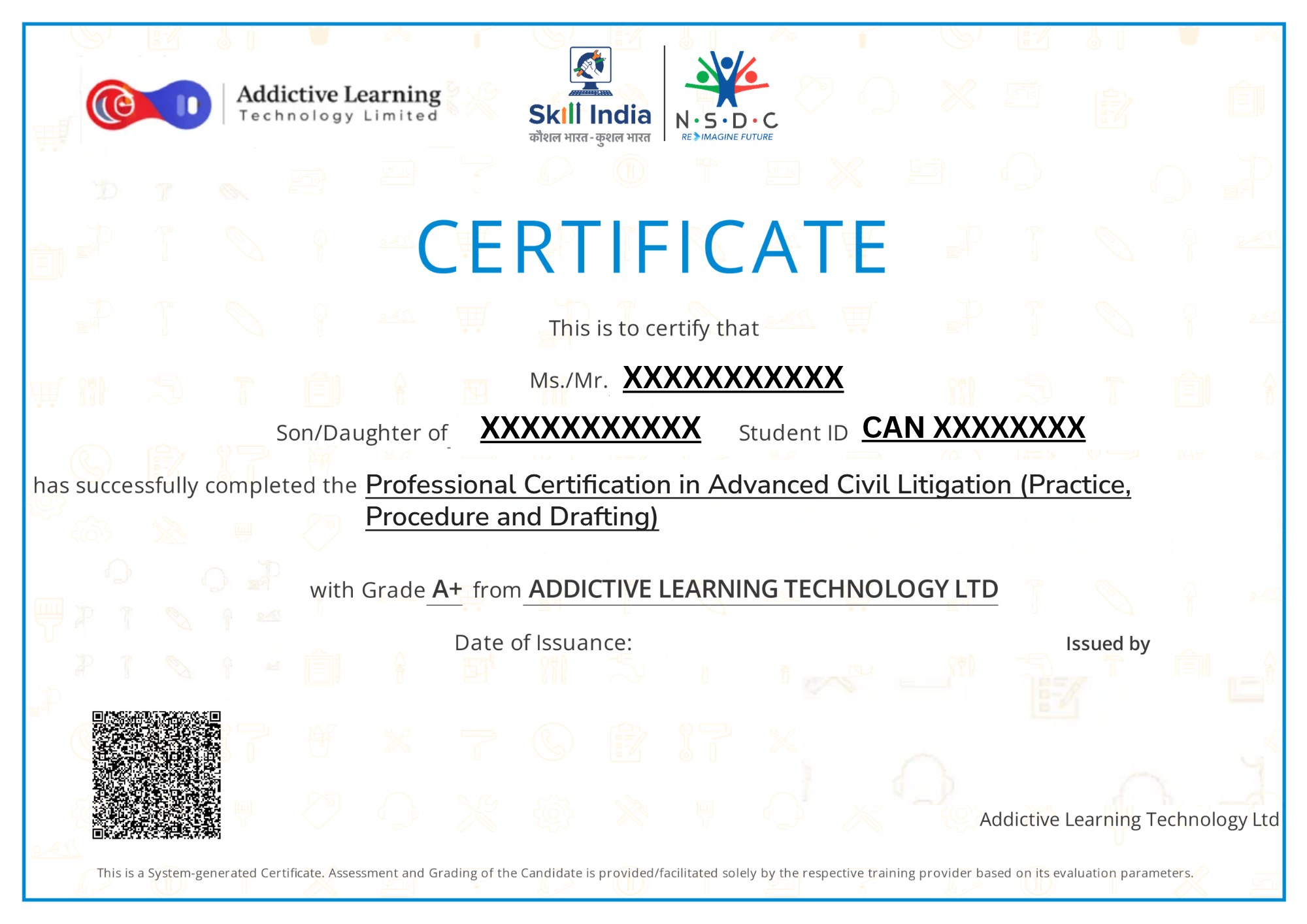
Certificate cobranded by Skill India + NSDC
This course is recognized by the National Skill Development Corporation, a PPP under the Ministry of Skill Development and Entrepreneurship of the Government of India.
You will receive a certificate cobranded by NSDC and Skill India on successful completion. This is how the certificate from NSDC and Skill India will look as per the current applicable format (may change as per the approval authorities):
Sample Certificate
Syllabus
Purpose of a brief for opinion and when a client seeks counsel's opinion
How to assemble and present the brief: statement of facts, documents and the specific questions posed
Framing the questions on which an opinion is sought
Structure of a legal opinion: facts, issues, applicable law, analysis and conclusion
Drafting techniques: stating assumptions, identifying gaps in instructions and qualifying the opinion
Advising on merits, prospects of success, limitation and choice of forum
Professional and ethical considerations while rendering an opinion
When a legal notice is required by statute or contract and when it is advisable
Essential ingredients of a legal notice
Various nuances of drafting a legally and factually robust legal notice
Statutory notices (e.g. Section 80 CPC, notices under contractual notice clauses)
Computation of notice period and consequences of non-compliance
Strategy and structure for drafting a reply to a legal notice
Preserving the client's position and avoiding admissions in the reply
Basic rules of CPC to be kept in mind while drafting a plaint
Whom to implead as a party (especially where the defendant is a corporate entity)
Standard components of a plaint: cause-title, body, list of dates, grounds and prayer
Jurisdiction (territorial and pecuniary) and cause of action
Vakalatnama, verification, affidavit
Types of relief in the prayer and how to frame them
Annexures and documents to be filed with the plaint
Nature and scope of summary suits and classes of suits maintainable
Distinction between an ordinary suit and a summary suit
Drafting the plaint in a summary suit and the requisite averments
Procedure for leave to defend and drafting the application for leave
Conditions on which leave to defend is granted, refused or granted conditionally
Court Fees Act
How to calculate court fee and value suits for different reliefs
Ad valorem versus fixed court fee
Consequences of insufficient court fee and how to make good a deficit
Scheme of the Limitation Act, 1963 and the role of the Schedule
How to compute the period of limitation for various proceedings
Condonation of delay and drafting an application under Section 5
Exclusion of time, acknowledgement and effect of legal disability
Limitation as a mixed question of law and fact in pleadings
Basic rules of CPC to be kept in mind while drafting a written statement
Specific and evasive denials and the effect of non-denial / deemed admission
Set-off and counter-claim
Drafting a replication / rejoinder and the limits on its scope
Top filing errors in pleadings and how to rectify them
What to do when a summons is received and timelines for filing
Principles governing amendment of pleadings
The proviso and the 'due diligence' test after commencement of trial
Drafting an application for amendment and the supporting affidavit
Amendments that change the nature of the suit or introduce time-barred claims
Responding to and opposing an application for amendment
Grounds for rejection of a plaint
Distinction between rejection of plaint and return of plaint
Drafting an application for rejection of plaint
Stage at which the application can be moved and the standard of scrutiny
Most common interlocutory applications: temporary injunction, attachment before judgment, appointment of commissioner and receiver
Selection of the suitable interim remedy
Demonstrating a prima facie case, balance of convenience and irreparable injury
Standard structure of an interlocutory application and the supporting affidavit
Applications for stay, condonation, exemption and similar reliefs
Restitution: scope, purpose and who may apply under Section 144 CPC
When restitution can be claimed and drafting the application
Caveat: right to be heard, parties entitled to file, timeline and validity
Effect of filing a caveat and situations where caveats are commonly used
Inherent powers of court (Section 151 CPC): purpose, scope and limitations
Power to transfer suits, appeals and proceedings under CPC and the Constitution
Grounds on which a transfer may be sought
Transfer petitions before the High Court and before the Supreme Court
Drafting a transfer petition and the supporting affidavit
Scheme of the Right to Information Act, 2005 and information that may be sought
Identifying the Public Information Officer and the appropriate public authority
Drafting an application seeking information from a government department
Fees, time-lines and the first and second appeal mechanism
Exemptions under Section 8 and how to frame requests effectively
Rules regarding admission and denial of documents
Procedural aspect: requirement of inspection of documents
Timeline for admission and denial and the binding nature of admissions
Affidavit in support of denial and the requirement to prove a denied document
Drafting an evidence affidavit (examination-in-chief by affidavit, Order XVIII Rule 4 CPC)
Exhibiting and proving documents through the evidence affidavit
Purpose of examination-in-chief, cross-examination and re-examination
Stages of witness examination and the form of questions permitted at each stage
Use of leading questions and impeaching the credibility of a witness
Using contradictions and previous statements
Special considerations for expert, child and hostile witnesses
Virtual testimony and video-conferencing in modern litigation
Practical exercise: preparing a cross-examination plan from the pleadings and documents
Conducting a simulated cross-examination of a witness
Handling objections and the role of the court during cross-examination
Feedback and critique on technique, sequencing and control of the witness
When a first appeal lies against a decree and the appellate forum
Identifying sub-heads and grounds of appeal
Drafting the memorandum of first appeal
Application for stay
Maintainability of a second appeal under Section 100 CPC
Requirement of a substantial question of law
Framing the substantial question of law in the memorandum of appeal
Drafting the regular second appeal
Review: grounds under Section 114 and Order XLVII CPC and when it lies
Drafting a review petition and identifying sub-heads
Revision under Section 115 CPC: scope and jurisdictional limits
Distinction between appeal, review and revision
Drafting a revision petition and responding to an appeal or revision
When an execution petition can be filed and where it is to be filed
Modes of execution available to the court
Powers of the executing court and the bar against going behind the decree
Drafting an execution petition
Scheme of the Specific Relief Act, 1963 and the reliefs available
Declaratory reliefs, injunctions (mandatory, prohibitory and perpetual)
Recovery of possession and cancellation / rectification of instruments
Connection between reliefs in the plaint and the Specific Relief Act
Litigation under the Commercial Courts Act, 2015 and the meaning of a commercial dispute
Pre-institution mediation under Section 12A
Jurisdiction and power of the court to try commercial cases and grant interim relief
Types of writs and the relief that may be granted under each
Writ jurisdiction of the High Court under Article 226
Supervisory jurisdiction of the High Court under Article 227
Jurisdiction of the Supreme Court under Article 32
Maintainability, locus standi and availability of alternative remedies
Drafting a writ petition
Leave to appeal under Article 136 of the Constitution
Scope of the Supreme Court's discretionary jurisdiction under Article 136
Grounds of appeal and what constitutes a question of law
Drafting a special leave petition: synopsis, list of dates, grounds and prayer
**You will be given 2 exercises every week. Only 18 exercises will be discussed in class. You need to perform 18 out of the above exercises and 6 writing assignments to pass the course.*
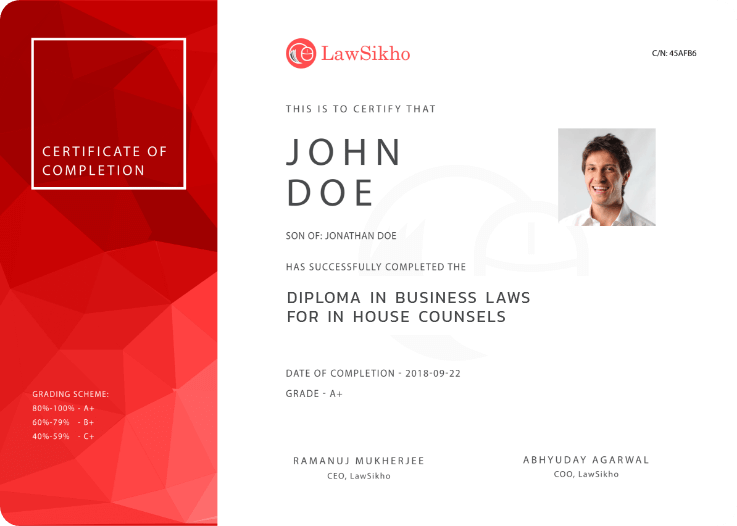
What does a LawSikho Certificate look like?
What does a LawSikho Certificate look like?
FAQs
We recommend that you should have completed your Higher Secondary / Class XII from a recognized Board / University. In the case of foreign nationals, you should have completed the equivalent of Higher Secondary in India in your respective country. You should also be comfortable with the English language and using a computer. However, we have no formal pre-qualification requirements because we are not a University or college. Anyone who wants to learn is welcome to join our courses.
If international students require hard copy material, they need to share their correct address and we will let them know the cost of the courier which they need to pay and then the hard copy will be dispatched. This is the process because the cost of an international courier is very high compared to the domestic courier within India (for domestic courier we have no additional charges). Some international students provide us with an Indian address for couriering hard copy material. In those cases, we charge nothing extra for the courier.
A person can visit the official website of LawSikho and find the relevant course and see the course syllabus, learning objectives and even a list of weekly exercises. You can also subscribe for free sample material. If more clarification about the course is needed, feel free to chat with our online chat specialist. You could also call us on our landline number, +91 11 40845203 for further assistance.
We do not offer any demo classes. You will not understand the course's quality by attending a single class as the results we produce is done through a combination of many things - study material, assignments, personal feedback on assignments, and then finally, class. The only way to experience the course is to take the course for a month, risk-free, as we give no questions asked and refund between the 30th and 45th day provided you attend all classes and solve all the assignments.
The refund policy may vary. We advise you to go through the refund policy given on the respective course page to know the actual refund policy applied to you.
There are no minimum attendance requirements, as we will teach the course online through a Learning Management System that allows you to pursue the course at your own pace and convenience.
We will conduct online weekly classrooms for 1.5- 3 hours. Attendance is recommended. Feedbacks by our experts on your assignments submitted is the goal of our sessions.
To know more about exercises and assignments submission requirements, please check the course page.
As candidates will be enrolling from across India and abroad, every candidate's schedule is likely to differ. The test will be available on the online portal for a substantial period so that you can take them at your convenience. We will give sufficient opportunity to everyone to attempt the test.
If any student is unable to attempt the test or facing any issues, can mail us at [email protected]
Requirements of the online test may vary as per the course. We suggest you read the test details on the course page to learn more.
The online MCQ is executed on the Learning Management System. You do not have to go to any special centres to give the test or exam. You can attempt the test by logging on to the online Learning Management System from your home or anywhere you wish. We recommend using a computer while giving these tests, as mobile phones are unreliable for giving tests.
Students should finish the MCQ test within the stipulated time in one sitting.
Please visit the course page to know MCQ test fees and guidelines.
You can use any of the following methods to pay for the course.
- Online payment through Razorpay - Credit Card, Debit Card, Netbanking, Amex & UPI
- International students can use Razorpay or Paypal
- NEFT/ RTGS (online through your bank account) or offline
For further details on making payments, please visit our enrolment page or call on +91 11 40845203 for assistance.
If you have a Credit Card with one of the following banks, you can pay using an EMI option.
- ICICI Bank
- Axis Bank
- Standard Chartered Bank
- Kotak Mahindra Bank
- HDFC Bank
- Yes Bank
- IndusInd bank
- RBL Bank
We allow our students to make the payment in installments. To know more about it, get in touch with us at +91 11 40845203.
Please do not expect us to teach you like college courses. Those are not effective. Our focus is on giving you a realistic experience of doing legal work. Hence you will get different exercises and assignments every week and all relevant material to solve them. Please do not worry that you have not read other associated concepts. We are recreating the experience of working in a law firm or in-house legal department, and we found that this is the kind of training that works best. Live classes will relate to the week’s assignments. You can read the modules from module 1, but we advise you to follow the courses according to where the assignments take you. By the end of the year, you would have covered all the syllabus and retained everything.
If it feels complicated and challenging midway, do not worry. The course is designed like this. You need to stick to it, hold on for dear life and ride along as you ride a roller coaster. Our responsibility is that you are satisfied and get all the results that you were promised by the end. If you are not, you can hold us responsible. But please, please trust the course design and stick to it until the course gets over.
No, there are no discounts available. We do not believe in discounts and never give one. Prices have only increased over time and not decreased.
The course starts on the commencement date for your batch. You would get access to all the study materials on the online learning management system, which you can view on your computer or mobile phone (Android & iOS). The study materials cannot be downloaded or printed.
We will dispatch hard copy materials for reference within 45 (forty five) days. We cannot deliver videos and periodic updates in hard copy; hence hard copy materials are not recommended for studying to attempt exams. To stay updated with the latest developments, we strongly recommend that you learn from online materials.
Every week, you will be given exercises to perform, which we will discuss in a live online classroom.
The passing criteria for any course are 40% of the total marks and completion of weekly exercises, articles/assignments as mentioned in the course guidelines.
Please check the passing criteria section on the course page for more details.
You can attempt the MCQ test only once.
If you fail in a course, you can request a re-examination once again. You can re-submit the required exercises and articles with a deduction of 3 marks.
For exercises that you have already submitted, and you do not wish to re-attempt, your marks will remain the same. We will give you some additional exercises to attempt to increase your chances of completing the course successfully. It will also enhance your learning.
If you have any doubt or question relating to the content, please write on the discussion forum of the LawSikho platform itself. Our concerned experts will respond to you within 24 to 48 working hours. You can also write your queries to [email protected]. Our concerned executives will support you to get your questions resolved within 24 working hours.
We ensure that class timings enable a maximum number of students to participate and take out time from work or college while at the same time they are feasible for experts.
Classes will be of 1-hour duration and will be held in any of the following time slots:
Weekdays: 8:00 pm - 10:00 pm IST
Saturdays: 7:00 pm - 10:00 pm IST
Sundays: 10:00 am - 8:00 pm IST
You will be informed of the class timings for the relevant week at least 48 hours before the class via email notifications and WhatsApp messages. We will also add it to your Google calendar. We will ensure we have fixed timing for this class to schedule your day well in advance according to it as far as possible.
Recordings of class sessions will be made available on the online learning management system for accessing within 48 hours of the session conducted.
Those who complete the course successfully will be awarded a LawSikho certificate. The certificate will be dispatched within 45 (forty five) days of course completion.
Please check the course guidelines for more details.
The course is designed keeping in mind the schedule of practising lawyers, working professionals, entrepreneurs and full-time students. The learnings are well spread out over a long period. There would be a specific learning objective every week, accompanied by assignments. It takes about 8-10 hours for a person of average intelligence to complete all course activities every week. You need to take this course one week at a time.
We do not guarantee that you will pass the course without putting in reasonable effort or attention. Still, the exact amount of time you would need to dedicate depends on your ability to grasp the material.
Yes, knowledge of the law is not a prerequisite for deriving value from the course. It is possible that what you learn in this course is entirely independent of any other course you have probably pursued or are pursuing. The course is designed keeping in mind that there will be many non-lawyers taking up this course. The only knowledge we assume is what one would expect to know after completing higher secondary school. All modules are reviewed from a high school graduate's perspective and ensured that they are effortless to understand.
You only require knowledge of the English language and basic computer skills to understand the concepts.
An active placement assistance program is available to students, including CV-writing, career guidance, and sharing of relevant job and internship opportunities. Job and internship opportunities will be shared with students on the WhatsApp group from time to time. Students who complete the exercises and perform well in those exercises and classes can be recommended to law firms, lawyers chambers and companies for jobs and internships. However, we do not guarantee any job or internship.
We have also started a career clinic for the benefit of our students. Students can visit our office in Delhi or seek career-related insights over phone or video calls on pre-designated days. More than 2000 positions have been shared with our students to date, and hundreds have got placements and internships through us. Our students have been placed in various law firms and other organisations as full-time employees and have obtained multiple opportunities for internships under the programme. How many opportunities you get will depend on your efforts in the course, and if you do the course well, you will be able to find jobs on your own.
We will also provide you with a career development course free of cost if you need it. Just ask our customer support if and when you need it after participating in at least three months of classes.
We also help you enhance your CV by writing and publishing articles and giving you networking exercises and coaching to build your professional network. Creating your professional network can make excellent opportunities available to you that you cannot even imagine today.
For more details, please see the placement assistance guidelines given on the course page.
How the courses are created, and its philosophy - We aim to create extraordinary lawyers and support the legal industry. You will find no other course which is as practical, provides as much personal attention to every student, or as many opportunities.
Syllabus, coverage and approach to issues - We do not spoon-feed you but give you experience what you will experience when you work at top law firms or big in-house legal departments. You will be prepared for the best and the worst. You will learn to deal with any legal issues, even those we didn’t teach you about, because that is how our course is designed.
Live Exercises - Pilots are put on simulators to practice flying before they are given an actual aircraft to fly. That is how our courses work as well. Even before you start dealing with real-life cases and matters, we train you to do such work through simulation exercises. This experience is invaluable for ambitious lawyers. Think of our courses like an online gym or a martial arts dojo for learning legal skills that will make you amazingly successful.
Personalized support - you can ask questions in the learning management system, interact with us on WhatsApp groups and even call us when you are struggling. We are here to work with you to make you succeed.
Placement assistance - Do you know any other course where you get this level of placement assistance? Law firms and companies love to hire our students because it is tough to find such highly-trained talent. Ask our graduate students! Also, we make you write articles, publish, and enhance your CV and network with many people. This provides you with next-level opportunities in your career.
Doubt-clearing weekly exercises - Doubts are cleared every week. If you can’t wait, post your doubts inside the module itself, our experts reply within one working day.
Grading system: Students will be graded according to the following grading system:
| Grade | Percentage |
| F (Fail) | <40 |
| C+ | 41 to 59 |
| B+ | 60 to 79 |
| A+ | 80 to 100 |
Migration from one course to another is possible. Students should email their migration request to our support team at [email protected] within ten days from the enrollment date.
We will not accept any requests after ten days.
Yes, you can migrate from one batch to another after paying a migration fee of INR 2000/- (or as per the prescribed fee pertaining at the time of migration) and the course fee difference between the admitted batch and transferee batch if any. If migrated, the work or assignments submitted earlier by you will not be considered.
A student is given sufficient time to submit the minimum number of required assignments. If they fail to do so, they can submit their pending assignments after the deadline with an extension fee of Rs 2000/- Please check the details of our different courses to know more about the assignment deadlines for individual courses.
The month and year may vary as per the type of course. We suggest you check the Migration Rules of your course on the course page.
LawSikho conducts exams during the course duration. If the course is accredited by MEPSC, LawSikho will conduct one certification test during the course duration & the MEPSC will conduct another after completion of the course.
Weekly exercises are very important to learn the practical aspects for which you joined the course. You get sufficient time to complete those. In case you can’t finish them within the due date, you get an extension to complete them with a deduction of a few marks.
You will not get a LawSikho certificate if you fail to submit the required number of assignments and articles. These are mandatory requirements for obtaining the certificate and value of the course for which you enrolled.
The certificate will have the Grade on it. If students want to know their scores, they can write to us at [email protected]. We will provide their scores.
Yes, you will have to attempt just one MCQ test at the end of the course for LawSIkho certification.
You must complete the required number of assignments and the MCQ test to complete the course successfully. They are mandatory requirements. You won’t get the LawSikho certificate if you fail to fulfil these requirements.
An online Live class is a video conference-based class that you can attend from mobile, tablet and personal computer through an application. You can see the teacher and the teacher can see you. You can even share your screen with the teacher for comments if the teacher requests it, and the teacher can show you his or her screen. You can see other people attending the class also. There is usually a lot of discussion amongst the students and teachers in the class. It is very much like a live classroom except that you do not have to travel to access the class; you can access it on the go as long as you have internet and a device.
We will point you out the relevant reading material and templates and precedences you need to solve an assignment. You can also freely discuss with other students in the course WhatsApp group. You can post queries in the learning management system as well while working on assignments. During the live sessions, you can ask questions to the expert and get your issue resolved. Sometimes it may be possible to schedule a call with evaluators and discuss with them, but this is at the discretion of the evaluator and at a time of his or her convenience. We cannot handle unlimited calls with every small question. You have to respect the time and availability of the evaluators also. For that, you already have the Learning Management System and the WhatsApp group, where you can post an unlimited number of doubts.
Our training methodology is unique. While any outside authority does not endorse it, the success of our students speaks for itself. Our methodology is described in detail in the previous questions. The legal industry loves to hire our students who have gone through the entire training we provided. Major companies have been hiring us to train their legal teams and managerial executives with cutting edge legal courses. This is proof of our success.
Yes, in all our premium courses, there are live weekly classroom sessions. Apart from one session related to your course, sometimes you will be invited to attend extra free sessions on writing, networking or other relevant skills. However, the course is conducted through an online learning management system, enabling students to access study materials from anywhere in the world at their own time and convenience. Course materials will be accessible on the online learning management system, which you can assess on a laptop/desktop. You can also access the course on your phone by downloading the LawSikho app. We may upload some course materials around the time of your class about the relevant issue. Apart from this, you will have access to significant hard copy material as well.
Live sessions on exercises shared will be conducted online every week. Once or twice a month, you will also have a session on writing influential articles and networking skills. In total, students will have 5-6 live sessions every month. At times there could be extra sessions that are optional to attend.
Our experts' weekly online sessions will include feedback on the previous week's exercise and explain new concepts related to upcoming exercises.
Attendance for sessions is not mandatory but crucial for learning to perform exercises that add value. Students who miss the session can watch the recorded versions of the sessions conducted on the Learning Management System (LMS) and the assignment portal (anything that is easier for you, it is uploaded on both platforms). We will add the recorded session to LMS within 48 working hours.
It is highly recommended that you complete weekly exercises. It is mandatory to submit 50% of subject exercises per course requirement and all writing assignments.
All study materials, including text, videos, drafting exercises, templates and regular tests, will be available only on the LMS and accessed using your login ID for the LMS. Students can also access the course through the state of the art mobile Apps, making learning convenient and accessible on a real-time basis.
Some courses require 100% of subject exercise submission. Please visit the course page to know the number of exercises and assignments to be submitted for a particular course.
For any other help or clarification, or grievance, please write to us at [email protected].
Our student support team representative will write back to you with a personalized response within 24 working hours.
Don’t forget to mention your Enrollment Number, Course and Batch when you communicate with LawSikho.
We are closed on Sundays and Central Government Gazetted Holidays.
How will you clear my doubts and help me if I am struggling to understand or learn a concept?
- In our live classes, you can ask questions, share your screen, receive personal feedback, and have your doubts cleared.
- If you need more help after getting feedback on an assignment or want career advice, you can schedule a private one-on-one call. Our evaluators and mentors are here to assist you and give you advice that's tailored to your needs.