


800+
Job offers received

2700+
Internships received

3300+
Freelance assignments received through the course

LawSikho Learners' Advantage
14000+
Number of Freelance assignments secured through LawSikho

3000+
Number of lawyers placed in jobs by LawSikho

11000+
Number of internships secured till date through LawSikho

17
Law Firms started by lawsikho learners

1500+
Recruiters who hired our learners


84000 USD (International)
Highest package secured

Success stories on Youtube


Medhavi Mishra

Viraj Patil

Kushagra


You get to learn from the best


Anmol Harshal Sadhwani
Senior Associate
BA LLB – ILS Law College, Pune | LLM – Jindal Global Law School
Corporate lawyer with over 5 years of experience working with Indian and international companies, including JP Morgan Chase Bank and Tech Mahindra Limited. Expertise in drafting and negotiating contracts in banking, corporate, and IT sectors. Experienced in litigation management and handling employee claims.

Deepak Arora
Senior Associate
PhD, University of Lucknow. IPR Masters degree, HNLU
Academic and research professional with over 7 years of experience, including a prior role as faculty. Currently pursuing a Ph.D. at the University of Lucknow, through which he has developed strong research, literature review, and scholarly writing skills. Contracts specialist, expert in interpreting Contract enforcement laws and has been teaching subjects such as Contract Law Labour and employment law professional with expertise in comparative international labour laws, workplace compliance, employee relations, and global workforce management across major jurisdictions.

Siddharth Ranka
Senior Associate
BLS LLB – SVKM's Pravin Gandhi College of Law, University of Mumbai LLM (IPR) – NMIMS, Mumbai UGC NET - Law PhD (Pursuing) – MIT WPU School of Law, Pune
Legal professional and academic mentor with over 5 years of experience in legal education, contract drafting, and legal research, focused on building practical, industry-ready legal skills. Experienced in mentoring aspiring legal professionals and bridging the gap between legal theory and real-world practice through application-based learning. His areas of expertise include contract drafting, business laws, paralegal training, compliance, and emerging legal technologies. He is passionate about equipping students with practical legal knowledge and professional skills relevant to today's evolving legal and corporate landscape.

Utsa Pattnaik
Senior Associate
BSL LLB, Diploma in Corporate Laws; LLM in Business Laws
Utsa brings over 15 years of professional experience in corporate governance and strategic legal advisory, serving as a senior legal professional across media and corporate sectors.

Aditi Bohra
Senior Associate
BA LLB (Hons.) – National Law University, Delhi | Former In-House Counsel – Wipro Limited
Legal professional and academic mentor with over three years of experience in contract drafting, commercial contracting, legal education, and legal technology. Former In-House Counsel at Wipro Limited with experience in drafting, reviewing, and negotiating commercial and IT agreements, particularly for US clients, while ensuring legal compliance, risk assessment, and effective contract management. Her areas of expertise include contract drafting and negotiation, commercial and IT contracts, SaaS Agreements, Contract Lifecycle Management (CLM), Legal Automation, Artificial Intelligence in legal practice, digital marketing and personal branding for legal professionals, and practical legal skills training.


Shraddha Mishra

I have completed a course from Lawsikho, last year & currently pursuing another. The rapid responsiveness of their teams is truly commendable. I am highly impressed by the quality of their employees, who are professional & dedicated. The courses provided invaluable insights, and the study material is comprehensive. Highly recommended.
Narmada Singh
I had a freelance session with Manyata, from LawSikho. I am totally impressed with the session hosted by her. She has a very friendly approach and she helped me set up freelance profile end to end. She went above and beyond and provided me with my 1st gig offer within 3 days of setting up my profile. I am grateful and thankful for the commitment she showed.
Alamnoor Singh
LawSikho offers impressive, well-structured legal courses with up-to-date materials and a strong focus on practical training. Their commitment to skill-building sets them apart, and their placement services are highly regarded. I would recommend LawSikho for anyone seeking to enhance their legal knowledge and career prospects.
Ssangeeta Sharma
Law Sikho is a very good platform for knowledge of law and gives practical insights. It's a good portal for both amateurs as well professionals. Keep it up Law Sikho.. Your name itself is inspiring.
What do you get inside the course
45+
hr.
live practical sessions with industry experts
100+
hr.
simulation oriented practice through highly empirical assignments
15+
hr.
personalised coaching catering to students’ specific needs and desired outcomes.
15+
hr.
hours of training to facilitate a successful career through freelancing
20+
hr.
assistance to help students build immaculate track records

Exposure to growing areas of law
It is a lot easier to find clients and get jobs in areas of law practice that are growing now rather than those that have stagnated. Lawsikho courses are designed to prepare you for the industry with skills & knowledge that are in demand by the market.

Learn & master real skills by doing
Gain real legal skills through hands-on practice. One hour of daily practice ensures expertise in the field. Our practical approach enables you to handle complex legal challenges confidently, preparing you for a rewarding and impactful career in the industry.

Knowledge & mentors for success
Our expert-designed courses guarantee a thriving legal career. Get unparalleled access to a wealth of knowledge and mentors who will guide you through every step, ensuring you acquire the necessary skills and insights to excel in the dynamic legal landscape.

Build an unmatched track record
Establish a strong online presence, publish articles, and connect with industry experts for your dream job. Leverage our guidance to build a formidable track record that showcases your expertise, helping you stand out from the competition and secure top-tier opportunities.

Find global jobs & freelance work
Our dedicated placement team and US subsidiary help you secure jobs, internships, and freelance projects worldwide. Expand your horizons, work with diverse clients, and gain exposure to international legal practices, propelling your career to new heights.

Ride in the remote work revolution
Earn more, work flexibly, and explore limitless opportunities in international remote work with LawSikho. Embrace the future of legal practice without restricting yourself to your city or town, and seize the chance to shape a successful and fulfilling legal career on a global scale.
 Key Highlights






Introduction
Imagine grabbing incredible opportunities to work with clients from all around the world. You might think you need loads of experience, but guess what? You can dive right in today!
Now, you might be wondering, 'Can I help clients with foreign laws even if I'm not certified there?' Great question! Let's explore giving valuable advice while staying within the rules.
Enforcement matters, big time. It's not just for the legal pros; it shapes the success of your law business. Let's unpack why enforcement is a game-changer.
Are you ready to take your law business global? Let's uncover why expanding internationally is a total win.
No waiting necessary! This is your moment to grow your law business beyond borders!
Imagine this: the global legal market is worth a staggering $800 billion. Just in the US alone, the legal industry rakes in around $300 billion. Now, picture India, with a legal sector valued at only $2 billion currently.
But here's the exciting part. This scenario presents us with an amazing chance to go beyond India and serve clients worldwide, not just locally.
And guess what? Even if you focus on the mighty US market, which is substantial, it's still only half of the entire global market.
With the world embracing remote work and communication, there's no better time to step into the international arena. Countless opportunities await!
Why Does Enforcement Matters?
Imagine making a deal with someone, but they don't hold up their end. What's your move? This is where enforcement steps in – ensuring promises are kept and conflicts are fairly resolved.
Back in 2019, the World Bank checked how countries handle these situations. They wanted to see how quickly business disputes are resolved.
Guess who aced it? Singapore! They're like the superheroes of keeping promises. But India didn't fare well and landed at a not-so-great 163rd place.
This tells us that having solid ways to make sure agreements are honored is like having a strong referee in the game. It keeps things fair and helps everyone stick to the rules.
Running a business, especially across borders, isn't just about having a piece of paper saying you made a deal or a court decree in your favor. The real deal is making sure the agreement or court decision is put into action. If that doesn't happen, it doesn't matter that you had an agreement or a legal victory.
In 2020, UK-based Cairn Energy Plc secured a major legal win against the Government of India over taxes. An important group, the International Arbitration Tribunal, ruled that India owed Cairn $1.4 billion. This was because India had imposed extra taxes on Cairn's business, which Cairn found unfair.
Anticipating resistance, Cairn took action even before India could object. They approached courts in nine different countries to ensure the decision was enforced. And guess what? Five of those countries said, 'Yes, India, you have to pay up!'
Now, here's the intriguing part.
With those 'yes' responses, Cairn gained the right to claim valuable assets owned by the Indian government in those countries. This could be sold to recover the money India was supposed to pay – like taking something valuable from a friend if they don't return borrowed items.
To sum up: Cairn Energy Plc emerged victorious against the Indian government and is determined to actually receive the money they rightfully earned. They're achieving this by leveraging laws and regulations across different countries.
Think of it as a global game of legal chess!
This underscores the urgency of taking swift action to ensure you genuinely receive what you've rightfully earned from a successful outcome.
Why did we create this course?
Have you ever wondered how businesses around the world work together? Imagine being the go-to expert who guides them on creating and enforcing contracts that span across borders. That's where our course comes in!
We saw a gap between what entrepreneurs and businesses need from legal experts when it comes to international contracts and what resources were available. So, we decided to bridge that gap and create a course that gives you the knowledge and skills to shine in this exciting field.
With remote work becoming the norm, businesses are collaborating across countries more than ever. This means tons of international contracts are being drawn up. And guess what? Our course isn't just about teaching you how to draft these contracts – it's also about showing you how to make sure they actually hold up.
In this course, we're going to help you master the art of dealing with contracts across different countries. We'll teach you how to negotiate, write, and make sure those agreements are followed, using the legal systems of each country. Plus, we'll show you how international arbitration can be a powerful tool in commercial disputes. Get ready to level up your contract skills
Come along on a fun learning adventure! Get ready to dive into the exciting realm of Diploma in International Contract Negotiation, Drafting and Enforcement
Who should take this course?
- If you're a lawyer who loves solving legal puzzles across borders and want to master international contract writing and enforcement, this course is for you.
- Law students and lawyers aiming to dive into the world of global contract creation and enforcement, including the exciting realm of international commercial arbitration, will find this course valuable.
- If you're curious about how to make smart plans for making sure contracts work smoothly across different countries, this course has got you covered.
- Law students and lawyers looking to earn extra income by helping out foreign law firms or assisting international lawyers in drafting and enforcing international contracts can gain crucial skills from this course.
- In-house legal experts working for big global companies will discover strategies to tackle international contract challenges and create contracts that really work.
- If you're a law student dreaming of landing a job in big multinational corporations, this course can give you a competitive edge.
- Legal professionals like lawyers, chartered accountants, and company secretaries who guide companies and startups stepping into the international arena will find essential insights in this course.
What will you learn from this course?
- Understanding Legal Systems: We'll explore different types of legal systems in various countries and their unique features. This knowledge will help us create contracts that work effectively in these countries.
- Crafting Effective Notices: We'll learn how to write notices for various situations like default, breach of contract, and starting arbitration. This is essential for international contracts.
- Navigating Court Systems: We'll dive into the court systems and case management in several countries, such as Singapore, the US, UK, Dubai, Hong Kong, Canada, Japan, Brazil, and the Netherlands.
- Resolving International Conflicts: We'll address conflicts that arise between organizations from different countries and within multinational companies.
- Mastering Negotiation Techniques: Learn different negotiation methods and how to use them while creating contracts. Negotiation can also be a way to resolve disputes.
- Understanding Mediation and Conciliation: We'll explore how international mediation and conciliation work, which can be crucial in resolving disputes.
- The Anatomy of Contracts: We'll break down the essential parts of a contract, especially for those involving multiple countries. Knowing these key parts is crucial during disputes.
- International Commercial Arbitration: Understand the ins and outs of international commercial arbitration. This includes dealing with both Indian and foreign aspects of such arbitration.
- Choosing Arbitration Rules: Learn how to select the right arbitration rules when dealing with international parties.
- Drafting Arbitration Clauses: We'll delve into creating arbitration clauses for international commercial arbitration in contracts spanning multiple countries.
- Picking the Right Arbitration Institution: Understand the implications of choosing the law of countries like Singapore, the UK, the US, Canada, and India as the governing law for your international contracts.
- Expert Contract Advice: Learn how to review the contract laws of any country to provide the best advice to clients regarding suitable governing laws.
- Preparing for Arbitration: We'll learn how to draft a Statement of Claim and a Statement of Defence for international commercial arbitration.
- Anti-Arbitration Injunctions: Explore how to obtain anti-arbitration injunctions in several countries, including Singapore, the UK, the US, Canada, and India.
- Challenging Arbitration Awards: We'll understand the process of initiating proceedings to challenge or set aside an arbitration award in different countries
Training Methodology

Online 24/7 access
Access study materials via our online portal & via our anroid & iOS apps.

Practical Exercises
Two practical exercises every week, each followed by written feedback.

Live Online Classes
Live online classes based on exercises, allowing questions and feedback.

Convenient Class timings
Classes held after work hours, typically on Sundays or after 8 PM on weekdays.

Live Doubt Clearing
Live doubt clearing for support and one-on-one sessions with mentors.
Who will be your potential clients / employers?
- Big Global Players: Multinational companies would love to have you on their team. You'll be the secret weapon in negotiating and creating contracts that work across borders, making your resume shine like a supernova when you apply for in-house positions.
- Ambitious Startups: A startup with big dreams, wanting to take their ideas beyond their home turf. They'd gladly hire you as a consultant to guide them on the tricky path of drafting international contracts and understanding the legal rules in new countries.
- Glam World: Celebrities, sports stars, and global media companies entering international deals can't do it without your expertise. They need someone who knows how to make sure contracts hold up across borders, and that someone is you!
- Arbitration: Arbitration institutions are searching for smart minds like yours. Your insights into international contract drafting are like gold for them, and they'd love to have you join their team.
- Cross-Border Transactions: Corporate lawyers aiming to create seamless transactions across countries will want you in their corner. You're the bridge between legal worlds, and that's an invaluable skill.
What kind of recruitment and placement support will I get?
- Unique Training Method: We're the sole organization in India offering comprehensive, exercise-based courses.
- Employer Recognition: Many leading employers, law firms, and companies actively seek our high-performing students.
- Career Opportunities: Success in our courses can lead to job placements, internships, and assessment internships in esteemed law firms, with renowned lawyers, and various companies.
- Empowering Learners: We focus on empowering learners with not just knowledge and skills, but also real-world opportunities.
- Dedicated Support Team: Our dedicated team is here to assist you with placements, internships, and freelance opportunities.
- Proven Success: Between April 2021 and June 2023, we've helped over 21,000 students secure job and internship opportunities.
- Media Recognition: Our achievements have been featured in respected media outlets like The Hindu, Business World, and India Education Diary.
- Impressive Value: Our students have secured over Rs. 2.7 Crore (USD 330,000) worth of work, with records of INR 30 LPA (USD 37,500) domestically and INR 50 LPA (USD 62,500) internationally.
- Comprehensive Support: From day one, our placement team guides you in setting goals, crafting standout CVs, enhancing interview skills, and supporting your critical first month on the job or during an internship.
- Trusted Recruiters: We've built strong collaborations with recruiters who prefer hiring our well-trained students.
- Competitive Edge: Partnering with us gives you an edge in the job market and opens doors to exciting career prospects.
What is unique about this course?
- Here, Empowerment with invaluable skills in negotiation, crafting, and ensuring the success of international contracts. Whether you're a student eager to learn, a law graduate seeking a competitive edge, or a working professional aiming to advance your career, this course is designed for you.
- By the end of this course, you can expect to have secured enough skills to be able to effectively advise startups or multinational companies on drafting their international contracts so as to ensure appropriate enforcement.
- By the end of this course, you will be able to learn how to draft various notices such as notice of breach, notice of commencement of arbitration, notice of waiver, notice of renewal etc. for international contracts. This skill is not being taught in any contract drafting course available for international contracts.
- This course is designed to be dynamic and immersive. To earn your well-deserved certificate, all you need to do is successfully finish the set of assignments we provide. Imagine honing your skills for just 4-5 hours a week – that's less time than a favorite TV show! And remember, these assignments are your key to unlocking the full potential of the course, which is already packed with awesome classes.
- You will have interactive classes with high-quality discussions which will be taken by the experts of this course. You can get all the doubts resolved in the classes or even outside the classes through course groups and email.
- You will get personal attention and coaching from our trainers who will be assigned to you, and have access to a dedicated course anchor who will help you with submissions or any guidance or issues you may have as you progress through the course.
- You will receive in-line feedback for the assignments you submit, which will improve your performance to a significant extent.
- You will be trained in writing for six writing assignments during the term of the course and if these are of publishable quality, these shall be published on the iPleaders blog which sees a footfall of more than a million visitors a month.
How is this course better than other online courses on International Contract Negotiation?
|
Service |
LawSikho |
Others |
|
Live training |
✔️ 100 live classes of 1.5 hours - 150 hours, with optional mentoring and feedback sessions |
❌ No live classes or upto 6 live classes |
|
Duration and depth of training |
✔️ 1 year, with 3 years access so that you acquire mastery |
❌ 1-2 months, primarily self-study with some reading material and pre-recorded videos - gives introductory training |
|
Practical exercises to develop your skill with in-line feedback |
✔️ |
❌ |
|
Training on writing articles and building |
✔️ |
❌ |
|
One-on-one guidance in case of doubts |
✔️ Can be scheduled for feedback on your personal drafts, your Upwork profile, for mock interviews, etc. |
❌ |
|
Comprehensive placement assistance (Jobs, internships, client opportunities) |
✔️ |
❌ |
|
Guidance on performing international freelance work |
✔️ |
❌ |
|
Total training you will get including self study |
600 hours |
<30 hours |
|
Money-back guarantee |
✔️ 45-day money back guarantee - see refund policy |
❌ |
Can I get remote freelance work after doing this course?
At LawSikho, we have two types of students: those who already possess good legal skills and those who are in the process of learning. We believe in enabling our learners to start earning from their knowledge without delay.
For students with professional-level legal skills, we offer opportunities in contract drafting, data & privacy, international business law, US immigration law, litigation support, and international IP law work.
However, we understand that acquiring professional-level skills takes time. For those who are still developing their legal skills, we provide alternative work opportunities such as writing articles, conducting research, legal transcription, data entry, law firm administration, social media management, and more. Some students even engage in tasks like voice-over work, data compilation, translation, and virtual assistance.
We have established a dedicated team that actively pitches to organizations in the US to help LawSikho students find remote work.
We have set up a US entity to bridge the trust gap between US legal professionals and an organization operating from India.
We focus on getting learners their first three clients, guiding them in crafting impressive proposals. By the time they secure these initial clients, learners become well-adjusted to the process and can independently attract more clients.
They build their CVs and profiles with real work experience and testimonials, opening doors to numerous opportunities.
Getting started is often the hardest part, but at LawSikho, we make the process frictionless. We have witnessed law students earning well over $1000 per month.
Some students have earned $500 in their first month as a side gig. We have students who, after a year, now earn $10,000 per month. While some may start with $300, they make progress by learning new skills, improving their profiles, and pitching for higher-paying work.
Between April 2021 and June 2023, we created over 21000+ opportunities for our learners, resulting in thousands of students securing freelance work. The total value of work secured amounts to over $3,30,000 (Aprox INR 2.7 Crore). Additionally, hundreds of individuals found employment, and secured internships.
Please note that these numbers represent the initial gigs facilitated directly by us or those on which we actively collaborated with the learners. Students have also secured additional work beyond our tracking.
Here are a few examples of learners who secured remote freelance work
- Vaishnavi Shrivastava, 2022 law graduate from D. Y. Patil College, University of Mumbai. She had done one of our IP courses in 2020. In April 2021, we set up our freelancing team. By May 2021, Vaishnavi had started freelancing when she was in 4th year of her college. She had obtained a domestic job offer in Chennai which would pay her 25K as a junior associate, which she rejected. Initially, she was doing content writing work for IP law firms in the US and Australia, and then she got remote trademark registration and other paralegal work as well. 8 months back she was earning INR 50,000 per month, working 80 hours in a month. Now, she has recently hit a personal earnings milestone INR 1,50,000 per month last month - and she works less than 80 hours/month!
- Soham Devlekar, who was a 3rd year LLB student from Babasaheb Apte Law College, University of Mumbai when he enrolled in our courses. In December last year, he received a part time job at Cowlitz Law Group in the US (a law firm that works on real estate, personal injury, family law, etc.). He started at 5 USD per hour and later was earning USD 8/hr for being a virtual assistant, doing social media marketing and some contract review. He was earning around USD 1400 per month.
How will you clear my doubts and help me if I am struggling to understand or learn a concept?
- In our live classes, you can ask questions, share your screen, receive personal feedback, and have your doubts cleared.
- If you need more help after getting feedback on an assignment or want career advice, you can schedule a private one-on-one call. Our evaluators and mentors are here to assist you and give you advice that's tailored to your needs.
Certification
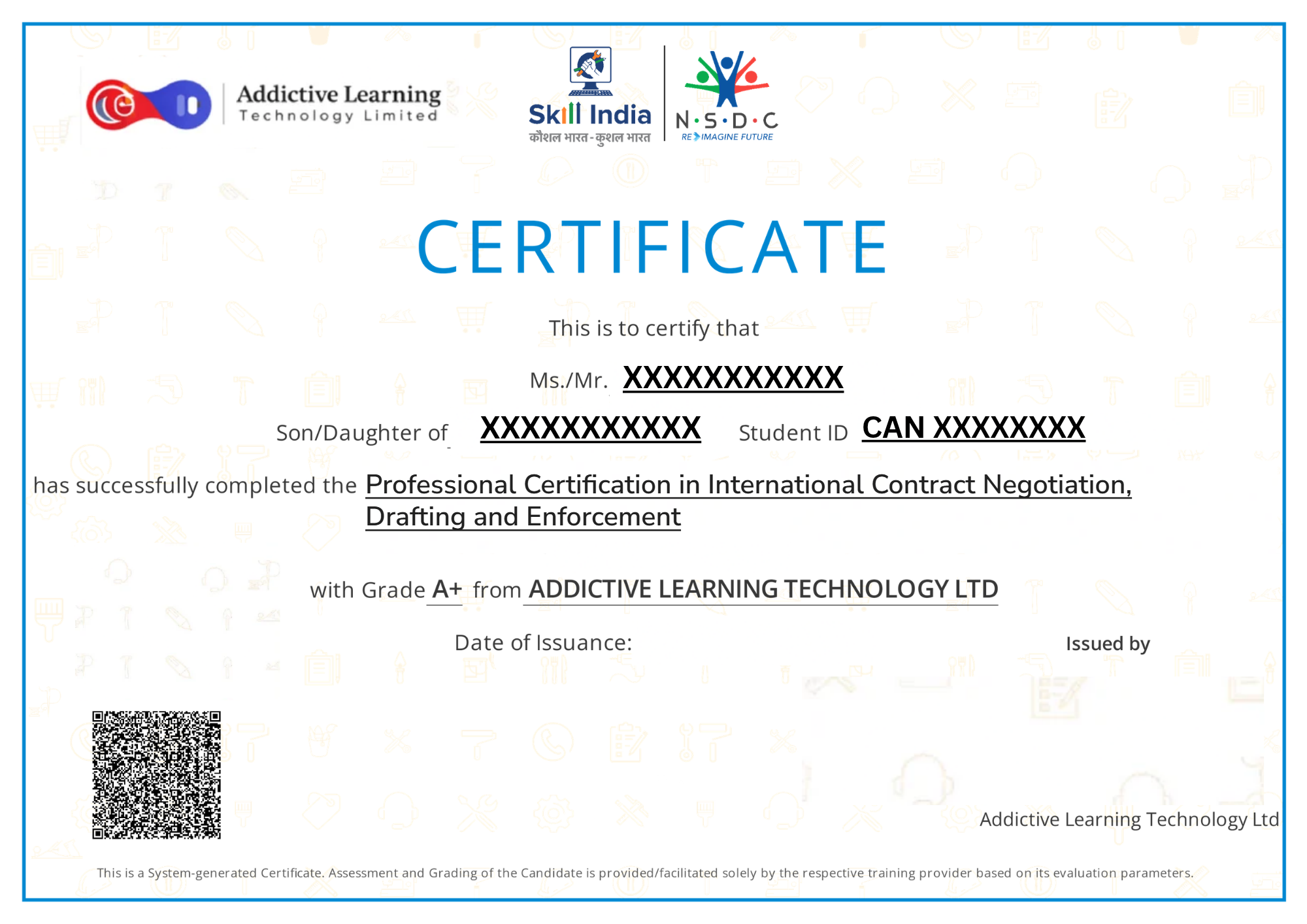
Certificate cobranded by Skill India + NSDC
This course is recognized by the National Skill Development Corporation, a PPP under the Ministry of Skill Development and Entrepreneurship of the Government of India.
You will receive a certificate cobranded by NSDC and Skill India on successful completion. This is how the certificate from NSDC and Skill India will look as per the current applicable format (may change as per the approval authorities):
Sample Certificate
Money back guarantee
If you take this course, follow it diligently for a month, attend all classes and do all the exercises but still do not find value in it, or are not able to understand or follow it or not find it good for any reason, we will refund the entire course fee to you. It is a 100% money back guarantee with only one condition, you must pursue it properly for a month. If you don’t find it valuable after that, get your entire money back.
Specific learning objectives
- Learn how to guide clients about the legal systems of different countries, how to find out the features of the legal system of any country and what resources you would rely on for this purpose.
- Learn about what kind of disputes can arise in international contracts and the preferred dispute resolution methods and draft contracts accordingly
- Learn how to advise clients about the enforcement environment in a country - the courts system and availability of courts for commercial litigation in Singapore, US, UK, Dubai, Hong Kong, Canada, Japan, Brazil and the Netherlands.
- Learn about what information you should secure and confirm with the clients before drafting international contracts
- Learn how to draft operative clauses in cross border contracts
- Learn how to advise clients on the appropriate governing law for international contracts
- Learn how to perform a conflict assessment and draft a report covering important points for a mediation
- Learn how to frame negotiation strategies for a client in international disputes
- Learn how to draft a settlement agreement for international mediations
- Learn what you need to consider in order to ensure enforceability of contracts in different jurisdictions and advise a client accordingly
- Learn how to draft ten important contracts which are used across the world
- Learn how to draft different types of notices and letters required for international contracts
- Learn how to brief offshore counsel with respect to arbitration proceedings
- Learn how to choose an appropriate arbitral institution for institutional arbitration
- Learn how to draft an arbitration clause for international commercial arbitration
- Learn the implications of choosing laws of Singapore, UK, US, Canada and India as governing law for a contract and advise a client on appropriate choice of law
- Learn how to draft a statement of claim and statement of defence for international commercial arbitration
- Learn how to quantify damages for the breach of contract and ask for appropriate reliefs
- Learn how to advise a client on challenging enforcement of foreign awards in India
What kind of assignments will you get?
- Review a contract for export of certain products. Identify which clauses of the contract will be subject to treaties and conventions and will be different from a contract within a country. Also identify the different types of disputes that may arise from the contract.
- In furtherance of entering into an sole selling agency agreement with a builder, a local estate agent has approached you for the purpose of determining the right type of dispute resolution mechanism for matters occurring out of such contracts.
- A Regional Director in a multinational corporation is facing consistent issues between two teams under him located in different countries. Both the team heads are constantly attempting to show each other down and ‘one-up’ each other. Perform a conflict assessment for the organization, in order to aid a mediation, determining the following:
- Who are the relevant stakeholders?
- What are their substantive interests?
- What do they disagree on?
- Will a consensus building approach be feasible here?
- Wantaas Private Limited, an Indian startup working on sharing news in short entertaining videos is looking to enter into the US market. However, the management has asked you, as the general counsel, to create a report highlighting to it the contract enforcement mechanisms and environment available in the US before it goes ahead and enters into any business transaction with any entities in the US. Make a presentation about the contract enforcement environment and mechanism in the US for your board.
- Draft obligations and payment clauses considering various payment mechanisms as well as confidentiality and non-compete clauses for an Indian artifacts entity looking to engage a distributor in the UAE to distribute and showcase their products in the UAE.
- A local competitor in the Japanese market has sprung up and is denting the sales of your client’s product. He was your client for the product for 6 months. This competitor has chosen a similar sounding name and color scheme, but in Japanese it’s written differently. He also hired one of your consultants, in breach of a non-compete clause, to make his website. There was an arbitration clause in the contract. What actions can you take to stop this?
- Your client, who is selling electric automobiles (like Tata or Mahindra) will open offices in Singapore, Dubai, US and UK in the next 18 months. Before they incur any expense and brief a local lawyer or consultant, they want your preliminary advice on a few key issues:
- A common neutral seat for international arbitration for local partners and distributors in all those states
- Enforceability of arbitral awards in those states against local partners
- A client from the Netherlands has requested an online arbitration agreement to be drafted for a prospective iOS and Android app developer for an e-commerce app. Draft the agreement and mention the choice of ODR rules/ e-arbitration service [The seat in online arbitrations is often mutually agreed by the parties by way of agreeing to the terms and conditions of the e-arbitration service. For e.g If you use SAMA, the seat of arbitration would be Mumbai, India, unless otherwise agreed by the parties]
- Your client, A, is a construction company which undertakes projects internationally, in collaboration with government agencies and peers. A agreed to enter into a construction contract, containing an arbitration clause, with the government of Lesotho for the purpose of building a flyover. Due to the pandemic, the country faced an extreme financial crisis which resulted in default of payment of installments to A. Draft a notice of commencement of arbitration on behalf of A.
- Raajbhog Restaurants LLC, a US based chain of Indian restaurants is now looking to extend its franchise to the UK. It has a significant supplier in India, who exports the authentic Indian spices to US and the food is prepared in accordance with the original recipes developed by Raajbhog. A Franchisee in the UK is ready to enter into an agreement with Raajbhog, however, the mandate is that the franchisee will have to use the supplier in India and prepare the food according to the recipes provided by Raajbhog in order to maintain the taste standards. Which governing law should the parties choose, since all three of them are based in different countries?
- The legal counsel of your client, a civil works company, which is incorporated in India, but managed from Singapore has approached you to determine whether the provisions of international commercial arbitration would be applicable in the case of their dispute with a government company which had given them a construction contract. Draft a legal opinion answering specific questions and concerns from the legal counsel.
Course Plan
Above prices are inclusive of all applicable taxes and charges.

1 online live class/ week
2 practical or drafting exercises per week
Get digital access to entire study material
Hardcopy study materials- available on additional charges.
Weekly assignments with model answer, along with one-on-one expert consultations for resolving doubts.
Access on LMS, Android & iOS app
Instructor feedback on assignments
Unlimited doubt clearing sessions.
Instructor led course with online live classes
Online exams (give exams as per your convenience on given time slots)
Certificate (by courier)
CV enhancement
Coaching for professional networking
Training for writing and publishing articles
Internship & Job Support
Interview preparation guidance
Access to updated content online for 3 years
Top students are recommended to law firms and companies (as applicable)
Syllabus
Sources of international law - treaties, conventions, practices, customs
Using INCOTERMS
UNIDROIT principles of international commercial contracts
Drafting contracts for interpretation in another legal system
How do these impact international contracts
Why contract enforcement is important
Which resources can be considered authentic and reliable?
How to keep track of developments
Hierarchy of courts for commercial disputes
Specialized commercial courts/ commercial divisions
Availability of small claims courts and fast-track procedures
- Caps
- Procedural Simplifications
- Can Parties Represent Themselves
Availability and criteria for pretrial attachment of movable assets
Automatic & Random Assignment of Cases to Judges
Timelines for following processes under civil procedure laws
- service of process;
- first hearing;
- filing of the statement of defense;
- completion of the evidence period;
- filing of testimony by expert; and
- submission of the final judgment
Restrictions on number and circumstances of adjournments
Public availability of performance measurement reports to monitor progress of cases and compliance with timelines
Use of pretrial conferences for case management
Availability of electronic case management systems for various processes
Automation of court proceedings
Hierarchy of courts for commercial disputes
Specialized commercial courts/ commercial divisions
Availability of small claims courts and fast-track procedures
- Caps
- Procedural Simplifications
- Can Parties Represent Themselves
Availability and criteria for pretrial attachment of movable assets
Automatic & Random Assignment of Cases to Judges
Evidentiary weight of a woman’s testimony
Timelines for following processes under civil procedure laws
- service of process;
- first hearing;
- filing of the statement of defense;
- completion of the evidence period;
- filing of testimony by expert; and
- submission of the final judgment
Restrictions on number and circumstances of adjournments
Public availability of performance measurement reports to monitor progress of cases and compliance with timelines
scheduling (including the time frame for filing motions and other documents with the court);
case complexity and projected length of trial;
possibility of settlement or alternative dispute resolution; exchange of witness lists;
Evidence;
jurisdiction and other procedural issues; and
narrowing down of contentious issues.
access laws, regulations and case law;
access forms to be submitted to the court;
receive notifications (for example, e-mails);
track the status of a case;
view and manage case documents (briefs, motions);
file briefs and documents with the court; and
view court orders and decisions in a particular case.
Possibility of electronic filing procedures without in-person interaction
Electronic service of complaint on the defendant
Electronic payment options for court fees
Public availability of judgments rendered by local courts
Hierarchy of courts for commercial disputes
Specialized commercial courts/ commercial divisions
Availability of small claims courts and fast-track procedures
- Caps
- Procedural Simplifications
- Can Parties Represent Themselves
Availability and criteria for pretrial attachment of movable assets
Automatic & Random Assignment of Cases to Judges
Timelines for following processes under civil procedure laws
- service of process;
- first hearing;
- filing of the statement of defense;
- completion of the evidence period;
- filing of testimony by expert; and
- submission of the final judgment
Restrictions on number and circumstances of adjournments
Public availability of performance measurement reports to monitor progress of cases and compliance with timelines
Use of pretrial conferences for case management
Availability of electronic case management systems for various processes
Automation of court proceedings
Hierarchy of courts for commercial disputes
Specialized commercial courts/ commercial divisions
Availability of small claims courts and fast-track procedures
- Caps
- Procedural Simplifications
- Can Parties Represent Themselves
Availability and criteria for pretrial attachment of movable assets
Automatic & Random Assignment of Cases to Judges
Timelines for following processes under civil procedure laws
- service of process;
- first hearing;
- filing of the statement of defense;
- completion of the evidence period;
- filing of testimony by expert; and
- submission of the final judgment
Restrictions on number and circumstances of adjournments
Public availability of performance measurement reports to monitor progress of cases and compliance with timelines
Use of pretrial conferences for case management
Availability of electronic case management systems for various processes
Automation of court proceedings
The different parts of a contract, and the sequence in which different clauses customarily appear in a contract
The categories to which each clause in a contract pertains
The Definitive Contract Drafting Checklist
The relevance of the introductory parts of a contract
How are introductory clauses drafted
What are representations and warranties and why are they required?
Tips and strategies in drafting representations and warranties clauses
The consequences of false representations
What are covenants?
The concept of conditions precedent and the relevance of the conditions precedent clause in a contract
Conditions subsequent and completion
The consequences of breach of conditions precedent and conditions subsequent clauses
How to draft the conditions precedent, conditions subsequent and completion clauses
The relevance of the obligations and payment clauses
How payment and increment clauses are drafted
The consequences of default in payment
How should consideration clauses be drafted?
How to decide the ‘term’ of a contract and draft the ‘term’ clause
How termination is connected with the term of the contract and how to draft termination clauses
The different methods by which a contract can be renewed
Which obligations under the contract continue to be applicable even after termination?
Which rights in an agreement can be assigned and which ones can be retained
How anti-assignment clauses work
The significance of the ‘change of control’ clauses and how these work
Is revocation of assignment possible?
The concept and the need for confidentiality, non-compete, non-solicit and exclusivity clauses
How to draft an effective confidentiality clause
In which situations can a non-compete clause be enforced?
Cases where non-solicit and exclusivity arrangements are used
What are non-circumvention clauses?
What are ‘no-waiver’ clauses?
Why are variation clauses required?
What are severability clauses used for?
The concept of an indemnity clause and the reason why it is required in a contract
Situations when an indemnity clause can be triggered
How to draft an effective indemnity clause
Difference between an indemnity and a guarantee
The effect of Limitation of Liability clauses
Drafting a notice as per the notice clause
Why it is important to provide for a receipt mechanism in a notice clause
How to determine and find the applicable consequences of breach based on the relevant law
Drafting notices for breach
Remedies for breach based on the state law
Why is a dispute resolution clause required in a contract?
Why are alternative dispute resolution methods better than conventional legal proceedings?
What is Arbitration? Which disputes are arbitrable and what is the difference between ad-hoc and institutional arbitration?
Learn how to draft an effective arbitration clause
The relevance of the Governing Law and jurisdiction clause
Learn how the Governing Law and jurisdiction clauses should be drafted
Does it require execution in a particular manner?
Does it require approval from a specific authority in accordance with the law?
Legalisation requirements - stamping, notarisation, apostille
Reasonability in clauses
Appropriate choice of governing law
Confidentiality Agreements / Non-disclosure Agreements
Employment Agreements
Lease Agreements
Licensing Agreements
Power of Attorney Document
Sale / purchase Agreements
Distribution Agreements
Loan Agreements
Joint Venture Agreements
Website Development Agreements
Notice of claim in a works contract
Notice to cure defect
Notice of breach
Notice invoking force majeure
Notice to commence negotiation
Notice claiming service credit
Notice claiming indemnity
Notice of commencement of arbitration
Letter of renewal/ extension
Letter of waiver
Addendums / Novation Agreement / Amendment agreement
Notice demanding payment
Response notice rejecting claim of service credit
Response notice rejecting force majeure invocation
Response notice denying indemnity
Response notice denying payment
Why is International Commercial Arbitration a preferred mode for dispute resolution in international transactions?
Legal work in international commercial arbitration for in-house counsels, corporate lawyers, arbitration lawyers and litigators
How to navigate the domestic and offshore legs of International Commercial Arbitration
What you need to know about foreign law to be effective in international commercial arbitration
How to brief offshore counsel with respect to arbitration proceedings
How international commercial arbitrations can be institutionalised and what are the important organisations in this area?
Ad hoc v International Arbitration
What are the key considerations in selection of the set of arbitration rules that will govern a dispute between contracting parties?
How do these vary in case of ad hoc arbitration vis-a-vis institutional arbitration?
UNCITRAL Arbitration Rules
How to apply the seat and venue consideration and remove uncertainty while drafting an effective and predictable arbitration clause.
Case studies of some well drafted and not so well drafted arbitration clauses.
Arriving at a Model Arbitration Clause for International Contracts and how to modify it as per applicable factual situation
Components of clauses in International Commercial Arbitration.
Institutional Arbitration Model Clauses for SIAC, HKIA, DIFC-Dubai, LCIA and AAA.
Pathological arbitration clauses.
Important components of an arbitration clause.
Why do clauses say ‘without reference to conflict of laws rules’?
Importance of ‘good faith’/ reasonable endeavor requirements.
Choice of law
How to answer common questions that every client faces about selection of seat, selection of arbitral institution and choice of law
Special emphasis on following Arbitration Institutions
- International Court of Arbitration
- London Court of International Arbitration
- Singapore International Arbitration Centre
- Hong Kong International Arbitration Centre
- International Centre for Settlement of Investment Disputes
Exclusivity clause and restraint of trade
Confidentiality and Causation
Delay and other performance defaults (Cost escalation)
Indemnity and limitation of liability
Unilateral amendment
Clauses in restraint of legal proceedings in different legal systems
Stamp duty or its equivalent in non-Indian laws (Contract/ Arbitral Award)
Causation
Remoteness of damage
Mitigation of damages
How to define the dispute
Quantification of Damages
· To what extent are liquidated damages valid?
· What if the amount of liquidated damages specified is very high?
· Is there some prohibition against inclusion of penalty clauses?
· Are indirect and remote damages enforceable?
· Is there a duty of the party suffering loss to mitigate damages?
· Are punitive damages, if agreed contractually, valid?
Types of reliefs
· Monetary compensation
· Punitive damages/ penalties
· Interpretation of contracts
· Restitution
· Is declaratory relief relevant?
· Interest
· Costs
· Do national laws constrain this?
FAQs
We recommend that you should have completed your Higher Secondary / Class XII from a recognized Board / University. In the case of foreign nationals, you should have completed the equivalent of Higher Secondary in India in your respective country. You should also be comfortable with the English language and using a computer. However, we have no formal pre-qualification requirements because we are not a University or college. Anyone who wants to learn is welcome to join our courses.
If international students require hard copy material, they need to share their correct address and we will let them know the cost of the courier which they need to pay and then the hard copy will be dispatched. This is the process because the cost of an international courier is very high compared to the domestic courier within India (for domestic courier we have no additional charges). Some international students provide us with an Indian address for couriering hard copy material. In those cases, we charge nothing extra for the courier.
A person can visit the official website of LawSikho and find the relevant course and see the course syllabus, learning objectives and even a list of weekly exercises. You can also subscribe for free sample material. If more clarification about the course is needed, feel free to chat with our online chat specialist. You could also call us on our landline number, +91 11 40845203 for further assistance.
We do not offer any demo classes. You will not understand the course's quality by attending a single class as the results we produce is done through a combination of many things - study material, assignments, personal feedback on assignments, and then finally, class. The only way to experience the course is to take the course for a month, risk-free, as we give no questions asked and refund between the 30th and 45th day provided you attend all classes and solve all the assignments.
The refund policy may vary. We advise you to go through the refund policy given on the respective course page to know the actual refund policy applied to you.
There are no minimum attendance requirements, as we will teach the course online through a Learning Management System that allows you to pursue the course at your own pace and convenience.
We will conduct online weekly classrooms for 1.5- 3 hours. Attendance is recommended. Feedbacks by our experts on your assignments submitted is the goal of our sessions.
As candidates will be enrolling from across India and abroad, every candidate's schedule is likely to differ. The test will be available on the online portal for a substantial period so that you can take them at your convenience. We will give sufficient opportunity to everyone to attempt the test.
If any student is unable to attempt the test or facing any issues, can mail us at [email protected]
Requirements of the online test may vary as per the course. We suggest you read the test details on the course page to learn more.
The online MCQ is executed on the Learning Management System. You do not have to go to any special centres to give the test or exam. You can attempt the test by logging on to the online Learning Management System from your home or anywhere you wish. We recommend using a computer while giving these tests, as mobile phones are unreliable for giving tests.
Students should finish the MCQ test within the stipulated time in one sitting.
Please visit the course page to know MCQ test fees and guidelines.
You can use any of the following methods to pay for the course.
- Online payment through Razorpay - Credit Card, Debit Card, Netbanking, Amex & UPI
- International students can use Razorpay or Paypal
- NEFT/ RTGS (online through your bank account) or offline
For further details on making payments, please visit our enrolment page or call on +91 11 40845203 for assistance.
If you have a Credit Card with one of the following banks, you can pay using an EMI option.
- ICICI Bank
- Axis Bank
- Standard Chartered Bank
- Kotak Mahindra Bank
- HDFC Bank
- Yes Bank
- IndusInd bank
- RBL Bank
We allow our students to make the payment in installments. To know more about it, get in touch with us at +91 11 40845203.
Please do not expect us to teach you like college courses. Those are not effective. Our focus is on giving you a realistic experience of doing legal work. Hence you will get different exercises and assignments every week and all relevant material to solve them. Please do not worry that you have not read other associated concepts. We are recreating the experience of working in a law firm or in-house legal department, and we found that this is the kind of training that works best. Live classes will relate to the week’s assignments. You can read the modules from module 1, but we advise you to follow the courses according to where the assignments take you. By the end of the year, you would have covered all the syllabus and retained everything.
If it feels complicated and challenging midway, do not worry. The course is designed like this. You need to stick to it, hold on for dear life and ride along as you ride a roller coaster. Our responsibility is that you are satisfied and get all the results that you were promised by the end. If you are not, you can hold us responsible. But please, please trust the course design and stick to it until the course gets over.
No, there are no discounts available. We do not believe in discounts and never give one. Prices have only increased over time and not decreased.
The course starts on the commencement date for your batch. You would get access to all the study materials on the online learning management system, which you can view on your computer or mobile phone (Android & iOS). The study materials cannot be downloaded or printed.
We will dispatch hard copy materials for reference within 45 (forty five) days. We cannot deliver videos and periodic updates in hard copy; hence hard copy materials are not recommended for studying to attempt exams. To stay updated with the latest developments, we strongly recommend that you learn from online materials.
Every week, you will be given exercises to perform, which we will discuss in a live online classroom.
The passing criteria for any course are 40% of the total marks and completion of weekly exercises, articles/assignments as mentioned in the course guidelines.
Please check the passing criteria section on the course page for more details.
You can attempt the MCQ test only once.
If you fail in a course, you can request a re-examination once again. You can re-submit the required exercises and articles with a deduction of 3 marks.
For exercises that you have already submitted, and you do not wish to re-attempt, your marks will remain the same. We will give you some additional exercises to attempt to increase your chances of completing the course successfully. It will also enhance your learning.
If you have any doubt or question relating to the content, please write on the discussion forum of the LawSikho platform itself. Our concerned experts will respond to you within 24 to 48 working hours. You can also write your queries to [email protected]. Our concerned executives will support you to get your questions resolved within 24 working hours.
We ensure that class timings enable a maximum number of students to participate and take out time from work or college while at the same time they are feasible for experts.
Classes will be of 1-hour duration and will be held in any of the following time slots:
- Weekdays: 8:00 pm - 10:00 pm IST
- Saturdays: 7:00 pm - 10:00 pm IST
- Sundays: 10:00 am - 8:00 pm IST
You will be informed of the class timings for the relevant week at least 48 hours before the class via email notifications and WhatsApp messages. We will also add it to your Google calendar.
We will ensure we have fixed timing for this class to schedule your day well in advance according to it as far as possible.
Recordings of class sessions will be made available on the online learning management system for accessing within 48 hours of the session conducted.
Those who complete the course successfully will be awarded a LawSikho certificate. The certificate will be dispatched within 45 (forty five) days of course completion.
Please check the course guidelines for more details.
The course is designed keeping in mind the schedule of practising lawyers, working professionals, entrepreneurs and full-time students. The learnings are well spread out over a long period. There would be a specific learning objective every week, accompanied by assignments. It takes about 8-10 hours for a person of average intelligence to complete all course activities every week. You need to take this course one week at a time.
We do not guarantee that you will pass the course without putting in reasonable effort or attention. Still, the exact amount of time you would need to dedicate depends on your ability to grasp the material.
Yes, knowledge of the law is not a prerequisite for deriving value from the course. It is possible that what you learn in this course is entirely independent of any other course you have probably pursued or are pursuing. The course is designed keeping in mind that there will be many non-lawyers taking up this course. The only knowledge we assume is what one would expect to know after completing higher secondary school. All modules are reviewed from a high school graduate's perspective and ensured that they are effortless to understand.
You only require knowledge of the English language and basic computer skills to understand the concepts.
Active placement, internships, and career-building-related assistance are provided to our learners from Day one of enrollment in the course. This is done through our dedicated Placement Team. This ensures that the learning process culminates in achieving tangible results in job and internship opportunities.
Placement support comprises a variety of services that would help you in achieving your dreams:
1. Our placement team will help you optimise your overall profile, including CV and Cover letter, which you will be using while applying for job/ internship opportunities.
2. You can reach out to our Placements Team for one-on-one personal mentorship and career guidance sessions.
3. Our team conducts regular Group mentorship sessions on the aforementioned topics to benefit a larger group of learners.
4. Our team collaborates with the country's top and varied workplaces and regularly sends our learners for internships and jobs at these places. If you perform diligently in the course, you will get such an opportunity through our Placements team, which is shared every day in our student groups.
5. Our team will also provide you with insights on freelance work, which you can use for remunerative benefits.
Placement and internship assistance at LawSikho aimed at making your experience with us a holistic one. The ultimate goal is to learn the skills from our vast content repository and use them to secure your dream internship or job.
For more details, please see the placement assistance guidelines given on the course page.
How the courses are created, and its philosophy - We aim to create extraordinary lawyers and support the legal industry. You will find no other course which is as practical, provides as much personal attention to every student, or as many opportunities.
Syllabus, coverage and approach to issues - We do not spoon-feed you but give you experience what you will experience when you work at top law firms or big in-house legal departments. You will be prepared for the best and the worst. You will learn to deal with any legal issues, even those we didn’t teach you about, because that is how our course is designed.
Live Exercises - Pilots are put on simulators to practice flying before they are given an actual aircraft to fly. That is how our courses work as well. Even before you start dealing with real-life cases and matters, we train you to do such work through simulation exercises. This experience is invaluable for ambitious lawyers. Think of our courses like an online gym or a martial arts dojo for learning legal skills that will make you amazingly successful.
Personalized support - you can ask questions in the learning management system, interact with us on WhatsApp groups and even call us when you are struggling. We are here to work with you to make you succeed.
Placement assistance - Do you know any other course where you get this level of placement assistance? Law firms and companies love to hire our students because it is tough to find such highly-trained talent. Ask our graduate students! Also, we make you write articles, publish, and enhance your CV and network with many people. This provides you with next-level opportunities in your career.
Doubt-clearing weekly exercises - Doubts are cleared every week. If you can’t wait, post your doubts inside the module itself, our experts reply within one working day.
Grading system: Students will be graded according to the following grading system:
| Grade | Percentage |
| F (Fail) | <40 |
| C+ | 41 to 59 |
| B+ | 60 to 79 |
| A+ | 80 to 100 |
Migration from one course to another is possible. Students should email their migration request to our support team at [email protected] within ten days from the enrollment date.
We will not accept any requests after ten days.
Yes, you can migrate from one batch to another after paying a migration fee of INR 2000/- (or as per the prescribed fee pertaining at the time of migration) and the course fee difference between the admitted batch and transferee batch if any. If migrated, the work or assignments submitted earlier by you will not be considered.
A student is given sufficient time to submit the minimum number of required assignments. If they fail to do so, they can submit their pending assignments after the deadline with an extension fee of Rs 2000/- Please check the details of our different courses to know more about the assignment deadlines for individual courses.
The month and year may vary as per the type of course. We suggest you check the Migration Rules of your course on the course page.
LawSikho conducts exams during the course duration. If the course is accredited by MEPSC, LawSikho will conduct one certification test during the course duration & the MEPSC will conduct another after completion of the course.
Weekly exercises are very important to learn the practical aspects for which you joined the course. You get sufficient time to complete those. In case you can’t finish them within the due date, you get an extension to complete them with a deduction of a few marks.
You will not get a LawSikho certificate if you fail to submit the required number of assignments and articles. These are mandatory requirements for obtaining the certificate and value of the course for which you enrolled.
The certificate will have the Grade on it. If students want to know their scores, they can write to us at [email protected]. We will provide their scores.
Yes, you will have to attempt just one MCQ test at the end of the course for LawSIkho certification.
You must complete the required number of assignments and the MCQ test to complete the course successfully. They are mandatory requirements. You won’t get the LawSikho certificate if you fail to fulfil these requirements.
An online Live class is a video conference-based class that you can attend from mobile, tablet and personal computer through an application. You can see the teacher and the teacher can see you. You can even share your screen with the teacher for comments if the teacher requests it, and the teacher can show you his or her screen. You can see other people attending the class also. There is usually a lot of discussion amongst the students and teachers in the class. It is very much like a live classroom except that you do not have to travel to access the class; you can access it on the go as long as you have internet and a device.
We will point you out the relevant reading material and templates and precedences you need to solve an assignment. You can also freely discuss with other students in the course WhatsApp group. You can post queries in the learning management system as well while working on assignments. During the live sessions, you can ask questions to the expert and get your issue resolved. Sometimes it may be possible to schedule a call with evaluators and discuss with them, but this is at the discretion of the evaluator and at a time of his or her convenience. We cannot handle unlimited calls with every small question. You have to respect the time and availability of the evaluators also. For that, you already have the Learning Management System and the WhatsApp group, where you can post an unlimited number of doubts.
Our training methodology is unique. While any outside authority does not endorse it, the success of our students speaks for itself. Our methodology is described in detail in the previous questions. The legal industry loves to hire our students who have gone through the entire training we provided. Major companies have been hiring us to train their legal teams and managerial executives with cutting edge legal courses. This is proof of our success.
Yes, in all our premium courses, there are live weekly classroom sessions. Apart from one session related to your course, sometimes you will be invited to attend extra free sessions on writing, networking or other relevant skills. However, the course is conducted through an online learning management system, enabling students to access study materials from anywhere in the world at their own time and convenience. Course materials will be accessible on the online learning management system, which you can assess on a laptop/desktop. You can also access the course on your phone by downloading the LawSikho app. We may upload some course materials around the time of your class about the relevant issue. Apart from this, you will have access to significant hard copy material as well.
Live sessions on exercises shared will be conducted online every week. Once or twice a month, you will also have a session on writing influential articles and networking skills. In total, students will have 5-6 live sessions every month. At times there could be extra sessions that are optional to attend.
Our experts' weekly online sessions will include feedback on the previous week's exercise and explain new concepts related to upcoming exercises.
Attendance for sessions is not mandatory but crucial for learning to perform exercises that add value. Students who miss the session can watch the recorded versions of the sessions conducted on the Learning Management System (LMS) and the assignment portal (anything that is easier for you, it is uploaded on both platforms). We will add the recorded session to LMS within 48 working hours.
It is highly recommended that you complete weekly exercises. It is mandatory to submit 50% of subject exercises per course requirement and all writing assignments.
All study materials, including text, videos, drafting exercises, templates and regular tests, will be available only on the LMS and accessed using your login ID for the LMS. Students can also access the course through the state of the art mobile Apps, making learning convenient and accessible on a real-time basis.
Some courses require 100% of subject exercise submission. Please visit the course page to know the number of exercises and assignments to be submitted for a particular course.
For any other help or clarification, or grievance, please write to us at [email protected].
Our student support team representative will write back to you with a personalized response within 24 working hours.
Don’t forget to mention your Enrollment Number, Course and Batch when you communicate with LawSikho.
We are closed on Sundays and Central Government Gazetted Holidays.

Note: This is an indicative list of our guest faculty members and not an exhaustive list. We may change the faculty members at any point based on availability.