























100+
Job offers received

230+
Internships received

150+
Freelance assignments received through the course

LawSikho Learners' Advantage
14000+
Number of Freelance assignments secured through LawSikho

3000+
Number of lawyers placed in jobs by LawSikho

11000+
Number of internships secured till date through LawSikho

17
Law Firms started by lawsikho learners

1500+
Recruiters who hired our learners



84000 USD (International)
Highest package secured

Success stories on Youtube



Yashika Malhotra

Samridhi Jain

Reviews on Quora

Soma Chakraborty
See moreYou get to learn from the best


Komal Shah
Co-founder and CKO, LawSikho
CS, Corporate law, ICSI. M.Com, LLB, Accountancy, Gujarat University
Komal, Co-founder of LawSikho, led in-house legal teams for a decade, specializing in IPOs, takeovers, and transactions in India, Ireland, and the UK. Managed compliance for subsidiaries in 19 countries.

Manyata Singhal
Associate
B.A. LL.B., L.L.M
Seasoned trademark attorney, offers guidance to students interested in trademark law and intellectual property rights, including insights into attorney roles and legal nuances in this specialization

Siddhartha Priya
Senior Associate
Ph.D. in Marketing. LL.B. MBA. B.Tech.
with over 10 years of diverse experience, mentors students interested in marketing, law, business, and more, offering insights into career opportunities in these fields.



Shraddha Mishra

I have completed a course from Lawsikho, last year & currently pursuing another. The rapid responsiveness of their teams is truly commendable. I am highly impressed by the quality of their employees, who are professional & dedicated. The courses provided invaluable insights, and the study material is comprehensive. Highly recommended.
Narmada Singh
I had a freelance session with Manyata, from LawSikho. I am totally impressed with the session hosted by her. She has a very friendly approach and she helped me set up freelance profile end to end. She went above and beyond and provided me with my 1st gig offer within 3 days of setting up my profile. I am grateful and thankful for the commitment she showed.
Alamnoor Singh
LawSikho offers impressive, well-structured legal courses with up-to-date materials and a strong focus on practical training. Their commitment to skill-building sets them apart, and their placement services are highly regarded. I would recommend LawSikho for anyone seeking to enhance their legal knowledge and career prospects.
Ssangeeta Sharma
Law Sikho is a very good platform for knowledge of law and gives practical insights. It's a good portal for both amateurs as well professionals. Keep it up Law Sikho.. Your name itself is inspiring.
What do you get inside the course
90+
hr.
live practical sessions with industry experts
200+
hr.
simulation oriented practice through highly empirical assignments
10+
hr.
personalised coaching catering to students’ specific needs and desired outcomes.
10+
hr.
training to facilitate a successful career through freelancing
40+
hr.
assistance to help students build immaculate track records

Exposure to growing areas of law
It is a lot easier to find clients and get jobs in areas of law practice that are growing now rather than those that have stagnated. Lawsikho courses are designed to prepare you for the industry with skills & knowledge that are in demand by the market.

Learn & master real skills by doing
Gain real legal skills through hands-on practice. One hour of daily practice ensures expertise in the field. Our practical approach enables you to handle complex legal challenges confidently, preparing you for a rewarding and impactful career in the industry.

Knowledge & mentors for success
Our expert-designed courses guarantee a thriving legal career. Get unparalleled access to a wealth of knowledge and mentors who will guide you through every step, ensuring you acquire the necessary skills and insights to excel in the dynamic legal landscape.

Build an unmatched track record
Establish a strong online presence, publish articles, and connect with industry experts for your dream job. Leverage our guidance to build a formidable track record that showcases your expertise, helping you stand out from the competition and secure top-tier opportunities.

Find global jobs & freelance work
Our dedicated placement team and US subsidiary help you secure jobs, internships, and freelance projects worldwide. Expand your horizons, work with diverse clients, and gain exposure to international legal practices, propelling your career to new heights.

Ride in the remote work revolution
Earn more, work flexibly, and explore limitless opportunities in international remote work with LawSikho. Embrace the future of legal practice without restricting yourself to your city or town, and seize the chance to shape a successful and fulfilling legal career on a global scale.
 Key Highlights





Introduction
“I am a jack of all trades but master of none”
Every lawyer in our fraternity has at some point or the other related to this phrase.
As law students, we used to idolise legal eagles who have established themselves in a particular field of law and have created history. We looked up to the likes of Nani Palkhiwala for taxation and H. M. Seervai for constitutional laws and wondered what it would be like if we could become the next authority on let say: Competition Law.
This hunger drives students towards working in a specific area of law with a specialised knowledge set.
Now cut to the present day, where students have joined the M&A departments of premier law firms (mostly because it is the most aspired sector for students and does pay the highest) and want to become the next Harvey Specter or Mike Ross. Fresh graduates are immediately piled up with the responsibility of the never-ending series of due diligence, advisories, acquisitions, mergers, de-mergers, transactions, and e-mails. In the midst of all this, imagine you get a query from a non-legal friend of yours needing some assistance on the Food Safety and Standards Authority of India and you have no answer to that.
Why?
Because you are an M&A lawyer, not a lawyer specialising in food laws. But how do you explain that to your friend because according to him, you are the only lawyer he knows.
You either try connecting him to a lawyer who works in that domain or you try finding a lawyer, seek answers and get back to your friend on the same.
These instances are far more relatable to lawyers who are working in extremely niche fields.
And it's interesting to know that this was not a problem twenty years ago because back then, the law firm culture had not exploded and lawyers were expected to work in every domain possible. We had more number of litigating lawyers than transactional lawyers who had to face three new kinds of law every single day.
However, the scenario has massively changed today.
Today, law firms are developing super niche departments and are investing in lawyers who become specialised asset for a particular domain. These firms have also become full-service to lure clients because now instead of one lawyer dealing with ten domains, firms can show that they have ten specialised departments providing specialised services in each domain.
Yes, that has worked out very well for companies who can now sign up with one law firm that will cater to all its needs but does it work out for lawyers individually as well? Especially the young task force?
This is where the situation gets tricky and in fact, is the ultimate dilemma that the fraternity faces.
To be a jack of all trades or a master of one!
Let us try to look at it logically. Less than 5% of the young task force is absolutely determined as to what stream of law they want to pursue. It is either a family decision or a deep affinity towards the subject that pretty much makes up their mind at an initial stage to either become a tax lawyer, or an M&A lawyer, or a real estate lawyer, etc. These are the professionals who are also hell-bent on either establishing a litigation niche or making it up to partnership in a premier tier 1 firm in that particular field of law.
What happens to the remaining 95%? Most of us are pretty much clueless at the time of our graduation as to what field of law we really do want to pursue. We are not randomly pulling out numbers here it is a thorough assessment after having surveyed over 2000 students in the last 5 years.
Call it the lack of exposure in college or not enough internships but young graduates severely lack the clarity to charter their career path. Worst case scenario- they enter into one of the specialised niche departments of a law firm and two or three years down the line, face a massive saturation of doing the same transaction and the same quality of work again and again. Some even realise that they don't even enjoy that particular department.
This is not just a problem with the young task force, but also with mid-level lawyers who are between a rock and a hard place situation. They have invested quite a lot of money and time in developing a niche but is it now feasible for them to go back to base zero to try out a new area of law? Not so much! This is the reason why most of them prefer to remain in their chosen areas wondering if they can ever diversify.
But why diversify in the first place?
We have had many professionals asking us why is specialization a bad thing? Now don’t get us wrong. We are not belittling the importance of gaining specialized knowledge in a particular field. It is in fact an asset to gain significant expertise in one or two areas of law.
That being said, what does it say about the long term value of a lawyer who is not well adept with various areas of a legal system? Let us be very honest today- with the world moving towards automation and artificial intelligence, law firms in the future are going to resort to significant resource cutting in an area where there is anyway no mass hiring.
The fraternity is going to get smaller and more polished. In such a scenario is it a prudent decision to have limited skill sets in just one area of law? For example: if you have been working in the M&A-FEMA segment of a law firm and there is massive cost-cutting in this segment making you vulnerable. What are your chances of making a switch to another department and starting from scratch considering you have kept yourself away from 15-20 different kinds of law? Even if you do move to another department you are looking at a 40% pay cut at the least as you have to start from A0 or at the most A1 level of a law firm.
This is why diversification in various areas of law makes you bankable for those areas and gives you a long-term opportunity to get a specialisation in a later part of your life.
Another way of diversification for lawyers is to move into litigation but this diversification certainly comes at a heavy cost. The pay cut is even more excruciating because we all know how litigation pays in your initial years.
This is where the option of becoming an in-house counsel to a company starts looking lucrative to lawyers.
This is that sweet spot where you don't have to take a massive pay cut and at the same time have the privilege of working for well-established MNCs.
But while lawyers explore this opportunity, we often come across some of the most popular myths prevalent today.
“In-house counsels have clerical jobs and mostly have a liaison work with the law firms”
“But an in-house counsel does not have to go to courts”
“In-house counsels do not need to draft contracts, prepare transactional documents and argue in courts”
“In-house counsels get to go home by 6 PM in the evening and do not have long hours like transactional lawyers”
Becoming an in-house counsel to a company has always been perceived as a soft option, an easy task, and is often considered as an early retirement by many of the professionals in the fraternity.
But let us stop you right there. The truth is far from it!
If becoming an in-house counsel was such an easy task and involved no “real work” then general counsels of companies would not be paid to the tune of INR 80-90 Lakhs per annum today. Yes- you have read it right. Check out this article by VCCircle and the figures published by them. The average salary of an in-house lawyer today in India is anywhere between INR 10-12 Lakhs per annum with a starting salary of not less than INR 7-8 Lakhs per annum and this is the minimum amount we are talking about.
And all this was in the year 2016. Add a 15% increment to that to judge the calculation of the figures applicable today.
If you notice carefully, law firms are still in the highest pay brackets but if you compare their attrition rate with that of companies, then companies are far more superior in the chart. What we mean to say is that companies are not only offering commensurate salaries but are certainly offering a better work environment which has kept the attrition rate is lower in comparison to law firms.
Why are in-house counsels paid so well?
When a JSW Steel Ltd-led consortium had almost settled the deal for Monnet Ispat & Energy- they were faced with a separate challenge. The IBC tribunal insisted on including small operational creditors as well, something that was not contemplated before. JSW Steel’s in-house legal team led by general counsel Rajiv Bakshi stepped in, helping the consortium make a quick decision and raise its bid by ₹ 25 crores which resulted in JSW bagging the Monnet Ispat deal.
Tata Sons Private Limited was looking to appoint someone who could lead the transactions, restructuring and joint ventures of the company and thereby appointed Shuva Mandal as the group general counsel in July 2017. The Tata group has since then, completed numerous transactions and has consistently held that Mandal’s involvement has turned out to be very crucial in saving time and money for the Tata group.
This is the kind of role those in-house counsels are expected to play today. They are no longer on the periphery doing secretarial work. They are walking hand in hand with the management and are often the deciding factor for them. The marketing and the sales team can come up with inventive strategies but it is the legal team that certifies the feasibility and possibility of those strategies.
In fact, the burden of responsibility has become multifold. Law firms have a standard protocol in terms of advising the companies. Yes, they are extremely sound with their specialised skill sets but in the end- their role is to limit themselves to the proposition given by the company and answer in a yes or no. However, companies need more than that- they want solutions. If not yes- then what?
This is often not catered to even by the most established partners in law firms. The reason is simple- law firms are outsourced legal advisors. They do not understand the pulse of a company the way the management does. Law firms will not have the bandwidth to understand that because they are catering to multiple clients.
But an in-house counsel will. The speciality of an in-house counsel is not only that he/she needs to understand the set up of the company, but he/she also needs to understand the industry in general. An in-house counsel gets the pulse of the organisation and strategies accordingly. Companies have started investing heavily in expanding their legal teams to reduce their reliance upon law firms for this very reason. This also serves a dual purpose of monitoring the expenses because law firms have become explosive with their billing rates.
Now, it's not possible for in-house legal teams to replace the work of law firms but in-house lawyers have the responsibility to monitor the value addition of the work being done by the law firms in terms of the money being invested. It is the job of an in-house counsel to hire the right kind of law firm for the required work and ensure that the advisory is solution-oriented in nature which fits the bill and requirements of the company. This is not a mere liaison job but a responsibility to determine the fate of the company.
A new development is also taking shape...
Lawyers are not only looking to diversify between domains of law but are also now looking to diversify their functional roles in general. B- Schools in India like ISB, IIM-A are now having a separate and preferable quota for professionals like lawyers seeking to do an MBA. Class diversity in premier B- schools reflects 20% of lawyers.
It is true- lawyers have now started to move out of this zone and explore different functional areas. The route makes much more sense when you have worked as an in-house counsel to a company where you not only have legal backing but you also understand how companies function in general.
But the route to becoming an in-house counsel is easier said than done...
You need to get this straight. Some companies like ICICI, JSW, Hindustan Coca Cola Beverages Pvt Ltd, etc do have a programme of taking in college graduates, training them, and then reinstating them as legal managers to the company. However, getting into such companies is extremely difficult. In a college placement programme, they will probably take 1 out of 30 or 40 applicants after a rigorous set of hiring. This approach is taken up by extremely few companies that can afford to invest in fresh blood.
The remaining lot will look for an experienced segment of professionals who are not limited to one area of law but have dipped their feet in multiple domains and have litigation experience added as well. But how is it possible for young graduates to gain skill sets which only come after 2-3 years of practice.
The scene is even more interesting for transactional and litigating lawyers. Transactional lawyers are usually under the impression that coming from premier tier 1 law firms will make them a natural pick for companies. Litigating lawyers feel that their litigation experience alone is enough to attract companies.
Not at all.
Companies want a mixed bag of everything!!!
A company on a daily basis essentially deals with everything- M&A, IPR, telecommunication and media laws, cyber laws, data privacy competition laws, real estate, contracts, FSSA, legal metrology Act, secretarial laws and litigation. Why would it look to invest in someone who has only worked in one arm of a particular department of a law firm or only has litigation experience?
Especially, when and if they are given the choice to hire another in-house counsel having experience of 2-3 years of handling the affairs of a company?
So what is the solution here?
This has been one of the most interesting challenges that we, as an educational company have faced.
What if you save the time and opportunity cost and invest in learning the skill sets that companies usually aspire for. Law students no longer need to wait to get into the workforce to explore the possibility of becoming an in-house counsel if they can get exposed to these areas of law at a very early age. What if we tell you that you can go on working as a transactional lawyer or a litigating lawyer and gain the skill sets that in-house counsels are required to gain in order to explore that career option later on. Moreover, current in-house counsels are always looking to upgrade their skills in order to move to a separate industry and be equipped to handle its legal affairs. Not only lawyers, but even chartered accountants, CS, managers, engineers, etc can get exposed to the legal compliances and complexities companies need to follow in totality. Lawyers contemplating moving to another functional domain can also benefit from this.
Keeping all this in mind, LawSikho has developed a diploma in business laws for in-house counsels which is an online 12-month long immersive and interactive programme.
This course was created to equip lawyers and entrepreneurs with essential business and legal skills.
A business goes through many stages of growth after incorporation, and various skill sets are required to handle evolving challenges that businesses face on the legal, regulatory, and business front. The course was originally developed by keeping in mind the business leaders and entrepreneurs, but later this idea has proved to be very popular with business lawyers as it inculcates a wide range of very useful legal skills and essential knowledge.
Another category of people who benefit a lot from the course is 2nd generation business leaders from family businesses who want to bring in new skills and ideas in an already established business.
This course delivers practical knowledge with respect to grasping knowledge in all areas of law. It also helps lawyers to understand business objectives better, which is especially important for lawyers working in in-house legal teams. It invites ideas and content from experts who are established in-house counsels in the legal fraternity.
Given the dual push of the startup economy and the growth of in-house legal teams, this course has become our most popular course.
This course provides extensive material with a resource library of over 100 lectures, thousands of pages of reading material (online access), hard copy material of important chapters sent to your address, focused skill-development exercises, and institutionalized mentorship. The course makes learning business law simple and develops professional skills that are highly sought after in the job market.
The panel includes litigators, law firm partners, investors, bankers, and other top professionals with decades of practical experience. You will learn practical skills related to legal strategy, business laws, decision-making, contract drafting, legal compliance and negotiation. The goal of the panel is to effectively transfer industry knowledge and practical legal insights otherwise unavailable in academia to the young lawyers and business leaders through this course. Periodic online interactions are organized with industry experts to discuss areas of their expertise with learners.
Going through the syllabus will itself convince you about the large range of skills and knowledge you will be acquiring. There is no other course available in India with respect to business laws for in-house counsels which are as comprehensive as this one.
You will be learning practical skills through simulation exercises around contract drafting, company searches, due diligence, etc.
Our alumni include IIT and IIM graduates, national law school graduates across the country and alumni of foreign universities such as Harvard, Stanford and NYU, top IAS officers working in ministries such as the Ministry of Finance and Ministry of Defence of Government of India. Our alumni are already working at top law firms like Amarchand Mangaldas, AZB & Partners, Luthra & Luthra and MNCs like IBM, Infosys, British Petroleum, Larsen & Toubro, Accenture, Genpact, Reliance, Aditya Birla Group and a number of funded startups. Those who take the course can also receive periodic mentorship from our alumni in deserving cases.
Our Learners
 Aditi Lahiri
Senior Associate Writer and News Reporter, Amie Legal
 Surbhi Sharma
Assistant Manager at GirnarSoft
 Swanay Mohanty
Law Student
 Sayandeep Pahari
Legal Associate at PLR Chambers
Who should take this course?
Your gateway to a rewarding and fulfilling career in the legal profession. In this dynamic field, where knowledge and skills are key, this course is designed to empower a diverse range of individuals:
- Legal Professionals: Lawyers who aspire to join in-house legal teams or compliance departments will find this course invaluable. It equips them with the necessary skills and knowledge to excel in corporate legal roles.
- Business Executives: Business managers, directors, managing directors (MDs), unit heads, and officers within large enterprises can benefit from this course. Understanding business laws is crucial for making informed decisions and ensuring legal compliance within their organizations.
- Aspiring Lawyers: Individuals with a legal background seeking to specialize in the domain of business laws will discover this course to be a stepping stone towards achieving their career goals.
- Law Students: Law students who wish to gain a comprehensive understanding of business laws will find this course beneficial. It can enhance their prospects during internship applications and impress potential recruiters.
- Litigators: For litigators looking to diversify their expertise and delve into the realm of business laws, this course offers an opportunity to expand their skill set and knowledge base. It opens up avenues for pursuing corporate litigation.
- Entrepreneurs: Entrepreneurs who aim to master the legal aspects of running a business will find this course invaluable. It equips them with the legal knowledge necessary for making sound business decisions and ensuring compliance with applicable laws and regulations.
What will you learn from this course?
- Get exposure to strategic and drafting work in connection with various aspects of business law.
- How to optimally structure a business and why subsidiaries and holding companies are created.
- Learn how to handle the legal aspects of important business processes, obtain licenses, draft and negotiate contracts.
- Learn how to create or assess an intellectual property strategy for a business, how to protect IP assets from infringement.
- Understand the basics of accounting and taxation.
- Learn legal work related to import-export.
- How do companies raise capital through debt and equity?
- Understand the commercial aspects of business decisions and transactions.
- Apart from statutory knowledge, develop strategic thinking.
- Learn, understand, and apply the cardinal principles of corporate governance.
- Understand sector-specific laws and government policies.
- Draft various documents, petitions, applications until you are conversant with each.
- A step-by-step walkthrough of important legal workaround business transactions.
- Learn how to conduct legal due diligence exercises.
- Learn about the various compliances, FDI and ECB regulations, how to deal with regulators like competition commission, RBI, SEBI, MCA, etc.
Training Methodology

Online 24/7 access
Access study materials via our online portal & via our anroid & iOS apps.

Practical Exercises
Two practical exercises every week, each followed by written feedback.

Live Online Classes
Live online classes based on exercises, allowing questions and feedback.

Convenient Class timings
Classes held after work hours, typically on Sundays or after 8 PM on weekdays.

Live Doubt Clearing
Live doubt clearing for support and one-on-one sessions with mentors.
What is the career potential after doing this course?
This course equips you with essential skills that are highly sought after in the legal industry. Let's explore the exciting career prospects awaiting you:
- This is one course that draws the crowd from multiple function areas. Entrepreneurs aiming to learn about how to structure their business, understand the various compliances involved, the Dos and Donts of running a sole proprietorship, partnership firm, or LLP can hugely benefit from this.
- If you want to work in corporate litigation or arbitration, doing this course will give you the depth you require with respect to knowledge of business law.
- If you are a business manager with an inclination to learn the law, this course will give you the best return on investment as what you learn you will be able to apply at work just like many of our alumni.
- If you are an entrepreneur interested in learning about law and regulations to give you an advantage in the marketplace, you will find this course to be a perfect fit.
- If you are already working in an in-house legal team and struggling with learning practical things about lots of different areas of business laws, and need professional coaching and help in learning things quickly and systematically, this course will be great.
- If you are a litigator looking to add some businesses on a retainer ship basis, the knowledge and skills you get from this course will be tremendously helpful.
- Apart from big metros, there is a lot of opportunities to use the knowledge you will learn from this course in areas that have factories, manufacturing, trading, mining, constructions, etc. as companies in those areas also need business lawyers and often do not find local legal talent who actually have useful business law skills.
- If you are a law student in your final years but want to work in a company, this is one of the best courses to do besides a contract drafting course.
Potential employers
- Banks and NBFCs
- Law firms
- Manufacturing companies
- Transportation companies
- Retail and FMCG
- Independent lawyers
- Technology companies
- Startups
- VC firms
- Any company with in-house legal teams
Relevant Industries






What kind of recruitment and placement support will I get?
- Unique Training Method: We're the sole organization in India offering comprehensive, exercise-based courses.
- Employer Recognition: Many leading employers, law firms, and companies actively seek our high-performing students.
- Career Opportunities: Success in our courses can lead to job placements, internships, and assessment internships in esteemed law firms, with renowned lawyers, and various companies.
- Empowering Learners: We focus on empowering learners with not just knowledge and skills, but also real-world opportunities.
- Dedicated Support Team: Our dedicated team is here to assist you with placements, internships, and freelance opportunities.
- Proven Success: Between April 2021 and June 2023, we've helped over 21,000 students secure job and internship opportunities.
- Media Recognition: Our achievements have been featured in respected media outlets like The Hindu, Business World, and India Education Diary.
- Impressive Value: Our students have secured over Rs. 2.7 Crore (USD 330,000) worth of work, with records of INR 30 LPA (USD 37,500) domestically and INR 50 LPA (USD 62,500) internationally.
- Comprehensive Support: From day one, our placement team guides you in setting goals, crafting standout CVs, enhancing interview skills, and supporting your critical first month on the job or during an internship.
- Trusted Recruiters: We've built strong collaborations with recruiters who prefer hiring our well-trained students.
- Competitive Edge: Partnering with us gives you an edge in the job market and opens doors to exciting career prospects.
What is unique about this course?
- First and foremost - this course is a unique blend of legal, practical and soft skills,specifically curated for law firm aspirants by a multi-faceted “been there, done that” team.
- This course imbibes the best of the content from all our specialised courses and is modelled keeping in mind the requirements of in-house counsels.
- The course is not limited to a provision-by-provision study of some statutes and associated case laws alone.
- The course trains you on different kinds of actual work that is required to be performed by in-housels.
- After finishing the course, you will know as much practical knowledge as an in-house counsel working at an MNC will know after a year or two.
- It is not a mere theoretical study, but hands-on practical lessons where you will have to draft a lot of documents.
- The course is tough and intensive, you will not be awarded the certificate unless you complete the required number of assignments. You will have to invest 4-5 hours per week in developing your skills, in addition to the classes on this course.
- You will have interactive classes with high-quality discussions which will be taken by the experts of this course. You can get all the doubts resolved in the classes or even outside the classes through course groups and email.
- You will get personal attention and coaching from our trainers who will be assigned to you, and have access to a dedicated course anchor who will help you with submissions or any guidance or issues you may have as you progress through the course.
- You will receive in-line feedback for the assignments you submit, which will improve your performance to a significant extent.
- You will have access to other doubt clearing mechanisms also, in addition to the online classes such as a discussion forum where queries are responded to within a period of 48 hours, a WhatsApp group that will include your peers and batchmates as well as the course anchor, evaluator and support team from LawSikho.
- You will be trained in writing for six writing assignments during the term of the course and if these are of publishable quality, these shall be published on the iPleaders blog which sees a footfall of more than a million visitors a month.
Can I get remote freelance work after doing this course?
At LawSikho, we have two types of students: those who already possess good legal skills and those who are in the process of learning. We believe in enabling our learners to start earning from their knowledge without delay.
For students with professional-level legal skills, we offer opportunities in contract drafting, data & privacy, international business law, US immigration law, litigation support, and international IP law work.
However, we understand that acquiring professional-level skills takes time. For those who are still developing their legal skills, we provide alternative work opportunities such as writing articles, conducting research, legal transcription, data entry, law firm administration, social media management, and more. Some students even engage in tasks like voice-over work, data compilation, translation, and virtual assistance.
We have established a dedicated team that actively pitches to organizations in the US to help LawSikho students find remote work.
We have set up a US entity to bridge the trust gap between US legal professionals and an organization operating from India.
We focus on getting learners their first three clients, guiding them in crafting impressive proposals. By the time they secure these initial clients, learners become well-adjusted to the process and can independently attract more clients.
They build their CVs and profiles with real work experience and testimonials, opening doors to numerous opportunities.
Getting started is often the hardest part, but at LawSikho, we make the process frictionless. We have witnessed law students earning well over $1000 per month.
Some students have earned $500 in their first month as a side gig. We have students who, after a year, now earn $10,000 per month. While some may start with $300, they make progress by learning new skills, improving their profiles, and pitching for higher-paying work.
Between April 2021 and June 2023, we created over 21000+ opportunities for our learners, resulting in thousands of students securing freelance work. The total value of work secured amounts to over $3,30,000 (Aprox INR 2.7 Crore). Additionally, hundreds of individuals found employment, and secured internships.
Please note that these numbers represent the initial gigs facilitated directly by us or those on which we actively collaborated with the learners. Students have also secured additional work beyond our tracking.
LawSikho does not guarantee any job, internship, freelance work or placement. Career support is provided on a best-effort basis, and outcomes depend on individual performance and market conditions.
How will you clear my doubts and help me if I am struggling to understand or learn a concept?
- In our live classes, you can ask questions, share your screen, receive personal feedback, and have your doubts cleared.
- If you need more help after getting feedback on an assignment or want career advice, you can schedule a private one-on-one call. Our evaluators and mentors are here to assist you and give you advice that's tailored to your needs.
Money-back guarantee
We're so confident that you'll love it that we offer a 100% money back guarantee. Here's the deal: enroll in the course, give it your best shot for a month by attending classes and doing all the exercises. If you still don't feel like you're getting value from it or it's just not clicking with you, no worries! We'll happily refund the entire course fee. The only catch is that you need to give it a fair shot for a month. If you're not satisfied after that, we'll gladly give you your money back.
Your success and satisfaction are our top priorities!
Specific Learning Objectives
- Advising on how to arrive at an optimal business structure for a profitable business - proprietorship, partnership, LLP or company;
- Advising on how to structure a family business and dealing with legal issues specific to family businesses;
- How to draft a co-founders agreement, partnership deed and LLP agreement in line with the commercial intent of your clients;
- Advising on how to incorporate and run an LLP or a private limited company on a day-to-day basis;
- Managing the regular compliances for a company - issue and transfer of shares, meetings and annual compliance requirements as well as specific transactions such as related party transactions, private placements and inter-corporate transactions;
- Advising on how to arrive at an optimal structure for a non-profit business - society, trust or non-profit company, issues faced in their incorporation and operation and tax benefits available to nonprofits;
- Advising on how to use the MSMED Act for money recovery and payment-related disputes;
- How to register an entity under the ‘Startup India’ scheme and advising on the use of tax and other benefits available to startups under the scheme;
- Getting to know the basics of accounting;
- Advising management/clients on the applicability of income tax to different types of business structures, the heads under which income can be taxed, and the requirements in relation to filing income tax returns;
- Advising management/clients on how to ensure deduction of income tax at source;
- Advising on whether GST applies to a business, how to complete registration, what is the point of taxation, types of GST, how to avail of an input tax credit, how to opt for composition scheme, how to file the returns and impact of GST on import-export transactions;
- Advising management on how to install corporate governance and decision-making mechanisms in a company, how to give authority to directors and how to deal with conflict of interest;
- Providing guidance on how to decide the remuneration of directors and managers and how to take out profits of a company;
- Advising management on how to prevent corporate frauds and using the protection mechanism under the Companies Act;
- Advising management on the applicability of corporate social responsibility (CSR) provisions under the Companies Act, 2013;
- Advising on negotiation and drafting different types of contracts for management /clients;
- Guiding management/clients about the stages in investment transactions and M&A, consideration and contracts involved in M&A;
- Advising clients on the applicability of FDI regulations to foreign investment in different types of business vehicles and industry sectors;
- Drafting Non-Disclosure Agreements (NDAs), Shareholders Agreements (SHAs), Share Subscription Agreements (SSAs) and Share Purchase Agreements (SPAs);
- Advising management/clients on negotiating and obtaining single bank loans and syndicated loans to finance business as well as how to secure External Commercial Borrowings (ECBs);
- Drafting/reviewing a single bank and syndicated loan agreement clauses;
- Advising on how a non-profit entity can raise funds from foreign sources (i.e. receive donations under Foreign Contribution Regulation Act or FCRA);
- Drafting employment agreements for top executives and advising on how to structure incentives for key employees (ESOPs);
- Advising on basic labour law compliances to keep a business running;
- Advise management/clients on how to protect business IP and data from misuse by employees, use of non-compete and non-solicit clauses;
- Advising on applicability of industrial licensing norms and environmental compliances required;
- Drafting effective arbitration clauses, notices for arbitration, advising on how to claim interim reliefs and how to use anti-suit injunctions;
- Advising on whether or not electronic contracts can be used for a particular transaction, how are electronic/digital signatures obtained and used;
- Advising on the applicability of data protection & GDPR;
- Drafting key IT contracts - outsourcing agreements, cloud computing agreements, End-User License Agreements (EULA) and master services agreements;
- Advising on the issue of takedown notices for online intellectual property infringement;
- Advising on what is copyrightable, rights available to the copyright owner, what are the consequences of infringement of copyrights and what remedies are available in case of infringement of copyrights;
- Advising on what is patentable, what are the components of a patent application, how to get international patent registrations, what are the rights available to patent holders, how you can get a patent for biotechnology inventions and pharmaceutical products;
- Registering trademarks, advising on steps for international registration of trademarks, rights of trademark owners and how to enforce them;
- Advising clients/management on strategies to monetize intellectual property;
- Drafting licensing agreements and assignment agreements;
- Advising on and drafting different organizational policies and creating business processes to minimize legal risk;
- Advising on rules and procedures governing the procurement of goods and services for central government departments;
- Advising on bidding and tender submissions for government procurement;
- Advising on drafting concession agreements;
- Understanding laws applicable to specific sectors and the compliances that are required to be followed;
- Understanding litigation management that has to be followed by in-house counsels and how to develop such strategies.
List of Weekly Exercises
We believe in practical skills - and this is why make sure that you get to apply whatever you learn! For example, these are the kind of exercises you will be doing regularly:
- How to draft a Partnership Agreement;
- How to draft a Co-Founders Agreement;
- How to draft Memorandum and Articles of Association of a private limited company;
- Applicability of Goods and Services Tax, the requirement of registration and compliance required;
- Eligibility and process for registration under Micro, Small and Medium Enterprises Development Act, 2006;
- How to draft a share purchase agreement;
- How to finalise board composition pursuant to investment;
- Exercise on eligibility to receive foreign direct investment, sectoral caps and compliance post receipt;
- Exercise on eligibility to avail of the input tax credit;
- Exercise on eligibility to avail of composition scheme;
- Exercise on applicability and basic compliance under Income tax;
- Exercise on deciding whether the company form is a suitable business structure in a specific case;
- Comparing balance sheets of companies to arrive at which can be a better entity for investment;
- Whether a firm is eligible for appointment as auditors and the formalities to be completed for such appointment;
- Appointment, of a nominee director, his liabilities and formalities for appointment
- Identifying whether a transaction is a related party transaction and the compliance required;
- Determining eligibility for severance compensation for a director and appointment of a director to office or place of profit;
- Determining business be carried out at an Annual General Meeting and drafting the notice and explanatory statement for the same;
- Drafting a Non-Disclosure Agreement;
- How to negotiate the terms of a service contract;
- Drafting a commercial lease;
- Factors an investor will consider for making an investment and drafting clauses of shareholders agreement;
- How a transfer of shares is executed;
- How inter corporate transactions can be carried out and the compliance required
- How to choose a suitable method for an M&A transaction;
- How to draft clauses of letter of the offer under the takeover code;
- How to draft clauses of a scheme of arrangement for a merger/amalgamation/demerger;
- How to plan FDI in e-commerce and restrictions applicable to it;
- Identifying whether specific disputes are arbitrable;
- How to draft a notice of commencement of arbitration;
- How to draft arbitration clauses for international commercial arbitration;
- Exercise on where electronic contracts can be used and the use of digital signatures;
- Exercise on deciding whether GDPR will be applicable in a specific case;
- Exercise on what can be considered a trademark;
- Identifying whether an act constitutes passing off;
- Exercise on identifying the point of time when rights under copyright law arise and whether an act constitutes an infringement of copyrights;
- Exercise on identifying whether certain products/services are patentable or not;
- Exercise on identifying what a specification is under patent law and whether an act constitutes an infringement of patents;
- Exercise on determining which clauses in a loan transaction would meet the objective of the lender;
- Exercise on drafting the clauses of a loan agreement;
- Draft the clauses of an employment agreement;
- Draft clauses in an executive employment agreement;
- Drafting clauses of an ESOP Plan for a small startup and for a large private or public company;
- Exercise on the identification of insurance required for businesses in a variety of sectors;
- Exercise on choosing an appropriate avenue for personal investment;
- How to secure information about government procurement and understanding how government procurement works;
- How to go about the submission of bids and tenders in case of government procurement;
- Exercise in relation to insurance policies;
- Exercise on private-public partnership and concession agreement;
- Exercise in relation to EPC contracts;
- Exercise on identifying recovery mechanisms;
- Exercises on advisory in relation to personal finance.
- Exercise on drafting arbitration clause for international commercial arbitration
- Exercise on trademark concepts
- Exercise on patents and patentability
- Exercises on Draft a Loan Agreement
- Exercises on insurance for businesses and the basics of personal finance
- Exercise on government procurement and bidding and tender systems
- Exercises on the concept of LLP and drafting an LLP Agreement
- Exercise on personal income tax and taxation of business structures
- Exercise on identifying applicability of TDS, MAT and tax on distributions
- Exercise on drafting a notice and agenda for a board meeting
- Exercise on drafting a Power of Attorney
- Exercise on drafting a Memorandum of Understanding
- Exercise on Takeover code
- Exercise on Draft a Syndicate Loan Agreement
- Exercise on identifying the legal remedies for Recovery
- Exercise on Prevention of Sexual Harassment Act and Maternity Benefits Act
- Exercise on Government Contract Management
- Exercises on trademark concepts
- Exercises on the patentability of a product
- Exercise on POSH policies and Maternity Benefits Act
- Exercise on setting up a sole proprietorship and creating a succession document for family businesses
- Exercise on creating a privacy policy and terms and conditions for a client's website
- Exercises on identifying legal remedies for recovery of debt
Toppers' Testimonials
This course has taught me the most crucial lesson ever which is time management. All you need is discipline once you take this course. I have learned how to research faster and now my articles are of publishable quality. I also learnt to draft many agreements which we were never taught in college. I believe that every law student and legal professional who is interested in this subject should take up this course.

B.A LL.B
Two months into the course, I can already feel that I have been learning so much yet there is so much more to learn. Unlike the typical law school approach of teaching just the theoretical concepts, we get to learn practical applications of the concepts that we learn in the course.

Legal Assistant in S.K. Birla Group of Companies
As a founder of a small startup, I get to learn and apply skills especially those pertaining to the drafting of agreements. Not being from a legal background, the team has ensured that the concepts of the course are simple to understand and apply them in reality.

Entrepreneur | Co-Founder | Super Connector | A Glitch in The Matrix
This is a great course! All the modules are useful and interestingly designed. The planning and structure of the course as well as the interactive lectures have proved incredibly useful to get a grasp on the basics of corporate law.

Professional
The practical learning which we get from working on weekly exercises has given me an edge over other students of my batch. I think every law student interested in this subject should take up this course as it fills the gap between what is taught to us in college and what is implemented while working practically.

5th Year BALLB Student
This course provides a perspective into practical intricacies of law. During my internship with a law firm, a transaction came up and I could contribute greatly towards it.

Transactional Lawyer
This course has given me the right direction towards excellence. Everyone can benefit from learning this from law students to professionals. A law student can learn the right application of the law by doing exercises and professionals can benefit from this course too.

Advocate at Aarna law
Although an international student, I find this course very useful. I was able to understand and convince others with regards to board meetings and committees which wouldn't have been possible had I not taken this course. This course is extremely challenging but I am thoroughly enjoying it.

VAT Compliance Manager at DHL Express
This course was full of insightful learnings for me. The teaching course is different from other courses as it does not spoon-feed you yet urges you to learn. It helped me develop the skills actually needed for work and motivated me to achieve my goals realistically. I got to learn alongside lawyers working in different fields who took up this course.

B.A.LL.B 5th year from College of Law and Legal Studies (TMU), Moradabad, India
In this course, I got to learn how to research and write an article. It helped me to publish many articles which did not only helped me enhance my CV but also I even won a moot court competition because of my legal research skills.

Assistant Blog Manager at iPleaders
The live sessions constitute the strongest part of this course. The course is designed in a way to benefit anyone from any field who is interested in the subject.

Student, School of Excellence in Law, Tamil Nadu, India
Industry Academia Panel

COO and Co-Founder, LawSikho


Chartered Accountant and Corporate Trainer

Partner, Khaitan & Co. (KCO), Mumbai

Founder, Signzy Technologies, featured in Forbes 30 under 30

Partner, P&A Law Offices (Former General Counsel of SREI Group)

Co-founder and Chief Knowledge Officer, LawSikho

CEO and Co-Founder, iPleaders and LawSikho

Founder & Managing Partner - PSL Advocates & Solicotors Member - ICC Commission on Arbitration & ADR

Partner, Amicus Services

Counsel, Inventus Law, Palo Alto, California

Founder Director, Institute Of Corporate Sustainability Management and

Director, NHRC

Partner, Ashlar Law

Chartered Accountant, Partner, S. K. Rathi & Co.

Counsel, Bombay High Court (Former Senior Associate with Kane & Company)

Former Legal Counsel, Screenwriters Association of India

IBC Lawyer - RSA Law Consultants

Associate- Rajaram Associates

Principal Associate- Khaitan & Co.

Independent Professional, NBA Legal Consultants

Ex - associate, Indus Law

Advocate & Partner, ASN Law Chamber
Here are some of our faculty members

Co-Founder and COO, Lawsikho (former corporate lawyer)

Co-founder and Chief Knowledge Officer, LawSikho, former in-house counsel and company secretary with over a decade of experience in securities, funds and capital markets
Note: This is an indicative list of our guest faculty members and not an exhaustive list. We may change the faculty members at any point based on availability.
What do top legal experts and practitioners say about this course?

ITC Limited
Good overview and basic knowledge of all legal matters that pertain to starting and running a business.
VVR BabuChief Information Officer, ITC Limited

SpicyIP, IDIA
This well-structured and easily accessible course could not have been more timely.
Prof. Shamnad BasheerFormer MHRD Prof. IP Law, Founder of SpicyIP, IDIA (Amicus Curiae in the Novartis case)

Jerome Merchant & Partners
Lawsikho is doing a good job at identifying what needs to be taught to make students industry-ready. We have had several law students who have pursued an iPleaders or Lawsikho courses and who then interned or worked with us, and they have consistently been better than what we see typically of law students
Sameer SibalPartner, Jerome Merchant & Partners

LawFarm
Having worked as an in house counsel briefly and now as entrepreneur in the legal space, I can say that the concepts the course teaches are highly valuable for aspiring business lawyers and people who want to start new businesses, especially in the legal space.
Sreerupa ChoudhuryFounder, LawFarm

Rajasthan High Court
The syllabus is comprehensive and well planned.
Umesh Sharmaformer Registrar of the Rajasthan High Court (Jodhpur Bench)
Syllabus
Optimal structure for family business
Taxation issues
Partition and family settlement
Co-founders agreement;
Basics of Partnership and partnership deed, registration procedures, dissolution;
Basics of LLP and LLP Agreement, steps of incorporation, annual and periodic compliances, winding up.
One person company
Advantages of company
Steps for incorporation
Annual compliances
Conversion of business from one form to another
MCA processes for inspection and clarifications
Procedure and key issues for incorporation of a trust/society / non-profit company
Tax benefits for a non-profit entity
Structuring of a non-profit entity
MSMED Act: Advantages of registration and registration process;
Money recovery procedures for startups;
Dispute resolution mechanisms;
Benefits under SME procurement policy;
Sample disclosure to be made under MSMED Act.
Advisor’s agreement;
Strategic communication for issuing advisor options.
How to draft partnership deeds and LLP agreements;
Drafting memorandum and articles of association of companies;
Process for the incorporation of partnership, company and LLP;
How to start a non-profit venture and process for claiming various government incentives for non-profits;
Advisor agreement;
All about shell companies.
Partnership Deed;
LLP Agreement;
Co-Founder’s Agreement;
Memorandum and Articles of Association(as per Companies Act, 2013).
Elementary accounting and record-keeping for various forms of business entities (for a person who is not trained in finance);
Accounting and the Law;
Financial planning for a business.
Corporate income tax;
Tax deduction at source;
Taxation of software;
Minimum Alternate Tax (MAT);
Taxation of software product and SAAS companies;
Tax on issue of capital (e.g. equity, bonus shares and convertible instruments) to different entities;
Transfer pricing and related concepts.
Indirect taxes: Introduction to GST;
How to determine GST applicability to you;
GST Framework - Dual GST, State GST, Central GST, Integrated GST;
GST Registration Process (Who should register and when, registration process, Consequences of non-registration);
Advantages of working with GST registered company/vendors;
How to calculate GST rates for your products/services;
Best practices for GST invoices;
How to make GST payment;
Input tax credit law;
Composition scheme in GST;
How to obtain GST refunds and rebates;
Exemptions from GST;
Compliance requirements and filing of returns;
Impact of GST on import-export transactions.
Import and export duties, the process of import-export, incentives for exporters.
Periodic Webinars from general counsels, law firm partners, senior government officers and successful businessmen;
Sample Agreements, checklists, application forms and documents;
Industry updates from top law firms in India and Silicon Valley;
Recruitment preparation and career guidance toolkit – learn about career opportunities for commercial lawyers, how to crack interviews, draft covering letters and CVs, and convert internships into job offers (with video training).
Non-Disclosure Agreement;
Consultancy Agreements;
Confidentiality Agreement;
Exclusivity Agreement;
Memorandum of Understanding;
Interim services Agreement;
Commercial Lease Agreement;
Advisor’s Agreement;
Manufacturing Agreement;
Distribution agreement;
Marketing Agreement
Collaboration/Co-branding Agreement;
Advertising Agreement;
Amendment agreement, novation, addendum;
Notices under agreements.
Introduction to raising investment – financial and strategic investment;
Business structuring and investment;
Seed funding and basics of incubators;
Angel investments and regulation of angel funds;
Steps in an investment transaction – negotiation, drafting and legal strategy;
How to conduct due diligence?
Understanding non-disclosure agreements (NDAs);
Understanding capitalisation table and term sheets;
Private placement process;
Transfer of shares;
Dealing with multiple investors;
Shareholders Agreements and how to negotiate them;
Exit issues in investment transactions;
Advanced issues – Private equity, PIPES transactions, Strategic investment and Joint ventures.
How to negotiate shareholders agreements and term sheets (with case studies);
How to negotiate shareholders agreements with investors;
How to conduct due diligence.
Non-disclosure agreement;
Shareholders and share subscription agreement;
Term sheet;
Due diligence report.
How to identify important regulatory concerns in a foreign investment transaction;
FCRA requirements for receiving donations.
Sample loan agreement from a domestic bank;
Syndicate loan agreement for ECB;
Personal Guarantee of Promoters.
Sample RBI approval to open a liaison office;
FDI approval letter format;
Sample sectoral approval application;
Sample FIPB and sectoral approvals.
Employment agreement;
Employee-sharing arrangement;
Sample ESOP Plan;
Sample board resolution approving ESOP Plan;
Sample letter for granting stock options.
Sample clauses for institutional arbitration (from renowned arbitration institutions);
Sample clauses for ad hoc arbitration and their pros and cons;
How to draft a customized arbitration clause for speedy and cost-effective arbitration;
When to apply for anti-suit injunction.
Arbitration notice.
Statement of work;
Service Level Agreement;
Avenue sub-merchant agreement;
Master Services agreement;
Sub-merchant agreement;
Maintenance and Support Agreement;
Privacy Policy;
Terms of Service;
Takedown Notice;
Cease and Desist Notice for IP Infringement.
How to obtain copyright, trademark and patent registration in India;
Procedure for international registration of trademarks and patents;
How to enforce IP rights against imported items and fake products;
DRM technologies and copyright law;
Special court orders for protecting and enforcing IP rights;
How to draft end-user license agreements (EULAs).
IP License Agreement;
Franchisee Agreement;
Assignment Agreement;
Takedown Notice.
Recruitment policy, compensation policy, performance management policy, leave policy, medical policy, sexual harassment policy, data protection and confidentiality policy, grievance redressal policy, whistleblower policy, emergency policies, media communications policy, social media and blogging policy;
Insider trading policy for listed companies;
Practical checklists for framing various internal policies of the company;
Understanding insurance policies and their strategic use in the management;
Sample D&O Policy and negotiation essentials.
Learn whether a particular business should be located in an SEZ, or an EOU or an ordinary exporter.
Notice inviting tenders;
Public-Private Partnership and Concession Agreements.
How to get facts and evidence from internal teams;
How to build a local counsel network;
How and when to engage law firms;
How to shortlist arguing counsels;
In-house counsel’s responsibility for the development of arguments;
Measurement and communication of economics and ROI with management;
How to involve business teams in litigation strategy;
How to create litigation roadmaps/branches/tree diagrams;
Certification
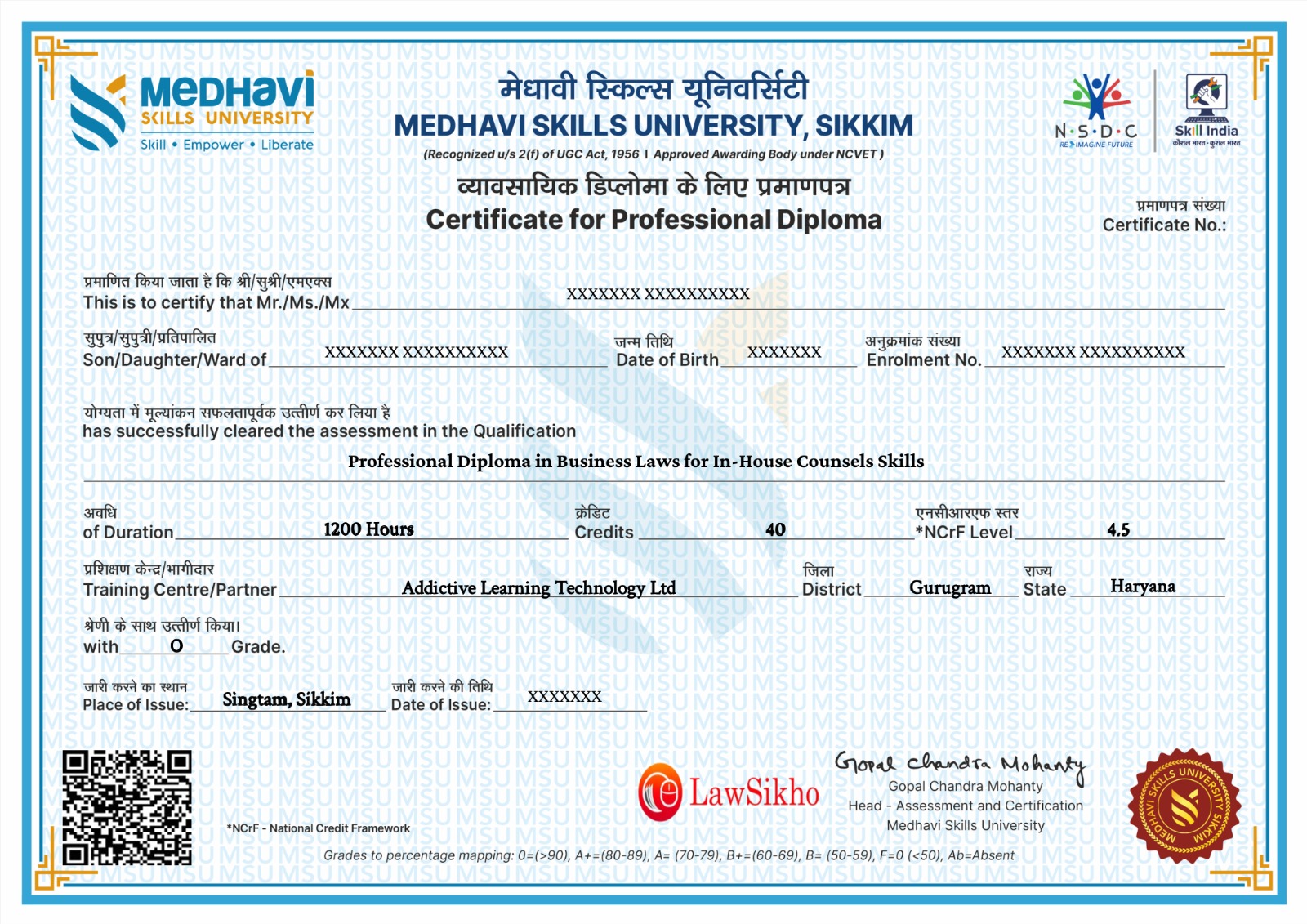
Get Skill India + NSDC certified through the awarding body Medhavi Skills University.
Get certified under the Skill India Mission. Our learners are eligible for NSDC & Skill India certification on course completion through the awarding body Medhavi Skills University.
Sample Certificate
Course Plan
Above prices are inclusive of all applicable taxes and charges.
 Free Materials
- Get Sample Material in your inbox
- Regular career guidance on email
- Sample Exercises
- Five very useful lessons
- No Certification for Free Material

2 practical exercises/ Drafting exercises per week
Article writing assignments (on request)
1 online live class/week
Get digital access to entire study material
Access on LMS, Android & iOS app
Instructor feedback on assignments
Unlimited doubt clearing sessions.
Instructor led course with online live classes
Online exams (give exams as per your convenience on given time slots)
Certificate (by courier)
CV enhancement
Coaching for professional networking
Internship & Job Support
Interview preparation support
Content access for 3 years
Top performers are recommended for jobs and client opportunities (as applicable)
FAQs
We recommend that you should have completed your Higher Secondary / Class XII from a recognized Board / University. In the case of foreign nationals, you should have completed the equivalent of Higher Secondary in India in your respective country. You should also be comfortable with the English language and using a computer. However, we have no formal pre-qualification requirements because we are not a University or college. Anyone who wants to learn is welcome to join our courses.
If international students require hard copy material, they need to share their correct address and we will let them know the cost of the courier which they need to pay and then the hard copy will be dispatched. This is the process because the cost of an international courier is very high compared to the domestic courier within India (for domestic courier we have no additional charges). Some international students provide us with an Indian address for couriering hard copy material. In those cases, we charge nothing extra for the courier.
A person can visit the official website of LawSikho and find the relevant course and see the course syllabus, learning objectives and even a list of weekly exercises. You can also subscribe for free sample material. If more clarification about the course is needed, feel free to chat with our online chat specialist. You could also call us on our landline number, +91 11 40845203 for further assistance.
We do not offer any demo classes. You will not understand the course's quality by attending a single class as the results we produce is done through a combination of many things - study material, assignments, personal feedback on assignments, and then finally, class. The only way to experience the course is to take the course for a month, risk-free, as we give no questions asked and refund between the 30th and 45th day provided you attend all classes and solve all the assignments.
The refund policy may vary. We advise you to go through the refund policy given on the respective course page to know the actual refund policy applied to you.
There are no minimum attendance requirements, as we will teach the course online through a Learning Management System that allows you to pursue the course at your own pace and convenience.
We will conduct online weekly classrooms for 40 minutes to an hour. Attendance is recommended. Feedbacks by our experts on your assignments submitted is the goal of our sessions.
To know more about exercises and assignments submission requirements, please check the course page.
As candidates will be enrolling from across India and abroad, every candidate's schedule is likely to differ. The test will be available on the online portal for a substantial period so that you can take them at your convenience. We will give sufficient opportunity to everyone to attempt the test.
If any student is unable to attempt the test or facing any issues, can mail us at [email protected]
Requirements of the online test may vary as per the course. We suggest you read the test details on the course page to learn more.
The online MCQ is executed on the Learning Management System. You do not have to go to any special centres to give the test or exam. You can attempt the test by logging on to the online Learning Management System from your home or anywhere you wish. We recommend using a computer while giving these tests, as mobile phones are unreliable for giving tests.
Students should finish the MCQ test within the stipulated time in one sitting.
Please visit the course page to know MCQ test fees and guidelines.
You can use any of the following methods to pay for the course.
- Online payment through Razorpay - Credit Card, Debit Card, Netbanking, Amex & UPI
- International students can use Razorpay or Paypal
- NEFT/ RTGS (online through your bank account) or offline
For further details on making payments, please visit our enrolment page or call on +91 11 40845203 for assistance.
If you have a Credit Card with one of the following banks, you can pay using an EMI option.
- ICICI Bank
- Axis Bank
- Standard Chartered Bank
- Kotak Mahindra Bank
- HDFC Bank
- Yes Bank
- IndusInd bank
- RBL Bank
We allow our students to make the payment in installments. To know more about it, get in touch with us at +91 11 40845203.
Please do not expect us to teach you like college courses. Those are not effective. Our focus is on giving you a realistic experience of doing legal work. Hence you will get different exercises and assignments every week and all relevant material to solve them. Please do not worry that you have not read other associated concepts. We are recreating the experience of working in a law firm or in-house legal department, and we found that this is the kind of training that works best. Live classes will relate to the week’s assignments. You can read the modules from module 1, but we advise you to follow the courses according to where the assignments take you. By the end of the year, you would have covered all the syllabus and retained everything.
If it feels complicated and challenging midway, do not worry. The course is designed like this. You need to stick to it, hold on for dear life and ride along as you ride a roller coaster. Our responsibility is that you are satisfied and get all the results that you were promised by the end. If you are not, you can hold us responsible. But please, please trust the course design and stick to it until the course gets over.
No, there are no discounts available. We do not believe in discounts and never give one. Prices have only increased over time and not decreased.
The course starts on the commencement date for your batch. You would get access to all the study materials on the online learning management system, which you can view on your computer or mobile phone (Android & iOS). The study materials cannot be downloaded or printed.
We will dispatch the hard copy materials for reference within 45 (forty five) days. We cannot deliver videos and periodic updates in hard copy; hence hard copy materials are not recommended for studying to attempt exams. To stay updated with the latest developments, we strongly recommend that you learn from online materials.
Every week, you will be given exercises to perform, which we will discuss in a live online classroom.
The passing criteria for any course are 40% of the total marks and completion of weekly exercises, articles/assignments as mentioned in the course guidelines.
Please check the passing criteria section on the course page for more details.
You can attempt the MCQ test only once.
If you fail in a course, you can request a re-examination once again. You can re-submit the required exercises and articles with a deduction of 3 marks.
For exercises that you have already submitted, and you do not wish to re-attempt, your marks will remain the same. We will give you some additional exercises to attempt to increase your chances of completing the course successfully. It will also enhance your learning.
If you have any doubt or question relating to the content, please write on the discussion forum of the LawSikho platform itself. Our concerned experts will respond to you within 24 to 48 working hours. You can also write your queries to [email protected]. Our concerned executives will support you to get your questions resolved within 24 working hours.
We ensure that class timings enable a maximum number of students to participate and take out time from work or college while at the same time they are feasible for experts.
Classes will be of 1-hour duration and will be held in any of the following time slots:
- Weekdays: 8:00 pm - 10:00 pm IST
- Saturdays: 7:00 pm - 10:00 pm IST
- Sundays: 10:00 am - 8:00 pm IST
You will be informed of the class timings for the relevant week at least 48 hours before the class via email notifications and WhatsApp messages. We will also add it to your Google calendar.
We will ensure we have fixed timing for this class to schedule your day well in advance according to it as far as possible.
Recordings of class sessions will be made available on the online learning management system for accessing within 48 hours of the session conducted.
Those who complete the course successfully will be awarded a LawSikho certificate. The certificate will be dispatched within 45 (forty five) days of course completion.
Please check the course guidelines for more details.
The course is designed keeping in mind the schedule of practising lawyers, working professionals, entrepreneurs and full-time students. The learnings are well spread out over a long period. There would be a specific learning objective every week, accompanied by assignments. It takes about 8-10 hours for a person of average intelligence to complete all course activities every week. You need to take this course one week at a time.
We do not guarantee that you will pass the course without putting in reasonable effort or attention. Still, the exact amount of time you would need to dedicate depends on your ability to grasp the material.
Yes, knowledge of the law is not a prerequisite for deriving value from the course. It is possible that what you learn in this course is entirely independent of any other course you have probably pursued or are pursuing. The course is designed keeping in mind that there will be many non-lawyers taking up this course. The only knowledge we assume is what one would expect to know after completing higher secondary school. All modules are reviewed from a high school graduate's perspective and ensured that they are effortless to understand.
You only require knowledge of the English language and basic computer skills to understand the concepts.
An active placement assistance program is available to students, including CV-writing, career guidance, and sharing of relevant job and internship opportunities. Job and internship opportunities will be shared with students on the WhatsApp group from time to time. Students who complete the exercises and perform well in those exercises and classes can be recommended to law firms, lawyers chambers and companies for jobs and internships. However, we do not guarantee any job or internship.
We have also started a career clinic for the benefit of our students. Students can visit our office in Delhi or seek career-related insights over phone or video calls on pre-designated days. More than 2000 positions have been shared with our students to date, and hundreds have got placements and internships through us. Our students have been placed in various law firms and other organisations as full-time employees and have obtained multiple opportunities for internships under the programme. How many opportunities you get will depend on your efforts in the course, and if you do the course well, you will be able to find jobs on your own.
We will also provide you with a career development course free of cost if you need it. Just ask our customer support if and when you need it after participating in at least three months of classes.
We also help you enhance your CV by writing and publishing articles and giving you networking exercises and coaching to build your professional network. Creating your professional network can make excellent opportunities available to you that you cannot even imagine today.
For more details, please see the placement assistance guidelines given on the course page.
How the courses are created, and its philosophy - We aim to create extraordinary lawyers and support the legal industry. You will find no other course which is as practical, provides as much personal attention to every student, or as many opportunities.
Syllabus, coverage and approach to issues - We do not spoon-feed you but give you experience what you will experience when you work at top law firms or big in-house legal departments. You will be prepared for the best and the worst. You will learn to deal with any legal issues, even those we didn’t teach you about, because that is how our course is designed.
Live Exercises - Pilots are put on simulators to practice flying before they are given an actual aircraft to fly. That is how our courses work as well. Even before you start dealing with real-life cases and matters, we train you to do such work through simulation exercises. This experience is invaluable for ambitious lawyers. Think of our courses like an online gym or a martial arts dojo for learning legal skills that will make you amazingly successful.
Personalized support - you can ask questions in the learning management system, interact with us on WhatsApp groups and even call us when you are struggling. We are here to work with you to make you succeed.
Placement assistance - Do you know any other course where you get this level of placement assistance? Law firms and companies love to hire our students because it is tough to find such highly-trained talent. Ask our graduate students! Also, we make you write articles, publish, and enhance your CV and network with many people. This provides you with next-level opportunities in your career.
Doubt-clearing weekly exercises - Doubts are cleared every week. If you can’t wait, post your doubts inside the module itself, our experts reply within one working day.
Grading system: Students will be graded according to the following grading system:
| Grade | Percentage |
| F (Fail) | <40 |
| C+ | 41 to 59 |
| B+ | 60 to 79 |
| A+ | 80 to 100 |
Migration from one course to another is possible. Students should email their migration request to our support team at [email protected] within ten days from the enrollment date.
We will not accept any requests after ten days.
Yes, you can migrate from one batch to another after paying a migration fee of INR 2000/- (or as per the prescribed fee pertaining at the time of migration) and the course fee difference between the admitted batch and transferee batch if any. If migrated, the work or assignments submitted earlier by you will not be considered.
A student is given sufficient time to submit the minimum number of required assignments. If they fail to do so, they can submit their pending assignments after the deadline with an extension fee of Rs 2000/- Please check the details of our different courses to know more about the assignment deadlines for individual courses.
The month and year may vary as per the type of course. We suggest you check the Migration Rules of your course on the course page.
LawSikho conducts exams during the course duration. If the course is accredited by MEPSC, LawSikho will conduct one certification test during the course duration & the MEPSC will conduct another after completion of the course.
Weekly exercises are very important to learn the practical aspects for which you joined the course. You get sufficient time to complete those. In case you can’t finish them within the due date, you get an extension to complete them with a deduction of a few marks.
You will not get a LawSikho certificate if you fail to submit the required number of assignments and articles. These are mandatory requirements for obtaining the certificate and value of the course for which you enrolled.
The certificate will have the Grade on it. If students want to know their scores, they can write to us at [email protected]. We will provide their scores.
Yes, you will have to attempt just one MCQ test at the end of the course for LawSIkho certification.
You must complete the required number of assignments and the MCQ test to complete the course successfully. They are mandatory requirements. You won’t get the LawSikho certificate if you fail to fulfil these requirements.
An online Live class is a video conference-based class that you can attend from mobile, tablet and personal computer through an application. You can see the teacher and the teacher can see you. You can even share your screen with the teacher for comments if the teacher requests it, and the teacher can show you his or her screen. You can see other people attending the class also. There is usually a lot of discussion amongst the students and teachers in the class. It is very much like a live classroom except that you do not have to travel to access the class; you can access it on the go as long as you have internet and a device.
We will point you out the relevant reading material and templates and precedences you need to solve an assignment. You can also freely discuss with other students in the course WhatsApp group. You can post queries in the learning management system as well while working on assignments. During the live sessions, you can ask questions to the expert and get your issue resolved. Sometimes it may be possible to schedule a call with evaluators and discuss with them, but this is at the discretion of the evaluator and at a time of his or her convenience. We cannot handle unlimited calls with every small question. You have to respect the time and availability of the evaluators also. For that, you already have the Learning Management System and the WhatsApp group, where you can post an unlimited number of doubts.
Our training methodology is unique. While any outside authority does not endorse it, the success of our students speaks for itself. Our methodology is described in detail in the previous questions. The legal industry loves to hire our students who have gone through the entire training we provided. Major companies have been hiring us to train their legal teams and managerial executives with cutting edge legal courses. This is proof of our success.
You can find those courses and other details in the course section of our official website www.lawsikho.com
Yes, in all our premium courses, there are live weekly classroom sessions. Apart from one session related to your course, sometimes you will be invited to attend extra free sessions on writing, networking or other relevant skills. However, the course is conducted through an online learning management system, enabling students to access study materials from anywhere in the world at their own time and convenience. Course materials will be accessible on the online learning management system, which you can assess on a laptop/desktop. You can also access the course on your phone by downloading the LawSikho app. We may upload some course materials around the time of your class about the relevant issue. Apart from this, you will have access to significant hard copy material as well.
Live sessions on exercises shared will be conducted online every week. Once or twice a month, you will also have a session on writing influential articles and networking skills. In total, students will have 5-6 live sessions every month. At times there could be extra sessions that are optional to attend.
Our experts' weekly online sessions will include feedback on the previous week's exercise and explain new concepts related to upcoming exercises.
Attendance for sessions is not mandatory but crucial for learning to perform exercises that add value. Students who miss the session can watch the recorded versions of the sessions conducted on the Learning Management System (LMS) and the assignment portal (anything that is easier for you, it is uploaded on both platforms). We will add the recorded session to LMS within 48 working hours.
It is highly recommended that you complete weekly exercises. It is mandatory to submit 50% of subject exercises per course requirement and all writing assignments.
All study materials, including text, videos, drafting exercises, templates and regular tests, will be available only on the LMS and accessed using your login ID for the LMS. Students can also access the course through the state of the art mobile Apps, making learning convenient and accessible on a real-time basis.
Some courses require 100% of subject exercise submission. Please visit the course page to know the number of exercises and assignments to be submitted for a particular course.
For any other help or clarification, or grievance, please write to us at [email protected].
Our student support team representative will write back to you with a personalized response within 24 working hours.
Don’t forget to mention your Enrollment Number, Course and Batch when you communicate with LawSikho.
We are closed on Sundays and Central Government Gazetted Holidays.