
Introduction
Ever wondered who makes sure that amazing new inventions get the recognition they deserve? That’s the job of a Patent Examiner—a crucial player in the world of intellectual property.
A Patent Examiner is like a gatekeeper for new ideas. They carefully review patent applications, look at detailed descriptions of inventions, and decide if these innovations meet the legal requirements for a patent.
From cool tech gadgets to groundbreaking medical discoveries, Patent Examiners get to see a wide variety of new ideas and technologies.
Choosing a career as a Patent Examiner has some great perks:
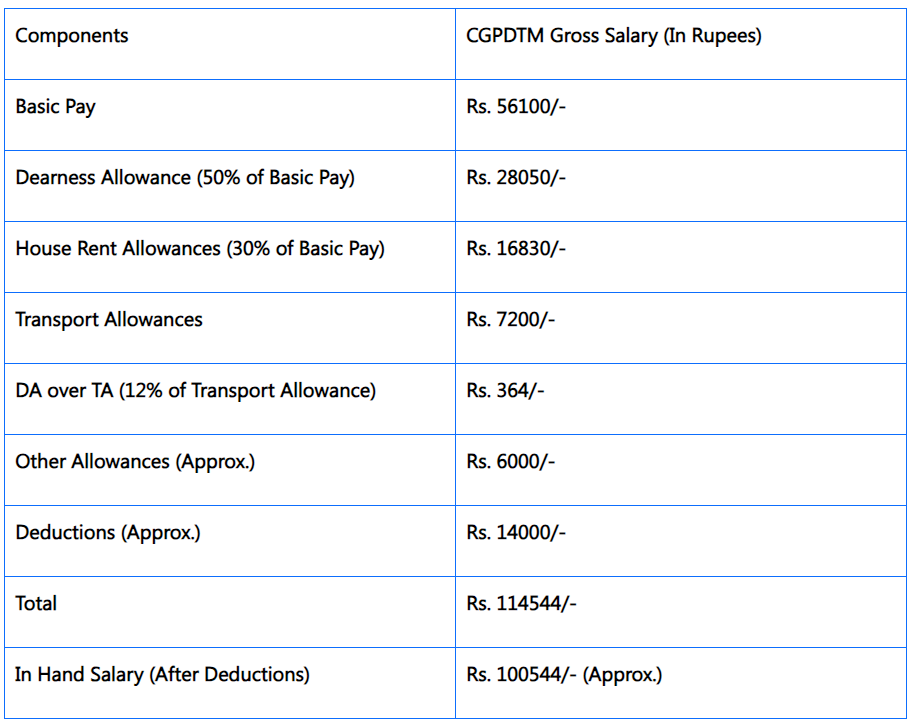
- Great Pay: Start with a salary between ₹8 to ₹12 lakhs per year, with lots of room for growth.
- Job Security: It’s a government job, which means good stability and a clear path for advancement.
- Exciting Work: Each day brings something new, from evaluating inventions to making important decisions that affect industries and economies.
- Awesome Benefits: Enjoy government allowances, pension schemes, and opportunities for professional development.
- Impactful Work: Help protect new ideas, support innovation, and contribute to various industries.
The following table outlines the gross salary for a Patent Examiner in India.
A Career with High Demand
The role is in high demand—during the last exam, a whopping 553 vacancies were filled!
This number is significantly higher compared to many other government exams, where vacancies often range from a few dozen to a few hundred at max.
This high demand underscores just how crucial and sought-after the role of a Patent Examiner is in the field of intellectual property.
This is a Career for the Curious and Detail-Oriented!!
If you love technology, have a curious mind, and enjoy solving problems, being a Patent Examiner could be the perfect fit. This job mixes technical know-how with legal skills, making it great for those who thrive on intellectual challenges and want to be at the forefront of innovation.
Who Should Consider Becoming a Patent Examiner?
- Technical Graduates: If you have a degree in science, engineering, or technology, and are eager to apply your technical knowledge in the realm of intellectual property, this role is ideal for you.
- Legal Professionals: If you are a legal practitioner with an interest in patent law, this position will allow you to specialize and manage patent-related matters effectively.
- Researchers and Inventors: If you're involved in research or have developed new technologies, becoming a patent examiner can help you understand and navigate the patent process.
- Pharmacists and Biotech Experts: With advancements in pharmaceuticals and biotechnology, this role is essential for securing patents related to new drug formulations and biotech innovations.
Who Can Become a Patent Examiner?
To qualify for the patent examiner exam, candidates must meet the following criteria:
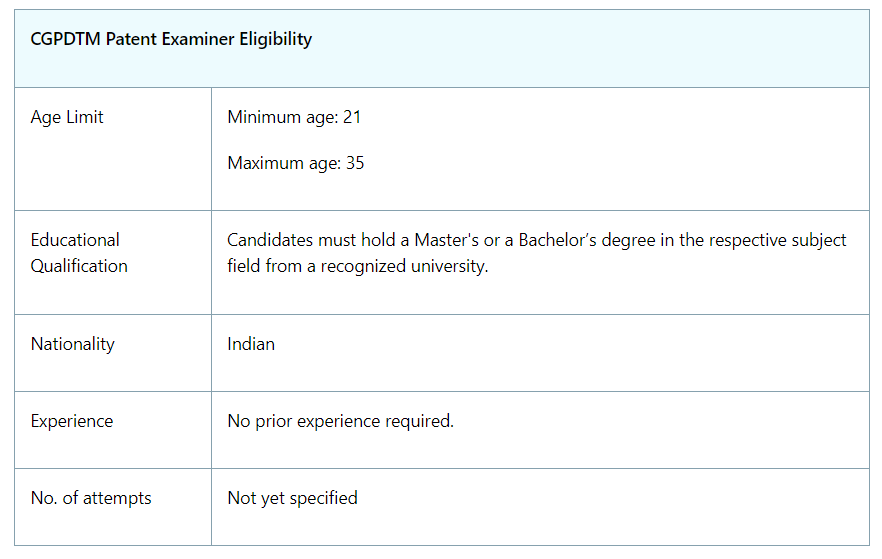
The upper age limit is relaxable for reserved categories as follows:
- SC/ ST/ Government Servant candidates: by up to 5 years
- OBC candidates: 3 years
- PwBD candidates:10 years
Exam Overview and Structure
Posts for the recruitment of Patent examiners are notified by the Department of Promotion of Industry and Internal Trade (DPIIT). The examination and process of recruitment is conducted by National testing Agency (NTA). Previously, it was conducted by the Quality Council of India (QCI).
The exam is conducted in 3 phases:
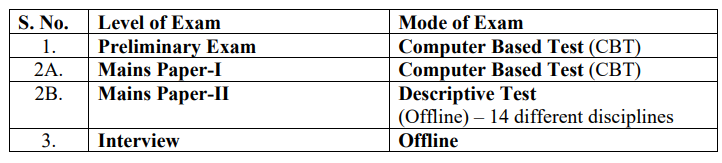
Phase 1: Preliminary examination (online)
This is a 2 hour long objective exam conducted in the online medium. It consists of multiple choice questions for 150 marks.
Syllabus includes:
- General English - 15 marks
- Verbal and Non-Verbal Reasoning - 30 marks
- Quantitative Aptitude - 30 marks
- General Knowledge and Current Affairs - 30 marks
- General Science - 30 marks
- IP Legislation in India, WIPO, and Related Treaties - 15 marks
The minimum qualifying marks in preliminary exam for UR :30%; OBC/EWS :25% and others :20%
Further, cut off of the preliminary exam will be prepared as per the vacancy and no. of candidates to be qualified for mains exam. This criterion is tentative and competent authority has the right to do modification as per requirements.
Phase 2: Mains (offline)
The main examination is conducted in the offline mode and consists of 2 papers.
Paper 1 is an OMR based exam of 100 marks for 2 hours long duration. The syllabus consists of
- General Knowledge and Current Affairs - 20 Marks
- General Aptitude - 20 Marks
- Elementary Mathematics - 20 Marks
- English Language Proficiency - 20 Marks
- Knowledge Related to Intellectual Property Rights (IPRs) - 20 Marks
Paper 2 consists of descriptive questions of 300 marks having a time duration of 3 hours. It tests knowledge in the technical and scientific fields of discipline and knowledge selected at the time of filling the form like biotechnology, bio-chemistry, computer science, etc.
For an example of a detailed syllabus for paper 2, click here.
The cumulative marks obtained in Paper-1 and Paper-2 will be assigned 80% weightage in the final list of qualified candidates.
The number of candidates to be eligible for interview may be about five times the total approximate number of vacancies to be filled through this recruitment process.
Phase 3: Interview

Preparation of seniority list-
The final list of qualified candidates for the CGPDTM Patent Examiner position will be accompanied by a common seniority list in various disciplines calculated using a normalisation procedure.
How will we help you?
- Trends Analysis of Past Papers: Gain insights into past papers to understand recurring themes, question patterns, and key areas of focus.
- Time Management: Master effective time management strategies to ensure you can handle the exam efficiently and complete all sections within the allotted time.
- How to Approach the Exam: Learn the best strategies and approaches for tackling the examination, including study techniques and exam strategies.
- Paperwork and Documentation: Understand the paperwork and documentation required for the examination process, including how to prepare and submit necessary forms.
Training Methodology

Online 24/7 access
Access to basic study material through an online learning management system, Android and iOS app

MonthlyTime-table for self study and Practice Test
The monthly time-table helps you in completing your syllabus in time and there will be weekly mocks on what you have learned in the week. Also there will be 5 full length mocks on each subject so that you can self-evaluate yourself after completing a subject.

Live Online Classes
Based on the exercises, there will be a live video-based online class. You can ask questions, share your screen, get personal feedback in this class.

Convenient Class timings
Classes are held after regular working hours once a week.

Live Doubt Clearing
You can ask questions, get your doubt cleared live as well as through online forums
What is unique about this course?
- Personal guidance: Every candidate will be given personal attention for the preparation of their examination. This is not like a coaching center with hundreds of students in a batch, where teachers don't know your name or your dreams.
- Top-notch content: Exhaustive notes will be provided to the students so that they don’t have to purchase any other book or reading material after taking this course.
- A unique presentation of the content: Content will be presented in a color-coded format to help you to figure out important keywords and sentences. While revising, it will be easier to find out case laws, maxims, and important points related to every topic.
- Speed reading friendly content: Our content is specially designed with the help of experts to help you to read it at a much faster speed as compared to any other content.
- Smart study techniques: Every candidate will be guided about how much to study on which topic according to the importance of the topic in the examination.
- Special tools to make learning faster and easier: Flow charts, Videos Lectures, Mind Maps, and much more. All these unique techniques which help in learning things in a faster and better way.
- Live session: Live online sessions will be conducted to discuss various important concepts with the questions as per the examination question pattern. This will help you to handle the questions at the time of examination.
- Self-paced: You can use reference material provided by us and prepare at your speed. There is no compulsion to attend sessions on every concept to understand it.
- Solutions to queries through various platforms: You can ask your queries to our mentors, experts, evaluators, and support team on various platforms like our Learning management system (LMS), emails, calls, and in live sessions.
How is this course different from other test prep courses?
|
Service |
Ours |
Others |
|
Live classes |
live classes of 1.5 hours each week |
No live classes |
|
Cost |
Rs. 48000 |
Rs.80,000 and above without any live classes and personalised attention |
|
Faculty |
Learn from those who have qualified the exams. |
Recording of one person - no scope of interaction with faculty |
|
Corrections, feedback and doubt-clearing |
Detailed practice for MCQs and written questions, schedule Zoom and phone calls to clear more doubts |
No corrections, minimal customer support |
|
Total training you will get |
60 hours (20 hours of live classes plus 40 hours of self study, mocks and feedback sessions) |
About 5 - 10 hours |
|
Money-back guarantee |
45-day money back guarantee - see refund policy on the website |
Not available |


Faculty

Registered patent agent, Acura IP services


Patent agent, Senior Associate at K&S Partners

Consultant at K&S Partners

CEO / Director specializing in IP (Patent) Management and Project/Design Engineering at BKSAY WORKS PVT. LTD

Technolegal Professional, Lawyer, Telecommunication Engineer, IP Enthusiast, Patent Agent, Canadian Immigration Law, Trademark Law, Contract Management

Head-Corporate IP at Piramal Group, Certified Indian Patent Agent, Certified Indian Trademark Agent

IPR Consultant /Patent Agent
Note: This is an indicative list of our guest faculty members and not an exhaustive list. We may change the faculty members at any point based on availability.
Syllabus
Chapter 1: Overview of Intellectual Property Rights
- Definition and Importance
- Types of Intellectual Property (Patents, Copyrights, Trademarks, and Trade Secrets)
- Historical Development and Evolution
Chapter 2: Key Concepts and Terminology
- Intellectual Property vs. Industrial Property
- Exclusive Rights and Fair Use
- Enforcement and Infringement
Chapter 3: The Patent Act, 1970
- Objectives and Scope
- Patentable and Non-Patentable Inventions
- Patent Application and Examination Process
- Patent Rights and Remedies
Chapter 4: The Copyright Act, 1957
- Scope and Objectives
- Copyrightable Works and Rights
- Duration and Transfer of Copyright
- Enforcement and Remedies
Chapter 5: The Trademarks Act, 1999
- Definition and Classification of Trademarks
- Registration Process and Requirements
- Rights Conferred and Infringement
- Case Studies and Jurisprudence
Chapter 6: The Designs Act, 2000
- Scope and Objectives
- Registration of Designs
- Rights and Remedies
- Key Case Studies
Chapter 7: The Geographical Indications of Goods (Registration and Protection) Act, 1999
- Definition and Scope
- Registration Process
- Protection and Enforcement
- Case Studies
Chapter 8: Introduction to WIPO
- History and Objectives
- Structure and Functions
- WIPO's Role in Global IP System
Chapter 9: WIPO-administered Treaties
- Paris Convention for the Protection of Industrial Property
- Berne Convention for the Protection of Literary and Artistic Works
- Madrid System for the International Registration of Marks
- Hague System for the International Registration of Industrial Designs
- Patent Cooperation Treaty (PCT)
- WIPO Copyright Treaty (WCT) and WIPO Performances and Phonograms Treaty (WPPT)
Chapter 10: TRIPS Agreement (Trade-Related Aspects of Intellectual Property Rights)
- Overview and Objectives
- Key Provisions and Compliance
- Impact on National Legislation
Chapter 11: Regional Agreements and Treaties
- European Patent Convention (EPC)
- The African Regional Intellectual Property Organization (ARIPO)
- The Eurasian Patent Organization (EAPO)
Chapter 12: Emerging Trends in IP
- Digital Rights Management (DRM)
- Artificial Intelligence and IP
- Biotechnology and IP
Microbiology
Biochemistry
Molecular Biology and Genetics
Process Biotechnology
Bioprocess Engineering
Plant and Animal Biotechnology
Characteristics of animal cells
Immunology
Recombinant DNA Technology
Bioinformatics
Structure and function of biomolecules
Metabolic pathways and their regulation
Recombinant DNA technology and applications
Immunological techniques
Food Chemistry and Nutrition
Food Microbiology
Food Products Technology
Food Engineering
Inorganic Chemistry
Physical Chemistry
Organic Chemistry
Interdisciplinary Topics
Chemistry of High Polymers
Polymer Characterization
Synthesis and Properties
Polymer Blends and Composites
Polymer Technology
Polymer Rheology
Polymer Processing
Polymer Testing
Biomedical Instrumentation
Anatomy and Physiology
Medical Physics and Biochemistry
Biomedical Signal Processing
Medical Image Processing
Microprocessor-Based Medical Instrumentation
Biomaterials
Biomechanics
Materials and Components
Physical Electronics, Electron Devices, and ICs
Signals and Systems
Network Theory
Electromagnetic Theory
Electronic Measurements and Instrumentation
Analog Electronic Circuits
Digital Electronic Circuits
Control Systems
Communication Systems
Microwave Engineering
Computer Engineering
Circuit Theory
Signals & Systems
E.M. Theory
Analog Electronics
Digital Electronics
Energy Conversion
Power Electronics and Electric Drives
Analog Communication
Control Systems
Microprocessors and Microcomputers
Measurement and Instrumentation
Power Systems: Analysis and Control
Power System Protection
Digital Communication
Digital Logic
Computer Organization and Architecture
Programming and Data Structures
Algorithms
Theory of Computation
Compiler Design
Operating System
Databases
Information Systems and Software Engineering
Computer Networks
Web Technologies
Mathematical Methods of Physics
Classical Mechanics
Electromagnetic Theory
Quantum Mechanics
Thermodynamics and Statistical Physics
Electronics and Experimental Methods
Classical Mechanics
Electromagnetic Theory
Quantum Mechanics
Thermodynamic and Statistical Physics
Electronics and Experimental Methods
Atomic and Molecular Physics
Condensed Matter Physics
Nuclear and Particle Physics
Engineering Mechanics
Static Friction. Kinematics and Kinetics
Strength of Materials
Structural Analysis
Design of Structures: Steel, Concrete and Masonry Structures: Structural Steel Design
Design of Concrete and Masonry Structures
Dimensional Analysis and Similitude
Laminar Flow
Open channel flow
Hydraulic Machines and Hydropower:
Geotechnical Engineering
Construction Technology, Equipment, Planning, and Management
Engineering Materials
Construction
Mechanics
Mechanics of Rigid Bodies
Mechanics of Deformable Bodies
Engineering Materials
Theory of Machines
Manufacturing Science
Manufacturing Process
Manufacturing Management
Thermodynamics, Gas Dynamics, and Turbine
Heat Transfer
I.C. Engines
Steam Engineering
Refrigeration and Air-Conditioning
Thermodynamics and Rate Processes
Extractive Metallurgy
Physical Metallurgy
Mechanical Metallurgy
Manufacturing Processes
Textile Fibres
Yarn Manufacture and Properties
Fabric Manufacture and Structure
Textile Testing
Preparatory Processes
Dyeing
Printing
Course Plan
Above prices are inclusive of all applicable taxes and charges.

5 online practise live classes/ sessions
1 online live session per week
Numerous questions to practise
Viva preparation support
Access to course material and live lectures for five years.
Group and personal mentoring sessions for all the subjects and viva.
Get digital access to entire study material
Access on LMS, Android & iOS app
Instructor feedback on assignments
Instructor led course with online live classes
CV enhancement
Coaching for professional networking
Internship & job support
Personalised freelancing support
Top performers are recommended for jobs and client opportunities