

Complete 30-day study plan to prepare for UGC NET December 2025. Week by week schedule, Paper I and Paper II strategies, mock test calendar, revision techniques, and expert tips for last minute aspirants.
Table of Contents
Got just 30 days until UGC NET? Don’t panic, you can do this.
You are wondering if it is even possible to prepare and qualify in such a short time. The honest answer is yes, it is absolutely possible, but here’s what matters: you don’t need to master everything to qualify. You just need to score above the cutoff, and that’s totally achievable with smart, focused preparation.
The exam is scheduled from December 31, 2025, to January 7, 2026, which gives you roughly 27-30 days from today.

Tight? Yes. Impossible? Absolutely not.
Hundreds of candidates qualify every year with exactly this timeline. That sounds intimidating, but countless candidates have qualified for UGC NET with exactly this timeline.
This guide gives you a day by day roadmap, no generic advice, just practical strategies that work when time is short. You’ll learn exactly which topics to prioritize, when to take mock tests, and how to walk into that exam hall feeling confident instead of overwhelmed.
Ready? Let’s turn these 30 days into your qualification story.
Can You Really Clear UGC NET in Just 1 Month?
Yes, you can, provided you prepare with intention and clarity. The UGC NET syllabus is vast, with ten units in Paper I and an entire subject in Paper II, but the real secret is that you are not expected to master everything. You are expected to score above the cutoff, and that is a very different goal. Once you understand this distinction your entire preparation shifts. You stop feeling overwhelmed and you start thinking like a strategist.
Thirty days give you enough time to cover high weightage topics, practice the right questions and build strong exam taking skills. You can develop the kind of confidence that comes from solving targeted PYQs, noticing repeated patterns and learning how to choose the questions that fetch marks quickly. What thirty days cannot give you is deep expertise in every unit, but that is not required to qualify. When you accept this reality your preparation becomes focused and far more effective.
The moment you move from the mindset of “I need to study everything” to “I need to score qualifying marks,” the exam stops looking impossible. It becomes manageable, predictable and achievable. And with a clear plan, one month is more than enough to put yourself in a winning position.
This intensive plan works best for candidates who already have a foundation in their Paper II subject, typically those who have completed their Master’s degree recently.
It also suits working professionals who cannot dedicate months to preparation but can commit 4 to 8 hours daily for one month.
If you have attempted UGC NET before and have some familiarity with the pattern, you are in an even better position. Fresh graduates with strong subject basics can also succeed with this timeline if they follow the plan religiously.
Exam Schedule and Important Dates for UGC NET December 2025
December 31, 2025 to January 7, 2026: What You Need to Know
The National Testing Agency has confirmed that the UGC NET December 2025 exam will be conducted from December 31, 2025, to January 7, 2026, in Computer Based Test mode across multiple cities in India.
Your specific exam date depends on your chosen subject, and you will receive this information through the city intimation slip released approximately 10 days before the exam. The admit card will follow shortly after, so keep checking the official NTA website regularly.
Shift Timings and Exam Day Logistics
The exam is conducted in two shifts daily. The morning shift runs from 9:00 AM to 12:00 PM, with gates opening at 7:30 AM and closing at 8:30 AM. The afternoon shift runs from 3:00 PM to 6:00 PM, with entry starting at 1:30 PM.
You will have exactly 3 hours to complete both Paper I and Paper II in a single continuous session with no break in between. This format requires stamina, so factor this into your preparation.
Exam Pattern Breakdown for Strategic Preparation
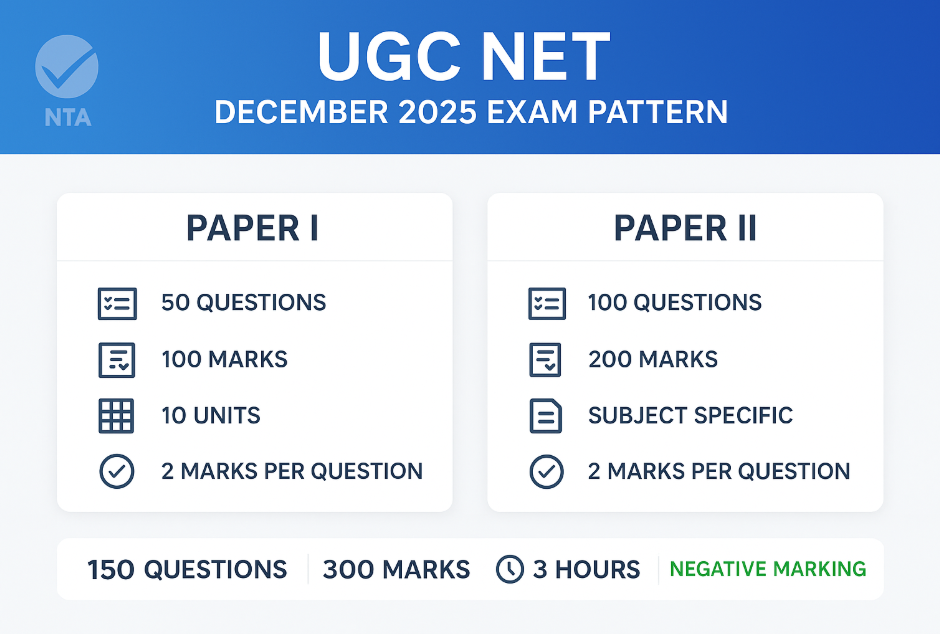
Paper I Structure: 50 Questions, 100 Marks, 10 Units
Paper I tests your teaching and research aptitude and is common for all candidates regardless of their chosen subject. It consists of 50 Multiple Choice Questions worth 100 marks, with each question carrying 2 marks.
The 10 units are Teaching Aptitude, Research Aptitude, Comprehension, Communication, Mathematical Reasoning and Aptitude, Logical Reasoning, Data Interpretation, Information and Communication Technology, People Development and Environment, and Higher Education System.
Each unit typically contributes 5 questions worth 10 marks.
Paper II Structure: 100 Questions, 200 Marks, Subject Specific
Paper II evaluates your expertise in your chosen subject from the 85 subjects offered by UGC. It contains 100 MCQs worth 200 marks, again with 2 marks per question. The syllabus is typically divided into 10 units as per the official UGC NET syllabus, with 8 to 12 questions expected from each unit depending on the subject.
Paper II carries double the weightage of Paper I, making it crucial for your overall score. Check your subject specific syllabus from the NTA website to identify unit wise distribution.
Understanding Cut Off Trends for JRF and Assistant Professor
The UGC NET result declares three categories of qualified candidates: those eligible for Junior Research Fellowship and Assistant Professor, those eligible for Assistant Professor only, and those eligible for PhD admission only.
According to recent NTA notifications, the minimum qualifying marks are 40% aggregate for General and EWS categories and 35% for SC, ST, OBC, PwD, and other reserved categories. However, meeting minimum qualifying marks does not guarantee qualification.
The actual qualification depends on where you stand in the merit list.
Based on the December 2024 results released by NTA, 5,158 candidates have qualified for JRF and Assistant Professor, 48,161 have qualified for Assistant Professor, while 1,14,445 have qualified for PhD only admission out of approximately 6.49 lakh candidates who appeared.
The cut offs vary significantly by subject and category, with competitive subjects like English, Commerce, and Education having higher cut offs. Your target should be to score well above the minimum qualifying percentage to improve your chances.
Why Every Mark Counts in a 1 Month Scenario
In a time constrained preparation, every mark becomes precious because you cannot afford to leave scoring opportunities on the table.
The difference between qualifying and missing the cut off can literally be 2 to 4 marks. This is why strategic preparation matters more than comprehensive preparation when you have limited time.
Focus your energy on topics where you can score reliably rather than spreading yourself thin across everything.
Why “No Negative Marking” Changes Everything
Here is the game changing feature of UGC NET that many candidates underutilize: there is absolutely no negative marking. This means every question you attempt has zero downside risk.
In a 1 month preparation scenario, this allows you to attempt all 150 questions regardless of certainty level. Even educated guesses have a 25% chance of being correct. Your strategy should be to attempt every single question, never leaving any blank, because leaving a question unanswered guarantees zero marks, while attempting it gives you at least a chance.
The 30 Day Master Study Plan for UGC NET: Week by Week Breakdown
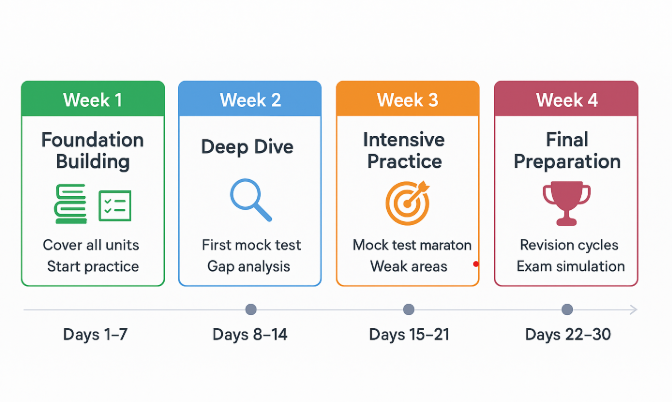
Week 1 (Days 1-7): Foundation and High Priority Topics
Days 1-3: Paper I Core Units and Paper II Foundation
Your first three days set the tone for the entire month. On Day 1, download and print the official syllabus for both Paper I and your Paper II subject from the NTA UGC NET website.
Spend the morning understanding the complete syllabus structure and marking high priority topics. In the afternoon, begin with Paper I Unit 1 (Teaching Aptitude) and Unit 2 (Research Aptitude) as these are the most scoring and fact based units.
Day 2 continues with Paper I Unit 6 (Logical Reasoning) in the morning, as this requires practice based preparation that should start early. The afternoon shifts to Paper II, where you begin with the first two units of your subject syllabus.
On Day 3, cover Paper I Unit 7 (Data Interpretation) in the morning session and continue with Paper II Units 3 and 4 in the afternoon. By the end of Day 3, you should have completed 4 Paper I units and 4 Paper II units at a foundational level.
Days 4-7: Building Momentum with Practice Questions
Days 4 to 7 are about reinforcing what you have learned while continuing to expand coverage. Each day follows a pattern: morning for Paper I (covering Units 3, 4, 5, and 8 respectively), afternoon for Paper II (Units 5 to 8), and evening for practice questions from topics covered that day.
By the end of Week 1, you should have covered 8 out of 10 Paper I units at a basic level and 8 Paper II units. The remaining units will be covered in Week 2.
More importantly, you should have started building the habit of daily practice questions, which is crucial for exam readiness. Do not worry if your retention feels incomplete at this stage. Revision cycles in later weeks will reinforce everything.
Week 2 (Days 8-14): Deep Dive and Parallel Preparation
Days 8-10: Paper I Remaining Units with Paper II Expansion
Week 2 begins with completing the remaining Paper I units. Day 8 covers Unit 9 (People, Development, and Environment) and Unit 10 (Higher Education System). These units have significant overlap with current affairs, so focus on recent policy changes, NEP 2020 highlights, and environmental developments. Parallel to this, continue Paper II with Units 9 and 10 of your subject.
Days 9 and 10 are dedicated to deepening your understanding of high weightage topics identified in Week 1.
Revisit Teaching Aptitude and Research Aptitude with more detailed notes, as these units contribute 20 marks combined and are largely factual.
For Paper II, identify the 3 to 4 units that carry maximum weightage based on previous year question analysis and dedicate extra time to these. Complete any remaining unit coverage by Day 10.
Days 11-14: First Mock Test and Gap Analysis
Day 11 is your first full length mock test day. Simulate exam conditions completely: find a quiet room, set a 3 hour timer, and attempt all 150 questions without breaks.
Use a quality mock test from reputed platforms or previous year papers. Do not check answers during the test. After completing, take a break before scoring yourself.
Days 12 to 14 are critical for gap analysis. Carefully analyze your mock test performance unit by unit. Identify which Paper I units need more attention and which Paper II topics caused the most errors.
Create a “weak areas list” that will guide your Week 3 preparation. This analysis is more valuable than just knowing your score. Additionally, continue daily practice with 30 to 40 questions covering topics you found difficult.
Week 3 (Days 15-21): Intensive Practice and Revision
Days 15-17: High Weightage Topics Revision Across Both Papers
Week 3 shifts from learning new content to intensive revision and practice. Days 15 to 17 focus exclusively on high weightage topics identified through your mock test analysis.
For Paper I, this typically means Teaching Aptitude, Research Aptitude, Logical Reasoning, and Data Interpretation. For Paper II, focus on the top 5 units by question frequency in your subject.
Create condensed revision notes during this phase. For each topic, prepare a one page summary with key concepts, frequently tested facts, and any formulas or frameworks.
These notes become your revision material for the final week. Spend mornings on Paper I revision and afternoons on Paper II, with evenings dedicated to practice questions targeting your weak areas.
Days 18-21: Mock Test Marathon and Performance Analysis
Days 18 to 21 constitute your mock test intensive phase. Take a full length mock test every alternate day (Days 18, 20) and use the intervening days (19, 21) for detailed analysis and targeted revision. By Day 21, you should have completed at least 3 full length mock tests including the one from Day 11.
Track your scores across these tests to monitor improvement. More importantly, track your error patterns. Are you making careless mistakes in Reading Comprehension? Are certain Paper II topics consistently troublesome? Use this data to fine tune your preparation focus for Week 4.
Your score should ideally show improvement across successive mocks, but even if it does not, the practice itself is building exam stamina and question solving speed.
Week 4 (Days 22-30): Final Revision and Exam Readiness
Days 22-25: Quick Revision Cycles and Weak Area Focus
Week 4 is exclusively about revision and confidence building. Days 22 to 25 involve rapid revision cycles using the condensed notes you created in Week 3. Cover Paper I completely in one day and Paper II across two days, focusing especially on topics from your weak areas list. Do not attempt to learn anything new at this stage.
During this phase, switch to topic wise mini tests instead of full length tests. If Logical Reasoning is weak, do 20 Logical Reasoning questions in a timed 30 minute session. This targeted practice is more effective than full tests when addressing specific weaknesses. Continue with at least 50 practice questions daily, but keep sessions short and focused.
Days 26-28: Full Length Mock Tests Under Exam Conditions
Days 26 and 28 are your final full length mock tests. These should simulate actual exam conditions as closely as possible: same timing (9 AM or 3 PM depending on your expected shift), same duration (3 hours), same environment (no distractions). Do not check answers immediately. Treat these as dress rehearsals for the actual exam day.
Day 27 between these mocks is for analysis and light revision. Review your Day 26 mock, note any recurring errors, and do targeted revision only for those topics.
Do not overburden yourself. The goal is consolidation, not cramming. After Day 28’s mock, do a final analysis but focus more on building confidence in what you know rather than worrying about gaps.
Days 29-30: Mental Preparation and Last Minute Review
Days 29 and 30 are about mental readiness, not academic cramming.
On Day 29, do a light revision of your one page summaries, focusing on frequently tested facts and formulas. Download your admit card if not already done, and verify your exam center location and travel time. Prepare everything you need for exam day: admit card printout, valid ID, water bottle, and any permitted items.
Day 30, the day before your exam, should be the lightest study day of your entire preparation. Do a brief 2 hour revision in the morning, then stop studying completely. Spend the afternoon relaxing, perhaps watching something light or spending time with family.
Go to bed early and get at least 7 to 8 hours of sleep. Your brain needs rest to perform optimally, and last minute cramming does more harm than good.
Mastering All 10 Units of UGC NET paper 1 in Limited Time
High Priority Units: Teaching Aptitude, Research Aptitude, Logical Reasoning
When time is limited, you need a clear priority framework. The high priority units for Paper I are Teaching Aptitude (Unit 1), Research Aptitude (Unit 2), and Logical Reasoning (Unit 6).
These three units together contribute approximately 30 marks and have a crucial characteristic: they are highly predictable. The concepts tested in Teaching and Research Aptitude are largely factual and repeat across exams. Learn them well once, and you can score reliably.
Teaching Aptitude covers concepts like teaching methods, levels of teaching, characteristics of good teachers, classroom communication, and evaluation methods.
Research Aptitude focuses on research types, hypothesis formulation, research design, sampling methods, and thesis writing.
Both units require memorization of definitions and classifications, which can be done quickly with focused effort. Logical Reasoning requires practice more than memory, so start early and do at least 10 questions daily.
Medium Priority Units: Data Interpretation, Communication, Reading Comprehension
The medium priority units are Data Interpretation (Unit 7), Communication (Unit 4), and Reading Comprehension (Unit 3). Data Interpretation tests your ability to analyze tables, charts, and graphs, requiring both understanding and speed.
This unit responds well to practice, so include Data Interpretation questions in your daily routine. Communication covers barriers, effective communication, mass media, and classroom communication, with significant overlap with Teaching Aptitude.
Reading Comprehension is interesting because it does not require any prior knowledge. The passage contains all answers, and success depends on reading speed and comprehension skills.
Many candidates make the mistake of not practicing comprehension, assuming it is intuitive. Dedicate 2 to 3 practice passages daily in Week 2 and 3 to build speed. Time yourself and aim to complete comprehension questions faster as the weeks progress.
Quick Win Units: ICT, Environment, Higher Education System
Units 5 (Mathematical Reasoning), 8 (Information and Communication Technology), 9 (People, Development, and Environment), and 10 (Higher Education System) are your quick win opportunities.
These units cover relatively limited content that can be covered quickly. Information and Communication Technology includes basics of computers, internet, e-learning, and digital initiatives.
Environment covers pollution, sustainable development, and recent environmental policies. Higher Education System focuses on UGC, NAAC, IQAC, and NEP 2020.
For these units, focus on current developments and policy updates. Questions on NEP 2020, digital India initiatives, and recent UGC regulations have become increasingly common. Read the Ministry of Education website for policy updates.
These units can be covered in 2 to 3 days of focused study, making them highly efficient for time constrained preparation.
Teaching Aptitude and Research Aptitude: Your Scoring Foundation
Key Concepts That Appear Every Year
Certain concepts appear in UGC NET Paper I with remarkable consistency.
In Teaching Aptitude, expect questions on: types of teaching (memory, understanding, reflective levels), characteristics of effective teaching, learner characteristics, factors affecting teaching, classroom management, and evaluation types (formative, summative, diagnostic). Create flashcards for these concepts and revise them daily.
In Research Aptitude, the recurring topics include: types of research (fundamental, applied, action), research methods (experimental, descriptive, historical), steps of research, hypothesis characteristics, sampling techniques (probability and non-probability), data collection tools, and research ethics.
The questions are typically definitional or classificatory, asking you to identify which category something belongs to. Master the definitions and examples for each concept.
Quick Revision Strategies for Unit 1 and Unit 2
For these two units, the most effective revision strategy is creating a comprehensive chart that captures all concepts on 2 to 3 pages. Use tables to organize information: one column for the concept, another for definition, and a third for examples.
This visual organization makes last minute revision highly efficient. You can review both units in 30 minutes using such charts.
Another effective technique is the “explain to someone” method. Pick a concept like types of research and explain it as if teaching someone else. This forces you to organize your understanding and reveals gaps in your knowledge.
If you cannot explain it simply, you have not understood it well enough. Do this exercise for all major concepts in Units 1 and 2 during Week 3.
Logical Reasoning and Data Interpretation: Practice Based Mastery
Common Question Types and Shortcuts
Logical Reasoning in UGC NET includes syllogisms, statement and assumptions, statement and conclusions, coding decoding, blood relations, direction sense, and analogies. The key to scoring well is recognizing question types quickly and applying the right approach.
For syllogisms, learn the Venn diagram method thoroughly. For coding decoding, identify the pattern (forward shift, reverse shift, or substitution) before attempting.
Data Interpretation questions typically present data through tables, bar graphs, pie charts, or line graphs. The questions test calculation speed and accuracy. Learn percentage calculation shortcuts: 10% of any number is dividing by 10, 5% is half of 10%, and so on. Practice calculating mentally wherever possible.
For complex calculations, learn approximation techniques that give answers close enough to choose the correct option.
Daily Practice Routine for Reasoning Skills
Unlike factual units, Reasoning and Data Interpretation improve only through practice.
Establish a daily routine of solving 10 Logical Reasoning questions and 5 Data Interpretation sets (each set containing 4 to 5 questions). Time yourself strictly: aim for 1 minute per Reasoning question and 5 minutes per Data Interpretation set. This builds the speed necessary for actual exam conditions.
Source your practice questions from previous year UGC NET papers and quality mock tests. Focus on variety rather than volume. If you have done 50 syllogism questions, move to statement assumption questions rather than doing another 50 syllogisms. Cover all question types at least twice during your preparation. Track your accuracy by question type and allocate more practice to your weak areas.
Reading Comprehension and Communication: Smart Approach
Speed Reading Techniques for Comprehension Passages
Reading Comprehension typically presents a 300 to 400 word passage followed by 5 questions. The challenge is time: spending too long on comprehension reduces time for other questions.
Develop a two pass reading technique. First pass: skim the passage in 60 seconds to understand the main idea and structure. Second pass: read questions first, then search the passage for specific answers.
Practice identifying question types. Some questions ask about the main idea, others about specific details, and some ask about the author’s tone or conclusion. Main idea questions can often be answered from skimming. Detail questions require locating specific sentences.
Tone questions need overall passage understanding. Knowing what each question seeks helps you search efficiently.
Communication Concepts That Are Frequently Tested
Communication in Paper I covers types of communication (verbal, non-verbal, formal, informal), barriers to communication (physical, psychological, semantic), effective communication characteristics, classroom communication, and mass communication media.
There is significant overlap with Teaching Aptitude, so study these units together.
Key concepts to memorize include: Shannon Weaver model of communication, Berlo’s SMCR model, types of barriers and their examples, characteristics of effective communication (clarity, conciseness, correctness, completeness), and mass media types with their advantages and limitations.
Create a comparison table showing different communication models and their components for quick revision.
ICT, Environment, and Higher Education: Quick Coverage Strategy
Current Affairs Integration for These Units
Units 8, 9, and 10 have strong connections to current developments, making them both scoring and dynamic. For Information and Communication Technology, focus on Digital India initiatives, e-governance projects, MOOCs and SWAYAM platform, cybersecurity basics, and recent technological developments in education. The SWAYAM portal itself provides good context for e-learning questions.
For Environment, understand sustainable development goals (SDGs), recent climate agreements, India’s environmental policies, pollution types and control measures, and biodiversity conservation.
Higher Education System questions frequently cover UGC functions, NAAC accreditation process, IQAC role, National Education Policy 2020 highlights, and recent reforms in higher education. Read the NEP 2020 summary document from the Ministry of Education website.
Must Know Topics and Recent Developments
For Information and Communication Technology, ensure you know: basics of computer hardware and software, internet fundamentals, types of networks, web technologies, cloud computing basics, and educational technology tools.
Recent developments like AI in education, virtual classrooms, and learning management systems are increasingly tested. Be familiar with DIKSHA, SWAYAM, and NPTEL platforms.
For Higher Education System, memorize: UGC establishment (1956), its powers and functions, types of universities in India, academic credit system, choice based credit system (CBCS), and quality assurance mechanisms.
NEP 2020 topics include multidisciplinary education, academic bank of credits, multiple entry exit, and 10+2+3 structure changes. A 10 page summary of NEP 2020 should be part of your revision material.
Paper II Smart Preparation: Subject Specific Strategies for 30 Days
Analyzing Your Subject Syllabus for Strategic Prioritization
Identifying High Weightage Units in Your Subject
Every Paper II subject has its own syllabus divided into approximately 10 units, but the weightage distribution is rarely uniform. Your first task is to identify which units carry more questions.
Download previous year question papers for your subject from INFLIBNET and analyze the question distribution. Typically, 3 to 4 units contribute 50 to 60% of the questions.
For example, in Law (Paper II), Constitutional Law, Jurisprudence, and Criminal Law typically have higher weightage.
In English Literature, Literary Criticism, British Literature, and Indian Writing in English are frequently tested.
In Commerce, Accounting, Business Management, and Economics for Business have maximum questions. Identify these core units for your subject and allocate proportionally more time to them.
Previous Year Question Pattern Analysis
Beyond unit weightage, analyze the question types in your subject. Are questions primarily factual (testing definitions and concepts) or analytical (testing application and comparison)? Factual subjects allow for more predictable preparation, while analytical subjects require deeper conceptual understanding. This analysis should inform your study approach.
Note recurring topics within units. Some topics appear almost every year while others are rarely tested. In a 1 month preparation, prioritizing recurring topics over obscure ones is strategic efficiency.
Create a “high frequency topics” list for your subject and ensure you have covered all of them by Week 2. These become your non negotiable revision targets.
The 60-40 Approach for Paper II in Limited Time
60% Focus on Core and Frequently Asked Topics
With limited time, adopt the 60-40 approach: dedicate 60% of your Paper II preparation time to core units and frequently asked topics, and 40% to covering remaining syllabus for breadth.
This ensures you have strong command over scoring areas while maintaining baseline coverage across all units.
For your core units, aim for a comprehensive understanding. Read standard textbooks or quality notes, understand concepts thoroughly, and practice ample questions. Do not just memorize; understand the logic behind concepts.
For subjects like Law, this means understanding principles behind legal provisions, not just memorizing sections. For subjects like Commerce, understand the rationale behind accounting treatments.
40% Coverage of Remaining Syllabus for Breadth
The remaining 40% of your time goes toward covering the syllabus breadth. Here, your approach is different: focus on key concepts, definitions, and important facts rather than deep understanding.
Create bullet point summaries of each remaining unit. The goal is to ensure you can attempt questions from any unit, even if you cannot answer them all correctly.
For peripheral units, prioritize recent developments and frequently repeated topics. Use shortcuts like reading chapter summaries from textbooks or watching video explanations for quick coverage.
Do not get stuck trying to understand every nuance. Remember, you need to score above cut off, not achieve perfection. Breadth ensures you do not face surprise topics with zero knowledge.
Subject Specific Tips for Popular UGC NET Subjects
Humanities and Social Sciences Preparation Approach
If your subject is English, Hindi, History, Political Science, or Sociology, your preparation emphasizes reading and retention.
These subjects are text heavy and require familiarity with a broad range of content. Focus on key authors, movements, theories, and their characteristics. Create timeline charts for historical subjects and theory comparison tables for subjects like Sociology and Political Science.
For literature subjects, focus on major works, their themes, and critical perspectives. You do not need to read entire novels or poems, but you must know their content, characters, and significance.
Previous year questions often repeat authors and works, so analyze previous years questions carefully.
For theory oriented subjects, understand the major theoretical frameworks and their proponents thoroughly.
Commerce, Management, and Law Preparation Tips
These professional subjects test both conceptual understanding and practical application.
For Commerce, ensure strong basics in Accounting (journal entries, ledger posting, financial statements), Business Management (planning, organizing, directing, controlling), and Economics. Recent changes in accounting standards and corporate law provisions are frequently tested.
For Law specifically, focus on Constitutional Law (fundamental rights, directive principles, amendment procedures), Jurisprudence (schools of jurisprudence, legal concepts), and your core substantive law areas.
Understanding landmark judgments and their principles is crucial. The LawSikho UGC NET Law preparation resources provide structured guidance for law aspirants specifically.
Science and Technical Subjects Strategy
For subjects like Computer Science, Economics, or Psychology, the approach combines conceptual understanding with problem solving.
These subjects often have numerical or analytical questions that require practice, not just reading. Dedicate significant time to solving practice problems, especially for quantitative topics.
For Computer Science, focus on programming concepts, data structures, algorithms, and database management.
For Economics, ensure strong foundations in micro and macro concepts, with practice in numerical problems.
For Psychology, balance between theoretical schools and applied concepts like research methods and statistics. Create formula sheets for subjects with numerical components.
Daily Study Schedule Templates: Customizable Plans for Different Situations
The Intensive 8-10 Hour Daily Plan for Full-Time Aspirants
Morning Session: Fresh Mind for Complex Topics
If you can dedicate full time to preparation, structure your day to maximize cognitive efficiency. The morning session from 6:00 AM to 10:00 AM is when your mind is freshest.
Use this 4 hour block for complex topics requiring deep thinking: Paper II core units, Logical Reasoning, Data Interpretation, or any subject matter you find challenging.
Start with 30 minutes of quick revision of yesterday’s topics before diving into new material.
Afternoon Session: Practice and Application
The afternoon session from 12:00 PM to 4:00 PM is ideal for practice and application. After a lunch break, your energy may be slightly lower, making this period better suited for question solving than conceptual learning.
Spend this block attempting practice questions, solving previous year papers, and taking topic wise tests. Include both Paper I and Paper II questions in your afternoon practice.
Evening Session: Revision and Mock Tests
The evening session from 6:00 PM to 9:00 PM focuses on revision and consolidation. Review what you studied in the morning, strengthen weak areas identified during afternoon practice, and create or update your revision notes.
If taking a full mock test, this is a good time slot. End your day with 30 minutes of light reading or formula review before sleep. Ensure you are done studying by 9:30 PM to allow wind down time before bed.
The Working Professional’s 4-5 Hour Daily Plan to qualify UGC NET December 2025
Early Morning Power Study Session
For working professionals, early morning is your most productive time before work demands begin. Wake up at 5:00 AM and study from 5:30 AM to 7:30 AM.
This 2 hour block is for your most important tasks: new concept learning for Paper II or high priority Paper I units. Keep your study materials ready the night before to avoid wasting time in the morning.
No phone or distractions during this sacred time.
Lunch Break Quick Revision
Use your lunch break for 30 to 45 minutes of quick revision. This is not the time for new learning but for reinforcing morning concepts or reviewing flashcards.
Keep digital notes or a small notebook with revision points accessible on your phone. Even 30 focused minutes daily adds up to 15 hours over a month.
Use this time for fact based units like Teaching Aptitude or Research Aptitude that benefit from repeated exposure.
Post Work Focused Study Block
After work, allocate 2 to 2.5 hours for focused study from 8:00 PM to 10:30 PM. Begin with 30 minutes of practice questions to shift your mind from work mode to study mode. Then spend 1.5 hours on Paper II preparation, focusing on one unit per day. End with 30 minutes creating or reviewing notes.
Weekends become crucial for mock tests and catching up on any backlog. Plan to study 6 to 8 hours on both Saturday and Sunday.
The Balanced 6-7 Hour Plan for Most Aspirants
Optimal Time Distribution Across Papers
For most aspirants, a balanced 6 to 7 hour daily plan is sustainable and effective. Allocate approximately 2 to 2.5 hours for Paper I and 3 to 3.5 hours for Paper II, with 1 hour for practice and revision.
This reflects the 1:2 marks ratio between the papers. Within Paper I time, rotate between units to avoid monotony: Teaching Aptitude one day, Logical Reasoning the next.
Building Sustainable Study Habits in 30 Days
Sustainability matters even in a 1 month sprint. Studying 10 hours one day and 2 hours the next is less effective than consistent 6 to 7 hour days.
Build a routine: same wake up time, same study blocks, same breaks. Your brain thrives on patterns. Include 10 to 15 minute breaks between study sessions and one longer 30 minute break for meals or refreshment.
Stay hydrated and avoid heavy meals that cause drowsiness during study time.
Mock Tests and Previous Year Papers: Your Secret Weapons
Creating Your 1 Month Mock Test Calendar
Week 1: Topic-Wise Tests for Both Papers
In Week 1, focus on topic wise tests rather than full length mocks. After covering each Paper I unit, attempt a 10 to 15 question topic test.
This provides immediate feedback on your understanding while concepts are fresh. For Paper II, take unit wise tests as you complete each unit. These short tests build confidence and identify weak areas early.
The goal in Week 1 is not scoring high but understanding the question format and your baseline level. Do not be discouraged by low scores. You are still in learning mode. What matters is identifying which concepts need more attention.
Keep a log of your topic wise test scores to track improvement over the month.
Week 2-3: Section-Wise and Full Length Tests
From Day 11 onwards, transition to section wise and full length tests. Day 11 marks your first full length mock under timed conditions.
Subsequent full length tests follow on Days 18, 20, 26, and 28. Between full length tests, take section wise tests: complete Paper I test one day, complete Paper II test another day.
Source your mock tests carefully. Use official previous year papers from NTA as your primary resource since they most accurately reflect actual exam difficulty. Supplement with mock tests from reputable platforms.
Avoid free mocks of unknown quality as they may have incorrect answers or unrealistic difficulty levels. Quality matters more than quantity.
Week 4: Exam Simulation Under Real Conditions
Week 4 mocks should simulate exam day as closely as possible. Take them at 9:00 AM or 3:00 PM based on your expected shift. Sit at a desk, not on your bed. Keep only permitted items nearby.
Do not check your phone during the 3 hours. Practice sitting for the full duration without breaks. This builds the mental stamina needed for exam day.
After Week 4 mocks, focus on error analysis rather than score anxiety. Your scores will likely plateau or fluctuate slightly, which is normal. What matters is whether you are making the same mistakes repeatedly. If yes, those areas need targeted revision. If your mistakes are random, you are on track. The goal is entering the exam with confidence in your abilities.
How to Analyze Mock Test Results Effectively
Identifying Patterns in Your Mistakes
Simple scoring tells you very little. Deep analysis reveals actionable insights. After each mock, categorize your wrong answers: conceptual error (you did not know the concept), silly mistake (you knew but miscalculated or misread), time pressure error (you rushed and chose wrong), or guessing error (you guessed wrong).
Each category requires different remediation.
Conceptual errors mean you need to revisit that topic and study it properly. Silly mistakes require more careful reading, perhaps underlining key words in questions. Time pressure errors suggest you need to manage time better or attempt that section earlier when you are fresh. Guessing errors are acceptable if you genuinely did not know.
This analysis transforms a simple score into a strategic improvement plan.
Converting Weak Areas into Scoring Opportunities
Your weak areas, once identified, become your biggest scoring opportunities. The logic is simple: improving from 2 out of 5 to 4 out of 5 in a weak area is easier than improving from 4 out of 5 to 5 out of 5 in a strong area.
Dedicate specific time blocks to weak area improvement rather than general revision of everything.
For each weak area, follow a three step process: study the concepts thoroughly, practice 20 to 30 questions specifically from that topic, then test yourself again. If improvement is visible, move on.
If not, you may need different study resources or a different approach. Sometimes watching a video explanation works better than reading, or vice versa. Find what works for your weak areas specifically.
Previous Year Question Papers: Strategic Utilization
Last 5 Years Paper Analysis for Pattern Recognition
Previous year papers are gold mines of information. Analyze the last 5 years of UGC NET papers for your subject. Look for patterns: which topics appear every year, which question styles are common, what difficulty level to expect. Create a frequency chart showing topic wise question count across years.
This analysis directly informs your prioritization. If a topic has appeared in 4 out of 5 years, it is almost certainly appearing again.
If a topic has never appeared, it might still appear, but it is lower priority. In a 1 month scenario, prioritizing high frequency topics is essential. Ensure you have studied every topic that appears frequently before worrying about rare topics.
Frequently Repeated Concepts and Questions
Beyond topic frequency, note specific concepts or even question styles that repeat. In Paper I, certain Teaching Aptitude concepts like levels of teaching and types of evaluation appear with remarkable regularity.
In various Paper II subjects, foundational concepts are tested repeatedly. Sometimes, questions are even repeated with slight modifications.
Compile a list of these high frequency concepts and ensure you know them cold. These become your confidence boosters on exam day. When you see a question on a topic you have identified as frequently repeated, you will likely know the answer immediately. This saves time and builds positive momentum during the exam.
Revision Techniques and Memory Strategies for Rapid Recall
The Spaced Repetition Method Adapted for 30 Days
Day 1, Day 3, Day 7, Day 14 Revision Cycle
The science of memory shows that we forget most of what we learn unless we revise it at strategic intervals. In a 30 day preparation, adapt the spaced repetition principle: revise a topic on Day 1 (initial learning), Day 3 (first revision), Day 7 (second revision), and Day 14 (consolidation). This schedule maximizes retention with minimum time investment.
Practically, this means creating a revision calendar alongside your study calendar. When you study Teaching Aptitude on Day 1, schedule a 15 minute revision on Day 3, another on Day 7, and another on Day 14.
Use your revision notes rather than original sources for these quick reviews. The revision sessions should be much shorter than initial learning sessions.
Creating Effective Revision Notes
Your revision notes are different from study notes. They should be condensed, typically one page per unit, containing only key concepts, definitions, formulas, and frequently tested facts.
Use bullet points, tables, and diagrams for quick visual scanning. Avoid lengthy explanations; if you need detailed explanations, your understanding is incomplete.
Color coding helps: use one color for definitions, another for examples, another for exceptions or special cases. This visual organization allows your eyes to quickly find what you need during revision.
Some aspirants use digital notes for searchability; others prefer handwritten notes for better retention. Choose what works for you, but ensure your notes are genuinely condensed and scannable.
Memory Techniques for Exam Success
Mnemonics for Paper I Concepts
Mnemonics are powerful for remembering lists and classifications. For example, the characteristics of good teaching can be remembered using an acronym. If the characteristics are Clarity, Enthusiasm, Organization, and Knowledge, the mnemonic could be “CEOs Know” (CEO + Know). Create your own mnemonics for complex lists in Paper I.
For Research Aptitude, create mnemonics for steps of research, types of sampling, or characteristics of hypothesis. The sillier or more personal the mnemonic, the better you will remember it. “Silly” mnemonics engage your brain differently than dry facts. Spend time creating mnemonics during Week 2 and use them exclusively during revision in Week 4.
Mind Maps and Visual Learning for Complex Topics
Mind maps work exceptionally well for topics with multiple interconnected concepts. Draw the central topic in the middle and branch out to related subtopics, then further to specific details.
For example, a mind map for Communication would have Communication at the center, branches for Types, Barriers, Models, and Characteristics, with further branches for each.
The act of creating a mind map forces you to understand relationships between concepts, which aids both understanding and retention. Mind maps are also excellent revision tools since they present an entire topic on one page.
Create mind maps for complex topics in both Paper I and Paper II during Week 2, then use them for rapid revision in Week 4.
The Last Week Revision Strategy for UGC NET Exam
Quick Revision Cards and One Page Summaries
The last week requires special revision tools. Create pocket sized revision cards for each Paper I unit and major Paper II topics. Each card should contain only the most essential points: key definitions, formulas, and frequently tested facts. These cards become your companions in the final days, reviewable during any free moment.
Your one page summaries should now be complete: 10 pages for Paper I (one per unit) and 10 pages for Paper II (one per unit). If you cannot fit a unit on one page, you have not condensed enough. The constraint forces prioritization. Review these summaries once daily in the last week, spending about 30 minutes total for Paper I and 30 minutes for Paper II.
What to Revise and What to Skip in Final Days
In the final 3 days, focus only on high weightage topics and frequently tested concepts. This is not the time to cover topics you have never studied. If a topic is weak despite your efforts, accept it and move on. Your energy is better spent reinforcing what you know than struggling with what you do not.
Skip any topic that feels consistently confusing even after multiple attempts. Skip topics that rarely appear in previous years. Skip detailed nuances in favor of broad concepts. The final days are about confidence building and consolidation.
Walk into the exam knowing you have mastered the most important 70 to 80% of the syllabus rather than having shallow knowledge of 100%.
Common Mistakes to Avoid in 1 Month Preparation
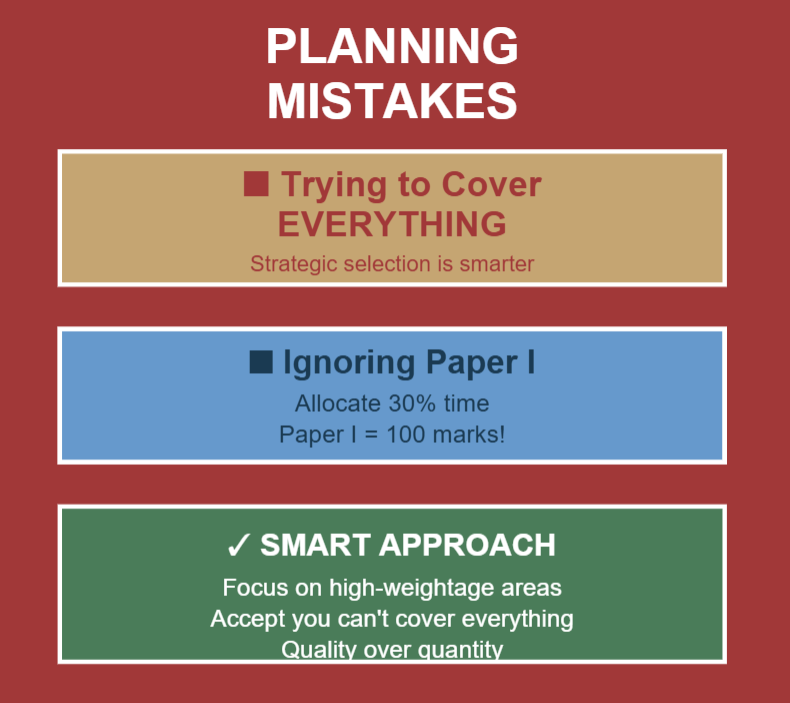
Planning and Strategy Mistakes
Trying to Cover Everything vs. Strategic Selection
The most common mistake in limited time preparation is attempting to cover the entire syllabus. This leads to superficial understanding of everything and deep understanding of nothing. Accept that you cannot cover everything.
Strategic selection means deliberately choosing to focus on high weightage areas and accepting lower mastery of peripheral topics. This is not giving up; it is smart resource allocation.
Ignoring Paper I While Focusing Only on Paper II
Many candidates assume Paper I is easy and focus entirely on Paper II. This is dangerous because Paper I contributes 100 marks, exactly one third of your total score. Moreover, Paper I cut offs exist. A brilliant Paper II performance can be undermined by a weak Paper I score.
Allocate at least 30% of your preparation time to Paper I throughout the month.
Study Approach Mistakes
Reading Without Practice and Application
Reading your notes or textbooks passively feels productive but often is not. The exam tests your ability to answer questions, not your ability to read material. Every concept you learn should be followed by practice questions testing that concept.
If you study for an hour, at least 20 minutes should be spent on questions. Without application, retention and exam performance suffer.
Skipping Mock Tests Until the Last Week
Some aspirants want to “complete the syllabus” before taking mock tests, planning to do all mocks in the last week. This is strategically flawed. Mock tests serve multiple purposes beyond assessment: they reveal knowledge gaps, build exam stamina, and improve time management.
Starting mocks late means losing these benefits when you need them most. Take your first full mock by Day 11 at the latest.
Mental and Physical Health Mistakes
Sacrificing Sleep for Extra Study Hours
The temptation to reduce sleep for extra study hours is strong, especially in a 1 month scenario. Resist it. Sleep is when your brain consolidates learning and memories form. Studying until 2 AM and sleeping only 4 hours is counterproductive because your retention will be poor.
Seven to eight hours of sleep is non negotiable. Better to study 6 hours with good sleep than 10 hours with sleep deprivation.
Isolating Yourself Completely During Preparation
Intense preparation does not mean cutting off all human contact. Complete isolation increases stress and can lead to burnout.
Maintain some social connections: have meals with family, take short walks with friends, or at least communicate with fellow aspirants who understand your situation.
These interactions provide emotional support and prevent the tunnel vision that leads to anxiety.
Conclusion
Preparing for UGC NET in 1 month is challenging but absolutely achievable with the right strategy, discipline, and mindset. The key is accepting that this timeline requires smart preparation, not comprehensive preparation.
You will not master every topic, but you can score above the cut off by focusing on high weightage areas, practicing consistently, and building exam readiness through mock tests.
Follow the week by week plan outlined in this guide. Build your foundation in Week 1, deepen your understanding and take your first mock in Week 2, intensify practice in Week 3, and consolidate through revision in Week 4.
Prioritize Paper I units strategically, apply the 60-40 approach to Paper II, and never skip mock tests. Remember that there is no negative marking, so attempt every question.
Most importantly, take care of your mental and physical health during this intensive month. Sleep properly, maintain some social connections, and manage stress through breaks and perspective.
The exam is important, but it is not your only chance. Candidates who approach the exam with confidence and preparation perform better than those who approach it with anxiety and exhaustion. You have 30 days. Make them count, and you might just surprise yourself with the result.
Frequently Asked Questions
Is 1 month enough to clear UGC NET for the first time?
Yes, 1 month can be enough for first time aspirants if you have a foundation in your Paper II subject and follow a disciplined preparation strategy. Many candidates have qualified UGC NET with one month of focused preparation. The key is strategic prioritization rather than attempting to cover everything. Focus on high weightage topics, practice regularly, and take multiple mock tests.
How many hours should I study daily for UGC NET in 1 month?
For full time aspirants, 8 to 10 hours of effective study daily is ideal. Working professionals should target 4 to 5 hours on weekdays and 6 to 8 hours on weekends. Quality matters more than quantity, so ensure your study hours are focused and distraction free. Consistent 6 to 7 hour days are more effective than irregular bursts of 12 hours followed by low productivity days.
Should I focus more on Paper I or Paper II with limited time?
Both papers are important, but Paper II carries double the marks (200 vs 100). A reasonable allocation is 40% time to Paper I and 60% to Paper II. However, do not neglect Paper I as it has separate cut offs. Your Paper II expertise means nothing if you fail the Paper I cut off. Ensure you cover all Paper I units and practice adequately for both papers.
Can working professionals clear UGC NET in 1 month?
Absolutely. Many working professionals have qualified UGC NET with 1 month of preparation by utilizing early mornings, lunch breaks, and post work hours effectively. The 4 to 5 hour daily plan outlined in this guide is specifically designed for working professionals. Weekend intensive study becomes crucial. Plan for 6 to 8 hours on both Saturday and Sunday.
What is the best time to start mock tests in a 1 month preparation?
Start your first full length mock test by Day 11 of your preparation. This gives you enough time to cover the basics before testing yourself but leaves ample time for improvement based on mock analysis. Topic wise mini tests should start from Day 4 onwards. Do not wait until you feel “ready” because mock tests themselves prepare you.
How do I prepare for UGC NET Paper I all 10 units in 30 days?
Prioritize the units based on scoring potential. High priority: Teaching Aptitude, Research Aptitude, Logical Reasoning (allocate 12 to 15 days). Medium priority: Data Interpretation, Communication, Reading Comprehension (allocate 8 to 10 days). Quick coverage: ICT, Environment, Higher Education, Mathematical Reasoning (allocate 5 to 7 days). This distribution ensures maximum coverage with strategic focus.
How to prepare for UGC NET Paper II Law in 1 month?
For UGC NET Law, prioritize Constitutional Law, Jurisprudence, and Criminal Law as these typically carry higher weightage. Focus on understanding legal principles and landmark judgments rather than memorizing sections verbatim. Use previous year questions to identify frequently tested topics. The LawSikho UGC NET Law course offers structured preparation specifically for law aspirants.
Which topics should I skip if I cannot cover the entire syllabus?
Skip topics that rarely appear in previous year papers, highly specialized or obscure topics within units, detailed nuances when you already understand the basic concept, and topics that remain confusing despite multiple attempts. Focus your energy on high frequency, high weightage topics. In a 1 month scenario, covering 70 to 80% of the syllabus thoroughly is better than covering 100% superficially.
Is coaching necessary for 1 month UGC NET preparation?
Coaching is helpful but not mandatory for 1 month preparation. If you join coaching, ensure it is specifically designed for short term preparation. Many aspirants successfully self study using quality books, online resources, and previous year papers. The decision depends on your self discipline, subject clarity, and available resources. Online crash courses can provide structure if self study feels overwhelming.
How many mock tests should I take in 1 month?
Aim for at least 5 full length mock tests during your 1 month preparation: one each on Days 11, 18, 20, 26, and 28 approximately. Additionally, take topic wise and section wise tests regularly throughout the month. More important than the number is how you analyze each mock. A carefully analyzed mock teaches more than three mocks taken and forgotten.
What should I do in the last week before the UGC NET exam?
The last week should focus on revision, not new learning. Review your condensed notes and one page summaries daily. Take 1 to 2 full length mock tests under exam conditions. Address any remaining weak areas with targeted practice. Download and verify your admit card. Plan your exam day logistics including travel and timing. Get adequate sleep and avoid studying on the final day.
Can I qualify for JRF with just 1 month of preparation?
JRF qualification is more competitive than Assistant Professor eligibility, requiring a higher cut off score. While difficult, it is possible to qualify for JRF with 1 month of preparation if you have excellent subject foundations, follow an intensive preparation strategy, and score significantly above the basic cut off. Set your target score accordingly and focus on maximizing marks in both papers.
How do I balance Paper I and Paper II preparation in limited time?
Create a daily schedule that includes both papers every day rather than dedicating entire days to one paper. Morning sessions can alternate between Paper I and Paper II concepts, while afternoons include practice from both papers. This parallel approach ensures neither paper is neglected and helps you build connections between concepts where relevant.
Should I study new topics in the last week or only revise?
In the last week, focus primarily on revision. Studying new topics at this stage leads to shallow understanding and can reduce confidence by highlighting what you do not know. Exceptions exist only if a high weightage topic was genuinely missed earlier. Otherwise, consolidate what you have learned. Walk into the exam confident about the 70 to 80% you know well rather than anxious about the 20 to 30% you do not.
How do I stay motivated during the intensive 1 month preparation?
Break your preparation into small, achievable daily goals and celebrate completing them. Track your progress visually using a calendar or checklist. Take regular breaks and maintain some social connections. Remind yourself of your goals: why you want to qualify UGC NET and what opportunities it opens. Connect with fellow aspirants for mutual motivation. Remember that this intensive period is temporary and the reward is worth the effort.





 Allow notifications