
Master UGC NET Law Paper 2 with complete syllabus breakdown, unit-wise topics, exam pattern, preparation strategy and best books.
Table of Contents
So you’re gearing up for UGC NET?
Let me tell you something straight up, Paper II is where the real game begins.
While Paper I tests your general aptitude, Paper II is your chance to prove you actually know your law. And here’s the thing: it carries 200 marks, which means this is literally where your ranking is made or broken.

Think about it. You’re not just aiming to pass, you’re fighting for every single mark. Whether you’re dreaming of becoming an Assistant Professor or securing that coveted Junior Research Fellowship, mastering Paper II isn’t optional. It’s non negotiable.
Now, I know what you’re thinking: “Ten units? A hundred questions? How do I even start?”
That’s exactly what we’re going to tackle together. From Jurisprudence to Constitutional Law fundamentals, this guide breaks down everything you need to know, unit by unit, topic by topic.
For your information, there is no negative marking means every question you attempt is a potential score booster. The strategy is clear: understand the syllabus, prioritize high weightage units, and practice until Paper II becomes second nature.
Ready to transform that overwhelming syllabus into a clear, conquerable roadmap? Let’s dive in.
UGC NET Law Exam Pattern
Understanding the exam pattern is your first step toward effective preparation. The UGC NET Law examination follows a computer based test (CBT) format and consists of two papers conducted in a single 3 hour session without any break.
Complete Exam Structure and Duration
The UGC NET Law exam comprises Paper 1 (General Aptitude) with 50 questions worth 100 marks and Paper 2 (Law) with 100 questions worth 200 marks. Each question in UGC NET Law carries 2 marks, with no negative marking for incorrect or unattempted answers. Both papers are conducted together in a single 3 hour session, with the medium of examination available in both English and Hindi.
Why No Negative Marking Works in Your Favor?
The absence of negative marking in UGC NET Law is a significant strategic advantage that many candidates fail to utilize.
Since there’s no penalty for wrong answers, you should never leave any question unanswered. Even educated guesses can potentially add to your score, making time management and attempting all 150 questions essential for maximizing your marks.
Minimum Qualifying Marks for Different Categories
To qualify UGC NET Law, candidates from General/Unreserved/EWS categories must secure at least 40% aggregate marks (120 out of 300) across both papers.
For reserved categories including OBC NCL, SC, ST, PwD, and Transgender candidates, the minimum qualifying percentage is 35% (105 out of 300).
How to Download UGC NET Law Syllabus PDF?
Having the official syllabus PDF is essential for structured preparation. The NTA releases the official UGC NET Law syllabus on its website, which remains the most authoritative source for your preparation.
Official NTA Syllabus PDF Links (English and Hindi)
You can download the official UGC NET Law Syllabus 2025 PDF from the UGC NET Online Portal. The syllabus is available in both English and Hindi mediums.
UGC NET Law Syllabus: Unit Wise
The UGC NET Law Paper 2 syllabus is divided into 10 comprehensive units covering the entire spectrum of legal education.
Each unit addresses distinct areas of law and carries roughly equal weightage in the examination. Below is a detailed breakdown of each unit with its sub topics.
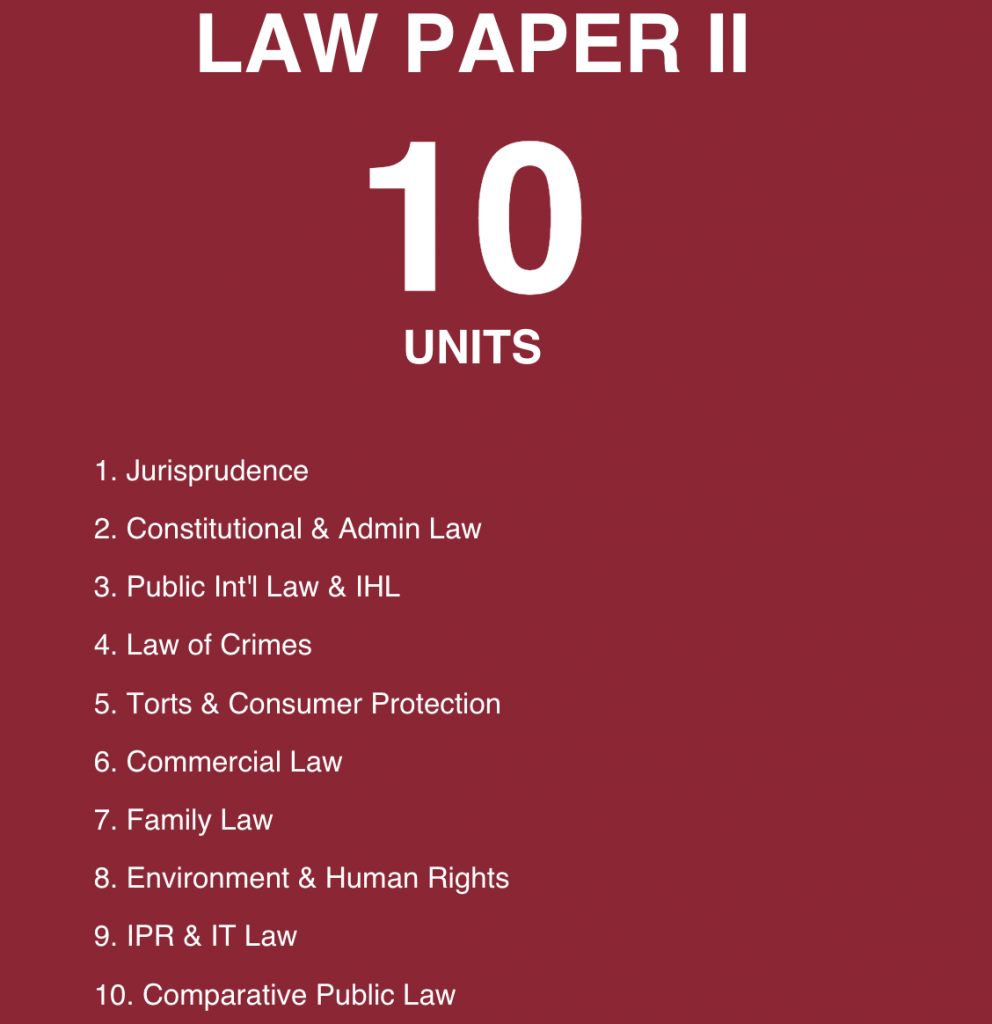
UNIT I: JURISPRUDENCE
Jurisprudence forms the theoretical foundation of legal studies and is essential for understanding the philosophy behind law.
This unit tests your grasp of legal theories, concepts of rights and duties, and contemporary perspectives on law and justice.
Nature and Sources of Law
The nature and sources of law form the foundational understanding of jurisprudence, examining what law is and where it originates.
You must understand the distinction between formal sources (legislation, precedent, custom) and material sources (historical, legal, and literary sources).
This topic frequently appears in UGC NET examinations through questions on Austin’s command theory, Hart’s rule of recognition, and Kelsen’s grundnorm.
Schools of Jurisprudence: Natural Law, Positivism, Realism and Sociological School
The schools of jurisprudence represent different philosophical approaches to understanding law and its relationship with society.
Natural Law theory emphasizes the connection between law and morality, Positivism focuses on law as it is rather than as it ought to be, Legal Realism examines law in action through judicial decisions, and the Sociological School studies law as a social phenomenon.
Understanding the key proponents like Aquinas, Austin, Holmes, and Pound is crucial for this topic.
Law and Morality, Rights and Duties
The relationship between law and morality explores whether legal validity depends on moral content, a debate central to jurisprudence.
The concept of rights includes Hohfeldian analysis of rights (claim rights, liberties, powers, immunities) and their correlative duties.
Questions often test your understanding of legal rights versus moral rights and the jurisprudential debates around natural rights theory.
Legal Personality, Property, Ownership and Possession
Legal personality determines which entities can hold rights and bear duties under law, including natural persons, corporations, and the debate around unborn persons and idols.
Property, ownership, and possession are interconnected concepts where ownership denotes complete dominion over property while possession refers to physical control. Understanding Salmond’s analysis of possession (corpus and animus) is frequently tested.
Concept of Liability and Global Justice
The concept of liability in jurisprudence covers the various theories of liability including strict liability, vicarious liability, and the conditions under which legal responsibility arises.
Global justice explores contemporary jurisprudential debates on international justice, distributive justice, and cosmopolitan theories of law. Rawls’ theory of justice and its critiques are important for this topic.
Law, Poverty and Development: Modernism and Post Modernism
This topic examines law’s role in addressing poverty and facilitating development, particularly relevant in developing nations like India.
Modernism in law refers to rationalist approaches emphasizing formal legal structures, while post modernism critiques these universal claims and emphasizes pluralism, deconstruction, and contextual understanding of law.
Understanding critical legal studies and their critique of traditional jurisprudence is important here.
Important Jurisprudence Case Laws for UGC NET
Key jurisprudence cases you should study include Salmond v. Salmond (corporate personality), Mohd. Ahmed Khan v. Shah Bano Begum[1985 SC] (law and morality), and Vishaka v. State of Rajasthan [1997 SC] (judicial law making).
These cases illustrate theoretical concepts in practical application and are frequently referenced in UGC NET questions testing the intersection of jurisprudential theory and judicial practice.
UNIT II: CONSTITUTIONAL AND ADMINISTRATIVE LAW
Constitutional and Administrative Law forms one of the most important units in UGC NET Law Paper 2, covering the foundational legal framework governing the Indian state and its administration.
This unit consistently carries high weightage in examinations.
Preamble, Fundamental Rights and Duties, Directive Principles of State Policy
The Preamble declares India as a Sovereign Socialist Secular Democratic Republic and contains the core constitutional values. Fundamental Rights guarantee civil liberties while Fundamental Duties outline citizen obligations.
Directive Principles guide state policy making, and understanding the interplay between these three organs is essential.
Union and State Executive and Their Interrelationship
The Union Executive comprises the President, Vice President, Prime Minister, and Council of Ministers, while State Executives include the Governor and Chief Minister with their councils.
The interrelationship between Union and State executives, particularly regarding Governor’s discretionary powers, President’s rule under Article 356, and cooperative federalism, forms a crucial examination topic. Recent controversies regarding gubernatorial appointments make this particularly relevant.
Union and State Legislature: Distribution of Legislative Powers
The distribution of legislative powers between Union and State is governed by the three lists in Schedule VII: Union List (100 subjects), State List (61 subjects), and Concurrent List (52 subjects).
The doctrine of pith and substance, colorable legislation, and the residuary power of Parliament (Article 248) are frequently tested concepts. Understanding Article 249 (Rajya Sabha’s special power) and Article 252 (parliamentary legislation for states) is important.
Judiciary and Emergency Provisions
The Indian judiciary’s independence, structure (Supreme Court, High Courts, subordinate courts), and powers including judicial review form a cornerstone of constitutional law.
Emergency provisions under Part XVIII cover National Emergency (Article 352), President’s Rule (Article 356), and Financial Emergency (Article 360).
The 44th Constitutional Amendment’s safeguards against emergency misuse and landmark cases like S.R. Bommai v. Union of India [1994 SC] are crucial.
Election Commission of India and Special Provisions for Certain States
The Election Commission of India (Article 324) is an independent constitutional body responsible for conducting free and fair elections. Special provisions exist for certain states under Part XXI, including former Article 370 for Jammu and Kashmir (now reorganized), and others. Understanding the scope of Election Commission’s powers and state specific constitutional provisions is important.
Administrative Law: Nature, Scope and Importance
Administrative law governs the exercise of powers by administrative authorities and provides mechanisms for controlling administrative action.
It developed as a response to the welfare state’s expansion and the need to balance administrative efficiency with individual rights protection.
The distinction between administrative, quasi judicial, and legislative functions of administrative bodies is a frequently tested concept.
Principles of Natural Justice and Judicial Review of Administrative Actions
The principles of natural justice include audi alteram partem (right to hearing) and nemo judex in causa sua (rule against bias), which administrative bodies must follow.
Judicial review of administrative actions can occur on grounds of illegality, irrationality (Wednesbury unreasonableness), and procedural impropriety. Understanding the scope and limitations of judicial review, including the distinction between review and appeal, is essential.
Landmark Constitutional and Administrative Law Case Laws
Essential cases include Kesavananda Bharati v. State of Kerala [1973 SC] (basic structure doctrine), Maneka Gandhi v. Union of India [1978 SC](expanded Article 21), S.R. Bommai v. Union of India [1994 SC](Article 356 limitations), and A.K. Kraipak v. Union of India [1970 SC] (natural justice in administrative proceedings).
These cases represent the evolution of constitutional and administrative law in India and are frequently referenced in UGC NET questions.
UNIT III: PUBLIC INTERNATIONAL LAW AND IHL
Public International Law and International Humanitarian Law (IHL) examine the legal framework governing relations between states and the protection of individuals during armed conflicts.
This unit covers international legal principles, institutions, and contemporary challenges.
International Law: Definition, Nature, Basis and Sources
International law refers to the body of rules governing relations between states and, increasingly, international organizations and individuals.
Its nature remains debated, whether it constitutes “true law” given the absence of a centralized enforcement mechanism. The sources of international law, as enumerated in Article 38 of the ICJ Statute, include treaties, custom, general principles, judicial decisions, and scholarly writings.
Recognition of States and Governments
Recognition of states involves acknowledging an entity’s statehood based on the Montevideo Convention criteria (permanent population, defined territory, government, capacity for relations with other states).
Recognition of governments, distinct from state recognition, acknowledges the legitimacy of a particular regime. The distinction between constitutive and declaratory theories of recognition is important for examination purposes.
Nationality, Immigrants, Refugees and IDPs
Nationality establishes the legal bond between an individual and a state, determining rights and obligations. Immigration law governs the movement of people across borders, while refugees are those fleeing persecution.
Internally Displaced Persons (IDPs) remain within their country but are displaced due to conflict or disasters. India’s approach to refugees, lacking domestic refugee legislation, is a relevant examination topic.
Extradition and Asylum
Extradition is the formal process by which a state surrenders an individual to another state for trial or punishment, governed by bilateral treaties and principles like double criminality and specialty.
Asylum is the protection granted by a state to foreign nationals fleeing persecution, with distinctions between territorial and extraterritorial asylum. Understanding the principle of non refoulement and its customary international law status is crucial.
United Nations and Its Organs
The United Nations, established in 1945, comprises six principal organs: General Assembly, Security Council, Economic and Social Council, Trusteeship Council (now inactive), International Court of Justice, and Secretariat.
Understanding the composition, functions, and limitations of each organ, particularly the Security Council’s veto power and the ICJ’s jurisdiction, is essential for this topic.
Settlement of International Disputes and World Trade Organization (WTO)
International disputes can be settled through diplomatic methods (negotiation, mediation, conciliation) or legal methods (arbitration, judicial settlement through ICJ).
The WTO, established in 1995, governs international trade through agreements like GATT, GATS, and TRIPS, with its Dispute Settlement Body providing a quasi judicial mechanism. Understanding the WTO’s dispute settlement procedures and appellate body crisis is relevant.
International Humanitarian Law (IHL): Conventions, Protocols and Implementation Challenges
IHL, also known as the law of armed conflict, regulates the conduct of hostilities and protects victims of armed conflicts.
The four Geneva Conventions of 1949 and their Additional Protocols form the core of IHL. Implementation challenges include non state actor compliance, classification of conflicts, and the relationship between IHL and human rights law.
Understanding the distinction between international and non international armed conflicts is important.
UNIT IV: LAW OF CRIMES
The Law of Crimes unit covers criminal law principles, offences, and punishments
General Principles of Criminal Liability: Actus Reus, Mens Rea and Constructive Liability
Criminal liability requires the combination of actus reus (guilty act) and mens rea (guilty mind), embodied in the maxim actus non facit reum nisi mens sit rea. Different offences require different levels of mens rea, intention, knowledge, rashness, or negligence.
Constructive liability extends criminal responsibility to group members or accomplices beyond the actual perpetrator, as seen in common intention and common object provisions.
Stages of Crime and Inchoate Crimes: Abetment, Conspiracy and Attempt
Crimes progress through stages: intention, preparation, attempt, and completion. Inchoate crimes criminalize conduct that precedes the complete offence: abetment (instigating, engaging in conspiracy, or aiding), criminal conspiracy (agreement between two or more persons to commit an illegal act), and attempt (acts done towards commission with intent).
Understanding the distinction between preparation and attempt, particularly through the proximity test, is essential.
General Exceptions in Criminal Law
General exceptions provide defenses that negate criminal liability despite the commission of an otherwise criminal act.
These include mistake of fact, judicial acts, accident, necessity, consent, communication made in good faith, acts of minors and persons of unsound mind, intoxication, and private defense.
Understanding the scope and limitations of each exception is crucial for examination success.
Offences Against Human Body, State, Terrorism and Property
Offences against the human body include culpable homicide, murder, causing death by negligence, hurt, grievous hurt, and kidnapping.
Offences against the state include sedition, waging war, and related offences. Terrorism offences have received enhanced attention in BNS with dedicated provisions. Property offences include theft, extortion, robbery, dacoity, criminal misappropriation, and cheating.
Offences Against Women and Children
Special provisions protect women and children from criminal exploitation, including offences like rape and sexual offences, dowry death, cruelty by husband, and POCSO Act provisions. Understanding the procedural protections and enhanced punishments for these offences is important for the examination.
Drug Trafficking, Counterfeiting and Public Tranquility Offences
Drug trafficking offences are primarily governed by the NDPS Act, 1985, with severe penalties including death penalty for repeat offenders of certain quantities.
Counterfeiting offences cover currency and government stamps. Public tranquility offences include unlawful assembly (five or more persons with common object), rioting, affray, and promoting enmity between groups. Understanding the distinction between unlawful assembly and rioting is frequently tested.
Theories and Kinds of Punishments, Victim Compensation
Punishment theories include deterrent, preventive, retributive, and reformative approaches, with modern criminal justice increasingly emphasizing reformation and victim compensation. Types of punishment include death, imprisonment (rigorous and simple), forfeiture of property and fine. The Victim Compensation Scheme under Section 357A CrPC provides state funded compensation to victims of crime.
UNIT V: LAW OF TORTS AND CONSUMER PROTECTION
This unit covers civil wrongs that result in personal or property damage and the legal framework protecting consumer interests. Understanding the principles of tortious liability and consumer protection mechanisms is essential.

Nature, Definition and General Principles of Tortious Liability
A tort is a civil wrong independent of contract, for which the remedy is a common law action for unliquidated damages.
The essential elements of tortious liability include: a wrongful act or omission, legal damage (injuria sine damno versus damnum sine injuria), and the act being the proximate cause of damage. Understanding the distinction between tort and crime, and tort and breach of contract, is fundamental.
General Defenses in Law of Torts
General defenses that can absolve tortious liability include volenti non fit injuria (voluntary assumption of risk), plaintiff’s wrongdoing, inevitable accident, act of God, private defense, necessity, statutory authority, and act of state.
Each defense has specific requirements and limitations that must be understood for examination purposes.
Specific Torts: Negligence, Nuisance, Trespass and Defamation
Negligence requires duty of care, breach of that duty, and resulting damage, with the Donoghue v. Stevenson neighbor principle establishing duty of care.
Nuisance (public and private) involves unreasonable interference with land use or public rights. Trespass can be to person (assault, battery, false imprisonment), land, or goods. Defamation protects reputation through actions for libel (permanent form) and slander (transient form).
Remoteness of Damages, Strict and Absolute Liability
Remoteness determines which consequences of wrongful acts are compensable, with the Re Polemis (direct consequences) and Wagon Mound (reasonable foreseeability) tests being important. Strict liability (Rylands v. Fletcher) imposes liability without fault for escape of dangerous things brought onto land. Absolute liability [M.C. Mehta v. Union of India (1987 SC)] extends this principle without the Rylands exceptions for hazardous industries.
Tortious Liability of the State
The tortious liability of the state in India is governed by Article 300 of the Constitution, which preserves the position as it existed before independence.
The distinction between sovereign and non sovereign functions determines state liability, with sovereign functions traditionally exempt. Cases like State of Rajasthan v. Vidyawati [1962 SC] and Kasturi Lal v. State of UP [1964 SC] establish the jurisprudence on state liability.
Consumer Protection Act 1986: Definitions, Rights and Redressal Mechanism
The Consumer Protection Act, 1986 (now replaced by the 2019 Act for new cases, but 1986 Act is in syllabus) defines consumer, goods, services, and deficiency in service. Consumer rights include safety, information, choice, redressal, and consumer education.
The three tier redressal mechanism comprises District Forums, State Commissions, and National Commission, with territorial and pecuniary jurisdiction rules.
Motor Vehicles Act 1988: No Fault Liability and Claims Tribunal
The Motor Vehicles Act, 1988, introduces no fault liability for death or permanent disability arising from motor vehicle accidents, providing compensation without proving negligence. Claims Tribunals (MACT) adjudicate compensation claims under the structured formula approach established in Sarla Verma v. Delhi Transport Corporation [2009 SC]. Understanding the multiplier method for calculating compensation is important.
Competition Act 2002: Anti Competitive Agreements and Abuse of Dominance
The Competition Act, 2002, prohibits anti competitive agreements, including horizontal agreements (cartels) and vertical agreements (exclusive dealing, tie in arrangements). Abuse of dominant position covers predatory pricing, denial of market access, and discriminatory conditions.
The Competition Commission of India (CCI) enforces these provisions with powers to investigate, issue cease and desist orders, and impose penalties.
UNIT VI: COMMERCIAL LAW
Commercial Law covers the legal principles governing business transactions, including contracts, sale of goods, negotiable instruments, and company law. This unit requires understanding both theoretical principles and practical applications.

Essential Elements of Contract and E Contract
A valid contract requires offer, acceptance, consideration, capacity to contract, free consent, lawful object, and certainty of terms (Sections 10 to 30 Indian Contract Act). E contracts, formed through electronic means, have gained legal recognition under the Information Technology Act, 2000. Understanding click wrap, browse wrap, and shrink wrap agreements is relevant for contemporary commercial law.
Breach of Contract, Frustration, Void and Voidable Agreements
Breach of contract occurs when a party fails to perform obligations, entitling the aggrieved party to damages (compensatory, nominal, liquidated) or specific performance.
Frustration (Section 56) excuses performance when circumstances beyond parties’ control make performance impossible.
Void agreements (ab initio invalid) differ from voidable agreements (valid until avoided), with specific provisions covering agreements in restraint of trade, marriage, and legal proceedings.
Standard Form of Contract and Quasi Contract
Standard form contracts are pre drafted by one party with terms not individually negotiated, raising concerns about unfair terms and inequality of bargaining power.
The courts have developed doctrines like fundamental breach and reasonable notice to protect weaker parties.
Quasi contracts also called restitutionary obligations, impose liability to prevent unjust enrichment even without formal contract.
Specific Contracts: Bailment, Pledge, Indemnity, Guarantee and Agency
Bailment involves delivery of goods for a specific purpose with return obligation, while pledge is bailment of goods as security for debt.
Indemnity is a promise to save from loss, while guarantee involves a tripartite arrangement with surety, principal debtor, and creditor.
Agency creates representation relationships, with understanding of agent’s authority (actual, implied, apparent) being essential.
Sale of Goods Act 1930
The Sale of Goods Act, 1930, governs contracts for sale of goods, distinct from bailment, hire purchase, and work and labor contracts.
Key concepts include transfer of property and risk, conditions and warranties, doctrine of caveat emptorand its exceptions, and rights of unpaid seller (lien, stoppage in transit, resale).
Understanding the implied conditions as to title, description, quality, and sample is frequently tested.
Partnership and Limited Liability Partnership
Partnership (governed by Indian Partnership Act, 1932) is a relationship between persons who agree to share profits of a business carried on by all or any of them acting for all. Rights and duties of partners, partnership property, and dissolution procedures are key topics.
Limited Liability Partnership (LLP Act, 2008) combines partnership flexibility with limited liability, with understanding of differences from traditional partnership being important.
Negotiable Instruments Act 1881
The Negotiable Instruments Act, 1881, governs promissory notes, bills of exchange, and cheques. Key concepts include negotiability, holder in due course, presentment, dishonor, and discharge.
Section 138 (dishonor of cheque) has significant importance due to its criminal liability provisions and presumption of legally enforceable debt. Understanding the requirements for Section 138 prosecution is essential.
Company Law: Incorporation, Prospectus, Shares and Debentures
Company incorporation under Companies Act, 2013, requires MOA, AOA, and registration with the Registrar of Companies. Prospectus is an invitation to the public to subscribe for shares, with civil and criminal liability for misstatements.
Shares represent ownership in the company with different classes (equity, preference), while debentures are debt instruments acknowledging the company’s loan obligation.
Company Law: Directors, Meetings and Corporate Social Responsibility
Directors are the company’s governing organ, with duties of care, skill, good faith, and avoiding conflicts of interest.
Company meetings include board meetings, general meetings (AGM, EGM), with specific quorum and voting requirements.
Corporate Social Responsibility mandates qualifying companies to spend 2% of average net profits on CSR activities, with understanding of CSR rules being important.
UNIT VII: FAMILY LAW
Family Law governs personal relationships including marriage, divorce, adoption, guardianship, maintenance, and succession. This unit requires understanding of different personal laws applicable to various communities in India.
Sources and Schools of Family Law
Indian family law derives from multiple sources based on religious personal laws: Hindu Law (Mitakshara and Dayabhaga schools), Muslim Law (Hanafi, Shafei, Maliki, Hanbali schools for Sunnis; Ithna Ashari for Shias), Christian Law, and Parsi Law.
Codified personal laws like Hindu Marriage Act, Hindu Succession Act, and Special Marriage Act have modified traditional laws while retaining certain customary elements.
Marriage and Dissolution of Marriage
Marriage under different personal laws has varying requirements: Hindu marriage requires ceremonies (saptapadi), capacity, and absence of prohibited relationships; Muslim marriage (nikah) is a civil contract requiring proposal, acceptance, and dower. Christian and Parsi marriages require monogamy and ceremonies.
Dissolution includes divorce, nullity, and judicial separation, with grounds varying across personal laws.
Matrimonial Remedies: Divorce and Theories of Divorce
Divorce theories include fault theory (innocent spouse versus guilty spouse), consent theory (mutual agreement), and breakdown theory (irretrievable breakdown of marriage). The Hindu Marriage Act combines fault and consent grounds, while Muslim law recognizes various forms including talaq, khula, mubarat, and judicial divorce. The Supreme Court’s recognition of irretrievable breakdown as ground for divorce under Article 142 is significant.
Changing Dimensions of Marriage: Live in Relationships
Live in relationships have gained legal recognition through judicial pronouncements, with the Supreme Court in S. Khushboo v. Kanniammal [2010 SC] holding that such relationships are not criminal. The Protection of Women from Domestic Violence Act, 2005, extends protection to women in “relationships in the nature of marriage.” Understanding the legal status of children born from live in relationships and maintenance rights is important.
Recognition of Foreign Decrees in India
Foreign matrimonial decrees are recognized in India under Section 13 of the Civil Procedure Code, subject to conditions including competent jurisdiction, proper service, decision on merits, and compliance with Indian public policy.
The Supreme Court in Y. Narasimha Rao v. Y. Venkata Lakshmi [1991 SC] established criteria for recognizing foreign divorce decrees, particularly important for NRI marriages.
Maintenance, Dower and Stridhan
Maintenance obligations exist under personal laws and Section 125 CrPC covering wife, children, and parents.
Under Muslim law, dower (mahr) is the wife’s right payable by husband, either prompt (muajjal) or deferred (muwajjal). Stridhan under Hindu law is the wife’s absolute property received before or during marriage, with the husband having no ownership rights over it.
Adoption, Guardianship and Acknowledgement
Adoption under Hindu Adoptions and Maintenance Act, 1956, creates a parent child relationship with specific eligibility requirements. Muslims cannot adopt under personal law but can act as guardians under Guardians and Wards Act, 1890.
Acknowledgement (iqrar) under Muslim law establishes paternity for a child of uncertain parentage. Understanding the distinction between natural, testamentary, and certificated guardians is important.
Succession and Inheritance
Succession laws govern the devolution of property upon death. Hindu Succession Act, 1956 (amended 2005), provides equal rights to daughters in coparcenary property.
Muslim law distinguishes between Sharers, Residuaries, and Distant Kindred for inheritance.
Indian Succession Act, 1925, governs Christians and Parsis. Understanding the distinction between testamentary and intestate succession is essential.
Will, Gift and Wakf
A will is a testamentary disposition of property taking effect after death, with Hindus governed by Indian Succession Act and Muslims by personal law with testamentary capacity limited to one third of property. Gift (hiba) under Muslim law requires declaration, acceptance, and delivery of possession.
Wakf is dedication of property for religious or charitable purposes recognized as pious, with understanding of different types (public, private, wakf al aulad) being important.
Uniform Civil Code: Debate and Implications
Article 44 of the Constitution directs the State to secure a Uniform Civil Code for citizens throughout India.
The debate involves balancing constitutional aspirations with religious freedom and cultural diversity. Recent developments including Uttarakhand’s UCC legislation make this topic highly relevant for examination.
UNIT VIII: ENVIRONMENT AND HUMAN RIGHTS LAW
This unit covers the legal framework for environmental protection and human rights, examining both international and domestic mechanisms for safeguarding environmental and human rights.
Meaning and Concept of Environment and Environmental Pollution
“Environment” under the Environment Protection Act, 1986, includes water, air, land, and the interrelationship between these and human beings, living creatures, plants, and property.
Environmental pollution refers to the presence of pollutants in quantities harmful to living beings or the environment. Understanding the classification of pollution (air, water, soil, noise) and their legal regulation is fundamental to this topic.
International Environmental Law and UN Conferences
International environmental law has developed through landmark UN Conferences: Stockholm Conference (1972) establishing environmental protection as an international concern, Rio Summit (1992) producing Agenda 21 and key conventions (Climate Change, Biodiversity), Johannesburg Summit (2002), and Paris Agreement (2015) on climate change. Understanding principles like sustainable development, precautionary principle, and polluter pays is essential.
Constitutional and Legal Framework for Environment Protection in India
Environmental protection in India has constitutional backing through Article 48A (state’s duty to protect environment) and Article 51A(g) (citizen’s duty). The Supreme Court has read the right to clean environment into Article 21. Key legislation includes Environment Protection Act, 1986, Water Act, 1974, Air Act, 1981, and Wildlife Protection Act, 1972. Understanding the interplay between constitutional provisions and statutory framework is important.
Environmental Impact Assessment and Hazardous Waste Control
Environmental Impact Assessment (EIA) is a mandatory process for projects likely to cause significant environmental impact, governed by EIA Notification, 2006.
The assessment evaluates potential environmental consequences and proposes mitigation measures. Hazardous waste management is governed by Hazardous Waste Management Rules, 2016, regulating generation, collection, treatment, and disposal of hazardous waste in compliance with Basel Convention obligations.
National Green Tribunal (NGT): Powers and Jurisdiction
The National Green Tribunal, established under the NGT Act, 2010, is a specialized environmental court with original and appellate jurisdiction over environmental matters.
It applies principles of sustainable development, precautionary principle, and polluter pays while adjudicating disputes. Understanding NGT’s composition, jurisdiction, procedures, and relationship with regular courts and Supreme Court is important for examination.
Concept and Development of Human Rights
Human rights are fundamental rights inherent to all human beings regardless of nationality, sex, origin, religion, or other status. The concept evolved from natural rights theory through the Universal Declaration of Human Rights (1948) to contemporary international human rights law. Understanding the generations of rights (civil political, economic social cultural, solidarity rights) and their progressive development is essential.
Universalism and Cultural Relativism
Universalism holds that human rights apply equally to all persons everywhere, while cultural relativism argues that rights must be understood within specific cultural contexts. This debate affects implementation of international human rights standards in diverse societies. Understanding the balancing approach adopted by international bodies and regional human rights systems is important for examination.
International Bill of Rights
The International Bill of Rights comprises the Universal Declaration of Human Rights (1948), International Covenant on Civil and Political Rights (1966) with its Optional Protocols, and International Covenant on Economic, Social and Cultural Rights (1966).
These instruments establish the comprehensive framework of internationally recognized human rights with varying levels of state obligations and implementation mechanisms.
Group Rights: Women, Children, Persons with Disabilities, Minorities and Weaker Sections
Group specific rights address vulnerabilities of particular categories: women’s rights (CEDAW), children’s rights (CRC), disability rights (CRPD), minority rights, and rights of weaker sections. These rights recognize that formal equality may be insufficient and require special measures to ensure substantive equality. Understanding the specific conventions and domestic legislation protecting each group is important.
Human Rights Commissions: NHRC, NCM, NCW, NCSC, NCST and NCBC
India has established multiple human rights protection bodies: National Human Rights Commission (Protection of Human Rights Act, 1993), National Commission for Minorities (NCM Act, 1992), National Commission for Women (NCW Act, 1990), National Commission for Scheduled Castes, National Commission for Scheduled Tribes (Article 338 and 338A), and National Commission for Backward Classes (Article 338B). Understanding their composition, powers, functions, and limitations is essential.
UNIT IX: INTELLECTUAL PROPERTY RIGHTS AND INFORMATION TECHNOLOGY LAW
This unit covers the protection of intellectual creations and the legal framework governing information technology. Understanding both theoretical foundations and practical applications is essential.
Concept, Meaning and Theories of Intellectual Property
Intellectual property refers to creations of the mind, inventions, literary and artistic works, designs, symbols, and names used in commerce.
Theoretical justifications include labor theory (Locke), personality theory (Hegel), utilitarian theory (incentive based), and social planning theory. Understanding these theories helps explain the scope and limitations of IP protection.
International Conventions on Intellectual Property
Key international IP conventions include Paris Convention (industrial property), Berne Convention (copyright), TRIPS Agreement (WTO comprehensive framework), WIPO Copyright Treaty, and Patent Cooperation Treaty.
India is a member of these conventions, and understanding their minimum standards and flexibilities is important for examination. The TRIPS Agreement’s impact on Indian IP law post 1995 is particularly significant.
Copyright and Neighboring Rights: Subject Matter, Limitations and Infringement
Copyright (governed by Copyright Act, 1957) protects original literary, dramatic, musical, artistic works, cinematograph films, and sound recordings. Protection is automatic without registration, lasting 60 years (author’s lifetime plus 60 years for literary works).
Fair dealing provisions, compulsory licensing, and statutory licenses create limitations. Neighboring rights protect performers, broadcasters, and producers.
Law of Patent: Patentability, Grant Procedure and Remedies
Patents (governed by Patents Act, 1970, as amended) protect novel, inventive, and industrially applicable inventions. Section 3 of Patents Act, 1970 excludes certain subject matters from patentability including mathematical methods, plants and animals, and traditional knowledge.
The grant procedure involves filing, examination, pre grant opposition, grant, and post grant opposition. Compulsory licensing provisions allow government intervention for access to patented products.
Law of Trademark: Registration, Types, Infringement and Passing Off
Trademarks (Trade Marks Act, 1999) protect distinctive signs identifying goods or services. Registration provides statutory protection and presumption of validity, though unregistered marks can be protected through passing off action.
Types include word marks, device marks, shape marks, color marks, and sound marks. Infringement occurs when identical or deceptively similar marks are used for identical or similar goods, while passing off protects goodwill even without registration.
Protection of Geographical Indications
Geographical Indications (GI) identify goods as originating from a particular region where quality, reputation, or characteristics are essentially attributable to that origin.
The Geographical Indications of Goods (Registration and Protection) Act, 1999, governs GI protection in India. Examples include Darjeeling Tea, Basmati Rice, and Kanchipuram Silk. Understanding the distinction between GIs and trademarks is important.
Bio diversity and Traditional Knowledge Protection
Biodiversity protection is governed by Biological Diversity Act, 2002, implementing the Convention on Biological Diversity. Access to genetic resources requires National Biodiversity Authority approval, with benefit sharing obligations.
Traditional knowledge protection involves preventing biopiracy and ensuring benefit sharing with communities. The sui generis system for plant variety protection (PPV&FR Act, 2001) and traditional knowledge digital library are relevant topics.
Information Technology Law: Digital Signature, E Governance and Electronic Records
The Information Technology Act, 2000, provides legal recognition to electronic records and digital signatures. Digital signatures use asymmetric cryptography and are validated through licensed certifying authorities.
E governance provisions facilitate electronic filing, contracts, and government services. Electronic records are admissible as evidence under Section 65B of Indian Evidence Act.
Cyber Crimes, Penalties and Adjudication Under IT Act
Cyber crimes under IT Act include unauthorized access, hacking, identity theft, cyber terrorism, and publication of obscene material. The Act provides for adjudicating officers for civil contraventions and criminal courts for offences. Understanding the jurisdictional issues and intermediary liability provisions is important.
UNIT X: COMPARATIVE PUBLIC LAW AND SYSTEMS OF GOVERNANCE
This unit studies different legal systems and governance structures comparatively, examining how different countries approach constitutional and administrative matters.
Comparative Law: Relevance, Methodology and Concerns
Comparative law studies different legal systems to understand their similarities, differences, and mutual influences. Its relevance lies in law reform, understanding one’s own legal system better, and international harmonization.
Methodology involves selecting comparators, analyzing rules in context, and drawing meaningful conclusions. Concerns include avoiding superficial comparisons and recognizing cultural contexts that shape legal systems.
Forms of Governments: Presidential vs Parliamentary, Unitary vs Federal
Presidential systems (USA) feature separation of executive from legislature with directly elected president, while parliamentary systems (UK, India) have executive responsibility to legislature.
Unitary systems concentrate power at center (UK, France), while federal systems divide powers between central and constituent units (USA, India, Canada). Understanding the advantages and disadvantages of each form is essential for comparative analysis.
Models of Federalism: USA, Canada and India
American federalism features dual sovereignty with enumerated federal powers and reserved state powers, modified by the supremacy clause. Canadian federalism follows a similar pattern but with residuary power to center.
Indian federalism is described as “quasi federal” or “federal with unitary bias,” with strong central government, single citizenship, and emergency provisions allowing centralization. Understanding the evolution of cooperative federalism in each country is important.
Rule of Law: Formal and Substantive Versions
The rule of law principle holds that law should govern society rather than arbitrary decisions of individuals. Formal rule of law emphasizes procedural requirements laws must be prospective, clear, stable, and accessible.
Substantive rule of law adds content requirements laws must protect fundamental rights and ensure justice. Dicey’s formulation (supremacy of law, equality before law, constitution as consequence of rights) remains influential.
Separation of Powers: India, UK, USA and France
Separation of powers doctrine distributes governmental functions among legislature, executive, and judiciary to prevent concentration of power.
The USA follows strict separation with checks and balances. The UK has fusion of powers in cabinet government. India follows a modified separation with overlapping functions. France combines elements with a Constitutional Council for constitutional review.
Understanding judicial interpretations in each system is important.
Independence of Judiciary, Judicial Activism and Accountability
Judicial independence requires security of tenure, adequate remuneration, and insulation from political pressure. Methods of ensuring independence vary appointment processes, impeachment procedures, and administrative autonomy.
Judicial activism involves courts expanding their role beyond traditional adjudication, exemplified by PIL in India. Judicial accountability debates balance independence with transparency and responsiveness.
Systems of Constitutional Review: India, USA, Switzerland and France
Constitutional review examines whether laws conform to constitutional requirements. The USA follows diffuse review where all courts can examine constitutionality. India has a similar system with Supreme Court as final arbiter. Switzerland combines judicial review with strong referendum democracy.
France’s Constitutional Council (Conseil Constitutionnel) primarily conducts abstract pre enactment review, though this has evolved with the QPC procedure.
Amendment of Constitution: India, USA and South Africa
Constitutional amendment procedures reflect the tension between stability and adaptability. The US Constitution requires supermajority support (two thirds Congress, three fourths states), making amendment difficult.
India’s Article 368 provides different procedures for different provisions some requiring simple majority, others special majority with state ratification. South Africa’s Constitution, has amendment procedures protecting its fundamental values.
Ombudsman: Sweden, UK and India
The Ombudsman institution originated in Sweden (1809) as a parliamentary commissioner investigating maladministration. The UK Parliamentary Commissioner for Administration (1967) investigates complaints referred through MPs.
India’s Lokpal (Lokpal and Lokayuktas Act, 2013) handles corruption complaints against public functionaries. Understanding the powers, limitations, and effectiveness of these institutions in different contexts is important.
Open Government and Right to Information: USA, UK and India
Open government principles require transparency and citizen access to governmental information.
The USA’s Freedom of Information Act (1966) established the model. UK’s Freedom of Information Act (2000) provides similar rights with exemptions. India’s Right to Information Act, 2005, has been praised as progressive legislation. Understanding the scope, exemptions, and enforcement mechanisms in each jurisdiction is essential for comparative analysis.
Best Books for UGC NET Law Paper II Preparation
Selecting the right books is crucial for effective preparation. The following recommendations cover both comprehensive guides and subject specific authoritative texts.
Subject wise Book Recommendations
For Jurisprudence, Dr. N.V. Paranjape’s “Jurisprudence and Legal Theory” provides comprehensive coverage suitable for UGC NET.
For deeper understanding, Dias’ “Jurisprudence” offers analytical clarity.
For Constitutional Law, M.P. Jain’s “Indian Constitutional Law” is considered the definitive text, supplemented by V.N. Shukla for concise coverage.
For Criminal Law, K.D. Gaur’s “Textbook on Indian Penal Code” and Ratanlal & Dhirajlal’s commentary remain standard references.
For Family Law, Paras Diwan’s works on Hindu Law and Muslim Law provide accessible explanations. For Commercial Law, Avtar Singh’s books on Contract and Company Law are widely recommended.
For comprehensive UGC NET preparation, “UGC NET Law Guide” by Rukmesh, “Trueman’s UGC NET Law” by Suman Chauhan, and “Universal’s UGC NET Law Examination Solved Papers” by Krishan Keshav provide exam focused content.
“The Ultimate Guide to UGC NET (Law) Examination” by Bhavna Sharma (updated for new criminal laws) is highly recommended.
Bare Acts are essential. Many questions directly quote statutory provisions, making familiarity with exact language crucial.
Mock Tests and Practice Strategies for UGC NET Law Paper II
Practice through mock tests is essential for developing exam temperament, improving speed, and identifying weak areas. A strategic approach to mock tests significantly enhances examination performance.

How Many Mock Tests Should You Attempt?
Aim to complete at least 30 to 40 full length mock tests before the examination. In the initial preparation phase, take sectional tests focusing on specific units to build conceptual understanding.
During the final 60 days, shift to full length tests simulating actual examination conditions.
Analyze each mock test thoroughly identify not just wrong answers but also lucky correct guesses and time consuming questions.
Maintain an error log categorizing mistakes by unit and topic to focus revision efforts. Gradually improve your attempt rate, targeting 95 to 100% attempt with 65 to 70% accuracy.
Quality matters alongside quantity. Use mock tests from reputed coaching institutes that accurately reflect NTA question patterns. Practice under timed conditions to build stamina for the 3 hour examination. Review difficult questions with explanations to reinforce learning.
Conclusion
UGC NET Law Paper II represents a comprehensive assessment of your legal knowledge across ten diverse units. Success requires systematic preparation that balances breadth of coverage with depth of understanding in high weightage areas.
Begin your preparation by thoroughly understanding the syllabus and exam pattern, then create a realistic study schedule allocating time proportionate to unit weightage. Focus on Constitutional Law, Jurisprudence, Criminal Law, and Family Law as priority units while ensuring no unit is neglected entirely.
Supplement textbook study with previous year question papers, mock tests, and case law review.
Remember that UGC NET rewards conceptual clarity over rote memorization.
Understanding the “why” behind legal principles enables you to tackle application based questions effectively.
Stay updated on recent legal developments and maintain consistency in your preparation efforts. With dedicated effort and strategic preparation, qualifying UGC NET Law and securing your path to legal academia is achievable.
Frequently Asked Questions
What is the syllabus for UGC NET Law?
The UGC NET Law Paper II syllabus comprises 10 units: Jurisprudence, Constitutional and Administrative Law, Public International Law and IHL, Law of Crimes, Law of Torts and Consumer Protection, Commercial Law, Family Law, Environment and Human Rights Law, IPR and IT Law, and Comparative Public Law and Systems of Governance.
How many units are there in UGC NET Law Paper II?
There are 10 units in UGC NET Law Paper II, each covering distinct areas of law with multiple sub topics. All units carry roughly equal weightage, though Constitutional Law and Jurisprudence historically feature more questions.
Is there negative marking in UGC NET Law?
No, there is no negative marking in UGC NET Law. Each correct answer awards 2 marks, while incorrect or unattempted questions receive zero marks. This makes it advisable to attempt all 150 questions.
Which books are best for UGC NET Law Paper II preparation?
Recommended books include M.P. Jain (Constitutional Law), K.D. Gaur (Criminal Law), Paras Diwan (Family Law), N.V. Paranjape (Jurisprudence), and Avtar Singh (Commercial Law). For comprehensive guides, “UGC NET Law Guide” by Rukmesh and Bhavna Sharma’s “Ultimate Guide to UGC NET (Law)” are highly recommended.
Can final year LLM students apply for UGC NET Law?
Yes, final year LLM students are provisionally eligible to apply for UGC NET Law. However, they must complete their degree and obtain the minimum required marks (55% for General, 50% for reserved categories) within two years of the NET result declaration.
How to prepare for UGC NET Law Paper II in 3 months?
In 3 months, allocate the first 6 weeks for completing the syllabus (2 units per week), next 3 weeks for revision and previous year papers, and final 3 weeks for intensive mock tests and weak area improvement. Dedicate at least 6 to 7 hours daily with focus on high weightage units first.
What are the most important topics in UGC NET Law Paper II?
Most important topics include Fundamental Rights and Judicial Review (Constitutional Law), Schools of Jurisprudence (Jurisprudence), General Principles and Exceptions (Criminal Law), Marriage and Divorce (Family Law), Contract Essentials (Commercial Law), and Principles of Tortious Liability (Torts).
Has the UGC NET Law syllabus changed for 2025?
The current UGC NET Law syllabus was revised in 2019 and remains applicable for 2025 examinations. However, candidates should study the Bharatiya Nyaya Sanhita (BNS) 2023 which has replaced the IPC, as questions may reflect these new criminal laws.
How to cover the entire UGC NET Law Paper II syllabus?
Create a unit wise study schedule, use comprehensive guide books covering all topics, maintain subject wise notes for revision, and practice previous year papers to understand coverage expectations. Focus on conceptual understanding rather than memorizing every detail.
What is the passing percentage for UGC NET Law?
General category candidates must secure 40% aggregate marks across both papers to qualify. Reserved categories (OBC NCL, SC, ST, PwD, Transgender) require 35%. The actual qualifying cutoff varies each session based on difficulty and competition.
How many months are required to prepare for UGC NET Law?
With dedicated full time preparation, 4 to 6 months is generally sufficient to cover the syllabus comprehensively. Working professionals should plan for 6 to 8 months. The key is consistent daily study (5 to 7 hours) with regular revision and mock tests.




 Allow notifications