

Complete guide for UGC NET Exam Paper 1: Unit-wise syllabus, exam pattern, preparation strategy, and tips for candidates.
Table of Contents
If you’re preparing for UGC NET, I’m guessing you’ve already spent countless hours diving into your core subject for Paper 2. But here’s something that might surprise you: many brilliant candidates fail the exam not because of Paper 2, but because they completely underestimate Paper 1. The General Paper on Teaching and Research Aptitude is compulsory for everyone, regardless of your subject, and it can make or break your qualification chances.
And I have seen this pattern repeat itself too many times. Candidates with exceptional knowledge walk out of the examination hall disappointed because they couldn’t clear the minimum cut-off in Paper 1. The truth is, Paper 1 isn’t difficult; it’s just different from what you’re used to studying. And that’s exactly why I’ve put together this comprehensive guide for candidates like you.
In this article, I’ll walk you through everything you need to know about UGC NET Paper 1; from the complete unit-wise syllabus to exam patterns, preparation strategies, and the best resources to use. Whether you’re aiming for Junior Research Fellowship or Assistant Professor eligibility, mastering Paper 1 is non-negotiable. So let’s dive in and ensure that your legal expertise translates into exam success.

Before we get into the syllabus details, let’s first understand what Paper 1 is all about and why it deserves your serious attention. The National Testing Agency (NTA) conducts UGC NET twice a year: in June and December, to determine eligibility for Assistant Professor positions and Junior Research Fellowship in Indian universities and colleges.
How Does Paper 1 Differ from Paper 2 in the UGC NET Exam?
Paper 1 and Paper 2 serve completely different purposes in the UGC NET examination. While Paper 2 tests your subject-specific knowledge across multiple units. For instance, if you have opted for law as your core subject for Paper 2, you will be studying legal topics like Jurisprudence, Constitutional Law, and Law of Crimes and Paper 1 evaluates your general aptitude for teaching and research. Think of Paper 2 as testing what you know, and Paper 1 as testing whether you have the skills to teach and research effectively.
The fundamental difference lies in content and approach. Paper 1 covers 10 generic units including Teaching Aptitude, Research Methodology, Logical Reasoning, Data Interpretation, and Communication; topics that every aspiring academician should master regardless of their subject specialisation. This means a Management Candidate or a Commerce candidate and a Law candidate will answer the exact same Paper 1 questions.
What Are the Minimum Qualifying Marks for Paper 1?
Here’s where many candidates get caught off guard. According to UGC regulations, General category (including EWS) candidates must secure a minimum of 40% marks in Paper 1 (that’s 40 out of 100 marks) to qualify. For reserved category candidates including SC, ST, OBC-NCL, and PwD, the minimum requirement is 35% marks. Failing to meet these thresholds in Paper 1 means automatic disqualification; even if you score exceptionally well in Paper 2.
Why Paper 1 Matters for Your Final Score
Your final UGC NET score is calculated by combining marks from both papers, with Paper 1 contributing 100 marks and Paper 2 contributing 200 marks to your total of 300. While Paper 2 carries double the weightage, Paper 1’s contribution is significant enough to impact your ranking. Candidates competing for JRF (top 6% nationally) often find that strong Paper 1 performance gives them the edge over competitors with similar Paper 2 scores. Simply put, treating Paper 1 as a formality rather than a scoring opportunity is a strategic mistake you cannot afford to make.
UGC NET Paper 1 Exam Pattern
Understanding the exam pattern thoroughly before you start preparing will help you allocate your time and energy wisely. The NTA Information Bulletin provides complete details about the examination structure, and I’ll break down the key aspects for you here.
How Many Questions Are Asked in Paper 1?
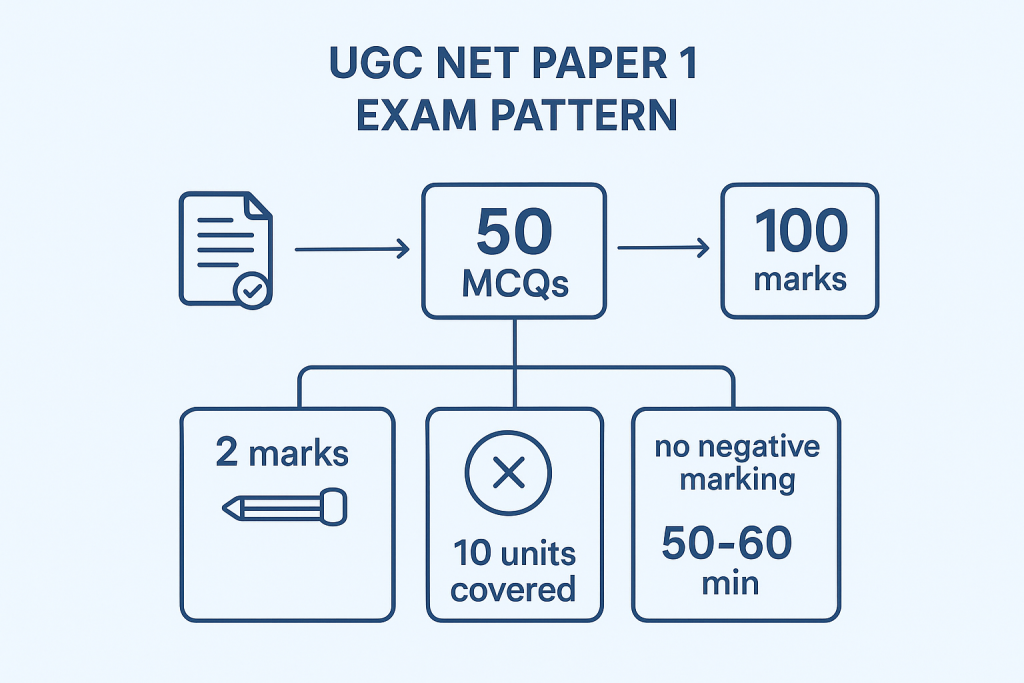
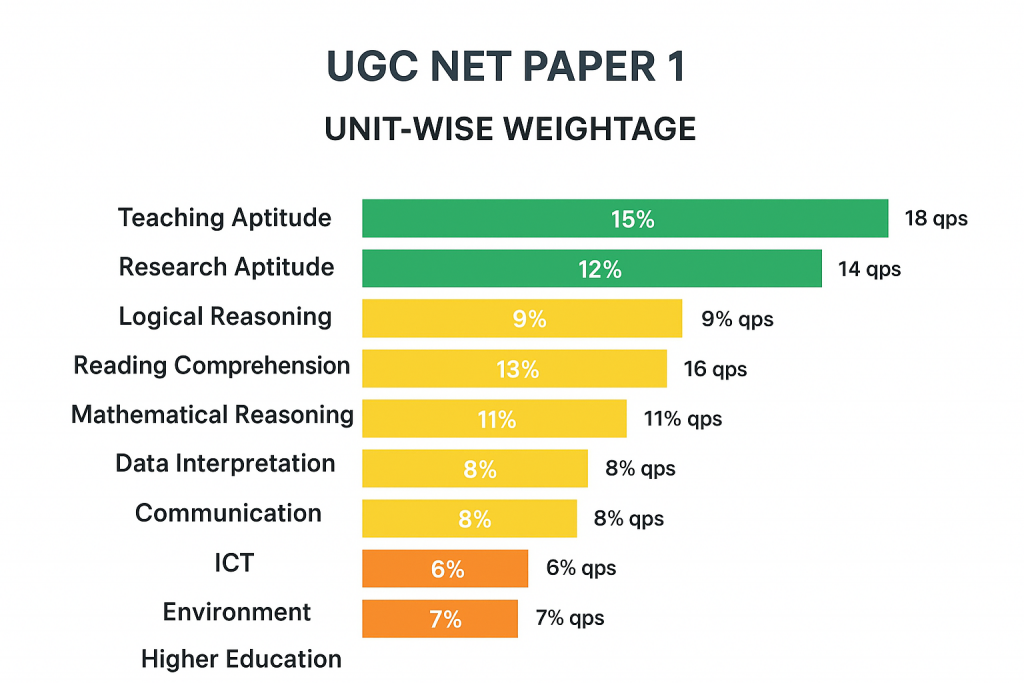
Paper 1 consists of 50 Multiple Choice Questions (MCQs), each carrying 2 marks, for a total of 100 marks. These 50 questions are distributed across all 10 units of the syllabus, though the exact number of questions from each unit may vary slightly between different exam sessions. Based on previous year analysis, you can expect approximately 5 questions from each unit, with some high-weightage units like Teaching Aptitude and Logical Reasoning occasionally featuring 4-6 questions.
What is the Marking Scheme and Is There Negative Marking?
This is excellent news for you: there is absolutely no negative marking in UGC NET. Every correct answer earns you 2 marks, while wrong answers and unattempted questions carry zero marks. This marking scheme is incredibly candidate-friendly because it means you should attempt every single question, even if you’re unsure about the answer. Intelligent guessing cannot hurt your score but might add valuable marks. So never leave any question unanswered, make an educated guess based on elimination if needed.
How Should You Allocate Time During the 3-Hour Exam?
The UGC NET examination is conducted as a single session of 3 hours (180 minutes) covering both Paper 1 and Paper 2 without any break. You’ll answer 50 questions in Paper 1 and 100 questions in Paper 2, totaling 150 questions. Since there’s no fixed time separation between papers, you have flexibility in managing your time but this flexibility can also become a trap if you’re not strategic.
Section-Wise Time Management Strategy
Allocate approximately 50-60 minutes for Paper 1 and 120-130 minutes for Paper 2. Within Paper 1, prioritise your strongest units first to build confidence and secure quick marks. Start with Teaching and Research Aptitude if you’ve prepared well for them, as these are conceptual and don’t require calculations. Then move to Logical Reasoning and Data Interpretation, which require more time but are highly scoring if you practice adequately.
For the Reading Comprehension passage, don’t spend more than 8-10 minutes; read the questions first, then scan the passage for relevant answers. Leave units like ICT and Higher Education System for later, as these often require recall-based answers that either you know or you don’t. The key is to never get stuck on a single question for more than 2 minutes. Mark it for review and move on; you can always return to it if time permits.
Syllabus of UGC NET Paper 1
Now let’s get into the heart of your preparation: the complete unit-wise syllabus. The official UGC NET syllabus divides Paper 1 into 10 comprehensive units. I’ll explain each unit in detail, highlighting how your legal background can help and which topics need extra attention.
Unit 1 – Teaching Aptitude: What Topics Are Covered?
Teaching Aptitude is typically the first unit in the syllabus and carries significant weightage in the exam. This unit tests your understanding of what makes an effective teacher, how learners differ from each other, and how teaching-learning processes work. As a future professor or researcher, these concepts will directly apply to your career.
Key Concepts
The unit covers the nature, objectives, characteristics, and basic requirements of teaching. You need to understand the three levels of teaching: Memory level (where students simply recall information), Understanding level (where students comprehend and explain concepts), and Reflective level (where students analyze, evaluate, and create new ideas). Each level has different characteristics and requires different teaching strategies, and questions often test your ability to identify which level a particular teaching activity represents.
Learner characteristics form another crucial topic within this unit. You should understand how age, motivation, prior knowledge, learning styles, and individual differences affect the learning process. The unit also covers various teaching methods including lecture method, discussion method, demonstration, project-based learning, and learner-centered approaches. Questions frequently ask you to identify the most appropriate teaching method for specific situations or compare the advantages and limitations of different approaches.
Unit 2 – Research Aptitude
Research Aptitude is perhaps the unit where masters’ candidates have the greatest inherent advantage. Your dissertation work, research methodology training, and exposure to academic writing during your Master’s program directly connect to the concepts tested here. This unit evaluates your understanding of the research process from problem identification to conclusion.
Research Methods and Thesis Writing Topics
The unit covers types of research including fundamental research (pure/basic research aimed at expanding knowledge), applied research (solving practical problems), and action research (improving specific practices). You should understand the differences between qualitative research (exploring meanings and experiences), quantitative research (measuring and analyzing numerical data), and mixed-methods research. Questions often present research scenarios and ask you to identify the appropriate research type or method.
The research process is tested extensively. You need to know the steps involved: identifying a research problem, reviewing literature, formulating hypotheses, designing the research methodology, collecting and analyzing data, and drawing conclusions. Concepts like variables (independent, dependent, intervening), sampling methods (probability and non-probability sampling), and research ethics (informed consent, confidentiality, plagiarism) are frequently tested. Understanding these concepts from your masters’ program dissertation experience gives you a practical foundation that pure theoretical study cannot match.
Unit 3 – Reading Comprehension: What Question Types Appear?
Reading Comprehension tests your ability to understand, analyze, and draw inferences from written passages. This unit typically presents one or more passages of approximately 300-500 words followed by 5-6 questions. Your years of reading complex legal judgments and academic articles have prepared you well for this unit.
Passage Types and Question Patterns
Passages in Paper 1 usually cover topics from social sciences, humanities, science and technology, or current affairs. The language is academic but accessible, similar to editorial articles in quality newspapers. You won’t encounter highly technical passages requiring specialized knowledge: the questions test comprehension skills rather than subject expertise. Topics might include education policy, environmental issues, technological developments, or philosophical discussions.
Question types include direct factual questions (where the answer is explicitly stated in the passage), inference-based questions (where you must draw logical conclusions from given information), vocabulary questions (asking the meaning of words in context), and questions about the author’s tone, purpose, or main argument. The key strategy is to read questions before reading the passage; this helps you know what to look for. Then scan the passage actively, marking relevant portions. Don’t waste time reading every word carefully; instead, develop the skill of extracting relevant information quickly.
Unit 4 – Communication: Verbal and Non-Verbal Concepts
Effective communication is fundamental to teaching and research, making this unit highly relevant for aspiring academicians. The syllabus covers the nature and characteristics of communication, different types and modes, barriers to effective communication, and specific aspects of classroom communication.
Classroom Communication Skills
Communication is defined as the process of transmitting information, ideas, emotions, and skills through symbols and words. You need to understand the basic communication model: sender, message, channel, receiver, feedback, and noise. The unit distinguishes between verbal communication (using words: spoken or written) and non-verbal communication (body language, gestures, facial expressions, eye contact). Questions often test your ability to identify examples of each type or explain their relative importance in teaching.
Mass communication, intrapersonal communication, interpersonal communication, and group communication are different levels of communication you should understand. The unit also covers formal and informal communication channels within educational institutions. For classroom communication specifically, you need to know how teachers can use verbal and non-verbal cues effectively, the importance of feedback in teaching, and how to create an interactive classroom environment. Think about your best professors: what made their communication effective? That practical understanding will help you answer these questions.
Barriers to Effective Communication
Communication barriers are obstacles that prevent messages from being transmitted or understood accurately. Physical barriers include noise, distance, and environmental factors. Psychological barriers involve emotions, attitudes, perceptions, and mental state of communicators. Semantic barriers arise from language differences, jargon, and ambiguous words. Cultural barriers stem from differences in values, beliefs, and customs between sender and receiver.
Understanding how to overcome these barriers is equally important. Questions may ask you to identify barriers in given scenarios or suggest solutions. In the classroom context, barriers might include students’ lack of attention, language difficulties, fear of asking questions, or teacher’s inability to explain concepts clearly.
If you are looking at a crash course, you can check this YouTube video.
Unit 5 – Mathematical Reasoning: What Topics Should You Focus On?
I’ll be honest: Mathematical Reasoning is often the most challenging unit for students, especially those who haven’t worked with numbers since their undergraduate days. However, with systematic practice, this unit becomes highly scoring because answers are definite and can be verified through logical working.
Number Series, Percentages, and Ratios
Number series questions present a sequence of numbers following a hidden pattern, and you must identify the next number or the missing number. Patterns can involve addition, subtraction, multiplication, division, squares, cubes, or combinations thereof. The key is recognising the pattern quickly. Start by looking at differences between consecutive numbers, then check if those differences follow a pattern. With practice, you’ll start recognising common patterns instantly.
Percentage questions test your understanding of calculating percentages, percentage change (increase or decrease), and converting between fractions, decimals, and percentages. Ratio and proportion questions involve comparing quantities and solving for unknown values. These concepts are interconnected: a percentage is essentially a ratio with 100 as the denominator. Practice these topics using basic arithmetic shortcuts rather than relying on calculators, since calculators aren’t allowed in the exam. Understanding concepts like “if something increases by 25%, it becomes 5/4 of original” saves calculation time.
Quick Calculation Techniques
Speed matters in this unit because mathematical questions can consume disproportionate time if you’re not prepared. Learn mental math shortcuts: multiplication by 11, divisibility rules, square roots of common numbers, and percentage calculation tricks. For example, finding 15% of a number is easier if you calculate 10% and then add half of it. Practice approximation techniques for Data Interpretation questions: you don’t always need exact answers when options are sufficiently different. Regular practice with previous year questions will help you identify which calculation techniques are most useful for UGC NET.
Unit 6 – Logical Reasoning: What Makes This Unit High-Scoring?
Logical Reasoning tests your ability to think systematically and draw valid conclusions from given information. This is a practice-intensive unit where your performance improves directly with the number of questions you solve. Many candidates find this unit enjoyable once they understand the underlying patterns.
Syllogisms, Analogies, and Venn Diagrams
Syllogisms are logical arguments where a conclusion is drawn from two given statements (premises). You need to determine whether the conclusion follows logically from the premises. Learn the standard syllogism rules: “All A are B” means A is completely inside B, “Some A are B” means A and B overlap, “No A is B” means A and B are completely separate. Venn diagrams are extremely helpful for visualizing these relationships and checking conclusions quickly.
Analogies test your ability to identify relationships between pairs of concepts. If “Doctor : Hospital :: Teacher : ?” the answer is “School” because the relationship is “professional : workplace.” Practice identifying different types of relationships: synonyms, antonyms, part-whole, cause-effect, tool-user, and category-member relationships. The key is first identifying the relationship in the given pair before looking at the options. Classification and odd-one-out questions similarly require identifying what common characteristic links certain items.
Deductive vs Inductive Reasoning
Understanding the difference between deductive and inductive reasoning is crucial. Deductive reasoning moves from general premises to specific conclusions: if the premises are true, the conclusion must be true. For example: “All lawyers are humans. Rahul is a lawyer. Therefore, Rahul is human.” The conclusion follows necessarily from the premises. Inductive reasoning moves from specific observations to general conclusions: the conclusion is probable but not certain. For example: “Every lawyer I’ve met knows about contracts. Therefore, all lawyers probably know about contracts.”
Questions may present arguments and ask you to identify whether they’re deductive or inductive, or to evaluate the strength of inductive arguments. Understanding logical fallacies that are errors in reasoning is also important. Common fallacies include hasty generalisation, circular reasoning, false cause, and appeal to authority.
Unit 7 – Data Interpretation: How to Master Tables, Charts, and Graphs?
Data Interpretation questions present data in various formats: tables, bar graphs, line graphs, pie charts and ask you to analyse, compare, and draw conclusions. This unit tests your ability to extract relevant information from data presentations and perform calculations accurately.
Common DI Question Patterns
Questions typically involve calculating percentages, ratios, averages, or growth rates from given data. You might be asked to compare performance across different categories or time periods, identify trends, or find maximum/minimum values. The data presentations can seem overwhelming initially, but with practice, you’ll develop the ability to quickly identify what information is relevant for each question.
The key strategy is to not get intimidated by complex-looking tables or graphs. Read the questions first to understand what you need to find. Then look at the data selectively: you rarely need to analyze all the data to answer a specific question. Develop approximation skills: if you need to calculate 847 + 923, approximating as 850 + 920 = 1770 is often sufficient when options are spread apart. Practice with previous year papers to understand the typical difficulty level and question types in UGC NET specifically.
Unit 8 – Information and Communication Technology (ICT): What Modern Concepts Are Tested?
ICT is an increasingly important unit given the digital transformation in education and governance. This unit tests your familiarity with computer basics, internet technologies, digital initiatives, and the role of technology in education. While you don’t need to be a tech expert, staying updated with current digital developments is essential.
Digital India, E-Governance, and Cyber Security
The Digital India initiative is a flagship government program aimed at transforming India into a digitally empowered society. You should know its key pillars: broadband highways, universal mobile connectivity, public internet access, e-governance, e-kranti (electronic delivery of services), information for all, electronics manufacturing, IT for jobs, and early harvest programs. Questions often test your knowledge of specific schemes under Digital India.
E-governance refers to using ICT to deliver government services, exchange information, and enable communication between government and citizens. Understand different models: G2C (Government to Citizen), G2B (Government to Business), G2G (Government to Government), and G2E (Government to Employee). Key e-governance initiatives include UMANG, DigiLocker, e-Hospital, and various state-level portals. The objective is increasing transparency, reducing corruption, and improving service delivery efficiency.
Cyber security has become crucial with increasing digitization. Understand basic concepts like malware (viruses, worms, trojans, ransomware), phishing, hacking, and identity theft. Know about protective measures including firewalls, antivirus software, encryption, and secure passwords. Questions may test your understanding of cyber crimes and legal provisions addressing them.
ICT in Education and E-Learning
ICT has transformed education delivery, and this topic has gained prominence especially post-pandemic. E-learning platforms, MOOCs (Massive Open Online Courses), virtual classrooms, and digital libraries are key concepts. Know about SWAYAM (Study Webs of Active Learning for Young Aspiring Minds), India’s national MOOC platform offering courses from school to postgraduate level. NPTEL (National Programme on Technology Enhanced Learning) focuses on engineering and science courses.
The National Digital Library of India, e-PG Pathshala (postgraduate e-content), and INFLIBNET (information and library network) are important digital education initiatives. Understand concepts like blended learning (combining online and traditional instruction), flipped classroom (students learn content online and use class time for discussion), and synchronous vs asynchronous learning. Virtual classrooms, video conferencing tools, learning management systems (LMS), and educational apps have become mainstream; expect questions testing your familiarity with these concepts and their educational applications.
Unit 9 – People, Development, and Environment
This unit covers sustainable development, environmental issues, and the relationship between human activities and the natural environment. Given increasing global focus on climate change and sustainability, this unit’s relevance continues to grow.
Sustainable Development Topics
Sustainable development is defined as development that meets present needs without compromising future generations’ ability to meet their own needs. This concept, popularised by the Brundtland Commission Report (1987), balances economic growth, social inclusion, and environmental protection. Understand the three pillars: economic sustainability (profitable growth), social sustainability (equitable development), and environmental sustainability (resource conservation).
The United Nations Sustainable Development Goals (SDGs) adopted in 2015 provide a framework of 17 goals to be achieved by 2030. Key SDGs include No Poverty, Zero Hunger, Quality Education, Clean Energy, Climate Action, and Life on Land. Questions may ask about specific goals, their targets, or India’s progress. Know about related concepts like carbon footprint, ecological footprint, carrying capacity, and biodiversity conservation. Understanding the balance between development needs and environmental protection is central to this unit.
Environmental Laws and Policies Relevant to Paper 1
The Environment Protection Act, 1986 is the umbrella legislation empowering the central government to protect and improve environmental quality. The Wildlife Protection Act, 1972, Forest Conservation Act, 1980, and Air and Water (Prevention and Control of Pollution) Acts establish specific regulatory frameworks. Questions may test your knowledge of these legislations’ basic provisions.
International environmental agreements are equally important. The Paris Agreement on climate change (2015), Kyoto Protocol, Montreal Protocol (ozone layer protection), and Convention on Biological Diversity are frequently tested. Understand India’s commitments under these agreements, including Nationally Determined Contributions (NDCs) for emission reduction. Environmental Impact Assessment (EIA), pollution control mechanisms, and the role of bodies like the National Green Tribunal connect your legal knowledge with environmental governance; giving you an integrated understanding that pure science students might lack.
Unit 10 – Higher Education System in India
This unit tests your understanding of how higher education is structured, governed, and regulated in India. As someone aspiring to work within this system as a professor or researcher, knowing its organization is professionally relevant beyond just exam preparation.
NEP 2020 and UGC Regulations
The National Education Policy 2020 is a landmark reform document that reshapes Indian education. Key higher education reforms include multidisciplinary universities, flexible curriculum with multiple entry-exit options, Academic Bank of Credits, four-year undergraduate programs with research options, and reduced emphasis on rote learning. The policy envisions increasing Gross Enrollment Ratio to 50% by 2035 and establishing a single regulator for higher education (except legal and medical education).
The University Grants Commission (UGC) is the primary regulatory body for higher education in India. Understand its functions: coordinating and maintaining standards, providing grants to universities, advising government on higher education matters, and framing regulations. Key UGC regulations cover minimum qualifications for faculty appointments (where UGC NET qualification features prominently), academic standards, examination reforms, and anti-ragging measures.
NAAC, NIRF, and Academic Reforms
The National Assessment and Accreditation Council (NAAC) evaluates and accredits higher education institutions based on seven criteria: curricular aspects, teaching-learning, research, infrastructure, student support, governance, and institutional values. Institutions receive grades from A++ (highest) to C (lowest), and this accreditation has become increasingly important for institutional reputation and funding. Understand how the assessment process works and what parameters are evaluated.
The National Institutional Ranking Framework (NIRF) ranks institutions across various categories: universities, engineering, management, pharmacy, law, medical, and others. Parameters include teaching-learning, research, graduation outcomes, outreach, and perception. Recent reforms emphasize outcome-based education, choice-based credit systems, and research promotion; concepts that may appear in questions about current trends in higher education.
How to Prepare for UGC NET Paper 1?
Now that you understand what’s in the syllabus, let’s discuss how to prepare effectively. The right strategy can help you score 70+ marks in Paper 1, giving you a comfortable cushion and improving your overall ranking chances.
What is the Ideal Preparation Timeline for Paper 1?
Your preparation timeline depends on your current commitments and starting point. If you’re also preparing for Paper 2 simultaneously (which most candidates do), you need to balance time between both papers strategically. Here’s how different timelines work:
3-Month Study Plan with Weekly Targets
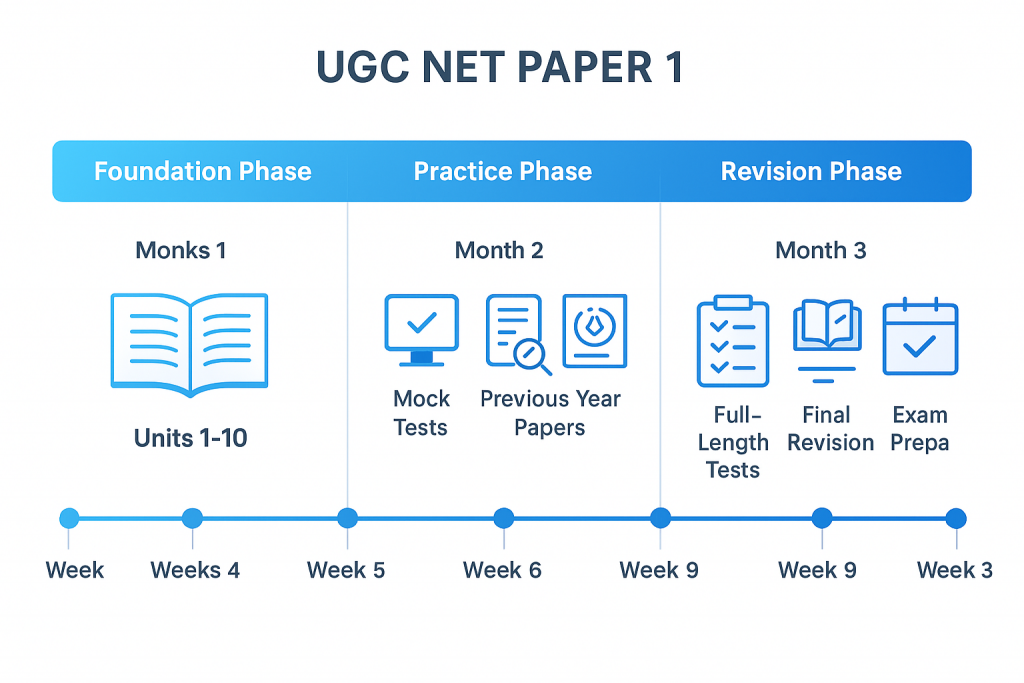
A three-month timeline is ideal for comprehensive preparation. Dedicate the first month to covering all 10 units thoroughly; approximately 2-3 days per unit. Spend the second month on practice: solve previous year papers, attempt mock tests, and identify weak areas. Use the third month for revision and intensive practice, focusing more on weak units while maintaining strong areas. Allocate 2-3 hours daily for Paper 1 alongside your Paper 2 preparation.
2-Month Intensive Study Plan
If you have two months, increase daily study hours to 3-4 hours for Paper 1. Cover units more quickly: one unit every 4-5 days in the first month. Combine practice with learning: after completing each unit, immediately solve previous year questions from that unit. The second month should focus primarily on full-length mock tests and targeted revision. This timeline requires more intensive effort but is achievable with discipline.
1-Month Crash Course Approach (For Revision)
One month is only realistic if you’ve already covered the syllabus previously or have strong foundational knowledge. This timeline works best as a revision phase before the exam. Focus on previous year paper analysis to identify high-frequency topics. Solve at least one full-length mock test every alternate day. Revise theoretical concepts from your notes rather than studying fresh from books. Prioritize practice over learning: at this stage, solving questions matters more than reading theory.
Which Books Are Best for UGC NET Paper 1 Preparation?
Choosing the right study material is crucial for efficient preparation. The market is flooded with UGC NET books, but not all are equal in quality. Here are my recommendations based on content quality and exam relevance.
Comprehensive Guides and Practice Books
Trueman’s UGC NET/SET Paper 1 by M. Gagan is perhaps the most popular comprehensive guide, covering all 10 units with theoretical concepts and practice questions. Arihant’s UGC NET Paper 1 Guide is another excellent option with extensive practice questions and model papers. Both books are updated regularly to reflect current exam patterns. Choose one as your primary resource rather than trying to study from multiple comprehensive guides.
Subject-Specific Books for Each Unit
For Teaching and Research Aptitude, KVS Madaan’s book provides detailed coverage with Indian education context examples. For Logical Reasoning and Mathematical Aptitude, RS Aggarwal’s books offer extensive practice questions with varying difficulty levels, though these are general aptitude books, not UGC NET specific. For ICT and Higher Education units, supplement your main book with current affairs updates since these topics evolve rapidly.
For Higher Education System specifically, focus on NEP 2020 and recent UGC notifications. The official documents are freely available on government websites and provide the most accurate information. For Environment topics, NCERT Environmental Studies books provide a good foundation, supplemented by current affairs on environmental policies and international agreements.
Practice Sets and Previous Year Papers
Previous year papers are your most valuable resource. Solve papers from the last 5-7 years to understand question patterns, difficulty levels, and frequently repeated topics. Arihant and other publishers compile previous year papers with solutions. Additionally, attempt at least 10-15 full-length mock tests before the actual exam; this builds exam stamina and helps you develop time management skills under pressure.
What Online Resources Can Help Your Preparation?
Digital resources complement books effectively, especially for practice and staying updated with current developments.
Official NTA Resources
The NTA UGC NET official website should be your first stop. Download the official syllabus PDF, check previous year question papers (when available), and read the information bulletin carefully. NTA also releases mock tests to familiarize candidates with the CBT interface; attempt these to understand the actual exam environment. The official resources are free and authentic, ensuring you’re preparing from accurate information.
Best YouTube Channels and Courses
Several YouTube channels offer free UGC NET Paper 1 lectures. Channels focusing specifically on UGC NET preparation provide structured content covering all units. While I won’t recommend specific channels (as quality varies and new channels emerge regularly), look for those with systematic unit-wise coverage, explanation of concepts rather than just shortcuts, and positive reviews from past successful candidates. LawSikho’s UGC NET course provides structured preparation specifically designed for law candidates, with expert faculty and comprehensive study material covering both papers.
Conclusion
Preparing for UGC NET Paper 1 doesn’t have to be overwhelming, especially when you approach it strategically. As an LLM candidate, you already possess skills that give you an edge, your research training aligns with Research Aptitude, your legal reading abilities support Reading Comprehension, and your logical thinking developed through legal analysis helps in Logical Reasoning. The key is recognizing these advantages and building upon them while dedicating focused effort to areas that need more attention, like Mathematical Reasoning and ICT.
Remember that Paper 1 is not optional or secondary, it’s a gateway that must be cleared before your Paper 2 expertise even matters. Allocate 30-40% of your total preparation time to Paper 1, use quality resources, practice extensively with previous year papers and mock tests, and maintain consistency throughout your preparation. With the right strategy and dedicated effort, scoring 70+ in Paper 1 is absolutely achievable, significantly boosting your chances of qualifying for JRF or Assistant Professor eligibility. Start your preparation today, stay consistent, and trust the process.
Frequently Asked Questions About UGC NET Paper 1
What is the UGC NET Paper 1 Syllabus in 2025?
The UGC NET Paper 1 syllabus covers 10 units: Teaching Aptitude, Research Aptitude, Reading Comprehension, Communication, Mathematical Reasoning, Logical Reasoning, Data Interpretation, ICT, People-Development-Environment, and Higher Education System. This syllabus is common for all subjects including Law.
How Many Units Are There in UGC NET Paper 1?
Paper 1 consists of 10 units covering general aptitude topics related to teaching and research. Each unit typically contributes 4-6 questions to the exam, though the exact distribution varies between sessions.
Is Paper 1 Common for All Subjects in UGC NET?
Yes, Paper 1 is identical for all 85 subjects in UGC NET. Whether you’re appearing for Law, Commerce, English, or any other subject, you’ll answer the same Paper 1 questions testing general teaching and research aptitude.
What Are the Minimum Qualifying Marks for Paper 1?
General category candidates need minimum 40% marks (40 out of 100) in Paper 1. Reserved category candidates (SC/ST/OBC-NCL/PwD) need minimum 35% marks. Failing to meet this threshold results in disqualification regardless of Paper 2 performance.
Is There Negative Marking in UGC NET Paper 1?
No, there is absolutely no negative marking in UGC NET. Wrong answers carry zero marks, same as unattempted questions. This means you should attempt every question; intelligent guessing cannot hurt your score.
How Much Time Should I Dedicate to Paper 1 Preparation?
Ideally, dedicate 30-40% of your total UGC NET preparation time to Paper 1. This translates to approximately 2-3 hours daily if you’re preparing for 3-4 months, alongside your Paper 2 preparation.
Can I Clear UGC NET by Scoring Well Only in Paper 2?
No, you must clear minimum qualifying marks in BOTH papers independently. Even an excellent Paper 2 score cannot compensate for failing to meet Paper 1’s minimum threshold. Both papers contribute to your final ranking.
Which Units Are Most Important in UGC NET Paper 1?
Teaching Aptitude, Research Aptitude, and Logical Reasoning typically carry higher weightage. However, all units are important since questions come from each unit. Focus on your strengths while improving weak areas.
What Are the Best Books for UGC NET Paper 1 Preparation?
Trueman’s UGC NET/SET Paper 1 and Arihant’s UGC NET Paper 1 Guide are popular comprehensive resources. Supplement with RS Aggarwal for reasoning practice and previous year papers for understanding actual exam patterns.
How Many Months of Preparation Are Required for Paper 1?
Three months is ideal for comprehensive preparation if you’re starting fresh. Two months of hard work with intensive effort. One month is only suitable for revision if you’ve already covered the syllabus. Consistency matters more than duration.
Is Coaching Necessary for UGC NET Paper 1?
Coaching isn’t strictly necessary, many candidates clear with self-study using quality books and online resources. However, structured coaching like LawSikho’s UGC NET course provides guided preparation, doubt resolution, and mock tests that can accelerate your preparation.
What is the Difference Between JRF and Assistant Professor Qualification?
Candidates in the top 6% nationally qualify for Junior Research Fellowship (JRF), which includes a monthly stipend for pursuing PhD. Others above minimum qualifying marks get Assistant Professor eligibility only. Both allow you to teach, but JRF provides research funding support.
Where Can I Download the Official UGC NET Paper 1 Syllabus PDF?
The official syllabus PDF is available on the NTA UGC NET website and UGC’s official syllabus portal. Download only from official sources to ensure accuracy and completeness.





 Allow notifications