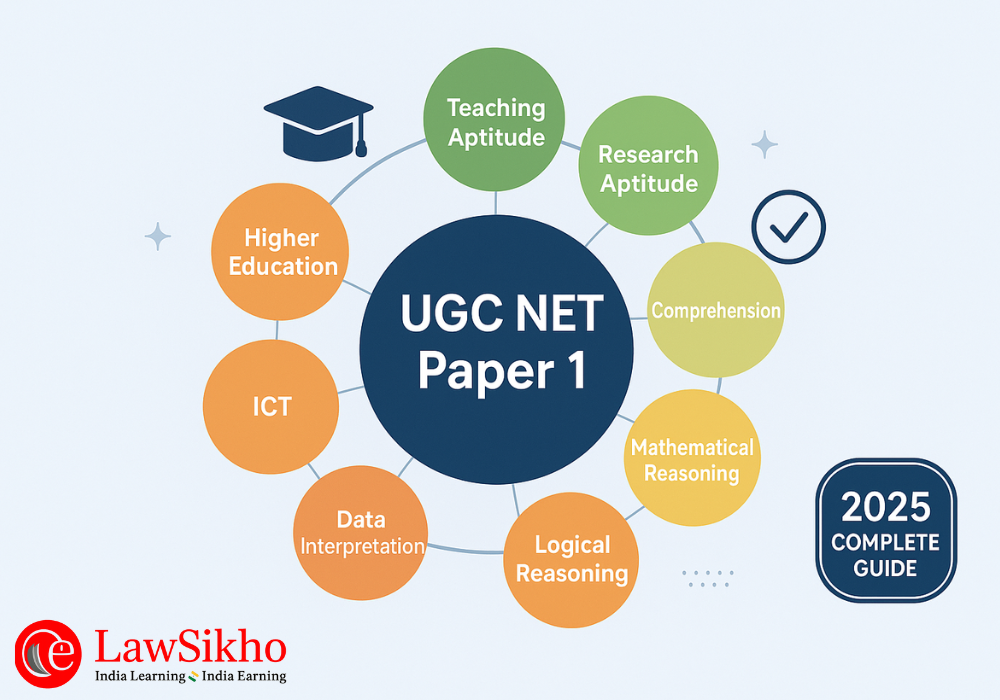

UGC NET Paper 1 important topics with unit-wise weightage analysis. Master high-scoring areas like Teaching Aptitude, Research Aptitude, and Logical Reasoning with this complete preparation guide.
Table of Contents
Let me be honest with you about something most UGC NET aspirants discover too late: UGC NET Paper 1 is where dreams of qualifying either flourish or fall apart. You have probably heard that UGC NET Paper 2 carries double the marks, and that is true. But here is what nobody tells you clearly enough: scoring low in Paper 1 can drag down your overall aggregate, disqualifying you even if you excel in your subject paper; since qualification depends on the combined 40% threshold (120/300 marks for General/EWS) across both papers.
The challenge with Paper 1 is not its difficulty but its breadth. Ten units covering everything from teaching methodology to environmental science, from logical reasoning to information technology. Without a strategic approach, you could spend months preparing topics that yield only 2-3 questions while neglecting areas that consistently contribute 8-10 questions to your score. This guide changes that equation entirely by giving you a data-driven roadmap based on actual question patterns from previous years.
In the sections ahead, you will find a complete unit-wise breakdown of Paper 1 with priority tiers based on scoring potential, the most important topics within each unit that NTA loves to test, trend analysis showing how the question pattern has evolved over five years, and a practical time allocation strategy that maximizes your marks with minimum wasted effort. Whether you have six months or six weeks before the exam, this guide will help you focus your energy where it matters most.

UGC NET Paper 1 Exam Structure
50 Questions, 100 Marks, and 60 Minutes of Testing
Paper 1 of UGC NET tests your teaching and research aptitude through 50 multiple choice questions worth 100 marks total. Each correct answer fetches you 2 marks, and here is the best part: there is absolutely no negative marking for wrong answers. This means you should attempt every single question, even if you need to make an educated guess. The exam is conducted in Computer Based Test (CBT) mode, and you get 180 minutes (3 hours) for both Paper 1 and Paper 2 combined without any break between them.
The 50 questions are distributed across 10 units, with each unit typically contributing 5 questions worth 10 marks. While this equal distribution might suggest that all units deserve equal attention, the reality is quite different. Some units have predictable, repeating question patterns that make them highly scoring with proper preparation. Others require significantly more time investment for the same 10 marks. Understanding this distinction is what separates strategic preparation from random studying.
Exam Pattern of UGC NET Paper 1
Question Distribution Across 10 Units
The NTA UGC NET syllabus divides Paper 1 into ten comprehensive units: Teaching Aptitude, Research Aptitude, Reading Comprehension, Communication, Mathematical Reasoning and Aptitude, Logical Reasoning, Data Interpretation, Information and Communication Technology (ICT), People, Development and Environment, and Higher Education System. Each unit is designed to test specific competencies that every aspiring teacher and researcher should possess, regardless of their subject specialization.
Marking Scheme and Time Allocation for UGC NET Exam Paper 1
The marking scheme for Paper 1 is straightforward and candidate-friendly. Every correct answer earns you +2 marks, while incorrect or unattempted questions carry zero marks with no penalty. This means attempting all 50 questions is always beneficial since guessing cannot hurt your score but might add valuable marks. With 150 questions total across both papers and 180 minutes to complete them, effective time management becomes crucial for success.
For optimal performance, most successful candidates allocate approximately 50-60 minutes to Paper 1 and reserve 120-130 minutes for Paper 2. Within Paper 1, you should aim to spend roughly 1-1.2 minutes per question on average. However, this does not mean rigid time allocation for each question. Some questions, particularly in Reading Comprehension and Data Interpretation, naturally require more time, while Teaching Aptitude and Higher Education questions can often be answered quickly if you have prepared well.
What is the Minimum Qualifying Marks for UGC NET Paper 1?
According to UGC NET qualifying criteria, you must score an aggregate of at least 40% marks in Paper 1 and Paper 2 together to qualify for NET. For General category candidates (including EWS), this means securing at least 40 out of 100 marks. For reserved categories including SC, SaT, OBC-NCL, and PwD, the threshold is relaxed to 35% (35 out of 100 marks).
However, merely clearing this threshold is not enough if you are aiming for JRF qualification. Since the final merit is calculated based on aggregate marks from both papers, scoring well above the minimum in Paper 1 significantly improves your chances of making the top 6% cut-off required for JRF.

Which Are the High-Weightage Units in UGC NET Paper 1?
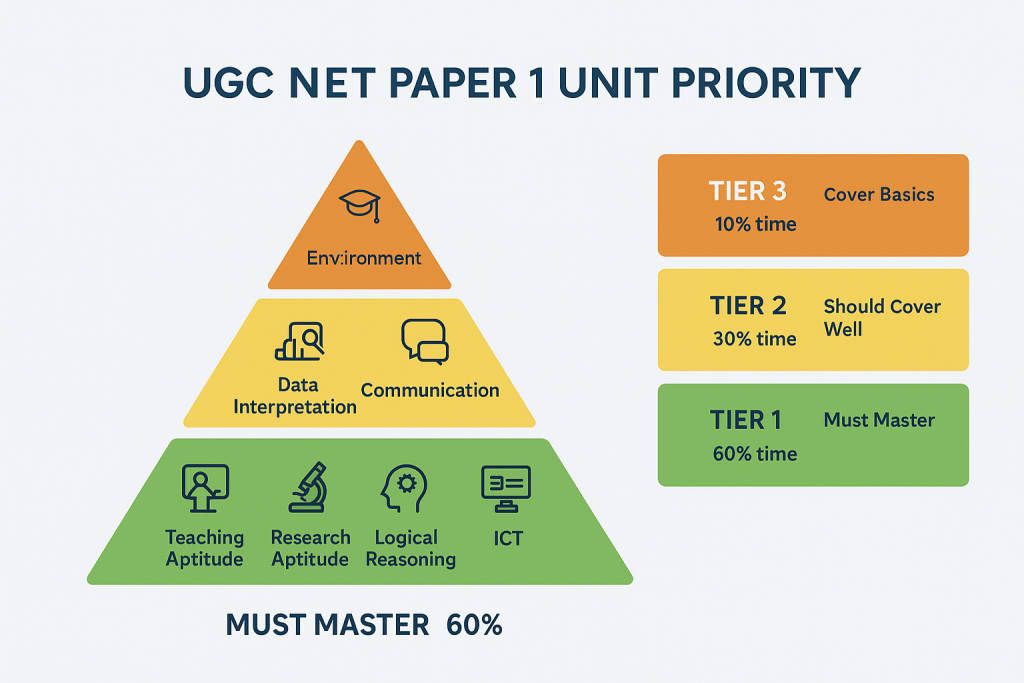
Tier 1 (Must Master): Teaching Aptitude, Research Aptitude, Logical Reasoning, ICT and Mathematical Reasoning
Teaching Aptitude and Research Aptitude form the conceptual backbone of Paper 1, and questions from these units tend to repeat with predictable patterns. If you understand the core concepts of teaching levels (memory, understanding, reflective), learner characteristics, research types, and sampling methods, you can confidently answer most questions from these units. The theoretical nature of these topics means that once you grasp the fundamentals, retention becomes relatively easy compared to calculation-heavy units.
It is pertinent to mention here that, off lately, the number of questions from teaching aptitude has seen a slight decline.
In recent UGC NET cycles, the importance of ICT, Mathematical Reasoning, and Logical Reasoning has increased significantly, with these units consistently contributing (together) 18–22 questions.
Logical Reasoning deserves Tier 1 status because it offers the highest return on preparation investment. Questions on syllogisms, Venn diagrams, and coding-decoding follow standard patterns that become second nature with practice. Unlike factual units where you must remember specific information, logical reasoning skills improve permanently once developed. Students who dedicate 2-3 weeks to systematic reasoning practice often report scoring 5-6 marks consistently from this unit alone.
ICT and Mathematical Reasoning round out Tier 1 because of their scoring predictability. ICT questions frequently test abbreviations, digital education initiatives like SWAYAM and NPTEL, and basic internet terminology. These are factual questions with definite answers that reward memorization. Mathematical Reasoning, despite intimidating some candidates, actually involves basic arithmetic that most graduates can handle with focused practice on percentages, ratios, and simple calculations.
Tier 2 (Should Cover Well): Data Interpretation and Communication
Data Interpretation sits in Tier 2 because while it is highly scoring for prepared candidates, it requires more time investment both in preparation and during the exam. Questions involve analyzing bar graphs, pie charts, line graphs, and tables to draw conclusions or make calculations. The good news is that DI questions have objective, verifiable answers. Once you develop speed and accuracy through practice, this unit becomes a reliable source of marks.
Communication is another Tier 2 unit that balances theoretical concepts with practical application. Questions cover types of communication (verbal, non-verbal, written), classroom communication dynamics, barriers to effective communication, and mass media concepts. While not as predictable as Tier 1 units, Communication questions rarely involve complex reasoning. Solid conceptual understanding combined with previous year paper practice typically ensures 4-6 marks from this unit.
Tier 3 (Cover Basics): Environment, Higher Education, Comprehension
People, Development and Environment falls into Tier 3 not because it is unimportant, but because its scope is vast while question patterns vary significantly across sessions. Topics range from pollution and climate change to sustainable development goals and international environmental agreements. The key strategy here is focusing on frequently tested areas like SDGs, major environmental summits, and pollution types rather than attempting exhaustive coverage.
Higher Education System questions test your knowledge of Indian higher education structure, regulatory bodies like UGC, AICTE, and NAAC, and recent policies including NEP 2020. While this unit has gained importance since NEP 2020 implementation, the breadth of potential topics makes comprehensive preparation challenging. Focus on major commissions, current regulatory framework, and NEP 2020 key provisions for optimal results.
Reading Comprehension is placed in Tier 3 because it tests skills rather than knowledge, making traditional preparation less effective. You cannot memorize your way through comprehension passages. The best approach is regular reading practice and developing strategies for quickly identifying main ideas, making inferences, and understanding vocabulary in context. Attempting comprehension questions toward the end of your Paper 1 time allocation prevents them from consuming disproportionate time.
What Makes These Units More Scoring Than Others
Units with Repeating Question Patterns
Analysis of previous year papers reveals that certain topics appear with remarkable consistency across exam sessions. Teaching Aptitude questions on levels of teaching, characteristics of effective teaching, and evaluation types repeat frequently with slight variations in wording. Similarly, Research Aptitude questions on research types, sampling methods, and hypothesis testing follow predictable patterns. Recognising these patterns through PYQ analysis gives you a significant advantage.
Logical Reasoning and ICT also demonstrate strong pattern consistency. Syllogism questions follow standard formats that become easy to solve once you learn the rules. ICT questions on abbreviations, internet terminology, and government digital initiatives draw from a relatively finite pool of concepts. Students who solve 5 years of previous papers typically encounter most question types before the actual exam, reducing surprises significantly.
Which Units Require More Preparation Time
Data Interpretation and Mathematical Reasoning require more preparation time because they demand practice rather than just understanding. You cannot simply read about how to interpret bar graphs; you must actually solve numerous DI sets to develop speed and accuracy. Similarly, mathematical concepts like percentages, ratios, and time-work problems need hands-on practice. Budget at least 3-4 weeks of dedicated practice for these units if you want consistent scoring.
Environment and Higher Education require time investment of a different nature. These units demand memorization of facts, dates, and specific provisions. The SDGs, major environmental agreements, education commission recommendations, and NEP 2020 features all require committed memorization effort. However, the unpredictability of question selection means you might prepare extensively yet face questions from areas you did not cover.
UGC NET Paper 1 Important Topics 2025
Unit 1: Teaching Aptitude Important Topics
Here are some of the important topics covered under this unit:
Levels of Teaching (Memory, Understanding, Reflective): Most Asked Concept
The three levels of teaching, namely memory level, understanding level, and reflective level, constitute the most frequently tested concept in Teaching Aptitude. Memory level focuses on rote learning and recall, understanding level emphasizes comprehension and application, while reflective level involves critical thinking and problem-solving. Questions typically ask you to identify which level a particular teaching activity represents or to arrange activities in order of cognitive complexity.
Learner Characteristics and Individual Differences
This topic covers how learners differ in their cognitive abilities, learning styles, motivation levels, and socio-economic backgrounds. Questions often test your understanding of visual, auditory, and kinesthetic learning styles, factors affecting learning readiness, and how teachers should accommodate individual differences. Understanding adolescent and adult learner characteristics is particularly important since UGC NET focuses on higher education teaching contexts.
Evaluation Systems: Formative vs Summative Assessment
The distinction between formative assessment (ongoing, diagnostic) and summative assessment (final, evaluative) appears regularly in Paper 1. Formative assessment occurs during the learning process to provide feedback, while summative assessment measures learning outcomes at the end. Questions may also cover Continuous Comprehensive Evaluation (CCE), criterion-referenced versus norm-referenced testing, and various assessment tools like rubrics and portfolios.
Teaching Methods: Teacher-Centred vs Learner-Centred Approaches
Understanding the spectrum from teacher-centred methods (lecture, demonstration) to learner-centred approaches (discussion, project-based learning, collaborative learning) is essential. Questions test your ability to identify appropriate teaching methods for different learning objectives and to recognize the characteristics, advantages, and limitations of each approach. The trend in education toward constructivist, learner-centred pedagogy makes this a conceptually important area.
Unit 2: Research Aptitude Important Topics
Types of Research: Fundamental, Applied, Action, and Experimental
Research Aptitude questions frequently test your ability to distinguish between different research types. Fundamental (basic/pure) research aims to expand theoretical knowledge without immediate practical application. Applied research solves specific practical problems. Action research involves practitioners investigating their own practice for improvement. Experimental research manipulates variables to establish cause-effect relationships. Knowing the purpose, characteristics, and examples of each type is crucial.
Sampling Techniques: Probability vs Non-Probability Methods
Sampling is a consistently tested topic covering both probability sampling (simple random, stratified, cluster, systematic) and non-probability sampling (convenience, purposive, snowball, quota). Questions typically ask you to identify which sampling method suits a particular research scenario or to recognize the characteristics of different techniques. Understanding when each method is appropriate based on research objectives and population characteristics is key.
Hypothesis Formulation and Testing
Questions cover the nature of hypotheses, types (null hypothesis, alternative hypothesis, directional, non-directional), and the process of hypothesis testing. You should understand how hypotheses guide research design, the relationship between hypothesis and research questions, and basic concepts of statistical significance in hypothesis testing. This topic connects theoretical research concepts with practical research execution.
Research Ethics, Plagiarism, and Intellectual Property
Research ethics has gained increasing importance in recent years. Topics include informed consent, confidentiality, avoiding plagiarism, proper citation practices, intellectual property rights, and publication ethics. Questions may test your understanding of what constitutes ethical violations, how to handle ethical dilemmas in research, and the role of institutional ethics committees. This area reflects growing emphasis on research integrity in academia.
Unit 3: Reading Comprehension Strategies
How to Approach Passage-Based Questions
Reading Comprehension presents passages followed by questions testing understanding, inference, and vocabulary. The most effective approach involves first skimming the questions to know what to look for, then reading the passage actively while marking relevant sections. Avoid bringing outside knowledge into answers; comprehension questions should be answered strictly based on passage content. Practice with diverse passage types improves both speed and accuracy.
Inference and Interpretation Techniques
Inference questions require you to draw conclusions not explicitly stated but logically implied by the passage. Look for contextual clues, author’s tone, and logical connections between ideas. Interpretation questions may ask about the author’s purpose, the passage’s central theme, or the meaning of specific phrases in context. Developing these skills requires consistent reading practice with academic and general interest texts.
Unit 4: Communication Important Topics
Types of Communication: Verbal, Non-Verbal, Written
Understanding the complete communication spectrum is essential for this unit. Verbal communication includes oral and written forms, while non-verbal communication encompasses body language, facial expressions, gestures, and paralinguistic features like tone and pitch. Questions test your ability to identify communication types, understand their relative effectiveness in different contexts, and recognize how verbal and non-verbal elements interact.
Classroom Communication and Barriers
Classroom communication dynamics form a significant portion of this unit. Topics include teacher-student interaction patterns, effective classroom communication strategies, feedback mechanisms, and barriers to effective communication (physical, psychological, linguistic, cultural). Understanding how to overcome communication barriers and create conducive learning environments is particularly relevant for aspiring teachers.
Mass Media and Society
This topic covers the role of mass media in education and society, including print media, electronic media, and digital media. Questions may address media’s influence on public opinion, educational broadcasting, the use of media in teaching-learning processes, and media literacy. Understanding both traditional media forms and emerging digital platforms demonstrates contemporary awareness expected of future educators.
Unit 5: Mathematical Reasoning and Aptitude Topics
Number Series and Pattern Recognition
Number series questions present sequences where you must identify the pattern and predict the next term or find a missing term. Patterns may involve arithmetic progressions, geometric progressions, squares, cubes, or combinations of operations. The key is systematic analysis: check for addition/subtraction patterns first, then multiplication/division, then more complex relationships. Regular practice develops pattern recognition intuition.
Practice is essential for mastering number series. Start with simple arithmetic progressions and gradually move to complex patterns involving multiple operations. Many students find it helpful to write out the differences between consecutive terms to identify underlying patterns. Speed comes with exposure to various pattern types through consistent daily practice.
Percentages, Ratios, and Basic Calculations
Percentage problems test your ability to calculate percentage increase/decrease, find percentages of quantities, and solve comparison problems. Ratio questions involve proportional relationships, often requiring you to find unknown quantities given ratio information. These concepts form the foundation for Data Interpretation as well. Master the shortcut methods and mental calculation techniques to save time during the exam.
Converting between fractions, decimals, and percentages should become second nature. Learn common fraction-percentage equivalents (1/4 = 25%, 1/5 = 20%, 1/8 = 12.5%) for quick mental calculations. Practice problems involving successive percentage changes and ratio manipulation to build confidence with these fundamental concepts.
Time, Speed, Distance, and Work Problems
Time-speed-distance problems use the relationship Distance = Speed × Time in various configurations. Questions may involve average speed, relative speed (objects moving toward or away from each other), or problems with multiple journey segments. Work problems involve calculating how long individuals or groups take to complete tasks, often with efficiency variations.
These problems require setting up equations correctly based on given conditions. Practice identifying which formula applies to each problem type. Learn shortcut methods for common scenarios like trains crossing platforms or persons meeting while walking toward each other. With sufficient practice, these become reliable scoring areas.
Unit 6: Logical Reasoning Important Topics
Syllogisms and Logical Propositions
Syllogisms involve drawing conclusions from two premises containing common terms. Understanding the four types of categorical propositions (All A are B, No A are B, Some A are B, Some A are not B) and their relationships is fundamental. Learn the standard syllogism rules and practice identifying valid versus invalid conclusions. Venn diagram approaches often simplify complex syllogism problems.
Practice is crucial for syllogism mastery. Work through problems systematically using either the rule-based approach or Venn diagram method, whichever suits you better. Pay attention to common traps like illicit distribution and undistributed middle terms. With consistent practice, syllogisms become one of the most reliable scoring topics in Paper 1.
Square of Opposition
The Square of Opposition is another predictable and compact topic that guarantees at least one question in most cycles. You are expected to know the four relationships:
- Contradictory (A–O and E–I): cannot both be true or both false
- Contrary (A–E): cannot both be true but can both be false
- Sub-contrary (I–O): cannot both be false but can both be true
- Sub-alternation (A–I and E–O): truth flows downward, falsity flows upward
Questions typically ask you to identify the correct relationship between two given statements or test what follows when one statement is true/false. Since the entire concept fits in a single diagram and has only these fixed relationships, thorough revision just once or twice is enough to secure full marks with minimum effort.
Fallacies
Fallacies have become a regular and easy-scoring topic, appearing in 1–2 questions almost every shift.
Questions expect you to identify the type of fallacy in a given argument or statement. Most Repeated Fallacies (memorise these 8–10 only):
- Fallacy of Undistributed Middle: Middle term not distributed in at least one premise.
- Illicit Major / Illicit Minor: Major or minor terms distributed in conclusion but not in premise.
- Exclusive Premises: Both premises are negative → no conclusion.
- Affirmative Conclusion from Negative Premise: Invalid.
- Fallacy of Four Terms: Middle term used in two different senses.
- Ad Hominem: Attacking the person instead of the argument.
- Straw Man: Misrepresenting the opponent’s argument.
- Hasty Generalisation: Conclusion from insufficient sample.
- Slippery Slope & Red Herring: Occasionally asked.
Focus only on the first 5 (formal fallacies) for syllogism-based questions and the next 3–4 (informal) for statement-based questions. With just one page of notes and 30 previous-year questions, you can score 100% in the fallacy section.
Unit 7: Data Interpretation Topics
Bar Graphs, Pie Charts, and Line Graphs
Data Interpretation questions present data in graphical form and ask you to analyse, compare, or calculate based on this data. Bar graphs show comparisons between categories, pie charts show proportional distribution, and line graphs show trends over time. Each type requires specific reading skills: comparing bar heights, calculating sector percentages, or identifying trend patterns.
Practice reading information quickly and accurately from graphs. Learn to estimate values from graphs when exact readings are not possible. Common question types include finding averages, calculating percentage changes, comparing across categories, and identifying maximum/minimum values. Speed in data extraction directly impacts your overall score.
Table-Based Data Analysis
Tables present data in row-column format, often with multiple variables. Questions require you to navigate the table structure, locate relevant data points, and perform calculations or comparisons. Large tables with many rows and columns can be overwhelming, so developing efficient scanning techniques is important.
Practice with tables containing different data types (numbers, percentages, ratios). Learn to identify relevant rows and columns quickly based on question requirements. Many table questions involve multiple calculation steps, so accuracy in basic arithmetic is essential. Check your calculations when time permits to avoid careless errors.
Mixed Data Sets and Comparative Analysis
Some DI questions present data in multiple formats (table plus graph, or multiple graphs) requiring integrated analysis. These questions test your ability to synthesize information from different sources and draw comparative conclusions. They typically appear as question sets where 3-5 questions are based on the same data.
Approach mixed data sets by first understanding what each component shows and how they relate. Identify which data source is relevant for each question before attempting calculations. Practice with complete DI sets rather than isolated questions to develop this integrated analysis skill.
Unit 8: ICT (Information and Communication Technology) Topics
Abbreviations and Technical Terminology
ICT questions frequently test knowledge of computer and internet-related abbreviations. Common ones include HTTP, HTML, URL, FTP, TCP/IP, LAN, WAN, CPU, RAM, ROM, and many others. You should know what each abbreviation stands for and basic understanding of what the term means. This is primarily a memorization task with high scoring potential.
Create a comprehensive list of ICT abbreviations and review it regularly. Group related abbreviations (networking terms, hardware terms, software terms) for easier memorization. Questions may also test understanding of terms like bandwidth, server, client, cloud computing, and cybersecurity concepts. Building a strong ICT vocabulary pays dividends on exam day.
Internet Basics and Digital Education Platforms
This topic covers fundamental internet concepts including how the internet works, web browsers, search engines, email, social media, and online safety. Questions may test understanding of internet protocols, domain types, and digital literacy concepts. In the educational context, understanding e-learning, MOOCs (Massive Open Online Courses), and virtual classrooms is increasingly important.
The digital transformation in education has made this area more relevant. Understand concepts like synchronous versus asynchronous learning, Learning Management Systems (LMS), and digital content creation tools. COVID-19 accelerated digital education adoption, making these concepts practically important for future educators.
SWAYAM, NPTEL, and E-Learning Initiatives
Government e-learning initiatives are frequently tested topics. SWAYAM (Study Webs of Active Learning for Young Aspiring Minds) is India’s national MOOC platform. NPTEL (National Programme on Technology Enhanced Learning) provides online courses primarily in engineering and sciences. Other initiatives include DIKSHA, e-PG Pathshala, and National Digital Library.
Know the full forms, purposes, and key features of major digital education platforms. Understand how these initiatives align with NEP 2020 goals of expanding quality education access. Questions may test specific features, target audiences, or the ministries/organizations behind these initiatives.
Unit 9: People, Development, and Environment Topics
Pollution Types and Environmental Issues
Environmental pollution topics include air pollution (causes, effects, measurement indices like AQI), water pollution (sources, treatment, water quality parameters), soil pollution, and noise pollution. Questions may test knowledge of pollutants, their sources, health impacts, and control measures. Understanding environmental degradation causes and consequences demonstrates awareness expected of educated citizens.
Climate Change and Global Warming
Climate change is a consistently tested topic covering greenhouse gases, global warming mechanisms, evidence of climate change, and mitigation strategies. Know the major greenhouse gases (CO2, methane, nitrous oxide, CFCs), their sources, and relative contributions to warming. Understanding the difference between climate change and weather variation is conceptually important.
Sustainable Development Goals (SDGs)
The 17 Sustainable Development Goals adopted by UN member states in 2015 are frequently tested. While memorizing all 17 goals is helpful, focus on education-related goals (SDG 4: Quality Education), environment-related goals (SDG 13: Climate Action, SDG 14: Life Below Water, SDG 15: Life on Land), and understanding the overall 2030 Agenda framework.
International Environmental Agreements
Major environmental agreements tested include the Paris Agreement on climate change, Montreal Protocol on ozone layer protection, Kyoto Protocol, Convention on Biological Diversity, and various UN environmental conferences. Know the key provisions, participating countries, and outcomes of major agreements. Recent developments like COP meetings may also appear in questions.
Unit 10: Higher Education System Topics
NEP 2020: Key Provisions and Implementation
The National Education Policy 2020 has become a frequently tested topic since its release. Key provisions include the Four-Year Undergraduate Programme (FYUP) with multiple entry-exit options, Academic Bank of Credits enabling credit transfer between institutions, and establishment of the National Research Foundation to boost research funding. Understanding these structural changes demonstrates awareness of the current educational landscape.
NEP 2020 also emphasizes multidisciplinary education, mother tongue instruction in early years, vocational integration, and technology use in education. The policy’s vision of making India a global knowledge superpower by 2040 frames many of its provisions. Questions may test specific provisions, implementation timelines, or the policy’s approach to various educational challenges.
Regulatory Bodies: UGC, AICTE, NAAC, NCTE
Understanding the roles and functions of major higher education regulatory bodies is essential. UGC (University Grants Commission) coordinates and maintains standards in university education. AICTE (All India Council for Technical Education) regulates technical education. NAAC (National Assessment and Accreditation Council) assesses and accredits institutions. NCTE (National Council for Teacher Education) regulates teacher education.
Know the establishment year, parent ministry, key functions, and recent initiatives of each regulatory body. Questions may ask about specific powers, composition, or recent policy decisions by these bodies. NEP 2020 proposes significant restructuring of the regulatory landscape, so understanding both current structure and proposed changes is valuable.
Evolution of Indian Higher Education (Important Commissions)
The historical development of Indian higher education includes several landmark commissions and committees. Key ones include University Education Commission (1948-49, Radhakrishnan Commission), Secondary Education Commission (1952-53, Mudaliar Commission), Education Commission (1964-66, Kothari Commission), and National Policy on Education (1968, 1986/92). Each commission’s major recommendations shaped subsequent educational development.
Focus on the key recommendations and lasting impact of major commissions rather than exhaustive details. Understanding how Indian higher education evolved from colonial structures to the current system provides context for contemporary developments. Questions typically test knowledge of commission names, years, chairpersons, and significant recommendations.
Value Education and Quality Assurance
Value education emphasizes ethical, moral, and citizenship values in education. Questions may cover the importance of value education, its integration in curriculum, and approaches to implementing value-based education. This topic connects with NEP 2020’s emphasis on holistic development beyond academic achievement.
Quality assurance in higher education involves accreditation, ranking frameworks (NIRF), and institutional quality improvement mechanisms. Understanding how NAAC accreditation works, the NIRF ranking methodology, and quality enhancement initiatives demonstrates awareness of accountability mechanisms in higher education. This area has gained importance as institutions increasingly focus on quality metrics.
How Has the UGC NET Paper 1 Question Pattern Changed Over the Years?
5-Year Trend Analysis (2020-2024): Shift Towards Application-Based Questions
Analysis of UGC NET Paper 1 questions from 2020 to 2024 reveals a clear shift from purely factual recall toward application-based testing. Earlier papers contained more straightforward definition and identification questions, while recent papers increasingly present scenarios requiring you to apply concepts. For example, instead of simply asking “What are the levels of teaching?”, newer questions might present a classroom situation and ask you to identify which teaching level it represents.
This shift aligns with the broader educational emphasis on competency-based assessment rather than rote memorization. For your preparation, this means understanding concepts deeply enough to apply them in unfamiliar contexts. Simply memorizing definitions is no longer sufficient; you must practice applying concepts through scenario-based questions. Previous year papers from 2022 onwards provide excellent practice material for this question type.
Increased Weightage on Research Aptitude and ICT
Logical reasoning and ICT units have seen increased importance in recent years, reflecting the growing emphasis on reasoning skills and digital literacy in higher education. ICT questions have evolved to include more questions on e-learning platforms, digital education initiatives, and educational technology.
The integration of NEP 2020 content into Higher Education questions is another notable trend. Questions on FYUP, Academic Bank of Credits, and National Research Foundation have appeared regularly since 2021. Staying updated with NEP 2020 implementation developments gives you an edge in this unit. The Environment unit continues to emphasize SDGs and climate change, reflecting global sustainability priorities.
UGC NET Paper 1: Preparation Time to be Allocated Across Units
60% Time on High-Weightage Units
Dedicate approximately 60% of your Paper 1 preparation time to Tier 1 units: Logical Reasoning, ICT, Mathematical Reasoning, Teaching Aptitude and Research Aptitude. These five units offer the highest return on preparation investment due to their predictable question patterns and scoring potential. Within this allocation, spend extra time on Logical Reasoning and Mathematical Reasoning since they require practice rather than just reading.
30% Time on Medium-Priority Units
Allocate 30% of your time to Tier 2 units: Data Interpretation and Communication. Data Interpretation requires consistent practice with different graph and table types, so incorporate daily DI practice into your schedule. Communication concepts can be covered relatively quickly through focused study of theoretical frameworks combined with previous year question practice.
10% Time on Quick-Revision Units
Reserve 10% of your time for Tier 3 units: Environment, Higher Education, and Comprehension. For Environment and Higher Education, focus on high-frequency topics like SDGs, major environmental agreements, regulatory bodies, and NEP 2020. Reading Comprehension cannot be prepared through memorization, so the time here should involve practicing passage-based questions to develop reading speed and inference skills.
Week-Wise Preparation Plan for Paper 1
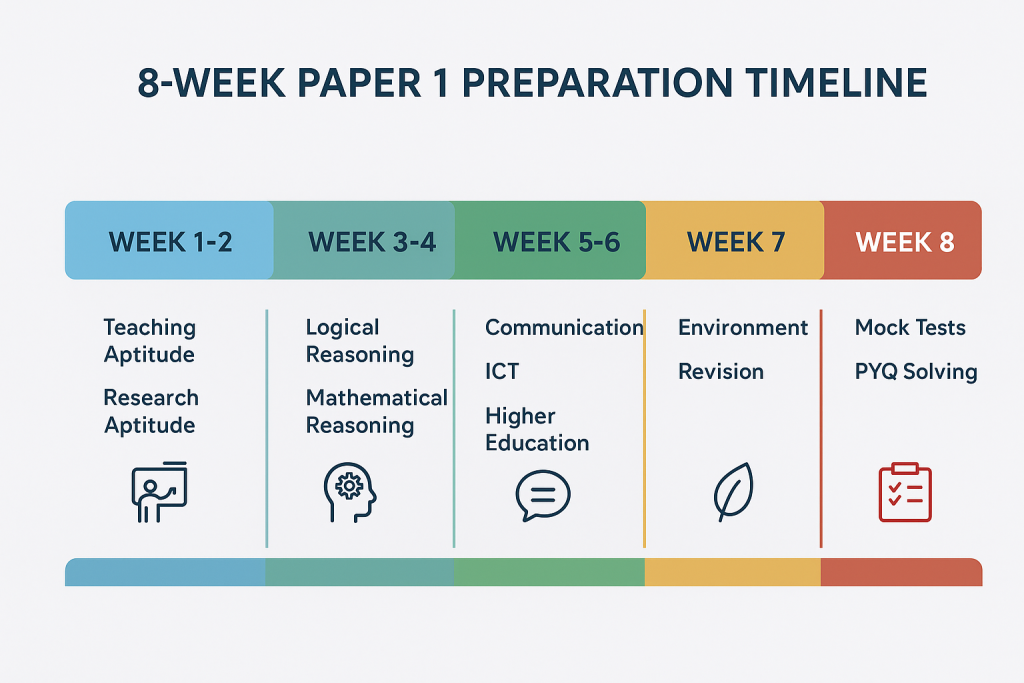
8-Week Intensive Schedule for Focused Preparation
During weeks 1-2, cover Teaching Aptitude and Research Aptitude thoroughly. These conceptual units provide the foundation for Paper 1 and are relatively easier to master. Weeks 3-4 should focus on Logical Reasoning and Mathematical Reasoning, emphasizing daily practice problems. Start with basic concepts and progressively tackle more complex problems. Begin Data Interpretation practice during week 4 as well.
Weeks 5-6 cover Communication, ICT, and Higher Education units. These are more memorization-intensive, so create summary notes and flashcards for quick revision. Week 7 focuses on the Environment unit and overall revision of all topics. Week 8 is dedicated to mock tests and previous year paper solving, identifying weak areas and addressing them before the exam.
How to Integrate Paper 1 with Paper 2 Preparation
Since Paper 2 carries double the marks, you cannot neglect it for Paper 1. The recommended approach is dedicating 30-40% of daily study time to Paper 1 and 60-70% to Paper 2. Schedule Paper 1 topics in morning slots when your mind is fresh for logical reasoning and calculations. Reserve Paper 2 subject study for longer afternoon/evening sessions when sustained reading is more feasible.
Time Management During the Actual Exam
Time You Should Allot per Unit
Within the recommended 50-60 minutes for Paper 1, allocate approximately 3-4 minutes per 5-question unit for theoretical sections (Teaching Aptitude, Research Aptitude, Communication, ICT, Higher Education, Environment). Logical Reasoning and Mathematical Reasoning may need 5-6 minutes given calculation requirements. Data Interpretation typically requires 6-8 minutes due to graph/table analysis. Reading Comprehension, if saved for last, should get remaining time.
Which Questions to Attempt First for Maximum Score
Start with your strongest theoretical units where you can quickly identify correct answers without much deliberation. This builds confidence and secures easy marks. Next, tackle Logical Reasoning and Mathematical Reasoning while your mind is fresh for calculations. Attempt Data Interpretation after theoretical sections when you have a sense of remaining time. Save Reading Comprehension for last since it requires passage reading regardless of your preparation level.
What Are the Best Resources for Paper 1 Preparation?
Recommended Books for Paper 1
Several books provide comprehensive Paper 1 preparation coverage. Trueman’s UGC NET Paper 1 by M. Gagan offers complete syllabus coverage with previous year questions. KVS Madaan’s guide is particularly strong for Teaching Aptitude and Research Aptitude concepts. Arihant’s UGC NET Paper 1 provides excellent practice questions and mock tests. For Logical Reasoning and Mathematical Aptitude, R.S. Aggarwal’s books remain classics that build strong foundations.
Online Resources and Official Materials
NTA Official Website and Information Bulletin
The NTA UGC NET official website should be your primary reference for authentic information. Download the official Information Bulletin for each exam cycle to verify syllabus, exam pattern, and any changes. The website also hosts notifications, admit cards, and results. Relying on official sources prevents confusion from outdated or incorrect information circulating elsewhere.
Previous Year Papers: Where to Find and How to Use
Previous year papers are available on various platforms including NTA’s official website and preparation websites like Testbook and JRFAdda. Download papers from 2018 onwards (after NTA took over examination) for the most relevant practice. Solve papers in timed conditions, analyse your mistakes, and identify recurring topics. This analysis reveals patterns that guide your final revision priorities.
Free YouTube Channels and Online Lectures
Several YouTube channels offer free Paper 1 preparation content. Look for channels providing systematic unit-wise coverage rather than random topic videos. Quality channels explain concepts through examples and solve previous year questions. However, use online content to supplement rather than replace structured book-based preparation. Video lectures are particularly helpful for understanding Logical Reasoning techniques and Mathematical shortcuts.
What Mistakes Should You Avoid in UGC NET Paper 1 Preparation?
Ignoring Paper 1 Completely Until Last Week
The most damaging mistake is treating UGC NET Paper 1 as an afterthought. Many candidates focus entirely on Paper 2 subject preparation, planning to “quickly cover” Paper 1 in the final week. This approach fails because Paper 1 covers diverse topics requiring systematic study, and skills like logical reasoning cannot be developed overnight. Start Paper 1 preparation alongside Paper 2 from day one of your preparation journey.
Over-Preparing Low-Weightage Units
Some candidates spend excessive time on Environment and Higher Education units trying to cover every possible topic. Given the vast scope and unpredictable question selection in these units, exhaustive preparation is neither possible nor efficient. Stick to high-frequency topics and accept that you might encounter unfamiliar questions. Your time is better invested in mastering Tier 1 units where preparation directly correlates with scoring.
Skipping Practice Questions and Mock Tests
Reading and understanding concepts is necessary but insufficient. Many candidates feel confident after studying yet struggle during the exam because they have not practiced enough under timed conditions. Regular mock tests expose you to actual exam pressure, help you develop time management skills, and reveal weak areas needing attention. Aim for at least 10-15 full-length mock tests before the actual exam.
Exam Day Mistakes to Avoid
Poor Time Management Across Units
Running out of time and leaving questions unattempted is a common regret. Without planned time allocation, candidates often spend too long on difficult questions early in the paper, leaving insufficient time for easier questions later. Follow your practiced time allocation strategy, move on from questions consuming excessive time, and return to them only if time permits after completing other sections.
Leaving Questions Unattempted (No Negative Marking)
With no negative marking in UGC NET, every unattempted question is a guaranteed loss of potential marks. Even random guessing gives you a 25% chance of gaining 2 marks. Before submitting, ensure you have attempted all 50 questions. If genuinely unsure, eliminate obviously wrong options and make an educated guess among remaining choices. Never leave any question blank.
Second-Guessing Well-Prepared Answers
Exam anxiety sometimes makes candidates doubt their initial answers and change them unnecessarily. Research suggests first instincts are often correct for well-prepared candidates. Unless you identify a clear error in your reasoning, stick with your initial answer. Excessive second-guessing wastes time and can change correct answers to incorrect ones. Trust your preparation and move forward confidently.
Conclusion
Preparing for UGC NET Paper 1 does not require covering every possible topic in the syllabus. What it requires is strategic focus on high-weightage areas that consistently appear in examinations. This guide has walked you through the unit-wise priority approach, identifying Teaching Aptitude, Research Aptitude, Logical Reasoning, ICT, and Mathematical Reasoning as your Tier 1 priorities deserving 60% of preparation time. Data Interpretation and Communication form Tier 2, while Environment, Higher Education, and Comprehension round out Tier 3.
Start your preparation today by focusing on Tier 1 units and building strong conceptual foundations. Practice regularly with previous year papers and mock tests to develop both accuracy and speed. Remember that Paper 1 is not meant to trip you up; it is designed to test competencies every aspiring teacher should possess. With the strategic approach outlined in this guide, you can confidently score well above the 40% threshold and contribute positively to your overall NET qualification. Your academic career awaits, and mastering Paper 1 is your first decisive step toward that goal.
Frequently Asked Questions
How many questions come from each unit in UGC NET Paper 1?
Each of the 10 units in Paper 1 typically contributes 5 questions worth 10 marks. This equal distribution means the 50 questions cover Teaching Aptitude, Research Aptitude, Comprehension, Communication, Mathematical Reasoning, Logical Reasoning, Data Interpretation, ICT, Environment, and Higher Education with approximately 5 questions each.
Which are the UGC NET Paper 1 important topics for 2025?
The most important topics include levels of teaching, research types and sampling methods, syllogisms and Venn diagrams, fallacies, ICT abbreviations and digital education platforms, NEP 2020 provisions, SDGs, and regulatory bodies like UGC and NAAC. These topics appear consistently across previous year papers.
Is Paper 1 easier than Paper 2 in UGC NET?
Paper 1 is generally considered easier because it tests general aptitude rather than deep subject expertise. However, its diverse syllabus covering 10 different areas can be challenging for candidates who focus only on their subject. With proper preparation, Paper 1 can become a scoring advantage.
Can I qualify UGC NET if I score low in Paper 1 but high in Paper 2?
Yes, you can still qualify UGC NET even with low marks in Paper 1, provided your aggregate score (Paper 1 + Paper 2 out of 300) crosses the cut-off for your category and subject. Many candidates qualify with 30-40 in Paper 1 if they score 130-160+ in Paper 2 (common in tough subjects).
How much time should I spend preparing for UGC NET Paper 1?
Dedicate approximately 30-40% of your total preparation time to Paper 1. If you have 4-6 months for overall preparation, this means 8-10 weeks focused on Paper 1 topics. Within daily study schedules, allocate 2-3 hours for Paper 1 alongside your Paper 2 subject preparation.
What are the most repeated topics in UGC NET Paper 1?
Levels of teaching, research types, sampling methods, hypothesis formulation, syllogisms, coding-decoding, fallacies, ICT abbreviations, SWAYAM/NPTEL initiatives, SDGs, major environmental agreements, UGC functions, and NEP 2020 provisions are among the most frequently repeated topics.
Is Teaching Aptitude more important than Research Aptitude in UGC NET Paper 1?
Both units carry equal marks (10 marks each) and are equally important. However, Teaching Aptitude concepts are often more intuitive for candidates, while Research Aptitude may require more dedicated study if you lack research background. Prioritize based on your current knowledge gaps.
How do I prepare for Logical Reasoning if I am weak in it?
Start with basic concepts of syllogisms, Venn diagrams, and coding-decoding. Practice systematically using R.S. Aggarwal or similar books, beginning with easy problems and gradually increasing difficulty. Daily practice of 15-20 questions over 3-4 weeks significantly improves reasoning skills.
Are NEP 2020 questions asked every year in UGC NET Paper 1?
Yes, since NEP 2020’s release in 2020, questions on its key provisions have appeared regularly in Paper 1. Focus on major reforms like FYUP, Academic Bank of Credits, multidisciplinary education, and National Research Foundation. This trend is likely to continue in December 2025.
Should I solve previous year papers for UGC NET Paper 1?
Absolutely yes. Previous year papers reveal question patterns, frequently tested topics, and actual difficulty levels. Solve papers from 2018 onwards under timed conditions. Analyze mistakes and identify recurring topics to guide final revision priorities. Aim for at least 5-10 previous papers.
How many mock tests should I attempt for UGC NET Paper 1?
Attempt minimum 10-15 full-length Paper 1 mock tests during your preparation. Start mock tests after covering approximately 70% of the syllabus, initially without strict time limits. Gradually introduce timed conditions as you gain confidence. Analyze each mock to identify improvement areas.
Which is the most scoring unit in UGC NET Paper 1?
Logical Reasoning, Mathematical Reasoning and ICT are often considered most scoring because they have predictable question patterns. Syllogisms follow standard rules, and ICT abbreviations are finite and memorizable. With focused preparation, candidates consistently score 8-10 marks from each of these units.
Can I skip Mathematical Reasoning if I am not good at maths?
Skipping any unit means losing potential marks. Mathematical Reasoning involves basic arithmetic (percentages, ratios, time-work) that most graduates can handle with practice. Instead of skipping, invest 2-3 weeks in practicing fundamental problems. The questions are not advanced mathematics; they test basic numerical aptitude.
What is the minimum score needed in UGC NET Paper 1 to qualify NET?
The minimum qualifying score (aggregate of Paper 1 and Paper 2) is 40% for General and EWS categories (40 out of 100 marks) and 35% for reserved categories (35 out of 100 marks). However, aim higher since aggregate marks from both papers determine JRF qualification. Scoring 50-60+ in Paper 1 strengthens your overall position.





 Allow notifications