
Complete topic-wise analysis of UGC NET Paper 1 previous year questions. Learn unit-wise weightage, high-frequency topics, question patterns, and strategic preparation tips.
Table of Contents
If you have been solving UGC NET Paper 1 previous year questions randomly, hoping that somehow the patterns will make sense, you are not alone. Most aspirants approach PYQs like a numbers game: solve more, hope for the best. But here is what separates candidates who consistently score 70+ in Paper 1 from those who struggle to cross the qualifying cutoff: the former understand exactly what NTA asks, while the latter are essentially preparing blind.
The problem with most PYQ resources available online is that they are essentially PDF dumps. You get hundreds of questions without any analysis, without any pattern recognition, and without any strategic guidance on where to focus your limited preparation time. What you need is not more questions; you need to understand which topics repeat, which units carry more weightage than others, and how the UGC NET Paper 1 exam pattern has evolved over the last five years. That understanding alone can transform your UGC NET Paper 1 preparation from guesswork into strategy.
This guide provides exactly that: the first comprehensive topic-wise analysis of UGC NET Paper 1 previous year questions from 2019 to 2025. You will learn which units consistently get more questions, which sub-topics within each unit are high-frequency, and how to use this data to create a study plan that maximizes your score with minimum wasted effort. Whether you have six months or sixty days, the insights here will help you prepare smarter, not just harder.

UGC NET Paper 1 Exam Pattern
Before diving into the topic-wise analysis, let us establish a clear understanding of how Paper 1 is structured. Knowing the exam pattern helps you plan your time allocation during both preparation and the actual examination.
How many questions in UGC NET Paper 1
UGC NET Paper 1 consists of 50 Multiple Choice Questions carrying a total of 100 marks. Each question is worth 2 marks, and you need to select the single correct answer from four options provided. The questions test your understanding across 10 distinct units covering teaching aptitude, research methodology, reasoning, comprehension, and awareness of the higher education system.
The critical point to understand here is time management. Paper 1 and Paper 2 are conducted together in a single 3-hour session without any break. This means you have approximately 180 minutes to complete 150 questions across both papers. Most successful candidates allocate roughly 50 to 60 minutes for Paper 1 and the remaining time for Paper 2, though this ratio depends on your individual strengths. According to the official NTA UGC NET portal, both papers are conducted as a Computer Based Test in English and Hindi medium.
Is there negative marking in UGC NET Exam
Here is some good news: there is no negative marking in UGC NET. You receive +2 marks for every correct answer, zero marks for incorrect answers, and zero marks for unanswered questions. This means you should attempt every single question, even if you need to make an educated guess. There is absolutely no penalty for trying, so leaving questions unanswered is essentially leaving marks on the table.
Which Units have more weightage in UGC NET exam
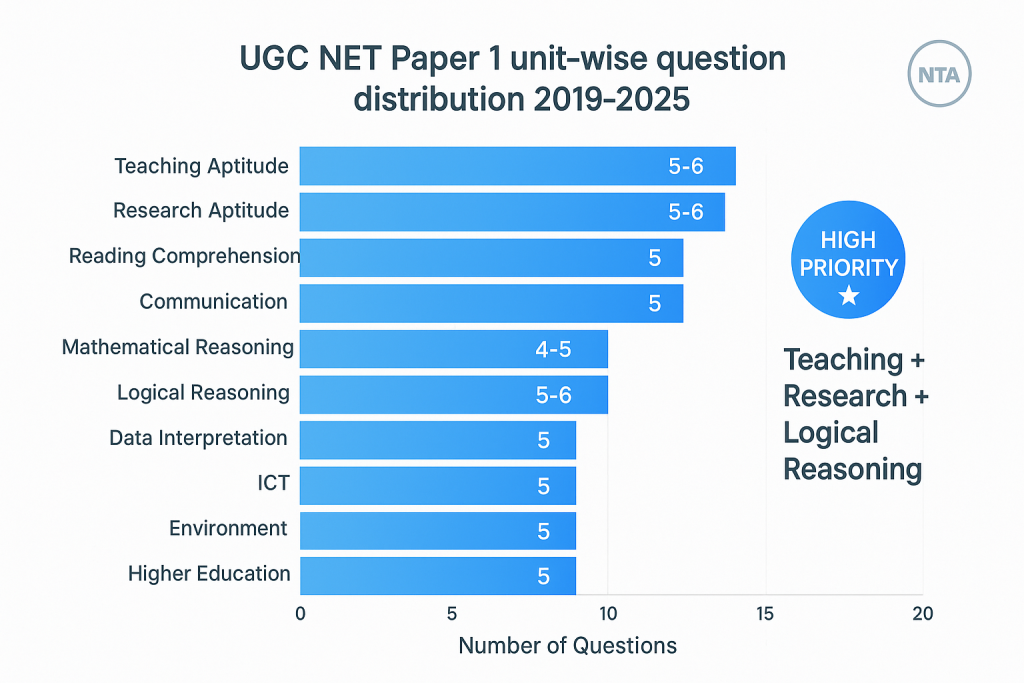
One of the most persistent myths about UGC NET Paper 1 is that all 10 units receive equal weightage. The official syllabus lists 10 units, and with 50 questions, the assumption is that each unit contributes exactly 5 questions. However, if you actually analyse previous year papers, you will discover that this “equal distribution” rarely happens in practice.
Analysis of UGC NET Paper 1 papers from 2019 to 2025 reveals a clear pattern in question distribution. Teaching Aptitude, Research Aptitude, Mathematical Reasoning and ICT together contribute 20-25 questions per exam, representing 40-50 marks. These four units alone can determine whether you clear the cutoff or fall short.
In recent cycles, logical Reasoning (Unit 6) and Data Interpretation (Unit 7) together also account for 10 to 12 questions in most exam cycles. The remaining six units: Reading Comprehension, Communication, Environment, and Higher Education, typically share the remaining 26 to 30 questions with some variation based on the specific exam session.
Complete Topic-Wise Analysis of UGC NET Paper 1 Previous Year Questions
Now let us examine each unit in detail, analyzing the specific topics that appear frequently and the question patterns you should expect.
Unit 1: Teaching Aptitude Questions
Teaching Aptitude is one of the most consistent units in UGC NET Paper 1, contributing 5 to 6 questions in virtually every exam session since 2019. The questions in this unit test your understanding of educational concepts, teaching methodologies, learner psychology, and evaluation systems. Unlike some other units where question distribution fluctuates, Teaching Aptitude maintains remarkable stability.
What makes this unit particularly important is that the questions are largely conceptual rather than calculation-based. If you understand the core concepts well, you can answer these questions quickly and accurately, leaving more time for calculation-heavy sections like Data Interpretation. Teaching Aptitude questions increasingly focus on application-based scenarios rather than simple definition recall.
High-yield Topics: Teaching Methods, Evaluation Systems, Learning Theories
Within Teaching Aptitude, certain sub-topics appear with remarkable consistency. Teaching methods classification, particularly the distinction between teacher-centered and learner-centered approaches, appears in almost every exam. You should thoroughly understand the lecture method, discussion method, demonstration method, project method, and their respective characteristics. Questions often ask you to identify which method is most suitable for a given classroom scenario.
Evaluation systems form another high-frequency area. Expect questions on the difference between formative and summative evaluation, criterion-referenced versus norm-referenced tests, and Choice Based Credit System (CBCS). Bloom’s Taxonomy, both the original 1956 version and the revised 2001 version by Anderson and Krathwohl, is particularly important. You should know the six levels (Remembering, Understanding, Applying, Analyzing, Evaluating, Creating) and the action verbs associated with each level.
Sample Question Patterns with Solution Approach
Teaching Aptitude questions typically follow predictable patterns. You will encounter direct definitional questions like “Which level of Bloom’s Taxonomy involves creating new or original work?” You will also face scenario-based questions that present a classroom situation and ask which teaching method or evaluation approach is most appropriate. The key to solving these efficiently is building a strong conceptual foundation rather than memorizing isolated facts.
Unit 2: Research Aptitude Questions
Research Aptitude questions have evolved significantly over the past five years. Earlier papers focused heavily on basic definitions: what is research, types of research, steps in the research process. Recent papers, particularly from 2023 onwards, show an increased emphasis on research ethics, plagiarism awareness, and practical applications of research methodology. This shift reflects the growing concern about academic integrity in Indian higher education.
High-Frequency Topics: Sampling, Hypothesis, Research Methods
Three sub-topics dominate Research Aptitude questions: sampling techniques, hypothesis formulation and testing, and types of research. For sampling, you must know both probability sampling methods (simple random, stratified, systematic, cluster) and non-probability sampling methods (convenience, purposive, snowball, quota). Questions often ask you to identify the most appropriate sampling technique for a given research scenario.
Hypothesis-related questions test your understanding of null hypothesis versus alternative hypothesis, directional versus non-directional hypotheses, and the logic of hypothesis testing. You should understand why we reject or fail to reject the null hypothesis rather than “accept” it. Research types questions typically distinguish between fundamental (basic) and applied research, quantitative and qualitative approaches, and experimental versus descriptive methods. The official UGC guidelines emphasize research ethics, and questions on plagiarism, self-plagiarism, and ethical data handling have become increasingly common.
Unit 3: Reading Comprehension Questions
Passage Types and Question Patterns
Reading Comprehension is one of the most predictable sections in Paper 1. Each exam includes exactly one passage followed by 5 questions, contributing 10 marks. The passages cover diverse topics: science, social issues, education policy, environmental concerns, or philosophical discussions (very likely to be from the newspaper). The challenge is not subject knowledge but rather your ability to understand, analyze, and draw inferences from unfamiliar text.
Question patterns in this section typically include: identifying the main idea or central theme, understanding the meaning of specific words or phrases in context, drawing inferences not explicitly stated in the passage, identifying the author’s tone or attitude, and answering detail-based factual questions. Most questions can be answered by carefully reading the passage without any prior subject knowledge.
Skills Tested Beyond Basic Comprehension
While the section is called “Reading Comprehension,” it actually tests multiple cognitive skills beyond basic understanding. You are expected to analyze arguments presented in the passage, evaluate the author’s reasoning, and sometimes identify logical fallacies or assumptions. These higher-order thinking skills connect Reading Comprehension with the Logical Reasoning unit, making both sections mutually reinforcing in your preparation.
Unit 4: Communication Questions
Classroom Communication vs Mass Communication Focus
Communication questions in UGC NET Paper 1 cover two broad areas: classroom communication (teacher-student interaction) and mass communication (media, information dissemination). Earlier papers focused more heavily on mass communication models like Shannon-Weaver and Berlo’s SMCR model. Recent papers show increased emphasis on classroom communication, barriers to effective teaching communication, and the role of non-verbal communication in educational settings.
You should understand the basic elements of communication: sender, message, channel, receiver, feedback, and noise. Questions often ask about barriers to communication, which include semantic barriers (language issues), psychological barriers (preconceptions, emotions), physical barriers (environmental factors), and organizational barriers (hierarchy, filtering). The shift toward digital communication post-2020, including online teaching challenges and virtual classroom dynamics, has introduced new question areas.
Barriers and Effective Communication Topics
Effective communication in teaching contexts has become a high-frequency topic. Questions test your understanding of how teachers can overcome communication barriers, the role of feedback in the communication cycle, and the difference between one-way and two-way communication models. You should also understand formal versus informal communication channels and their appropriate uses in educational institutions.
Unit 5: Mathematical Reasoning and Aptitude
Number Series, Percentages, and Basic Arithmetic Patterns
Mathematical Reasoning tests your numerical aptitude through questions on time and distance, number system, percentages, ratio and proportion, profit and loss, simple and compound interest, and averages. The difficulty level is generally moderate, comparable to bank clerical exams rather than engineering entrance tests. Most questions can be solved with basic arithmetic if you apply the right approach.
Number series questions ask you to identify the pattern and find the next term. Common patterns include arithmetic progression, geometric progression, squares and cubes, alternating operations, and combination patterns. Percentage-based questions typically involve calculating percentage increase or decrease, comparing quantities, or solving profit and loss scenarios. The key to success is not advanced mathematics but speed and accuracy in basic calculations.
Difficulty Level Trend (2019-2025)
The difficulty level of Mathematical Reasoning has remained moderate to easy from 2019 to 2025, though there is a slight trend toward more inference-based questions rather than pure calculation questions. Practice with time pressure is essential for this section.
Unit 6: Logical Reasoning Questions
Syllogisms, Fallacies, and Venn Diagrams
Logical Reasoning is one of the highest-weightage sections, contributing 5 to 6 questions per exam. The section tests your ability to analyze arguments, draw valid conclusions, and identify logical fallacies. Three sub-topics dominate: syllogisms (deductive arguments with major premise, minor premise, and conclusion), analogies, Venn diagrams (visualizing relationships between sets), and fallacies (common errors in reasoning).
Syllogism questions present two or three statements and ask you to identify which conclusion necessarily follows. You should be familiar with the four types of categorical propositions: All A are B, No A is B, Some A are B, Some A are not B. Venn diagram questions ask you to represent relationships visually and determine the validity of arguments. Understanding the classical square of opposition, which shows logical relationships between these four proposition types, is essential.
Pattern Recognition in UGC NET Paper 1 Previous Year Questions
A notable trend in recent years is the inclusion of Indian Logic (Nyaya) questions. The official UGC NET syllabus explicitly mentions Pramanas (means of valid knowledge): Pratyaksha (perception), Anumana (inference), Upamana (comparison), Shabda (verbal testimony), Arthapatti (implication), and Anupalabddhi (non-apprehension). Questions on the five-membered syllogism (Panchavayava) of Nyaya philosophy, the structure of Anumana (inference), and Hetvabhasas (fallacies of inference) have appeared with increasing frequency since 2022.
Unit 7: Data Interpretation Questions
Chart Types and Question Complexity Trends
Data Interpretation questions present data in graphical format, typically bar charts, pie charts, line graphs, or tables, and ask you to answer questions based on the data. The section consistently contributes 5 questions per exam. Question types include reading values directly from charts, calculating percentages or ratios based on presented data, identifying trends over time, and making comparisons between different data series.
The complexity of DI questions has slightly increased over recent years. Earlier papers featured straightforward value-reading questions. Recent papers include more inference-based questions that require you to interpret what the data suggests rather than simply extracting numerical values. You might be asked which conclusion is supported by the data, which statement contradicts the data, or what trend the data indicates.
Calculation-Heavy vs Inference-Based Questions
Understanding the difference between calculation-heavy and inference-based DI questions helps with time management. Calculation-heavy questions require precise arithmetic and can be time-consuming if you are not quick with mental math. Inference-based questions require understanding what the data means in context and can often be answered through logical reasoning without extensive calculation. Practicing both types ensures you can handle whatever question pattern appears in your exam.
Unit 8: Information and Communication Technology
Digital Initiatives in Education: SWAYAM, MOOC, e-PG Pathshala
ICT questions test your awareness of digital tools, internet technologies, and government initiatives in digital education. The SWAYAM portal, India’s indigenous MOOC platform, is a particularly high-frequency topic. You should know that SWAYAM stands for Study Webs of Active Learning for Young Aspiring Minds, its four quadrants (video lectures, reading material, self-assessment, discussion forum), and its coordinating agencies (NPTEL for engineering, UGC for postgraduate courses, CEC for undergraduate courses, etc.).
Other digital initiatives frequently tested include e-PG Pathshala (postgraduate e-content hosted by INFLIBNET), National Digital Library, SWAYAM Prabha (32 DTH channels for education), DIKSHA (school education platform), and the Academic Bank of Credits. Understanding what each initiative does, which agency manages it, and its target audience helps you answer matching-type questions that appear frequently.
Basic ICT Terminology and Government Portals
Beyond educational initiatives, ICT questions cover basic computer and internet terminology: hardware components, software types, networking concepts (LAN, WAN, MAN), internet protocols (HTTP, FTP, SMTP), cloud computing basics, and cybersecurity awareness. Government portals like DigiLocker, National Academic Depository, and e-governance initiatives also appear in questions. The key is staying updated with current digital initiatives through the Ministry of Education website.
Unit 9: People, Development and Environment
SDGs, Environmental Agreements, and Pollution Topics
Environment questions cover a wide range: pollution types and control measures, environmental legislation in India, international environmental agreements, Sustainable Development Goals (SDGs), renewable energy, and climate change. The SDGs are particularly important; you should know there are 17 goals adopted in 2015 with a 2030 target date, and be familiar with goals specifically related to education (SDG 4: Quality Education) and environment (SDG 13: Climate Action).
International environmental agreements tested frequently include the Paris Agreement (2015, climate change), Kyoto Protocol (1997, greenhouse gas reduction), Montreal Protocol (1987, ozone layer protection), and CBD (Convention on Biological Diversity). Questions typically ask about signing dates, key provisions, India’s commitments, or distinctions between agreements. The Environmental Protection Act 1986 and its provisions also appear regularly.
Current Affairs Integration in Environment Questions
Unlike some other units where questions are relatively static, Environment questions often integrate current affairs. Recent papers have included questions on India’s Nationally Determined Contributions (NDCs), the National Action Plan on Climate Change (8 missions), and specific environmental issues in news. Staying updated through newspapers and the Ministry of Environment website helps you prepare for these contemporary questions.
Unit 10: Higher Education System
NEP 2020 and Recent Policy Questions
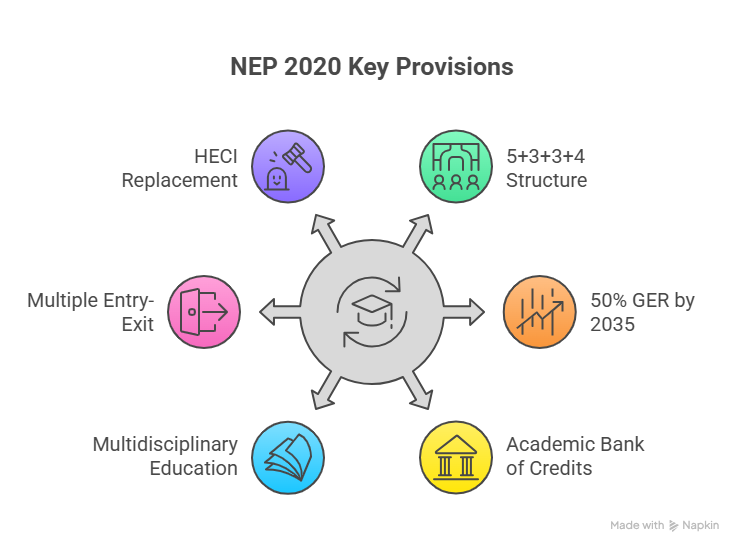
The Higher Education System has become one of the most dynamic units following the National Education Policy 2020. Questions on NEP 2020 provisions have appeared in virtually every exam since its implementation. You must know the 5+3+3+4 school structure, the target of 50% Gross Enrollment Ratio (GER) by 2035, the concept of Academic Bank of Credits, multiple entry-exit options, the proposed Higher Education Commission of India (HECI), and the emphasis on multidisciplinary education.
Historical aspects remain relevant too. Questions test your knowledge of ancient Indian universities (Takshashila, Nalanda, Vikramashila), major education commissions (Radhakrishnan Commission 1948, Kothari Commission 1964), and the evolution of Indian higher education since independence. Understanding both historical context and contemporary reforms provides a complete picture of this unit.
UGC Regulations, NAAC, and Institutional Framework
Institutional questions cover the UGC (University Grants Commission) and its functions, NAAC (National Assessment and Accreditation Council) and its 7 criteria for accreditation, types of universities (central, state, deemed, private), and regulatory bodies for professional education (AICTE for technical, NCTE for teacher education, BCI for law, MCI for medicine). You should understand how these bodies interact and their respective jurisdictions as outlined in the UGC Act and regulations.
How Exam Pattern of UGC NET Paper 1 Has Changed
The overall difficulty of UGC NET Paper 1 has shown moderate variation across years. The year 2020 saw moderate difficulty with conceptual-based questions dominating. By 2021, the exam became slightly more challenging with increased emphasis on ICT and application-based scenarios.
A significant trend since 2022-2023 is the move from pure recall questions toward application-based questions. Instead of asking “What is formative evaluation?” Recent papers present a classroom scenario and ask “Which type of evaluation is the teacher using in this situation?” This shift rewards conceptual understanding over rote memorization and benefits candidates who prepare for application rather than just definitions.
UGC NET Important Topics
Several topics have gained prominence in recent years. Research ethics, including plagiarism awareness and responsible conduct of research, now appears regularly. Indian Logic (Nyaya philosophy) questions have increased since 2022. ICT questions have evolved from basic terminology to government digital initiatives and their applications in education. NEP 2020 has dominated Higher Education questions since its implementation. Environment questions increasingly integrate climate change, sustainable development, and India’s environmental commitments.
Emerging Trends You Cannot Ignore
Increased Focus on NEP 2020 and Contemporary Policies
NEP 2020 represents the most significant change in Indian education policy in 34 years. Every exam since its implementation has included multiple questions on its provisions. You should understand not just what NEP proposes but why: the rationale behind 5+3+3+4 structure, the need for multidisciplinary education, the problem Academic Bank of Credits solves, and the vision of transforming higher education institutions into large multidisciplinary universities by 2040.
Rising Complexity in Reasoning and Data Interpretation
Reasoning and DI sections have shown increasing complexity in recent years. Logical Reasoning now includes more questions on Indian Logic that many science and commerce candidates find unfamiliar. Data Interpretation questions increasingly require inference rather than simple calculation. This rising complexity means you cannot afford to neglect these sections or prepare them superficially. Dedicated practice with gradually increasing difficulty is essential.
How to Prepare for UGC NET Paper 1 Using Previous Year Questions
Your study plan should balance two factors: the importance of each unit (based on question frequency) and your current proficiency. High-importance, low-proficiency units deserve maximum attention. If you are weak in Logical Reasoning but it contributes 10 to 12 marks, that section needs intensive focus. Conversely, if you are already strong in Reading Comprehension, maintenance practice is sufficient.
3-Month Plan: 60% High-Frequency Topics, 30% Moderate, 10% Low-Frequency
If you have three months for preparation, divide your time strategically. Spend 60% of your preparation time on high-frequency topics: Teaching Aptitude, Research Aptitude, Logical Reasoning, and Data Interpretation. These four areas together contribute approximately 40 to 50 marks and form the scoring core of Paper 1. Allocate 30% to moderate-frequency topics: Communication, ICT, Environment, and Higher Education. Reserve 10% for Reading Comprehension (which primarily requires practice rather than content learning) and Mathematical Reasoning basics.
Within each unit, further priority is based on sub-topic frequency. In Teaching Aptitude, spend more time on teaching methods, evaluation systems, and Bloom’s Taxonomy than on obscure historical facts. In Research Aptitude, focus on sampling techniques, hypothesis testing, and research ethics rather than memorizing research definitions. This strategic allocation ensures your limited time produces maximum score improvement.
1-Month Plan: Focus Exclusively on Tier 1 Topics
If you have only one month, ruthless prioritization is essential. Focus exclusively on Tier 1 topics: teaching methods, evaluation types, Bloom’s Taxonomy, sampling techniques, hypothesis formulation, research ethics, syllogisms, fallacies, Venn diagrams, basic DI calculations, NEP 2020 key provisions, and major digital initiatives (SWAYAM, NPTEL). These topics alone can help you score 50 to 60 marks if mastered well. Accept that you will rely on general knowledge and intelligent guessing for remaining topics.
Best Practice Strategy for UGC NET Paper 1 Previous Year Questions
Solve Topic-Wise Before Attempting Full Papers
Many candidates make the mistake of jumping straight into full-length previous year papers. A better approach is solving topic-wise questions first. Take all Teaching Aptitude questions from the last 5 years and solve them together. This helps you recognize patterns, identify frequently tested sub-topics, and understand the typical question formats for that unit. Only after completing topic-wise practice should you attempt full papers.
Analyse Incorrect Answers to Identify Patterns
Simply solving questions is not enough; analyzing your mistakes is where real learning happens. For every incorrect answer, identify why you got it wrong. Was it a conceptual gap, a careless error, a time management issue, or an unfamiliar question type? Tracking your errors reveals patterns. If you consistently miss Nyaya philosophy questions, that topic needs dedicated study. If you make careless errors in DI calculations, you need accuracy drills.
Take Weekly Full-Length Mocks in Final Month
In your final month of preparation, shift from topic-wise practice to full-length mock tests. Take at least one complete Paper 1 mock every week under exam conditions: timed, without breaks, without referring to notes. Analyze your mock test performance by unit, not just aggregate score. If you consistently score low in Logical Reasoning across mocks, that section needs emergency intervention. Several websites provide authentic previous year papers that serve as excellent mock test material.
Last Week Revision Strategy for UGC NET Exam
Review Only High-Frequency Topics and Formulas
In your final week, resist the temptation to learn new topics. Focus exclusively on revising what you already know. Review your notes on high-frequency topics, go through the formulas you have prepared for Mathematical Reasoning, and refresh your memory on key provisions of NEP 2020 and important digital initiatives. New topics attempted in the last week rarely stick and can create confusion during the exam.
Focus on Units Where You Are Scoring Below 70%
Your mock test analysis should reveal which units consistently pull down your score. If you are scoring above 70% in a unit, maintenance revision is sufficient. But if you are scoring below 70% in any unit, dedicate extra revision time to bring it up. Remember, Paper 1 is about consistent performance across units, not excellence in one area at the cost of others. Aim for solid scores across all units rather than perfect scores in some and failing scores in others.
Solve One Full PYQ Paper Daily
In your last week, solve one complete previous year paper daily. This maintains your exam temperament, keeps your problem-solving speed sharp, and builds confidence. Treat each paper as a dress rehearsal for the actual exam. Time yourself strictly, attempt all questions, and review your performance immediately after. This daily practice ensures you walk into the exam hall with momentum rather than rust.
Conclusion
Understanding UGC NET Paper 1 previous year question patterns is what separates strategic preparation from random effort. The analysis presented in this guide reveals several key insights that should shape your preparation approach.
First, the “equal weightage” myth is exactly that: a myth. Teaching Aptitude, Research Aptitude, Logical Reasoning, and Data Interpretation consistently carry more weight than other units. Preparing accordingly means allocating approximately 60% of your time to these high-frequency areas. Second, within each unit, certain sub-topics repeat with remarkable consistency. Teaching methods, evaluation types, Bloom’s Taxonomy, sampling techniques, hypothesis testing, syllogisms, Venn diagrams, NEP 2020 provisions, and SWAYAM appear in virtually every exam. Mastering these specific topics gives you a solid scoring foundation regardless of what else appears in your particular exam session.
Third, the exam pattern has evolved. Recent papers show increased emphasis on application-based questions, Indian Logic, research ethics, digital initiatives, and contemporary education policy. Preparing with outdated materials or ignoring these emerging trends leaves you vulnerable to unexpected question types. Finally, how you practice matters as much as what you practice. Topic-wise analysis, error tracking, mock test discipline, and strategic revision are what convert raw knowledge into actual exam performance. Paper 1 is not about knowing everything; it is about knowing what matters most and executing consistently under exam conditions. Use the insights from this analysis to prepare smarter, focus your limited time on high-yield areas, and walk into your exam with confidence grounded in data-driven strategy.
FAQs
How many questions come from each unit in UGC NET Paper 1?
While the official structure suggests 5 questions per unit (10 units × 5 questions = 50 questions), actual distribution varies. Teaching Aptitude and Research Aptitude typically get 5 to 6 questions each, Logical Reasoning and Data Interpretation also receive 5 to 6 questions each, while remaining units receive 4 to 5 questions with some variation across exam sessions.
Which unit has the highest weightage in UGC NET Paper 1?
No single unit dominates, but Teaching Aptitude, Research Aptitude, and Logical Reasoning combined contribute approximately 30 to 36 marks (15 to 18 questions) consistently. If you include Data Interpretation, these four units together represent nearly 40 to 50 marks, making them the scoring core of Paper 1.
Is solving the last 5 years of UGC NET Paper 1 Previous Year Questions enough for preparation?
Solving the last 5 years of PYQs provides excellent pattern recognition and covers most frequently tested topics. However, PYQs alone are insufficient. You also need conceptual understanding from standard textbooks, awareness of current affairs for Environment and Higher Education units, and regular mock test practice for speed and accuracy development.
Do questions repeat in UGC NET Paper 1?
Exact question repetition is rare, but concept repetition is very common. The same sub-topics appear repeatedly with different framing. For example, questions on Bloom’s Taxonomy levels, formative versus summative evaluation, or probability versus non-probability sampling appear in various forms across multiple years. Understanding concepts deeply prepares you for any framing.
Which topics should I prioritize if I have only 2 months for preparation?
Focus on high-frequency topics: teaching methods, evaluation systems, Bloom’s Taxonomy, sampling techniques, hypothesis testing, research ethics, syllogisms, fallacies, Venn diagrams, Indian Logic basics, DI chart reading, NEP 2020 key provisions, SWAYAM and digital initiatives, major environmental agreements, and SDGs. These topics alone can help you score 60 to 70 marks with solid preparation.
How has UGC NET Paper 1 changed after NEP 2020 implementation?
NEP 2020 has significantly impacted the Higher Education unit, with multiple questions on its provisions appearing in every exam since implementation. Additionally, there is increased focus on contemporary digital initiatives aligned with NEP’s vision, multidisciplinary education concepts, and the Academic Bank of Credits framework. Staying updated on NEP implementation is essential.
Are Teaching Aptitude and Research Aptitude the most important units?
Yes, from a scoring perspective. Together they contribute 20 to 24 marks consistently. More importantly, these units have relatively stable, predictable content that rewards thorough preparation. Unlike Environment or Higher Education where current affairs can introduce unpredictable questions, Teaching and Research Aptitude largely test established concepts.
Can I clear UGC NET Paper 1 without studying Logical Reasoning thoroughly?
It is risky. Logical Reasoning contributes approximately 10 to 12 marks when combined with Mathematical Reasoning elements. If you neglect this section, you are essentially surrendering significant marks. While you can compensate to some extent with strong performance in other units, avoiding Logical Reasoning entirely makes clearing the cutoff substantially harder, especially for JRF aspirants.
What is the minimum score needed in UGC NET Paper 1 to qualify?
There is no separate cutoff for Paper 1. Your aggregate score across Paper 1 and Paper 2 combined determines qualification. For general category candidates, approximately 40% aggregate (120 out of 300) is typically required for Assistant Professor eligibility. JRF has higher cutoffs that vary by subject. However, strong Paper 1 performance significantly boosts your aggregate and JRF ranking.
Are ICT questions becoming more technical in recent exams?
ICT questions have evolved but not necessarily become more technical. The shift is toward government digital initiatives (SWAYAM, NPTEL, e-PG Pathshala, National Digital Library) rather than advanced technical concepts. Basic computer and internet terminology remains relevant, but increasingly questions test your awareness of educational technology applications rather than deep technical knowledge.
Should I study Environment topics from current affairs or syllabus only?
Both. The syllabus covers foundational topics like pollution types, environmental agreements, and SDGs that appear consistently. However, Environment questions also incorporate current developments: India’s climate commitments, recent environmental policy changes, and contemporary environmental issues. Balancing syllabus fundamentals with current affairs awareness ensures comprehensive preparation.





 Allow notifications