
Swayam Prabha UGC NET: Learn about 40 channels, GSAT-15, BISAG-N, INFLIBNET, channel names, and SWAYAM vs Prabha differences with PYQs.
Table of Contents
If you are preparing for UGC NET Paper 1, you have probably come across questions about Swayam Prabha in previous year papers. This topic appears consistently under Teaching Aptitude, ICT, and Higher Education Systems units, with questions in formats like true/false, matching columns, statement-based MCQs, and assertion-reason. Understanding Swayam Prabha thoroughly can help you secure those 2-3 crucial marks that often make the difference between qualifying and missing the cut-off.
Swayam Prabha is India’s DTH-based educational broadcasting initiative, launched on 7 July 2017 with 32 channels and now expanded to 40 channels following a major September 2023 reorganization. Most online resources still contain outdated channel information, which can cost you marks. This guide gives you the updated facts you need: the complete technical infrastructure, the 40-channel ecosystem and proven preparation strategies to confidently tackle any question NTA throws at you.
What is Swayam Prabha and Why is it Important for UGC NET?

Swayam Prabha represents one of India’s flagship initiatives in democratizing higher education through technology. For UGC NET aspirants, understanding this platform is not optional but essential, as questions about its features, channels, and infrastructure appear regularly in UGC NET Paper 1. This section provides you with a solid foundation on what Swayam Prabha is, how it operates, and why NTA considers it important enough to test repeatedly.
Swayam Prabha: Meaning
The term “Swayam Prabha” comes from Sanskrit and translates to “self-luminous” or “self-shining.” This name symbolizes the initiative’s goal of empowering learners to illuminate their own educational paths through accessible, quality content. The platform officially launched under the Ministry of Human Resource Development, which has since been renamed the Ministry of Education.
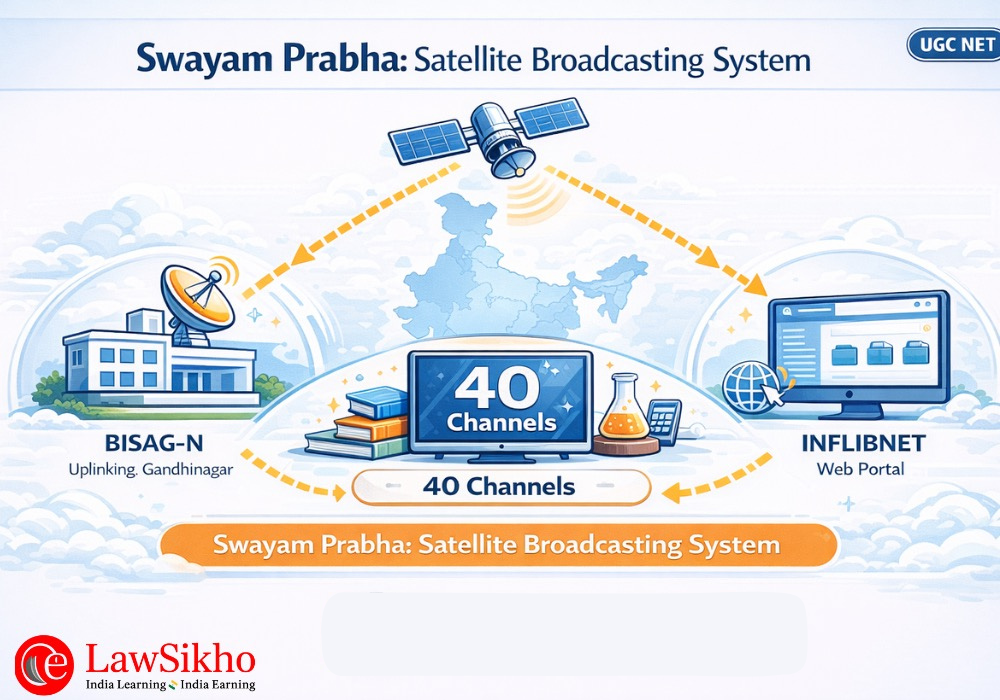
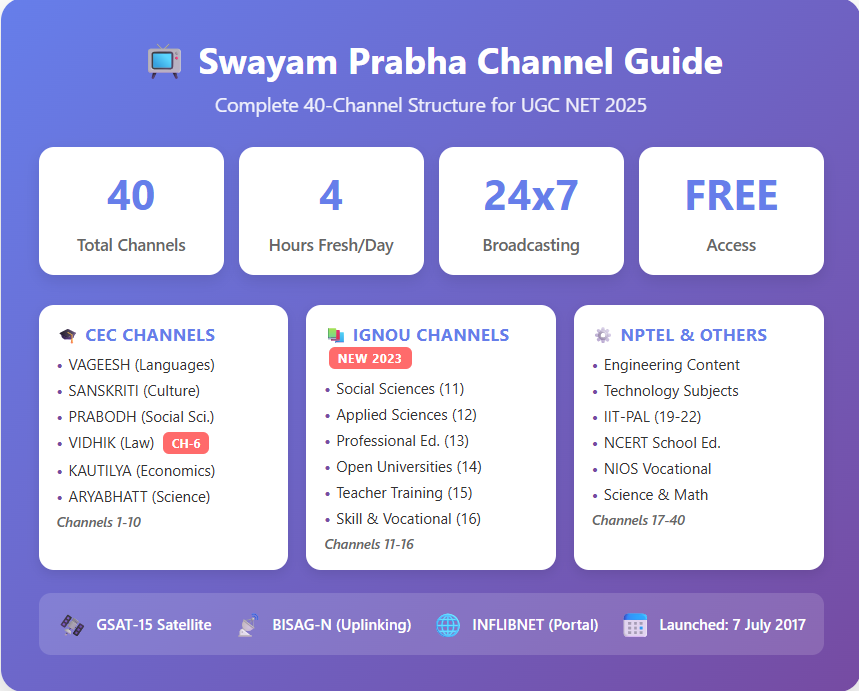
Swayam Prabha is a group of 40 Direct-to-Home (DTH) television channels devoted to telecasting high-quality educational programmes on a 24×7 basis. Unlike online platforms that require internet connectivity, Swayam Prabha uses satellite technology to broadcast content directly to television sets across India. The initiative specifically targets learners in remote and rural areas where internet penetration remains limited, ensuring that geographical barriers do not prevent access to quality education.
The technical infrastructure behind Swayam Prabha involves several key components that NTA frequently tests. The channels operate using the GSAT-15 satellite, which provides coverage across the entire Indian subcontinent. Content is uplinked from BISAG-N (Bhaskaracharya National Institute for Space Applications and Geo-informatics) located in Gandhinagar, Gujarat. The web portal where viewers can access archived content is managed by the INFLIBNET Centre (Information and Library Network). These technical details appear frequently in matching-type questions, so memorizing the GSAT-15, BISAG-N, and INFLIBNET connection is essential.
It was inaugurated on 7 July 2017 as part of the government’s broader Digital India initiative. The platform was conceived to address a fundamental challenge in Indian education: how to reach millions of students in areas with poor or no internet connectivity while maintaining quality standards comparable to premier institutions. The answer was leveraging existing DTH infrastructure that was already present in many Indian households.
The initiative built upon earlier efforts like Gyan Darshan, which had been broadcasting educational content since 2000. However, Swayam Prabha represented a significant upgrade in terms of scale, content quality, and institutional involvement. By bringing together content from India’s premier institutions including IITs, UGC, CEC, IGNOU, NCERT, and NIOS, the platform created a comprehensive educational ecosystem. Today, with 40 channels covering everything from primary school content to postgraduate-level courses, Swayam Prabha serves as a supplementary learning resource for students across all educational levels, including those preparing for competitive examinations like UGC NET.
Key Objectives of Swayam Prabha
Understanding the objectives of Swayam Prabha helps you answer conceptual questions about the platform’s purpose and target audience. NTA often frames questions around why the initiative was launched and whom it serves.
Bridging the Digital Divide
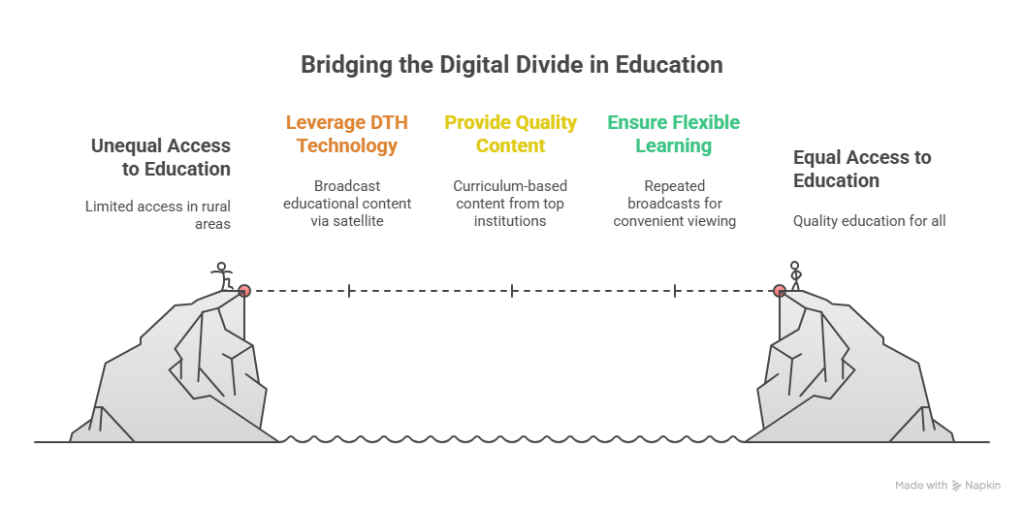
The primary objective of Swayam Prabha is to bridge India’s digital divide in education. While urban areas increasingly have access to high-speed internet and online learning platforms, vast portions of rural India still struggle with connectivity issues. According to government data, DTH television penetration is significantly higher than broadband internet in rural areas. Swayam Prabha leverages this existing infrastructure to deliver educational content without requiring internet connectivity.
This approach ensures that a student in a remote village in Rajasthan has access to the same quality of educational content as a student in Delhi or Mumbai. The only requirement is a basic television set and access to DD Free Dish or any other DTH service provider. This democratization of education is a key concept that appears in UGC NET questions about the platform’s significance.
Making Quality Education Accessible in Remote Areas
Beyond just bridging the digital divide, Swayam Prabha aims to ensure that geographical location does not determine the quality of education a student receives. The platform provides curriculum-based content developed by India’s most prestigious educational institutions. Courses cover diverse disciplines including arts, sciences, commerce, engineering, law, medicine, and agriculture at undergraduate and postgraduate levels.
The content schedule is designed with learners’ convenience in mind. Every day, there is new content for at least 4 hours, which is then repeated 5 more times throughout the day. This repetition allows students to choose viewing times that suit their schedules, whether they are morning learners or prefer studying late at night. The flexibility is particularly valuable for working professionals and students who need to balance their studies with other responsibilities.
SWAYAM vs Swayam Prabha: Key Differences for UGC NET
This is one of the most frequently tested topics in UGC NET Paper 1. Many aspirants confuse SWAYAM (the online MOOC platform) with Swayam Prabha (the DTH television initiative). Understanding the clear distinctions between these two platforms is crucial for avoiding silly mistakes that can cost you marks.
SWAYAM: The Online MOOC Platform
SWAYAM stands for “Study Webs of Active-Learning for Young Aspiring Minds.” It is an online Massive Open Online Course (MOOC) platform launched by the Ministry of Education to provide free access to quality higher education. Unlike Swayam Prabha, SWAYAM requires an active internet connection and operates through a web-based portal at swayam.gov.in.
The platform was developed by the Ministry of Education in collaboration with AICTE (All India Council for Technical Education), NPTEL, and IIT Madras, with technical support from Google Inc. and Persistent Systems Ltd. SWAYAM launched on 9 July 2017, just two days after Swayam Prabha’s inauguration. This close timing often leads to confusion among aspirants, but the platforms serve different purposes and use different delivery mechanisms.
SWAYAM offers over 2,000 courses across various disciplines, from school education to postgraduate level. The platform is interactive, allowing students to watch video lectures, read course materials, attempt assessments, participate in discussion forums, and earn certificates upon completion. A significant feature of SWAYAM is its credit transfer provision: according to UGC guidelines, students can transfer up to 20% of their total credits from SWAYAM courses to their degree programs at participating universities. Ten national coordinators, including UGC, NPTEL, CEC, NCERT, NIOS, IGNOU, and AICTE, manage course content across different domains.
Swayam Prabha: The DTH Television Initiative
Swayam Prabha operates on an entirely different model. Instead of requiring internet connectivity, it broadcasts educational content through 40 DTH television channels using the GSAT-15 satellite. The platform is accessible to anyone with a television and basic DTH setup, making it ideal for areas with limited or no internet access.
Unlike SWAYAM’s interactive model, Swayam Prabha is a one-way broadcast medium. Students watch pre-recorded educational content but cannot interact with instructors or participate in discussions through the platform itself. However, the web portal maintained by INFLIBNET Centre provides access to archived videos, allowing students to watch content on-demand if they have internet access. The platform does not offer certificates or credit transfer options, as its primary purpose is supplementary education rather than formal course completion.
Delivery Mode and Content Format Differences
The fundamental difference lies in delivery: SWAYAM uses internet-based delivery requiring active connectivity, while Swayam Prabha uses satellite-based DTH broadcasting that works without internet. This distinction is critical for exam questions that ask about the mode of content delivery or accessibility requirements.
Content format also differs significantly. SWAYAM courses include interactive elements like quizzes, assignments, discussion forums, and peer assessment. Swayam Prabha content is primarily video lectures and educational programmes designed for passive viewing. The scheduling model is also different: SWAYAM courses follow a semester-based structure with defined start and end dates, while Swayam Prabha broadcasts continuously with new content every day.
Certification and Credit Options
This is another key distinction that NTA tests. SWAYAM offers verified certificates upon successful completion of courses, and these certificates can be used for credit transfer in universities that have adopted the UGC’s credit transfer guidelines. Students can earn up to 20% of their total degree credits through SWAYAM courses. Swayam Prabha, on the other hand, does not offer any certification or credit transfer options. It functions purely as a supplementary educational resource rather than a formal course platform.
Why Swayam Prabha Matters for UGC NET Paper 1
For UGC NET aspirants, understanding Swayam Prabha is not just about general knowledge. It directly contributes to your UGC NET Paper 1 score, appearing across multiple units of the syllabus.
Syllabus Coverage: Teaching Aptitude, Research Methodology, ICT, and Higher Education Systems
Swayam Prabha appears in multiple units of the UGC NET Paper 1 syllabus. Under Teaching Aptitude (Unit 1), it is covered under “Teaching Support Systems” and “Digital Initiatives in Higher Education.” The platform is discussed alongside other digital learning initiatives like SWAYAM, MOOCs, and e-PG Pathshala. Understanding these platforms as part of the broader teaching-learning ecosystem helps you answer comparative questions.
Under ICT (Unit 9), Swayam Prabha appears as an example of technology-enabled learning. Questions often focus on the technical infrastructure: which satellite is used, where the uplinking centre is located, and which institution manages the web portal. These specific details require memorization, as they are tested in matching-type questions.
The Higher Education System unit also includes Swayam Prabha as part of government initiatives to improve access and quality in higher education. Questions in this context often focus on the platform’s objectives, target audience, and role in bridging educational disparities. Understanding the policy context helps you answer questions that require interpretation rather than mere recall.
Questions on Swayam Prabha
Based on analysis of previous year papers from 2019 to 2024, Swayam Prabha questions typically appear in specific formats. Statement-based questions ask you to identify correct or incorrect statements about the platform. For example: “Statement 1: Swayam Prabha uses GSAT-15 satellite for broadcasting. Statement 2: The web portal is managed by NCERT.” You need to evaluate each statement independently and choose the correct combination.
Matching-type questions are particularly common, asking you to match channel numbers with their names, or match components (satellite, uplinking centre, portal manager) with their correct identifications. For example: “Match List I (Component) with List II (Identification): A. Satellite – I. INFLIBNET, B. Uplinking Centre – II. GSAT-15, C. Web Portal – III. BISAG-N.” These questions require precise memorization of technical details.
True/false and assertion-reason questions test your understanding of relationships between concepts. For example: “Assertion: Swayam Prabha is accessible without internet connectivity. Reason: Swayam Prabha operates through DTH satellite broadcasting.” Understanding not just the facts but the logical connections between them helps you tackle such questions confidently.
Updated Swayam Prabha Channel List
Understanding the complete channel structure of Swayam Prabha is essential for UGC NET preparation. This section provides the most current information about all 40 channels, their managing institutions, and the content they cover. Pay special attention to the September 2023 reorganization, as many resources still contain outdated information.
Overview of 40 Channels
Swayam Prabha currently operates 40 DTH channels, a significant expansion from the original 32 channels at launch in 2017. Each channel is dedicated to specific disciplines and educational levels, creating a comprehensive educational ecosystem. The channels are available through DD Free Dish, Dish TV, and other DTH service providers at no additional cost to viewers.
The channel allocation follows a logical structure designed to serve different educational needs. Channels 1 to 10 are managed by CEC (Consortium for Educational Communication) and cover higher education content across humanities, social sciences, law, commerce, and sciences. Channels 11 to 16, following the September 2023 reorganization, are now managed by IGNOU and cover a mix of disciplines including social sciences, professional education, and vocational training.
Channels 17, 18 and several others are managed by NPTEL (National Programme on Technology Enhanced Learning) and focus on engineering and technology subjects. The IIT-PAL (Professor Assisted Learning) channels provide content specifically designed to help school students with Physics, Chemistry, Mathematics, Statistics and Biology. NCERT and NIOS manage channels dedicated to school education for secondary and higher secondary levels. This structured allocation ensures that learners at every level, from school students to postgraduate aspirants, find relevant content.
Content Provider Institutions
Seven major institutions collaborate to provide content for Swayam Prabha channels. Understanding this ecosystem helps you answer questions about which institution is responsible for what content. The Consortium for Educational Communication (CEC), established by UGC, is one of the primary content providers and manages the first ten channels covering humanities and social sciences.
IGNOU (Indira Gandhi National Open University) became the National Coordinator for four channels (11 to 16) from September 2023. NPTEL, a joint initiative of IITs and IISc, provides engineering and technology content. NCERT (National Council of Educational Research and Training) and NIOS (National Institute of Open Schooling) contribute school education content. UGC itself provides oversight and contributes through CEC. IITs also provide specialized content through the IIT-PAL initiative for school students preparing for competitive exams.
How Swayam Prabha Channels Help UGC NET Aspirants
While Swayam Prabha is primarily designed for undergraduate and postgraduate students, UGC NET aspirants can use specific channels for subject-wise preparation and understanding of topics that appear in UGC NET Paper 2.
Subject-Wise Channel Navigation for Different Disciplines
If you are preparing for UGC NET Commerce, KAUTILYA (Channel 07) covers Economics, Commerce, and Finance content that aligns with your UGC NET Paper 2 syllabus. Law aspirants can benefit from VIDHIK (Channel 06), which focuses on Law, Legal Studies, and Human Rights. For Education subject aspirants, SAARASWAT (Channel 04) covers Education, Psychology, and Home Science.
English Literature and Hindi aspirants can find relevant content on VAGEESH (Channel 01) for Language and Literature, and SANSKRITI (Channel 02) for History, Culture, and Philosophy. Social Science disciplines are covered by PRABODH (Channel 03). Management aspirants can refer to PRABANDHAN (Channel 05) for Management and Information Science content. This subject-specific organization allows you to supplement your preparation with video lectures from experts.
How to Access Swayam Prabha
You can access Swayam Prabha through multiple platforms. The simplest method is through DD Free Dish, a free DTH service provided by the government or JioTV. If you have an existing DTH connection like Dish TV or Tata Play, Swayam Prabha channels are available in the educational channels section. For those with internet access, the official web portal at swayamprabha.gov.in provides live streaming of all channels and an archive of past broadcasts that you can watch on-demand.
Swayam Prabha: Content Scheduling and Accessibility
Understanding the content schedule is important both for your own learning and for answering exam questions about the platform’s operational details.
Daily Fresh Content (4 Hours) and Repeat Telecasts
Each Swayam Prabha channel broadcasts new content for at least 4 hours every day. This fresh content is then repeated 5 more times throughout the day, giving viewers a total of 6 opportunities to watch the same content. This repetition model ensures that students can choose viewing times that fit their schedules, whether early morning, afternoon, or late night.
Archive and On-Demand Viewing Options
For students who miss live broadcasts or prefer on-demand viewing, the INFLIBNET-managed web portal maintains an archive of all telecasted videos. This digital repository allows students to search for specific topics, download videos for offline viewing, and access content from any channel at any time. The archive is particularly useful for exam preparation, as you can focus on specific topics rather than waiting for relevant content to air.
CEC-Managed Channels (Channel 1-10)
The Consortium for Educational Communication manages the first ten channels of Swayam Prabha, covering undergraduate and postgraduate content across humanities, social sciences, law, commerce, and natural sciences. These channels are the most frequently tested in UGC NET, so memorizing their names and subject areas is essential.
Humanities and Language Channels (VAGEESH, SANSKRITI)
Channel 01, named VAGEESH, covers Humanities content specifically focusing on Language and Literature. It broadcasts programmes related to Indian languages, literature studies, and linguistic analysis suitable for undergraduate and postgraduate students.
Channel 02, named SANSKRITI, covers Humanities content focusing on History, Culture, and Philosophy. This channel is particularly relevant for students of History, Philosophy, and Cultural Studies, offering content that explores India’s rich cultural heritage and philosophical traditions.
Social Sciences Channels (PRABODH, SAARASWAT, PRABANDHAN)
Channel 03, PRABODH, covers Social Science content focusing on Social and Behavioral Sciences. This includes Sociology, Political Science, and related disciplines. The content is designed for students pursuing undergraduate and postgraduate degrees in social science disciplines.
Channel 04, SAARASWAT, focuses on Education, Psychology, Home Science, and related subjects. For UGC NET Education aspirants, this channel provides supplementary content that aligns with Paper 2 syllabus topics. Channel 05, PRABANDHAN (meaning “Management”), covers Management, Library Science, and Information Science. Management and Library Science UGC NET aspirants can find relevant content here.
Law, Economics, and Sciences Channels (VIDHIK, KAUTILYA, ARYABHATT, SPANDAN, DAKSH)
Channel 06, VIDHIK, is dedicated to Law, Legal Studies, and Human Rights. For UGC NET Law aspirants preparing through LawSikho, this channel serves as an excellent supplementary resource with video lectures on various legal topics from university faculty.
Channel 07, KAUTILYA, covers Economics, Commerce, and Finance. This is highly relevant for Commerce and Economics UGC NET aspirants. Channel 08, ARYABHATT (named after the renowned mathematician and astronomer), covers Physical Sciences including Mathematics, Physics, and Chemistry.
Channel 09, SPANDAN, focuses on Life Sciences including Botany, Zoology, and Bio-Science. Channel 10, DAKSH (meaning “Skilled” or “Proficient”), covers Applied Sciences and Allied Physical and Chemical Sciences. Together, these channels provide comprehensive coverage of science subjects at the higher education level.
IGNOU-Managed SWAYAM PRABHA Channels (Channels 11-16)
A significant development occurred in September 2023 when IGNOU was entrusted with the responsibility of National Coordinator for six Swayam Prabha channels. This reorganization is crucial for the UGC NET Exam, as questions may test whether you know the current channel allocation. Channels 11 to 16 are now managed by IGNOU from their headquarters in New Delhi.
Social Sciences and Humanities (Channel 11)
Channel 11 covers Social Sciences and Humanities content provided by IGNOU. According to IGNOU’s official page on Swayam Prabha, this channel covers video content from multiple schools including the School of Social Sciences (SOSS), School of Humanities (SOH), School of Gender and Development Studies (SOGDS), School of Foreign Languages (SOFL), School of Translation Studies and Training (SOTST), School of Social Work (SOSW), and School of Extension and Development Studies (SOEDS).
The channel aims to initiate new ways of learning by educating students with improved methods of curriculum delivery. It covers various Post Graduate, UG, and Certificate courses offered by IGNOU. Students can access digital repositories from the Swayam Prabha portal for on-demand viewing.
Basic and Applied Sciences (Channel 12)
Channel 12 focuses on Basic and Applied Sciences. It aims to extend the outreach of sciences by offering multimedia educational content across various disciplines of sciences and interdisciplinary sectors. The channel provides content structured at awareness, certificate, and diploma levels for developing skills, entrepreneurship, and professionalism in Applied Sciences.
This channel covers video content from IGNOU’s School of Sciences (SOS), School of Agriculture (SOA), and School of Inter-Disciplinary and Trans-Disciplinary Studies (SOITS). The content meets educational requirements of lifelong learners seeking to understand scientific concepts and their applications.
Professional Education (Channel 13)
Channel 13 is dedicated to Professional Education, aiming to impart knowledge and skills required for entry into specific professions or occupations. The channel covers courses on various sectors that meet the needs of today’s workplace and help individuals develop their talent for future career progression.
This channel covers content from IGNOU’s School of Computer and Information Sciences (SOCIS), School of Management Studies (SOMS), School of Law (SOL), School of Journalism and New Media Studies (SOJNMS), School of Tourism and Hospitality Service Management (SOTHSM), and Discipline of Library and Information Science. For UGC NET aspirants in Management, Law, Computer Science, or Library Science, this channel provides relevant supplementary content.
State Open Universities and Gyan Darshan (Channel 14)
Channel 14 serves State Open Universities and continues the legacy of Gyan Darshan. It aims to bring lifelong learning to learners across the country and fulfil the learning needs of different communities. The channel focuses on non-formal education, supplementary education, and open and distance education.
The channel covers content from all State Open Universities (SOUs) and Gyan Darshan programming from IGNOU’s Electronic Media Production Centre (EMPC). It serves as supplementary knowledge resources for people engaged in different professions or enrolled in academic programmes in various open universities across the country.
Capacity Building and Teacher Education (Channel 15)
Channel 15 caters to the training needs of various functionaries of the higher education system in India. The focus is on contemporary staff development topics including Digital Learning Resources, OER and MOOCs, Curriculum and Instructional Design, Multidisciplinary and Holistic Education, Credit Accumulation, Academic Bank of Credits, Digital Pedagogy, AI and Machine Learning, Online and Blended Learning, Disability and Special Need Education, and Research Skills.
This channel covers content from STRIDE (Staff Training and Research Institute of Distance Education) and School of Education (SOE) at IGNOU. For UGC NET Education aspirants, this channel provides valuable content on teacher education and professional development topics.
Skill and Vocational Education (Channel 16)
Channel 16 focuses on Skill and Vocational Education, providing education and training for skills development to meet vocational and technical requirements for economic development. The videos provide quality vocational education in accordance with job market needs and contribute to employable skills among youth and adults.
This channel covers content from IGNOU’s School of Continuing Education (SOCE), School of Vocational Education and Training (SOVET), School of Engineering and Technology (SOET), School of Health Sciences (SOHS), and School of Performing and Visual Arts (SOPVA). The demand-driven and value-added content targets both formal and informal sectors.
NPTEL-Managed Channels (Various Channels)
NPTEL (National Programme on Technology Enhanced Learning) is a joint initiative of IITs and IISc that provides engineering and technology content through Swayam Prabha. NPTEL-managed channels focus on technical education and are particularly useful for students pursuing engineering and technology courses.
Engineering and Technology Subjects
NPTEL channels cover core engineering disciplines including Chemical Engineering, Civil Engineering, Computer Science and Engineering, Electrical Engineering, Electronics and Communication Engineering, and Mechanical Engineering. The content is developed by IIT faculty members and follows a structured curriculum approach.
Each NPTEL channel typically focuses on a specific engineering domain. For example, separate channels cover Chemical Engineering and Chemistry content, Civil Engineering content, Computer Science content, Electrical and Electronics content, and general engineering sciences. The lectures are known for their academic rigor and comprehensive coverage of technical topics.
Science and Mathematics Channels
Beyond engineering-specific content, NPTEL also provides channels covering fundamental sciences and mathematics that form the foundation for all technical education. These channels offer content on Physics, Chemistry, Mathematics, and Biological Sciences at the undergraduate and postgraduate levels.
The science and mathematics content from NPTEL complements the engineering content by providing strong conceptual foundations. Students preparing for competitive examinations, including those who need to understand technical concepts for UGC NET subjects like Computer Science or Environmental Sciences, can benefit from these channels.
IIT-PAL Channels for School Students (Channel 22)
IIT-PAL (Professor Assisted Learning) is a special initiative where IIT professors create educational content specifically designed for school students preparing for competitive examinations like JEE and NEET.
Biology, Chemistry, Mathematics, Physics Channels
IIT-PAL is dedicated to content covering the four main science subjects: Physics, Chemistry, Mathematics, and Biology lectures. These lectures are tailored for Class 11 and 12 students.
The IIT-PAL channels represent a unique approach where India’s top professors make their expertise accessible to school students across the country. While these channels are primarily aimed at school students, the pedagogical approaches demonstrated can be useful for UGC NET Education aspirants studying effective teaching methods and technology-enhanced learning.
NIOS and NCERT Channels
The National Institute of Open Schooling (NIOS) and National Council of Educational Research and Training (NCERT) contribute channels focused on school education at secondary and higher secondary levels.
School Education Channels (Secondary and Higher Secondary)
NIOS and NCERT channels provide curriculum-based content aligned with school syllabi. These channels cover subjects taught at Class 9 to 12 levels and are particularly useful for students preparing for board examinations. The content follows the NCERT curriculum and is presented in accessible formats.
For UGC NET aspirants, understanding the role of NIOS and NCERT in the broader educational ecosystem is relevant for Paper 1 questions about educational institutions and their functions. NIOS provides open schooling options for those who could not complete formal schooling, while NCERT develops curriculum and textbooks used across schools in India.
Teacher Education and Gyanamrit
Some channels within the NCERT and NIOS allocation focus on teacher education and professional development. These channels broadcast content related to pedagogical approaches, classroom management, assessment techniques, and curriculum development. The Gyanamrit initiative, which provides specialized educational content, is also part of this ecosystem.
For UGC NET Education aspirants, these teacher education-focused channels provide practical examples of the theoretical concepts covered in the Paper 2 syllabus. Understanding how digital platforms are being used for teacher professional development is relevant for questions about modern teaching support systems.
Swayam Prabha Content Providers: CEC, NPTEL, IGNOU & More
Understanding which institutions provide content for Swayam Prabha and their respective roles helps you answer detailed questions about the platform’s organizational structure. This section examines the major content providers and their contributions.
National Coordinators and Their Roles
Swayam Prabha operates through a system of National Coordinators, each responsible for specific channels and content domains. This distributed model ensures that experts in various disciplines contribute content appropriate to their areas of expertise.
CEC (Consortium for Educational Communication)
The Consortium for Educational Communication is one of the Inter University Centres established by UGC. CEC was established specifically to address the needs of higher education through television and emerging ICT. As the National Coordinator for Channels 1 to 10, CEC provides content across humanities, social sciences, law, commerce, and sciences. CEC also develops MOOCs offered on the SWAYAM platform, creating a connection between the two initiatives.
NPTEL (National Programme on Technology Enhanced Learning)
NPTEL is a joint initiative of IITs and IISc funded by the Ministry of Education. It has been appointed as the National Coordinator for engineering and technology content on Swayam Prabha. NPTEL’s video lectures, developed by IIT faculty, are known for their quality and comprehensive coverage. The organization provides content for multiple channels focusing on different engineering disciplines.
IGNOU (Indira Gandhi National Open University)
IGNOU became the National Coordinator for six channels (11 to 16) from September 2023 after the reorganization. As India’s largest open university with extensive experience in distance education, IGNOU brings expertise in creating content for diverse learner populations. The university’s Electronic Media Production Centre (EMPC) supports video production for Swayam Prabha broadcasts.
Other Key Content Providers
Beyond the major National Coordinators, several other institutions contribute to the Swayam Prabha ecosystem.
NCERT (National Council of Educational Research and Training)
NCERT is the apex body for school education in India, developing curriculum and textbooks used across schools. For Swayam Prabha, NCERT provides content focused on school education, particularly for secondary and higher secondary levels. The content aligns with the national curriculum and supports students preparing for board examinations.
NIOS (National Institute of Open Schooling)
NIOS provides open schooling opportunities for students who cannot attend regular schools. On Swayam Prabha, NIOS contributes content that supports alternative education pathways. The content is designed to be accessible and self-explanatory, following the open and distance learning approach.
IITs and UGC
Individual IITs contribute content through initiatives like IIT-PAL, where professors create lectures specifically for school students. UGC, beyond its role through CEC, provides overall coordination and ensures that content meets quality standards appropriate for higher education. The involvement of these prestigious institutions lends credibility to the Swayam Prabha platform.
Role of INFLIBNET Centre
INFLIBNET plays a crucial but often overlooked role in the Swayam Prabha ecosystem. Understanding its functions helps you answer technical questions about the platform’s infrastructure.
Web Portal Management
The INFLIBNET Centre (Information and Library Network) manages the official Swayam Prabha web portal at swayamprabha.gov.in. This portal provides live streaming of all 40 channels, allowing viewers with internet access to watch content online. INFLIBNET ensures the technical infrastructure supporting the web portal remains operational and accessible.
Archive and Digital Repository
Beyond live streaming, INFLIBNET maintains a comprehensive archive of all content broadcast on Swayam Prabha channels. This digital repository allows students to search for specific topics, access past broadcasts, and download content for offline viewing. The archive function transforms Swayam Prabha from a purely broadcast platform into a searchable educational resource, significantly enhancing its utility for learners.
Swayam Prabha Previous Year Questions for UGC NET (2019-2025)
Analyzing previous year questions is one of the most effective preparation strategies for any competitive examination. This section examines the types of questions that have appeared on Swayam Prabha and the topics that NTA tests most frequently.
Question Types and Patterns
Based on analysis of UGC NET papers from 2019 to 2024, Swayam Prabha questions follow predictable patterns. Understanding these patterns helps you prepare more effectively.
Statement-Based Questions
Statement-based questions present multiple statements about Swayam Prabha and ask you to identify which are correct or incorrect. For example: “Which of the following statements about Swayam Prabha is correct? (1) It uses GSAT-15 satellite for broadcasting, (2) It was launched in 2015, (3) The web portal is managed by NCERT.” You need to evaluate each statement against your knowledge and select the appropriate option.
Matching the Column Questions
Matching questions are extremely common for Swayam Prabha. Typical formats include: Match channel numbers with channel names (e.g., CH-04 with SAARASWAT, CH-06 with VIDHIK, CH-07 with KAUTILYA). Match technical components with their identifications (e.g., Satellite with GSAT-15, Uplinking Centre with BISAG-N, Portal Manager with INFLIBNET). Match channels with their subject areas (e.g., VAGEESH with Language and Literature, KAUTILYA with Economics and Commerce).
True/False and Assertion-Reason Questions
Assertion-Reason questions test your understanding of causal relationships. Example: “Assertion (A): Swayam Prabha is accessible in areas without internet connectivity. Reason (R): Swayam Prabha uses DTH satellite broadcasting technology.” You need to determine if both A and R are true, and if R correctly explains A.
Most Frequently Asked Topics on Swayam Prabha in the UGC NET
Certain topics appear more frequently than others. Focusing your preparation on these areas maximizes your chances of scoring.
Number of Channels
Questions about the number of channels appear regularly. Remember that Swayam Prabha started with 32 channels and currently has 40 channels. Some older question papers may reference 32 or 34 channels based on when they were set, but current examinations should reference 40 channels.
Satellite and Technical Infrastructure
Technical infrastructure questions test knowledge of GSAT-15 (the satellite), BISAG-N Gandhinagar (the uplinking centre), and INFLIBNET (the web portal manager). These three components appear repeatedly in matching questions. Create a clear mental association: GSAT-15 for broadcasting, BISAG-N for uplinking, INFLIBNET for the web portal.
Content Providers and Managing Institutions
Questions often ask which institutions provide content or manage specific channels. Remember the major providers: CEC (Channels 1-10), IGNOU (Channels 11-16 from September 2023), NPTEL (engineering channels), NCERT and NIOS (school education channels), and IITs (IIT-PAL channels).
Memorizing the specific channel names is valuable for matching questions. The CEC channels have distinctive Sanskrit names: VAGEESH, SANSKRITI, PRABODH, SAARASWAT, PRABANDHAN, VIDHIK, KAUTILYA, ARYABHATT, SPANDAN, and DAKSH. Each name has a meaning connected to its subject area.
SWAYAM vs Swayam Prabha Distinctions
Questions testing the difference between SWAYAM and Swayam Prabha are highly common. Key distinctions to remember: SWAYAM is online and requires internet, Swayam Prabha is DTH-based and does not require internet. SWAYAM offers certificates and credit transfer, Swayam Prabha does not. SWAYAM is interactive with assessments and forums, Swayam Prabha is primarily passive viewing.
The full forms are also tested: SWAYAM stands for “Study Webs of Active-Learning for Young Aspiring Minds,” while Swayam Prabha means “Self-Luminous” in Sanskrit. Both were launched in July 2017, within two days of each other, but serve different purposes.
Swayam Prabha for UGC NET: How to Prepare Effectively
Having understood the content, let us focus on effective preparation strategies. This section provides actionable tips to help you master Swayam Prabha topics for UGC NET.
Key Facts to Memorize
Certain facts require straight memorization. Create flashcards or use spaced repetition techniques to commit these to memory.
Numbers and Statistics (40 Channels, 4 Hours Fresh Content, etc.)
Create a list of all numerical facts: 40 total channels currently, 4 hours of fresh content daily, repeated 5 times (total 6 viewing opportunities), launched on 7 July 2017, 10 channels managed by CEC, 6 channels managed by IGNOU (from September 2023). Associate these numbers with their context through repeated revision.
Use memory techniques like grouping related numbers. For example: “7-7-17” for the launch date (7th day, 7th month, 2017). “40-4-5” for channels-fresh hours-repeat times. Such patterns make recall easier during the exam.
Important Names (BISAG-N, INFLIBNET, GSAT-15)
The three key technical terms must be memorized with their functions: GSAT-15 is the satellite used for broadcasting, BISAG-N (Bhaskaracharya National Institute for Space Applications and Geo-informatics) in Gandhinagar is the uplinking centre, INFLIBNET (Information and Library Network) manages the web portal.
Create a mnemonic: “G-B-I” for “Gateway (satellite) – Broadcasting (uplinking) – Internet (portal)” mapping to GSAT-15, BISAG-N, and INFLIBNET respectively.
Channel Names with Subject Areas
The CEC channel names require focused memorization. Use the first letters to create a mnemonic: “VSPSPV KAS D” (Vageesh, Sanskriti, Prabodh, Saaraswat, Prabandhan, Vidhik, Kautilya, Aryabhatt, Spandan, Daksh). Associate each name with its subject through the name’s meaning. Vidhik means legal, so it covers Law. Kautilya was an economist, so it covers Economics and Commerce. Aryabhatt was a mathematician and astronomer, so it covers Physical Sciences.
Quick Revision Techniques
Develop efficient revision strategies that maximize retention in minimum time.
Mnemonics for Channel Categories
Create category-based mnemonics. For CEC channels by subject: Humanities (VAGEESH, SANSKRITI), Social Sciences (PRABODH, SAARASWAT, PRABANDHAN, VIDHIK), Commerce (KAUTILYA), Sciences (ARYABHATT, SPANDAN, DAKSH). Remember “2 Humanities, 4 Social Sciences, 1 Commerce, 3 Sciences” for the CEC distribution.
Comparison Charts for Quick Recall
Create a side-by-side comparison chart for SWAYAM vs Swayam Prabha covering: Full form, Launch date, Delivery mode, Internet requirement, Certificate provision, Credit transfer, Interactivity level, Managing body. Review this chart during revision to reinforce the distinctions.
30-Day Revision Plan for Swayam Prabha Topics
In the first week, focus on understanding the basic concepts: what Swayam Prabha is, why it was launched, and its key objectives. Create notes covering the definition, launch date, and primary purpose. In the second week, memorize the technical infrastructure: satellite, uplinking centre, and web portal manager.
In the third week, focus on the channel structure. Memorize CEC channel names and their subject areas, understand the IGNOU channel reorganization from September 2023, and learn about NPTEL and IIT-PAL channels. In the fourth week, concentrate on the SWAYAM vs Swayam Prabha comparison and practice previous year questions. Use the final days for quick revision of all facts using your flashcards and mnemonics.
Common Mistakes to Avoid
Being aware of common errors helps you avoid them during the exam.
Confusing SWAYAM with Swayam Prabha
This is the most common mistake. Remember: SWAYAM is online (needs internet), Swayam Prabha is DTH-based (no internet needed). SWAYAM has the full form “Study Webs of Active-Learning for Young Aspiring Minds,” while Swayam Prabha is simply a Sanskrit name meaning “Self-Luminous.” When you see questions about credit transfer or certificates, the answer is always SWAYAM, not Swayam Prabha.
Outdated Channel Numbers
Many resources still mention 32 or 34 channels. The current number is 40 channels. Also, be aware of the September 2023 reorganization where IGNOU took over Channels 11 to 16. If a question refers to older channel allocations, use your judgment based on when the question appears to have been set.
Ignoring Technical Details (Satellite, Uplinking Centre)
Some aspirants focus only on the conceptual aspects and ignore technical details. NTA specifically tests GSAT-15, BISAG-N, and INFLIBNET in matching questions. These three terms must be memorized with their exact functions. Do not skip technical preparation thinking it is not important.
Conclusion
Swayam Prabha is more than just another topic in your UGC NET syllabus. It represents India’s commitment to democratizing education through technology and bridging the gap between urban and rural learners. For your examination, understanding this platform comprehensively can help you secure those crucial marks in UGC NET Paper 1 that often determine success.
Remember the key facts. Use the preparation strategies outlined in this guide: memorize the channel names and their subject areas, create mnemonics for quick recall, and practice previous year questions to understand the testing patterns. Stay updated with any changes to the platform, as NTA tends to test current information. With thorough preparation, Swayam Prabha questions will become easy marks in your UGC NET journey.
Frequently Asked Questions on Swayam Prabha for UGC NET
What is the full form of Swayam Prabha?
Swayam Prabha does not have an acronym-based full form. The term comes from Sanskrit and means “self-luminous” or “self-shining.” This name symbolizes the initiative’s goal of empowering learners to illuminate their own educational paths through accessible content.
How many channels are there in Swayam Prabha?
Swayam Prabha currently operates 40 DTH channels. The platform started with 32 channels at its launch in July 2017 and has expanded over time.
Why is Swayam Prabha important for UGC NET preparation?
Swayam Prabha appears regularly in UGC NET Paper 1 under Teaching Aptitude, ICT, and Higher Education Systems units. Questions test knowledge of the platform’s technical infrastructure, channel structure, and differences from SWAYAM. Mastering this topic can help you score marks in multiple question formats.
Which Swayam Prabha topics are most frequently asked in UGC NET?
The most frequently tested topics include: the satellite used (GSAT-15), the uplinking centre (BISAG-N), the web portal manager (INFLIBNET), the number of channels (40), CEC channel names and their subject areas, and the differences between SWAYAM and Swayam Prabha.
How to use Swayam Prabha channels for UGC NET exam preparation?
While primarily designed for curriculum-based learning, specific channels can supplement your UGC NET preparation. KAUTILYA (Channel 07) is useful for Commerce aspirants, VIDHIK (Channel 06) for Law aspirants, SAARASWAT (Channel 04) for Education aspirants, and PRABANDHAN (Channel 05) for Management and Library Science aspirants.
Which satellite is used for Swayam Prabha broadcasting?
GSAT-15 satellite is used for broadcasting Swayam Prabha channels. This satellite provides coverage across the entire Indian subcontinent, enabling DTH reception throughout the country.
Who manages the Swayam Prabha web portal?
The INFLIBNET Centre (Information and Library Network) manages the Swayam Prabha web portal at swayamprabha.gov.in. INFLIBNET also maintains the digital archive of all broadcast content.
Where are Swayam Prabha channels uplinked from?
Swayam Prabha channels are uplinked from BISAG-N (Bhaskaracharya National Institute for Space Applications and Geo-informatics) located in Gandhinagar, Gujarat.
Which institutions provide content for Swayam Prabha?
Major content providers include CEC (Consortium for Educational Communication), NPTEL (National Programme on Technology Enhanced Learning), IGNOU (Indira Gandhi National Open University), NCERT (National Council of Educational Research and Training), NIOS (National Institute of Open Schooling), and IITs.
Is Swayam Prabha free to access?
Yes, Swayam Prabha is completely free to access. There are no subscription fees, registration charges, or hidden costs. You only need a television with DD Free Dish or any other DTH service provider.
How many hours of fresh content does Swayam Prabha provide daily?
Each Swayam Prabha channel provides at least 4 hours of new content daily. This fresh content is repeated 5 more times throughout the day, giving viewers 6 opportunities to watch the same content.
Is the internet required to watch Swayam Prabha?
No, the internet is not required to watch Swayam Prabha channels through DTH television. The channels are broadcast via satellite and can be received on any TV with a basic DTH setup. However, if you want to access the web portal for live streaming or archived videos, you will need internet connectivity.



 Allow notifications