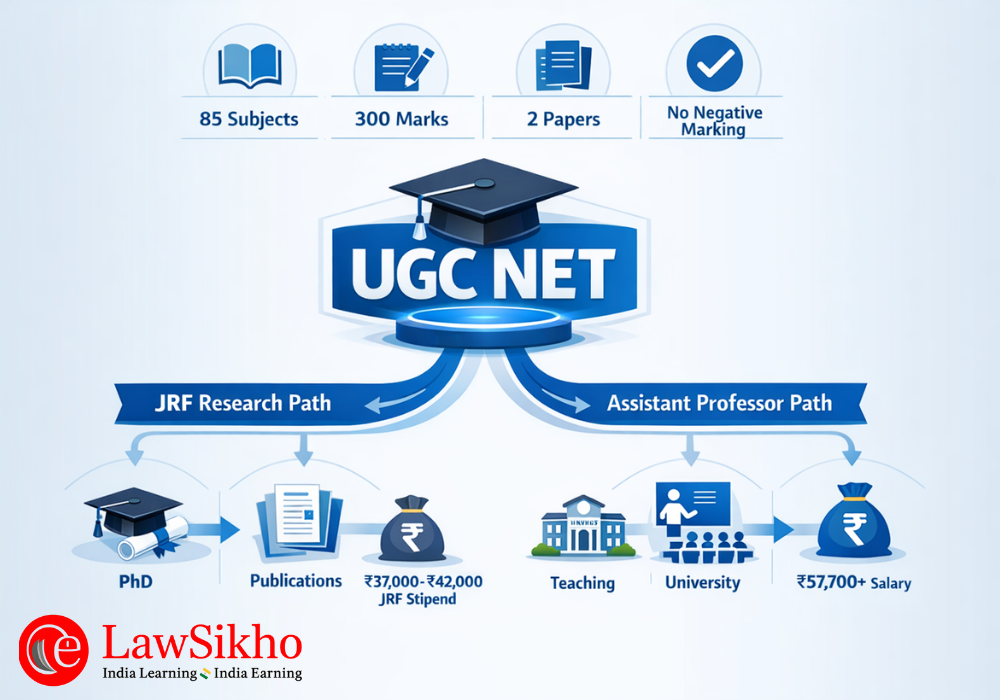

Complete guide to UGC NET exam covering eligibility, exam pattern, syllabus, preparation strategy, JRF fellowship (₹37,000-₹42,000), and Assistant Professor salary.
Table of Contents
You have just completed your postgraduate degree, and suddenly everyone around you is talking about UGC NET. Some say it is mandatory for teaching, others mention something about JRF and PhD funding. You have heard the exam has 85 subjects, two papers, and lakhs of candidates competing twice every year. The syllabus looks vast, the eligibility criteria seem complicated, and you are not even sure if your qualification makes you eligible. If this confusion sounds familiar, you are not alone; over 10 lakh aspirants register for UGC NET every cycle, and most begin their journey exactly where you are right now.
This comprehensive guide serves as your one-stop resource for everything related to the UGC NET exam. Whether you want to understand who can appear, how the exam works, or what career opportunities await after qualification, you will find detailed answers here. I have structured this guide to take you from basic understanding to strategic preparation, so you can approach UGC NET with clarity and confidence rather than confusion and anxiety.
Here is what we will inter alia cover in detail the UGC NET exam and its significance for academic careers, eligibility criteria, exam pattern breaking down Paper I and Paper II with marking schemes, unit-wise syllabus breakdown, proven preparation tips, application process, and career opportunities including salaries Assistant Professor salaries and JRF fellowship stipends.

Understanding the UGC NET Exam
The University Grants Commission National Eligibility Test, commonly known as UGC NET, is India’s premier examination for determining eligibility for academic careers. This national-level test opens two distinct pathways: qualification as an Assistant Professor eligible to teach at universities and colleges across India, and award of the Junior Research Fellowship for pursuing doctoral research with government-funded stipends. Understanding this exam thoroughly is your first step toward building a successful academic career.
Conducted by National Testing Agency (NTA)
The National Testing Agency (NTA) has been conducting UGC NET on behalf of the University Grants Commission since December 2018, when it took over from CBSE. NTA brought significant improvements including standardized computer-based testing across multiple cities, better examination infrastructure, and streamlined result processing. All official notifications, application forms, admit cards, and results are published on the NTA UGC NET portal.
Exam Frequency and Sessions
UGC NET is conducted twice every year in June and December sessions, giving aspirants two opportunities annually to qualify. The exam takes place across multiple days due to the large number of candidates and 85 subjects offered.
Each session operates independently, meaning you can appear in both June and December sessions of the same year if needed.
Computer-Based Test Format
UGC NET is conducted exclusively in Computer-Based Test (CBT) mode at designated examination centers across hundreds of cities in India. You attempt the exam on a computer terminal where questions appear on screen, and you select answers by clicking the appropriate option. The interface is user-friendly, allowing navigation between questions, marking questions for review, and changing answers before final submission.
The CBT format has several advantages over the old pen-and-paper mode. You can easily move between questions, review flagged questions, and track your progress through a visual dashboard. The system automatically saves your responses, eliminating the risk of answer sheet errors. If you have never taken a computer-based exam, NTA provides mock tests on their website to familiarize yourself with the interface before the actual exam.
Importance of UGC NET for your academic career
UGC NET qualification is more than just another certificate; it is the gateway to India’s higher education ecosystem. Whether you dream of lecturing at a central university, conducting funded research at a premier institution, or building a career in educational content, UGC NET opens doors that remain closed to non-qualified candidates. The exam validates your teaching aptitude and subject expertise at a national level, making you eligible for positions across the country.
Gateway to Teaching in Universities and Colleges
With UGC NET qualification, you become eligible to apply for permanent Assistant Professor positions in central universities, state universities, deemed universities, autonomous colleges, and government-aided private colleges across India. The Bar Council of India mandates that law colleges must appoint only UGC NET qualified candidates as Assistant Professors, and similar requirements exist across disciplines. This makes NET qualification practically mandatory for anyone serious about an academic teaching career.
The career rewards are substantial. Under the 7th Pay Commission, Assistant Professors receive Level 10 pay scale with basic pay starting at ₹57,700 per month, which can reach up to ₹1,82,400 at the maximum level. When you add Dearness Allowance (currently 55% of basic), House Rent Allowance (8-24% depending on city classification), and other allowances, the total monthly package typically ranges between ₹75,000 to ₹1,00,000 in central universities. State university salaries vary but remain attractive compared to most private sector alternatives.
Access to Research Opportunities and PhD Programs
Beyond teaching, UGC NET with JRF qualification enables you to pursue research as a financially supported career path. The Junior Research Fellowship provides ₹37,000 monthly for the first two years, increasing to ₹42,000 as Senior Research Fellow from the third year onwards. This fellowship runs for up to five years, allowing you to complete your PhD without financial stress while receiving a respectable income.
UGC NET JRF (at certain universities) holders also receive annual contingency grants for research expenses: ₹10,000 for humanities and social sciences, ₹12,500 for sciences. If university accommodation is not available, you are entitled to House Rent Allowance based on city classification. Many premier institutions reserve PhD seats for JRF holders or give them preference in admissions, making JRF qualification a significant advantage for research careers. The fellowship follows you to whichever UGC-recognized institution you join for your doctoral program.

UGC NET Exam Eligibility Criteria
Understanding eligibility criteria is crucial before you begin preparation. UGC NET has specific requirements regarding educational qualifications, percentage marks, and age limits that vary based on whether you are targeting Assistant Professor eligibility or JRF. Let me break down each requirement so you can confirm your eligibility with certainty.
Nationality
Only Indian nationals can appear for UGC NET examination. This citizenship requirement is verified during the application process and again during document verification after qualification. You need to provide valid identity proof such as Aadhaar card, passport, or voter ID while applying and during examination.
Educational Qualification Requirements
The educational qualification requirements form the foundation of UGC NET eligibility. These requirements ensure that candidates possess the academic foundation necessary for teaching and research roles in higher education.
Master’s Degree with 55% Marks (50% for Reserved Categories)
To appear for UGC NET, you must have completed a Master’s degree or equivalent from a university or institution recognized by the University Grants Commission. For General and General-EWS category candidates, the minimum requirement is 55% marks or equivalent grade in your postgraduate degree. If you belong to SC, ST, OBC-NCL (Non-Creamy Layer), PwD, or third gender categories, you get a 5% relaxation, bringing the minimum requirement to 50% marks.
If your university follows CGPA grading instead of percentage marks, you need to convert your CGPA using your university’s official conversion formula. Most universities use the formula: Percentage = CGPA × 9.5 or provide specific conversion certificates. I recommend obtaining an official percentage conversion certificate from your university to avoid discrepancies during document verification, as NTA accepts the conversion formula specified by your awarding institution.
Provisional Eligibility Rules for Final Year Postgraduate Students
If you are currently in the final year of your Master’s programme, you can absolutely apply for and appear in UGC NET by selecting “Appearing” as your qualification status in the application form. You need to provide your enrollment details while applying. However, you must complete your Master’s degree with the required percentage within two years of appearing for NET, failing which your qualification will stand cancelled and you will need to appear again.
Four-Year Undergraduate Programme (FYUP) Eligibility Under NEP 2020
Under the National Education Policy (NEP) 2020 framework, candidates who have completed a Four-Year Undergraduate Programme (FYUP) with at least 75% marks or equivalent grade can apply for UGC NET directly without requiring a Master’s degree. This provision recognizes the research components embedded in FYUP curricula. However, the four-year degree must be from a UGC-recognized university and include research elements aligned with NEP 2020 structure; verify specific eligibility in the official NTA Information Bulletin for your examination session.
Age Limit for UGC NET
Age limits for UGC NET depend on whether you are targeting only Assistant Professor eligibility or also aiming for the Junior Research Fellowship. This distinction is crucial for planning your examination timeline.
No Age Limit for Assistant Professor Eligibility
Here is encouraging news for mature candidates and career changers: there is absolutely no upper age limit for appearing in UGC NET if you are aiming only for Assistant Professor eligibility. Whether you are 25, 35, 45, or older, you can appear for NET and qualify for teaching positions. This makes UGC NET an excellent option for working professionals looking to transition into academia, homemakers returning to careers, or anyone who discovered their passion for teaching later in life.
30 Years Maximum for JRF with Category-Wise Relaxations
If you are aiming for Junior Research Fellowship to pursue PhD with stipend support, the upper age limit is 30 years as on the first day of the month in which the examination is concluded. Relaxations include 5 years for SC/ST/OBC-NCL/PwD/third gender/women candidates (that is up to 35 years), 3 years for LLM holders, and up to 5 years for research experience or armed forces service. However, total relaxation across all grounds is strictly capped at 5 years maximum.
UGC NET Exam Pattern
Understanding the exam pattern transforms UGC NET from an intimidating unknown into a manageable challenge with clear parameters. The examination structure has specific rules regarding papers, questions, marks, duration, and qualifying criteria that you must internalize before beginning preparation. Let me break down every component of the exam pattern so you know exactly what awaits you on examination day.
Paper I: Teaching and Research Aptitude
Paper I is the common gateway that every UGC NET aspirant must clear, regardless of their subject specialization. This paper tests your aptitude for teaching and research through a standardized format designed to assess skills that every aspiring professor and researcher should possess.
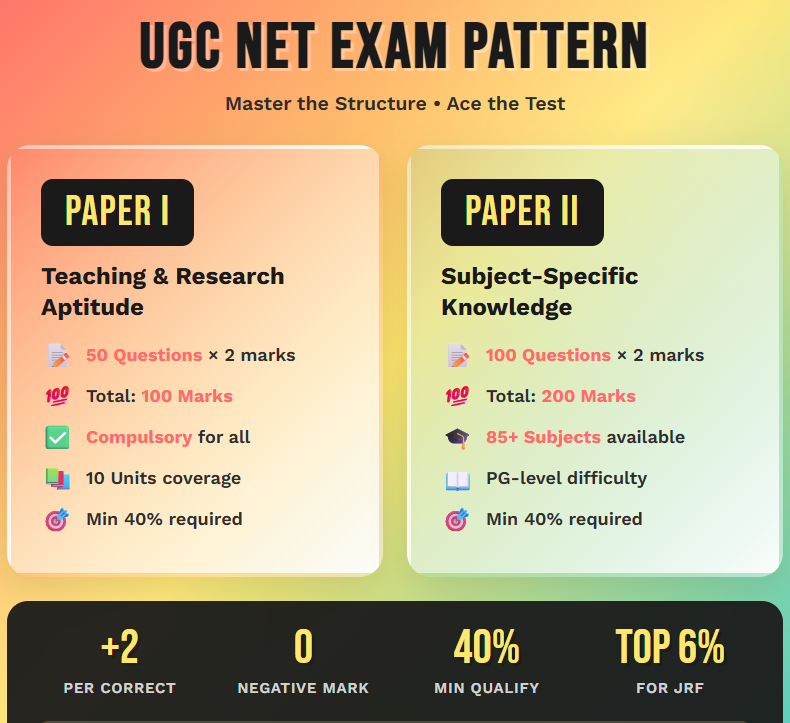
50 Questions for 100 Marks
Paper I comprises 50 compulsory multiple-choice questions worth 2 marks each, totaling 100 marks. The questions are distributed across 10 units covering diverse topics from teaching methodology and research aptitude to logical reasoning and data interpretation. Each question has four options, and you must select the most appropriate answer. All questions are compulsory; there is no choice within the paper.
Compulsory for All Candidates
Paper I is mandatory for all candidates appearing for UGC NET across all 85 subjects. Whether you are appearing for English Literature, Law, Commerce, Political Science, or any other subject, you will face the same Paper I questions as every other candidate in your examination shift. This common paper creates a level playing field and tests fundamental skills necessary for academic careers.
Paper II: Subject-Specific Knowledge Test
Paper II tests your in-depth knowledge of your chosen subject at a postgraduate level. This is where your subject expertise determines your overall score and ranking in the merit list.
100 Questions for 200 Marks
Paper II contains 100 multiple-choice questions worth 2 marks each, totaling 200 marks. The questions cover the entire syllabus of your chosen subject, testing both conceptual understanding and application-based knowledge. The difficulty level is generally higher than Paper I, reflecting the expectation that you have postgraduate-level mastery of your subject. Like Paper I, you need minimum 40% marks (80 out of 200) in Paper II to qualify.
85+ Subject Options Available
NTA offers 85 subjects for Paper II, covering humanities, social sciences, languages, sciences, commerce, law, and various interdisciplinary fields. The subject list includes popular options like Law, English, Hindi, Political Science, History, Economics, Commerce, Management, Psychology, Sociology, and many more. Each subject has a unique syllabus divided into 8-10 units, published on the NTA official website.
You must choose a subject that corresponds to or is closely related to your Master’s degree specialization. For instance, if your Master’s is in Commerce with Finance specialization, you should opt for Commerce as your Paper II subject. Review the complete subject list and syllabus before making your final decision, as you cannot change your subject after application submission except during the brief correction window.
Choosing Your Subject from 85 Options
Selecting the right Paper II subject is one of the most critical decisions in your UGC NET journey. Beyond matching your Master’s degree qualification, consider factors like your depth of knowledge, availability of study materials, competition level in that subject, and career opportunities after qualification. Some subjects have higher competition and cut-offs than others.
Download and thoroughly review the official syllabus of your intended subject before finalizing your choice. Cross-reference syllabus units with your Master’s coursework to identify topics you already know well and areas needing additional study. If your postgraduate degree covers multiple areas (like an interdisciplinary MA), choose the subject where your conceptual clarity is strongest.
Marking Scheme and Qualifying Criteria
Understanding the marking scheme helps you strategize your exam attempt for maximum scores. UGC NET has a candidate-friendly scoring system that rewards attempts without penalizing wrong answers.
+2 Marks Per Correct Answer with No Negative Marking
Each correct answer in both Paper I and Paper II earns you +2 marks. There is absolutely no negative marking for incorrect or unattempted questions. This means you should attempt every single question even if you are unsure, as guessing cannot hurt your score but might add valuable marks.
Minimum 40% Aggregate to Qualify
To qualify UGC NET, you must meet the minimum qualifying marks requirement. For General category candidates, this threshold is 40% aggregate marks in both the papers taken together. For reserved category candidates (SC, ST, OBC-NCL, PwD), the threshold is relaxed to 35% aggregate marks.
Top 6% Criteria for JRF Selection
Meeting minimum qualifying marks makes you eligible for consideration, but final qualification depends on cut-off percentiles. NTA prepares a merit list based on aggregate marks in both papers combined. Candidates scoring in the top 6% qualify for JRF (which includes Assistant Professor eligibility), while those meeting minimum thresholds but below top 6% qualify only for Assistant Professor eligibility. The actual cut-off marks vary each session based on exam difficulty and candidate numbers.
UGC NET Exam Syllabus
The UGC NET syllabus provides your preparation roadmap. Understanding what to study and how topics are distributed helps you allocate time efficiently and prioritize high-weightage areas. Let me break down the syllabus for both papers with strategic insights on where to focus your efforts.
UGC NET Paper I Syllabus
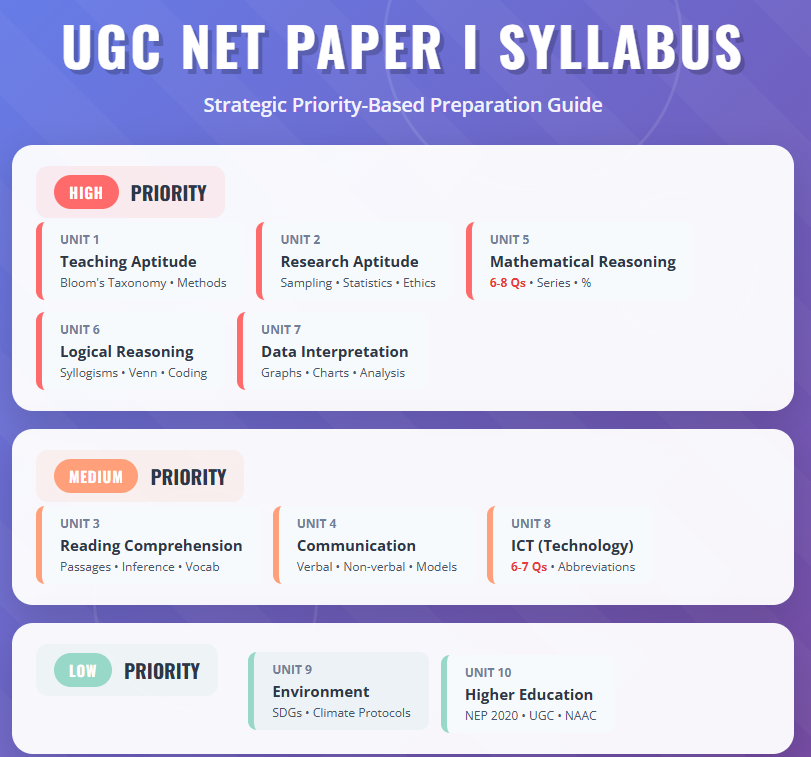
Paper I syllabus covers 10 units testing general aptitude for teaching and research. Based on previous year question analysis, certain units consistently contribute more marks than others, making strategic prioritization essential for scoring well.
Unit 1: Teaching Aptitude
Teaching Aptitude tests your understanding of what makes effective teaching and learning. Key topics include teaching concepts (nature, objectives, characteristics), levels of teaching (memory level, understanding level, reflective level), teaching methods (lecture, discussion, demonstration, project-based learning), and learner characteristics across different age groups. Bloom’s Taxonomy of educational objectives (knowledge, comprehension, application, analysis, synthesis, evaluation) is frequently tested.
Unit 2: Research Aptitude
Research Aptitude covers the research process from problem identification to thesis writing. Focus areas include research meaning and characteristics, types of research (fundamental, applied, action research; quantitative vs qualitative), research methods, hypothesis formulation (null vs alternative), sampling techniques (random, stratified, purposive, cluster sampling), and basic statistical concepts (mean, median, mode, standard deviation, correlation). Understanding research ethics and thesis structure is also tested. Together with Teaching Aptitude, this unit accounts for approximately 10-12 questions (20-24 marks) per exam.
Units 3-5: Comprehension, Communication, and Mathematical Reasoning
Unit 3 (Reading Comprehension) presents passages followed by questions testing understanding, inference-making, and vocabulary in context. Passages come from diverse topics including science, social issues, and current affairs. Unit 4 (Communication) covers verbal and non-verbal communication, barriers to effective communication, communication models, and classroom communication techniques. Unit 5 (Mathematical Reasoning) tests basic numerical ability including number series, percentages, ratios, profit-loss, time-work problems, and data sufficiency.
These three units together contribute approximately 15-18 questions per exam. Mathematical Reasoning questions have increased in recent cycles to 6-8 questions per shift, making it one of the most rewarding units for candidates comfortable with basic arithmetic. The questions follow predictable patterns: number/letter series, percentages, ratios, averages, and simple coding-decoding.
Units 6-7: Logical Reasoning and Data Interpretation
Unit 6 (Logical Reasoning) tests analytical thinking through syllogisms, Venn diagrams, coding-decoding, blood relations, direction sense, and critical reasoning questions requiring you to identify logical fallacies and evaluate arguments. Unit 7 (Data Interpretation) tests your ability to analyze data from tables, bar graphs, line graphs, pie charts, and mixed diagrams, requiring percentage calculations, ratio identification, and trend analysis.
These skill-based units reward consistent practice rather than mere memorization. Analysis of recent papers shows Logical Reasoning and Mathematical Reasoning combined contribute 10-12 questions per exam.
Units 8-10: ICT, Environment, and Higher Education System
Unit 8 (Information and Communication Technology) covers computer fundamentals, internet concepts, e-learning platforms, and government digital initiatives (SWAYAM, NPTEL, Digital India). Questions typically test abbreviations (HTTP, HTML, URL, LAN, WAN, TCP/IP) and basic cyber security concepts. Unit 9 (Environment) tests awareness of sustainable development, environmental issues, climate change, Sustainable Development Goals, and international environmental agreements (Paris Agreement, Kyoto Protocol, Montreal Protocol).
Unit 10 (Higher Education System) covers Indian higher education structure, UGC functions, accreditation bodies (NAAC, NBA), and National Education Policy 2020 provisions. NEP 2020 questions have become increasingly common in recent cycles. These units together contribute approximately 12-15 questions, with ICT receiving higher weightage in recent papers (sometimes 6-7 questions per shift).
Paper I: High-Weightage Topics to Prioritize
Based on analysis of previous year papers from 2019-2025, Teaching Aptitude and Research Aptitude together typically account for 20-24 marks, making them your scoring foundation. Logical Reasoning, Mathematical Reasoning, and Data Interpretation reward daily practice and can add another 20-24 marks for candidates with systematic preparation. ICT has emerged as a high-scorer due to its finite testable content; create a comprehensive abbreviation list and review it regularly.
For efficient preparation, allocate approximately 30-40% of your Paper I study time to high-priority units (Teaching, Research, Reasoning). Medium-priority units (Comprehension, Communication, ICT) need 2-3 days each for concept understanding followed by practice. Lower-priority units (Environment, Higher Education) can be covered through current affairs reading and targeted memorization of key facts like SDGs, environmental protocols, and NEP 2020 provisions.
UGC NET Exam Paper II Syllabus: Subject-Specific Coverage
Paper II syllabus for each of the 85 subjects is structured into 8-10 units covering core curriculum areas at postgraduate level. The depth expects thorough conceptual clarity, not surface-level awareness.
Subject-Wise Syllabus for Popular Subjects
Let me illustrate syllabus structure using popular NET subjects. English Literature covers British Literature (period-wise from Old English to Contemporary), American Literature, Indian Writing in English, Literary Criticism and Theory, and Language and Linguistics. Commerce covers Accounting, Business Management, Marketing, Finance, Human Resource Management, and Business Environment. Political Science includes Political Theory, Indian Political System, Comparative Politics, International Relations, Public Administration, and Political Thought (Western and Indian).
Law Paper II covers 10 units: Jurisprudence, Constitutional Law, Law of Torts, Law of Crimes, Law of Contracts, Family Law, Property Law, Administrative Law, Company Law, and International Law. Each unit has detailed sub-topics aligned with standard LLM curricula across Indian universities. The syllabus depth requires going beyond basic definitions to application-level understanding.
History covers Ancient, Medieval, Modern Indian History, World History, and Historiography. Economics covers Microeconomics, Macroeconomics, Statistics, Indian Economy, International Economics, and Development Economics. Each subject syllabus is available as a detailed PDF document with specific topics under each unit.
Download Official Subject-Wise Syllabus PDFs
Download official subject-wise syllabus for all 85 Paper II subjects from the UGC NET official website. These documents are available in both English and Hindi. Print your subject syllabus immediately after deciding to prepare; it becomes your preparation roadmap for tracking unit-wise progress.
Tips to prepare for UGC NET Exam
Preparation strategy separates candidates who qualify from those who don’t despite similar knowledge levels. A structured approach that accounts for available time, prioritizes high-weightage topics, and includes systematic practice through mock tests maximizes your chances of clearing UGC NET.
UGC NET Exam Preparation Timeline
Your preparation timeline should be realistic based on your current knowledge level, available daily study hours, and target session. Two common timelines work for most candidates.
6-Month Preparation Plan
A 6-month plan is ideal for comprehensive preparation, especially if you are appearing for UGC NET while completing other commitments. Divide your timeline into phases: Months 1-2 for completing Paper I syllabus with concept clarity, Months 2-4 for Paper II syllabus coverage unit by unit, Month 5 for revision and previous year paper analysis, and Month 6 for intensive mock tests and final revision.
Allocate approximately 4-6 hours daily with this timeline. Cover 2-3 Paper I units per week initially, then shift focus to Paper II while maintaining weekly Paper I revision. Create handwritten notes for quick revision, as writing reinforces memory better than passive reading. Track your progress against syllabus completion targets weekly.
3-Month Crash Course
If you have limited time, a 3-month intensive strategy can work with 6-8 hours daily dedicated study. Week 1-2: Complete Paper I high-priority units (Teaching, Research, Reasoning). Week 3-6: Cover Paper II syllabus focusing on high-weightage units first. Week 7-10: Intensive previous year paper practice and mock tests. Week 11-12: Revision and weak area reinforcement.
With this compressed timeline, prioritization becomes critical. Skip exhaustive coverage of low-weightage Paper I units like Environment and Higher Education; instead, rely on current affairs reading and targeted memorization. For Paper II, identify 3-4 units that consistently carry more questions and master those first.
Best Books for UGC NET Exam Paper I
The right study materials accelerate preparation by providing structured content aligned with the examination pattern. Different books serve different purposes; choose based on your learning style and gaps.
Recommended Study Material
For comprehensive Paper I preparation, Trueman’s UGC NET Paper 1 and Arihant’s UGC NET Paper 1 Guide are widely recommended and cover all 10 units adequately. KVS Madaan’s books are excellent specifically for Teaching Aptitude, providing detailed coverage of educational concepts and theories. R.S. Aggarwal’s Quantitative Aptitude helps with Mathematical Reasoning and Data Interpretation units through extensive practice questions.
For Research Aptitude specifically, C.R. Kothari’s Research Methodology (simplified edition) provides conceptual clarity on research types, methods, and statistical concepts at the level tested in UGC NET. Avoid overly technical research methodology books meant for PhD scholars; NET tests basic understanding, not advanced statistical analysis.
Free Resources and Online Materials
The NTA official website provides authentic syllabus documents and releases mock tests that simulate the actual examination interface. Previous year papers from 2018 onwards (when NTA took over) are available on various educational platforms including Testbook, JRF Adda, and INFLIBNET. These papers are your primary practice resource and should be solved systematically.
YouTube channels focusing on UGC NET preparation offer free video lectures covering each unit. Choose channels that provide structured, unit-wise content rather than scattered topic coverage. Quality channels explain concepts using practical examples and work through previous year questions, helping you understand how theoretical concepts translate into exam questions.
UGC NET Exam Paper II Preparation Tips
Paper II carries 200 marks compared to Paper I’s 100 marks, making it the dominant factor in your overall score. Strategic Paper II preparation builds on your existing postgraduate knowledge while filling gaps systematically.
Understanding Your Subject Syllabus Thoroughly
Begin Paper II preparation by downloading and printing the official syllabus for your subject from the NTA website. Read through each unit and honestly assess which topics you are comfortable with from your Master’s studies and which need additional learning. Create a unit-wise preparation plan allocating more time to weaker areas and less to topics you already know well.
Map your Master’s course content to NET syllabus units to leverage existing knowledge efficiently. Identify topics that were not covered in your curriculum or were covered superficially, as these need focused attention. Many candidates fail Paper II not because they lack subject knowledge but because they did not identify and address these gaps early enough.
Recommended Reference Books for Popular Subjects
Your Master’s level textbooks serve as excellent primary sources for Paper II. Standard reference works in your field provide the depth needed for higher-level questions. For Law, M.P. Jain’s Constitutional Law, Ratanlal and Dhirajlal’s Law of Crimes, and Avtar Singh’s Contract Law are essential. For English Literature, refer to David Daiches’ Critical History of English Literature and M.H. Abrams’ Glossary of Literary Terms.
Subject-specific NET guides published by Trueman’s, Arihant, and other publishers provide syllabus-aligned content with practice questions. While these guides are useful for revision and understanding question patterns, they should supplement, not replace, standard textbooks. Deep conceptual understanding from primary texts prepares you for application-based questions that guides alone cannot cover.
Previous Year Papers and Mock Tests
Previous year papers and mock tests bridge the gap between syllabus coverage and exam performance. They reveal examination patterns, test your knowledge under timed conditions, and identify areas needing improvement.
Solving Previous Years Question Papers
Previous year papers are your most valuable preparation resource for understanding question types, difficulty levels, and topic frequency. Analyzing papers from 2019-2025 reveals which units consistently contribute more questions, helping you prioritize intelligently. Many concepts repeat across years with slight variations; identifying these patterns ensures you are prepared for predictable questions.
Beyond topic frequency, previous papers teach you the examination’s language. Understanding how concepts are tested (definition-based, application-based, comparison-based) helps you prepare appropriately. Some units like Teaching Aptitude test theoretical definitions while others like Logical Reasoning require solving skills; previous papers reveal these distinctions clearly.
Mock Test Schedule for Time Management
Start attempting full-length mock tests about 6-8 weeks before the exam, once you have covered approximately 70% of the syllabus. Initially, focus on accuracy without strict time limits, then gradually introduce time constraints. Aim to complete at least 15-20 full-length mock tests before the actual exam. After each test, conduct thorough error analysis to identify patterns in your mistakes and target those areas in subsequent study sessions.
JRF vs Assistant Professor in UGC NET
Understanding the distinction between JRF and Assistant Professor eligibility helps you set appropriate goals and preparation strategies. These two qualifications have different requirements, benefits, and career implications.
Understanding Both Qualifications
UGC NET awards two types of qualifications based on your performance: Junior Research Fellowship (JRF) for top scorers and Assistant Professor eligibility (formerly called NET Lectureship) for those meeting minimum criteria.
JRF (Junior Research Fellowship)
JRF is awarded to candidates who score in the top 6% of all qualified candidates in their subject. JRF serves dual purposes: it qualifies you for Assistant Professor positions AND provides a monthly stipend for pursuing PhD research at any UGC-recognized institution. The fellowship amount is ₹37,000 per month for the first two years as Junior Research Fellow, increasing to ₹42,000 per month from the third year onwards as Senior Research Fellow (SRF), for a total tenure of up to five years.
Assistant Professor Eligibility
Assistant Professor eligibility is awarded to candidates who meet the minimum qualifying marks (40% in aggregate for General category, 35% for reserved categories) but do not score in the top 6% for JRF. This qualification makes you eligible to apply for Assistant Professor positions in universities and colleges across India but does not provide any fellowship or financial support for research.
The qualification is valid for life (there is no expiry), allowing you to apply for teaching positions whenever suitable vacancies arise. However, actual appointment depends on individual university recruitment processes, where you compete with other NET-qualified candidates and may face additional requirements like PhD (for certain positions) or institution-specific criteria.
Side-by-Side Comparison
Understanding the differences between JRF and Assistant Professor eligibility helps you decide where to focus your efforts and set realistic expectations.
Eligibility and Age Criteria
For Assistant Professor eligibility, there is no upper age limit. You can appear for UGC NET at any age and qualify for teaching positions. For JRF, the upper age limit is 30 years as on the first day of the month in which the notification is issued, with relaxations: 5 years for OBC-NCLT, SC, ST, PwD, and women candidates (making it 35 years), If you are above 30 but want an academic career, you can still qualify for Assistant Professor through NET; only the JRF option closes.
Selection Process: Top 6% vs 40% Aggregate
JRF selection is highly competitive. You must score in the top 6% of all qualified candidates in your subject. The actual cut-off marks vary by subject and session; popular subjects like English, Political Science, and Law typically have higher JRF cut-offs (often 55-65% aggregate marks) due to more candidates. Assistant Professor cut-off is the minimum qualifying marks: 40% in each paper for General category, 35% for reserved categories.
This means you can qualify for Assistant Professor with 120-140 marks out of 300 (depending on category), while JRF might require 165-195+ marks depending on subject. The gap between these thresholds defines the challenge of JRF qualification.
Financial Benefits: ₹37,000-₹42,000 Stipend vs Professor Salary
For this, you may refer to the preceding section on “Gateway to Teaching in Universities and Colleges”
Career Path: Research vs Teaching
JRF sets you on a research career path. You spend 5 years conducting doctoral research, potentially publishing papers and attending conferences. After PhD completion, career options include postdoctoral research, faculty positions (where your PhD plus JRF background strengthens applications), or research roles in institutions. JRF experience demonstrates research capability, valued for positions requiring independent investigation.
Assistant Professor eligibility alone sets you on a teaching-focused path. You apply for faculty positions, clear institution-specific interviews, and begin teaching immediately upon appointment. Many Assistant Professors pursue PhD part-time while teaching, but the primary focus remains classroom instruction and student mentorship rather than full-time research.
Qualifying for both UGC NET JRF and Assistant Professor
Ideally you should aim for JRF. If you score in the top 6%, you automatically receive both JRF and Assistant Professor eligibility. You can then choose to pursue PhD using the fellowship OR apply for teaching positions, or even do both simultaneously at certain institutions. The strategic implication is clear: prepare to maximize your score rather than just clearing cut-offs. Every additional mark improves your JRF chances. Even if you ultimately fall short of the top 6%, you still qualify as Assistant Professor, so nothing is lost by aiming higher.
UGC NET Exam Application Process
Understanding the application process helps you avoid last-minute complications. Remember: Making errors while filing the application form can delay your UGC NET journey by six months.
Registration, Form Filling, and Document Upload
The application process begins at ugcnet.nta.ac.in. First, register by providing basic details (name, email, mobile number) to generate your Application Number and Password. Store these credentials safely as they are required for all future interactions including admit card download and result checking.
After registration, log in to fill the detailed application form. Enter personal details (name, date of birth, father’s name), academic qualifications (Master’s degree details, percentage, passing year), category information, and examination preferences (Paper II subject, exam city choices). Double-check all entries before proceeding, as most fields cannot be edited after submission.
Upload scanned copies of your recent passport-size photograph (10-200 KB, JPEG format) and signature (4-30 KB, JPEG format). Photograph specifications are strict: white background, face clearly visible, no head covering unless for religious reasons. The signature should be in black or blue ink on white paper. Rejected photos and signatures are a common reason for application issues.
Application Fee for UGC NET Exam
The application fee varies by category: ₹1,150 for General/Unreserved and General-EWS candidates, ₹600 for OBC (NCL) candidates, and ₹325 for SC, ST, PwD, and Transgender candidates. Pay through Net Banking, Credit Card, Debit Card, or UPI using the payment gateway. After successful payment, download and save the confirmation page. If payment fails but amount is deducted, wait 72 hours before re-attempting; the amount will be refunded automatically for failed transactions.
UGC NET Exam Admit Card Download and Exam Day Guidelines
Admit cards are released approximately 7-10 days before the examination on the NTA portal. Download by logging in with your Application Number and Date of Birth. The admit card contains your name, roll number, examination date and time, exam center address, and important instructions. Print at least two copies on A4 paper and verify all details match your identity documents.
On examination day, reach the center at least 30 minutes before gate closing time. Carry your admit card, valid photo ID (Aadhaar/passport/voter ID), and passport-size photographs. Electronic devices including mobile phones are strictly prohibited inside examination premises. The CBT interface will be similar to any mock tests you have practiced; use the first few minutes to familiarize yourself with navigation if needed.

Career Opportunities and Salary After Clearing UGC NET Exam
UGC NET qualification transforms your career prospects in academia and beyond. Understanding the opportunities and compensation structures helps you appreciate the value of your qualification and plan your career trajectory.
Assistant Professor Salary Under 7th Pay Commission
The 7th Pay Commission significantly improved academic salaries in India, making Assistant Professor positions financially attractive compared to many private sector alternatives.
Level 10 Pay Scale: ₹57,700 to ₹1,82,400
NET-qualified Assistant Professors receive Level 10 pay scale under the 7th Pay Commission. The basic pay starts at ₹57,700 per month at entry level and can reach up to ₹1,82,400 at the maximum of the scale. Annual increments of 3% on basic pay ensure regular salary growth. This basic pay forms the foundation on which various allowances are calculated.
DA, HRA, and Other Allowances
Your total salary includes multiple allowances beyond basic pay. Dearness Allowance (DA) is currently 55% of basic pay (as of January 2025), adding ₹31,735 to a starting basic of ₹57,700. House Rent Allowance varies by city classification: 24% (metros like Delhi, Mumbai), 16% and 8% depending upon the city, calculated on basic pay. For a starting Assistant Professor in Delhi, HRA adds ₹13,848 monthly.
Other benefits include Transport Allowance, medical facilities, pension contributions (under National Pension System), and leave travel concession. Academic institutions may provide additional benefits like subsidized housing, research grants, and professional development allowances.
In-Hand Salary in Central vs State Universities
In central universities following UGC pay scales fully, the in-hand salary for a starting Assistant Professor typically ranges from ₹80,000 to ₹1,00,000 per month after accounting for NPS and tax deductions. State universities may have slightly lower salaries depending on state government pay implementation. Private institutions vary widely; some match government scales while others pay significantly less (₹40,000-₹60,000 range).
Career Opportunities After Qualifying UGC NET Exam
UGC NET opens multiple career pathways beyond the traditional Assistant Professor route. Understanding these options helps you leverage your qualification for maximum career benefit.
Teaching Positions in Universities and Colleges
The primary career path after NET qualification is appointment as Assistant Professor in universities and colleges. You can apply to central universities, state universities, deemed universities, autonomous colleges, and government-aided private colleges across India. Track recruitment notifications through university websites, Employment News, and the UGC website. Most institutions conduct written tests and interviews beyond NET qualification, so prepare for institution-specific recruitment processes.
Research Positions and PhD Opportunities
With JRF qualification, you access funded PhD programs at premier institutions. Many universities reserve seats for JRF holders or give preference in PhD admissions. Beyond PhD, research positions are available in government research bodies like ICSSR (Indian Council of Social Science Research), ICHR (Indian Council of Historical Research), and various CSIR laboratories. JRF experience strengthens your applications for postdoctoral positions and research associate roles.
Research institutions, think tanks, and policy organizations also value NET-qualified candidates for research analyst positions. Organizations like NCAER, CPR, ORF, and similar bodies hire researchers with demonstrated academic credentials.
EdTech, Coaching, and Content Development and Writing
UGC NET qualification creates opportunities beyond traditional academia. EdTech companies actively recruit NET-qualified subject experts for content development, online teaching, curriculum design, and quality assurance roles. Coaching institutes for competitive exams (including UGC NET coaching itself) value NET-qualified faculty, especially those who cleared JRF. Content writing, textbook authoring, and educational consulting are additional avenues where your expertise and NET credential add credibility.
Conclusion
UGC NET stands as your gateway to a fulfilling academic career, offering pathways to both teaching excellence and research accomplishment. Through this comprehensive guide, you now understand the examination from every angle: eligibility requirements, exam pattern, the strategic importance of prioritizing high-weightage units like Teaching Aptitude, Research Aptitude, and Logical Reasoning, and the qualification criteria distinguishing JRF (top 6%) from Assistant Professor eligibility (40% minimum).
The career rewards justify the preparation effort. Assistant Professor positions offer stable government employment with salaries starting at ₹57,700 basic pay (total ₹75,000-₹1,00,000 with allowances), while JRF provides ₹37,000-₹42,000 monthly to fund your doctoral journey. Whether you choose teaching, research, or alternative careers in EdTech and content development, UGC NET qualification establishes your academic credentials nationally.
Download your subject syllabus from the NTA website, create a structured study plan, and begin your journey toward academic excellence today.
Frequently Asked Questions About UGC NET Exam
Can final year postgraduate students apply for UGC NET?
Yes, final year postgraduate students can apply for UGC NET by selecting “Appearing” status in the application form. You must complete your Master’s degree with the required percentage (55% for General, 50% for reserved categories) within two years of appearing for NET. If you fail to meet this requirement, your NET qualification will be cancelled.
What is the difference between JRF and Assistant Professor in UGC NET?
JRF (awarded to top 6% scorers) provides ₹37,000-₹42,000 monthly fellowship for PhD research plus Assistant Professor eligibility. Assistant Professor eligibility (for those meeting 40% minimum) only qualifies you for teaching positions without any fellowship. JRF has an age limit of 30 years (with relaxations); Assistant Professor eligibility has no age limit.
Is there negative marking in UGC NET?
No, there is absolutely no negative marking in UGC NET. Each correct answer earns +2 marks, while incorrect or unattempted questions carry zero marks. This means you should attempt every question, as guessing cannot reduce your score.
How many months are needed to prepare for UGC NET?
Most successful candidates prepare for 4-6 months with 5-6 hours daily study. Working professionals with limited time should plan 6-8 months with focused weekend preparation. A 3-month intensive strategy can work with 6-8 hours daily dedicated study if you already have strong subject fundamentals.
What is the salary of an Assistant Professor after qualifying the UGC NET Exam?
Under the 7th Pay Commission, Assistant Professors receive Level 10 pay scale with basic pay starting at ₹57,700 per month. With Dearness Allowance (55%), House Rent Allowance (8-24%), and other benefits, total in-hand salary ranges from ₹75,000-₹1,00,000 in central universities. State university and private institution salaries vary.
Is there any age limit for UGC NET exam?
For Assistant Professor eligibility, there is no upper age limit. For JRF, the maximum age is 30 years with relaxations: 5 years for OBC-NCL, SC, ST, PwD, and women candidates (making it 35 years).
How many attempts are allowed for the UGC NET Exam?
There is no limit on the number of attempts for UGC NET. You can appear unlimited times until you qualify, subject to meeting eligibility criteria (especially age limit for JRF) each time you apply.
What happens if I score below 40% in Paper I but high in Paper II?
You will not qualify for UGC NET. Minimum 40% marks in Paper I (40 out of 100 for General category) is mandatory regardless of Paper II score. Both papers must independently meet the minimum threshold for qualification.
Can I apply for UGC NET with 50% marks in my Master’s degree?
Only if you belong to SC, ST, OBC-NCL, PwD, or third gender categories. General and General-EWS candidates require 55% marks minimum. Reserved category candidates get 5% relaxation, making 50% marks sufficient for eligibility.
What is the JRF stipend?
JRF fellows receive ₹37,000 per month during years 1-2 as Junior Research Fellow, and ₹42,000 per month during years 3-5 as Senior Research Fellow. Additional benefits include annual contingency grants (₹10,000 for humanities, ₹12,500 for sciences) and House Rent Allowance if hostel accommodation is not provided.
Is PhD mandatory to become an Assistant Professor after NET?
No, NET qualification alone makes you eligible for Assistant Professor positions. However, many institutions now require PhD for permanent appointments, and UGC guidelines stipulate completing PhD within a few years of appointment. Having NET is the eligibility gateway; PhD often becomes a selection advantage.
Can I change my Paper II subject after submitting the application?
No, subject change is not permitted after final application submission. You can only modify it during the brief correction window (typically 2-3 days after application deadline) if NTA activates this option. Choose your subject carefully before submission.
How do I download my UGC NET admit card?
Visit ugcnet.nta.ac.in, click on “Download Admit Card,” log in with your Application Number and Date of Birth, and download the PDF. Admit cards are released approximately 7-10 days before the examination. Print multiple copies and verify all details match your ID documents.




 Allow notifications