

Complete guide to UGC NET Exam covering eligibility, exam pattern, syllabus for Law and Commerce, application process, preparation strategies, and career opportunities after qualification.
Table of Contents
If you have been dreaming of an academic career in India, whether as an Assistant Professor at a prestigious university or as a funded researcher pursuing your PhD, you have probably heard about UGC NET. This single examination stands as the gateway to both teaching and research careers in higher education, and understanding it thoroughly can make the difference between years of confusion and a clear path forward.
The University Grants Commission National Eligibility Test, commonly known as UGC NET, is conducted by the National Testing Agency (NTA) on behalf of the UGC. This examination serves a dual purpose: it determines your eligibility for the position of Assistant Professor in Indian universities and colleges, and it awards the Junior Research Fellowship (JRF) to top performers who wish to pursue doctoral research with financial support. The JRF comes with a monthly stipend of ₹37,000 for the first two years, increasing to ₹42,000 from the third year onwards, making it one of the most sought-after fellowships for aspiring researchers.
In this comprehensive guide, we will walk you through everything you need to know about UGC NET, from eligibility requirements and exam patterns to syllabus breakdowns for Law and Commerce subjects, application procedures, preparation strategies, and what happens after you qualify. Whether you are a final year postgraduate student just beginning to explore your options or a working professional looking to transition into academia, this guide will serve as your complete roadmap to UGC NET success.

UGC NET Exam Details
Understanding the eligibility criteria is the first step toward appearing for the UGC NET exam. Candidates must meet specific educational qualifications and age requirements to apply for this national-level test.
Eligibility
Nationality
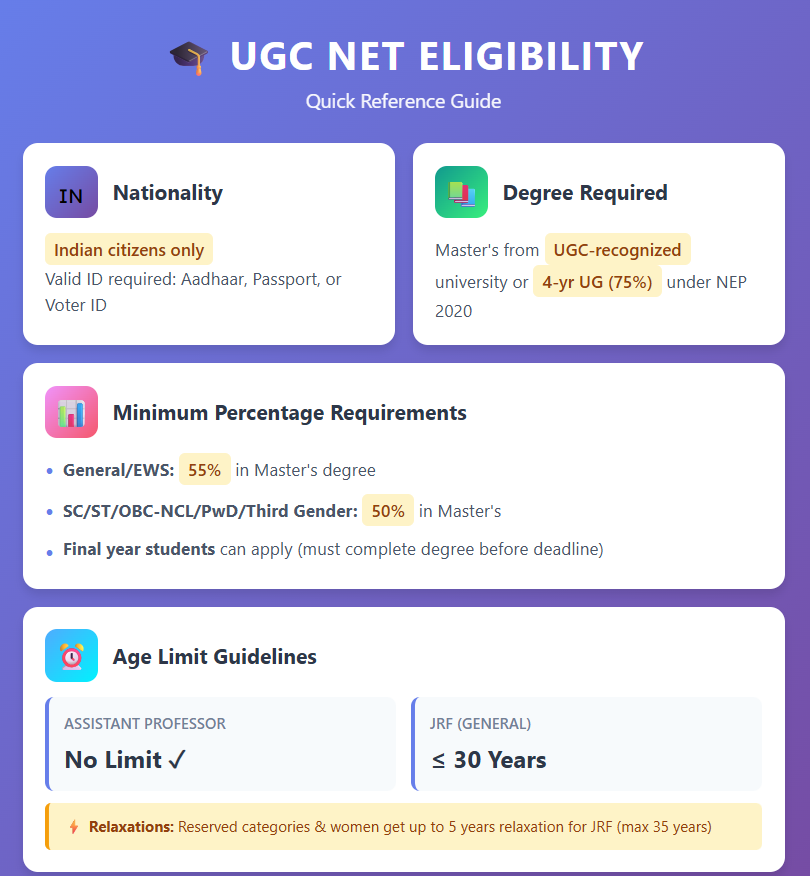
UGC NET is open exclusively to Indian nationals, and this eligibility criterion is verified twice; first during application submission and later during post-qualification document verification. Candidates must present valid government-issued identity proof such as Aadhaar card, passport, or voter ID both at the time of applying and on the examination day.
Educational Requirements
Master’s Degree from Recognized Universities
To appear for UGC NET, you must hold a Master’s degree or equivalent from a university or institution recognized by the University Grants Commission. The degree must be in a subject relevant to the Paper II subject you wish to appear for. This includes degrees obtained through regular mode, distance education, or open universities, provided the institution holds proper UGC recognition. Foreign degrees are also accepted if they have been validated by the Association of Indian Universities and for law students they have to ascertain their equivalence via Bar council of India.
Percentage Requirements: 55% for General/EWS and 50% for Reserved Categories
The minimum percentage requirement varies based on your category. If you belong to the General or Economically Weaker Section (EWS) category, you need at least 55% marks or an equivalent grade in your Master’s degree. This 55% threshold is calculated based on the aggregate marks across all semesters or years of your postgraduate programme.
For candidates belonging to reserved categories including SC (Scheduled Caste), ST (Scheduled Tribe), OBC-NCL (Other Backward Classes Non-Creamy Layer), PwD (Persons with Disabilities), and Third Gender, the requirement is relaxed to 50% marks. This relaxation recognizes the need for equitable representation in academic positions and ensures that qualified candidates from these categories are not excluded due to marginal differences in academic scores.
Final year postgraduate students may apply
If you are currently in the final year of your Master’s programme, you are eligible to apply for UGC NET. This provision allows you to attempt the examination while completing your degree, giving you a head start in your academic career. However, you must complete your degree with the required percentage before the deadline specified in the notification to maintain your eligibility for the certificate.
Four-Year Undergraduate Programme (FYUP) Eligibility Under NEP 2020
Under the National Education Policy 2020 provisions, candidates who have completed a four-year undergraduate programme with a minimum of 75% marks are also eligible for JRF and PhD admissions. This new pathway recognizes the restructured higher education system and provides opportunities for students from multidisciplinary undergraduate programmes to pursue research careers without necessarily completing a traditional two-year Master’s degree.
However, FYUP candidates aspiring to become Assistant Professors must complete a Master’s degree, as it remains a mandatory requirement for teaching positions in higher education institutions.
Age Limit for UGC NET Exam
No Age Limit for Assistant Professor Eligibility
Here is some excellent news for career changers and those who discovered their academic calling later in life: there is no upper age limit for appearing in UGC NET for Assistant Professor eligibility. Whether you are 25 or 55, if you meet the educational qualifications, you can appear for the examination and become eligible for teaching positions. This policy recognizes that valuable teaching experience and subject expertise can come at any age.
30 Years Maximum for JRF with Category-Wise Relaxations
For the Junior Research Fellowship, however, there is an age restriction. General category candidates must not exceed 30 years of age as on the first day of the month in which the exam is concluded i.e. 1st June/1st December. Reserved category candidates (OBC-NCL, SC, ST, PwD) and women receive up to 5-year relaxation, extending the limit to 35 years, 3 years for LLM holders, and up to 5 years for research experience and armed forces service. However, total relaxation across all grounds is strictly capped at 5 years maximum.
UGC NET Exam Details: Exam Pattern
The UGC NET examination follows a computer-based test (CBT) format conducted at designated centres across India. The entire examination consists of two papers conducted in a single session of 3 hours without any break in between. Paper I tests your general teaching and research aptitude through 50 multiple-choice questions worth 100 marks, while Paper II evaluates your subject-specific knowledge through 100 questions worth 200 marks. The total marks for both papers combined is 300.
One of the most candidate-friendly aspects of UGC NET is the absence of negative marking. Every correct answer earns you 2 marks, while incorrect or unattempted questions simply carry zero marks. This means you should attempt every single question, even if you need to make an educated guess, since there is no penalty for wrong answers. This marking scheme significantly changes your exam strategy compared to examinations with negative marking.
Time management becomes crucial since you need to answer 150 questions in 180 minutes, giving you approximately 72 seconds per question. Most successful candidates recommend spending around 50-60 minutes on Paper I and reserving 120-130 minutes for Paper II, though you have the flexibility to allocate time as per your strengths. The CBT interface allows you to navigate between papers and mark questions for review, so you can return to challenging questions after completing the easier ones.
Both papers are conducted in succession without any interval, and you cannot leave the examination hall before the full duration is complete. The medium of examination is available in both English and Hindi, except for language-specific subjects. Familiarizing yourself with the CBT interface through NTA’s mock tests available on the official UGC NET portal is highly recommended before your actual examination.
UGC NET Exam Details: Syllabus
Understanding the syllabus is the foundation of effective UGC NET preparation. The examination tests your knowledge across two distinct areas: Paper I covers teaching and research aptitude common to all subjects, while Paper II is specific to your chosen subject from among 83 available options. Below, we will cover the Paper I syllabus applicable to everyone, followed by detailed breakdowns for two popular subjects: Law and Commerce.
Syllabus for UGC NET Paper 1
Paper I is the common paper that every UGC NET aspirant must clear, regardless of their chosen subject. It consists of 50 multiple-choice questions worth 100 marks, testing your aptitude for teaching and research careers in higher education. The syllabus is divided into 10 comprehensive units, and understanding each unit thoroughly is essential since you need to score at least 40% (35% for reserved categories) in the aggregate to qualify.
Unit 1: Teaching Aptitude forms the conceptual foundation of your future teaching career. This unit covers the nature, objectives, characteristics, and basic requirements of teaching at different levels. You need to understand the three levels of teaching: Memory level (where students simply recall information), Understanding level (where students comprehend and explain concepts), and Reflective level (where students analyze, evaluate, and create new ideas). The unit also covers learner characteristics including how age, motivation, prior knowledge, and learning styles affect the learning process. Various teaching methods like lecture, discussion, demonstration, and project-based learning are tested, along with their advantages and limitations.
Unit 2: Research Aptitude evaluates your understanding of the research process from problem identification to conclusion. This unit covers types of research including fundamental research (pure research aimed at expanding knowledge), applied research (solving practical problems), and action research (improving specific practices). You should understand the differences between qualitative research, quantitative research, and mixed-methods approaches. Key concepts include variables (independent, dependent, intervening), sampling methods (probability and non-probability), hypothesis formulation, research ethics (informed consent, confidentiality, plagiarism), and thesis writing. Your postgraduate dissertation experience provides a practical foundation for this unit.
Unit 3: Reading Comprehension tests your ability to understand, analyze, and draw inferences from written passages. This unit typically presents one or more passages of 300-500 words followed by 5-6 questions. Passages cover topics from social sciences, humanities, science and technology, or current affairs. Question types include direct factual questions (answers explicitly stated in the passage), inference-based questions (drawing logical conclusions), vocabulary questions (meaning of words in context), and questions about the author’s tone, purpose, or main argument. The strategy is to read questions first, then scan the passage for relevant answers.
Unit 4: Communication covers the nature and characteristics of communication essential for effective teaching. You need to understand the basic communication model: sender, message, channel, receiver, feedback, and noise. The unit distinguishes between verbal communication (spoken and written words) and non-verbal communication (body language, gestures, facial expressions, eye contact). Different levels of communication including intrapersonal, interpersonal, group, and mass communication are covered. Classroom communication skills, barriers to effective communication (physical, psychological, semantic, cultural), and methods to overcome these barriers are frequently tested topics.
Unit 5: Mathematical Reasoning tests your numerical aptitude through number series, percentages, ratios, and basic calculations. Number series questions present sequences following hidden patterns where you must identify the next or missing number. Patterns can involve addition, subtraction, multiplication, division, squares, cubes, or combinations. Percentage questions test calculating percentages, percentage change, and converting between fractions, decimals, and percentages. This unit rewards practice, and learning mental math shortcuts significantly improves your speed and accuracy during the examination.
Unit 6: Logical Reasoning is a high-scoring unit testing your ability to think systematically and draw valid conclusions. Syllogisms are logical arguments where conclusions are drawn from two given statements, and Venn diagrams help visualize these relationships quickly. Analogies test your ability to identify relationships between pairs of concepts (synonyms, antonyms, part-whole, cause-effect, tool-user relationships). Understanding deductive reasoning (general to specific, conclusions necessarily true) versus inductive reasoning (specific to general, conclusions probable) is important. Common logical fallacies including hasty generalization, circular reasoning, and false cause are also covered.
Unit 7: Data Interpretation presents data in tables, bar graphs, line graphs, and pie charts, requiring you to analyze, compare, and draw conclusions. Questions typically involve calculating percentages, ratios, averages, or growth rates from given data. You may need to compare performance across categories or time periods, identify trends, or find maximum/minimum values. The key strategy is reading questions first to understand what information you need, then looking at the data selectively. Approximation skills are valuable since exact calculations are often unnecessary when answer options are sufficiently spread apart.
Unit 8: Information and Communication Technology (ICT) tests your familiarity with computer basics, internet technologies, and digital initiatives. The Digital India initiative and its key pillars (broadband highways, universal mobile connectivity, e-governance, e-kranti) are frequently tested. E-governance models (G2C, G2B, G2G, G2E) and DigiLocker appear regularly. Cyber security concepts including malware, phishing, hacking, and protective measures are important. ICT in education covers e-learning platforms, MOOCs, SWAYAM, NPTEL, virtual classrooms, and concepts like blended learning and flipped classroom.
Unit 9: People, Development, and Environment covers sustainable development, environmental issues, and the relationship between human activities and the natural environment. Sustainable development (meeting present needs without compromising future generations’ ability) and its three pillars (economic, social, environmental sustainability) are core concepts. The United Nations Sustainable Development Goals (SDGs) adopted in 2015 with 17 goals for 2030 are frequently tested. Environmental legislation including Environment Protection Act 1986, Wildlife Protection Act 1972, and Air and Water Pollution Acts are covered. International agreements like the Paris Agreement, Kyoto Protocol, and Convention on Biological Diversity are important topics.
Unit 10: Higher Education System in India tests your understanding of how higher education is structured and governed in India. The National Education Policy 2020 is a landmark reform document with key provisions including multidisciplinary universities, flexible curriculum with multiple entry-exit options, Academic Bank of Credits, and four-year undergraduate programmes. The University Grants Commission (UGC) functions as the primary regulatory body, and you should understand its roles in coordinating standards, providing grants, and framing regulations. NAAC accreditation (evaluating institutions on seven criteria with grades from A++ to C) and NIRF ranking parameters are important contemporary topics that appear regularly in questions.
For a detailed understanding on complete unit-wise breakdown of UGC NET Paper 1 with preparation strategies, recommended books, and previous year question analysis, you can refer to the our articles linked herein.
Syllabus for UGC NET Paper 2
Law
The UGC NET Law Paper II syllabus is divided into 10 comprehensive units covering the entire spectrum of legal education. Unit I covers Jurisprudence, including nature and sources of law, schools of jurisprudence (Natural Law, Positivism, Realism, Sociological School), concepts of rights and duties, legal personality, and theories of liability. This unit forms the theoretical foundation and typically contributes 8-10 questions.
Unit II on Constitutional and Administrative Law is one of the highest-weightage units, covering the Preamble, Fundamental Rights and Duties, Directive Principles, executive and legislative structures, judiciary, emergency provisions, and principles of natural justice. Unit III covers Public International Law and International Humanitarian Law, including recognition of states, nationality, extradition, UN organs, and Geneva Conventions. Unit IV examines Law of Crimes, covering criminal liability principles, stages of crime, general exceptions, and various categories of offences under the new Bharatiya Nyaya Sanhita 2023.
The remaining units cover Unit V (Law of Torts and Consumer Protection), Unit VI (Commercial Law including contracts, sale of goods, partnership, negotiable instruments, and company law), Unit VII (Family Law across different personal law systems), Unit VIII (Environment and Human Rights Law), Unit IX (Intellectual Property Rights and Information Technology Law), and Unit X (Comparative Public Law and Systems of Governance). For complete unit-wise topic details, refer to our detailed UGC NET Law Paper II syllabus guide.
Commerce
The UGC NET Commerce Paper II comprises 10 units covering diverse areas of commerce and business studies. Unit 1 covers Business Environment and International Business, including globalisation, trade policies, and business ethics. Unit 2 on Accounting and Auditing is the highest-weightage unit, typically contributing 12-15 questions and covering financial accounting, cost accounting, management accounting, and auditing standards.
Unit 3 examines Business Economics with demand-supply analysis, production theory, market structures, and macroeconomic concepts. Unit 4 covers Business Finance including time value of money, capital budgeting, capital structure theories, and working capital management. Unit 5 combines Business Statistics and Research Methods, testing statistical tools, probability, hypothesis testing, and research methodology concepts.
Unit 6 covers Business Management and Human Resource Management, including management theories, planning, organizing, HRM functions, and industrial relations. Unit 7 focuses on Banking and Financial Institutions, covering RBI functions, monetary policy, and current banking developments. Unit 8 examines Marketing Management including consumer behaviour and digital marketing. Unit 9 covers Legal Aspects of Business with key commercial legislations, and Unit 10 addresses Income Tax and Corporate Tax Planning. For detailed weightage analysis and preparation strategies, explore our complete UGC NET Commerce Paper II guide.
UGC NET Exam Marking Scheme and Qualifying Criteria
Every correct answer in UGC NET earns you 2 marks, regardless of whether it appears in Paper I or Paper II. The exam follows a straightforward scoring system with absolutely no negative marking for incorrect answers, while unattempted questions carry zero marks. This candidate-friendly approach eliminates the penalty associated with guessing, making it a significant advantage you should leverage.
Given this no-penalty structure, your exam strategy should be clear: attempt every single question. Even when you’re completely unsure about an answer, take the time to eliminate obviously incorrect options and make an educated guess from what remains. Since there’s no risk of losing marks, attempting all questions statistically increases your chances of scoring higher compared to leaving blanks.
However, attempting questions is only part of the equation; you must also meet the minimum qualifying thresholds. For General/Unreserved and EWS candidates, you need to score at least 40% aggregate across both papers, which equals 120 marks out of 300. Reserved category candidates (OBC-NCL, SC, ST, PwD, Third Gender) require 35% aggregate, translating to 105 marks out of 300. While meeting these percentages is mandatory for qualification, it’s important to understand that they represent only the minimum requirement. The actual cut-off marks vary each session depending on the competition level and overall performance of candidates.
Cut-Off for UGC NET Exam
The cut-off for Assistant Professor eligibility is notably lower than the JRF cut-off, as JRF is reserved for top performers. For instance, this time around, the General category JRF cut-off for Commerce was approximately 224 marks, while Assistant Professor eligibility required around 194 marks, showing a typical gap of 20 marks. Understanding this distinction helps you set realistic targets; if your goal is Assistant Professor eligibility, aim comfortably above the qualifying threshold, but if you’re targeting JRF, prepare for significantly higher competitive scores.
Cut-offs vary considerably across subjects based on competition levels and candidate performance. Popular subjects like Commerce, English, and Education typically see higher cut-offs due to larger candidate pools, while niche subjects may have lower cut-offs but fewer positions. Law generally falls in the moderate range, with JRF cut-offs between 180-200 marks for the General category, though these figures fluctuate by session.
Historical trends reveal that cut-offs have been steadily rising as more candidates adopt systematic preparation methods and competition intensifies. To stay competitive, analyze previous year cut-offs specific to your subject and use them to set achievable targets. Benchmark your mock test performance against these figures to gauge your readiness and adjust your preparation strategy accordingly.
UGC NET Exam Application Process: Step-by-Step Guide
Finding Information on Official UGC NET Portals
The official website for UGC NET is https://ugcnet.nta.ac.in/, which serves as your primary source for all authentic information regarding notifications, applications, admit cards, and results. The NTA also maintains the general portal for updates across all examinations it conducts. For syllabus downloads, you can visit the UGC NET Online syllabus portal. Always verify information from these official sources rather than relying on third-party websites to avoid misinformation.
Register and Apply for UGC NET Exam Online
Creating Your Account on the NTA Portal
The first step is visiting the official NTA UGC NET website and clicking on the registration link for the current examination cycle. You will need to provide basic details including your name, date of birth, mobile number, and email address. Upon successful registration, the system generates a unique application number and password, which you must save securely. This application number serves as your identifier throughout the examination process, from application to certificate download.
Filling Personal, Educational, and Exam Details
After registration, log in to complete your application form with detailed personal information including address, identification details, and category certificates if applicable. The educational details section requires information about your qualifying degree, university, year of passing, and percentage obtained. Ensure accuracy in these details as discrepancies can lead to application rejection or certificate cancellation later.
Selecting Exam City and Subject Preferences
You can select up to four preferred examination cities, and the NTA allots centres based on availability. Choose cities you can easily travel to, keeping in mind that the examination may be scheduled across multiple days.
Subject selection for Paper II is crucial and cannot be changed after submission, so verify that you are selecting the correct subject code from the 83 available options.
Uploading Photograph, Signature and Category Certificates: Exact Specifications
The photograph must be a recent passport-sized colour image with white or light background, in JPEG format between 10-200 KB. Your signature should be in running handwriting (not block letters) on white paper with black ink, in JPEG format between 4-30 KB. Category certificates for reserved category candidates must be uploaded in the prescribed format. Ensure all documents meet the exact specifications mentioned in the Information Bulletin to avoid rejection.
Application Fee and Payment Methods
Category-Wise Fee (General, OBC, SC/ST, PwD)
The application fee for UGC NET Exam is as follows: General/Unreserved candidates pay ₹1,150, OBC-NCL candidates pay ₹600, and SC/ST/PwD/Third Gender candidates pay ₹325. The fee is non-refundable under any circumstances, so ensure you meet all eligibility criteria before applying.
Online Payment Options: Cards, Net Banking, UPI
Payment can be made through multiple online modes including credit cards, debit cards, net banking, UPI, and digital wallets like Paytm. The payment gateway is secure and provides instant confirmation. Keep your device charged and ensure stable internet connectivity during the payment process to avoid transaction failures.
After successful payment, download and save the payment confirmation receipt immediately. This receipt serves as proof of your completed application and may be required for future reference. The system also sends confirmation to your registered email and mobile number, but maintaining your own copy is advisable.
Preparation Tips for UGC NET Exam
Mastering Teaching Aptitude and Research Methodology
Teaching Aptitude and Research Methodology form the conceptual core of Paper I and together contribute approximately 10-12 questions. For Teaching Aptitude, focus on understanding levels of teaching (memory, understanding, reflective), learner characteristics, teaching methods, and evaluation techniques. Create flashcards for key concepts and their proponents since matching questions are common.
Research Methodology requires understanding the entire research process from problem formulation to report writing. Focus on types of research (fundamental, applied, action), research designs, sampling methods, and data collection techniques. Since many postgraduate students have dissertation experience, connect these theoretical concepts to your practical research work for better retention.
Building Skills in Logical Reasoning and Data Interpretation
Logical Reasoning and Data Interpretation are skill-based units that improve significantly with practice. For Logical Reasoning, master syllogisms using Venn diagrams, practice analogies systematically, and understand deductive versus inductive reasoning. Dedicate at least 30 minutes daily to solving reasoning problems during your preparation period.
Data Interpretation involves analyzing tables, bar graphs, line graphs, and pie charts. The calculations are not complex, but speed matters. Practice approximation techniques since exact calculations are often unnecessary when answer options are sufficiently spread apart. Previous year questions from these units are your best practice material.
Staying Updated on ICT, Environment, and Higher Education
These three units require a combination of conceptual understanding and current awareness. For ICT, study Digital India initiatives, e-governance schemes, cyber security basics, and ICT applications in education. For Environment, focus on sustainable development concepts, international environmental agreements, and Indian environmental legislation.
Higher Education System questions often reference recent policy changes, so stay updated on NEP 2020 provisions, UGC regulations, NAAC accreditation processes, and NIRF ranking parameters. Following UGC’s official website and education news portals helps you stay current with developments that may appear in questions.
UGC NET Paper II Preparation Approach
Mapping Your Master’s Curriculum to UGC NET Syllabus
Your postgraduate coursework provides a strong foundation for Paper II preparation. Compare your Master’s syllabus with the UGC NET Paper II syllabus for your subject and identify overlapping areas. For these topics, revision may suffice rather than fresh learning. Identify gaps where your curriculum did not cover NET syllabus topics and prioritize those for dedicated study.
Identifying High-Weightage Topics and Frequently Asked Topics
Not all topics carry equal weightage in the examination. Analyse previous year papers to identify units and topics that consistently feature heavily. For Law, Constitutional Law, Jurisprudence, and Criminal Law typically have higher representation. For Commerce, Accounting and Auditing, Business Finance, and Management dominate. Allocate preparation time proportionate to weightage while ensuring no unit is completely neglected.
Creating Subject-Specific Notes and Mind Maps
Active note-making significantly improves retention compared to passive reading. Create concise notes for each unit, highlighting key concepts, important case laws or theorists, and potential MCQ areas. Mind maps work exceptionally well for units with interconnected concepts, helping you visualize relationships and recall information during the examination.
Best Books for UGC NET Exam
Recommended Books for Paper I Preparation
Trueman’s UGC NET Paper 1 by M. Gagan provides comprehensive coverage of all 10 units with practice questions. Arihant’s UGC NET Paper 1 Guide is another reliable option with model papers included. For specific units, RS Aggarwal’s books help with Logical Reasoning practice, though they are general aptitude books rather than NET-specific.
Subject-Wise Standard Reference Books for Popular Paper II Subjects
For Law, M.P. Jain’s Indian Constitutional Law is essential for Unit II, while N.V. Paranjape covers Jurisprudence effectively. K.D. Gaur’s textbook on Indian Penal Code and Ratanlal & Dhirajlal’s commentary serve Criminal Law preparation. For Commerce, Trueman’s UGC NET Commerce guide provides integrated coverage, while subject-specific texts like those by Avtar Singh (Commercial Law) and I.M. Pandey (Financial Management) offers depth.
Free Online Resources and Government Portals
Numerous YouTube channels offer comprehensive UGC NET preparation content, including subject-wise video lectures, paper pattern analysis, and previous year question discussions completely free of cost. Additionally, educational websites and government portals like UGC-NET official website and INFLIBNET provide free study materials, sample papers, and e-resources that can supplement your preparation.
Additionally, the NTA official website provides free mock tests familiarizing you with the CBT interface. For syllabus updates and official notifications, regularly check both NTA and UGC websites. Government portals like India Code provide access to bare acts essential for Law preparation.
Solving Previous Year Papers and Mock Tests for UGC NET Exam
Previous year papers are your most valuable preparation resource as they reveal actual question patterns, difficulty levels, and topic emphasis better than any textbook or coaching material. They demonstrate how concepts are tested in MCQ format, which often differs from descriptive examinations, and many questions or their variations repeat across sessions, making PYQ practice directly scoring. Understanding these patterns gives you a significant advantage in knowing what to expect and how to approach different question types.
To maximize practice benefits, begin with sectional mock tests after completing each unit to reinforce learning immediately. Transition to full-length mock tests 6-8 weeks before the exam, aiming to complete at least 15-20 tests under actual examination conditions including time limits and CBT interface simulation.
Time Management and Revision Tips
Creating a 3-6 Month Study Plan
For comprehensive preparation, a 6-month timeline works best. Dedicate the first 3-4 months to syllabus completion, covering both Paper I and Paper II systematically. Allocate time proportionate to unit weightage, spending more hours on high-scoring units. Create weekly targets and track progress to maintain accountability.
If you have only 3 months, adopt an intensive approach. Cover high-weightage units thoroughly in the first 6 weeks, complete the remaining syllabus in the next 3 weeks, and reserve the final 3 weeks for revision and mock tests. Daily study time should be 4-6 hours minimum, with longer sessions on weekends.
Last Month Revision Techniques
The final month should focus exclusively on revision and practice, not new learning. Revise from your own notes rather than re-reading textbooks. Solve at least one full-length mock test every alternate day. Focus on weak areas identified through mock analysis while maintaining strong areas through quick revision. Avoid starting new topics in the last two weeks.
UGC NET Exam Admit Card
The NTA typically releases admit cards 15-20 days before the examination date. To download your admit card, visit the official UGC NET website, click the admit card download link, and enter your application number and date of birth. Once downloaded, carefully verify all details including your name, photograph, examination centre address, and reporting time before taking multiple printouts, as the admit card is mandatory for entry.
If you notice any discrepancies in personal details, centre allocation, or photograph, contact the NTA helpline immediately rather than waiting until exam day. Minor errors such as spelling mistakes may be corrected at the examination centre with proper supporting documents like your original ID proof. However, for significant errors that could affect your eligibility or create entry issues, raise a formal grievance through the official redressal mechanism well before the examination date to ensure timely resolution.
UGC NET Online Exam
Navigating the CBT Interface
The computer-based test interface displays one question at a time with four options. Navigation buttons allow you to move between questions, jump to specific question numbers, or switch between Paper I and Paper II. The question palette on the right shows colour-coded status: not visited, answered, marked for review, and answered but marked for review.
Spend the first few minutes familiarizing yourself with the interface before diving into questions. The clock displays remaining time prominently. Use the scroll functionality if questions contain images or lengthy text. Practice on NTA’s official mock tests to build comfort with the interface before the actual examination.
Marking Questions for Review and Time Management
The “Mark for Review” feature is your strategic tool for time management. If a question seems solvable but time-consuming, mark it for review and move on. After completing easier questions, return to marked questions using the question palette. This prevents you from getting stuck on difficult questions early and missing easier ones later.
Paper-Wise Time Allocation During UGC NET Exam
The 3-hour duration requires strategic time allocation between 150 questions. A common approach is spending 50-60 minutes on Paper I (50 questions) and 120-130 minutes on Paper II (100 questions). This gives you approximately 70 seconds per question in Paper I and 75 seconds per question in Paper II.
However, adjust this based on your strengths. If you are confident in Paper I, you might complete it in 45 minutes, leaving more time for Paper II. The key is practicing your time allocation during mock tests until you find your optimal rhythm. Always reserve the last 10 minutes for reviewing marked questions and ensuring all questions are attempted.
UGC NET Result
UGC NET Result Declaration Process
UGC NET results are typically declared 2-3 months after the examination, so for December 2025, expect results in March-April 2026 with official notifications sent to registered email addresses and mobile numbers. To check your result, visit the official NTA UGC NET website, enter your application number and date of birth, and access your scorecard displaying marks in both papers, total aggregate, qualifying status (JRF, Assistant Professor, or PhD eligible), and category-wise rank. Download and save multiple copies of your scorecard immediately for future reference and documentation purposes.
Before final results are declared, NTA releases provisional answer keys along with your recorded responses for verification and challenge. If you believe any answer is incorrect, you can challenge it by paying ₹200 per question through the online grievance system within the 2-3 day challenge window, and expert committees review these objections. Successful challenges lead to revised answer keys with fee refunds, and many candidates have improved their scores through this process, so carefully compare your responses against the provisional key if you have valid contestations.
UGC NET Exam Scorecard
Your UGC NET scorecard contains your personal details, subject code and name, marks obtained in Paper I and Paper II, total aggregate marks, category, qualifying status, and all-India rank (for JRF qualifiers). The scorecard also mentions the validity period and can be downloaded from the NTA website for up to one year after result declaration.
UGC NET Certificate Download and Validity
Download Your NET Qualification Certificate
After result declaration, qualified candidates can download their e-certificates from the NTA website. The certificate is digitally signed and verifiable, eliminating the need for physical copies in most recruitment processes. The certificate mentions your name, roll number, subject, qualifying status (JRF/Assistant Professor/PhD admission), and date of qualification.
Certificate Validity Period and Usage
The Assistant Professor eligibility certificate is valid for lifetime once you qualify. However, the JRF award must be availed within a specified period from the result declaration date, typically three years. The certificate number can be verified by recruiters through the NTA verification portal, ensuring authenticity.
Your Next Steps After Qualifying
Qualifying UGC NET opens multiple pathways. For Assistant Professor positions, start applying to universities and colleges through their recruitment portals and employment news notifications. Maintain updated CVs and prepare for interviews that test both subject knowledge and teaching demonstration skills.
For JRF recipients, identify universities and research supervisors in your area of interest. Apply for PhD admission, which typically involves an interview since NET qualifiers are often exempt from entrance tests. Complete the JRF activation process through the UGC portal to start receiving your fellowship amount after PhD enrolment.
Category-Wise Reservation Policy in UGC NET
UGC NET follows the Government of India’s reservation policy for determining cut-offs and JRF allocation. The reservation percentages are: SC (15%), ST (7.5%), OBC-NCL (27%), General-EWS (10%), and PwD (with 40% or more disability) (5% horizontal reservation across all categories). These reservations apply to the JRF award and ranking, ensuring equitable representation in research fellowships.
For Assistant Professor eligibility, separate cut-offs are determined for each category based on their respective candidate pools. This means SC, ST, OBC-NCL, and PwD candidates compete within their category pools for determining qualified numbers, though the qualifying percentage requirement itself is relaxed to 35% (compared to 40% for General/EWS). EWS candidates have the same 40% qualifying requirement as General category but benefit from separate cut-offs.
Candidates must possess valid category certificates issued by competent authorities to avail reservation benefits. OBC-NCL candidates must ensure their certificates include the non-creamy layer clause and are valid for the current year. PwD candidates require certificates specifying at least 40% disability from authorized medical boards. False category claims lead to disqualification and potential legal consequences.
Career Opportunities and Salary After UGC NET Qualification
UGC NET qualification transforms your career prospects in academia and beyond. Understanding the opportunities and compensation structures helps you appreciate the value of your qualification and plan your career trajectory.
Assistant Professor Salary Under 7th Pay Commission
The 7th Pay Commission significantly improved academic salaries in India, making Assistant Professor positions financially attractive compared to many private sector alternatives. NET-qualified Assistant Professors receive Level 10 pay scale under the 7th Pay Commission. The basic pay starts at ₹57,700 per month at entry level and can reach up to ₹1,82,400 at the maximum of the scale. Annual increments of 3% on basic pay ensure regular salary growth.
Your total salary includes multiple allowances beyond basic pay. Dearness Allowance (DA) is currently 55% of basic pay (as of January 2025), adding ₹31,735 to a starting basic of ₹57,700. House Rent Allowance varies by city classification: 24% (metros like Delhi, Mumbai), 16% and 8% depending upon the city, calculated on basic pay. For a starting Assistant Professor in Delhi, HRA adds ₹13,848 monthly.
Other benefits include Transport Allowance, medical facilities, pension contributions (under National Pension System), and leave travel concession. Academic institutions may provide additional benefits like subsidized housing, research grants, and professional development allowances.
Career Opportunities After UGC NET Qualification
Teaching Positions in Universities and Colleges
The primary career path after NET qualification is appointment as Assistant Professor in universities and colleges. You can apply to central universities, state universities, deemed universities, autonomous colleges, and government-aided private colleges across India. Track recruitment notifications through university websites, Employment News, and the UGC website. Most institutions conduct written tests and interviews beyond UGC NET qualification, so prepare for institution-specific recruitment processes.
Research Positions and PhD Opportunities
With JRF qualification, you access funded PhD programs at premier institutions. Many universities reserve seats for JRF holders or give preference in PhD admissions. Beyond PhD, research positions are available in government research bodies like ICSSR (Indian Council of Social Science Research), ICHR (Indian Council of Historical Research), and various CSIR laboratories. JRF experience strengthens your applications for postdoctoral positions and research associate roles. Research institutions, think tanks, and policy organizations also value UGC NET-qualified candidates for research analyst positions. Organizations like NCAER, CPR, ORF, and similar bodies hire researchers with demonstrated academic credentials.
EdTech, Coaching, and Content Development Opportunities
UGC NET qualification creates opportunities beyond traditional academia. Coaching institutes, EdTech companies actively recruit UGC-NET-qualified (particularly JRF-qualified) subject experts for content development, online teaching, curriculum design, and quality assurance roles. Content writing, textbook authoring, and educational consulting are additional avenues where your expertise and NET credential add credibility.
Conclusion
UGC NET is undoubtedly a challenging examination, but it is entirely conquerable with systematic preparation and strategic approach. The key takeaways from this guide are clear: understand the eligibility criteria thoroughly, master the exam pattern and marking scheme, cover the syllabus systematically with emphasis on high-weightage areas, and practice extensively with previous year papers and mock tests.
Your journey to becoming an Assistant Professor or securing the Junior Research Fellowship begins with a single step: downloading the official syllabus from the NTA UGC NET portal and creating your study plan today. Remember that consistency matters more than intensity; regular daily preparation over months yields better results than last-minute cramming. For comprehensive preparation resources, expert guidance, and structured courses tailored for UGC NET aspirants, explore LawSikho’s UGC NET preparation programmes that have helped hundreds of candidates achieve their academic career dreams.
Frequently Asked Questions About UGC NET Exam Details
Can final year postgraduate students apply for UGC NET?
Yes, candidates appearing in the final year of their Master’s degree are eligible to apply for UGC NET. However, they must complete their postgraduate degree with the required minimum percentage (55% for General/EWS, 50% for reserved categories) before the deadline specified in the notification. If qualification requirements are not met by the deadline, the NET certificate may be cancelled.
What is the difference between UGC NET JRF and Assistant Professor eligibility?
JRF (Junior Research Fellowship) qualifies you for both research fellowship with monthly stipend (₹37,000-₹42,000) and Assistant Professor positions, while Lectureship (Assistant Professor eligibility) only qualifies you for teaching positions without fellowship benefits. JRF has a 30-year age limit with category relaxations, whereas Assistant Professor eligibility has no upper age restriction.
Is there negative marking in UGC NET?
No, there is absolutely no negative marking in UGC NET. Each correct answer earns 2 marks, while incorrect and unattempted questions carry zero marks. This means you should attempt every question, using educated guessing if necessary, since wrong answers cannot reduce your score.
What is the age limit for JRF in UGC NET?
The maximum age for JRF is 30 years for General category candidates as on the 1st day of the month in which the examination concluded. OBC-NCL, SC, ST, Women, PwD candidates get 5 years relaxation (35 years).
Can I change my exam city after submitting the UGC NET application?
Yes, you can change your exam city preferences during the correction window that opens after the application deadline, typically for 2-3 days. However, city changes after the correction window closes are not permitted under normal circumstances. Final centre allocation depends on availability and may not always match your preferences.
Can I change my UGC NET Paper II subject after submitting the application?
No, subject change is generally not permitted after application submission, even during the correction window. Subject selection is considered final, so verify your subject code carefully before submitting the form. Choosing the wrong subject can waste your examination attempt.
What is the minimum qualifying percentage required for UGC NET?
General and EWS category candidates need minimum 40% aggregate marks (120 out of 300) across both papers. Reserved category candidates (SC, ST, OBC-NCL, PwD, Third Gender) need minimum 35% aggregate marks (105 out of 300). These are minimum thresholds; actual cut-offs are higher based on competition.
How is UGC NET score calculated and normalized?
UGC NET scores are calculated by adding marks from Paper I (out of 100) and Paper II (out of 200) for a total of 300 marks. Since examinations are conducted across multiple shifts and days, NTA applies normalization to ensure fairness across different question paper sets. Normalized scores determine final rankings and cut-offs.
Is UGC NET certificate valid for lifetime or does it expire?
The Assistant Professor eligibility certificate is valid for lifetime once you qualify. However, for JRF, you must avail the fellowship within the specified validity period (typically 3 years from result declaration). The JRF fellowship itself has a maximum tenure of 5 years, after which it converts to Senior Research Fellowship.
Can I appear for both UGC NET and SET exams simultaneously?
Yes, you can appear for both UGC NET and State Eligibility Tests (SET/SLET) conducted by various states. Both qualifications make you eligible for Assistant Professor positions, though NET is valid nationally while SET is typically valid only in the state that conducted it. Many candidates attempt both to maximize their chances.
How do I download my UGC NET admit card?
Visit the official NTA UGC NET website at ugcnet.nta.ac.in, click on the admit card download link when available, and enter your application number and date of birth. Verify all details carefully, download the admit card, and take multiple printouts. The admit card is mandatory for examination centre entry.
Is UGC NET compulsory for Assistant Professor in private colleges?
UGC regulations mandate NET/SET qualification for Assistant Professor appointments in all UGC-recognized institutions, including private colleges and universities. However, some private institutions may have relaxed requirements or conduct their own selection processes. PhD holders awarded under UGC 2009 regulations may be exempt from NET requirements in certain institutions.




 Allow notifications