
Complete UGC NET Exam guide covering eligibility (55%/50% marks), exam pattern (Paper I & II, 300 marks), syllabus, preparation strategies, JRF fellowship, and Assistant Professor salary.
Table of Contents
If you have ever dreamed of standing in front of a classroom full of eager students, shaping young minds at a university, or conducting groundbreaking research with government funding, the UGC NET exam is your gateway. The University Grants Commission National Eligibility Test is India’s most important qualification exam for anyone aspiring to become an Assistant Professor or pursue a PhD with financial support through the Junior Research Fellowship.
This comprehensive guide covers everything you need to know about the UGC NET exam, from eligibility criteria and exam pattern to preparation strategies and career outcomes. Whether you are a law graduate eyeing a teaching career, a commerce postgraduate planning to enter academia, or a working professional looking to transition into higher education, this guide will walk you through every step of your UGC NET journey.
Why does UGC NET matter so much? Consider this: in this cycle alone, over 9 lakh candidates registered for the exam, with 6,84,922 actually appearing. The competition is intense, but the rewards are substantial. Qualifying UGC NET opens doors to permanent government teaching positions with salaries starting at ₹57,700 basic pay under the 7th Pay Commission, or research fellowships offering ₹37,000 to ₹42,000 monthly (contingency fund 10,000 (JRF) –₹12,000 (SRF) per year depending on year). For law graduates specifically, the Bar Council of India mandates that law colleges appoint only UGC NET qualified candidates as Assistant Professors, making this qualification non-negotiable for an academic legal career.

Understand the UGC NET Exam and Its Importance
The UGC NET exam serves as India’s national benchmark for determining eligibility in higher education teaching and research positions. Conducted by the National Testing Agency on behalf of the University Grants Commission, this examination tests both your general aptitude for academic work through Paper I and your specialized subject knowledge through Paper II. Understanding what this exam offers and how it fits into your career goals is the first step toward successful preparation.
Purpose of the UGC NET Exam
The UGC NET exam serves a dual purpose that makes it unique among competitive examinations in India. When you appear for this test, you are essentially competing for two types of qualifications based on your performance: eligibility for Assistant Professor positions and qualification for Junior Research Fellowship. Your combined score in both papers determines which qualification you receive, with higher scorers earning both benefits simultaneously.
Assistant Professor Eligibility
Qualifying UGC NET makes you eligible to apply for Assistant Professor positions in universities, colleges, and higher education institutions across India. This includes central universities, state universities, deemed universities, autonomous colleges, and government-aided private colleges. Once you clear the minimum qualifying criteria, you can apply for permanent teaching positions that offer job security, attractive salaries, and the prestige of shaping future generations.
Junior Research Fellowship (JRF) for Funded PhD Research
Achieving a rank in the top 6% nationally makes you eligible for the Junior Research Fellowship (JRF), which offers significant financial assistance for doctoral studies. JRF recipients receive a monthly stipend of ₹37,000 for the initial two years, along with an annual contingency grant of ₹10,000 for research-related expenditures. Upon advancement to Senior Research Fellow status from the third year, the monthly stipend increases to ₹42,000, with the contingency fund rising to ₹12,000 annually. This fellowship enables you to pursue your PhD without financial burden while simultaneously qualifying you for Assistant Professor roles.
UGC NET Exam Conducting Body and Examination Schedule
The administration of the UGC NET Exam has evolved over the years to ensure standardized, transparent, and efficient testing across the country. Understanding who conducts the exam and when it happens helps you plan your preparation timeline effectively and ensures you never miss application deadlines or exam dates.
Role of National Testing Agency (NTA)
The National Testing Agency (NTA) took over the responsibility of conducting UGC NET from CBSE in 2018, bringing significant improvements in exam administration. NTA conducts the examination in Computer-Based Test mode across hundreds of cities in India, ensuring accessibility for candidates from all regions. You can find all official notifications, application forms, syllabi, and results on the NTA UGC NET official portal.
The exam is typically conducted twice a year in June and December cycles, giving you two opportunities annually to qualify.
UGC NET Exam vs Other Academic Exams: Key Differences
Many aspirants get confused between UGC NET and other similar examinations. Understanding how UGC NET differs from CSIR NET and State SET helps you choose the right exam based on your educational background and career goals. Each exam serves a different purpose and caters to different subject domains.
UGC NET Exam vs CSIR NET Exam
The fundamental difference lies in the subjects covered. UGC NET Exam is conducted for humanities, social sciences, languages, arts, commerce, and some applied sciences, covering 85 subjects in total. CSIR NET, on the other hand, is specifically for science subjects including Life Sciences, Physical Sciences, Chemical Sciences, Mathematical Sciences, and Earth Sciences.
If you hold a postgraduate degree in English, Political Science, Commerce, Law, History, or similar disciplines, UGC NET is the exam for which you need to appear. However, if your Master’s is in Physics, Chemistry, Biology, or Mathematics, you should appear for CSIR NET instead. Both exams qualify you for JRF and Assistant Professor positions, but in their respective subject domains.
UGC NET Exam vs State SET/SLET Exam
State Eligibility Tests (SET) or State Level Eligibility Tests (SLET) are conducted by individual states for Assistant Professor eligibility within that particular state. While UGC NET qualification is valid across India, SET qualification is typically restricted to the state that conducted the exam. This is a crucial difference for candidates planning their career geography.
The advantage of clearing UGC NET is its national validity, meaning you can apply for teaching positions anywhere in India. SET is a good backup option if you want to work specifically in a particular state, but UGC NET remains the preferred qualification due to its wider acceptance. Many candidates appear for both to maximize their opportunities.
JRF vs Assistant Professor in UGC NET Exam
One of the most common confusions among UGC NET aspirants is understanding the difference between JRF and Assistant Professor qualification. Both are valuable outcomes of clearing the exam, but they serve different career paths and come with different benefits. Understanding this distinction helps you set appropriate goals based on your career aspirations.
Understanding Both Qualifications
The UGC NET exam awards two types of qualifications based on your performance. Your score determines whether you qualify for one or both, and understanding what each offers helps you decide where to focus your efforts and what score to target.
JRF (Junior Research Fellowship)
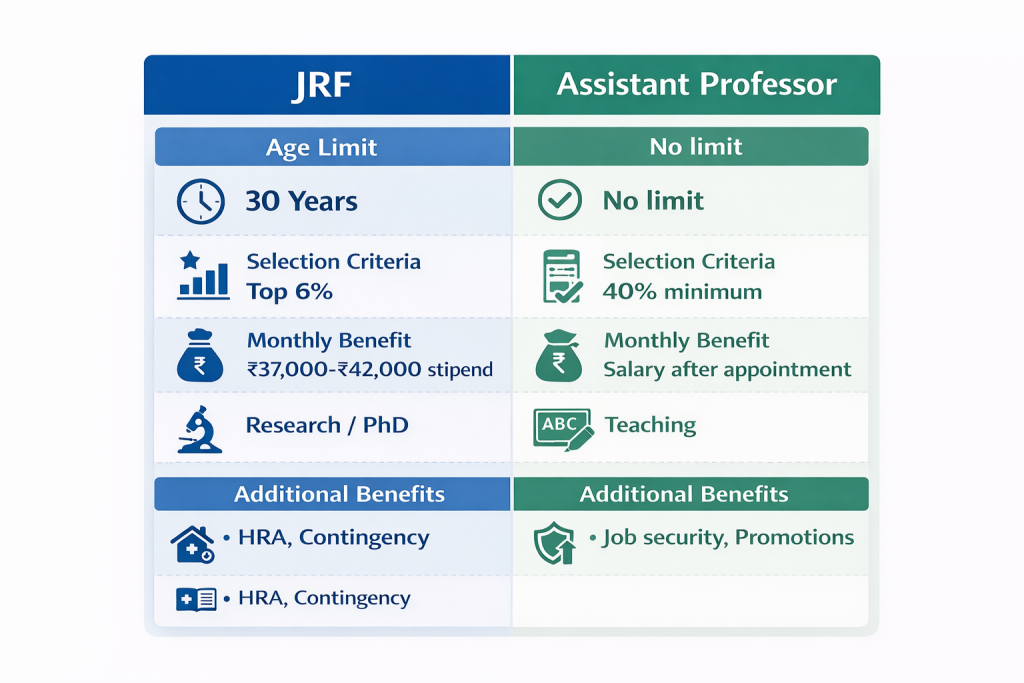
Junior Research Fellowship is awarded to candidates who score in the top 6% nationally. JRF qualifies you for pursuing PhD with government funding, receiving a monthly stipend of ₹37,000 during the first two years and ₹42,000 from the third year onwards as Senior Research Fellow. Beyond the stipend, you receive annual contingency grants for research expenses and House Rent Allowance if hostel accommodation is not provided.
Assistant Professor Eligibility
Candidates who clear the minimum qualifying criteria (aggregate of 40% in both the papers for General, 35% for reserved categories) but do not make it to the top 6% qualify for Assistant Professor eligibility only. This means you can apply for teaching positions in universities and colleges across India but do not receive any fellowship for research. There is no age limit for this qualification, making it accessible to candidates of all ages.
Side-by-Side Comparison
Comparing the two qualifications across different parameters helps you understand which one aligns better with your goals. The choice between focusing on JRF or being satisfied with Assistant Professor eligibility depends on your career plans, age, and financial needs.
Eligibility and Age Criteria
For JRF, the maximum age limit is 30 years with 5 years relaxation for reserved categories, effectively making it 35 years for SC/ST/OBC-NCL/PwD/Women candidates. For Assistant Professor eligibility, there is absolutely no upper age limit, meaning candidates of any age can qualify and apply for teaching positions.
Selection Process: Top 6% vs 40% Aggregate
JRF is awarded to candidates scoring in the top 6% nationally after normalization of scores across shifts. So only a small fraction qualified for JRF. Assistant Professor eligibility requires only meeting the minimum 40% threshold in aggregate of both the papers.
Financial Benefits: ₹37,000-₹42,000 Stipend vs Professor Salary
JRF provides an immediate financial benefit of ₹37,000 monthly (increasing to ₹42,000 after two years) along with contingency grants and HRA. Over a five-year fellowship, this amounts to approximately ₹20-25 lakh. Assistant Professor eligibility leads to salary only after you secure a teaching position, with starting basic pay of ₹57,700 under 7th Pay Commission Level 10.
Career Path: Research vs Teaching
JRF is ideal if you want to pursue a PhD and build a research career. The fellowship provides financial support to focus entirely on your doctoral work. Assistant Professor eligibility is perfect if you want to start teaching immediately without pursuing PhD first, though you will need to complete PhD within a reasonable period as stated in the UGC guidelines.
Qualifying for both UGC NET JRF and Assistant Professor
Here is the best part: if you qualify for JRF by scoring in the top 6%, you automatically qualify for Assistant Professor eligibility as well. This means JRF holders can choose to either pursue PhD with fellowship support OR apply directly for teaching positions. You essentially get the best of both worlds, which is why serious aspirants should aim for JRF even if their primary interest is teaching.
UGC NET Exam: Eligibility Criteria
Before you begin your preparation journey, confirming that you meet the eligibility requirements is essential. The good news is that UGC NET eligibility criteria are fairly inclusive, and most postgraduate students or graduates will find themselves eligible. Let me walk you through each requirement so you can verify your eligibility with confidence.
Nationality
Only Indian nationals are eligible to appear for the UGC NET examination. This is a fundamental requirement as the exam is designed to determine eligibility for teaching and research positions in Indian universities and colleges. Foreign nationals, even if they hold degrees from Indian universities, are not eligible to appear for this examination.
Educational Qualification Requirements
The educational qualifications form the core eligibility criteria for the UGC NET Exam. Your postgraduate degree, the percentage you secured, and the recognition status of your university all play important roles in determining your eligibility. Understanding these requirements in detail helps you assess your position accurately.
Master’s Degree from Recognized University
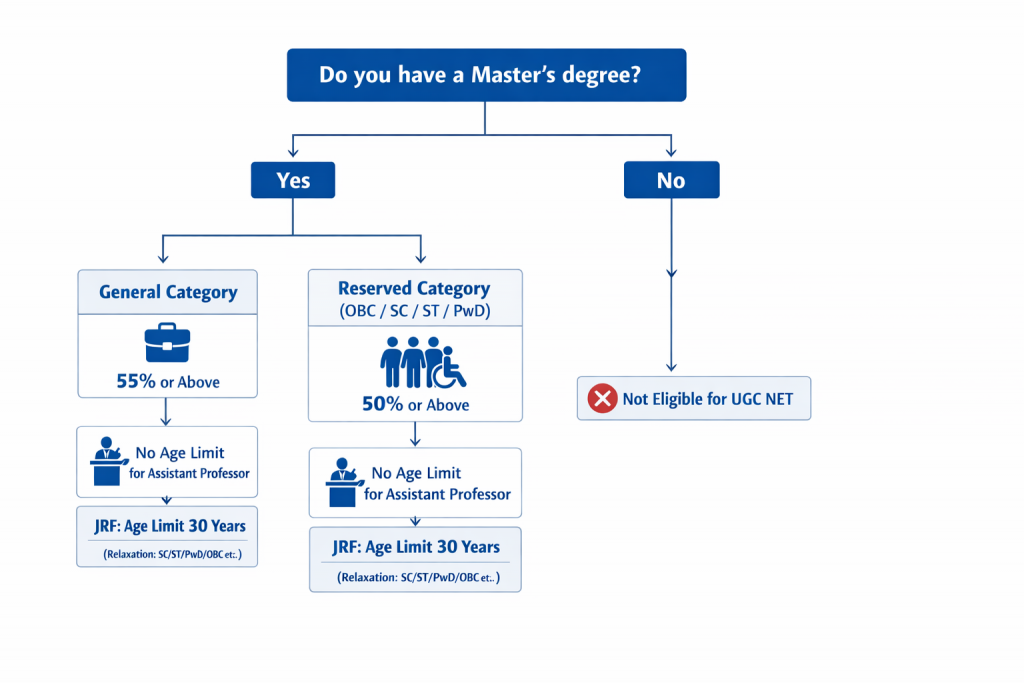
The fundamental requirement for UGC NET is a Master’s degree or equivalent from a university or institution recognized by the University Grants Commission. Your Master’s degree should be in a subject corresponding to one of the 85 subjects offered in Paper II. This includes conventional degrees like MA, MSc, MCom, MBA, as well as professional degrees like LLM, MTech, and MCA.
For General and EWS category candidates, the minimum percentage requirement is 55% marks or equivalent grade in your Master’s degree. If you belong to SC, ST, OBC-NCL (Non-Creamy Layer), PwD (Persons with Disability), or Third Gender categories, you get a 5% relaxation, meaning you need only 50% marks. If your university follows the CGPA system, you will need to convert it to percentage using your institution’s official formula.
Final Year Postgraduate Students
If you are currently in the final year of your Master’s programme, you can absolutely apply for and appear for the UGC NET Exam. While filling the application form, simply select “Appearing” as your qualification status and provide your enrollment details. However, you must complete your Master’s degree with the required percentage within two years of appearing for NET, failing which your qualification will be cancelled.
Four-Year Undergraduate Programme (FYUP) Under NEP 2020
Under the National Education Policy 2020, candidates who have completed a Four-Year Undergraduate Programme with at least 75% marks or equivalent grade (70% or equivalent grade for SC/ST/OBC-NCL/Differently Abled/EWS) are now eligible to apply for UGC NET directly, without requiring a Master’s degree. This provision allows FYUP graduates to pursue both JRF for PhD research and Assistant Professor positions, provided the programme is recognized by UGC and offered by an accredited university.
Age Limit for UGC NET Exam
The age limit rules for UGC NET are particularly favourable compared to many other competitive exams. Understanding these limits helps you plan your career timeline and identify which qualification type you should aim for based on your current age.
No Age Limit for Assistant Professor Eligibility
Here is encouraging news for mature candidates: there is absolutely no upper age limit for appearing in UGC NET if you are aiming only for Assistant Professor eligibility. Whether you are 25, 35, 45, or even 55 years old, you can appear for NET and qualify for teaching positions. This makes UGC NET an excellent option for working professionals looking to transition into academia, homemakers returning to careers, or anyone who discovered their passion for teaching later in life.
30 Years Maximum for JRF with Category-Wise Relaxations
If you are aiming for Junior Research Fellowship to pursue PhD with stipend support, the upper age limit is 30 years as on the first day of the month in which the notification is issued. However, significant relaxations apply for various categories. SC, ST, OBC-NCL, PwD, Third Gender, and women candidates of all categories receive 5 years relaxation, extending their eligibility to 35 years.
Candidates who have served in the armed forces are entitled to age relaxation of up to 5 years, subject to the length of their service. LLM holders and researchers with prior experience may also benefit from specific relaxation provisions as outlined in the official UGC NET Information Bulletin. Always verify the exact relaxation applicable to your category from the official notification.
UGC NET Exam Pattern
Understanding the exam pattern thoroughly before you start preparing is absolutely crucial. Many candidates dive into preparation without fully grasping how the exam is structured, which leads to misallocated effort and suboptimal results. The UGC NET exam has a unique two-paper structure that tests different competencies, and knowing exactly what you are up against helps you plan your preparation strategically.
Exam Structure
The structural elements of UGC NET, including how papers are organized, the testing mode, and time allocation, directly impact your preparation and exam-day strategy. Familiarizing yourself with these aspects ensures you enter the examination hall with complete clarity.
Two Papers in a Single Three-Hour Session
UGC NET Exam consists of two papers that you attempt in a single continuous session of 180 minutes without any break. Paper I tests your teaching and research aptitude and is common for all candidates regardless of their subject. Paper II tests your in-depth knowledge of your chosen subject from 85 available options. There is no separate time allocation for each paper, giving you flexibility to manage your time based on your strengths.
Computer-Based Test (CBT) Mode
The examination is conducted exclusively in Computer-Based Test mode at designated centres across India. You will answer questions on a computer screen, selecting options with mouse clicks and navigating through questions using an intuitive interface. The CBT system allows you to move freely between Paper I and Paper II during the exam, mark questions for review, and change your answers before final submission.
The question palette on your screen shows the status of all questions through colour coding: answered, not answered, marked for review, and answered but marked for review. This visual system helps you track your progress and ensures you do not leave any question unattempted. Practice with NTA’s official mock test available on their website to familiarize yourself with the interface before exam day.
Total Questions, Marks, and Time Allocation
The examination comprises a total of 150 objective-type multiple choice questions worth 300 marks. Paper I contains 50 questions carrying 2 marks each, totaling 100 marks. Paper II contains 100 questions carrying 2 marks each, totaling 200 marks. All questions are compulsory with no choice or optional sections.
The typical time allocation strategy followed by successful candidates is approximately 50-60 minutes for Paper I and 120-130 minutes for Paper II. Since Paper II carries double the marks and tests deeper subject knowledge, it deserves the larger share of your time. However, you can adjust this based on your individual strengths and weaknesses.
Paper I: Teaching and Research Aptitude
Paper I evaluates your general aptitude for academic careers through questions on teaching methodology, research concepts, reasoning, and awareness of higher education systems. This paper is common for all candidates appearing across all 85 subjects, making it a level playing field where everyone faces the same questions.
50 Questions Worth 100 Marks
Paper I contains 50 multiple-choice questions worth 100 marks total, with each correct answer fetching you 2 marks. The questions are distributed across 10 units covering diverse topics from teaching methodology to research concepts, communication skills to logical reasoning. With no negative marking, you should attempt every single question even if you are unsure.
All 10 Units at a Glance
The 10 units of Paper I are: Unit 1 (Teaching Aptitude), Unit 2 (Research Aptitude), Unit 3 (Comprehension), Unit 4 (Communication), Unit 5 (Mathematical Reasoning and Aptitude), Unit 6 (Logical Reasoning), Unit 7 (Data Interpretation), Unit 8 (Information and Communication Technology), Unit 9 (People, Development and Environment), and Unit 10 (Higher Education System). Each unit typically contributes 5-6 questions, though the exact distribution may vary slightly between exam cycles.
Paper II: Subject-Specific Knowledge Test
Paper II is your domain expertise test where your postgraduate knowledge is thoroughly evaluated. The questions test both conceptual understanding and application-based knowledge at a level expected of someone qualified to teach at the university level.
100 Questions Worth 200 Marks
Paper II contains 100 MCQs worth 200 marks, with each correct answer earning 2 marks. This paper carries twice the weightage of Paper I, emphasizing the importance of strong subject preparation. The questions cover the entire syllabus of your chosen subject, testing both theoretical concepts and their practical applications.
Choosing Your Subject from 85 Options
NTA offers 85 subjects for Paper II, covering humanities, social sciences, languages, sciences, commerce, and various interdisciplinary fields. You must choose a subject that corresponds to or is closely related to your Master’s degree specialization. For instance, if your Master’s is in English Literature, you should opt for English; if you completed LLM, you should choose Law. Review the complete subject list before making your final decision, as you cannot change it after application submission.
Marking Scheme and Qualifying Criteria for UGC NET Exam
The marking scheme and qualifying criteria determine whether you clear the exam and which qualification you receive. Understanding these rules helps you set realistic score targets and develop appropriate exam strategies.
+2 Marks Per Question with No Negative Marking
The marking scheme in UGC NET is straightforward and candidate-friendly. Each correct answer earns you +2 marks, and there is absolutely no negative marking for incorrect or unattempted questions. This means you should attempt every single question even if you are guessing, as wrong answers cannot hurt your score but might add valuable marks through lucky guesses.
Aggregate of 40% In Paper 1 and Paper 2 Together
To qualify UGC NET Exam, you must meet the minimum qualifying marks requirement in both the papers together. For General category candidates, this threshold is aggregate of 40% in both the papers (for reserved category candidates (SC/ST/OBC-NCL/PwD), the threshold is relaxed to 35% in each paper). Meeting these minimum criteria makes you eligible for consideration, but final qualification depends on cut-off percentiles. Candidates scoring in the top 6% nationally qualify for JRF, while those above minimum threshold but below top 6% qualify only for Assistant Professor eligibility.
UGC NET Exam Syllabus
The syllabus is your complete roadmap for preparation. With a clear understanding of what topics are covered and their relative importance, you can allocate your study time efficiently and ensure comprehensive coverage. Both Paper I and Paper II have well-defined syllabi that you should download and use as preparation checklists.
Paper I Syllabus: 10 Units Explained
Paper I syllabus covers 10 distinct units that test various competencies required for academic careers. Each unit has specific topics and subtopics that you need to study systematically. Understanding what each unit covers helps you prioritize based on your existing strengths and weaknesses.
Alt-text: “UGC NET Paper I unit-wise weightage pie chart showing distribution of marks across Teaching Aptitude, Research Aptitude, Logical Reasoning, Data Interpretation, and other units”
Unit 1: Teaching Aptitude (Methods, Learner Characteristics, Evaluation)
Teaching Aptitude covers the nature, objectives, and characteristics of teaching at various levels of education. You will encounter questions on teaching methods including lecture, discussion, demonstration, and project-based learning. The unit also covers learner characteristics across different age groups, factors affecting learning like motivation and attention, and evaluation systems including formative and summative assessment, Bloom’s Taxonomy, and Continuous Comprehensive Evaluation.
Unit 2: Research Aptitude (Methodology, Sampling, Data Analysis)
Research Aptitude covers the entire research process from identifying a problem to drawing conclusions. Key topics include types of research (basic vs applied, quantitative vs qualitative, descriptive vs experimental), research designs, hypothesis formulation, sampling techniques (random, stratified, purposive, cluster), data collection methods, and basic statistics including measures of central tendency, correlation, and interpretation. Understanding research ethics, plagiarism, and thesis structure is also tested.
Units 3-5: Comprehension, Communication, Mathematical Reasoning
Unit 3 on Reading Comprehension presents passages followed by questions testing your understanding, inference-making ability, and vocabulary in context. These passages may come from diverse topics including science, social issues, philosophy, or current affairs. The key is reading carefully and answering based on passage content, not your prior knowledge.
Unit 4 on Communication covers verbal and non-verbal communication, barriers to effective communication, and classroom communication techniques. You should understand communication models like Shannon-Weaver and Berlo’s SMCR, types of communication (intrapersonal, interpersonal, group, mass), and effective presentation skills.
Unit 5 on Mathematical Reasoning and Aptitude tests basic numerical ability including number series, percentages, ratios, profit-loss, time-work problems, and data sufficiency. This unit is scoring for candidates comfortable with basic mathematics and requires regular practice to build speed and accuracy.
Units 6-7: Logical Reasoning and Data Interpretation
Unit 6 on Logical Reasoning tests your analytical thinking through syllogisms, logical connectives, Venn diagrams, coding-decoding, blood relations, direction sense, and critical reasoning. You will encounter questions requiring you to identify logical fallacies, evaluate arguments, and draw valid conclusions from given premises.
Unit 7 on Data Interpretation tests your ability to analyze data presented in tables, bar graphs, line graphs, pie charts, and mixed diagrams. Questions require you to calculate percentages, find ratios, identify trends, and make comparisons. Based on analysis of previous papers from 2019-2024, tables dominate DI questions, contributing approximately 40-50% of all questions in this unit.
Units 8-10: ICT, Environment, Higher Education System
Unit 8 on Information and Communication Technology covers computer fundamentals, internet and web technologies, e-learning platforms, and government digital initiatives like SWAYAM, Swayam Prabha, NPTEL, and Digital India. Questions on cybersecurity basics and common abbreviations (RAM, ROM, CPU, HTML, URL) appear frequently.
Unit 9 on People, Development and Environment tests awareness of sustainable development, environmental issues, climate change, biodiversity, pollution, and international environmental agreements. Unit 10 on Higher Education System covers the structure of Indian higher education, UGC functions, accreditation bodies like NAAC and NBA, and importantly, the National Education Policy 2020. Recent exams have increased emphasis on NEP 2020 provisions.
Paper II Syllabus: Subject-Specific Coverage
Paper II syllabus varies for each of the 85 subjects and is designed to cover the core curriculum at postgraduate level. The depth of knowledge expected is substantial, requiring you to have thorough conceptual clarity rather than just surface-level awareness.
Law Subject (Paper II) Syllabus
Belowmentioned is the gist of the law syllabus for UGC NET Paper 2.
Unit I: Jurisprudence covers the theoretical foundation of legal studies, examining the nature and sources of law, schools of jurisprudence (Natural Law, Positivism, Realism, and Sociological School), and the relationship between law and morality. The unit includes concepts of legal personality, rights and duties, property, ownership and possession, liability theories, and global justice. Understanding landmark cases and the role of law in addressing poverty and development through modernist and post-modernist perspectives is essential for this section.
Unit II: Constitutional and Administrative Law forms one of the most important units, covering India’s constitutional framework including the Preamble, Fundamental Rights, Duties, and Directive Principles. The unit examines the Union and State Executive and Legislature, distribution of legislative powers, judiciary, emergency provisions, and the Election Commission. Administrative law principles including natural justice, judicial review of administrative actions, and landmark cases like Kesavananda Bharati and Maneka Gandhi are crucial topics.
Unit III: Public International Law and IHL examines the legal framework governing relations between states and protection of individuals during armed conflicts. The unit covers international law’s definition, nature, sources, recognition of states and governments, nationality, extradition, asylum, and the United Nations system. International Humanitarian Law conventions, protocols, implementation challenges, settlement of international disputes, and the World Trade Organization’s role complete this comprehensive section.
Unit IV: Law of Crimes covers criminal law principles including general principles of criminal liability with actus reus, mens rea, and constructive liability. The unit examines stages of crime, inchoate crimes (abetment, conspiracy, attempt), general exceptions, and offences against human body, state, terrorism, property, women, and children. Drug trafficking, counterfeiting, public tranquility offences, theories of punishment, and victim compensation schemes are also included in this unit.
Unit V: Law of Torts and Consumer Protection addresses civil wrongs and consumer rights, beginning with the nature, definition, and general principles of tortious liability. The unit covers general defences, specific torts (negligence, nuisance, trespass, defamation), remoteness of damages, strict and absolute liability, and tortious liability of the state. Consumer Protection Act provisions, Motor Vehicles Act’s no-fault liability, Claims Tribunals, and Competition Act’s regulations on anti-competitive agreements complete this section.
Unit VI: Commercial Law encompasses legal principles governing business transactions including essential elements of contracts and e-contracts, breach, frustration, void and voidable agreements. The unit examines standard form contracts, quasi-contracts, specific contracts (bailment, pledge, indemnity, guarantee, agency), Sale of Goods Act, partnership, and Limited Liability Partnership. Negotiable Instruments Act provisions and company law aspects including incorporation, prospectus, shares, debentures, directors’ duties, meetings, and Corporate Social Responsibility are covered comprehensively.
Unit VII: Family Law governs personal relationships under different religious personal laws, covering sources and schools of Hindu, Muslim, Christian, and Parsi family law. The unit examines marriage requirements and dissolution, matrimonial remedies including divorce theories, changing dimensions like live-in relationships, and recognition of foreign decrees. Maintenance, dower, stridhan, adoption, guardianship, succession, inheritance, will, gift, wakf, and the ongoing debate on Uniform Civil Code are essential topics.
Unit VIII: Environment and Human Rights Law covers the legal framework for environmental protection including the meaning of environment, pollution types, and international environmental law through UN Conferences. Constitutional provisions (Articles 48A and 51A(g)), key environmental legislation, Environmental Impact Assessment, hazardous waste control, and National Green Tribunal’s powers are examined. Human rights concepts, universalism versus cultural relativism, International Bill of Rights, group rights for vulnerable categories, and various human rights commissions (NHRC, NCM, NCW, NCSC, NCST, NCBC) complete this unit.
Unit IX: Intellectual Property Rights and IT Law addresses protection of intellectual creations, covering IPR concepts, theories, and international conventions including TRIPS Agreement. The unit examines copyright and neighboring rights, patent law (patentability, grant procedure, remedies), trademark law (registration, infringement, passing off), and geographical indications protection. Biodiversity, traditional knowledge protection, Information Technology Act provisions on digital signatures, e-governance, electronic records, cyber crimes, penalties, and adjudication mechanisms are comprehensively covered.
Unit X: Comparative Public Law and Systems of Governance studies different legal systems comparatively, examining relevance, methodology, and concerns of comparative law alongside forms of government (presidential versus parliamentary, unitary versus federal). The unit covers models of federalism in USA, Canada, and India, rule of law concepts, separation of powers in different jurisdictions, and judicial independence. Systems of constitutional review, amendment procedures, Ombudsman institutions, and open government principles including Right to Information across USA, UK, and India conclude this comparative analysis.
Commerce Subject (Paper II) Syllabus
Given below is the syllabus for UGC NET Commerce Paper 2.
Unit 1: Business Environment and International Business covers business environment (economic, political, legal, socio-cultural factors), globalisation theories, international trade theories (absolute advantage, comparative advantage, Heckscher-Ohlin model), and modes of entry into international markets. The unit examines WTO regulations, regional trading blocs (SAARC, ASEAN, EU), foreign direct investment policies, balance of payments, and trade policies including tariff and non-tariff barriers. Business ethics, corporate social responsibility, corporate governance principles, India’s CSR regulations under Companies Act 2013, and sustainable business practices reflecting ESG considerations are also covered.
Unit 2: Accounting and Auditing covers financial accounting (partnership accounts, company accounts, holding company accounts, accounting for amalgamation), cost accounting (marginal costing, standard costing, budgetary control, cost-volume-profit analysis), and management accounting (ratio analysis, fund flow analysis, cash flow analysis, responsibility accounting). Accounting standards include both Indian AS and IFRS with focus on preparation of financial statements and various costing methods. Auditing topics include types of audits, audit planning and procedures, vouching, verification of assets and liabilities, audit reporting, internal control systems, audit evidence, sampling, auditor’s liability, forensic auditing, environmental auditing, IT auditing, and company audit provisions under Companies Act 2013.
Unit 3: Business Economics covers demand and supply analysis, production and cost theory, market structures, pricing strategies, elasticity of demand, consumer behaviour theories (cardinal and ordinal approaches), production functions, and cost concepts (short-run and long-run). Equilibrium analysis under perfect competition, monopoly, monopolistic competition, oligopoly, indifference curve analysis, and production possibility frontier are examined. Macroeconomic concepts include business cycles, inflation, monetary and fiscal policy, Keynesian economics, multiplier effect, IS-LM model, determination of national income, and contemporary economic issues relevant to India.
Unit 4: Business Finance focuses on time value of money, capital budgeting techniques (NPV, IRR, Payback Period, Profitability Index), capital structure theories (net income approach, net operating income approach, MM propositions), and cost of capital. Working capital management includes cash management models (Baumol and Miller-Orr), receivables management, inventory management techniques, and WACC computation. Dividend policy theories (Walter model, Gordon model, MM dividend irrelevance hypothesis), financial derivatives, risk management, and portfolio theory complete this unit.
Unit 5: Business Statistics and Research Methods covers measures of central tendency, dispersion, correlation, regression, probability distributions (binomial, Poisson, normal), hypothesis testing, and sampling distributions. Statistical tools include descriptive statistics, index numbers, ANOVA, chi-square test, and non-parametric tests for quantitative analysis. Research methodology covers research designs (exploratory, descriptive, causal), sampling methods (probability and non-probability), data collection instruments, reliability and validity concepts, and hypothesis testing including Type I and Type II errors.
Unit 6: Business Management and Human Resource Management covers management principles, functions (planning, organizing, leading, controlling), strategic management, change management, and knowledge management. Classical management theories (Taylor, Fayol, Weber), neo-classical theories (Hawthorne studies), and modern theories (systems approach, contingency theory) are examined. HRM topics include human resource planning, recruitment and selection, training and development, performance appraisal (MBO, 360-degree feedback, BARS), compensation management, employee welfare, HR analytics, industrial relations, trade unions, collective bargaining, and labour legislation.
Unit 7: Banking and Financial Institutions covers the Indian banking system, Reserve Bank of India functions, monetary policy tools (repo rate, reverse repo rate, CRR, SLR, open market operations), and RBI’s role as banker to government, banker’s bank, and banking sector regulator. The structure of Indian banking includes commercial banking, development banking, cooperative banking, NBFCs, scheduled and non-scheduled banks, public and private sector banks, and development banks (NABARD, SIDBI, EXIM Bank). Recent developments include digital banking, financial inclusion, Basel norms, capital adequacy requirements, priority sector lending, NPA management, digital currency, UPI adoption, and banking sector reforms.
Unit 8: Marketing Management covers marketing concepts, marketing mix (4Ps extended to 7Ps for services), market segmentation, targeting, positioning (STP), consumer behaviour theories, decision-making process, and factors influencing consumer behaviour (cultural, social, personal, psychological). Consumer behaviour models (Howard-Sheth, Nicosia, Engel-Kollat-Blackwell), organizational buying behaviour, marketing research, product life cycle management, branding strategies, and distribution channel management are examined. Contemporary topics include digital marketing, social media marketing, green marketing, relationship marketing, SEO, content marketing, email marketing, marketing analytics, integrated marketing communication, brand equity, brand extension, and pricing strategies (penetration, skimming, competitive, value-based).
Unit 9: Legal Aspects of Business covers Indian Contract Act 1872 (essential elements, types of contracts, performance, discharge, breach, remedies, special contracts including indemnity, guarantee, bailment, agency), Sale of Goods Act 1930 (conditions and warranties, transfer of property, rights of unpaid sellers), and Companies Act 2013 (company formation, types, prospectus, share capital, management, directors, meetings, winding up). Consumer Protection Act 2019 (consumer rights, disputes, redressal machinery, product liability), Competition Act 2002 (anti-competitive agreements, abuse of dominance, combinations), and Intellectual Property Rights (patents, copyrights, trademarks, geographical indications) are covered. Information Technology Act 2000, environmental legislation, and labour laws affecting business operations are also included.
Unit 10: Income Tax and Corporate Tax Planning covers basic income tax concepts (previous year, assessment year, residential status, incidence of tax), computation of income under five heads (salary, house property, business/profession, capital gains, other sources), deductions under Chapter VI-A, set-off and carry forward of losses, and tax rates for different assessees. Corporate tax planning includes tax minimization methods, distinction between tax planning, tax evasion, and tax avoidance, MAT provisions, dividend distribution tax, and presumptive taxation schemes. Recent amendments include new tax regime options, corporate tax rate reductions, faceless assessment procedures, and tax planning for business decisions like make versus buy and own versus lease.
Download Official UGC NET Exam Syllabus PDFs
You can download the official subject-wise syllabus for all 85 Paper II subjects from the NTA UGC NET website. Navigate to the syllabus section, select your subject, and download either the English or Hindi version based on your preference. The documents are available as PDF files that you can print and use as preparation checklists.
UGC NET Exam: Application Process
The application process for UGC NET is entirely online and must be completed carefully to avoid rejection. Understanding each step, the documents required, and the specifications for uploads ensures your application is accepted without issues. Let me walk you through the complete process.
Step-by-Step Application Process
The application process involves multiple steps that must be completed in sequence. Missing any step or providing incorrect information can lead to application rejection. Follow these steps carefully when the application window opens.
Registration and Login Credentials
Visit the NTA UGC NET official website and click on “New Registration.” You will need to provide basic details including your name, email ID, mobile number, and date of birth to create your login credentials. After successful registration, you receive an Application Number and Password via email and SMS. Keep these credentials safe as you will need them for all future activities including admit card download and result checking.
Filling Personal and Academic Details
Log in using your credentials and complete the application form in multiple sections. Enter personal details including your name exactly as it appears on your Class 10 certificate, address, category, and PwD status if applicable. Then fill in educational qualification details including your Master’s degree information, university name, year of passing, and percentage or CGPA. Select your Paper II subject carefully from the 85 available options, as you cannot change this after submission.
Photo and Signature Upload Specifications
For photograph, you need a recent passport-size colour photo in JPG/JPEG format with file size between 10 KB and 200 KB. The background should be white or light-coloured, and your full face should be clearly visible without sunglasses or cap. For signature, sign with black ink on white paper and upload in JPEG format with file size between 4 KB and 30 KB. Many applications get rejected due to non-compliant photographs, so verify specifications carefully before uploading.
Application Fees and Payment
The application fee varies by category and must be paid online for the application to be considered complete. The application fees are: ₹1,150 for General (UR) category candidates, ₹600 for General-EWS and OBC-NCL candidates, and ₹325 for SC, ST, PwD, and Third Gender candidates. These fees are non-refundable once paid, so ensure you meet all eligibility criteria before applying.
You can make the payment through credit card, debit card, net banking, or UPI. After successful payment, download and save the confirmation page as proof of successful application submission. The confirmation page contains your Application Number and other important details that you will need for future reference. Also save the transaction ID and payment receipt for any future clarifications.
UGC NET Admit Card Download
The admit card is typically released 7-10 days before the scheduled exam date. Log in to the NTA UGC NET website with your Application Number and Date of Birth, navigate to the “Download Admit Card” section, and save the PDF. Print multiple copies and verify all details including your name, photograph, exam centre address, roll number, and reporting time. On exam day, carry your admit card along with a valid photo ID such as Aadhaar Card, Passport, Voter ID, or PAN Card.
Prepare for UGC NET Exam
Preparation strategy can make or break your UGC NET performance. The right approach, combined with consistent effort and smart resource utilization, significantly improves your chances of qualifying. This section provides a structured framework for preparation that has helped thousands of candidates succeed.
Paper-Wise Preparation Guide
Paper I
Teaching Aptitude: Focus on Concepts Over Memorization
Teaching Aptitude requires understanding different teaching methodologies rather than memorizing definitions. Focus on why certain methods work in specific situations, how learner characteristics vary across age groups, and what makes evaluation effective. Create mental frameworks connecting teaching methods with appropriate learning contexts. Standard books like KVS Madaan and Trueman’s UGC NET Paper I provide comprehensive coverage.
Research Aptitude: Understanding the Research Process
Research Aptitude becomes manageable once you understand the logical flow of research: identify problems, review literature, formulate hypotheses, design methodology, collect data, analyse results, draw conclusions. Focus on differentiating between research types, understanding when different sampling methods apply, and knowing basic statistics conceptually. You do not need to be a statistician, but you should understand what mean, median, mode, and correlation represent.
Logical Reasoning and Data Interpretation: Practice-Intensive Units
These units reward consistent practice. Solve at least 20-30 questions daily from Logical Reasoning and Data Interpretation during your preparation phase. Learn systematic approaches for syllogisms, Venn diagrams, and coding-decoding rather than trying to solve intuitively. For Data Interpretation, practice reading tables, bar charts, pie charts, and line graphs quickly and accurately. R.S. Aggarwal’s books are excellent resources for these units.
Current Affairs Units: ICT, Environment, Higher Education
Units 8-10 require staying updated with current developments. For ICT, focus on government digital initiatives like SWAYAM, Swayam Prabha, NPTEL, Digital India, and basic cyber security concepts. For Environment, follow recent climate conferences, environmental policies, and sustainable development goals. For Higher Education, thoroughly study NEP 2020 highlights, UGC regulations, and NAAC accreditation framework. These topics overlap with current affairs, so regular reading of education news helps.
Paper II
Paper II requires deep subject knowledge at postgraduate level. Your Master’s degree coursework forms the foundation, but strategic preparation is needed to cover the complete NET syllabus.
Mapping Your Master’s Coursework to UGC NET Exam Syllabus and Identifying Gaps
Start by downloading and printing the official syllabus for your subject from the NTA website. Go through each unit and honestly assess which topics you are comfortable with from your Master’s studies and which need additional learning. Many candidates fail Paper II not because they lack subject knowledge, but because they did not identify and address gaps early enough.
Create a detailed mapping between your postgraduate coursework and NET syllabus units. Topics covered in your curriculum can be revised quickly, while topics not covered require fresh learning. Allocate more time to gap areas and less to topics you already know well. This strategic allocation significantly improves preparation efficiency.
Subject-Specific Book Recommendations
For Paper II, your standard postgraduate textbooks serve as excellent primary sources. Supplement these with subject-specific NET guides published by Trueman’s, Arihant, and other publishers for practice questions. For Law, refer to textbooks by M.P. Jain (Constitutional Law), Avtar Singh (Contract and Tort), K.D. Gaur (Criminal Law), and Ratanlal & Dhirajlal. For Commerce, standard texts like S.P. Gupta for Business Statistics and S.N. Maheshwari for Accounting is recommended.
Study Plans Based on Your Timeline and Situation
Different candidates have different timelines and circumstances. A fresh graduate with six months to prepare needs a different approach than a working professional with three months. Here are tailored strategies for different situations.
6-Month Comprehensive Preparation Roadmap
With six months, you have adequate time for thorough preparation. Spend the first two months building conceptual foundation across all units of Paper I and Paper II. Use months three and four for deep diving into high-weightage topics and solving topic-wise questions. Dedicate month five to revision and solving previous year papers. Reserve the final month exclusively for mock tests and exam simulation.
Aim for 6-8 hours of daily study if you are a full-time aspirant. Divide time roughly 40:60 between Paper I and Paper II, given Paper II’s higher weightage. Maintain a study journal to track progress and identify weak areas needing additional attention.
3-Month Intensive Preparation
Three months requires a more focused approach. Prioritize high-scoring topics and spend less time on areas with lower returns. For Paper I, focus heavily on Teaching Aptitude, Research Aptitude, Logical Reasoning, and Data Interpretation as these contribute maximum marks. For Paper II, identify the 60-70% of syllabus that historically contributes most questions and master those areas first.
30-Day Last-Minute Preparation Approach
With only 30 days, shift from learning to strategic scoring. Focus exclusively on high-frequency topics identified through previous year paper analysis. Solve 5-7 years of previous papers, analyse patterns, and memorize frequently tested facts. Take at least 10-15 full-length mock tests to build exam stamina and time management skills. Do not try to cover everything; instead, maximize scores from areas you already know.
Study Strategies for Working Professionals
Working professionals should leverage weekends intensively with 8-10 hours of study each day. Use weekday commute time for revision and light topics. Focus on conceptual understanding rather than extensive note-making to save time. Consider taking leave during the final month for intensive preparation. Online coaching and recorded lectures help working candidates study at their own pace.
Previous Year Papers and Mock Tests
Previous year papers and mock tests are your most valuable preparation resources. They provide insights into question patterns, difficulty levels, and time management that no textbook can offer.
Solving UGC NET Exam PYQs
Previous year papers reveal frequently asked topics, question patterns, and difficulty levels. Solve papers from the last 5-10 years and analyse them systematically. Categorise questions unit-wise to identify which units have higher weightage. Note which specific topics repeat frequently, as these are high-priority areas. After solving, analyse your wrong answers to identify knowledge gaps and address them through focused study.
Solving Mock Tests
Start attempting full-length mock tests about 6-8 weeks before the exam, once you have covered approximately 70% of the syllabus. Initially focus on accuracy without strict time limits, then gradually introduce time constraints. Aim to complete at least 15-20 full-length mocks before the actual exam. LawSikho offers UGC NET mock tests that simulate the actual exam environment with detailed performance analytics.
UGC NET Exam Cut-off and Result
Understanding how cut-offs work and how results are declared helps you set realistic expectations and plan your post-exam activities. The cut-off varies each session based on multiple factors, and knowing the declaration timeline helps you prepare for the next steps.
Cut-Off for UGC NET Exam
The UGC NET cut-off is the minimum score required to qualify for JRF or Assistant Professor eligibility. NTA announces subject-wise and category-wise cut-offs after each exam cycle. The cut-off varies based on exam difficulty, number of candidates appearing, and overall score distribution.
This time around, indicative cut-offs for popular subjects were: Commerce (JRF: 224, Assistant Professor: 194), Law (JRF: 200, Assistant Professor: 178), Political Science (JRF: 244, Assistant Professor: 218), English (JRF: 188, Assistant Professor: 166). These marks are out of 300 (combined Paper I and II). Your target score should be at least 15-20 marks above the historical cut-off to ensure comfortable qualification.
UGC NET Result Declaration Process
The result declaration follows a systematic process that includes answer key release, challenge period, and final result announcement. Understanding this timeline helps you plan your activities accordingly.
Timeline for Announcement of Results
Results are typically announced 6-8 weeks after the examination concludes. The provisional answer key is released first, followed by a challenge period, then the final answer key and results together. Keep checking the NTA UGC NET website regularly during this period.
To check your result, visit the official NTA UGC NET website and click on the “Result” link when activated. Enter your Application Number and Date of Birth, then submit to view your result. The result page shows your qualification status (JRF, Assistant Professor, or Not Qualified) along with your overall percentile score.
Answer Key and Challenge Process
NTA first releases the provisional answer key along with recorded responses of all candidates. You can download your response sheet and match it with the answer key to estimate your score. If you find any answer incorrect, you can submit a challenge by paying ₹200 per question challenged. Challenges are reviewed by subject experts, and if found valid, the answer key is revised.
The challenge window remains open for 3-5 days after answer key release. After reviewing all challenges, NTA releases the final answer key which is used for calculating results. No further challenges are entertained after the final key is released.
UGC NET Scorecard
The scorecard is your official document showing your examination performance. Your UGC NET scorecard contains your personal details, roll number, subject name and code, marks obtained in Paper I and Paper II separately, total marks, overall percentile, and qualification status. It also mentions whether you qualified for JRF, Assistant Professor, or PhD Admission only. Download and save multiple copies of your scorecard as you will need it for job applications.
UGC NET Certificate Download and Validity
The UGC NET Exam qualification certificate is the official document recognizing your achievement, and understanding its validity period and usage helps you plan your career effectively.
UGC NET Exam qualification certificates are issued by UGC and can be downloaded from the official website after qualifying—you can access your e-certificate through the UGC portal using your application credentials. The certificate contains your photograph, qualification details, and a unique verification code that employers can use to verify authenticity.
The UGC NET qualification certificate is valid for life for Assistant Professor eligibility, meaning you can apply for teaching positions at any point in your career. For JRF, the fellowship must be availed within two years of qualifying, after which only the Assistant Professor eligibility remains. Keep your certificate safe and use it while applying for teaching positions, PhD admissions, or research positions.
Reservation Policy in UGC NET
The UGC NET exam follows the reservation policy of the Government of India for central educational institutions. Reserved category candidates (SC, ST, OBC-NCL, PwD, EWS) benefit from relaxed eligibility criteria including 50% marks requirement instead of 55%, 5% age relaxation for JRF, and category-wise separate cut-offs. The reservation percentages in final selection are: SC (15%), ST (7.5%), OBC-NCL (27%), EWS (10%), and PwD (5% horizontal reservation). Candidates must provide valid category certificates issued by competent authorities at the time of application.
Career Opportunities and Salary After UGC NET Exam Qualification
Qualifying UGC NET opens multiple career pathways in academia, research, and related sectors. Understanding what opportunities await and the financial benefits associated with each path helps you make informed career decisions after qualification.
Assistant Professor Position and Salary
The primary career outcome for most UGC NET qualifiers is appointment as Assistant Professor in universities and colleges. The position comes with job security, attractive compensation, and the satisfaction of shaping young minds.
7th Pay Commission Level 10 Salary
After qualifying UGC NET Exam and securing an Assistant Professor position, you become eligible for 7th Pay Commission Level 10 pay scale. The basic pay ranges from ₹57,700 at entry level to ₹1,82,200 at the maximum of the scale, with annual increments of 3%. Your starting basic pay depends on your qualifications and the institution’s policies.
Your total salary includes Dearness Allowance (DA) currently at 55% of basic pay, House Rent Allowance (HRA) varying from 8% to 24% based on city classification (X, Y, or Z), and Transport Allowance. For a starting basic of ₹57,700, the calculations are: DA adds approximately ₹31,735, HRA adds ₹4,616 to ₹13,848 depending on city, bringing gross salary to approximately ₹95,000-₹1,05,000 before deductions in central universities.
Research Career Through JRF
For those passionate about research, JRF provides an excellent foundation for building an academic research career. The fellowship supports your PhD journey and positions you for research roles after completion.
PhD Admission Process with JRF
JRF qualification gives you a significant advantage in PhD admissions across universities. Many institutions reserve seats for JRF holders or give preference in selection. You apply to universities offering PhD in your subject, submit your JRF award letter along with a research proposal, and often face only an interview rather than an entrance test. The fellowship is transferable to any UGC-recognized institution.
During the fellowship, you receive ₹37,000 monthly for the first two years as Junior Research Fellow. After successful progression to Senior Research Fellow (SRF) status typically through review and publications, the stipend increases to ₹42,000 monthly for the remaining three years. You also receive contingency grants for research expenses like books, equipment, and conference attendance.
Career After PhD Completion
After completing PhD with JRF, multiple career paths open up. You can join universities as Assistant Professor with enhanced pay scale, become a researcher at national institutes like ICSSR, ICHR, or CSIR laboratories, or pursue post-doctoral research in India or abroad. PhD with JRF also qualifies you for research scientist positions in government bodies and think tanks.
Alternative Career Paths
Beyond traditional academia, UGC NET qualification opens doors to several alternative career paths that leverage your expertise and credentials.
EdTech and Online Teaching Opportunities
Educational technology companies like LawSikho actively recruit NET-qualified subject experts for content development, online teaching, and curriculum design roles. Salaries in EdTech often match or exceed academic positions, and the work offers flexibility. Your NET qualification signals subject expertise and teaching aptitude, making you a valuable hire.
Content Development and Curriculum Design Roles
Publishing houses, online learning platforms, and educational institutions hire NET-qualified candidates for developing study materials, question banks, and curricula. These roles allow you to contribute to education without traditional classroom teaching. Your deep subject knowledge and understanding of academic standards make you ideal for creating high-quality educational content.
Research Positions in Government Bodies
Various government research organizations hire UGC NET-qualified candidates as Research Associates, Research Assistants, and Consultants. Bodies like NITI Aayog, various ministries, and research councils regularly recruit for policy research and analysis roles. Your research aptitude demonstrated through NET qualification makes you eligible for these positions that combine subject expertise with public policy impact.
Conclusion
The UGC NET exam is your gateway to a fulfilling career in academia, whether through teaching as an Assistant Professor or research through Junior Research Fellowship. This comprehensive guide has covered everything from eligibility criteria requiring a Master’s degree with 55%/50% marks, to exam pattern with Paper I (50 questions) and Paper II (100 questions), to preparation strategies and career outcomes.
The rewards of qualifying are substantial: Assistant Professor salaries starting at ₹57,700 basic pay with gross around ₹95,000-₹1,05,000 in central universities, or JRF stipend of ₹37,000-₹42,000 monthly for funded PhD research. Download the official syllabus from the NTA website, create a study schedule based on your timeline, and commit to consistent daily practice. If you want comprehensive preparation support, explore LawSikho’s UGC NET course that has helped numerous candidates qualify successfully.
Frequently Asked Questions About UGC NET Exam
Can I appear for the UGC NET Exam during my final year of Master’s degree?
Yes, final year postgraduate students can apply for and appear in the UGC NET Exam by selecting “Appearing” status in the application form. However, you must complete your Master’s degree with the required percentage (55% for General, 50% for reserved categories) within two years of appearing for NET, failing which your qualification will be cancelled.
Is there negative marking in UGC NET Exam?
No, there is absolutely no negative marking in UGC NET. Each correct answer earns you +2 marks, while wrong answers and unattempted questions carry zero marks. This means you should attempt every question even if you are guessing, as it cannot hurt your score.
What is the salary of an Assistant Professor after qualifying UGC NET?
NET-qualified Assistant Professors earn 7th Pay Commission Level 10 salary with basic pay ranging from ₹57,700 to ₹1,82,400. Including DA (55%), HRA (8-24%), and other allowances, the gross salary in central universities typically ranges from ₹95,000 to ₹1,05,000 at entry level.
Can final year students apply for the UGC NET Exam?
Yes, candidates in the final year of their Master’s programme can apply for UGC NET on a provisional basis. They must complete their degree with required percentage within two years of appearing for the exam, otherwise their NET qualification becomes invalid.
How to check the UGC NET Exam result?
Visit the NTA UGC NET official website and click on “Result” when the link becomes active. Enter your Application Number and Date of Birth to view your result showing qualification status and percentile score.
How many attempts are allowed for the UGC NET exam?
There is no limit on the number of attempts for UGC NET. You can appear unlimited times until you qualify, subject to meeting eligibility criteria (especially the JRF age limit of 30 years with category relaxations) each time you apply.
Can I change my Paper II subject after submitting the application?
No, subject change is not permitted after final application submission. You may only modify certain fields during the correction window if opened before the deadline. Choose your Paper II subject carefully before submission as it cannot be changed later.
How to download the UGC NET Exam admit card?
Log in to the NTA UGC NET website using your Application Number and Date of Birth. Navigate to “Download Admit Card” section, download the PDF, and print multiple copies. Admit cards are typically released 7-10 days before the exam.





 Allow notifications