
Last verified: April 2026
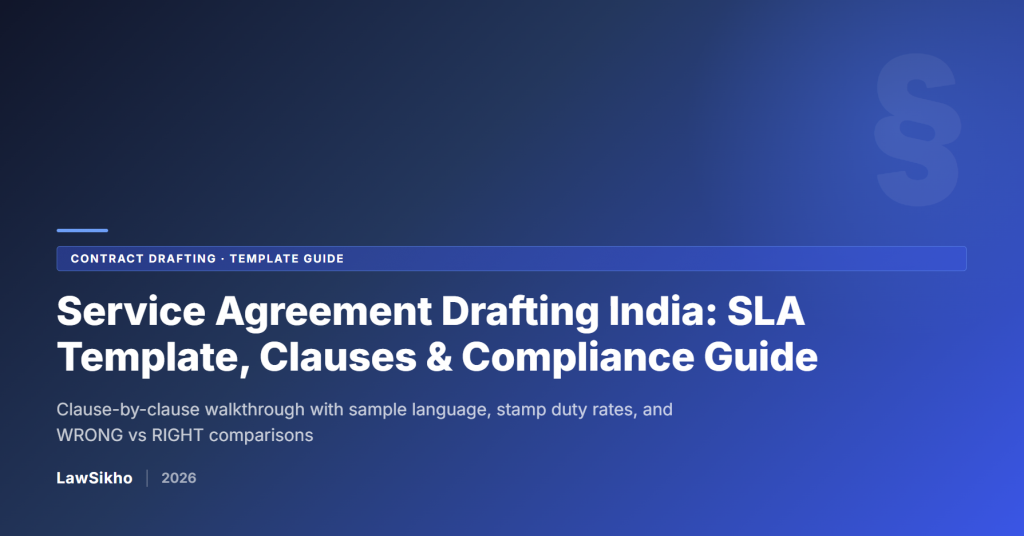
Service agreement drafting India requires more than copying a template. A poorly drafted SLA clause can cost your business lakhs in unrecoverable damages, because Indian courts will enforce only “reasonable compensation” under Section 74 of the Indian Contract Act 1872, regardless of what your contract states.
A service agreement is a legally binding contract between a service provider and client. It defines scope of work, payment terms, service levels, and remedies for non-performance. In India, these agreements are governed by the Indian Contract Act 1872, the Information Technology Act 2000, and the Consumer Protection Act 2019.
This guide provides everything you need to draft an enforceable service agreement. You’ll get sample clause language, a complete template structure, state-wise stamp duty rates, and industry-specific SLA variations. Whether you’re drafting for IT services, consulting, healthcare, or manufacturing, every clause is covered with India-specific legal backing.

Table of Contents
- Legal Framework Governing Service Agreements in India
- Complete Service Agreement Template Structure
- Clause-by-Clause Drafting Walkthrough
- Scope of Services Clause
- Payment Terms and Tax Compliance Clause
- Service Level Agreement (SLA) Clause
- Penalty and Liquidated Damages Clause
- Indemnity and Limitation of Liability Clause
- Termination and Exit Clause
- IP Ownership and Confidentiality Clause
- Force Majeure Clause
- Dispute Resolution and Governing Law Clause
- Drafting Dos and Don’ts: Common Mistakes vs Correct Approach
- Stamp Duty and Execution Requirements
- Industry-Specific SLA Variations
- Community Perspectives: What Businesses Get Wrong
- Frequently Asked Questions
- Conclusion
Legal Framework Governing Service Agreements in India
Service agreements in India operate within a multi-statute legal framework. Understanding which laws apply to your specific agreement prevents drafting clauses that courts will strike down as void or unenforceable.
Key Statutes and Sections You Must Know
These are the primary statutes governing service agreements in India:
- Indian Contract Act, 1872, the foundational law for all contracts
- Section 10, essential elements for a valid contract (free consent, lawful consideration, lawful object)
- Section 23, agreements with unlawful object or consideration are void
- Section 27, agreements in restraint of trade are void (with limited exceptions for sale of goodwill)
- Section 73, compensation for breach of contract (only for loss arising naturally from the breach)
- Section 74, liquidated damages and penalty (courts award only “reasonable compensation” not exceeding the stipulated amount)
- Sections 124-125, indemnity contracts and rights of indemnity holder
- Information Technology Act, 2000, governs electronic contracts, digital signatures, and data protection obligations in IT service agreements
- Consumer Protection Act, 2019, applies when services are rendered to consumers; defines “deficiency in service” and consumer rights
- Arbitration and Conciliation Act, 1996, governs arbitration clauses in service agreements; Section 7 defines what constitutes a valid arbitration agreement
- Indian Stamp Act, 1899, governs stamp duty on agreements; state-specific amendments apply
- GST Act, 2017, Section 51 CGST Act governs TDS on services; applicable when contract value exceeds ₹2.5 lakh for government entities
If you’re handling complex contract drafting regularly, understanding these statutes in depth is essential for creating enforceable agreements.
What Makes a Service Agreement Enforceable
For a service agreement to be legally enforceable in India under Section 10 of the Indian Contract Act:
- Free consent, both parties agree without coercion, undue influence, fraud, or misrepresentation
- Competent parties, both parties are of legal age (18+), sound mind, and not disqualified by law
- Lawful consideration, payment must be legal and clearly defined
- Lawful object, the service itself must not violate any law
- Not expressly declared void, the agreement must not fall under Sections 24-30 (void agreements)
Stamp duty compliance is critical for enforceability. An unstamped agreement may not be admitted as evidence in court unless stamp duty and penalty are paid. While service agreements are not compulsorily registrable, proper stamping makes them legally admissible.
Exemptions: When Standard Rules Don’t Apply
Not all service agreements follow the same rules. Here are specific exemptions and exceptions to be aware of:
1. Government Contract Exemption
- Legal basis: General Financial Rules (GFR) 2017 and public procurement guidelines
- Exempt FROM: standard commercial negotiation, government contracts follow prescribed formats via GeM (Government e-Marketplace), NIC eProcurement, or department-specific templates
- NOT exempt from: Indian Contract Act provisions, government contracts are still governed by contract law principles. Section 73-74 compensation rules still apply
- Practical implication: if you’re a service provider bidding on government contracts, you cannot negotiate SLA terms, they are pre-defined. Focus on compliance, not negotiation
2. Consumer Service Exemption
- Legal basis: Consumer Protection Act, 2019
- Exempt FROM: purely contractual remedies, consumers can bypass the service agreement and approach Consumer Disputes Redressal Commission directly for “deficiency in service”
- NOT exempt from: contractual obligations on the consumer side (payment terms, usage terms)
- Conditions: applies only to services rendered for consideration; excludes services rendered free of charge or under a contract of personal service
- Practical implication: SLA penalty caps in your agreement won’t protect you if a consumer forum awards higher compensation for deficient service. Draft consumer-facing agreements with this risk in mind
3. Employment vs Service Agreement Distinction
- Legal basis: multiple labor laws including Industrial Disputes Act, 1947 and state-specific Shops and Establishments Acts
- Exempt FROM: if the relationship is classified as “employment” rather than “service contract,” Indian labor laws override contractual terms. Termination clauses, non-compete restrictions (void under Section 27), and payment terms must comply with applicable employment legislation
- NOT exempt from: IP and confidentiality obligations can still be enforced even in employment relationships
- Conditions: courts look at substance over form, labeling someone a “contractor” while treating them as an employee won’t create a valid service agreement. Key factors: control over work, exclusivity, providing tools/equipment, integration into business
4. Inter-State Digital Services Exemption
- Legal basis: IT Act, 2000 and Information Technology (Reasonable Security Practices and Procedures and Sensitive Personal Data or Information) Rules, 2011
- Exempt FROM: physical stamp duty requirements when agreements are executed electronically with valid digital signatures under Section 5 of IT Act
- NOT exempt from: state-wise stamp duty obligations, e-stamping may still be required depending on the state and agreement value
- Practical implication: SaaS and cloud service agreements can be executed digitally, but verify stamp duty obligations in the state of execution
5. Limitation of Liability Cap Restriction
- Legal basis: Section 23 read with Section 73 of the Indian Contract Act
- Exempt FROM: unlimited liability capping, courts have held that clauses which completely bar a party from claiming damages under Section 73 are void under Section 23 as they contravene public policy
- NOT exempt from: reasonable limitation caps, proportionate caps (e.g., liability limited to fees paid in last 12 months) are generally enforceable
- Practical implication: you can cap liability, but you cannot eliminate it. Draft liability caps as a ceiling on damages, not a bar against all claims
Complete Service Agreement Template Structure
Every service agreement should follow a logical structure. Missing sections create ambiguity, and ambiguity in Indian courts typically favors the party that didn’t draft the agreement (contra proferentem rule).
Essential Sections in Order
A complete service agreement in India must contain these sections in sequence:
- Title and Date, “Service Agreement” with execution date
- Parties, full legal names, addresses, GST numbers, CIN/LLP identification
- Recitals, background context (“WHEREAS the Service Provider is engaged in…”)
- Definitions, define every term used (Services, Deliverables, Confidential Information, Business Day, Force Majeure Event)
- Scope of Services, detailed description with deliverables, exclusions, and acceptance criteria
- Service Levels (SLA), performance metrics, measurement methods, reporting frequency
- Term and Renewal, start date, duration, auto-renewal terms, renewal notice period
- Payment Terms, fees, invoice schedule, payment window, late payment interest, GST and TDS treatment
- Penalty and Liquidated Damages, SLA breach penalties, penalty caps, cure periods
- Representations and Warranties, what each party guarantees about themselves and the services
- Indemnification, who indemnifies whom, for what, with what caps
- Limitation of Liability, overall liability cap, exclusions from the cap
- Intellectual Property, ownership of deliverables, background IP, licenses granted
- Confidentiality, what’s confidential, obligations, duration, exceptions
- Data Protection, personal data handling, compliance with IT Act and applicable rules
- Termination, termination for cause, termination for convenience, notice periods, exit obligations
- Force Majeure, defined events, notice requirements, consequences, termination rights
- Dispute Resolution, mediation first, then arbitration, seat and venue, governing law
- General Provisions, entire agreement, amendment, waiver, severability, notices, assignment
- Schedules/Annexures, detailed SOW, SLA metrics table, rate card, approved subcontractors
Ready-to-Use Template Skeleton
Use this skeleton as your starting framework. Fill in the bracketed sections with your specific terms:
SERVICE AGREEMENT
This Agreement is entered into on [DATE] (“Effective Date”)
BETWEEN:
[Company Name], a company incorporated under the Companies Act 2013, having CIN [number], registered office at [address], GSTIN [number] (hereinafter referred to as the “Client”)
AND:
[Provider Name], a [company/LLP/sole proprietorship] having [CIN/LLPIN/PAN] [number], registered office at [address], GSTIN [number] (hereinafter referred to as the “Service Provider”)
The Client and the Service Provider are hereinafter individually referred to as a “Party” and collectively as the “Parties.”
WHEREAS:
A. The Service Provider is engaged in the business of providing [describe services].
B. The Client desires to engage the Service Provider to render certain services as described in Schedule A.
C. The Parties wish to set out the terms and conditions governing the provision of such services.
NOW THEREFORE, in consideration of the mutual covenants herein, the Parties agree as follows:
[Insert clause sections 1-19 as detailed in the Clause Walkthrough below]
IN WITNESS WHEREOF, the Parties have executed this Agreement on the date first above written.
For [Client Name] _________________ | For [Provider Name] _________________
Name: | Name:
Designation: | Designation:
Date: | Date:
SCHEDULE A: Scope of Services and Deliverables
SCHEDULE B: Service Level Agreement Metrics
SCHEDULE C: Fee Schedule and Payment Terms
Clause-by-Clause Drafting Walkthrough
Each clause below includes sample language you can adapt for your agreement. Every sample clause is drafted for Indian legal enforceability.
Scope of Services Clause
The scope clause is the single most important clause. Ambiguous scope descriptions are the #1 cause of service agreement disputes in India.
Sample Clause, Scope of Services:
“The Service Provider shall provide the services described in Schedule A (‘Services’) in accordance with the service levels specified in Schedule B. The Services shall include [list specific deliverables]. The Services shall NOT include [list explicit exclusions]. Any services outside the scope defined in Schedule A shall constitute ‘Additional Services’ and shall require a separate written work order signed by both Parties, specifying the scope, timeline, and fees for such Additional Services.”
Always include explicit exclusions. What the agreement doesn’t cover matters as much as what it covers. If you don’t exclude something, the client may argue it was implicitly included.
Payment Terms and Tax Compliance Clause
Payment clauses in Indian agreements must address GST, TDS, and late payment consequences specifically.
Sample Clause, Payment Terms:
“The Client shall pay the Service Provider the fees specified in Schedule C. All fees are exclusive of applicable GST. The Client shall pay GST at the prevailing rate in addition to the fees. The Service Provider shall issue GST-compliant tax invoices. The Client shall deduct Tax Deducted at Source (TDS) under Section 194C/194J of the Income Tax Act 1961, as applicable, at the prevailing rate and provide the Service Provider with TDS certificates (Form 16A) within the prescribed timelines. Payment shall be made within [30] days from receipt of a valid invoice. Late payments shall attract interest at [1.5]% per month, calculated from the due date until the date of actual payment.”
Specify whether TDS applies under Section 194C (contractors, 1%/2%) or Section 194J (professional/technical services, 10%). Using the wrong section creates compliance issues for both parties.
Service Level Agreement (SLA) Clause
The SLA clause defines measurable performance standards. Without specific metrics, “satisfactory service” means whatever each party wants it to mean.
Sample Clause, Service Levels:
“The Service Provider shall maintain the following service levels as measured on a [monthly/quarterly] basis:
(a) System Uptime: [99.5]% availability during Business Hours, measured as total available minutes minus downtime minutes divided by total available minutes × 100.
(b) Response Time: The Service Provider shall respond to service-related issues within the following timeframes: Critical (P1), [1] hour; High (P2), [4] hours; Medium (P3), [8] business hours; Low (P4), [2] business days.
(c) Resolution Time: Critical (P1), [4] hours; High (P2), [1] business day; Medium (P3), [3] business days; Low (P4), [5] business days.
The Service Provider shall submit a monthly SLA performance report to the Client within [5] business days of the end of each calendar month.”
Penalty and Liquidated Damages Clause
Under Section 74 of the Indian Contract Act, courts award only “reasonable compensation” even if a higher amount is specified. Your penalty clause must reflect a genuine pre-estimate of damages, not a punitive amount.
Sample Clause, SLA Penalties:
“In the event the Service Provider fails to meet the service levels specified in Schedule B, the following service credits shall apply:
(a) Uptime below [99.5]% but above [99.0]%: [5]% credit on monthly fees
(b) Uptime below [99.0]% but above [98.0]%: [10]% credit on monthly fees
(c) Uptime below [98.0]%: [20]% credit on monthly fees
(d) Two consecutive months below [98.0]%: Client may terminate for cause under Clause [X]
The total service credits in any calendar month shall not exceed [30]% of the monthly fees. These service credits represent a genuine pre-estimate of the loss suffered by the Client and are not penalties within the meaning of Section 74 of the Indian Contract Act, 1872.”
The last sentence is critical. Stating that the amount represents a “genuine pre-estimate” strengthens enforceability. Indian courts distinguish between liquidated damages (enforceable) and penalties (subject to reasonableness reduction).
Indemnity and Limitation of Liability Clause
Indemnity in India is governed by Sections 124-125 of the Indian Contract Act. The clause must balance protection with enforceability.
Sample Clause, Indemnity:
“The Service Provider shall indemnify, defend, and hold harmless the Client against all claims, damages, losses, and expenses (including reasonable legal fees) arising from: (a) the Service Provider’s breach of any representation, warranty, or obligation under this Agreement; (b) any infringement of third-party intellectual property rights by the Services or Deliverables; (c) the Service Provider’s negligence or willful misconduct in performing the Services; (d) any non-compliance with applicable laws by the Service Provider.”
Sample Clause, Limitation of Liability:
“The total aggregate liability of either Party under this Agreement shall not exceed the total fees paid or payable by the Client in the [12] months immediately preceding the event giving rise to the claim. This limitation shall not apply to: (a) liability for death or personal injury caused by negligence; (b) liability for fraud or fraudulent misrepresentation; (c) indemnification obligations under Clause [X]; (d) breach of confidentiality obligations under Clause [X]. Neither Party shall be liable for any indirect, incidental, consequential, special, or punitive damages, including loss of profits, revenue, data, or business opportunity.”
Ensure consistency between indemnity and limitation of liability. An indemnity clause that requires unlimited compensation undermines a liability cap in the next clause. Specify whether indemnity obligations fall within or outside the liability cap.
Termination and Exit Clause
A service agreement without clear exit terms creates “unnecessary drama” as practitioners commonly note. Define three termination scenarios:
Sample Clause, Termination:
“Either Party may terminate this Agreement:
(a) For Cause: by giving [30] days written notice if the other Party commits a material breach that remains uncured for [15] days after written notice specifying the breach.
(b) For Convenience: by giving [90] days prior written notice to the other Party.
(c) For Insolvency: immediately upon written notice if the other Party is subject to insolvency proceedings, voluntary winding up, or appointment of a receiver.
Exit Obligations: Upon termination, the Service Provider shall: (i) complete all work-in-progress within [15] days or as mutually agreed; (ii) deliver all Client data and materials within [10] days; (iii) provide reasonable transition assistance for a period of [30] days at the prevailing rates; (iv) return or destroy all Confidential Information within [15] days.”
IP Ownership and Confidentiality Clause
Sample Clause, Intellectual Property:
“All Deliverables created by the Service Provider specifically for the Client under this Agreement (‘Work Product’) shall be the exclusive property of the Client upon full payment. The Service Provider hereby assigns all rights, title, and interest in the Work Product to the Client. The Service Provider retains ownership of all pre-existing intellectual property, tools, methodologies, and frameworks (‘Background IP’) used in providing the Services. The Service Provider grants the Client a non-exclusive, perpetual, royalty-free license to use the Background IP solely to the extent embedded in or necessary for the use of the Work Product.”
Sample Clause, Confidentiality:
“Each Party shall maintain the confidentiality of all Confidential Information received from the other Party for a period of [3] years from the date of disclosure. Confidential Information shall not include information that: (a) is or becomes publicly available without breach; (b) was known to the receiving Party prior to disclosure; (c) is independently developed without reference to Confidential Information; (d) is disclosed pursuant to a court order, provided the disclosing Party is given prior written notice.”
Force Majeure Clause
Sample Clause, Force Majeure:
“Neither Party shall be liable for any failure or delay in performing its obligations where such failure or delay results from a Force Majeure Event. ‘Force Majeure Event’ means any event beyond the reasonable control of the affected Party, including but not limited to: natural disasters, epidemics, pandemics, acts of war or terrorism, government actions or sanctions, strikes or labor disputes (except those involving the affected Party’s employees), and failure of utility services or internet connectivity beyond the affected Party’s control. The affected Party shall: (a) notify the other Party within [48] hours of the occurrence; (b) provide evidence of the event and its expected duration; (c) use reasonable efforts to mitigate the impact. If the Force Majeure Event continues for more than [60] consecutive days, either Party may terminate this Agreement by giving [15] days written notice.”
Dispute Resolution and Governing Law Clause
Sample Clause, Dispute Resolution:
“This Agreement shall be governed by and construed in accordance with the laws of India. Any dispute arising out of or in connection with this Agreement shall be resolved as follows:
(a) Negotiation: The Parties shall first attempt to resolve the dispute through good faith negotiations between senior representatives within [30] days of written notice of the dispute.
(b) Mediation: If negotiation fails, the dispute shall be referred to mediation under the rules of [name of mediation body] within [30] days.
(c) Arbitration: If mediation fails, the dispute shall be finally resolved by arbitration under the Arbitration and Conciliation Act, 1996. The arbitration shall be conducted by a sole arbitrator mutually appointed by the Parties. The seat of arbitration shall be [City]. The language of arbitration shall be English.
The courts of [City] shall have exclusive jurisdiction for any proceedings ancillary to arbitration.”
Drafting Dos and Don’ts: Common Mistakes vs Correct Approach
Wrong vs Right Clause Comparisons
Mistake 1: Vague Scope
WRONG:
“The Service Provider shall provide IT support services to the Client as required from time to time.”
RIGHT:
“The Service Provider shall provide: (a) 24×7 server monitoring and incident management for [X] servers listed in Schedule A; (b) monthly security patching and updates per the schedule in Schedule B; (c) helpdesk support during Business Hours (9 AM – 6 PM IST, Monday-Friday) with P1-P4 response times as defined in Schedule B. Services explicitly excluded: hardware procurement, network infrastructure management, and end-user training.”
Mistake 2: Missing Tax Treatment
WRONG:
“The Client shall pay ₹5,00,000 per month for the Services.”
RIGHT:
“The Client shall pay ₹5,00,000 per month exclusive of GST. GST at the applicable rate (currently 18%) shall be payable in addition. The Client shall deduct TDS under Section 194J of the Income Tax Act at the applicable rate (currently 10%) and provide Form 16A within 15 days of the end of each quarter.”
Mistake 3: Unenforceable Non-Compete
WRONG:
“The Service Provider shall not provide services to any competitor of the Client for a period of 2 years after termination.”
RIGHT:
“During the term of this Agreement, the Service Provider shall not provide substantially similar services to the competitors listed in Schedule D without the Client’s prior written consent. This restriction shall not apply after termination of this Agreement.”
Post-termination non-competes are void under Section 27 of the Indian Contract Act. Only during-term non-competes with reasonable scope are enforceable.
Mistake 4: Liability Elimination
WRONG:
“The Service Provider shall not be liable for any damages whatsoever arising from the Services.”
RIGHT:
“The Service Provider’s total aggregate liability shall not exceed the fees paid by the Client in the 12 months preceding the claim. This cap excludes liability for: (a) breach of confidentiality; (b) IP infringement indemnity; (c) willful misconduct.”
Complete liability exclusions are void under Section 23 as they contravene public policy by denying statutory remedies under Section 73.
Mistake 5: No Exit Deliverables
WRONG:
“Either party may terminate by giving 30 days notice.”
RIGHT:
“Either Party may terminate for convenience by giving 90 days written notice. Upon termination, the Service Provider shall: (a) deliver all Client data in [format] within 10 days; (b) provide transition assistance for 30 days at prevailing rates; (c) return or certify destruction of all Confidential Information within 15 days; (d) issue final invoice within 10 days of termination.”
Red Flags That Make Agreements Unenforceable
- Unilateral amendment rights, “The Service Provider may modify these terms at any time” is unenforceable. Amendments require mutual written consent
- Verbal modifications, oral changes to a written agreement create evidence problems. Include “no oral modification” clause
- Excessive penalty clauses, Section 74 limits recovery to “reasonable compensation.” Penalties that exceed actual loss will be reduced by courts
- Waiver of statutory rights, clauses waiving consumer protection rights or Section 73 compensation rights are void under Section 23
- One-sided arbitration clauses, courts have struck down clauses where only one party can initiate arbitration
Stamp Duty and Execution Requirements
Stamp duty is the most commonly overlooked requirement in Indian service agreements. An unstamped agreement is not admissible as evidence in court, your entire contract becomes unenforceable.
State-Wise Stamp Duty Rates
Service agreements fall under “agreements not otherwise specified” in most state stamp schedules. Rates vary significantly:
| State | Stamp Duty Rate | Governing Act | Notes |
|---|---|---|---|
| Delhi | ₹100 (₹50 base + ₹50 for indemnity clause under Entry 34) | Indian Stamp Act, 1899 (Schedule I-A, Clause 5(c)) | Most service agreements contain indemnity, use ₹100 stamp paper |
| Maharashtra | ₹500 (post-2024 amendment) | Bombay Stamp Act, 1958 (amended) | Increased from ₹100 to ₹500 per MahaYuti government ordinance |
| Karnataka | ₹200 for agreements not otherwise specified | Karnataka Stamp Act, 1957 | Check specific category, some service agreements may fall under higher-value articles |
| Tamil Nadu | ₹100 for general agreements | Indian Stamp Act, 1899 (with state amendments) | Verify through TNREGINET portal for latest rates |
| Gujarat | ₹100 for agreements not otherwise specified | Gujarat Stamp Act, 1958 | E-stamping available through SHCIL portal |
Always verify current rates on your state’s stamp duty portal before execution. Rates change through budget announcements and government ordinances.
E-Stamping Process and Execution Formalities
E-stamping has replaced physical stamp paper in most states. The process:
- Visit your state’s e-stamping portal (e.g., SHCIL for multiple states, TNREGINET for Tamil Nadu, GRAS for Maharashtra)
- Select “Agreement” as document type
- Enter the agreement value and stamp duty amount
- Pay online via net banking, UPI, or credit card
- Download the e-stamp certificate with unique identification number (UIN)
- Print the agreement on the e-stamp certificate or attach it as the first page
- Both parties sign on every page; two witnesses sign on the execution page
Service agreements are not compulsorily registrable under the Registration Act, 1908. However, registration provides additional evidentiary value and is recommended for high-value agreements (above ₹10 lakh). Registration requires submission at the Sub-Registrar’s office within 4 months of execution.
Industry-Specific SLA Variations
SLA metrics and clause priorities vary by industry. Use these as starting points for your sector-specific agreement.
IT and Software Services
IT service agreements in India must address:
- Uptime SLA: 99.5-99.9% availability measured monthly (e.g., 99.5% = max 3.65 hours downtime/month)
- Response/resolution matrix: P1 (critical, system down) through P4 (low, cosmetic issue) with escalation paths
- Data protection: compliance with IT Act 2000 and Information Technology (Reasonable Security Practices) Rules, 2011. Specify data residency requirements if applicable
- Change management: formal change request process for scope modifications
- Source code escrow: for custom software development, include escrow arrangements releasing source code upon provider insolvency or material breach
- Regulatory compliance: if the client operates in banking/financial services, ensure compliance with RBI guidelines on IT outsourcing
For deeper training on commercial contract drafting and negotiation, LawSikho’s program covers real-world IT and technology agreements with hands-on exercises.
Consulting and Professional Services
Consulting agreements need different SLA focus:
- Deliverable-based milestones: instead of uptime, define completion milestones with acceptance criteria
- Acceptance testing: “Client shall review deliverables within [10] business days. Failure to provide written rejection within this period constitutes deemed acceptance”
- Key personnel: name specific consultants assigned to the project with replacement notification requirements
- Hourly vs fixed fee: specify billing method, hours tracking, and overtime treatment
- Non-solicitation: restrict hiring of each other’s employees during the term and for [12] months after (enforceable, unlike post-termination non-compete)
- Professional liability: require the consultant to maintain professional indemnity insurance of at least [₹50 lakh]
Healthcare and Medical Services
Healthcare SLAs have unique compliance requirements:
- Patient data protection: compliance with Information Technology (Reasonable Security Practices) Rules for sensitive personal data including health information
- Response time SLAs: for medical equipment maintenance, P1 (life-critical) response within 2 hours, resolution within 4 hours
- Regulatory compliance: Clinical Establishments (Registration and Regulation) Act requirements where applicable
- Liability considerations: medical negligence liability cannot be capped per consumer protection jurisprudence. Draft liability clauses with awareness that Consumer Disputes Redressal Commission can override contractual caps
- Quality standards: reference NABH or JCI accreditation standards as benchmarks
Manufacturing and Supply Chain
Manufacturing SLAs focus on tangible output metrics:
- Quality standards: defect rates (e.g., “not exceeding [0.5]% per batch”), adherence to BIS standards or ISO specifications
- Delivery timelines: “All deliveries within [X] days of purchase order. Delay penalty of [1]% per week, capped at [10]% of order value”
- Inspection and acceptance: inward inspection process, rejection criteria, replacement timelines
- Warranty provisions: minimum [12] month warranty on manufactured parts; defective item replacement within [7] working days
- Safety and compliance: compliance with Factories Act 1948, environmental clearances, and applicable safety standards
Community Perspectives: What Businesses Get Wrong
Most Common Service Agreement Disputes in India
Legal practitioners frequently encounter these disputes in service agreement matters:
Scope creep without documentation. The service provider performs additional work at the client’s verbal request, then disputes arise over payment. Without a written change order process, the provider has no contractual basis to claim additional fees. Always document scope changes in writing before performing the work.
Penalty clause enforcement. Clients impose SLA penalties that the provider considers excessive. Courts apply Section 74 and award only “reasonable compensation”, often less than the contractual penalty. Build penalty clauses as service credits tied to specific measurable SLA breaches, not punitive amounts.
Termination without exit obligations. Agreements that only specify notice periods without addressing data handover, transition assistance, and work-in-progress completion create costly disputes at exit.
U.S. template dependence. A recurring problem in Indian startups, copying American SaaS terms of service without adapting for Indian law. Section 27 (non-compete), Section 73-74 (damages), and data protection obligations differ significantly from U.S. law.
Practical Tips from Legal Practitioners
- Draft in active voice. “The Service Provider shall deliver”, not “delivery shall be made by the Service Provider.” Active voice creates clearer obligations
- If you can’t explain a clause in one sentence to your client, rewrite it
- Use defined terms consistently. If you define “Services” in Clause 1, never use “services” (lowercase) or “work” or “deliverables” to mean the same thing elsewhere
- Never rely on verbal agreements to supplement a written contract. Include an “Entire Agreement” clause: “This Agreement constitutes the entire agreement between the Parties and supersedes all prior negotiations, representations, and agreements”
- Always specify Indian Rupees (₹ / INR) as the currency, the TDS section applicable, and GST treatment in every payment clause
For structured training on practical contract drafting, LawSikho’s introductory program at ₹3,000 provides hands-on exercises covering Indian commercial agreements.
Disclaimer: This article is for informational purposes only and does not constitute legal advice. Contract laws and stamp duty rates are subject to change. Consult a qualified legal professional before drafting or executing service agreements. Verify stamp duty rates with your state’s official portal before execution.
Frequently Asked Questions
Is a service agreement legally binding in India?
Yes. A service agreement is legally binding and enforceable under the Indian Contract Act, 1872, provided it meets the essentials of a valid contract under Section 10, free consent, competent parties, lawful consideration, and lawful object. Proper stamping is required for the agreement to be admissible as evidence in court.
What stamp duty applies to a service agreement in India?
Stamp duty varies by state. Delhi charges ₹100 (₹50 base + ₹50 for indemnity clause). Maharashtra charges ₹500 post-2024 amendment. Karnataka charges ₹200 for agreements not otherwise specified. Service agreements are not compulsorily registrable but must be properly stamped for enforceability.
Can I draft a service agreement without a lawyer?
Yes, for straightforward engagements. Use the template structure and sample clauses in this guide as your starting framework. However, for high-value agreements (above ₹10 lakh), agreements involving IP ownership, or cross-border services, professional legal review is strongly recommended to avoid costly drafting errors.
What is the difference between a service agreement and an SLA?
A service agreement is the overall contract governing the business relationship, scope, payment, termination, liability. An SLA (Service Level Agreement) is typically a schedule or annexure within the service agreement defining specific performance metrics, response times, and penalties. You can have a service agreement without an SLA, but not an SLA without an underlying agreement.
Are non-compete clauses enforceable in Indian service agreements?
Post-termination non-compete clauses are void under Section 27 of the Indian Contract Act, 1872. During-term non-competes with reasonable scope are enforceable. Non-solicitation clauses restricting hiring of each other’s employees are generally enforceable for reasonable periods (typically 12-24 months).
How do I handle GST and TDS in a service agreement?
Specify whether fees are exclusive or inclusive of GST (18% for most services). Address TDS deduction, Section 194C for contractors (1% individual/HUF, 2% others) or Section 194J for professional services (10%). Include clauses requiring GST-compliant invoices and timely TDS certificate (Form 16A) issuance.
What happens if a service agreement is not stamped?
An unstamped agreement is not admissible as evidence in court under Section 35 of the Indian Stamp Act, 1899. The agreement remains valid between the parties but cannot be used to enforce rights in litigation or arbitration unless stamp duty plus penalty (typically 2-10x the duty amount) is paid subsequently.
Can I cap liability in a service agreement?
Yes, proportionate liability caps are enforceable in India. A common cap is “total fees paid in the 12 months preceding the claim.” However, complete exclusion of liability is void under Section 23 of the Indian Contract Act. Exclude gross negligence, fraud, IP infringement indemnity, and confidentiality breach from the cap.
What is the ideal term for a service agreement?
Most Indian service agreements run for 1-3 years with auto-renewal provisions. Include a renewal notice period (typically 60-90 days before expiry) and allow either party to provide non-renewal notice. For project-based work, use milestone-based agreements with defined completion dates.
How do I include force majeure in an Indian service agreement?
List specific triggering events (natural disasters, pandemics, government actions, strikes). Require the affected party to notify within 48 hours and provide evidence. Set a termination trigger (e.g., force majeure continuing beyond 60 days). Indian courts require force majeure events to be genuinely beyond the party’s control.
Should a service agreement be registered in India?
Service agreements are not compulsorily registrable under the Registration Act, 1908. However, registration provides additional evidentiary value. For agreements exceeding ₹10 lakh or involving significant IP transfer, voluntary registration at the Sub-Registrar’s office is recommended. Registration must be done within 4 months of execution.
What penalties apply for SLA breaches under Indian law?
Under Section 74 of the Indian Contract Act, courts award only “reasonable compensation” not exceeding the amount stipulated in the agreement. Even if your SLA specifies a specific penalty amount, the court may reduce it if it exceeds actual damage. Draft SLA penalties as “service credits” tied to measurable metrics and describe them as “genuine pre-estimates of loss.”
Can I use an e-stamp for a service agreement?
Yes. E-stamping is accepted in most Indian states through the SHCIL platform or state-specific portals (GRAS for Maharashtra, TNREGINET for Tamil Nadu). The e-stamp certificate has a unique identification number (UIN) for verification. Print the agreement on or attach the e-stamp certificate as the first page.
What makes an arbitration clause valid in India?
Under Section 7 of the Arbitration and Conciliation Act, 1996, an arbitration agreement must be in writing. Specify: (a) the seat of arbitration (which determines the governing procedural law); (b) number of arbitrators; (c) appointment mechanism; (d) language of proceedings. Avoid one-sided clauses where only one party can invoke arbitration.
How do I protect IP in a service agreement?
Distinguish between “Work Product” (created for the client, assign ownership upon payment) and “Background IP” (provider’s pre-existing tools, license to client). Include an IP assignment clause with “present and future” assignment language. For software, address source code ownership or escrow separately. Require the provider to warrant non-infringement of third-party IP.
Conclusion
Service agreement drafting India requires attention to Indian Contract Act provisions that differ significantly from U.S. or UK contract law. Section 27 voids post-termination non-competes. Section 74 limits penalty recovery to reasonable compensation. Section 23 prevents complete liability exclusions.
Use the template skeleton and sample clauses in this guide as your starting framework. Adapt the SLA metrics for your industry, IT uptime SLAs differ fundamentally from manufacturing quality SLAs. Always address GST, TDS, and stamp duty explicitly in your payment and execution clauses.
Stamp duty ranges from ₹100 (Delhi) to ₹500 (Maharashtra). Execute on e-stamp paper and get both parties to sign every page with two witnesses on the execution page. For agreements above ₹10 lakh, consider voluntary registration at the Sub-Registrar’s office for additional evidentiary protection.
The investment in proper drafting prevents disputes. A well-drafted service agreement with clear scope, measurable SLAs, and enforceable penalty mechanisms protects both parties and creates a foundation for a productive business relationship.
The same clause-by-clause discipline applies when you are structuring repayment in a loan agreement and promissory note.




 Allow notifications