

Legal research has always been a time-consuming task.
Table of Contents
Lawyers often spend countless sleepless nights gathering case laws, summarizing judgments, and structuring legal arguments.
However, with the rise of AI, this process has been revolutionized. What once took hours can now be completed in just minutes.
But here’s the key: AI tools don’t automatically deliver the best results; it all depends on how you use them.

The Challenge with AI in Legal Research
- Many legal professionals believe that simply typing a question into an AI tool will provide them with accurate, court ready answers.
- This assumption, however, is misleading.
- Most AI tools are not specifically designed for legal research.
- Without the right prompts, you may receive incomplete, misleading, or irrelevant results.
Why?
AI tools can process vast amounts of data, but if you don’t know how to ask the right questions, you won’t get the best responses.
Optimizing AI for Legal Research: How It Works
When used correctly, AI can save hours of work by extracting case laws, summarizing judgments, and structuring legal arguments efficiently. Here’s how different AI tools perform in legal research.
Testing AI Tools on a Real Legal Question
Let’s test the capabilities of three popular AI tools using a real-world legal question:
Research Question:

Perplexity provides a quick overview, summarizing key cases and policy debates.
- Pros:
- Provides an excellent starting point for quick research.
- Summarizes important issues, cases, and policies.
- Cons:
- Lacks depth in analysis.
- Often pulls information from news articles and blogs, without providing full case laws or legal reasoning.
2. JuriSphere (Free Version)
JuriSphere retrieves case laws and legal principles, making it useful for quick drafting.
- Pros:
- Useful for identifying case laws and legal principles.
- Good for quick drafting purposes.
- Cons:
- Doesn’t provide deeper analysis on conflicting precedents.
- Lacks detailed statutory interpretation.
3. ChatGPT-4.5 (Paid Version)
ChatGPT-4.5 delivers structured legal reasoning covering case laws, constitutional arguments, and legislative updates.
- Pros:
- Structured legal reasoning and detailed analysis.
- Covers a wide range of relevant legal materials.
- Cons:
- Lacks exact citations and full-text judgments, making it incomplete for serious litigation.
The Real Issue: AI Can’t Replace a Skilled Legal Researcher
Despite the power of AI, it cannot replace the skill and expertise of a human legal researcher. If you don’t know how to prompt AI effectively, you’ll end up wasting valuable time. Here’s what happens when you improve the prompts.
Better Prompts = Better Results
When you refine your queries, AI can provide more specific, actionable, and detailed research. This enhances the accuracy and relevance of your results.
Tip: You don’t need to invest in expensive AI tools to get better results. JuriSphere, for instance, is a great option for Indian legal research. The key is to structure your prompts effectively to get the most out of AI.
Common Pitfalls: Why Lawyers Struggle with AI Tools
Many lawyers struggle because they don’t understand how to properly prompt AI tools, verify sources, or structure their research effectively. As a result, they waste hours on incomplete or inaccurate AI generated results, which only makes their work more challenging.
Implementing AI Effectively in Legal Research
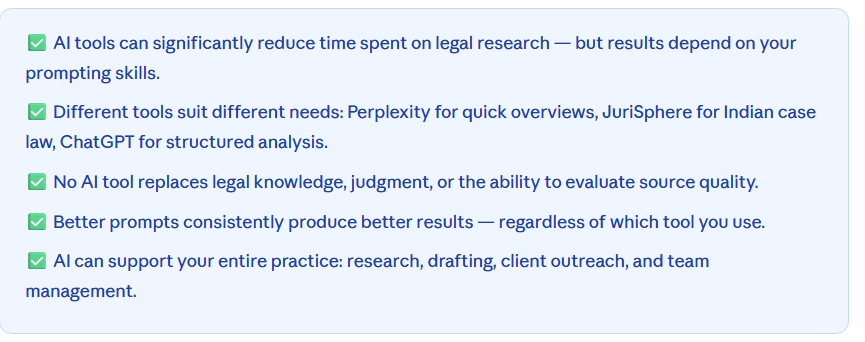
Here are the essential steps to improve your AI research:
1.Understand Legal Principles:
- You still need to know the fundamentals of drafting, commercial intent, statutory provisions, and litigation-specific principles.
2.Know How to Prompt AI Tools:
- Structure your queries in a way that ensures you get accurate and relevant information.
3.Maintain a Sense of Quality:
- You must be able to distinguish high-quality legal work from average results. Many lawyers lack this skill, which can lead to subpar outcomes.
4.Verify Sources:
- Always cross check AI-generated content with primary legal sources to ensure accuracy and compliance.
Beyond Legal Research: Other AI Applications in Law
AI can do more than just help with legal research. Here are some other ways AI can scale your practice:
1.Brand Building & Outreach:
- Use AI for creating website content, e-books, lead magnets, videos, and podcasts to engage potential clients.
2.Hiring & Training:
- AI can assist in hiring and training junior associates, while maintaining a high standard of quality control.
3.Template Creation & Quality Control:
- Automate the creation of standardized templates and playbooks. This ensures consistency and quality in your work.
4.AI-driven MIS:
- Implement AI-driven management information systems to track progress and optimize efficiency. This allows you to scale your practice without compromising on quality.
Conclusion
In conclusion, while AI tools have the potential to significantly enhance the efficiency of legal research, their effectiveness largely depends on how they are used. Lawyers must master the art of crafting precise and structured prompts to extract accurate, relevant information. While AI cannot replace the expertise of a skilled legal researcher, when used correctly, it can save valuable time and improve the quality of legal work. By understanding the principles of legal drafting, verifying AI-generated results, and leveraging AI across other areas like practice scaling and client outreach, legal professionals can maximize the benefits of AI in their day-to-day operations.





 Allow notifications