
Last verified: 2026-04-27
Calendar 2025 closed with India’s biggest fundraising year on record. 220 IPOs raised roughly Rs 1.78 lakh crore, anchored by a single Rs 15,512 crore issue from a non-banking financial conglomerate, with four mega issues clearing the Rs 10,000 crore mark. The retail base scaled in parallel: NSE crossed 12 crore registered investors on 23 September 2025, and the anchor-investor framework was deepened by a Third Amendment in late 2025 that lifted the anchor pool to 40 percent. The SEBI ICDR Amendment 2026 is the regulator’s structural response to that scale. Notified 16 March 2026 and effective 21 March 2026, it rewires two pillars of India’s IPO architecture in a single stroke.
So the demand was there. The retail army was there. What was missing?
Comprehension. SEBI’s own board memorandum, finalised in January 2026, said it openly: retail investors were “relying on grey market trends and unverified social media” to decide IPO bets, instead of reading the 800-page Draft Red Herring Prospectuses (DRHPs). Picture a first-time investor opening a UPI mandate at 10:01 a.m. on the first day of bidding, scrolling Telegram channels for the grey-market premium, and deciding her allocation off a screenshot. That’s the blind spot the regulator was watching.

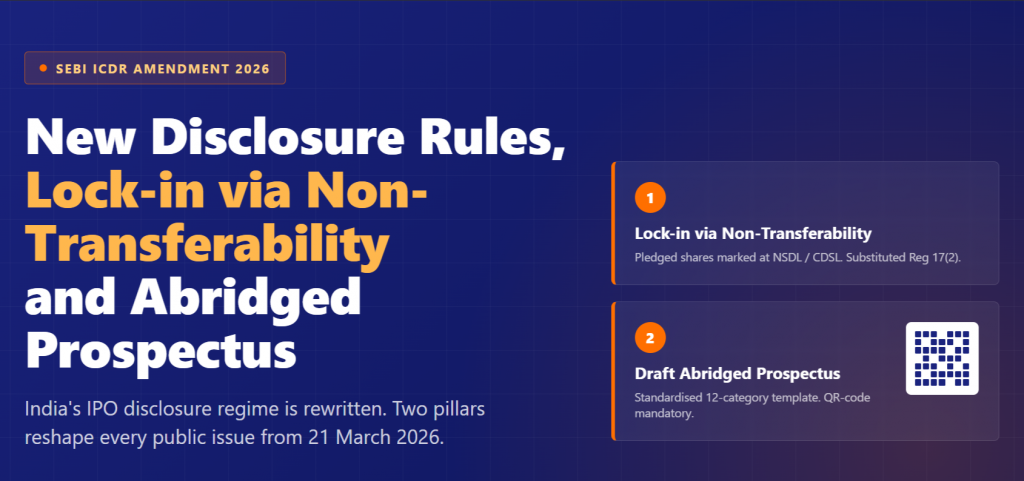
The SEBI ICDR Amendment 2026 changes the architecture in two specific ways. Depositories can now record pledged pre-issue non-promoter shares as “non-transferable” when conventional lock-in is mechanically impossible, ending the 60-to-90-day pledge-release scramble that used to sit in every IPO timeline. And a standardised draft abridged prospectus, built around a 12-category disclosure template under substituted Annexure I, must travel alongside every DRHP, RHP, and Letter of Offer, QR-accessible on every application form. The old Offer Document Summary, treated for years as marketing copy, is deleted.
The timing carried a second message. One day after the notification, the Supreme Court delivered its judgment in Securities and Exchange Board of India v. Terrascope Ventures Limited, 2026 INSC 245 (17 March 2026), reaffirming that diversion of issue proceeds contrary to the disclosed objects is fraud under PFUTP and cannot be cured by ratification or by parallel WTM proceedings. The Court restored SEBI’s full Section 15HA penalty and set aside the SAT order that had diluted it.
The pre-issue gate tightened. The post-issue penalty hardened. Same week, same posture. And the regulator’s chronology behind the amendment moved at the same tempo: a 13 November 2025 consultation paper, public comments closed 4 December 2025, board approval at the 212th meeting on 17 December 2025, gazetted in Part II Section 3 of the Gazette on 18 March 2026, with an operational lock-in circular following on 8 April 2026.
So who needs to digest this? Anyone whose paycheque is touched by an IPO: issuers planning FY27 listings, merchant bankers running sign-off protocols, company secretaries drafting first-line disclosure copy, and capital-markets associates building deal-execution muscle. The lawyer or CS who got ahead of the curve in April 2026 is the one called for the next mainboard mandate by August. The pre-IPO platform that SEBI Chair commentary has signalled, plus the LODR convergence already in motion, will compound that head start through FY27. It’s the new working knowledge.
Here’s the amendment in 50 words.
The SEBI ICDR Amendment 2026 (notified 16 March 2026, effective 21 March 2026) introduces two structural reforms to India’s IPO framework: depositories can now mark pledged pre-issue non-promoter shares as “non-transferable” to satisfy lock-in obligations, and a standardised draft abridged prospectus must accompany every DRHP and be accessible via QR code on every application form.
What follows is the practitioner walk-through. Reg-by-Reg, category-by-category, case-by-case.
What is the SEBI ICDR Amendment 2026?
So what exactly did SEBI notify? At its core, the SEBI (Issue of Capital and Disclosure Requirements) (Amendment) Regulations, 2026 is a two-pillar amendment to the existing SEBI (ICDR) Regulations, 2018 architecture. It modifies eleven regulations, substitutes one annexure, and replaces the old offer document summary with the draft abridged prospectus.
The practical effect lands on every public issue filed after 21 March 2026. Issuers can satisfy lock-in on pledged pre-issue non-promoter shares without forcing pledge releases. Retail investors can scan a QR code for a 12-category offer summary, and merchant bankers carry sharper sign-off exposure on every disclosure category. The amendment was drafted by the PMAC and cleared by the SEBI board at its 212th meeting on 17 December 2025.
A common misconception: the amendment isn’t the same as the November 2025 consultation paper. The paper proposed safeguards (AoA amendments, lender intimation) that didn’t make the gazette.
The pitfall? Confusing versions and either over-disclosing or missing the QR-code requirement. Read the gazette first; firm advisories second.
Notification and effective dates
Notified 16 March 2026. Gazetted 18 March 2026. Effective 21 March 2026. Operational circular 8 April 2026.
The two structural reform blocks at a glance
Block one: lock-in via non-transferability under new Regulation 17(2). Block two: the draft abridged prospectus framework, which substitutes Annexure I and amends Schedule VI Part E.
Why SEBI moved now: the retail-investor protection arc
The journey from ICDR 2018 to the 2026 amendment is short but dense. ICDR 2018 was gazetted in September 2018. March 2025 brought ICDR Amendment 2025 (eligibility relaxations, OFS caps, ESOP exemptions). By Q4 2025 the PMAC was drafting the next round; the public paper landed on 13 November 2025.
Why now? Structural pressure had hit a tipping point. The 2025 IPO calendar saw 220 issues raise Rs 1.78 lakh crore. Practitioner threads had flagged two pain points for two years: depositories couldn’t process lock-in on pledged shares, and the offer document summary was treated as marketing copy.
The third anchor was the Sahara India Real Estate Corporation Ltd. & Ors. v. SEBI, (2013) 1 SCC 1 line of reasoning: if a company can’t escape disclosure obligations by relabelling an issue as “private placement,” the disclosure infrastructure must be airtight. The Sahara holding established that disclosure breach attracts civil and criminal liability under what is now Section 26 of the Companies Act, 2013.
In practice, experienced counsel knew the consultation paper would generate consensus quickly. SEBI’s response document logged 17 entities on the lock-in proposal (zero disagreement) and 40 on the abridged prospectus (zero again).
A common question: “Is this a retail-only reform?” No, it’s also an issuer-process reform. The pitfall? Misreading intent and under-resourcing drafting.
The disclosure-volume problem
Modern Indian DRHPs run 800 to 1,200 pages. SEBI’s memorandum recorded the volume itself was the problem. The grey-market premium ecosystem (Telegram channels, IPO premium aggregators) had filled the comprehension vacuum.
From consultation paper to gazette
- Consultation paper: 13 November 2025
- Comments closed: 4 December 2025
- Board approval: 17 December 2025
- Gazetted: 16-18 March 2026
- Effective: 21 March 2026
- Operational circular: 8 April 2026
What the SEBI ICDR Amendment 2026 actually changes
So what’s actually different? The amendment touches eleven regulations of the SEBI ICDR Regulations, 2018 plus Schedule VI Part E and Annexure I. No top-3 SERP page provides a single-pane view. Here’s the matrix.
The Reg-by-Reg amendment matrix
| # | Regulation | Pre-2026 | Post-2026 |
|---|---|---|---|
| 1 | Reg 17(2) | Lock-in by demat freeze only | Depositories may mark pledged non-promoter shares “non-transferable” |
| 2 | Reg 25 | DRHP without abridged prospectus | DRHP must include draft abridged prospectus |
| 3 | Reg 32 | Offer document summary in DRHP | Offer document summary deleted |
| 4 | Reg 34 | Application form references DRHP | Application form must carry QR code + abridged-prospectus link |
| 5 | Reg 59C | OFS abridged prospectus rules | Aligned with substituted Annexure I |
| 6 | Reg 123 | Rights issue letter of offer | Abridged-prospectus equivalence |
| 7 | Reg 124 | Rights issue application | QR code + abridged-summary mandate |
| 8 | Reg 131 | Rights issue allotment | Updated cross-references |
| 9 | Reg 246 | SME IPO offer-document filing | Abridged prospectus rule extends |
| 10 | Reg 255 | SME application/allotment | QR code + abridged-prospectus accompaniment |
| 11 | Schedule VI Part E + Annexure I | Old offer document summary | 12-category disclosure template |
What was dropped between consultation paper and notification
In practice, what experienced merchant bankers know is that two items the consultation paper floated never made the gazette: the AoA-amendment requirement and the lender-notice requirement. A common question: did SEBI codify everything? No.
But prudent issuers should still build AoA clauses and lender intimation language into their data rooms. We’d recommend treating both as continuing best practice. The pitfall? Assuming the dropped items aren’t prudent; they weren’t abandoned, they were deferred.
Application scope
Mainboard IPOs, SME IPOs, rights issues, and confidential UDRHP-I filings are covered. QIPs and preferential allotments are out of scope; QIPs continue under Chapter VI of ICDR 2018.
Lock-in of pledged pre-issue shares: the new framework
Here’s where it gets interesting. Before 21 March 2026, if a non-promoter shareholder had pledged pre-issue shares to an NBFC, the issuer’s compliance team faced a logistical nightmare. Lock-in under Regulation 17 of the SEBI ICDR Regulations, 2018 required a depository freeze, and depositories couldn’t freeze an already-encumbered share. Sixty to ninety days of pre-IPO timeline routinely disappeared into pledge-release coordination.
New Regulation 17(2) inserts a workaround. When conventional lock-in cannot be created, the depository may, on issuer instruction, mark the securities “non-transferable” for the lock-in duration.
The scope is narrow: only non-promoter pledged shares. Promoter lock-in continues under Reg 16. The framework hooks into the Section 9 of the Depositories Act, 1996 regime.
The practical reality is that the AoA + lender-notice safeguards (dropped from the notification) still need to sit in the issuer’s data room. A common question: what if the lender invokes the pledge during lock-in? The marking doesn’t extinguish the security interest. But the depository cannot transfer until lock-in expires, so lenders typically defer invocation.
The pitfall? Assuming pledge release automatically releases the lock-in. The issuer must affirmatively instruct removal.
The new Regulation 17(2) verbatim
“Subject to sub-regulation (1), where lock-in of the specified securities cannot be created, the depositories shall, upon receipt of instructions from the issuer, record such securities as ‘non-transferable’ for the duration of the applicable lock-in period.”
Plain English: if you can’t freeze, mark.
How the non-transferability marking works mechanically
Five sequential nodes:
- Issuer board identifies pledged non-promoter shares.
- Issuer instructs the RTA.
- RTA forwards to NSDL or CDSL.
- Depository marks the account “non-transferable.”
- On expiry, issuer instructs removal.
Pledge invocation, release, and promoter scope
If a lender invokes during lock-in, the depository cannot transfer until lock-in lifts. If a pledge is released, the issuer must affirmatively instruct removal of the marking; don’t assume automation. Regulation 17(2) only covers non-promoter pledged shares; promoter lock-in continues under Reg 16, since promoters can typically arrange pledge release themselves.
Draft abridged prospectus: the new disclosure framework
This is the larger reform block. The amendment introduces a brand-new disclosure artefact: a standardised 12-category summary that must accompany every DRHP and be QR-accessible on every application form. The old offer document summary is deleted from the DRHP, RHP, and Letter of Offer.
Why the shift? The old summary was structurally weak: 30-50 pages of dense prose buried inside the DRHP, no standardised format, retail readers skipping it entirely. Each category in the new template is a future merchant-banker exposure point. The objective materiality test from Electrosteel Steels Limited v. SEBI, 2019 SCC OnLine SAT 244 (SAT, 14 November 2019) applies in full: merchant bankers cannot claim “professional judgment” to defend non-disclosure of material facts.
In practice, the template is audit-grade, not marketing; CFO and audit partner sign off in writing. A common question: “Is this just the old summary in a new wrapper?” No.
The pitfall? Treating the abridged prospectus as a softener. And under-disclosure here carries the same exposure as DRHP under-disclosure.
Draft abridged prospectus vs offer document summary
| Dimension | Old offer document summary | New draft abridged prospectus |
|---|---|---|
| Status | Embedded section | Stand-alone document |
| Format | Discretionary | Standardised (Annexure I) |
| Filing trigger | DRHP stage | DRHP, RHP, bid-application, UDRHP-I |
| Word limit | None | Per-category (100-500 words) |
| QR code | None | Mandatory |
| Authority | Reg 32 (deleted) | Annexure I + Schedule VI Part E |
| Categories | ~6 narrative | 12 structured |
The 12-category disclosure template
Substituted Annexure I sets the 12 categories.
| # | Category | Word/format limit |
|---|---|---|
| 1 | General instructions | DRHP cover = abridged prospectus first page; QR codes |
| 2 | Primary business summary | Up to 500 words; products, segments, top-5 customers, strategies |
| 3 | Industry summary | Up to 250 words |
| 4 | Promoters | Up to 100 words per promoter |
| 5 | Objects of the issue | Up to 100 words per object, tabular |
| 6 | Pre/post-offer shareholding pattern | Tabular |
| 7 | Restated consolidated financials | EBITDA, EPS, RoE, cash flow, contingent liabilities, RPTs (where Linde India Limited v. SEBI (SAT, 22 May 2024) principles bite) |
| 8 | Key Performance Indicators | Tabular; CFO + audit partner sign-off |
| 9 | Top 10 internal risk factors | Numbered list |
| 10 | Weighted average cost of acquisition | 1-year and 3-year (promoters and selling shareholders) |
| 11 | Board of Directors and KMP | Names + designations |
| 12 | Auditor qualifications and outstanding litigations | Cross-reference to DRHP/RHP (the Trafiksol ITS Technologies Ltd. v. SEBI pattern shows what under-disclosure costs) |
KPI selection (category 8) is the most contested practitioner question. The memorandum permits issuer-selected KPIs but requires consistency with internal management review. The audit committee’s dashboard becomes the starting point, not a marketing projection deck.
Two non-obvious effects: NBFC unlisted-share lending will scale; merchant-banker liability footprint widens, prompting dedicated drafting teams across Category-I bankers through FY27.
QR code, SME, and the Trafiksol cautionary tale
Every application form, price band advertisement, and public announcement must carry a QR code linking to the abridged prospectus, the RHP, and the price band advertisement. Functional from day one of bidding; a broken link is a disclosure failure, not an artwork failure.
The chain extends to SME IPOs through Reg 246, though the SME-specific format itself wasn’t changed; SME issuers layer the 2026 rules on top.
The Trafiksol matter (SAT, 24 January 2025) motivated the strengthened KPI and auditor-qualification rules. SEBI halted the Rs 45 crore SME IPO after the disclosed software supplier was found to have Rs 1 lakh paid-up capital, no filings since 2021, and a closed business address. SAT upheld the refund order, holding the issuer “had scant regard to the disclosure norms of SEBI (ICDR) Regulations.”
Compliance workflow: what issuers, merchant bankers and company secretaries must do
So how does a 2026-compliant IPO run? Here’s the 12-step checklist.
| # | Step | Owner |
|---|---|---|
| 1 | Board approves IPO | Board |
| 2 | AoA review and pre-IPO clauses | Company secretary |
| 3 | Identify pledged non-promoter shares | Compliance officer |
| 4 | Lender intimation on non-transferability | In-house counsel |
| 5 | Instruct RTA on non-transferability marking | Issuer |
| 6 | RTA forwards to depository | RTA |
| 7 | Draft abridged prospectus (12 categories) | CS + merchant banker |
| 8 | CFO + audit partner sign-off | CFO + audit partner |
| 9 | DRHP filing with draft abridged prospectus | Merchant banker |
| 10 | UDRHP-I (confidential route) | Merchant banker |
| 11 | RHP + QR-code application form | Issuer + merchant banker |
| 12 | Lock-in expiry: instruct depository to lift marking | Issuer |
That’s the spine. Each step has a single owner and an output document. AoA + lender-notice steps (2 and 4) are not codified but are prudent practice per the Cyril Amarchand alert.
In practice, the early timeline (steps 1-6) is where most issuers slip. A common question: who owns the abridged prospectus drafting? The CS owns the first draft, the merchant banker reviews and finalises, the CFO + audit partner sign off. The practical reality is that three roles, one document.
But the workflow has to run sequentially. Step 5 cannot happen before step 3, and step 9 cannot happen before step 8.
Issuer and merchant-banker workflow
Board approval, AoA review, lender intimation, DRHP filing with draft abridged prospectus, optional UDRHP-I, RHP + QR-code application form. Drafting partner, financial controller, audit partner, and counsel must initial the abridged prospectus before DRHP filing; each category needs its own diligence trail. See LawSikho on in-house counsel coordination during the IPO process, appointing independent directors before an IPO, and M&A-style due diligence techniques applied to IPO drafting.
Company secretary first-line drafting role
The 12-category template overlaps heavily with CS territory: KPI tracking, RPT disclosure, Board/KMP sections, auditor-qualification cross-references. Demand for SEBI-trained CS professionals will rise through FY27 and FY28. Pre-IPO regulated platforms (signalled by SEBI Chair commentary) will further expand the CS workload.
Confidential filings, exemptions, and SAT review
What about issuers using the confidential pre-filing route? The amendment handles them with one timing rule: the draft abridged prospectus must be available at the public filing of UDRHP-I, not at initial confidential pre-filing. An issuer using the Regulation 59C branch of the SEBI ICDR Regulations, 2018 has phase-two sequencing.
Confidential pre-filing: when the draft abridged prospectus is due
In practice, confidential pre-filing has two phases: confidential submission, then public UDRHP-I filing after SEBI observations. The abridged prospectus enters at phase two. So an issuer can refine the draft through SEBI’s confidential observations cycle without retail-facing exposure, but the moment UDRHP-I goes public, the 12-category template must be ready.
Reg 300 exemptions and standing for SAT review
A common question: who has standing to challenge a SEBI exemption under Reg 300? The Robert And Ardis James Company Limited v. SEBI, 2022 SCC OnLine SAT 1162 order (SAT, 2 September 2022), the Tamilnad Mercantile Bank IPO matter, clarified that an “aggrieved person” is part of the OFS or directly affected. Institutional investors excluded from the OFS lacked standing.
The pitfall? Assuming all stakeholders have standing under Reg 300. They don’t.
Penalties and enforcement risk under the new disclosure regime
So what happens if disclosures are inadequate? The penalty architecture is multi-layered, drawing on the Companies Act, the SEBI Act, and the SCRA in parallel.
Civil and criminal liability under the Companies Act
Section 34 of the Companies Act, 2013 imposes criminal liability for misstatement in a prospectus (up to 10 years’ imprisonment plus fine). Section 35 imposes civil liability on directors, promoters, and other persons authorising the prospectus, with defences narrowly construed.
In practice, what experienced practitioners know is that the Terrascope holding has hardened the post-issue side. Diversion of funds contrary to disclosed objects is fraud under PFUTP; ratification cannot cure breach; SEBI may impose Section 15HA penalty even where parallel WTM proceedings exist.
SEBI penalty toolkit and SCRA listing-conditions penalty
Section 15HA of the SEBI Act, 1992 imposes monetary penalty for fraudulent and unfair trade practices, supplemented by Section 11 and 11B directions and Section 15HB (residual). Section 23E of the Securities Contracts (Regulation) Act, 1956 adds a listing-conditions penalty.
A common question from junior counsel: is merchant-banker liability under PFUTP real or theoretical? Frankly, it’s real. Post-Electrosteel, SAT has confirmed objective materiality applies to merchant bankers. Post-Terrascope, ratification cannot cure.
The pitfall? Assuming penalty exposure is only on the issuer. Directors, promoters, and merchant bankers all carry exposure.
The 8 April 2026 SEBI follow-up circular and the wider 2025-2026 reform programme
The 8 April 2026 circular is the operational framework for lock-in. Practitioners expect at least one more circular through 2026 addressing the AoA + lender-notice items. Early signals suggest XBRL tagging in a 2027-2028 circular; regional-language abridged prospectus is parked. SEBI Chair commentary has signalled a regulated pre-IPO trading platform.
How does this fit the wider programme? ICDR Amendment 2025 (eligibility), Third Amendment 2025 (anchor allottees), and LODR (Amendment) 2026 (HVDLE) preceded it. 2025 was calibration; 2026 is structural reform.
A common question: is the operational circular the last word? No. But many advisers are planning Q3 FY27 timelines without flagging the 8 April mechanics. That’s the pitfall.
ICDR Amendment 2025 vs 2026
The 2025 amendment focused on eligibility. The 2026 amendment focuses on disclosure architecture. Different problem, same regulator.
| Reform area | 2025 amendment | 2026 amendment |
|---|---|---|
| Eligibility | Relaxed (OFS caps, ESOP exemptions) | Unchanged |
| Pre-issue lock-in | Unchanged | New Reg 17(2) non-transferability |
| Disclosure summary | Old offer document summary | New 12-category abridged prospectus |
| QR codes | Not addressed | Mandatory |
| Anchor allottees | Third Amendment 2025 reforms | Unchanged |
| RPT disclosures | Light touch | Sharper (within 12-category template) |
ICDR evolution 2009 to 2026
From ICDR 2009 through ICDR 2018 to the 2025-2026 cycle, the regime has tightened in every iteration.
| Year | Milestone |
|---|---|
| 2009 | ICDR 2009 notified (replaced DIP Guidelines) |
| 2012 | Sahara holding: civil + criminal liability for disclosure breach |
| 2018 | ICDR 2018 notified (consolidation) |
| 2019 | Electrosteel SAT order: objective materiality test |
| 2022 | Tamilnad Mercantile Bank SAT order: Reg 300 standing |
| 2024 | Trafiksol SEBI order: SME disclosure failure |
| Mar 2025 | ICDR Amendment 2025: eligibility relaxation |
| 13 Nov 2025 | Consultation paper |
| 17 Dec 2025 | Board approval at 212th meeting |
| 16-21 Mar 2026 | ICDR Amendment 2026 notified and effective |
| 17 Mar 2026 | Terrascope SC judgment |
| 8 Apr 2026 | Operational lock-in circular |
Where SEBI is heading next, and second-order effects
XBRL tagging is the next likely circular. AoA + lender-notice formalisation is expected. The LODR (Amendment) 2026 HVDLE framework is converging with the ICDR architecture, building toward SEBI’s broader 2026 disclosure architecture for listed companies and the LODR governance framework.
Three downstream consequences: NBFC unlisted-share lending will scale; merchant-banker liability footprint widens, prompting dedicated drafting teams across Category-I bankers; issuers pre-cleaning pledges earlier affects ESOP design (faster vesting unlocks), PE/VC exit strategy (cleaner cap tables), and anchor mandates (earlier price discovery).
The disclosure-jurisprudence arc: Sahara to Terrascope (2012-2026)
So how does the 2026 amendment connect to the case law? Each ruling tightened the regime; the 2026 amendment codifies the tightening.
The four-case arc in two sentences each
Sahara 2012: disclosure breach attracts civil + criminal liability, and SEBI’s reach extends over hybrid securities issued to fifty-plus investors regardless of “private placement” labelling. Electrosteel 2019: objective materiality test for prospectus disclosures, with merchant bankers liable for non-disclosure of facts a reasonable investor would consider material. Trafiksol 2024-25: SME disclosure failure draws Rs 45 crore refund, with the SAT holding the issuer “had scant regard to the disclosure norms of SEBI (ICDR) Regulations”.
The Terrascope judgment (Supreme Court, 17 March 2026, 2026 INSC 245) is the closer. The Court held that diversion of preferential-allotment proceeds contrary to disclosed objects is fraud under PFUTP, that ratification cannot cure breach, and that SEBI may impose Section 15HA penalty even where parallel WTM proceedings exist. Same week as the ICDR 2026 notification. The pairing isn’t coincidence; it’s regulatory posture.
In practice, what experienced practitioners know is that the four cases plus the amendment form a single doctrinal corpus. A common question: can post-facto ratification cure a disclosure breach? After Terrascope, no.
But many advisers still treat the case arc as decorative. It’s the enforcement architecture the amendment plugs into.
Same-week pairing: the regulator’s 2026 posture
ICDR 2026 notified 16 March 2026. Terrascope decided 17 March 2026. Tighter intake; harsher consequence. Read together.
Common mistakes and pitfalls in implementation
What’s going to go wrong in year one? Several mistake patterns are already visible across the early FY27 IPO pipeline.
Top 5 implementation mistakes
- Issuers assuming the AoA + lender-notice items are abandoned (they’re prudent practice).
- Merchant bankers treating the abridged prospectus as a marketing document (it’s audit-grade).
- KPI sections pulled from management projection decks instead of audit-committee dashboards.
- QR-code links tested only at print time, not at day-of-bidding.
- SME issuers missing the UDRHP-I trigger because advisers assume the confidential route is mainboard-only.
Why timeline compression is the underlying failure
Frankly, the most common failure mode is timeline compression. We’d recommend 90 days of pre-DRHP discipline; you’ll save six months of post-filing remediation.
A common question: is the QR-code requirement stylistic or substantive? Substantive. The pitfall? Treating any of these mistakes as cosmetic, when each is a pathway to a SAT proceeding.
Frequently asked questions
1. What is the SEBI ICDR Amendment 2026?
A structural amendment to the SEBI ICDR Regulations 2018, notified 16 March 2026 and effective 21 March 2026. It introduces lock-in via non-transferability for pledged pre-issue non-promoter shares (new Reg 17(2)) and a standardised draft abridged prospectus accessible by QR code.
2. When does it come into force?
Notified 16 March 2026, effective 21 March 2026. The 8 April 2026 operational circular followed. Every DRHP filed from 21 March 2026 must comply.
3. Which regulations of ICDR 2018 are amended?
Eleven: Reg 17, 25, 32, 34, 59C, 123, 124, 131, 246, 255, plus Schedule VI Part E and a substituted Annexure I.
4. What does the new Regulation 17(2) say?
“Subject to sub-regulation (1), where lock-in of the specified securities cannot be created, the depositories shall, upon receipt of instructions from the issuer, record such securities as ‘non-transferable’ for the duration of the applicable lock-in period.”
5. Does the amendment apply to SME IPOs?
Yes, through Regulation 246. SME issuers must include the draft abridged prospectus and meet QR-code requirements. The SME-specific format itself wasn’t changed.
6. Does the amendment apply to rights issues?
Yes. Regulations 123, 124, and 131 are amended, extending abridged-prospectus and QR-code architecture to rights issues.
7. Does it apply to QIPs and preferential allotments?
No. QIPs continue under Chapter VI of ICDR 2018. Preferential allotments operate under their own chapter.
8. Does it apply to confidential pre-filing IPOs?
Yes, with a timing rule. The draft abridged prospectus must be available at the public filing of UDRHP-I. Reg 59C route has phase-two obligations.
9. How does an issuer instruct the depository to mark shares non-transferable?
Through the RTA, which forwards to NSDL or CDSL. The depository marks the demat account “non-transferable” for the lock-in duration. On expiry, the issuer instructs removal.
10. What is the step-by-step IPO compliance checklist?
Twelve steps: board approval, AoA review, pledge register, lender intimation, RTA instruction, depository marking, abridged prospectus drafting, CFO + audit partner sign-off, DRHP filing, UDRHP-I (optional), RHP + QR-code application form, lock-in expiry instruction.
11. What QR code requirements has SEBI introduced?
Every application form, price band advertisement, and public announcement must carry a QR code linking to the abridged prospectus, the RHP, and the price band advertisement. A broken link is a disclosure failure.
12. What is the 8 April 2026 SEBI circular about?
The operational mechanism for lock-in under Reg 17(2): how depositories receive instructions, mark accounts non-transferable, and lift the marking on expiry.
13. Difference between draft abridged prospectus and offer document summary?
The old offer document summary was embedded with discretionary content. The new draft abridged prospectus is stand-alone, with a 12-category template, word limits, QR accessibility, and audit-grade content. The old summary has been deleted.
14. How does the SEBI ICDR Amendment 2025 differ from 2026?
The 2025 amendment focused on eligibility (OFS caps, ESOP/SAR exemptions). The 2026 amendment focuses on disclosure architecture. The Third Amendment 2025 on anchor allottees sits between them.
15. What happens if a pledge is invoked by the lender during lock-in?
The depository cannot transfer the security until lock-in expires. The marking doesn’t extinguish the security interest but constrains enforcement. Lenders typically defer invocation until after expiry.
16. Did SEBI codify the AoA-amendment and lender-notice requirements?
No. Both were proposed in the January 2026 board memorandum but weren’t codified. The 24 March 2026 Cyril Amarchand alert flagged this. A separate circular is expected.
17. If SEBI didn’t codify them, do issuers still need to do them?
Yes, as prudent practice. Lender disputes over pledged-share invocations remain a real legal exposure; AoA architecture and lender intimation language protect against post-IPO litigation.
18. What is a “non-transferable” share marking?
A depository annotation preventing transfer for the lock-in duration. NSDL or CDSL executes it on issuer instruction (via RTA), applying only to pledged pre-issue non-promoter shares.
References
Case law
- Electrosteel Steels Limited v. Securities and Exchange Board of India, 2019 SCC OnLine SAT 244. SAT Mumbai, 14 November 2019; consolidated appeal (Appeal Nos. 202, 223 and 224 of 2016) on prospectus disclosure of forest-clearance rejection and merchant-banker due diligence.
- Linde India Limited v. Securities and Exchange Board of India. SAT Mumbai, 22 May 2024; Appeal No. 329 of 2024 on materiality testing of related-party transactions and natural-justice requirements before interim directions.
- Robert And Ardis James Company Limited v. Securities and Exchange Board of India, 2022 SCC OnLine SAT 1162. SAT Mumbai, 2 September 2022; Tamilnad Mercantile Bank IPO matter on Reg 300 ICDR “aggrieved person” standing.
- Sahara India Real Estate Corporation Ltd. & Ors. v. Securities and Exchange Board of India & Anr., (2013) 1 SCC 1. Supreme Court of India, 31 August 2012; AIR 2012 SC 3829; civil and criminal liability for disclosure breach.
- Securities and Exchange Board of India v. Terrascope Ventures Limited, 2026 INSC 245. Supreme Court of India, 17 March 2026; Civil Appeal Nos. 5209-5211 of 2022; ratification cannot cure PFUTP breach.
- Trafiksol ITS Technologies Limited v. Securities and Exchange Board of India. SAT Mumbai, 24 January 2025; Appeal No. 687 of 2024; SME-IPO disclosure failure.
Statutes
- Securities Contracts (Regulation) Act, 1956. Section cited: 23E.
- Securities and Exchange Board of India Act, 1992. Sections cited: 11, 11B, 15HA, 15HB.
- Depositories Act, 1996. Sections cited: 7, 9.
- Companies Act, 2013. Sections cited: 26, 33, 34, 35.
- Securities and Exchange Board of India (Issue of Capital and Disclosure Requirements) Regulations, 2018. Reg 17, 25, 32, 34, 59C, 123, 124, 131, 246, 255, 300; Schedule VI Part E; Annexure I.
- Securities and Exchange Board of India (Issue of Capital and Disclosure Requirements) (Amendment) Regulations, 2026. Notified 16 March 2026; effective 21 March 2026.
Regulatory and circulars
- SEBI Notification dated 16 March 2026: ICDR (Amendment) Regulations 2026
- SEBI Board Memorandum, 212th board meeting, January 2026
- SEBI Consultation Paper, 13 November 2025 (sebi.gov.in)
- SEBI Circular dated 8 April 2026 (lock-in operational mechanism)
Secondary sources
- Cyril Amarchand Mangaldas client alert, 24 March 2026: Unlocking IPOs: SEBI’s ICDR Amendments
- MMJC advisory, 2 April 2026: SEBI ICDR Amendments, 2026
- NSE Annual Highlights 2025 (220 IPOs, Rs 1.78 lakh crore; Tata Capital Rs 15,512 crore as largest issue)
This article is for informational purposes only and does not constitute legal advice. For specific legal guidance, consult a qualified legal professional.
Master M&A Practice!
Learn M&A in 30 days, just for Rs. 100 →




 Allow notifications