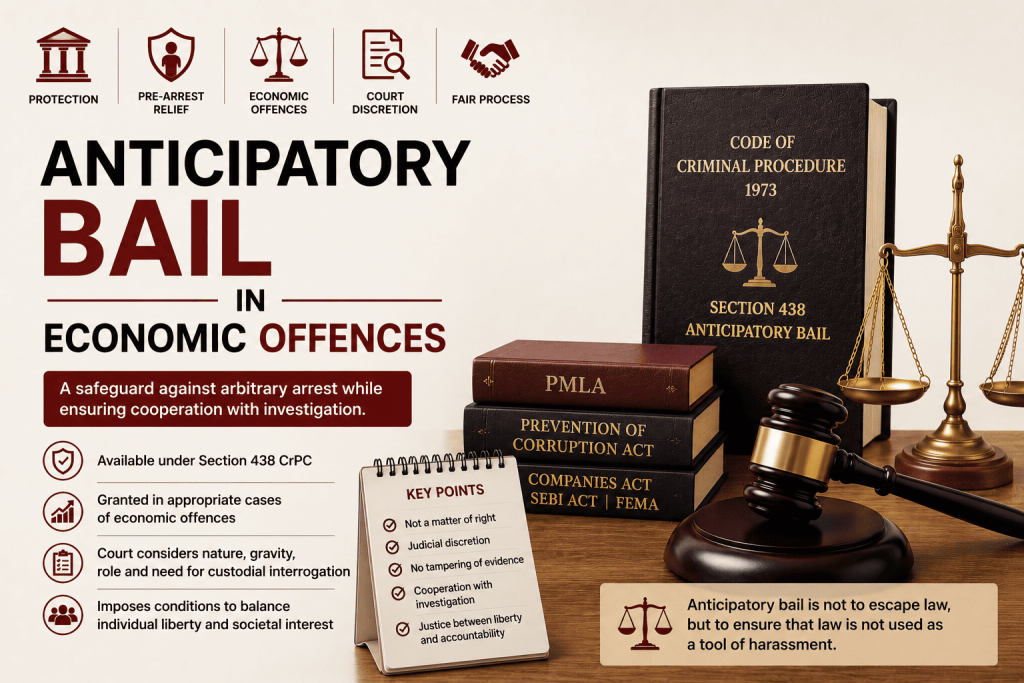

Anticipatory bail in economic offences is available but rarely granted in practice. The Supreme Court treats these offences as a class apart, and in money laundering cases the twin conditions of Section 45 of the Prevention of Money Laundering Act, 2002 apply even before arrest. The governing statute, the stage of the case and the applicant’s conduct decide the outcome.
This article sets out the law on anticipatory bail in economic offences: the class apart doctrine, the Section 45 PMLA twin conditions, the summons stage rule, and how the five statutory regimes differ.
The law here moved as recently as last week. On 16 July 2026, in Directorate of Enforcement v. Rajnish Bansal, the Supreme Court set aside anticipatory bail a High Court had granted in a post-matric scholarship scam money laundering case (LiveLaw report, 16 July 2026). The Court held that the High Court had failed to adequately consider the seriousness of the allegations and the need for custodial interrogation. The ED had pressed that the accused stood declared a proclaimed offender, and that an absconder is not entitled to pre-arrest protection at all.
The people this affects are specific: accused persons and counsel responding to action by the Enforcement Directorate (ED), CBI, a state Economic Offences Wing (EOW), the Serious Fraud Investigation Office (SFIO) or the GST and customs authorities. Law students and judiciary aspirants will also find that this area now carries its own settled question patterns.

Why do courts grant anticipatory bail in economic offences only sparingly?
Courts grant anticipatory bail in economic offences only sparingly because the Supreme Court treats these offences as a class apart. These are crimes that injure the economy and public funds rather than a single victim, usually through deep-rooted conspiracies. The power itself comes from Section 482 of the Bharatiya Nagarik Suraksha Sanhita, 2023, which replaced Section 438 of the Code of Criminal Procedure, 1973 from 1 July 2024. We have covered the general grounds and process for anticipatory bail under Section 482 BNSS separately; this post deals with what changes when the offence is economic.
And the change is substantial. A cheating FIR against a small trader and an ED money laundering case against a company promoter both involve the same pre-arrest remedy, but the tests the applicant must clear are entirely different. Where is the remedy easiest and hardest to get? Easiest in ordinary offences with no special statute in play; hardest where a statutory twin-conditions gate (PMLA, serious corporate fraud) sits on top of the class apart doctrine.
The class apart doctrine and where it came from
The class apart doctrine began in 1987, in State of Gujarat v. Mohanlal Jitamalji Porwal, (1987) 2 SCC 364, where the Supreme Court held that economic offenders imperil the economy and that the community’s interest demands serious treatment of such crimes. That case concerned the offence, not bail doctrine as such. But its language became the seed for everything that followed.
The phrase itself arrived in 2013. In Y.S. Jagan Mohan Reddy v. CBI, (2013) 7 SCC 439, the Supreme Court said economic offences constitute a class apart, because deep-rooted conspiracies and loss of public funds justify a different approach to bail. Its companion ruling, Nimmagadda Prasad v. CBI, (2013) 7 SCC 466, restated the same approach and quoted the 1987 reasoning on gravity.
Since then, “class apart” is the phrase every restrictive bail order in this field quotes. It doesn’t create a statutory bar (that comes from special statutes, discussed below). It operates as a weighting: gravity, the amount involved, and the public character of the loss count more heavily against pre-arrest protection than they would in an ordinary case.
Is bail still the rule and jail the exception in economic offences?
Bail remains the rule and jail the exception even in economic offences, but the two lines of authority pull in opposite directions and the outcome depends on which factors dominate. In Sanjay Chandra v. CBI, (2012) 1 SCC 40, the 2G case, the Supreme Court granted bail in a very large economic offence and held that seriousness alone cannot justify denying liberty. A decade later, Satender Kumar Antil v. CBI, (2022) 10 SCC 51 built a bail-reform framework that lists economic offences as a separate category, while clarifying that the category does not mean automatic denial.
So which strand wins in a given case? In practice, four factors tip the balance: the gravity and scale of the alleged offence, whether public funds are involved, the applicant’s conduct (cooperation versus evasion), and the stage of the investigation. An applicant who appeared on every summons in a Rs 2 crore private dispute sits at one end; an absconding promoter in a public-funds scam sits at the other.
One shortcut doesn’t work: offering to repay. In the Gajanan Dattatray Gore v. State of Maharashtra, 2025 INSC 913 ruling of 2025, the Supreme Court held that bail, whether regular or anticipatory, cannot be granted on an undertaking to deposit or repay money. It also directed that no trial court or High Court shall pass such orders in future. And courts treat repayment offers as an attempt to buy liberty, not as a bail ground.
Why do courts say custodial interrogation is needed in economic offences?
Courts say custodial interrogation is needed in economic offences because tracing a money trail requires confronting the accused with documents, accounts and co-conspirators in a setting the accused does not control. The leading modern statement is P. Chidambaram v. Directorate of Enforcement, (2019) 9 SCC 24, where the Supreme Court refused anticipatory bail in an ED money laundering investigation in 2019. The Court reasoned that economic offences involve deep-rooted conspiracies, and that pre-arrest protection can blunt an investigation that depends on custodial questioning.
The practical reality is that this argument appears in almost every ED and SFIO objection, whatever the facts. But experienced defence counsel meet it with a documented cooperation record: every summons answered, every document produced, nothing left for custody to extract (the record has to exist before the application is filed, not after). Where the agency can’t say what custody would add, the argument loses force.
Here is the whole field in one table. These seventeen rulings decide nearly every pre-arrest bail argument in economic offences today.
| Case | Year | Bench | One-line holding |
|---|---|---|---|
| Gurbaksh Singh Sibbia v. State of Punjab, (1980) 2 SCC 565 | 1980 | Supreme Court, 5-judge Constitution Bench | Anticipatory bail discretion is wide; no invariable restrictions are to be read into it. |
| State of Gujarat v. Mohanlal Jitamalji Porwal | 1987 | Supreme Court, 2-judge bench | Economic offenders imperil the economy; the community’s interest demands serious treatment. |
| Sanjay Chandra v. CBI | 2011 | Supreme Court, 2-judge bench | Bail is the rule even in serious economic offences; seriousness alone is no ground to refuse. |
| Y.S. Jagan Mohan Reddy v. CBI | 2013 | Supreme Court, 2-judge bench | Economic offences constitute a class apart; deep-rooted conspiracies and loss of public funds justify a different bail approach. |
| Nimmagadda Prasad v. CBI | 2013 | Supreme Court, 2-judge bench | Restates the class apart approach; gravity of economic offences is weighed at the bail stage. |
| Nikesh Tarachand Shah v. Union of India, (2018) 11 SCC 1 | 2017 | Supreme Court, 2-judge bench | The original Section 45 PMLA twin conditions were struck down under Articles 14 and 21. |
| P. Chidambaram v. Directorate of Enforcement | 2019 | Supreme Court, 2-judge bench | Anticipatory bail refused in an ED probe; custodial interrogation and gravity of economic offences prevail. |
| Sushila Aggarwal v. State (NCT of Delhi), (2020) 5 SCC 1 | 2020 | Supreme Court, 5-judge Constitution Bench | Anticipatory bail is not time-bound; special-statute restrictions are expressly preserved. |
| Vijay Madanlal Choudhary v. Union of India, 2022 SCC OnLine SC 929 | 2022 | Supreme Court, 3-judge bench | Amended Section 45 upheld; the twin conditions apply equally to anticipatory bail. |
| Satender Kumar Antil v. CBI | 2022 | Supreme Court, 2-judge bench | Bail-reform categories framed; economic offences are a distinct category but not an automatic denial class. |
| Directorate of Enforcement v. M. Gopal Reddy (24 February 2023) | 2023 | Supreme Court, 2-judge bench | Section 45 rigours apply to anticipatory bail applications under Section 438 CrPC. |
| Tarun Kumar v. Assistant Director, Directorate of Enforcement, 2023 INSC 1006 | 2023 | Supreme Court, 2-judge bench | Twin conditions applied strictly; parity arguments rejected. |
| Tarsem Lal v. Directorate of Enforcement, 2024 INSC 434 | 2024 | Supreme Court, 2-judge bench | An accused appearing on summons after cognizance is not in custody; no bail application is needed and Section 45 is not attracted. |
| Manish Sisodia v. Directorate of Enforcement, 2024 INSC 595 | 2024 | Supreme Court, 2-judge bench | Bail is the rule and jail the exception even under the PMLA; delay dilutes the Section 45 rigour. |
| Prem Prakash v. Union of India, 2024 INSC 637 | 2024 | Supreme Court, 2-judge bench | Liberty is the rule under the PMLA too; the Section 45 conditions are not a permanent bar. |
| Radhika Agarwal v. Union of India, 2025 INSC 272 | 2025 | Supreme Court, 3-judge bench | Customs and GST arrest powers upheld with CrPC/BNSS safeguards; warrantless tax arrests need recorded reasons to believe. |
| Serious Fraud Investigation Office v. Aditya Sarda, 2025 INSC 477 | 2025 | Supreme Court, 2-judge bench | Accused who evade warrants or abscond in serious economic offences are not entitled to anticipatory bail. |
| Directorate of Enforcement v. Rajnish Bansal | 2026 | Supreme Court, 2-judge bench | High Court’s anticipatory bail in a PMLA scholarship-scam case set aside; seriousness of the allegations and the need for custodial interrogation outweighed claimed cooperation. |
Do the Section 45 PMLA twin conditions apply to anticipatory bail?
Yes: the Section 45 twin conditions apply to anticipatory bail applications in money laundering cases, and this is now settled at the level of a three-judge bench. In Vijay Madanlal Choudhary v. Union of India, the Supreme Court upheld the amended Section 45 in 2022 and called it preposterous to suggest the twin conditions would bind regular bail but not anticipatory bail. A year later, Directorate of Enforcement v. M. Gopal Reddy applied that rule directly: Section 45 rigours govern such a pre-arrest application under Section 438 CrPC, and the Telangana High Court order that ignored them was set aside.
The Constitution Bench route around this doesn’t exist either. Sushila Aggarwal v. State (NCT of Delhi), which held in 2020 that anticipatory bail is not time-bound, expressly preserved the restrictions that special statutes place on the remedy. So the liberal general doctrine and the strict PMLA overlay coexist by design, not by oversight.
From Nikesh Tarachand Shah to the 2018 amendment to Vijay Madanlal
The twin conditions have already died and been reborn once, which is the part most coverage skips. In Nikesh Tarachand Shah v. Union of India, the Supreme Court struck down the original Section 45 in 2017 as violating Articles 14 and 21 of the Constitution: the conditions then hinged on the punishment for the scheduled offence, producing arbitrary results. But Parliament answered within a year, re-enacting Section 45 through the Finance Act, 2018 with the conditions tied to the “offence under this Act” language, that is, to money laundering itself.
Did the 2018 amendment validly revive the conditions after they were struck down? Vijay Madanlal answered yes in 2022, treating the re-enactment as having cured the defect the 2017 ruling identified. That three-step arc (struck down, re-enacted, upheld) is why you’ll still find pre-2018 High Court orders granting bail without the twin conditions; they belong to a statutory regime that no longer exists.
What must an applicant prove to satisfy the twin conditions?
An applicant must clear two cumulative hurdles under Section 45. The court must have reasonable grounds for believing that the applicant is not guilty of the money laundering offence. It must also be satisfied that the applicant is not likely to commit any offence while on bail.
Before either question arises, the public prosecutor gets an opportunity to oppose the application. At the pre-arrest stage this means arguing near-innocence on the agency’s own material, before trial, which is why the bar is so hard to clear.
But the section has a built-in relaxation. Its proviso allows release without the twin conditions for persons accused of laundering less than Rs 1 crore, and for certain protected categories (women, persons under sixteen, and the sick or infirm). The mistake seen most often is applicants ignoring the proviso entirely and fighting the full twin-conditions battle they did not need to fight.
Strictness is the default, though. In Tarun Kumar v. Assistant Director, Directorate of Enforcement, the Supreme Court applied the conditions rigorously in 2023 and rejected parity arguments: the fact that a co-accused got bail doesn’t dilute the statutory test for you. For the pleading mechanics of this threshold, iPleaders maintains a drafting checklist for Section 45 PMLA bail applications that pairs well with the doctrine set out here.
Has the Supreme Court softened Section 45 for delay and long incarceration?
The Supreme Court has softened Section 45 where trial delay and long incarceration are shown, without disturbing the twin conditions themselves. In Manish Sisodia v. Directorate of Enforcement, the Court restated in August 2024 that bail is the rule and jail the exception even under the PMLA, and held that prolonged incarceration with no realistic trial timeline dilutes the Section 45 rigour. Weeks later, Prem Prakash v. Union of India confirmed this is a line of authority, not a one-off: liberty remains the rule, and the twin conditions are not a permanent bar.
This is where the phrase “process as punishment” comes from. It describes the situation the 2024 rulings target: an undertrial serving what amounts to a sentence through investigation and trial delay alone. Does trial delay help a pre-arrest bail plea the same way? Less directly, since the applicant is not yet in custody, but a case pending for years with no arrest undercuts the agency’s custodial-interrogation urgency.
Fair warning: 2025 and 2026 have run the other way for anyone whose conduct is questionable. Aditya Sarda denied pre-arrest protection to warrant-evaders in April 2025. In Rajnish Bansal on 16 July 2026, the Supreme Court set aside a High Court’s grant of pre-arrest protection in a scholarship-scam PMLA case, with the ED pressing that the accused stood declared a proclaimed offender. The Court held that claimed cooperation and a complaint the accused had lodged against ED officials did not negate the need for custodial interrogation.
A related question comes up constantly in connected-case situations: how can someone hold interim bail in one money laundering case while staying in custody in another? Because each case is tested on its own record. Bail, interim or final, attaches to a specific case, and protection in one proceeding never carries over to a connected one.
Will the pending Vijay Madanlal review change the twin conditions?
A review of Vijay Madanlal is pending before a larger bench, and it could reshape this entire section, though no relaxation exists today. The review covers the supply of the ECIR to the accused, the reverse burden of proof, and aspects of Section 45 itself. Until it is decided, the 2022 ruling is the law.
Movement may also come from the procedural side, as courts work out how the reworded Section 482 BNSS interacts with special-statute bail restrictions. Anyone relying on this article in 2027 should check whether the review or a BNSS-era clarification has landed (this page records its last verification date at the top).
Do you need anticipatory bail after an ED summons?
No: if the Special Court has taken cognizance of the ED’s complaint and summons you, appearing in answer to that summons requires no bail application at all. That is the direct holding of Tarsem Lal v. Directorate of Enforcement in May 2024, and it is the single most useful ruling in this field for a person who has just received ED papers. The panic move (rushing to file for pre-arrest protection the day a summons arrives) is often exactly the wrong move, because a bail application invites the Section 45 test that mere appearance avoids.
What should you actually do after an ED summons under Section 50 of the PMLA? Appear, cooperate, and build a written record of both. The summons stage is an evidence-gathering stage, and your conduct in it becomes the core annexure of any later bail application, or the reason you never need one.
What did Tarsem Lal decide about appearing on summons?
Tarsem Lal decided that an accused who appears before the Special Court in answer to a summons is not in custody, so no bail application is needed and Section 45 is not attracted at that stage. The Court can require bonds under the general criminal procedure provisions, but furnishing a bond is not bail, and the twin conditions play no part in it. The decision removed a trap where appearance itself was being converted into a custody event that triggered the PMLA bail gate.
Can the ED still arrest you after cognizance? Not on its own authority. Tarsem Lal held that once the Special Court has taken cognizance of the complaint, the ED cannot arrest the accused without applying to that court and obtaining its permission. And arrest at that stage moves from the agency’s discretion to judicial control.
What is an ECIR and how does it differ from an FIR?
An ECIR (Enforcement Case Information Report) is the ED’s internal case document, and Vijay Madanlal held it is not an FIR. It isn’t registered under the general criminal procedure code, and there’s no general right to receive a copy of it (the pending review challenges exactly this). A person can therefore be summoned, questioned and even arrested in a PMLA case without ever seeing the founding document, which is unlike anything in ordinary criminal procedure.
For pre-arrest strategy, the consequence cuts both ways. You can’t wait for an ECIR copy to decide whether to seek protection, because you may never get one. But pre-arrest protection can be sought on a reasonable apprehension of arrest without an ECIR being registered or disclosed; the apprehension, supported by summonses, searches or a predicate FIR, is enough to move the court.
Agency playbooks: ED, SFIO, EOW and DGGI/DRI compared
Each agency runs a different pre-arrest playbook, and the right first move depends on which one is at your door. The ED works from an ECIR and Section 50 summonses, with the Tarsem Lal route available after cognizance and the Section 45 gate governing any bail application. The SFIO investigates under Section 212 of the Companies Act, 2013, where the Section 212(6) twin conditions and the absconder disqualification (discussed in the next section) control. A state EOW proceeds by ordinary FIR, so the general Section 482 BNSS route applies with class-apart weighting but no statutory twin conditions.
The tax agencies (DGGI for GST, DRI for customs) sit in a fourth box. Their arrest powers survive, but after the 2025 safeguards ruling discussed below, warrantless arrests need recorded reasons to believe, and procedural safeguards apply. An EOW FIR therefore calls for a conventional pre-arrest bail assessment, while an ED ECIR calls for a summons-compliance assessment first.
A second-order shift follows from all this, and it is changing how white-collar defence is practised. Since Tarsem Lal, competent counsel often advise summons compliance instead of filing for pre-arrest protection and attracting Section 45. The decisive lawyering now happens at the summons and ECIR stage, before any court is moved. Clients who bring in specialised counsel at the first summons get strategy; those who arrive after an arrest warrant get damage control.
How do PMLA, the Companies Act, GST law and the FEOA treat anticipatory bail differently?
Each statute overlays its own threshold on the general Section 482 BNSS power. The PMLA and Section 212(6) of the Companies Act impose full twin conditions, and GST and customs law carry safeguard-bound arrest powers. An absconder-driven disqualification operates around the Fugitive Economic Offenders Act, 2018 rather than under it. Understanding how white-collar crime is prosecuted in India under the PMLA and allied statutes helps here, because the prosecution regime determines the bail regime.
This map isn’t academic for one group of readers: directors, CFOs and GST-registered proprietors now face personal arrest exposure under statutes where pre-arrest protection is uncertain. For them, the useful output of this section is an arrest-response protocol per regime, not just doctrine. Which regime are you actually in? Answer that before drafting anything.
Is anticipatory bail available in SFIO investigations under the Companies Act?
Anticipatory bail is available in SFIO investigations, but Section 212(6) of the Companies Act, 2013 imposes twin conditions for the serious fraud offence under Section 447 that mirror the PMLA test. The court must hear the public prosecutor and must find reasonable grounds to believe the accused is not guilty and unlikely to offend on bail. Same architecture, different statute: a director facing a Section 447 complaint fights substantially the same battle as a PMLA accused.
The 2025 ruling that dominates this space is Serious Fraud Investigation Office v. Aditya Sarda. There, the Supreme Court held that accused persons who evade warrants or abscond in serious economic offences are not entitled to the remedy. The judgment turns conduct into a threshold question: before any twin-conditions argument begins, the court asks how the applicant behaved when process was issued.
Can a company director get pre-arrest protection in a Section 447 case at all, then? Yes, where the director appeared on every notice, the twin conditions can be argued and sometimes won. The disqualifying fact pattern is evasion, and boards would do well to treat responding to SFIO process as a compliance obligation, not a tactical choice.
Can you get anticipatory bail in a GST or customs arrest case?
Anticipatory bail remains a live remedy in GST and customs cases, and the 2025 safeguards ruling strengthened the applicant’s hand. In Radhika Agarwal v. Union of India, a three-judge bench upheld the arrest powers under the Customs Act, 1962 and the Central Goods and Services Tax Act, 2017. But it held that CrPC/BNSS safeguards apply to those powers, and that warrantless tax arrests require recorded reasons to believe. The judgment also affirms, at paragraph 70, that the remedy can be sought in these regimes on a reasonable apprehension of arrest, without waiting for an FIR to be registered.
The practical effect shows up in drafting. A GST pre-arrest application now pleads the safeguards: were reasons to believe recorded, was the arrest threshold under Section 132 met, were the procedural protections followed? And breach of a safeguard is itself a ground. Unlike the PMLA, no statutory twin conditions sit on this route, so the class apart weighting is the main headwind rather than a statutory gate.
What does a fugitive economic offender declaration under the FEOA change?
A fugitive economic offender declaration changes an accused’s litigation position drastically, but the FEOA itself contains no express bar on anticipatory bail. The Act works through Section 4 (its application to scheduled offences) and Section 12 (the declaration of a person as a fugitive economic offender). Section 14 permits courts to disentitle the declared offender from pursuing or defending civil claims. The bail consequence is indirect: the conduct that gets someone declared a fugitive (fleeing, refusing to return, evading process) is precisely the conduct that Aditya Sarda holds disqualifying for pre-arrest protection. It is also the conduct the ED pressed in Rajnish Bansal, where the Supreme Court set aside the High Court’s grant.
How does a fugitive economic offender differ from a proclaimed offender? The fugitive declaration is a statutory status under Section 12 of the FEOA, tied to scheduled offences where the total value involved is Rs 100 crore or more (Section 2(1)(m) of the FEOA). A proclaimed offender, by contrast, is declared by a criminal court under general criminal procedure after evading process in any case. A person can be both. And either status makes the remedy practically unattainable on current case law, though only through judicial doctrine, not FEOA text. Don’t overstate the statute; the disqualification lives in the judgments.
The five-regime comparison at a glance
The five regimes compare as follows, and this table is the decision-making core of the whole subject.
| Regime | Trigger offence | Bail threshold or safeguard | Anticipatory bail position and controlling case | Key relaxation |
|---|---|---|---|---|
| PMLA, 2002 (Section 45) | Money laundering under Sections 3 and 4 | Twin conditions plus public prosecutor’s opportunity to oppose | Twin conditions apply even pre-arrest: Vijay Madanlal (2022); M. Gopal Reddy (2023) | Proviso (under Rs 1 crore, protected categories); delay and long incarceration: Sisodia, Prem Prakash (2024); not attracted at summons stage: Tarsem Lal (2024) |
| Companies Act, 2013 (Section 212(6)) | Serious fraud under Section 447, SFIO investigation | Twin conditions mirroring Section 45 | Available, but absconders and warrant-evaders disentitled: SFIO v. Aditya Sarda (2025) | Clean appearance record keeps the twin-conditions argument open |
| CGST Act, 2017 / Customs Act, 1962 | Tax evasion offences under Section 132 CGST; customs offences | Arrest powers upheld subject to CrPC/BNSS safeguards; recorded reasons to believe for warrantless arrests | Remedy preserved, including before an FIR exists: Radhika Agarwal (2025), paragraph 70 | Safeguard breach itself supports the application; no statutory twin conditions |
| FEOA, 2018 | Scheduled economic offences; Section 12 declaration | No express bail bar; Section 14 civil-claim disentitlement | No FEOA-specific test; absconder case law governs: Aditya Sarda (2025), Rajnish Bansal (2026) | Returning and submitting to process before declaration |
| General law: BNSS, 2023 (Section 482) | Cheating, forgery and fraud offences under the Bharatiya Nyaya Sanhita, 2023, typically EOW FIRs | Ordinary anticipatory bail discretion | Available on the general test with class-apart weighting: Sibbia (1980) baseline; Jagan Mohan Reddy (2013) weighting | Cooperation, private nature of dispute, absence of public funds |
PMLA, 2002 (Section 45)
Prevention of Money Laundering Act, 2002
Companies Act, 2013 (Section 212(6))
Serious fraud investigated by the SFIO
CGST Act, 2017 / Customs Act, 1962
Tax and customs offences
FEOA, 2018
Fugitive Economic Offenders Act, 2018
General law: BNSS, 2023 (Section 482)
Bharatiya Nagarik Suraksha Sanhita, 2023
How do you apply for anticipatory bail in economic offences under Section 482 BNSS?
You apply for anticipatory bail in economic offences under Section 482 BNSS to the Sessions Court or the High Court. The application, though, must be built to clear the special-statute threshold that governs your regime, not just the general test. A PMLA application that doesn’t squarely address the twin conditions is dead on filing. The same drafting effort that wins an ordinary pre-arrest application is the starting point here, not the finish.
When should you file, and in which court?
File when the apprehension of arrest becomes reasonable and specific, which can be before any FIR or ECIR is registered. The width of the discretion comes from Gurbaksh Singh Sibbia v. State of Punjab, the 1980 Constitution Bench ruling that refused to read invariable restrictions into the anticipatory bail power; registration of a case is not a precondition. Summonses, a search, or a predicate FIR naming you all qualify as concrete apprehension triggers.
Forum choice is strategic. The default route runs through the Sessions Court first. But in agency-driven cases counsel often move the High Court directly, where the special-statute questions get fuller hearing (practice varies by state, and some High Courts insist on Sessions first). If the police are at the door and arrest is imminent, an application with an urgent interim-protection prayer is the realistic play; once arrest happens, the remedy switches to regular bail.
The transition from the old law changed the text more than the substance. Section 482 BNSS drops the four-factor list the old Section 438(1) carried, and the old statute-specific carve-outs now operate as separate exclusions. The position under the old Section 438 CrPC still explains most pre-2024 case law you will cite.
Documents, drafting and cost
The documents decide these applications more than the arguments do. An economic-offence application file should annex the complete summons record with replies, proof of every appearance, the ECIR copy if obtained (or the attempts made to obtain it), a tabulated asset disclosure, and the predicate FIR papers. Start from a working bail application format and rebuild its grounds around the statute you face: proviso applicability and twin-conditions material for PMLA, safeguards compliance for GST, appearance record for SFIO.
What does it cost? Court fees on a bail application are nominal everywhere in India. The real cost is professional fees, which vary widely with the forum and the seniority of counsel. A Sessions Court application in a district town and a High Court PMLA matter argued by senior counsel sit in entirely different price bands.
Frankly, this gets overlooked: a well-prepared paper book from junior counsel routinely beats an expensive oral argument mounted on a thin file.
What conditions do courts impose when granting anticipatory bail in economic offences?
Courts granting anticipatory bail in economic offences impose conditions aimed at the two risks they fear most: flight and evidence-tampering. The standard set includes:
- surrender of the passport and, frequently, a bar on leaving the country without leave of the court;
- joining the investigation whenever called, with cooperation as a continuing condition;
- disclosure of assets, and sometimes an undertaking not to alienate them;
- no tampering with evidence and no contact with witnesses or co-accused;
- travel restrictions within India, appearance bonds and sureties fixed to the scale of the alleged offence.
How long does the protection last? Sushila Aggarwal settled that anticipatory bail is not time-bound and can run until the end of trial, subject to the restrictions special statutes impose. In practice, though, breach of any condition invites cancellation, and in economic offences the agencies watch compliance closely.
Can an absconder or proclaimed offender still get anticipatory bail?
No: on current Supreme Court authority, an absconder or proclaimed offender is effectively disentitled from anticipatory bail in economic offences. Aditya Sarda held in 2025 that accused who evade warrants and abscond are not entitled to the remedy. In Rajnish Bansal in July 2026, the Supreme Court set aside a High Court grant in the case of an accused whom the ED said had been declared a proclaimed offender. The wide Sibbia discretion does not rescue an applicant whose own conduct shows contempt for process.
Does full cooperation guarantee the opposite result? It doesn’t. In Rajnish Bansal, claimed cooperation, and even a complaint the accused had lodged against ED officials, did not negate the need for custodial interrogation. Cooperation is necessary, never sufficient; it removes a disqualification without creating an entitlement.
Section 212(6) twin conditions for Section 447 fraud; absconder and warrant-evasion check: Aditya Sarda (2025) Radhika Agarwal (2025) safeguards: recorded reasons to believe; CrPC/BNSS protections; plead safeguard breach Ordinary Section 482 BNSS test with class-apart weighting Evaded warrants or absconding? Not entitled to anticipatory bail: Aditya Sarda (2025); Rajnish Bansal (2026)ED (ECIR / PMLA)
SFIO (Companies Act Section 212)
GST / Customs (DGGI / DRI)
EOW / Police FIR (BNS offences)
Absconder / Proclaimed Offender Gate
Anticipatory bail, interim protection and regular bail in economic offences compared
The three remedies operate at different stages: interim protection shields you while an anticipatory bail application is pending, anticipatory bail protects you before arrest, and regular bail is the post-arrest remedy. Mixing them up costs applicants real time, because each has its own test and its own failure consequences. The wider family of remedies is mapped in the full taxonomy of bail types under the BNSS; here the focus stays on how the three interact in economic offences.
| Point | Interim protection | Anticipatory bail | Regular bail |
|---|---|---|---|
| Stage | While the anticipatory bail application is pending | Before arrest | After arrest |
| Source | Court’s interim order on the pending application | Section 482 BNSS plus any special-statute overlay | General bail provisions of the BNSS plus any special-statute overlay |
| Do the Section 45 twin conditions bite? | Courts have granted interim shields while testing Section 45, as reported in ED-case practice | Yes, in PMLA cases: Vijay Madanlal; M. Gopal Reddy | Yes, in PMLA cases; delay may dilute the rigour: Sisodia, Prem Prakash |
| On failure | Lapses when the main application is decided against the applicant | Arrest becomes possible; strategy shifts to regular bail | Custody continues; appeal or fresh application on changed circumstances |
Is interim protection from arrest the same as anticipatory bail?
Interim protection from arrest isn’t the same as anticipatory bail: it is a temporary shield the court grants while your application for it awaits final hearing. In ED cases, courts have granted such interim orders while examining whether the applicant can meet the Section 45 threshold, a practice regularly reported from the Special Courts and High Courts. The protection is parasitic on the main application; it has no independent life.
The catch? When the main application fails, the interim order lapses with it, and the applicant faces arrest with the added disadvantage of a reasoned rejection on record. Interim protection buys preparation time. But it isn’t an outcome, and treating it as one is where most applicants go wrong.
When do interim bail, default bail and regular bail apply instead?
Interim bail, default bail and regular bail all belong to the post-arrest world, each attached to a different trigger. Interim bail is a short-duration release the court grants during the pendency of a main bail plea, sometimes on humanitarian grounds. Default bail arises when the agency fails to complete its investigation and file its complaint or chargesheet within the statutory period. Regular bail is the standard post-arrest remedy, and in PMLA cases it passes through the same Section 45 gate as anticipatory bail.
That last point changes strategy more than any other. A refusal of pre-arrest protection isn’t the end of the road; it moves the contest to the regular bail stage. There, the delay-and-incarceration line of Sisodia and Prem Prakash operates with greater force, because the applicant is actually in custody. Venue changes, the statute doesn’t.
Frequently asked questions on anticipatory bail in economic offences
Can anticipatory bail be granted in economic offences in India?
Yes, anticipatory bail can be granted in economic offences, but courts grant it sparingly because the Supreme Court treats these offences as a class apart. The outcome turns on the governing statute, the stage of the case, and the applicant’s conduct.
Can anticipatory bail be granted in a PMLA money laundering case?
It can, but the Section 45 twin conditions apply even pre-arrest, so grants are rare. The applicant must show reasonable grounds to believe they are not guilty and are unlikely to offend on bail. The proviso for amounts under Rs 1 crore and protected categories is the main practical opening.
What are the twin conditions under Section 45 of the PMLA?
The twin conditions require the court to find reasonable grounds for believing the accused is not guilty of the money laundering offence, and to be satisfied the accused is not likely to commit any offence while on bail. Both must be met, after the public prosecutor has had an opportunity to oppose.
What is the validity of anticipatory bail once granted: is it time-limited?
Anticipatory bail is not time-limited, and it can continue until the end of the trial. The Constitution Bench in Sushila Aggarwal (2020) settled this, while preserving the restrictions special statutes impose. A court retains the power to limit or cancel protection on breach of conditions.
Can anticipatory bail be granted in a GST arrest case under Section 132 CGST Act?
Anticipatory bail remains available in GST cases, and Radhika Agarwal (2025) strengthened applicants: warrantless tax arrests need recorded reasons to believe, and CrPC/BNSS safeguards apply. No statutory twin conditions govern this route. Breach of the safeguards itself supports the application.
Can anticipatory bail be filed before an FIR or ECIR is registered?
Yes, anticipatory bail can be filed before any FIR or ECIR exists, because a reasonable apprehension of arrest is the only trigger the law requires. Summonses, searches or a predicate case naming you can establish it. Under the Sibbia line, registration of a case is not a precondition.
Do I need to seek bail if I appear before the Special Court on a PMLA summons?
No, you don’t need bail to appear on a PMLA summons after cognizance. Tarsem Lal (2024) held that such appearance is not custody, that Section 45 is not attracted, and that the ED cannot arrest after cognizance without the Special Court’s permission. The court may require bonds, which are not bail.
What is the less-than-one-crore proviso to Section 45 PMLA and who can use it?
The proviso to Section 45 permits release without the twin conditions where the alleged laundering is less than Rs 1 crore, and for protected categories including women, persons under sixteen, and the sick or infirm. It converts a near-impossible test into ordinary bail discretion.
Is money laundering a bailable or non-bailable offence?
Money laundering is treated as a cognizable and non-bailable offence, as the Supreme Court confirmed in Vijay Madanlal (2022). Bail is therefore never a matter of right and must pass through the Section 45 conditions. The same gate governs anticipatory bail.
Can I still get anticipatory bail if I evaded summons or warrants earlier?
Almost certainly not: evasion of process is currently the strongest disqualification here. Aditya Sarda (2025) denied the remedy to warrant-evaders and absconders, and in Rajnish Bansal (2026) the Supreme Court set aside a grant where the ED said the accused stood declared a proclaimed offender.
Can anticipatory bail be cancelled or set aside after it is granted?
Yes, anticipatory bail can be cancelled for breach of conditions and set aside by a higher court on challenge. Rajnish Bansal (2026) is a live example, where the Supreme Court set aside a High Court grant in a PMLA case. Compliance discipline after the grant matters as much as the grant itself.
Is Section 45 PMLA constitutional after Nikesh Tarachand Shah?
The current Section 45 is constitutional: the 2017 striking down in Nikesh Tarachand Shah was answered by the Finance Act, 2018 re-enactment, which Vijay Madanlal upheld in 2022. A review before a larger bench is pending. Until it is decided, the twin conditions stand.
Anticipatory bail vs regular bail: what is the difference?
Anticipatory bail is sought before arrest and directs that the applicant be released on bail if arrested, while regular bail is sought after arrest to secure release from custody. In PMLA cases both pass through the Section 45 twin conditions. The choice is a question of stage, not preference.
Section 438 CrPC vs Section 482 BNSS: what changed for anticipatory bail?
The power continued: Section 482 BNSS dropped the four-factor list of the old Section 438(1), and the old carve-outs now operate as statute-specific exclusions. The transition took effect on 1 July 2024. Pre-2024 case law, including the economic-offences line, continues to guide the new provision.
Do I need anticipatory bail in both the predicate offence and the PMLA case?
They are separate proceedings, and protection in one doesn’t cover the other. M. Gopal Reddy (2023) shows the Section 45 rigours reaching an anticipatory bail application even when it was sought in the predicate context. Assess exposure and seek protection in each proceeding on its own footing.
What is the punishment for money laundering under the PMLA?
Money laundering is punishable with rigorous imprisonment of three to seven years and a fine, extendable to ten years where the scheduled offence falls under the narcotics law. The severity feeds directly into how strictly courts approach bail.
References
Case Law
- Directorate of Enforcement v. M. Gopal Reddy (Supreme Court, 24 February 2023)
- Directorate of Enforcement v. Rajnish Bansal, SLP(Crl) No. 4611/2026, order dated 16 July 2026 (Supreme Court); not yet reported on Indian Kanoon, see the LiveLaw report of 16 July 2026
- Gajanan Dattatray Gore v. State of Maharashtra, 2025 INSC 913
- Gurbaksh Singh Sibbia Etc. v. State of Punjab, (1980) 2 SCC 565
- Manish Sisodia v. Directorate of Enforcement, 2024 INSC 595
- Nikesh Tarachand Shah v. Union of India, (2018) 11 SCC 1
- Nimmagadda Prasad v. CBI, (2013) 7 SCC 466
- P. Chidambaram v. Directorate of Enforcement, (2019) 9 SCC 24
- Prem Prakash v. Union of India through Directorate of Enforcement, 2024 INSC 637
- Radhika Agarwal v. Union of India, 2025 INSC 272
- Sanjay Chandra v. CBI, (2012) 1 SCC 40
- Satender Kumar Antil v. CBI, (2022) 10 SCC 51
- Serious Fraud Investigation Office v. Aditya Sarda, 2025 INSC 477
- State of Gujarat v. Mohanlal Jitamalji Porwal, (1987) 2 SCC 364; AIR 1987 SC 1321
- Sushila Aggarwal v. State (NCT of Delhi), (2020) 5 SCC 1
- Tarsem Lal v. Directorate of Enforcement, Jalandhar Zonal Office, 2024 INSC 434
- Tarun Kumar v. Assistant Director, Directorate of Enforcement, 2023 INSC 1006
- Vijay Madanlal Choudhary v. Union of India, 2022 SCC OnLine SC 929
- Y.S. Jagan Mohan Reddy v. CBI, (2013) 7 SCC 439
Statutes
- Customs Act, 1962: arrest powers as considered in Radhika Agarwal
- Code of Criminal Procedure, 1973: section cited: 438 (repealed position)
- Prevention of Money Laundering Act, 2002: sections cited: 3, 4, 19, 44, 45, 50, 65, 71
- Companies Act, 2013: sections cited: 212, 212(6), 447
- Central Goods and Services Tax Act, 2017: sections cited: 69, 70, 132
- Fugitive Economic Offenders Act, 2018: sections cited: 2(1)(m), 4, 12, 14
- Bharatiya Nyaya Sanhita, 2023: cheating and forgery offences (successors to IPC 420, 467, 468, 471)
- Bharatiya Nagarik Suraksha Sanhita, 2023: section cited: 482
This article is for informational purposes only and does not constitute legal advice. For specific legal guidance, consult a qualified legal professional.





 Allow notifications