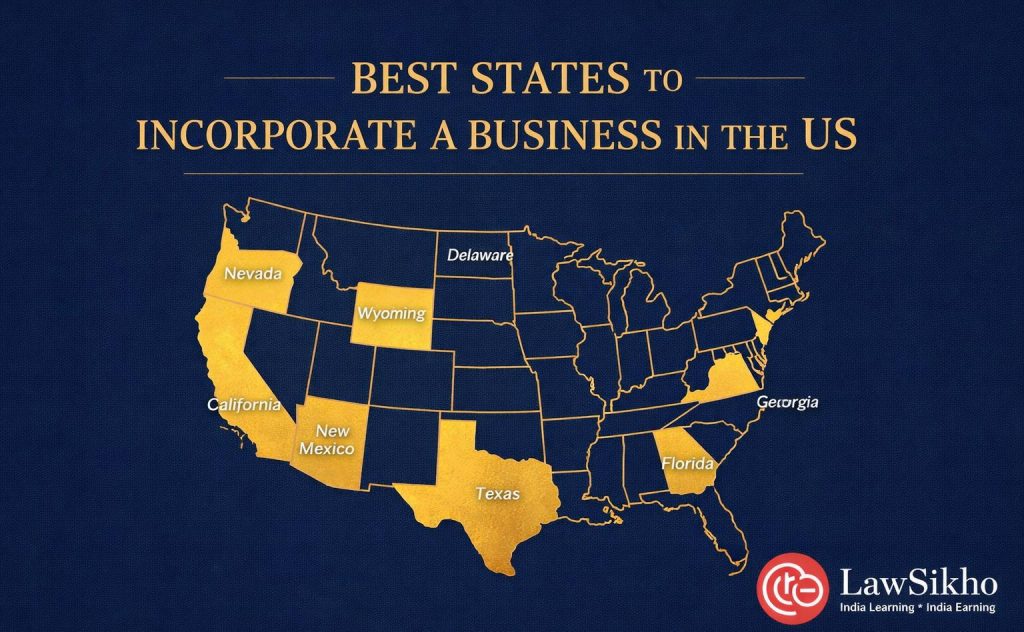

“The best states to incorporate a business in the US aren’t always the ones with the lowest taxes but they do share key advantages in legal infrastructure, compliance simplicity, and tax efficiency. Choosing the right state is one of the most consequential decisions an entrepreneur or their advisor can make.”
Table of Contents
“Understanding which are the best states to incorporate a business in the US requires looking beyond tax rates alone.
But here’s the thing: the best state to incorporate in isn’t always the one with the lowest taxes. There are trade-offs between tax savings, legal infrastructure, filing complexity, and where your business actually operates. This guide breaks all of it down so you can make or advise a well-informed decision.
Why the Choice of State Matters More Than You Think
Every US state has its own rules around corporate income tax, franchise fees, annual filing requirements, and legal precedent for business disputes. Incorporating in one state doesn’t mean you escape taxes in another if your business operates in California, for instance, California will still tax you, even if you incorporated in Wyoming.

This is why incorporation strategy is both a tax question and a legal one. The goal isn’t to simply chase the lowest tax rate. It’s to find the best balance of tax efficiency, legal simplicity, and operational fit for a specific business.
Key Factors to Consider Before Incorporating
Tax Efficiency
Low or zero taxes on corporate income, personal income, and sales are a major advantage. States like Wyoming, Nevada, and South Dakota have built their reputations specifically on this no corporate income tax, no personal income tax, and in some cases, no sales tax.
Ease of Compliance and Legal Infrastructure
Filing fees, annual reporting requirements, and the quality of legal precedent matter enormously. Delaware is the gold standard here its Court of Chancery has centuries of business case law, making it highly predictable for investors and acquirers. This is why most venture backed startups and Fortune 500 companies incorporate in Delaware, even if they never operate there.
Where You Actually Conduct Business
This is the most overlooked factor. If your business has employees, physical offices, or customers in a particular state, that state will likely require you to register as a “foreign entity” and pay taxes there regardless of where you incorporated. Choosing a tax friendly state for incorporation doesn’t exempt you from taxes where you actually do business.
The 7 Best States to Incorporate a Business in the US
Based on tax efficiency and ease of compliance, here are the top seven states:
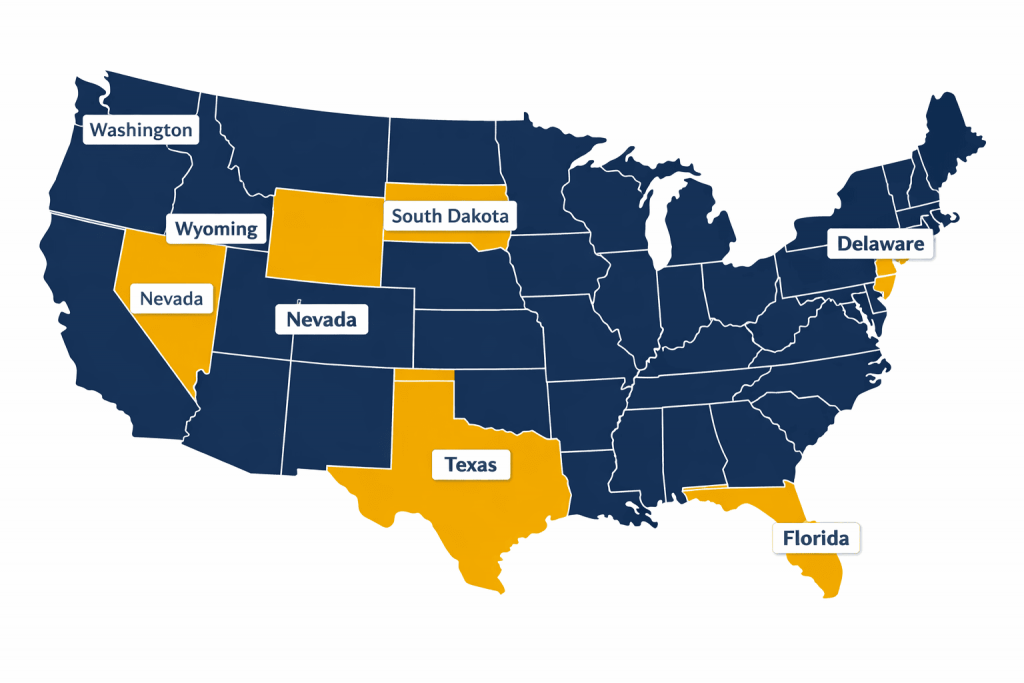
1. Delaware
Best for: Startups, venture-backed companies, businesses planning to raise capital
“Delaware consistently ranks among the best states to incorporate a business in the US, particularly for startups and investor-backed companies.” The Court of Chancery is dedicated exclusively to business disputes, offering speed and predictability. Delaware corporations that don’t operate locally owe only a franchise tax and no income tax on out of state earnings. Investors and acquirers are also more comfortable with Delaware entities, making it the default for companies planning to fundraise.
2. Wyoming
Best for: LLCs, small businesses, pass-through entities
“For those prioritizing privacy and zero taxes, Wyoming is one of the best states to incorporate a business in the US.” It has no corporate income tax, no personal income tax, and no franchise tax. It’s also known for strong LLC protections and privacy laws, making it attractive for business owners who want simplicity and asset protection without unnecessary cost.
3. Nevada
Best for: Corporations seeking strong liability protection
“Nevada is another of the best states to incorporate a business in the US for corporations seeking strong liability protection.” It also has some of the strongest liability protections for directors and officers in the country, and it does not share information with the IRS in certain circumstances. However, Nevada’s annual fees can be higher than Wyoming’s, so it’s worth comparing costs directly.
4. South Dakota
Best for: Financial services, trusts, and holding companies
South Dakota has no corporate income tax, no personal income tax, and no inheritance tax. It’s particularly popular for financial institutions and trust companies. Its simple regulatory environment makes it appealing for holding companies and businesses with passive income structures.
5. Florida
Best for: Businesses with US operations and large consumer markets
“Florida makes the list of best states to incorporate a business in the US for its combination of no personal income tax and large market size.” Florida has no personal income tax and is one of the largest consumer markets in the US. While it does have a corporate income tax (currently 5.5%), the absence of personal income tax and the sheer size of Florida’s economy makes it an attractive option for businesses that actually plan to operate there. It offers a practical mix of tax savings and market access.
6. Texas
Best for: Businesses in manufacturing, technology, energy, and large-scale operations
“Texas is one of the best states to incorporate a business in the US if your operations are large-scale and market-facing.” Texas has no corporate income tax and no personal income tax. It does levy a franchise tax (called the “margin tax”) on most businesses, but many small businesses fall below the threshold. Texas is one of the most economically active states in the US, with a massive domestic market and a business-friendly regulatory environment.
7. Washington
Best for: Technology companies and businesses without retail sales
Washington has no personal income tax and no corporate income tax, but it does impose a Business and Occupation (B&O) tax a gross receipts tax on revenue, not profit. This makes it particularly suitable for businesses with high margins. It is home to Amazon and Microsoft for a reason the overall tax environment remains competitive for large scale technology businesses.
Other States Worth Knowing: New Hampshire and Alaska
New Hampshire eliminates sales tax entirely and has no income tax on wages, though it does tax interest and dividends. It can be a strong fit for businesses with significant purchase volumes or service-based revenue.
Alaska has no state sales tax and no individual income tax, making it particularly favorable for pass through entities (like S-corps and partnerships) and businesses with large procurement costs. The trade-off is geographic and economic remoteness Alaska’s domestic market is limited.
These states may not suit every business, but for specific structures or sectors, they can offer meaningful advantages.
Don’t Overlook California and New York
Despite their high tax rates, California and New York are the two largest business states in the US. If you’re advising clients or building a practice in US corporate compliance, you need to understand how incorporation and taxation work in both states.
California has some of the highest corporate and personal income taxes in the country, plus a mandatory franchise tax (minimum $800/year) even for entities that don’t earn profit. New York similarly has complex corporate, city, and state level taxes.
Knowing these states isn’t optional they are where a disproportionate share of US businesses is actually headquartered or operating.
Comparative Overview: State-by-State Tax Snapshot
| State | Corporate Income Tax | Personal Income Tax | Sales Tax | Notes |
| Delaware | Yes (8.7%) | Yes | No | Best legal infrastructure; franchise tax applies |
| Wyoming | No | No | Yes (4%) | Strong LLC protections, low fees |
| Nevada | No | No | Yes (6.85%) | Strong director/officer protections |
| South Dakota | No | No | Yes (4.5%) | Favored for trusts and financial services |
| Florida | Yes (5.5%) | No | Yes (6%) | Large consumer market |
| Texas | No (franchise tax) | No | Yes (6.25%) | Massive domestic market |
| Washington | No (B&O tax applies) | No | Yes (6.5%) | Favored by tech companies |
| Alaska | No | No | No | No state sales tax; remote market |
| New Hampshire | Yes (on dividends) | No (on wages) | No | No sales tax |
“This table gives you a quick snapshot to help you identify the best states to incorporate a business in the US based on your specific structure and goals.” For an independent annual ranking of state tax competitiveness, refer to the Tax Foundation’s State Business Tax Climate Index.
“Final Thoughts: Choosing the Best States to Incorporate a Business in the US”
“Picking among the best states to incorporate a business in the US comes down to your business structure, market, and growth plans:”
- If you’re building a venture-backed startup, Delaware is almost always the right answer.
- If you want maximum tax savings with simplicity, Wyoming or Nevada make strong cases.
- If your business is actually operating in a large market, Florida or Texas offer the best of both worlds.
- If you’re working with clients in California or New York, learn those states thoroughly that’s where the most advisory work exists.
The businesses and professionals who understand this decision at a detailed level are the ones clients trust and pay to guide them through it.




 Allow notifications