

For decades, senior advocates have been able to charge premium fees and maintain their dominance in courtrooms. A major reason for this was their deep understanding of how specific judges think and decide cases.
Table of Contents
However, this advantage may no longer remain exclusive.
Imagine being able to:
- Analyze a judge’s past rulings
- Understand their legal philosophy and preferences
- Tailor your arguments accordingly to maximize persuasive impact
This is no longer hypothetical it is fast becoming a practical reality with AI.

What This Means for You
If you leverage this approach effectively:
1.Compete with senior lawyers
You can match experienced advocates who regularly appear before specific benches, as their “insider understanding” is no longer exclusive.
2.Strategize cases more effectively
You can prepare arguments based on the judge hearing your matter—regardless of whether you practice there regularly.
3.Choose the right senior counsel
You can identify which senior lawyer is best suited for a specific matter based on alignment with judicial preferences.
While senior lawyers may still enjoy trust and familiarity with the bench, this gap can gradually close as your preparation and argument quality improves.
Phase 1: Understanding the Psychology of the Bench
Let’s take a practical example:
You want to draft a bail application that has a higher likelihood of being approved.
Remember:
- Bail hearings are not final adjudications
- Judges do not deeply evaluate merits at this stage
- The focus is primarily on cooperation, risk, and procedural fairness
How to Use AI Here
- Collect past bail orders
- Use platforms like Indiankanoon or the Supreme Court website
- For High Courts or trial courts, refer to official court websites
- Gather 10-15 past bail orders of the same judge
- Download and organize
- Save these orders as PDFs
- Upload to AI tools (e.g., Claude)
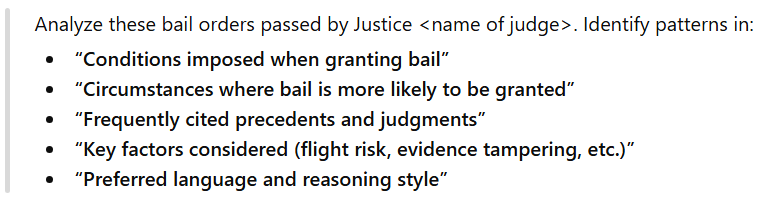
Use the following structured prompt:
Phase 2: Creating Custom Bail Applications
Once you understand the judge’s patterns, you can move to strategic drafting.
Step-by-Step Approach
1.Summarize your case facts
- Use AI to clearly structure your client’s facts.
2.Draft the bail application using AI
- Use this prompt:

3.Refine bail conditions
Follow up with:

Why This Approach Works
In practice, lawyers already refer to precedents before drafting arguments.
AI simply enhances this process by:
- Identifying patterns faster
- Structuring insights more clearly
- Allowing hyper-personalized argument building
You are essentially:
- Speaking the judge’s legal language
- Addressing their known concerns
- Aligning with their decision-making framework
The Outcome
Over time, this approach can lead to:
- Higher success rates in bail applications
- Stronger courtroom performance
- A reputation for precision and preparation
FAQ
1. How can AI help me in court?
AI can analyze a judge’s past rulings and preferences, helping you tailor your arguments and strategies to increase your chances of winning.
2. Do I need to be a senior lawyer to use AI effectively?
No, AI allows any lawyer to understand a judge’s preferences and draft better arguments, making it easier to compete with senior lawyers.
3. What type of court cases can AI help with?
AI can be used for any type of case where understanding a judge’s previous decisions is helpful, like bail applications, case strategies, and more.
4. How does AI analyze a judge’s rulings?
AI looks at patterns in past rulings, such as conditions for granting bail, precedents used, and factors the judge considers most important.
5. Will using AI guarantee a win in court?
While AI doesn’t guarantee a win, it helps you craft stronger, more personalized arguments that are likely to resonate with the judge’s style and preferences.
Conclusion
In conclusion, leveraging AI to understand and predict the preferences of judges can significantly enhance your courtroom strategy, allowing you to craft more persuasive, tailored arguments. By analyzing past rulings, understanding judicial philosophies, and aligning your submissions with a judge’s specific tendencies, you can level the playing field against senior lawyers. This approach not only improves the likelihood of favorable rulings but also helps build a reputation for precision, preparation, and an in-depth understanding of the bench. As AI continues to evolve, the potential to outsmart even the most seasoned advocates becomes increasingly accessible to all lawyers committed to strategic excellence.





 Allow notifications