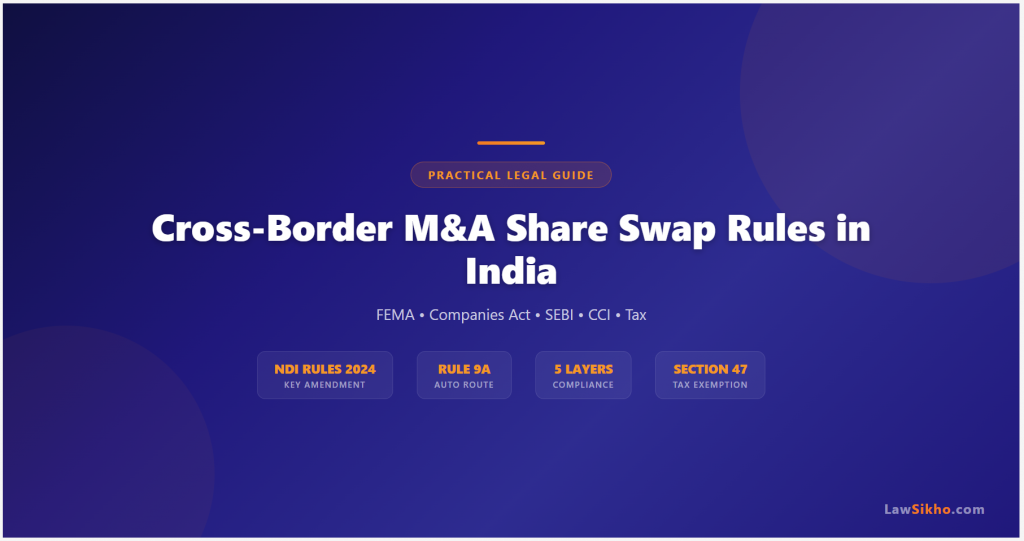

A cross-border share swap allows an Indian company and a foreign entity to exchange equity without either side deploying cash — making it one of the most capital-efficient deal structures available for international mergers and acquisitions. Until recently, Indian foreign exchange regulations made these transactions slow, uncertain, and heavily dependent on government approvals. The 2024 amendments to the Foreign Exchange Management (Non-Debt Instruments) Rules fundamentally changed this by opening secondary share swaps to the automatic route and simplifying the compliance pathway for both inbound and outbound transactions.
If you are a corporate lawyer, M&A practitioner, in-house counsel, or a startup founder structuring a cross-border deal, this guide breaks down the complete legal framework governing share swaps in India — FEMA, the Companies Act 2013, SEBI regulations, CCI merger control, tax treatment under the Income Tax Act, and the practical compliance steps that determine whether your transaction closes smoothly or stalls in regulatory approvals.
Table of Contents
What Is a Share Swap in Cross-Border M&A?
A share swap is a transaction where shares of one company are exchanged for shares of another company, with no cash changing hands between the parties. In the cross-border context, this means an Indian company issues or transfers its equity instruments to a person resident outside India, and in return receives equity instruments of a foreign company — or vice versa. The transaction is settled entirely through the issuance or transfer of securities rather than through monetary consideration.
The commercial logic behind share swaps is straightforward. When two companies want to combine operations, establish a joint venture, or restructure their group holdings across jurisdictions, deploying cash creates immediate liquidity pressure, triggers foreign exchange conversion costs, and may require external financing. A share swap avoids all three problems. The acquiring entity uses its own equity as currency, the target’s shareholders receive shares in the acquiring entity, and the transaction is effectively cash-neutral for both sides.

In Indian M&A practice, share swaps have been used in some of the largest transactions in the country’s corporate history. The HDFC–HDFC Bank merger used a share swap ratio of 42 new shares for every 25 existing shares, creating a combined entity with a market capitalisation exceeding ₹14,000 billion. The Vodafone–Idea merger similarly relied on a share exchange structure where Vodafone acquired a 50.3 per cent stake with Aditya Birla Group receiving a 26 per cent equity allocation. The Jindal Stainless merger used a share swap ratio of 100:195. These transactions demonstrate that share swaps are not a niche structure — they are the preferred mechanism for high-value Indian M&A where cash deployment would be prohibitively expensive or strategically undesirable.
In the cross-border context, the regulatory complexity increases significantly because the transaction must simultaneously comply with India’s foreign exchange regulations (FEMA and the NDI Rules), corporate law requirements under the Companies Act 2013, SEBI regulations if a listed entity is involved, Competition Commission of India (CCI) merger control thresholds, and the Income Tax Act provisions governing capital gains treatment. Each regulatory layer has its own compliance requirements, timelines, and approval pathways, and failure to comply with any one of them can unravel the entire deal.
The distinction between a primary share swap and a secondary share swap is critical for determining the regulatory route. A primary share swap involves the issuance of new shares by one or both entities — for example, an Indian company issues fresh equity to a foreign entity in exchange for newly issued shares in the foreign company. A secondary share swap involves the transfer of existing shares — for example, an Indian resident transfers existing shares in an Indian company to a non-resident in exchange for existing shares in a foreign company. Before the 2024 amendments, the regulatory treatment of these two structures was dramatically different, and understanding this distinction remains essential for deal structuring.
FEMA and the NDI Rules: The Core Regulatory Framework
The primary regulatory framework governing cross-border share swaps in India is the Foreign Exchange Management Act, 1999 (FEMA), read with the Foreign Exchange Management (Non-Debt Instruments) Rules, 2019 (NDI Rules). Every cross-border share swap involving an Indian entity or Indian residents must comply with these provisions, and the Reserve Bank of India (RBI) oversees enforcement through the authorised dealer (AD) bank network.
Before November 2015, all cross-border share swap transactions required prior government approval regardless of the sector or structure. The liberalisation that followed allowed primary share swaps under the automatic route for sectors where foreign direct investment (FDI) was permitted on the automatic route. However, this liberalisation was partial — secondary share swaps (involving only transfers of existing shares, with no new issuance) remained outside the automatic route and continued to require prior government approval.
The NDI Rules, as they stood before August 2024, created an asymmetry that caused significant practical difficulties. A foreign investor wanting to acquire shares in an Indian company through a primary issuance could proceed under the automatic route (subject to sectoral conditions), but if the same investor wanted to acquire existing shares from an Indian resident through a share swap (secondary transfer), government approval was mandatory. This restriction slowed deal timelines, introduced regulatory uncertainty, and made secondary share swap structures commercially unattractive in many transactions.
Both the FDI leg and the ODI (Overseas Direct Investment) leg of a share swap transaction must independently comply with all applicable FEMA conditionalities. This includes compliance with the entry route (automatic or government approval), sectoral caps on foreign investment, pricing norms, and reporting requirements. The ODI leg must additionally comply with the Foreign Exchange Management (Overseas Investment) Rules, 2022 (OI Rules). A failure to comply on either leg can invalidate the entire transaction, so deal counsel must map compliance requirements for both sides before structuring the swap.
The valuation of share swap transactions under FEMA requires assessment by a SEBI-registered merchant banker (for the Indian leg) or an investment banker registered outside India (for the foreign leg). The exchange ratio must reflect fair market value, and the AD bank requires documented evidence of the valuation methodology, the number of shares received and allotted, premium paid or received, brokerage details, and confirmation that the inward leg has been approved by DPIIT if applicable. This dual valuation requirement — FEMA-compliant on one side, OI Rules-compliant on the other — is one of the most commonly mishandled aspects of cross-border share swap compliance.
An important limitation to note is that the FEMA share swap framework applies only to incorporated companies. Limited Liability Partnerships (LLPs) and other unincorporated entities are excluded from the liberalised provisions. If your transaction involves an LLP, the share swap route under the NDI Rules is not available, and you would need to structure the transaction differently.
Cross-Border Share Swap — 5 Regulatory Layers
Every cross-border share swap in India must clear these five compliance frameworks
Secondary cross-border share swaps now permitted under the automatic route for FDI-eligible sectors. Rule 9A eliminates the prior approval requirement that slowed transactions for years.
The 2024 NDI Amendment: What Changed and Why It Matters
The Department of Economic Affairs notified the Foreign Exchange Management (Non-Debt Instruments) (Fourth Amendment) Rules, 2024 on 16 August 2024. This amendment, which implemented the Union Budget 2024–25 announcement to simplify FDI regulations, represents the most significant liberalisation of cross-border share swap rules in Indian foreign exchange law.
The centrepiece of the amendment is the introduction of Rule 9A in the NDI Rules, which governs the methods of transferring equity instruments between persons resident in India and persons resident outside India. Rule 9A, read with amended Schedule I of the NDI Rules, now expressly permits both primary issuances and secondary transfers of shares in an Indian company in exchange for equity capital of a foreign company under the automatic route. This is the change that matters most: secondary share swaps, which previously required government approval in virtually all cases, can now proceed without prior RBI approval for companies operating in automatic route sectors.
The amendment recognises multiple categories of share swap transactions. FDI-FDI swaps involve the exchange of equity instruments of one Indian company for equity instruments of another Indian company, with at least one party being a non-resident. FDI-ODI swaps involve an Indian company issuing equity to a non-resident in exchange for equity capital in a foreign entity — or an Indian resident transferring Indian company shares to a non-resident in exchange for foreign entity equity. ODI-ODI swaps involve an Indian entity transferring equity capital in one foreign entity for equity capital in another foreign entity held by a non-resident.
The practical impact of this amendment is substantial. Startups pursuing cross-border restructuring — including “reverse flipping” transactions where an overseas holding structure is unwound in favour of an Indian domicile — can now execute share swaps without depleting cash reserves or waiting for government approvals. Strategic investors who previously structured transactions as cash acquisitions to avoid the regulatory uncertainty of secondary share swaps can now use share-for-share structures with confidence. The elimination of prior approval requirements for automatic route sectors reduces deal timelines from months to weeks for the FEMA approval component.
However, certain restrictions remain. Transactions involving investment from countries sharing a land border with India (including China, Pakistan, Bangladesh, Nepal, Myanmar, Bhutan, and Afghanistan) continue to require prior government approval regardless of the sector or structure. Transactions in sectors that are on the government approval route (such as defence, broadcasting, and certain categories of financial services) also require prior approval even after the amendment. The automatic route liberalisation applies only to sectors where FDI is permitted on the automatic route up to the applicable sectoral cap.
The compliance obligations have not been eliminated — they have been simplified. Both legs of the swap must still comply with FEMA conditionalities, pricing norms must be met, valuations must be conducted by qualified professionals, and reporting to the AD bank remains mandatory. What has changed is that for a large category of transactions, the prior approval step has been removed from the critical path, allowing deals to close faster and with greater certainty.
NDI Rules 2024 — Before vs After
How the Fourth Amendment (16 August 2024) changed cross-border share swap rules
Faster Deals
FEMA approval no longer on the critical path for automatic route sectors
Cash-Neutral M&A
Companies can acquire cross-border using equity instead of depleting cash
Startup Friendly
Reverse flipping and cross-border restructuring simplified for Indian startups
Companies Act 2013: Corporate Law Compliance for Share Swaps
Every share swap involving an Indian company must comply with the relevant provisions of the Companies Act, 2013, regardless of whether the counterparty is domestic or foreign. The corporate law requirements operate independently of FEMA and must be satisfied in parallel.
When an Indian company issues shares as consideration in a share swap (rather than receiving cash), the issuance is treated as an allotment for consideration other than cash. This triggers Section 42 of the Companies Act (governing private placement) and Section 62(1)(c) (governing the issue of shares on a preferential basis). The company must obtain a valuation report from a registered valuer before the allotment, and the Board of Directors or the Audit Committee must appoint the valuer.
The shareholders must approve the issuance through a special resolution at an Extraordinary General Meeting (EGM). The explanatory statement accompanying the notice for the EGM must disclose the details of the share swap ratio, the basis of valuation, and the identity of the allottees. For private companies, the requirements are somewhat relaxed, but the valuation and board approval requirements remain mandatory.
If the share swap is structured as a scheme of arrangement (merger or amalgamation) under Sections 230–232 of the Companies Act, the National Company Law Tribunal (NCLT) must approve the scheme. This involves filing an application with the NCLT, obtaining directions for convening meetings of shareholders and creditors, holding the meetings and obtaining the requisite majority approvals (majority in number representing three-fourths in value), and obtaining the final NCLT order. For cross-border mergers specifically, the Companies (Compromises, Arrangements and Amalgamations) Rules, 2016 prescribe additional requirements including RBI approval.
The distinction between a share swap structured as a preferential allotment and one structured as a scheme of arrangement has significant implications for timeline, cost, and regulatory complexity. A preferential allotment can typically be completed in 4–8 weeks (excluding FEMA approvals), while a scheme of arrangement through NCLT routinely takes 6–12 months. Deal counsel should evaluate both routes at the structuring stage and choose based on the transaction’s commercial requirements.
SEBI Regulations: When a Listed Company Is Involved
When either the Indian acquiring company or the Indian target company in a share swap transaction is listed on a recognised stock exchange, additional SEBI regulations come into play. These requirements are layered on top of the FEMA and Companies Act compliance and can significantly affect deal structure, pricing, and timeline.
The SEBI (Substantial Acquisition of Shares and Takeovers) Regulations, 2011 (Takeover Code) apply when the share swap results in the acquirer crossing specified shareholding thresholds in a listed target company. Acquiring 25 per cent or more of the voting rights triggers the obligation to make an open offer to public shareholders. Even if the acquirer already holds more than 25 per cent, acquiring more than 5 per cent in any financial year triggers the same obligation. In a share swap context, the “acquisition” is the receipt of shares in the Indian listed company, even though no cash is paid. The Takeover Code does not distinguish between cash acquisitions and share swap acquisitions for the purpose of triggering the open offer obligation.
For schemes of arrangement involving listed companies, SEBI’s Master Circular on Schemes of Arrangement (SEBI/HO/CFD/POD-2/P/CIR/2023/93 dated 20 June 2023) requires the stock exchange to submit the scheme to SEBI for a No Objection Certificate (NOC) before the NCLT convenes shareholder meetings. SEBI reviews the scheme to ensure that public shareholder interests are protected, the valuation is fair, and the post-scheme shareholding structure complies with minimum public shareholding requirements.
SEBI has raised specific concerns about share swaps in the context of mergers between unlisted and listed companies. The primary concerns include dilution of public shareholding through the issuance of shares to the unlisted company’s promoters, inflated valuations of unlisted companies that increase promoter shareholding in the listed entity disproportionately, and substantial acquisition of voting rights through the scheme route that would otherwise trigger Takeover Code obligations. As a result, the post-scheme public shareholding in the listed entity must not fall below 25 per cent, which is the minimum public shareholding requirement under SEBI (Listing Obligations and Disclosure Requirements) Regulations, 2015.
Pricing for share issuances by listed companies in a share swap must comply with SEBI’s preferential allotment pricing guidelines. The price cannot be lower than the higher of the average of the weekly high and low of the volume-weighted average price over the preceding 26 weeks or 2 weeks. This pricing floor protects existing shareholders from dilution at below-market values but can create complications in volatile markets where the share price fluctuates significantly between the date of the share swap agreement and the date of actual allotment.
Competition Commission of India: Merger Control Thresholds
Share swap transactions that constitute a “combination” under Section 5 of the Competition Act, 2002 must be notified to the Competition Commission of India (CCI) and cannot be consummated until the CCI grants approval or the statutory waiting period expires.
The merger control regime was substantially revised in late 2024 with the introduction of a deal value threshold (DVT) alongside the existing asset and turnover thresholds. Under the revised framework, a transaction must be notified to the CCI if the combined assets of the parties exceed ₹2,000 crore or combined turnover exceeds ₹6,000 crore (as applicable); or the target’s assets exceed ₹350 crore or turnover exceeds ₹1,000 crore; or the deal value exceeds ₹2,000 crore (approximately USD 221 million) and the target has substantial business operations in India. The DVT is particularly relevant for share swap transactions involving startups and technology companies that may have low revenue or assets but high deal values based on equity valuations.
The definition of “control” under the Competition Act has been broadened to include the ability to exercise “material influence” over the management affairs or strategic commercial decisions of an enterprise. In a share swap context, the acquisition of a significant minority stake — even without majority control — may constitute acquisition of “material influence” and trigger a notification obligation. Deal counsel must assess not just the percentage of shares being acquired but the governance rights, board representation, and veto powers that accompany the share swap.
Certain share swap transactions are exempt from CCI notification. An acquisition of shares pursuant to a bonus issue, stock split, consolidation of face value, buy-back, or subscription to a rights issue — where such acquisition does not lead to acquisition of control — is exempt. However, a share swap structured as a preferential allotment or a scheme of arrangement that results in a change of control or crosses the specified thresholds is not exempt and must be notified.
Between late 2024 and the end of 2025, the CCI approved 162 combination notifications. The median review period for straightforward transactions (Phase I review) is approximately 30–45 days, but transactions raising competition concerns can take significantly longer if the CCI initiates a Phase II investigation.
Tax Treatment: Section 47 Exemptions and Capital Gains
The income tax treatment of a share swap transaction is a critical deal consideration because it determines whether the exchange of shares triggers an immediate capital gains tax liability for the transferring shareholders. Under the Income Tax Act, 1961, any transfer of a capital asset (including shares) gives rise to capital gains that are subject to tax. However, Section 47 provides specific exemptions for certain share exchange transactions that are not regarded as “transfers” for capital gains purposes.
Section 47(via) provides that the transfer of a capital asset by a shareholder in a scheme of amalgamation, where the transferor receives shares in the amalgamated company (and the amalgamated company is an Indian company), is not regarded as a transfer. This means that shareholders who receive shares in the merged entity instead of cash do not incur capital gains tax at the time of the amalgamation. The tax liability is deferred until the shareholder eventually sells the shares received in the amalgamated company.
Section 47(vib) provides a similar exemption for demergers — where a shareholder transfers shares of the demerged company and receives shares of the resulting company, no capital gains tax is triggered if the resulting company is an Indian company. Section 47(viia) extends this to certain cross-border amalgamations involving foreign companies, where at least 25 per cent of the shareholders of the amalgamating foreign company continue as shareholders of the amalgamated foreign company and the transaction does not attract capital gains tax in the country of incorporation of the amalgamating company.
For cross-border share swaps that are not structured as amalgamations or demergers under a court-approved scheme, the tax treatment depends on whether the transaction qualifies for any other exemption under Section 47. If no exemption applies, the transfer of shares in exchange for shares in another company is a taxable transfer, and the fair market value of the shares received is treated as the consideration for computing capital gains. This creates a potentially significant tax liability even though no cash has been received.
The practical implication is that deal structuring must account for tax efficiency from the outset. A share swap structured as a scheme of amalgamation under Sections 230–232 of the Companies Act typically benefits from the Section 47(via) exemption. A share swap structured as a preferential allotment outside a scheme may not qualify for the same exemption, making it essential to obtain advance tax rulings or structure the transaction to fit within an available exemption.
Individual promoters and shareholders involved in share swap transactions face a particular challenge: they may incur a tax liability on paper gains from the share exchange while receiving only illiquid shares (not cash) as consideration. Deal counsel must address this by negotiating appropriate indemnities, structuring deferred consideration arrangements, or ensuring that the share swap ratio accounts for the tax burden on individual shareholders.
Valuation Requirements: The Dual Compliance Challenge
Valuation is the single most technically demanding aspect of a cross-border share swap transaction because the exchange ratio must simultaneously satisfy the requirements of multiple regulatory frameworks — each with its own valuation standards, approved valuers, and documentation requirements.
Under FEMA, the valuation of the Indian company’s shares must be conducted by a SEBI-registered merchant banker. The valuation of the foreign company’s shares must be conducted by an investment banker or a valuer registered in the foreign jurisdiction. Both valuations must reflect fair market value, and the AD bank reviews the documentation before processing the transaction. The exchange ratio derived from these valuations must be commercially reasonable — a significant deviation from market value may trigger scrutiny from the AD bank or the RBI.
Under the Companies Act 2013, a registered valuer must conduct the valuation for any issuance of shares for consideration other than cash. The registered valuer must be registered under Section 247 of the Companies Act and comply with the Companies (Registered Valuers and Valuation) Rules, 2017. The valuation report must be filed with the Registrar of Companies as part of the allotment documentation.
Under SEBI regulations (for listed companies), the pricing must comply with SEBI’s preferential allotment pricing guidelines, which prescribe a floor price based on the volume-weighted average price over specified periods. This pricing floor may differ from the fair market value determined by the merchant banker, creating a reconciliation challenge.
The practical consequence is that a single cross-border share swap transaction may require three separate valuation exercises — one for FEMA compliance (merchant banker), one for Companies Act compliance (registered valuer), and one for SEBI compliance (SEBI pricing formula) — all of which must produce consistent results. Experienced deal counsel typically coordinate these valuations at the outset, using a common set of financial assumptions and a single valuation date to minimise the risk of inconsistent outputs.
Practical Compliance Checklist: Structuring a Cross-Border Share Swap
Structuring a cross-border share swap requires a sequenced approach to regulatory compliance. While the specific steps vary based on the transaction structure (primary vs. secondary swap, listed vs. unlisted entities, automatic vs. approval route sectors), the following framework applies to most transactions.
The first step is to determine the regulatory route. Identify whether the Indian company’s sector is on the automatic route or the government approval route for FDI. Verify whether the foreign investor or the foreign entity is from a country sharing a land border with India — if so, government approval is mandatory regardless of the sector. Confirm that the proposed share swap structure (primary issuance, secondary transfer, or a combination) is permitted under Rule 9A of the NDI Rules.
The second step is to engage qualified valuers. Appoint a SEBI-registered merchant banker for the FEMA valuation of the Indian company’s shares. Appoint a registered valuer under the Companies Act for the corporate law valuation. If a listed company is involved, verify that the proposed exchange ratio complies with SEBI’s preferential allotment pricing floor. Coordinate all three valuations to use consistent financial data and a common valuation date.
The third step is to obtain necessary corporate approvals. Convene a Board meeting to approve the share swap and the proposed exchange ratio. If the transaction involves a preferential allotment, convene an EGM and pass a special resolution with the requisite disclosures. If the transaction is structured as a scheme of arrangement, file the application with NCLT and follow the scheme approval process.
The fourth step is to assess CCI notification requirements. Calculate whether the transaction crosses the asset, turnover, or deal value thresholds under Section 5 of the Competition Act. If notification is required, file with the CCI and await clearance before consummation. Factor in the CCI review timeline (30–45 days for Phase I) when setting the deal’s expected closing date.
The fifth step is to complete FEMA reporting. File the required forms with the AD bank, including the valuation reports, board resolutions, shareholder approvals, and details of the shares issued or transferred. For the ODI leg, ensure compliance with the OI Rules and file the requisite reporting with the AD bank.
The sixth step is to address tax implications. Obtain advice on whether the transaction qualifies for a Section 47 exemption. If the transaction is structured as a scheme of amalgamation or demerger, confirm that the conditions for exemption under Section 47(via) or 47(vib) are met. For individual shareholders, assess the capital gains tax exposure and negotiate appropriate deal protections.
Cross-Border Share Swap — Compliance Timeline
Typical timelines for each regulatory step (automatic route, preferential allotment)
Practical Challenges and How to Address Them
Cross-border share swap transactions in India present several recurring practical challenges that deal teams must anticipate and plan for at the structuring stage.
The most common challenge is the mismatch between FEMA valuation norms and commercial deal terms. FEMA requires fair market value pricing, but the commercial exchange ratio negotiated between the parties may differ from what a strict fair market value analysis produces — particularly where the deal includes strategic premiums, control premiums, or discounts for minority positions. Deal counsel must ensure that the valuation report supports the agreed exchange ratio while remaining defensible under FEMA scrutiny. The solution is to engage the merchant banker early, share the commercial terms, and ensure the valuation methodology accounts for all relevant factors.
Another frequent challenge involves the land border restriction. The requirement for government approval for investments from countries sharing a land border with India has created significant complications for transactions involving Chinese investors or entities with indirect Chinese beneficial ownership. Even where the direct investor is from a non-border country, the government has scrutinised transactions where the ultimate beneficial owner has connections to a land-bordering country. Deal counsel must conduct thorough beneficial ownership analysis and, where applicable, factor in the government approval timeline (which can extend to 3–6 months or longer).
Timing coordination across multiple regulators is a persistent challenge. A cross-border share swap may require simultaneous clearance from the RBI/AD bank (FEMA), NCLT (Companies Act scheme), SEBI (listed company NOC), CCI (merger control), and the Income Tax authorities (advance ruling). Each regulator operates on its own timeline, and a delay in one approval can cascade through the entire deal. The solution is to build a regulatory clearance timeline at the outset and identify the critical path — typically, the NCLT process or CCI review is the longest lead-time item.
For startups pursuing reverse flipping transactions — unwinding an overseas holding structure in favour of an Indian domicile through share swaps — the 2024 NDI amendments have reduced but not eliminated the complexity. The swap of foreign holding company shares for Indian operating company shares must comply with both the NDI Rules (inbound FDI leg) and the OI Rules (outbound investment leg), and the valuation of both entities at the pre-revenue or early-revenue stage introduces additional uncertainty.
This post is updated when regulatory changes occur. Bookmark it.
Disclaimer: This article is for informational and educational purposes only and does not constitute legal advice. Laws, rules, and procedures are subject to change. For advice specific to your situation, consult a qualified legal professional. Information is current as of March 2026.
Frequently Asked Questions
Fundamentals
1. What is a share swap in cross-border M&A?
A cross-border share swap is a transaction where shares of an Indian company are exchanged for shares of a foreign company (or vice versa) without cash consideration. It allows companies to restructure, merge, or acquire across jurisdictions using equity as currency instead of deploying cash.
2. What is the difference between a primary and secondary share swap?
A primary share swap involves the issuance of new shares by one or both entities in exchange for each other’s equity. A secondary share swap involves the transfer of existing (already issued) shares between the parties. The distinction matters because secondary swaps were historically restricted under Indian FEMA regulations.
3. Which law governs cross-border share swaps in India?
Cross-border share swaps are governed by multiple regulatory frameworks simultaneously — FEMA and the NDI Rules (foreign exchange), Companies Act 2013 (corporate law), SEBI regulations (if listed companies are involved), the Competition Act 2002 (merger control), and the Income Tax Act 1961 (tax treatment of the exchange).
Regulatory and Compliance
4. Can cross-border share swaps now proceed under the automatic route?
Yes. Following the August 2024 amendment to the NDI Rules (introduction of Rule 9A), both primary and secondary share swaps in automatic route sectors can proceed without prior RBI or government approval, subject to compliance with all other FEMA conditionalities.
5. When is government approval still required for a cross-border share swap?
Government approval remains mandatory when the investment originates from a country sharing a land border with India, when the transaction involves a sector on the government approval route, or when the indirect beneficial owner has connections to a land-bordering country.
6. What valuation is required for a cross-border share swap under FEMA?
The Indian company’s shares must be valued by a SEBI-registered merchant banker, and the foreign company’s shares must be valued by an investment banker registered in the relevant foreign jurisdiction. Both valuations must reflect fair market value, and the AD bank reviews the documentation.
7. Do I need CCI approval for a share swap transaction?
If the transaction crosses the asset, turnover, or deal value thresholds under Section 5 of the Competition Act (including the new ₹2,000 crore deal value threshold introduced in 2024), you must notify the CCI and obtain approval before closing the transaction.
8. What SEBI approvals are needed if a listed company is involved in a share swap?
If the share swap triggers the open offer obligation under the Takeover Code (crossing 25 per cent voting rights or acquiring more than 5 per cent in a year), the acquirer must make an open offer. For schemes of arrangement, SEBI must issue a No Objection Certificate before the NCLT convenes shareholder meetings.
Tax and Practical
9. Is a share swap taxable in India?
It depends on the structure. Share swaps structured as amalgamations or demergers under court-approved schemes may qualify for exemption under Section 47(via) or 47(vib) of the Income Tax Act, meaning no capital gains tax is triggered at the time of exchange. Share swaps outside these structures may be taxable.
10. What is Section 47 of the Income Tax Act?
Section 47 lists specific transactions that are not regarded as “transfers” for capital gains purposes. It includes exemptions for share exchanges in amalgamations (Section 47(via)), demergers (Section 47(vib)), and certain cross-border amalgamations involving foreign companies (Section 47(viia)).
11. Can startups use share swaps for reverse flipping back to India?
Yes. The 2024 NDI amendments specifically facilitate reverse flipping by allowing Indian startups to unwind overseas holding structures through share swaps without cash deployment. The swap must comply with both NDI Rules (inbound) and OI Rules (outbound), and valuations of early-stage companies require careful handling.
12. What are the Companies Act requirements for a share swap?
The Indian company must obtain a valuation from a registered valuer, secure board approval, pass a special resolution at an EGM for preferential allotment, and comply with Section 42 and Section 62(1)(c) of the Companies Act 2013. Schemes of arrangement require NCLT approval under Sections 230–232.
Advanced
13. Can LLPs participate in cross-border share swaps?
No. The liberalised share swap provisions under the NDI Rules apply only to incorporated companies. LLPs and other unincorporated entities are excluded from the automatic route share swap framework.
14. How long does a typical cross-border share swap take to complete?
A share swap structured as a preferential allotment in an automatic route sector can be completed in 8–12 weeks including valuations, corporate approvals, and FEMA reporting. A scheme of arrangement through NCLT typically takes 6–12 months. CCI review adds 30–45 days for straightforward transactions.
15. What happens if the FEMA valuation and the Companies Act valuation produce different results?
The valuations must be reconciled. Both must reflect fair market value, but different methodologies or valuation dates can produce different numbers. Best practice is to coordinate the SEBI-registered merchant banker and the registered valuer from the outset, using common financial assumptions and a single valuation date to ensure consistency.




 Allow notifications