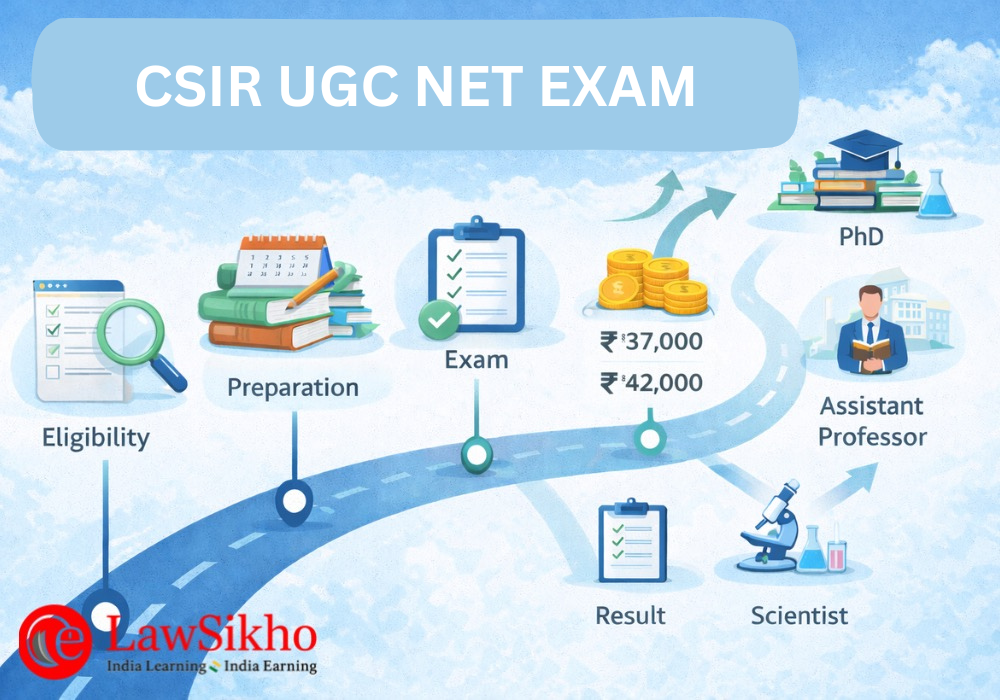

CSIR UGC NET Exam is a national-level test conducted to determine eligibility for Junior Research Fellowship (JRF) and Lectureship in science subjects. It assesses candidates on research aptitude, subject knowledge, and analytical ability through a structured, objective-based format. This exam serves as a key gateway for aspiring researchers and academicians seeking careers in Indian universities and research institutions.
Table of Contents
If you’re a science graduate dreaming of a career in research or academia, the CSIR UGC NET exam is your most important stepping stone. This national-level examination, conducted jointly by the Council of Scientific and Industrial Research (CSIR) and the University Grants Commission (UGC), opens doors to Junior Research Fellowships worth ₹37,000 per month and eligibility for Assistant Professor positions across Indian universities. For thousands of MSc, BTech, and integrated science program graduates, qualifying this exam represents the beginning of a prestigious career in scientific research.
The CSIR UGC NET covers five core science disciplines: Life Sciences, Chemical Sciences, Physical Sciences, Mathematical Sciences, and Earth, Atmospheric, Ocean and Planetary Sciences. Conducted twice yearly by the National Testing Agency (NTA), this computer-based examination tests your subject knowledge, analytical abilities, and research aptitude. Whether you’re aiming for a PhD with fellowship support or seeking to teach at the university level, CSIR NET qualification is often the essential first step.
This comprehensive guide walks you through everything you need to know about the CSIR UGC NET exam. From eligibility criteria and exam pattern to fellowship details and career pathways, we’ve covered every aspect to help you navigate your preparation journey successfully. You’ll find verified information on application procedures, subject-wise syllabus breakdowns, preparation strategies, and the financial benefits awaiting successful candidates.

Understanding the CSIR UGC NET Exam
The CSIR UGC NET (National Eligibility Test) is one of India’s most prestigious examinations for science graduates seeking careers in research and higher education. This examination serves a dual purpose: it identifies candidates eligible for Junior Research Fellowship (JRF) to pursue doctoral research, and it determines eligibility for Lectureship or Assistant Professor positions in Indian universities and colleges.
The exam is conducted by The Council of Scientific and Industrial Research (CSIR), India’s premier research and development organization, operating under the Ministry of Science and Technology. CSIR collaborates with UGC to design the examination framework, set the syllabus, and determine the fellowship criteria. This partnership ensures that successful candidates meet the standards required for both research positions in CSIR laboratories and teaching positions in UGC-affiliated institutions.
Since December 2019, the National Testing Agency (NTA) has been entrusted with the responsibility of conducting the Joint CSIR-UGC NET examination. NTA handles all operational aspects including online application processing, admit card generation, examination conduct in Computer-Based Test (CBT) mode, answer key release, and result declaration. You can access all official notifications and updates through the NTA CSIR NET portal.
Examination Schedule
The CSIR UGC NET examination is conducted twice every year, typically in June and December cycles. The exam is conducted in two shifts across examination centres throughout India.
Opportunities after qualifying CSIR UGC NET Exam
Qualifying the CSIR UGC NET exam opens multiple career pathways depending on your performance and the category you qualify under. The examination serves three primary purposes, each offering distinct benefits for your academic and research career.
Junior Research Fellowship (JRF)
The JRF award is the most sought-after outcome of the CSIR NET examination. Candidates who qualify for JRF receive a monthly fellowship of ₹37,000 for the first two years, along with an annual contingency grant of ₹20,000 provided to the research institution. This fellowship allows you to pursue full-time doctoral research at universities, IITs, or CSIR laboratories without financial constraints. JRF qualification also makes you automatically eligible for Lectureship positions.
The JRF certificate is valid for 2 years from the date of issue. Within this period, you must join a recognized research institution and activate your fellowship. If you fail to do so, your JRF eligibility lapses, though your Lectureship/Assistant Professor eligibility remains intact.
Assistant Professor
Candidates who qualify for Lectureship (also called NET qualification) become eligible to apply for Assistant Professor positions in Indian universities and colleges. Unlike JRF, Lectureship qualification has no upper age limit, making it accessible to working professionals and those returning to academia. The Lectureship certificate remains valid for a lifetime, giving you permanent eligibility for teaching positions in higher education institutions.
PhD Admission Opportunities
CSIR NET qualification, particularly JRF, significantly strengthens your PhD admission applications. Many premier institutions including IITs, IISc, and central universities give preference to JRF-qualified candidates during their doctoral admissions. Some universities directly admit JRF holders without requiring additional entrance examinations, recognizing the rigorous selection process of CSIR NET.
CSIR NET vs. UGC NET: Key Differences
One of the most common points of confusion among aspirants is understanding the difference between CSIR NET and UGC NET. While both examinations are conducted by NTA and serve similar purposes, they cater to entirely different academic disciplines and have distinct examination patterns. Knowing these differences helps you choose the right examination based on your educational background and career goals.
Purpose
The fundamental difference lies in the subject domains covered by each examination. CSIR NET is specifically designed for candidates from science and technology backgrounds, covering five core scientific disciplines. UGC NET, on the other hand, covers 85 subjects spanning humanities, social sciences, commerce, languages, and other non-science disciplines. Both examinations determine eligibility for JRF and Assistant Professor positions, but in their respective subject areas.
Subject Coverage
CSIR NET is exclusively for science stream candidates and covers five subjects: Life Sciences, Chemical Sciences, Physical Sciences, Mathematical Sciences, and Earth, Atmospheric, Ocean and Planetary Sciences. If your postgraduate degree is in any of these scientific disciplines, you should appear for CSIR NET rather than UGC NET.
UGC NET covers a much wider range of 85 subjects including English Literature, Commerce, Economics, Political Science, History, Law, Management, Education, and many more. If you hold a Master’s degree in humanities, social sciences, commerce, or languages, UGC NET is the appropriate examination for you. Notably, some subjects like Environmental Science can appear in both examinations, so check the specific syllabus to determine which aligns better with your preparation.
Exam Pattern and Marking Scheme
The examination patterns differ significantly between CSIR NET and UGC NET. CSIR NET has a three-part structure (Parts A, B, and C) with subject-specific variations in question numbers and marking schemes. The total marks are 200, with Part A covering General Aptitude common to all subjects. Importantly, CSIR NET includes negative marking, typically 25% marks allotted to that question for Part A and varying penalties for Parts B and C depending on the subject.
UGC NET follows a two-paper structure with Paper 1 (General Aptitude, 50 questions, 100 marks) and Paper 2 (Subject-specific, 100 questions, 200 marks). The total duration is 3 hours for both papers combined, and there is no negative marking in UGC NET. This absence of negative marking in UGC NET means candidates can attempt all questions without penalty, whereas CSIR NET requires more strategic answering.
The three-hour duration is common to both examinations, but the strategic approach differs. In CSIR NET, you must balance accuracy with coverage due to negative marking penalties. In UGC NET, you can attempt every question since incorrect answers don’t reduce your score.
Choosing the Right Exam for Your Career Goals
Choosing between CSIR UGC NET Exam and UGC NET Exam depends primarily on your academic background and career aspirations. Understanding when each examination is appropriate helps you focus your preparation effectively.
CSIR NET is the Right Choice for Science Graduates
Choose CSIR NET if you hold a Master’s degree (or equivalent) in Life Sciences, Chemical Sciences, Physical Sciences, Mathematical Sciences, or Earth Sciences. If your career goal involves research in scientific laboratories, pursuing a PhD in science disciplines, or teaching science subjects at the university level, CSIR NET is what you should opt for. Candidates with BTech, BPharma, or MBBS degrees in relevant scientific areas can also appear for CSIR NET.
UGC NET Exam is Well-Suited for Humanities and Social Science Students
Choose UGC NET if your Master’s degree is in humanities, social sciences, commerce, languages, law, management, or any non-science discipline. If you aspire to teach subjects like English, History, Political Science, Economics, or Commerce at the university level, or wish to pursue research in these fields, UGC NET is the appropriate examination. You can learn more about UGC NET eligibility and preparation through LawSikho’s UGC NET resources.
Can you Appear for CSIR UGC NET Exam and UGC NET Exam at the same time
Yes, you can appear for both CSIR NET and UGC NET if your educational qualifications make you eligible for both. For example, if you have an interdisciplinary background or hold degrees in both science and humanities streams, you may qualify for both examinations. However, since both are demanding examinations requiring focused preparation, most candidates choose to concentrate on one based on their primary career goals.
CSIR UGC NET Exam: Eligibility Criteria
Before beginning your preparation, confirming your eligibility for the CSIR UGC NET examination is essential. The eligibility criteria encompass educational qualifications, age limits (for JRF), and nationality requirements. Meeting these criteria is mandatory for your application to be accepted and your qualification to be valid.
Educational Qualification Requirements
The educational qualifications for CSIR NET are designed to ensure candidates have sufficient academic grounding in their chosen scientific discipline. Different degree holders have specific eligibility pathways.
Master’s degree
Candidates with an M.Sc. or equivalent degree such as Integrated BS–MS, BS (4 years), BE/B.Tech, B.Pharma, or MBBS in a relevant science discipline are eligible for CSIR NET. General and General‑EWS candidates must have at least 55% marks (without rounding off), while OBC‑NCL, SC, ST, PwD, and Third Gender candidates require a minimum of 50% marks from a recognized university or institution.
Result Awaited (RA) Category
Final year students who are enrolled in their qualifying degree program can apply under the Result Awaited (RA) category. This includes students appearing for their Master’s degree examinations or those who have completed their examinations but are awaiting results. However, RA category candidates must complete their degree with the required percentage within two years from the date of declaration of the CSIR UGC result, failing which their candidature may be cancelled.
Four-Year Undergraduate Programme (FYUP) Eligibility Under NEP 2020
Under the National Education Policy 2020 provisions, candidates who have completed a four-year undergraduate programme with a minimum of 75% marks are also eligible for JRF and PhD admissions. This new pathway recognizes the restructured higher education system and provides opportunities for students from multidisciplinary undergraduate programmes to pursue research careers without necessarily completing a traditional two-year Master’s degree.
However, FYUP candidates aspiring to become Assistant Professors must complete a Master’s degree, as it remains a mandatory requirement for teaching positions in higher education institutions.
Age Limit for JRF and Lectureship
The age criteria differ significantly between JRF and Lectureship qualifications, making it important to understand which category you’re targeting.
JRF Age Limit and Category-Wise Relaxations
The maximum age limit for JRF qualification is 30 years as on the 1st day of the month in which the exam is concluded. Age relaxations are provided for reserved categories: up to 5 years for OBC-NCL/SC, ST, PwD, Female, and Third Gender candidates
The age limit for JRF is strictly enforced because the fellowship is meant to support young researchers at the beginning of their academic careers. If you’re above the age limit but still wish to qualify for teaching positions, you can apply for Lectureship only, which has no upper age restriction.
Lectureship Age Criteria
There is no upper age limit for candidates applying for Lectureship or Assistant Professor eligibility. This makes CSIR NET accessible to working professionals, those returning to academia after career breaks, or anyone who crossed the JRF age limit but still wishes to pursue teaching in higher education. You simply need to meet the educational qualification requirements to be eligible for Lectureship.
Nationality
Only Indian nationals are eligible to apply for the Joint CSIR-UGC NET examination. Candidates must be citizens of India as per the Constitutional provisions. OCI (Overseas Citizen of India) or PIO (Person of Indian Origin) cardholders are not eligible for this examination. This nationality requirement applies to both JRF and Lectureship categories.
CSIR UGC NET Exam Pattern
Understanding the examination pattern is crucial for effective preparation. The CSIR NET follows a three-part structure that tests different competencies, from general aptitude to advanced subject knowledge and analytical abilities. The pattern varies slightly across the five subjects, so knowing the specifics for your chosen subject helps optimize your preparation strategy.
Three-Part Structure
The CSIR NET question paper is divided into three distinct parts, each serving a specific assessment purpose. All parts are attempted in a single three-hour session, requiring you to manage time effectively across different question types and difficulty levels.
Part A: General Aptitude (Common for All Subjects)
Part A tests your general aptitude and is common across all five CSIR NET subjects. It contains 20 questions, of which you need to attempt any 15. Each correct answer carries 2 marks, making the total for Part A 30 marks. Topics include numerical ability, logical reasoning, data interpretation and graphical analysis and general science. Negative marking of 25% of the marks allotted for each incorrect answer in this section.
Part B: Subject-Specific Core Concepts
Part B assesses your fundamental understanding of core concepts in your chosen subject. The number of questions varies by subject, ranging from 25 to 50 questions depending on the discipline. This section tests your grasp of basic principles, definitions, and conceptual clarity that form the foundation of your scientific discipline.
The marking scheme for Part B also varies by subject. For some subjects like Life Sciences and Chemical Sciences, each question carries 2 marks with negative marking of 25% of the marks to a particular question. For Physical Sciences and Mathematical Sciences, the marks per question (3 and 3.5, respectively) and negative marking (0.75 and 0.875, respectively) differ. Understanding your subject-specific pattern from the official source is essential.
Part C: Higher-Order and Analytical Questions
Part C is designed to test your analytical abilities and higher-order thinking skills. These questions require application of concepts, problem-solving, and synthesis of knowledge across topics. The questions are generally more challenging and carry higher marks per question, typically 4 to 5 marks depending on the subject.
Part C questions often involve numerical problems, case-based scenarios, or questions requiring integration of multiple concepts. The negative marking in Part C is also proportionally higher, between 1 to 1.32 marks per incorrect answer depending on the subject (25% of the marks allotted to a question). This section differentiates between candidates who have deep understanding versus those with only surface-level knowledge.
Subject-wise CSIR UGC NET Exam Pattern
Each of the five CSIR NET subjects has a slightly different examination pattern in terms of question numbers and marking schemes. Here’s the breakdown for each subject based on the official pattern.
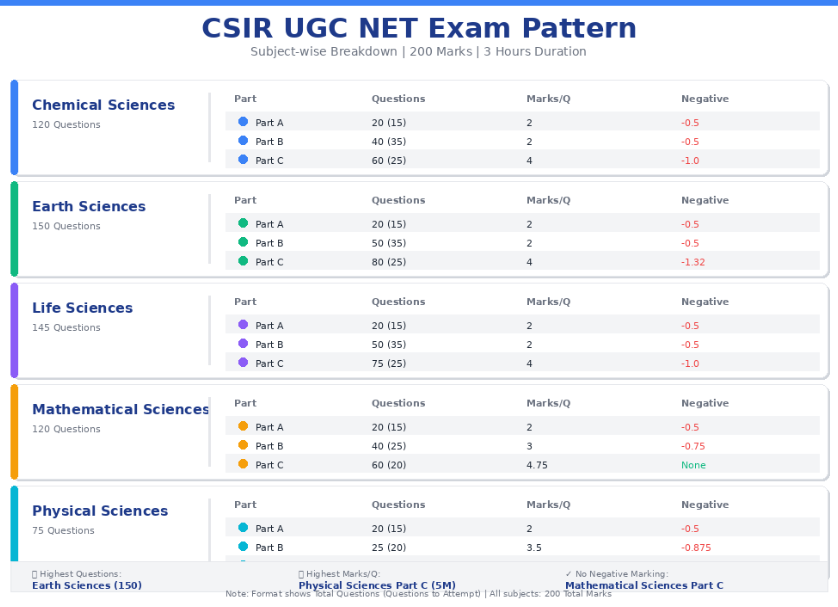
Chemical Sciences Exam Pattern
Chemical Sciences has 120 total questions: 20 in Part A (attempt 15), 40 in Part B (attempt 35), and 60 in Part C (attempt 25). Marks per question are 2 for Parts A and B, and 4 for Part C. Negative marking follows the same pattern as Life Sciences: 0.5 for Parts A and B, 1 mark for Part C. Total marks: 200.
Earth Sciences Exam Pattern
Earth, Atmospheric, Ocean and Planetary Sciences has 150 total questions: 20 in Part A (attempt 15), 50 in Part B (attempt 35), and 80 in Part C (attempt 25). Marks are 2 each for Parts A and B, and 4 for Part C. Negative marking is 0.5 for Parts A and B, and 1.32 for Part C, which is the highest among all subjects. Total marks: 200.
Life Sciences Exam Pattern
Life Sciences has 145 total questions: 20 in Part A (attempt 15), 50 in Part B (attempt 35), and 75 in Part C (attempt 25). The marks distribution is 2 marks per question in Parts A and B, and 4 marks per question in Part C. Negative marking is 0.5 for Parts A and B, and 1 mark for Part C. Total marks: 200.
Mathematical Sciences Exam Pattern
Mathematical Sciences has 120 total questions: 20 in Part A (attempt 15), 40 in Part B (attempt 25), and 60 in Part C (attempt 20). Marks per question are 2 for Part A, 3 for Part B, and 4.75 for Part C. Notably, there is no negative marking in Part C for Mathematical Sciences, while Parts A and B have 0.5 and 0.75 marks deduction respectively. Total marks: 200.
Physical Sciences Exam Pattern
Physical Sciences has few questions but higher marks per question. It has 75 total questions: 20 in Part A (attempt 15), 25 in Part B (attempt 20), and 30 in Part C (attempt 20). The marking differs here: 2 marks for Part A, 3.5 marks for Part B, and 5 marks for Part C. Negative marking is 0.5 for Part A, 0.875 for Part B, and 1.25 for Part C. Total marks: 200.
Marking Scheme and Negative Marking Rules
Understanding the marking scheme and negative marking rules is critical for developing your examination strategy.
Marks Distribution
The total marks for all CSIR NET subjects are 200, but the distribution across parts varies by subject. Part A consistently contributes 30 marks (15 questions × 2 marks) across all subjects. Part B typically contributes 70-75 marks depending on the subject, while Part C contributes 95-100 marks. This means Part C carries roughly half the total weightage, emphasizing the importance of analytical and higher-order thinking skills.
The number of questions you’re required to attempt is always less than the total questions available. This choice feature allows you to select questions you’re confident about, particularly important in Part C where negative marking is higher. Strategic selection based on your strengths can significantly impact your final score.
Negative Marking in CSIR UGC NET Exam
Negative marking in CSIR NET follows a proportional penalty system, typically deducting 25% of the marks assigned to a question for each incorrect answer. In Part A (2 marks per question), the deduction is 0.5 marks. In Part B, the deduction varies from 0.5 to 0.875 marks depending on the subject. In Part C, deductions range from 1 to 1.32 marks.
The strategic implication is clear: avoid random guessing, especially in Part C where the penalty is substantial. However, if you can eliminate two or more options through reasoning, attempting the question becomes statistically favorable. Practice with mock tests helps develop the judgment to know when attempting a question is worth the risk.
Minimum Qualifying Percentage for CSIR UGC NET Exam
For CSIR UGC NET, the combined marks of Parts A, B and C are used to prepare the merit list. To be considered for either JRF or Lectureship/Assistant Professor, candidates must score at least 33% in aggregate if they belong to General, EWS or OBC categories, and at least 25% if they belong to SC, ST or PwD/PwBD categories.
Syllabus of CSIR UGC NET Exam
The CSIR UGC NET syllabus is comprehensive, covering fundamental concepts through advanced topics in each scientific discipline. Understanding the syllabus structure helps prioritize your preparation and focus on high-weightage areas. The official syllabus PDFs are available on the NTA CSIR NET website for detailed reference.
Part A Syllabus (Common for All Subjects)
Part A syllabus is identical across all five subjects and tests general aptitude rather than subject-specific knowledge. This section can be prepared uniformly regardless of your chosen subject, making it a reliable source of marks if prepared well.
Numerical Ability Topics
Numerical ability covers number systems, simplification, percentages, profit and loss, simple and compound interest, ratio and proportion, LCM and HCF, averages, probability, trigonometry and mensuration. These are fundamental mathematical concepts that most science graduates are familiar with from their school and undergraduate education. Regular practice with numerical problems helps improve both accuracy and speed.
Reasoning and Analytical Ability
This section includes logical reasoning, series completion, coding-decoding, analogies, classification, ranking and arrangement, direction sense, calendar and clock, blood relations, and puzzle-solving. These questions test your ability to identify patterns, make logical deductions, and solve problems systematically. Practice with reasoning workbooks and previous year questions is essential.
Data Interpretation and Graphical Analysis
Data interpretation involves analyzing information presented in tables, bar graphs, pie charts, line graphs, and other visual formats. Questions require you to extract relevant data, perform calculations, and draw conclusions. Graphical analysis extends to understanding scientific graphs and charts commonly used in research publications.
General Sciences
General Science covers basic concepts from physics, chemistry, and biology that a science graduate is expected to know, such as common vitamins and deficiency diseases, human body systems and everyday health, fundamental physical and chemical phenomena, and widely used scientific instruments and innovations
Part B and C: Subject-Wise Syllabus
Parts B and C cover subject-specific content at increasing levels of complexity. Part B focuses on fundamental concepts while Part C tests application and analytical abilities. Here’s an overview of syllabus highlights for each subject.
Life Sciences
Life Sciences syllabus covers molecular biology of the cell, cellular organization, fundamental processes, inheritance biology, developmental biology, cell signaling, diversity of life forms, ecological principles, evolution and behavior, applied biology, and methods in biology. Key areas include biochemistry, genetics, immunology, microbiology, and plant and animal physiology.
Chemical Sciences
Chemical Sciences encompasses inorganic chemistry (periodic properties, coordination chemistry, organometallics), organic chemistry (stereochemistry, reaction mechanisms, spectroscopy) and physical chemistry (thermodynamics, kinetics, quantum chemistry).The syllabus also includes Chemistry in Nanoscience and Technology, Catalysis and Green Chemistry, Medicinal Chemistry, supramolecular chemistry and environmental chemistry.
Physical Sciences
Physical Sciences covers classical mechanics, electromagnetic theory, quantum mechanics, thermodynamics and statistical physics, electronics, atomic and molecular physics, condensed matter physics, nuclear and particle physics, and general physics. Mathematical physics forms a significant portion, including linear algebra, calculus, and differential equations applied to physical problems.
Mathematical Sciences
Mathematical Sciences syllabus includes analysis (real and complex), linear algebra, complex algebra, algebra, ordinary and partial differential equations, numerical analysis, calculus of variations, linear integral equations, classical mechanics, probability and statistics and descriptive statistics, exploratory data analysis. The syllabus demands strong foundational knowledge and problem-solving skills across pure and applied mathematics.
Earth Sciences
The CSIR UGC NET Earth Sciences syllabus spans geology, geophysics, meteorology, oceanography and physical geography. It covers topics like Earth–solar system, interior, plate tectonics, oceans and atmosphere, environmental earth sciences, mineralogy and petrology, structural geology, stratigraphy and paleontology, marine geology, geochemistry, seismology, climate and monsoon systems, and physical/chemical/biological oceanography.
Choosing the Right Subject
Selecting the appropriate CSIR NET subject is crucial as it determines your career trajectory in research and academia. Your choice should align with both your educational background and career aspirations.
Matching Your Academic Background with CSIR Subjects
Choose a subject that closely matches your postgraduate specialization. If your MSc is in Biochemistry, Biotechnology, Microbiology, Zoology, or Botany, Life Sciences is typically appropriate. Chemistry postgraduates should choose Chemical Sciences. Physics, Electronics, or Applied Physics graduates should opt for Physical Sciences. Mathematics and Statistics graduates should select Mathematical Sciences. Geology, Geophysics, and Environmental Science graduates typically choose Earth Sciences.
Career Prospects by Subject Area
Each subject opens different career pathways. Life Sciences leads to research opportunities in pharmaceutical companies, biotech firms, agricultural research institutes, and medical research centers. Chemical Sciences opens doors to chemical industries, materials research, and environmental laboratories. Physical Sciences connects to research in electronics, nuclear energy, space research (ISRO), and defense research (DRDO).
Mathematical Sciences qualifies you for research in theoretical sciences, data science, cryptography, and academic positions in mathematics departments. Earth Sciences leads to careers in oil and gas exploration, mining, meteorology, environmental consulting, and organizations like GSI (Geological Survey of India) and IMD (India Meteorological Department).
CSIR UGC NET Exam: Application Process
The application process for CSIR NET is entirely online, handled through the NTA portal. Completing the application accurately and within deadlines is essential, as errors can lead to rejection or complications during examination and certificate issuance.
Step-by-Step Application Process
The online application involves multiple steps that must be completed sequentially. Here’s the process flow for successful application submission.
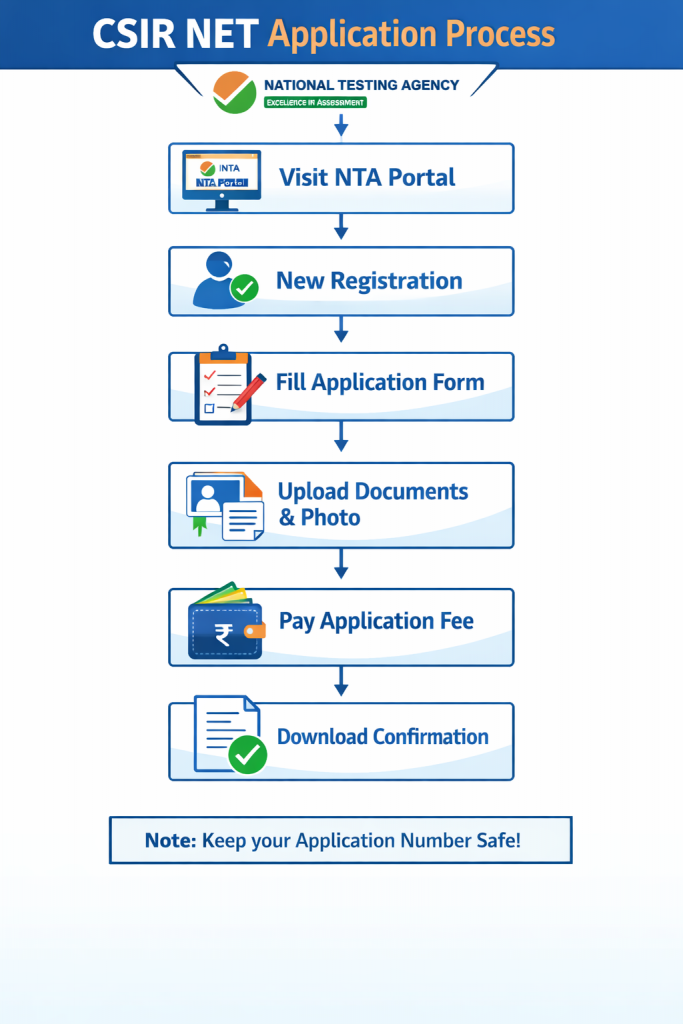
Registration on the NTA Portal
Visit the official CSIR NET application portal and click on “New Registration.” Enter your basic details including name, date of birth, email ID, and mobile number. After successful registration, you’ll receive an Application Number and password via email and SMS. These credentials are required for all subsequent steps and future logins.
Filling the Application Form
Log in using your Application Number and password to access the application form. Fill in your personal details, educational qualifications, category, choice code, 4 preferred examination cities, and other required details. Ensure all information matches your official documents exactly, as discrepancies may cause issues during verification. Select whether you’re applying for JRF and Lectureship or Lectureship only.
Uploading Documents and Photographs
Upload a recent passport-sized photograph (10-200 KB, JPG/JPEG format) and signature (10-50 KB, JPG/JPEG format) as per the specifications mentioned in the notification. Category certificates, disability certificates (if applicable), and other supporting documents may also need to be uploaded. Follow the exact specifications to avoid technical rejections.
Application Fee and Payment Mode
The application fee structure for CSIR UGC NET Exam is: General category candidates pay ₹1,150, General-EWS and OBC (NCL) candidates pay ₹600, and SC, ST, PwD, and Third Gender candidates pay ₹375.
You can make the payment through multiple online modes including Credit Card, Debit Card, Net Banking, and UPI. After successful payment, download and save the confirmation page for your records. The payment deadline is typically one day after the application form submission deadline, but it’s advisable to complete payment well in advance to avoid last-minute technical issues.
CSIR UGC NET JRF Fellowship Stipend
The financial benefits of qualifying CSIR NET with JRF are substantial and designed to support full-time research without financial stress. Understanding the fellowship structure, including allowances and upgradation pathways, helps you appreciate the value of this qualification and plan your research career effectively.
JRF Stipend and Allowances
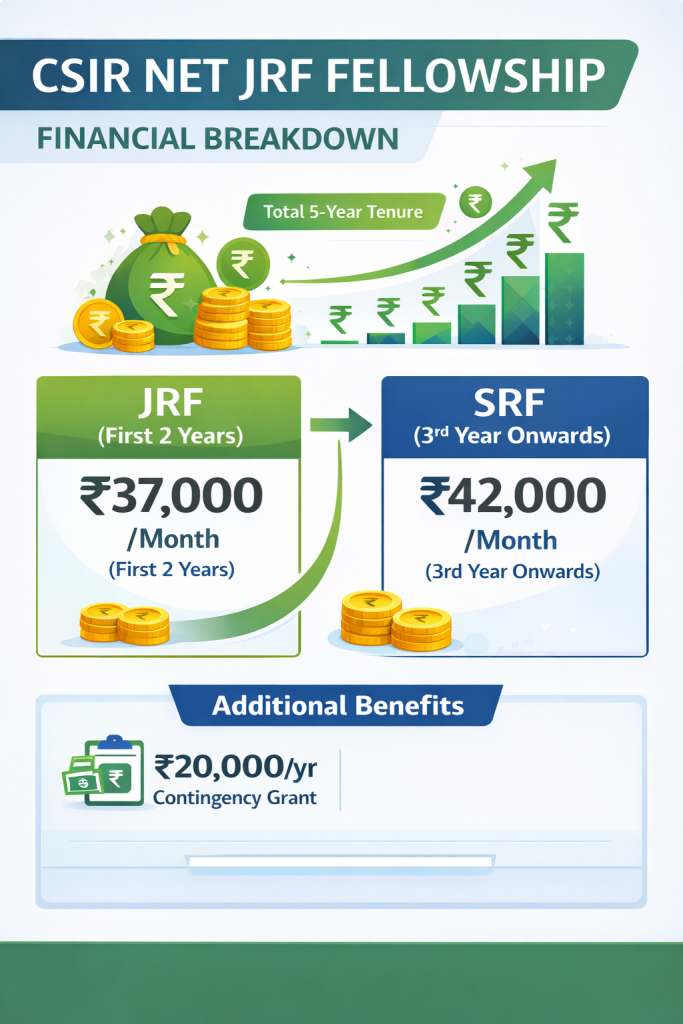
The JRF fellowship provides comprehensive financial support during your doctoral research. As per the revised rates effective from January 2023, JRF recipients receive a monthly stipend of ₹37,000 for the first two years. This amount is significantly higher than many entry-level job salaries and allows you to focus entirely on your research work. In addition to the monthly stipend, an annual contingency grant of ₹20,000 is reimbursed directly to the fellow to support your research expenses.
SRF Eligibility Criteria and Stipend
After completing two years as JRF and registering for a PhD program, you become eligible for upgradation to Senior Research Fellowship (SRF). The upgrade requires assessment of your research progress by a three-member expert committee including your research guide, Head of Department, and an external expert.
Upon successful upgradation to SRF, your monthly stipend increases to ₹42,000 from the third year onwards. If the committee does not recommend upgradation or you haven’t registered for PhD, you may continue as JRF with the ₹37,000 stipend for the third year, or your fellowship may be terminated based on committee recommendations. Since the number of fellowships in each subject is limited and allocated afresh in every exam cycle, securing and successfully upgrading a JRF is both competitive and contingent on consistent research performance.
Shyama Prasad Mukherjee (SPM) Fellowship
The Shyama Prasad Mukherjee Fellowship is a prestigious enhancement scheme for outstanding CSIR‑UGC NET JRF qualifiers, instituted in 2000 to honour Dr. Shyama Prasad Mukherjee, the first Vice‑President of CSIR in independent India. It is awarded to top performers in each science discipline to nurture exceptional research talent, offering an enhanced fellowship package, annual contingency grant and the prestige of being recognised among the country’s best young scientists.
SPM Fellows are shortlisted from the highest‑ranked JRF qualifiers in each subject and selected through a competitive interview process, with subject‑wise quotas across Life, Chemical, Earth, Mathematical and Physical Sciences. The fellowship is tenable for PhD work at CSIR labs, R&D institutions or universities, and its selective, merit‑based nature makes it a highly valued credential on an academic CV.
CSIR UGC NET Exam Cutoff and Result
Understanding the cutoff system and result process helps you set realistic targets and know what to expect after the examination. CSIR UGC NET cutoffs vary by subject and category, and the result determines your eligibility for JRF or Lectureship.
CSIR UGC NET Cutoff
CSIR NET releases separate cutoffs for JRF and for Lectureship/NET, with JRF cutoffs always higher. Candidates at or above the JRF cutoff qualify for both fellowship and lectureship, while those between the two cutoffs get lectureship eligibility only. Cutoffs are category‑wise and subject‑wise, and are computed fresh each cycle based on that exam’s performance and available fellowships.
Subject‑wise variation is substantial: popular subjects like Life Sciences usually have higher percentage cutoffs, whereas Mathematical Sciences and Earth Sciences may see lower cutoffs due to smaller candidate pools and differing difficulty levels. However, because each subject’s cutoff is set independently, cross‑subject comparisons are not very meaningful, so it is better to use only your own subject’s past cutoffs as an indicative target.
Answer Key and Response Sheet
After the examination, NTA releases provisional answer keys along with candidates’ recorded responses. You can access your response sheet by logging into the CSIR UGC NET portal with your credentials. This allows you to calculate your approximate score and identify any discrepancies in the answer key.
Result Declaration
Results are typically declared within 2-3 months after the examination. The result indicates whether you’ve qualified for JRF, Lectureship (NET), or have not qualified. Your percentile, subject rank, and category rank are also provided. Qualified candidates can download their e-certificates from the NTA portal after result declaration.
Challenge/Re-evaluation Process
NTA provides a window to challenge the provisional answer keys if you believe any answer is incorrect. The challenge must be submitted online with a fee of ₹200 per question, which is refunded if your challenge is accepted. Expert committees review all challenges before finalizing the answer keys.
After result declaration, there is no re-evaluation or re-checking provision as the examination is conducted in CBT mode with objective-type questions. The final answer key published by NTA is considered conclusive, and results are based on these finalized answers.
Certificate Validity
JRF Certificate Validity
The CSIR UGC NET JRF certificate is valid for two years from the date of issue mentioned on the certificate. Within this period, you must join a research institution and activate your fellowship. If you don’t join within the validity period, your JRF eligibility lapses, though your Lectureship eligibility remains intact.
NET Certificate Validity
The Assistant Professor or NET certificate is valid for a lifetime. Once you qualify for Assistant Professor, you remain permanently eligible to apply for Assistant Professor positions in Indian universities and colleges. This lifetime validity makes CSIR UGC NET qualification a valuable permanent credential for academic careers.
Preparation Tips for CSIR UGC NET Exam
Creating a Subject-Wise Preparation Plan
A well-structured preparation plan ensures comprehensive coverage of the syllabus while allowing adequate time for revision and practice. The plan should account for the different weightages of Parts A, B, and C.
Balancing Part A, Part B, and Part C Preparation
Part A (General Aptitude) carries 30 marks and is common across all subjects. Dedicate approximately 15-20% of your preparation time to Part A, focusing on numerical ability and reasoning. This section can be a reliable source of marks with consistent practice. Many candidates underestimate Part A and lose easy marks.
Parts B and C require the bulk of your preparation effort, with Part C deserving special attention due to its higher weightage (approximately 50% of total marks). Start with Part B fundamentals, as strong basics make Part C questions more manageable. Allocate 40% of your time to Part B concepts and 40% to Part C analytical practice.
Time Allocation Based on Weightage
Given that Part C contributes roughly half the total marks, prioritize developing analytical and problem-solving skills. Identify high-frequency topics from previous year papers and focus additional effort on these areas. For subjects like Life Sciences, topics like molecular biology, genetics, and biochemistry appear frequently in Part C questions.
Recommended Books for CSIR UGC NET Exam
Choosing the right study materials significantly impacts your preparation quality. Standard textbooks recommended for postgraduate courses form the foundation, supplemented by CSIR NET specific guides.
Best Books for Part A (General Aptitude)
For General Aptitude, books like “CSIR-NET General Aptitude: A New Outlook” by Christy Varghese and B. Francis are specifically designed for this examination. RS Aggarwal’s Quantitative Aptitude and Verbal and Non-Verbal Reasoning books provide comprehensive practice for numerical ability and reasoning sections.
Subject-Wise Book Recommendations
For Life Sciences, standard references include Lehninger’s Principles of Biochemistry, Alberts’ Molecular Biology of the Cell, Gerald Karp’s Cell and Molecular Biology, and Snustad and Simmons’ Principles of Genetics. For Chemical Sciences, JD Lee for Inorganic Chemistry, Paula Bruice for Organic Chemistry, and Atkins for Physical Chemistry are recommended.
Physical Sciences preparation benefits from Goldstein’s Classical Mechanics, Griffiths’ Introduction to Electrodynamics, and Shankar’s Principles of Quantum Mechanics. Mathematical Sciences requires Rudin’s Principles of Mathematical Analysis, Sheldon Axler’s Linear Algebra Done Right, and Simmons’ Differential Equations. For Earth Sciences, Arthur Holmes’ Introduction to Geology (a strong foundation pick) and related specialized texts are useful.
Online Resources and Mock Tests
Beyond books, online resources significantly enhance preparation. Previous year question papers (PYQs) are available on the INFLIBNET website and various coaching platforms. Regular mock tests help develop time management skills and exam temperament.
Previous Year Question Analysis and Practice
Analyzing previous year questions is one of the most effective preparation strategies, revealing patterns, frequently tested topics, and question styles.
Importance of Solving PYQs
Previous year questions provide insight into the examination pattern, difficulty level, and topic distribution. Solving PYQs from the last 5-10 years covers most important concepts and question types. Many questions repeat with slight modifications, making PYQ practice invaluable for scoring well.
Identifying Question Patterns and Trends
Analyze PYQs to identify high-frequency topics in your subject. For example, in Life Sciences, molecular biology and genetics questions consistently appear with high weightage. Track which topics appear in Part B versus Part C to understand the depth of understanding expected for each.
Create a topic-wise analysis chart marking how many questions appeared from each syllabus area over the past years. Focus additional preparation time on topics with consistent high representation. This strategic approach ensures you’re well-prepared for the most likely questions while covering the entire syllabus.
Career Opportunities After Qualifying CSIR UGC NET Exam
Qualifying CSIR NET opens diverse career pathways in research and academia. Whether you qualify for JRF or Lectureship, multiple opportunities await in government research institutions, universities, and private sector research organizations.

Career Opportunities for JRF Qualifiers
JRF qualification provides both immediate financial support through fellowship and long-term career advantages in research and academia.
Joining Research Institutions and CSIR Labs
JRF qualifiers can join any of the 37 CSIR laboratories across India for doctoral research. These laboratories, including NCL (Pune), CDRI (Lucknow), CCMB (Hyderabad), and others, offer excellent research infrastructure and mentorship. You can also join IITs, IISc, central universities, and other recognized research institutions with your JRF.
PhD Admission Process with JRF
Many premier institutions give preference to JRF-qualified candidates during PhD admissions. Some universities directly admit JRF holders without additional entrance tests, while others provide significant weightage to JRF qualification in their selection process. Your JRF award letter and scorecard strengthen your PhD applications considerably.
Research Scientist Career
After completing your PhD with JRF/SRF support, career pathways include research scientist positions in government laboratories (CSIR, DRDO, ISRO, ICMR), postdoctoral fellowships in India and abroad, and industry research positions in pharmaceutical, biotech, and technology companies. The research experience and publications gained during your fellowship period build a strong CV for these opportunities.
Career Options for Assistant Professor Qualifiers
Assistant Professor Positions in Universities
NET-qualified candidates are eligible to apply for Assistant Professor positions in universities, colleges, and higher education institutions across India. Central universities, state universities, and deemed universities regularly recruit Assistant Professors, with NET qualification being a mandatory or preferred requirement. The UGC website lists recruitment guidelines and opportunities.
Teaching in Colleges and Research Institutions
Beyond universities, NET-qualified candidates can teach in government and private colleges, technical institutions, and research organizations with training programs. Positions in institutions like IISERs, NITs, and specialized research institutes often prefer or require NET qualification. Teaching experience combined with research involvement creates a well-rounded academic profile.
Conclusion
The CSIR UGC NET examination stands as one of India’s most valuable qualifications for science graduates aspiring to careers in research and academia. With JRF fellowship offering ₹37,000 monthly and the Assistant Professor certificate providing lifetime eligibility for teaching positions, qualifying this exam opens doors that define career trajectories. The examination tests not just your subject knowledge but your analytical abilities and research aptitude, making successful candidates well-prepared for the demands of scientific research.
Your preparation journey should be strategic and systematic. Focus on understanding the exam pattern for your chosen subject, prioritize high-weightage topics identified through previous year question analysis, and develop strong fundamentals before advancing to analytical problem-solving. The combination of quality study materials, regular mock tests, and consistent effort over 4-6 months can prepare you adequately for this examination. Remember that the prestige of CSIR UGC NET Exam qualification and the opportunities it creates make every hour of preparation worthwhile.
Whether you’re a final-year MSc student or a working professional seeking transition to academia, CSIR NET offers a clear pathway forward. Start early, stay consistent, and leverage official resources from the NTA CSIR NET portal for the most accurate information. The investment you make in this examination pays dividends throughout your academic and research career.
FAQs on CSIR UGC NET Exam
What is the full form of CSIR UGC NET?
CSIR UGC NET stands for Council of Scientific and Industrial Research University Grants Commission National Eligibility Test.
How many times is the CSIR UGC NET Exam conducted in a year?
The CSIR UGC NET examination is conducted twice every year, typically in June and December cycles. The exact dates are announced by NTA through official notifications on the CSIR NET portal. Candidates can appear in multiple attempts without any restriction on the number of attempts.
Can final year MSc students apply for CSIR UGC NET Exam?
Yes, final year MSc students can apply under the Result Awaited (RA) category. However, they must complete their qualifying degree with the required minimum percentage (55% for General/OBC, 50% for SC/ST/PwD) before the deadline specified in the notification. Failure to meet this requirement may result in cancellation of candidature.
Is there negative marking in CSIR UGC NET exam?
Yes, CSIR UGC NET has negative marking. The deduction is typically 25% of the marks assigned to each question. For Part A (2 marks questions), 0.5 marks are deducted per wrong answer. For Parts B and C, the negative marking varies by subject but follows the same proportional principle.
What is the difference between JRF and Lectureship in CSIR UGC NET?
JRF (Junior Research Fellowship) qualification makes you eligible for both research fellowship (₹37,000 monthly stipend) and teaching positions. Lectureship qualification makes you eligible only for Assistant Professor and teaching positions, without fellowship benefits. JRF has an age limit of 30 years, while Assistant Professor has no upper age limit.
How much is the JRF fellowship amount per month?
As per revised rates effective from January 2023, the JRF stipend is ₹37,000 per month for the first two years. After upgradation to SRF (Senior Research Fellowship), the stipend increases to ₹42,000 per month from the third year onwards. An annual contingency grant of ₹20,000 is also provided to the host institution.
Is the CSIR UGC NET Exam more difficult than the UGC NET Exam?
CSIR NET is generally considered more challenging than UGC NET due to several factors: it covers advanced science concepts requiring strong analytical skills, includes negative marking unlike UGC NET, and has complex numerical and problem-solving questions in Parts B and C. However, difficulty perception varies by individual background.
Can BTech graduates apply for the CSIR UGC NET Exam?
Yes, BTech, BE, BPharma, and MBBS graduates with minimum required marks (55% for General/OBC, 50% for SC/ST/PwD) can apply for CSIR UGC NET Exam. However, if they qualify for JRF, the fellowship will only be activated after they complete a Master’s degree within two years of the JRF award.
What is the age limit for CSIR NET JRF?
The maximum age limit for JRF is 30 years as on the 1st day of the month in which the examination is concluded. Age relaxations are provided: up to 5 years for OBC-NCL, SC, ST, PwD, Female, and Third Gender candidates. There is no upper age limit for Assistant Professor qualification.
How long is the CSIR NET certificate valid?
The JRF certificate is valid for 2 years from the date of issue, within which the fellowship must be activated by joining a research institution. The Lectureship (NET) certificate is valid for a lifetime, providing permanent eligibility for Assistant Professor positions in Indian universities and colleges.
Can I apply for both CSIR NET and UGC NET?
Yes, you can apply for both examinations if your educational qualifications make you eligible for both. However, since they are demanding examinations requiring focused preparation, most candidates choose to concentrate on one based on their primary subject area and career goals.
What are the 5 subjects in CSIR UGC NET Exam?
The five subjects in CSIR UGC NET are: Life Sciences (Code 703), Chemical Sciences (Code 701), Physical Sciences (Code 705), Mathematical Sciences (Code 704), and Earth, Atmospheric, Ocean and Planetary Sciences (Code 702). Candidates choose one subject based on their postgraduate specialization.
Is the CSIR UGC NET Exam conducted online or offline?
CSIR NET is conducted in online mode as a Computer-Based Test (CBT) at designated examination centres across India. Candidates answer questions on computer terminals, and responses are automatically recorded. The examination duration is 3 hours for all subjects.
What is the passing percentage for CSIR NET?
There is no fixed passing percentage for CSIR NET. The cutoff marks vary by subject and category, determined after each examination based on difficulty level and candidate performance.
Can I get a government job after qualifying CSIR UGC NET Exam?
Yes, CSIR UGC NET qualification makes you eligible for various government positions. JRF qualifiers can join CSIR laboratories and government research institutions. Lectureship qualifiers are eligible for Assistant Professor positions in government universities and colleges. Many government organizations give preference to NET-qualified candidates.
How can I download the CSIR UGC NET Exam Admit Card?
Visit the official NTA CSIR NET portal (csirnet.nta.ac.in) and click on the “Download Admit Card” link. Log in using your Application Number and Date of Birth or password. After verification, your admit card will be displayed on screen. Download and print the admit card, ensuring all details are correct.




 Allow notifications