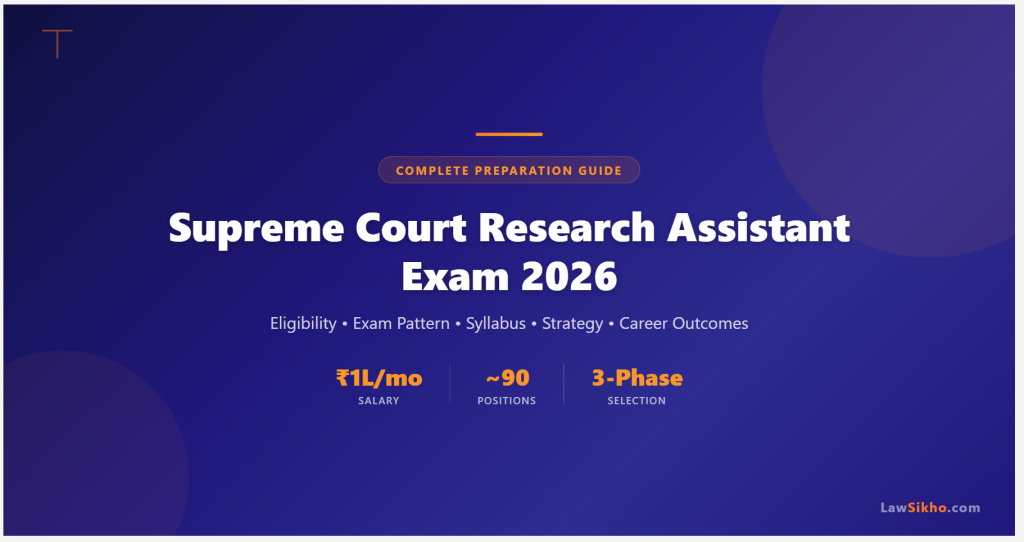

The Supreme Court of India recruits approximately 90 Law Clerk-cum-Research Associates every year through a highly competitive written examination and interview. For the 2026–27 term, the consolidated monthly remuneration has been increased to ₹1,00,000 — making this one of the most financially attractive short-term legal positions available to law graduates in the country. The exam tests your ability to research, reason, and write under pressure, and a year spent assisting a Supreme Court judge can reshape your entire legal career.
If you are a final-year law student or a recent graduate looking to build serious legal credentials before entering practice, academia, or the judiciary, this guide covers everything you need — eligibility, syllabus, exam pattern, subject-wise preparation strategy, interview tips, and career outcomes — based on the official 2026–27 notification and previous year patterns.
Table of Contents
What Is the Supreme Court Research Assistant (Law Clerk-cum-Research Associate) Position?
The official designation used by the Supreme Court of India is “Law Clerk-cum-Research Associate,” though candidates frequently search for this role using terms like “Supreme Court Research Assistant” or “SC Researcher.” The position was formalised under the “Scheme for Engaging Law Clerk-cum-Research Associates on Short-Term Contractual Assignment,” and the Supreme Court’s Recruitment Cell issues a fresh notification each year, typically in January.
The role is fundamentally a research position. Law Clerks are assigned to individual judges of the Supreme Court, and their primary responsibilities include preparing bench memos for upcoming cases, conducting legal research on points of law raised in pending matters, drafting preliminary notes on petitions, and assisting with the analysis of complex constitutional and statutory questions. The work demands fluency with legal databases such as e-SCR, SCC Online, Manupatra, LexisNexis, and Westlaw — the notification explicitly lists proficiency with these platforms as a required skill.

What makes this position distinctive from other entry-level legal roles is the direct exposure to the highest court in the country. You are not merely observing proceedings from the gallery. You are working behind the bench, understanding how judicial reasoning develops from raw briefs into final orders and judgments. Former law clerks have consistently reported that this experience fundamentally changed how they approach legal problems, whether they later went into litigation, corporate law, academia, or judicial services.
The engagement is contractual and typically lasts one year, running from approximately July to mid-May of the following year. The Supreme Court Registry retains the discretion to extend the engagement, though this is not guaranteed. During the term, law clerks cannot practise law independently or accept any other assignment — the position demands full-time commitment, including work on holidays and irregular hours when court schedules require it.
The community discussion around this position on platforms like LegallyIndia and Quora reveals a common theme: candidates who secured this role describe it as the single most formative year of their legal career. The credential of having worked under a Supreme Court judge carries weight in every subsequent professional setting — whether you are appearing before a district court, interviewing at a top-tier law firm, or applying for judicial services.
One practical challenge that candidates often underestimate is the workload intensity. The Supreme Court’s docket is enormous, and a single judge may have dozens of matters listed on any given day. Law clerks must be able to produce accurate, well-researched bench memos under tight deadlines. If you struggle with writing clearly and quickly, the preparation stage is where you need to build that capacity — not after you have been selected.
Eligibility Criteria for the 2026–27 Term
The eligibility requirements for the Supreme Court Law Clerk-cum-Research Associate examination are set out in the official notification issued by the Recruitment Cell. For the 2026–27 term, the notification was released on 20 January 2026 under reference number F.21(LC)/2026-SC(RC), and the application window ran from 20 January to 7 February 2026.
The core educational qualification is a Bachelor’s degree in Law — either a three-year LL.B. after graduation or a five-year integrated law programme — from any institution recognised by the Bar Council of India. Final-year students are also eligible to apply. Specifically, candidates studying in the fifth year of a five-year integrated course or the third year of a three-year post-graduation course may submit applications, provided they furnish proof of having obtained their law degree before taking up the assignment.
The age limit is 20 to 32 years as of 7 February 2026. This is a relatively generous age bracket compared to many other legal recruitment processes, and it means that candidates who have spent a few years in practice or pursuing further studies (such as an LL.M.) remain eligible. There is no upper limit on the number of attempts — you can apply in consecutive years as long as you remain within the age range.
Beyond the formal qualifications, the notification explicitly requires “research and analytical skills, writing ability, and working knowledge of computers, including retrieval of desired information from various search engines and processes such as e-SCR, Manupatra, SCC Online, LexisNexis, and Westlaw.” This is not a generic requirement. The subjective portion of the exam directly tests these skills, and the interview panel assesses your familiarity with legal research methodology. Candidates who have never used these databases during their law school years are at a measurable disadvantage.
The application fee for the 2026–27 cycle was ₹750 plus applicable bank charges, payable online through UCO Bank. No offline payment mode was available. The examination was conducted across 23 cities, including Delhi, Mumbai, Bengaluru, Chennai, Kolkata, Hyderabad, Lucknow, Chandigarh, Jaipur, Bhopal, and others — making it accessible to candidates across the country.
One important practical note: candidates who are selected cannot simultaneously hold any other position or practise as an advocate. If you are currently working at a law firm or in-house, you would need to resign before joining. The Registry treats this as a full-time, exclusive engagement.
A frequently asked question on forums is whether candidates enrolled in the Bar Council but not yet practising are eligible. The answer is yes — the requirement is a law degree from a BCI-recognised institution, not active enrolment as an advocate. However, having your Bar Council enrolment completed before the interview stage strengthens your profile.
Exam Pattern: Three-Phase Selection Process
The selection process for the Supreme Court Law Clerk-cum-Research Associate position consists of three distinct phases, each testing a different dimension of legal competence. Understanding the structure and weightage of each phase is essential for allocating your preparation time effectively.
Part I — Multiple Choice Questions (MCQ Test)
Part I is conducted in online mode. Candidates are tested on their understanding and application of law, along with English comprehension skills. The questions are multiple-choice, and there is negative marking of 0.25 marks for every incorrect answer. The minimum qualifying score for Part I is 60 per cent (though some sources indicate 40 per cent — the 2026 notification specifies the cut-off is determined by the Registry based on the applicant pool and difficulty level). Candidates who do not meet the Part I threshold are eliminated, and their Part II answer sheets are not evaluated.
The MCQ section covers Constitutional Law, Civil Law, Criminal Law, Interpretation of Statutes, Legal Reasoning and Aptitude, and English Comprehension. The questions are application-oriented rather than purely factual — you will be expected to apply legal principles to given fact patterns, not merely recall bare provisions.
Part II — Subjective Written Examination
Part II is where most candidates either secure their selection or lose it. The questions are displayed on a computer screen, but candidates write their answers on paper. This phase carries 300 marks, and the minimum qualifying score is 50 per cent. The time allotted is 3.5 hours.
The subjective paper tests four distinct skills. The first component is essay writing on contemporary legal issues — topics typically include constitutional developments, access to justice, judicial reform, or governance challenges. The second component is case analysis, where you are given a case and must identify the ratio decidendi, evaluate the reasoning, and apply the principles to a related scenario. The third component is a legal opinion or problem-based question requiring structured analysis of hypothetical facts. The fourth component is research and analytical writing, testing your ability to construct a coherent argument with appropriate citations.
The Part II paper is the single most important differentiator. MCQs can be prepared through practice and revision, but the subjective paper tests whether you can actually think and write like a legal researcher. Candidates who score well here are the ones who have practised writing bench memos, case summaries, and legal opinions before the exam — not on the day of the exam.
Part III — Interview
Candidates who clear both Part I and Part II are shortlisted for the interview at a ratio of approximately 1:3 (three candidates interviewed for every position). The interview carries 150 marks with a minimum cut-off of 50 per cent.
The interview panel assesses personality, legal aptitude, research orientation, and what the notification describes as “judicial temperament.” In practice, candidates report being asked about recent Supreme Court judgments, their views on legal issues of the day, their research interests, and their understanding of the judge’s role. Some panels test practical skills by presenting a legal problem and asking the candidate to outline a research approach on the spot.
One area where many candidates falter is the inability to discuss recent judgments with any depth. If you cannot name and analyse at least five significant Supreme Court decisions from the past 12 months, you are not adequately prepared for the interview. The panel expects you to demonstrate that you actively follow the Court’s work.
SC Law Clerk Exam — 3-Phase Selection Process
Supreme Court Law Clerk-cum-Research Associate Examination 2026–27
Complete Syllabus Breakdown: Subject-by-Subject
The syllabus for the Supreme Court Law Clerk exam spans six core areas for Part I and four skill areas for Part II. What follows is the most detailed breakdown available, compiled from the official notification, previous year question papers (available on sci.gov.in for 2015 onwards), and analysis of recurring question patterns.
Constitutional Law
Constitutional Law is the most heavily weighted subject in Part I and the most frequently tested area in Part II essays. The exam expects you to go beyond textbook knowledge of Articles and into the interpretive framework that the Supreme Court itself has developed over decades.
The core topics include Fundamental Rights under Part III of the Constitution (with particular emphasis on Article 14, 19, and 21 jurisprudence), Directive Principles of State Policy and their interplay with Fundamental Rights, the doctrine of Separation of Powers, Judicial Review (including its scope, limitations, and evolution through landmark cases), Constitutional Amendments (particularly the basic structure doctrine originating from the Kesavananda Bharati decision), and the powers and jurisdiction of the Supreme Court and High Courts under Articles 32, 136, 141, and 226.
Previous year papers show that questions on Constitutional Law are almost always application-based. You will not simply be asked “What is Article 21?” — you will be given a factual scenario and asked which fundamental right is engaged and what remedy is available. The ability to connect constitutional provisions with their judicial interpretation is what distinguishes a high-scoring answer.
For Part II, Constitutional Law topics appear most frequently in the essay section. Recent themes have included the tension between legislative supremacy and judicial review, the evolution of privacy as a fundamental right, and the scope of Article 142 (the Supreme Court’s extraordinary power to do “complete justice”). Candidates should be able to write 500–750 words on any major constitutional development from the past two years.
Civil Law
The Civil Law portion covers the Indian Contract Act 1872, the Specific Relief Act 1963, the Transfer of Property Act 1882, the Code of Civil Procedure 1908 (CPC), and the Law of Torts. The questions tend to focus on practical application — contract formation and breach scenarios, specific performance versus damages, the distinction between suits and applications under the CPC, and negligence and strict liability under Torts.
The CPC questions are particularly important because the Supreme Court’s own docket is heavily civil. Understanding Order VII Rule 11 (rejection of plaint), Order XXXIX (temporary injunctions), and the appellate jurisdiction framework is practically useful for the role itself, not just for the exam.
Criminal Law
The Criminal Law section historically covered the Indian Penal Code 1860, the Code of Criminal Procedure 1973, and the Indian Evidence Act 1872. However, with the enactment of the Bharatiya Nyaya Sanhita (BNS), the Bharatiya Nagarik Suraksha Sanhita (BNSS), and the Bharatiya Sakshya Adhiniyam (BSA) — all effective from 1 July 2024 — candidates must now be conversant with both the old and new codes.
The Supreme Court is currently adjudicating matters under both regimes (old codes for pre-July 2024 offences, new codes for subsequent ones), and the exam is likely to test your understanding of the transition. Key areas include general exceptions and defences, bail provisions (particularly the changes under BNSS Section 480 and 482 compared to the old Sections 437 and 438 CrPC), the FIR and charge sheet process under BNSS, and evidence admissibility including the new digital evidence provisions under the BSA.
If you have only studied the old IPC/CrPC/Evidence Act framework, you need to update your preparation with the new codes. The conversion is not merely a re-numbering — there are substantive changes in the law of bail, the introduction of Zero FIR, mandatory forensic investigation for offences carrying seven or more years of imprisonment, and new provisions on electronic and digital evidence.
Interpretation of Statutes
This subject tests your understanding of the rules and principles judges use to interpret legislation. The five key rules to know thoroughly are the Literal Rule (plain meaning), the Golden Rule (avoiding absurdity), the Mischief Rule (addressing the gap the statute was enacted to fill), Harmonious Construction (reconciling apparently conflicting provisions), and the use of Precedents in statutory interpretation.
Questions in this area often present a statutory provision and ask you to identify which rule of interpretation applies to a given factual scenario. This is one of the most directly practical subjects for the law clerk role — a significant part of your daily work will involve helping the judge interpret statutes.
Legal Reasoning and Aptitude
This section presents principle-fact problems where you are given a legal principle and a set of facts and must determine the correct legal conclusion. It also includes questions on legal maxims (such as “audi alteram partem,” “res judicata,” “nemo debet bis vexari,” and “ubi jus ibi remedium”), logical reasoning chains, and the ability to distinguish between binding and persuasive precedent.
Candidates with a strong CLAT or judicial services exam background tend to find this section manageable. However, the standard expected is higher than CLAT-level legal reasoning — the questions assume a completed legal education, not an undergraduate aptitude test.
English Comprehension
The English section includes reading comprehension passages (often drawn from legal judgments or academic texts), legal vocabulary, grammar and usage, and sentence construction. The passages tend to be dense and technical — practising with actual Supreme Court judgment excerpts is the most effective preparation.
Subject-Wise Preparation Strategy
Preparing for the Supreme Court Law Clerk exam requires a fundamentally different approach from preparing for university examinations. University exams reward comprehensive coverage; this exam rewards precise application. You will not score well by writing everything you know about a topic. You will score well by identifying the legal issue in a given scenario and applying the correct principle with authority.
Phase 1: Foundation Building (8–10 Weeks Before the Exam)
The first phase of preparation should focus on building a solid conceptual foundation across all six syllabus areas. For Constitutional Law, work through the bare text of the Constitution alongside a reliable commentary — the focus should be on understanding judicial interpretation, not memorising Article numbers. For Civil and Criminal Law, read the bare acts carefully and supplement them with leading case law on each major provision. For the new criminal codes (BNS, BNSS, BSA), use a conversion table to map old provisions to new ones, and focus on the provisions that have substantively changed rather than those that were merely renumbered.
The most effective resource for this phase is the set of previous year question papers available on the Supreme Court’s official website (sci.gov.in) for the years 2015 onwards. Analyse these papers before you begin studying — they will show you exactly what the exam prioritises and at what level of difficulty. Many candidates make the mistake of studying broadly and then looking at papers. Reverse this: look at the papers first, then study with precision.
Phase 2: Application and Practice (4–6 Weeks Before the Exam)
The second phase shifts from reading to writing. For Part I, practise MCQ sets under timed conditions with strict negative marking. The 0.25 mark deduction means that random guessing is statistically harmful — if you are unsure about a question, leave it blank unless you can eliminate at least two options.
For Part II, this phase is where your preparation must diverge from typical exam prep. The subjective paper requires you to produce four distinct types of legal writing: an essay, a case analysis, a legal opinion, and an analytical piece. Practise each type separately. Write at least one full-length case analysis per week. Draft legal opinions on hypothetical problems. Write timed essays on constitutional themes. Have someone with legal training review your writing — self-assessment is unreliable for legal writing because you cannot see your own gaps in reasoning.
The case analysis component deserves special attention because it is the most directly relevant to the law clerk role. In practice, you will be writing bench memos that summarise cases, identify the ratio, and flag relevant precedent for the judge. The exam tests exactly this skill. When you practise case analysis, use the format: facts → issue → rule → application → conclusion. Keep it structured, keep it precise, and always cite the relevant provision or precedent.
Phase 3: Revision and Interview Preparation (Final 2 Weeks)
The final phase combines rapid revision of Part I subjects with intensive interview preparation. For Part I, focus on your weak areas — if Constitutional Law is strong but Criminal Law is weak, spend 70 per cent of your revision time on Criminal Law. For Part II, re-read your best practice essays and case analyses to internalise the structure and flow.
For interview preparation, build a list of at least 10 significant Supreme Court judgments from the past 12 months and be prepared to discuss each one — the facts, the issue, the decision, and your own assessment of the reasoning. Be ready to discuss constitutional questions with nuance, not slogans. The panel is composed of senior members of the legal community who can immediately tell whether you have genuinely engaged with the Court’s work or are reciting prepared answers.
SC Law Clerk Exam — 6-Month Preparation Timeline
Structured study plan for the Supreme Court Research Assistant Examination
Analyse previous year papers BEFORE starting study — they show exactly what the exam prioritises. Papers from 2015 onwards available at sci.gov.in.
Key Changes in the 2026–27 Cycle
Several aspects of the 2026–27 recruitment cycle differ from previous years, and candidates should be aware of these changes.
The most significant change is the increase in remuneration from ₹80,000 per month (2025–26) to ₹1,00,000 per month for the 2026–27 term. This 25 per cent increase reflects the Supreme Court’s recognition of the demanding nature of the role and makes the position substantially more attractive financially.
The 2026 examination was held on 7 March 2026, with the model answer key released the following day on 8 March 2026. The objection window for the answer key closed on 9 March 2026, with a fee of ₹100 per objection (refundable if the objection was upheld). This rapid timeline — exam, answer key, and objection window all within 72 hours — is characteristic of the Supreme Court’s efficiency-focused approach to recruitment.
The examination was conducted across 23 cities, consistent with previous years. The application fee remained at ₹750 plus bank charges, payable online only. The total number of positions was approximately 90, forming a reserve pool from which candidates are assigned to individual judges based on administrative requirements.
One area where candidates should pay particular attention is the criminal law syllabus. The 2026 exam was the second cycle conducted after the full implementation of BNS, BNSS, and BSA. The transition period means that the exam may test provisions from both the old and new codes, particularly in areas where the law has substantively changed (such as bail provisions, electronic evidence, and the new concept of community service as a penalty under BNS).
Candidates preparing for the next cycle (2027–28) should begin monitoring the Supreme Court’s Recruitments page (sci.gov.in/recruitments/) from December 2026 onwards for the next notification. The timeline has been consistent in recent years: notification in January, application deadline in early February, exam in March, and results typically within two to three months.
Salary, Benefits, and Terms of Engagement
The consolidated monthly remuneration for the 2026–27 term is ₹1,00,000. This is a fixed amount with no additional dearness allowance, house rent allowance, or other perquisites. If the engagement is extended beyond the initial 12 months (at the Registry’s discretion), the remuneration for the extended period has historically been increased — the 2025–26 cycle provided ₹90,000 per month for extended engagements, up from ₹80,000 for the first year.
The engagement is purely contractual. There is no employer-employee relationship between the law clerk and the Supreme Court, and the position does not carry any of the service benefits associated with regular government employment — no pension, no provident fund, no leave encashment. The Registry can terminate the engagement at any time with prior notice.
Despite the contractual nature, the financial terms are highly competitive by the standards of entry-level legal positions in India. A first-year associate at most law firms outside the top tier earns between ₹4–8 lakh per annum. At ₹1,00,000 per month (₹12 lakh per annum), the Supreme Court law clerk position pays more than many mid-level positions at non-Tier-1 law firms, while simultaneously providing an unmatched credential.
The practical working conditions, however, are demanding. Law clerks are expected to be available during court working hours and often beyond. The Supreme Court’s schedule can be unpredictable, and urgent matters may require research to be completed over evenings, weekends, or holidays. Candidates should enter this role understanding that it is an intensive, high-output year — the reward is the experience and the credential, not a comfortable work-life balance.
No travel allowance is provided for candidates attending the written examination. However, once selected and assigned, law clerks are based at the Supreme Court premises in New Delhi.
Career Outcomes After the Supreme Court Clerkship
A year as a Supreme Court Law Clerk-cum-Research Associate opens career pathways that are difficult to access through any other entry-level route. The credential is recognised and valued across every branch of the legal profession in India.
For candidates planning to enter litigation, the clerkship provides an inside understanding of how the Supreme Court processes cases — from the filing stage through listing, hearing, and judgment. You learn what makes a good written submission, what irritates judges, how bench memos influence judicial thinking, and how the Court’s institutional processes work. This knowledge gives you a significant practical advantage when you begin appearing before courts as an advocate.
For those interested in judicial services, the clerkship demonstrates exactly the kind of legal reasoning and research capability that the judiciary values. Former law clerks have gone on to clear state judicial services examinations, and the experience of working with a Supreme Court judge provides a depth of understanding of judicial decision-making that no coaching institute can replicate.
For candidates interested in corporate law or joining a law firm, the Supreme Court clerkship is a powerful differentiator on your CV. Top-tier law firms in India actively recruit former Supreme Court law clerks, recognising the rigour and calibre that the selection process filters for. The professional network you build during the clerkship — connections with judges, senior advocates, fellow law clerks, and members of the Supreme Court Bar — creates long-term career opportunities.
For academic careers, the research and writing skills developed during the clerkship, combined with the exposure to cutting-edge constitutional and legal questions, provide an exceptional foundation for further academic work, including LL.M. applications, doctoral research, and teaching positions.
The common thread across all these pathways is that the Supreme Court clerkship is not merely a line on your CV. It is a year of intensive professional development that fundamentally upgrades your legal capabilities. The research skills, writing discipline, analytical rigour, and institutional knowledge you acquire during this period compound throughout your career.
How to Access Previous Year Question Papers
The Supreme Court of India provides previous year question papers for the Law Clerk-cum-Research Assistant examination on its official website. Papers for the years 2015 onwards are available for download at sci.gov.in.
These papers are the single most valuable preparation resource available. They show you exactly what the exam looks like — the difficulty level, the distribution of questions across subjects, the types of scenarios used in MCQs, and the nature of subjective questions. Every candidate should work through at least four years of past papers under timed conditions before sitting for the exam.
When analysing previous papers, pay attention to recurring themes. Constitutional Law questions frequently revisit Fundamental Rights interpretation, the basic structure doctrine, and the scope of judicial review. Criminal Law questions often involve bail scenarios and evidence admissibility. Civil Law questions regularly test contract breach remedies and CPC procedure. These recurring patterns are not accidental — they reflect the skills the Supreme Court considers essential for its law clerks.
For the 2026 exam specifically, the model answer key was released on 8 March 2026 (one day after the exam). Candidates were able to raise objections until 9 March 2026 by paying ₹100 per objection, which was refunded if the objection was accepted. This rapid answer key release is useful for future candidates because it provides an authoritative benchmark against which to evaluate your own answers when practising.
Supreme Court Clerkship vs. High Court Research Positions
Candidates often consider both the Supreme Court Law Clerk position and various High Court research assistant positions when planning their career. Understanding the differences helps you make an informed choice about where to direct your preparation efforts.
The Supreme Court position is a centralised, national-level examination with a single notification for approximately 90 positions. The exam is standardised, conducted in 23 cities, and the selection process (MCQ + subjective + interview) is uniform for all candidates. High Court positions, by contrast, are recruited individually by each High Court, with varying eligibility requirements, exam patterns, and compensation levels. There is no single “High Court Research Assistant Exam” — each High Court conducts its own process.
In terms of compensation, the Supreme Court position at ₹1,00,000 per month significantly exceeds most High Court research assistant stipends, which typically range from ₹25,000 to ₹50,000 per month depending on the court. The duration is also different — the Supreme Court engagement runs for approximately one year (July to May), while some High Court positions may be shorter or longer.
The career value of the Supreme Court clerkship is generally considered higher due to the prestige and visibility of the institution, the complexity of the matters you work on (constitutional cases, appeals from all High Courts), and the national scope of the professional network you build. However, High Court positions can be equally valuable if you plan to practise in a specific state or jurisdiction, as they provide deep familiarity with that court’s procedures and local legal community.
For candidates who are unable to secure the Supreme Court position, applying to High Court research positions at courts such as the Delhi High Court, Bombay High Court, or the Karnataka High Court is a strong alternative that provides similar research experience at a slightly smaller scale.
SC Law Clerk — Salary & Career at a Glance
How the Supreme Court Clerkship compares to other entry-level legal positions
| Factor | Supreme Court | High Court |
|---|---|---|
| Recruitment | Single national exam | Individual HC processes |
| Positions | ~90/year | Varies by court |
| Salary | ₹1,00,000/month | ₹25,000–50,000/month |
| Duration | ~1 year (Jul–May) | Varies |
| Matters | Constitutional, all appeals | State jurisdiction |
| Network | National | Regional |
Litigation
Inside knowledge of SC processes, judicial reasoning, and what makes effective written submissions.
Law Firm Practice
Top-tier firms actively recruit former SC clerks. The credential signals rigour and calibre.
Judicial Services
Deep understanding of judicial decision-making gives a measurable edge in JSE preparation.
Academia & Research
Exceptional foundation for LL.M., doctoral research, and teaching positions in law.
Important Dates and Timeline for Future Cycles
Based on the consistent pattern observed across recent recruitment cycles, candidates preparing for the 2027–28 term can expect the following approximate timeline:
The notification is typically released in January. For the 2026–27 cycle, it was released on 20 January 2026. The application window usually spans approximately two to three weeks, closing in early February. The written examination is held in March — the 2026 exam was on 7 March 2026. Results are declared within two to three months of the examination, and selected candidates join in July.
Candidates should begin monitoring the Supreme Court’s official Recruitments page (sci.gov.in/recruitments/) from December onwards. The notification is also published on major legal news platforms such as LiveLaw and SCC Online, and LawSikho publishes updated guides as soon as notifications are released.
The preparation timeline recommended by successful candidates is six to eight months of structured study. This means that if the exam is expected in March 2028, you should begin preparation no later than August or September 2027. Candidates who begin with only four to six weeks of preparation can still clear the exam if they have a strong legal foundation, but the subjective paper and interview require writing practice that cannot be compressed into a short period.
Disclaimer: This article is for informational and educational purposes only and does not constitute legal advice. Laws, rules, and procedures are subject to change. For advice specific to your situation, consult a qualified legal professional. Information is current as of March 2026.
Frequently Asked Questions
General Questions
1. What is the Supreme Court Research Assistant Exam?
The Supreme Court Research Assistant Exam is officially known as the Law Clerk-cum-Research Associate examination. It is conducted annually by the Supreme Court of India’s Recruitment Cell to select approximately 90 law graduates for short-term contractual positions assisting Supreme Court judges with legal research, bench memo preparation, and case analysis.
2. What is the salary of a Supreme Court Law Clerk-cum-Research Associate?
For the 2026–27 term, the consolidated monthly remuneration is ₹1,00,000. This was increased from ₹80,000 in the previous cycle. No additional allowances are provided. If the engagement is extended, the remuneration may be further increased.
3. Is the Supreme Court Law Clerk position permanent?
No. The position is a short-term contractual assignment, typically lasting one year (July to May). It does not carry any guarantee of permanent employment or continuation. The Supreme Court Registry can terminate the engagement at any time with prior notice.
4. Can final-year law students apply?
Yes. Students in the fifth year of a five-year integrated law course or the third year of a three-year LL.B. programme are eligible to apply, provided they obtain their law degree before the assignment begins.
5. What is the age limit?
The age limit is 20 to 32 years as of the application deadline (7 February 2026 for the 2026–27 cycle). There is no restriction on the number of attempts within this age range.
Exam Pattern and Preparation
6. What is the exam pattern?
The exam has three phases: Part I is an online MCQ test covering Constitutional Law, Civil Law, Criminal Law, Interpretation of Statutes, Legal Reasoning, and English Comprehension. Part II is a subjective written examination (pen-and-paper) covering essay writing, case analysis, legal opinion drafting, and analytical writing. Part III is an interview for shortlisted candidates.
7. Is there negative marking?
Yes. Part I has negative marking of 0.25 marks per incorrect answer. There is no negative marking in Part II or Part III.
8. What is the minimum qualifying score?
Part I requires a minimum of 60 per cent (or such cut-off as may be specified by the Registry). Part II requires a minimum of 50 per cent. The interview carries 150 marks with a minimum cut-off of 50 per cent.
9. Where can I download previous year question papers?
Previous year question papers from 2015 onwards are available on the Supreme Court’s official website at sci.gov.in under the “Old Question Papers” section for the Law Clerk examination.
10. Do I need to know BNS/BNSS/BSA for the exam?
Yes. Since the new criminal codes (BNS, BNSS, BSA) came into effect on 1 July 2024, the exam is expected to test provisions from both the old and new codes. Candidates should be particularly familiar with the changes in bail provisions, FIR procedures, and digital evidence rules under the new codes.
Career and Role
11. What does a Supreme Court Law Clerk actually do?
Law Clerks prepare bench memos for upcoming cases, conduct legal research on points of law, draft preliminary notes on petitions, and assist judges with the analysis of constitutional and statutory questions. Proficiency with legal databases (e-SCR, SCC Online, Manupatra, LexisNexis, Westlaw) is essential.
12. Can I practise law while serving as a Law Clerk?
No. The engagement is full-time and exclusive. Law Clerks cannot practise law independently or accept any other assignment during the term.
13. What are the career options after the Supreme Court clerkship?
Former law clerks have gone on to careers in litigation (appearing before the Supreme Court and High Courts), law firm practice (top-tier firms actively recruit former clerks), judicial services, academia, and policy roles. The credential is valued across all branches of the legal profession.
14. How is the Supreme Court clerkship different from High Court research positions?
The Supreme Court position is a national-level centralized examination for approximately 90 positions at ₹1,00,000 per month. High Court positions are recruited individually by each court, with varying compensation (typically ₹25,000–50,000 per month) and different eligibility and exam patterns. The Supreme Court clerkship is generally considered more prestigious due to the institution’s constitutional position and the complexity of matters handled.
15. When should I start preparing for the next cycle (2027–28)?
If the exam follows the same March timeline, begin preparation by August or September 2027. Monitor the Supreme Court’s Recruitments page (sci.gov.in/recruitments/) from December 2027 for the notification. Six to eight months of structured preparation is recommended, with emphasis on writing practice for the subjective paper and interview.




 Allow notifications