
Understanding the types of business structure in the US is essential for Indian lawyers who want to work with US client. In the US LLC, LLP, S-Corp, and C-Corp is essential for Indian lawyers seeking to work with US clients remotely. This guide breaks down each structure, key differences from Indian law, and which states are most business friendly. “Let us explore each of the types of business structures in the US in detail.”
Table of Contents
Introduction
If you are an Indian lawyer looking to work with US law firms or US clients remotely, one of the first things you need to master is how US businesses are structured. And here is the good news: the types of business structures in the US are fewer and more straightforward than you might expect.
In this you will learn the four main US business entities LLC, LLP, S-Corp, and C-Corp how they compare to structures you already know from Indian law, and which states are the most popular for incorporation. By the end, you will be able to advise US clients confidently on choosing the right business vehicle.

Key Takeaway: Mastering US business structures is one of the fastest ways Indian lawyers can make themselves indispensable to US law firms seeking remote legal support.

How US Business Structures Compare to India
If you have practised Indian corporate law, several US business structures will feel familiar. Sole proprietorships and general partnerships work similarly in both countries. However, there are important differences especially around LLPs and corporations that Indian lawyers must understand before advising US clients.
The biggest structural difference is this: in India, LLPs can be used by almost any business from real estate firms to nutrition companies. In the US, LLPs are strictly reserved for licensed professionals regulated by a state authority, such as lawyers, accountants, and doctors.
The 4 Main Types of Business Structures in the US
1. LLC (Limited Liability Company)
Among the types of business structure in the US, the LLC is the most widely used option for small and medium businesses. It was first created by Wyoming in the 1970s and has since been adopted by every US state.
An LLC offers limited liability protection meaning the owners (called members) are not personally responsible for business debts while keeping compliance requirements minimal compared to corporations.
Who should use an LLC?
- Service businesses such as real estate consultancies, brokerages, and social media agencies
- Businesses that do not intend to raise venture capital or go public
- Solo founders (a single person can form an LLC)
- Foreign business owners looking for a simple US presence
Importantly, licensed professionals’ lawyers, doctors, accountants cannot use an LLC for their professional practice. They must use an LLP instead.
Real-world example: Many of Donald Trump’s real estate holdings are structured as LLCs, a common choice for property businesses that want liability protection without heavy corporate compliance.
2. LLP (Limited Liability Partnership)
The LLP in the US serves a very specific purpose: it is exclusively for licensed professionals regulated by a state authority. This is the key difference from India, where any business can form an LLP.
In the US, the state’s LLP Act specifies exactly which professions are eligible typically lawyers, certified public accountants (CPAs), architects, and medical professionals.
Who should use an LLP?
- Law firms
- Accounting and CPA firms
- Medical practice groups
- Architecture firms
If you are helping a client who is a licensed professional in the US, an LLP is typically the most appropriate structure it provides limited liability while keeping the flexibility of a partnership.
3. S-Corporation (S-Corp)
An S-Corp is a type of corporation that avoids double taxation by passing corporate income, losses, and deductions directly to shareholders. However, it comes with several important restrictions that limit its use.
Key restrictions of an S-Corp:
- Shareholders must be individual persons companies and foreign entities cannot hold shares
- Cannot issue preferred stock (preference shares)
- Not suitable for businesses that plan to raise venture capital or be acquired by a larger corporation
- Involves more paperwork and compliance than an LLC
Because of the individual only shareholder rule, a foreign company cannot open an S-Corp subsidiary in the US. If LawSikho wanted to open a US entity, for example, it would need a C-Corp — not an S-Corp — because LawSikho itself is a company, not an individual.
4. C-Corporation (C-Corp)
The C-Corp is the gold standard for businesses that plan to grow, raise investment, or attract institutional shareholders. It is the structure of choice for startups, tech companies, and any business eyeing an IPO or acquisition.
Why choose a C-Corp?
- Can issue preferred stock (preference shares), which is essential for attracting venture capital investors
- Companies including foreign corporations can be shareholders
- Ideal for startups that may be acquired by large corporations like Google, Microsoft, or any multinational
- Required for any foreign company opening a US subsidiary
If your client is building a startup and may need to raise funding in the future, a C-Corp is almost always the right answer. If they are a small business with no investment plans, they might opt for an S-Corp or LLC to reduce compliance overhead.
Quick Comparison: LLC vs LLP vs S-Corp vs C-Corp
“The table below compares the types of business structures in the US at a glance.”
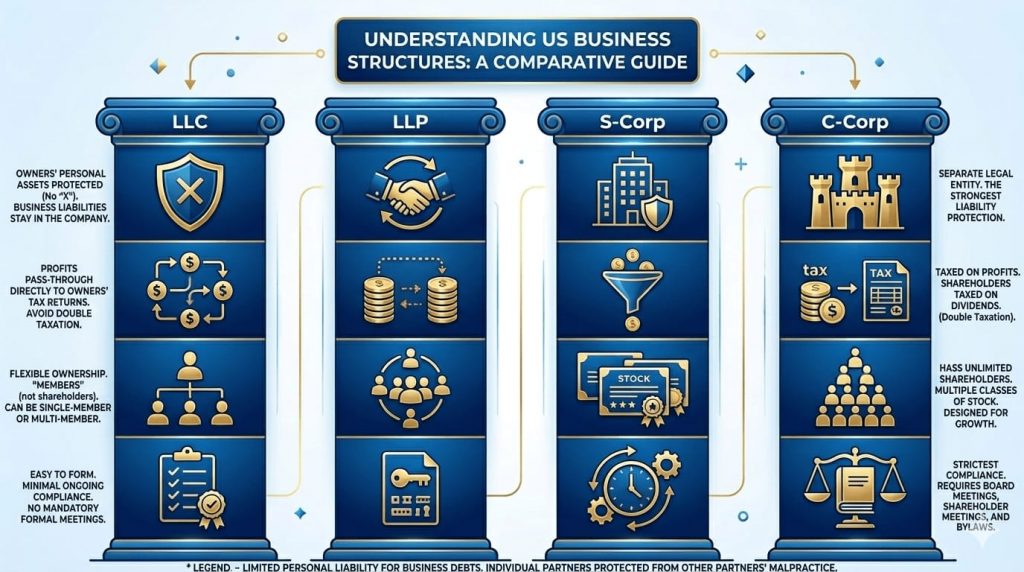
| Feature | LLC | LLP | S-Corp | C-Corp |
| Who can form it? | Any business (not licensed professionals) | Licensed professionals only | Individuals (US residents only) | Any entity, incl. foreign companies |
| Preferred stock? | No | No | No | Yes |
| Corporate shareholders? | Yes | Yes | No | Yes |
| Suitable for startups? | Limited | No | No | Yes |
| Compliance burden | Low | Moderate | High | High |
| Foreign subsidiary? | Yes | No | No | Yes |
External Resource: The Delaware Division of Corporations publishes an official Business Structure Comparison Table that explains all entities side-by-side. Reference it when advising clients on incorporation decisions.
Which State Should Your US Client Incorporate In?
“Now that you understand the types of business structures in the US, the next question is which state to incorporate in.” In the US, corporate law is state level legislation not federal. This means the rules around forming a corporation or LLC vary from state to state, though they are broadly similar. Choosing the right state is a strategic decision that affects costs, taxation, privacy, and access to courts.

Delaware — Historically the most popular state for incorporation, especially among startups and large corporations. Delaware has a dedicated Court of Chancery for corporate disputes, leading to highly predictable, business-friendly judgments. However, it has become expensive, and some cost-conscious businesses are now looking at alternatives.
Wyoming — Wyoming invented the LLC and remains highly innovative in business law. It has passed 13 laws specifically for cryptocurrency businesses, making it the top choice for crypto and blockchain companies. It is also very welcoming to foreign business owners seeking a US presence.
Texas — Fast growing and significantly cheaper than California or New York. Texas is gaining popularity among businesses relocating from high-cost states Elon Musk moved Tesla and SpaceX headquarters to Texas, reflecting the state’s pro-business environment.
New York — Home to Wall Street, the NYSE, and NASDAQ. New York is the financial capital of the US and one of the states with the highest concentration of law firms.
California — The home of Silicon Valley and the tech industry. California has the largest concentration of venture-backed startups in the US, but is expensive and heavily regulated.
Nevada, Florida & Others — Nevada is important for gaming businesses (Las Vegas) and offers strong privacy protections. Florida is an up-and-coming state for business formation, particularly in fintech and healthcare.
For Indian lawyers: The states with the highest number of law firms are California, New York, Texas, and Florida. However, Wyoming, Delaware, and Nevada generate the most incorporation work due to their business-friendly laws.
Frequently Asked Questions
Can a foreign company form an S-Corp in the US? No. S-Corps can only have individual persons as shareholders. Since a foreign company is not an individual, it cannot hold shares in an S-Corp. Foreign companies wishing to incorporate a US subsidiary must use a C-Corp instead.
What is the difference between an LLC and an LLP in the US? An LLC can be formed by any business type but is not available to licensed professionals for their practice. An LLP is exclusively for licensed professionals such as lawyers, accountants, and doctors as defined by state law.
Which US business structure is best for a startup raising venture capital? A C-Corporation is almost always the right choice. Only C-Corps can issue preferred stock (preference shares), which is the standard instrument used by institutional investors when funding early-stage companies.
Why did Wyoming create the LLC? Wyoming created the LLC structure in the 1970s to offer a business vehicle that combined limited liability with simpler compliance without requiring the full formality of a corporation. Other states quickly followed to capture registration revenue.
Conclusion
“Choosing between the types of business structures in the US depends on your client’s goals and funding needs.” Understanding the types of business structures in the US is not just academic knowledge it is one of the most practical skills an Indian lawyer can develop to work with US clients. To summarise:
- LLCs are the go-to structure for service businesses seeking limited liability with minimal paperwork
- LLPs are exclusively for licensed professionals such as lawyers and accountants
- S-Corps work for small domestic businesses, but cannot have corporate or foreign shareholders
- C-Corps are the preferred vehicle for startups, foreign subsidiaries, and businesses planning to raise investment
- State choice matters Delaware, Wyoming, New York, Texas, and California are the most important states to know
Mastering this knowledge puts you in a strong position to assist US law firms with corporate work remotely a skill that is in high demand and short supply among Indian legal professionals. Choosing the right types of business structures in the US depends on your client’s goals, ownership plan, and funding needs.





 Allow notifications