

UGC NET Eligibility: Complete guide on educational qualifications, age limit, percentage requirements, reservations & documents for JRF & Assistant Professor.
Table of Contents
Think you’re ready to apply for UGC NET? Not so fast.
Every year, thousands of candidates invest months preparing for UGC NET, only to discover their applications were never valid in the first place.
One missing percentage point, an expired category certificate, or a simple documentation error, and your candidature gets cancelled, even after you’ve cleared the exam.

Here’s what most aspirants don’t realize: NTA doesn’t verify your eligibility when you apply.
The final eligibility will be verified by NTA at a later stage. If they discover you were ineligible at any stage, even after you’ve qualified, your results are cancelled.
Whether you’re a law graduate planning your academic career, a final year student wondering if you can apply provisionally, or a working professional exploring teaching opportunities, you need absolute clarity before you hit that submit button.
Can you apply with 54.8% marks? Does your state OBC certificate actually work for UGC NET? Is there an age limit if you only want Assistant Professor eligibility? What about distance education degrees?
This guide answers every eligibility question about UGC NET 2025, backed by official NTA guidelines and UGC regulations.
By the end, you’ll know exactly where you stand and avoid the costly mistakes that derail thousands of applications each year. Because knowing you’re eligible is just as important as being prepared.
What After UGC NET Exam
The UGC NET serves as a standardised national level test mandated by the University Grants Commission for determining eligibility for academic positions in higher education institutions across India.
The examination is conducted by the National Testing Agency (NTA) in a Computer Based Test (CBT) mode, covering 85 subjects that range from humanities and social sciences to law, commerce, and computer applications.
The test evaluates candidates on two papers: Paper I, assessing teaching and research aptitude, and Paper II, testing domain specific knowledge in the chosen subject.
The significance of UGC NET extends beyond being a mere qualifying examination. For those aspiring to teach in universities and colleges, clearing NET or its state level equivalents (SET/SLET) remains the minimum eligibility condition for recruitment as Assistant Professor.
For research enthusiasts, qualifying with a higher rank opens doors to the prestigious Junior Research Fellowship, which provides financial support during doctoral studies.
Additionally, UGC NET scores are now accepted by many universities for direct PhD admission, making this examination a multi purpose gateway to academic careers.
Three Categories of UGC NET Qualification
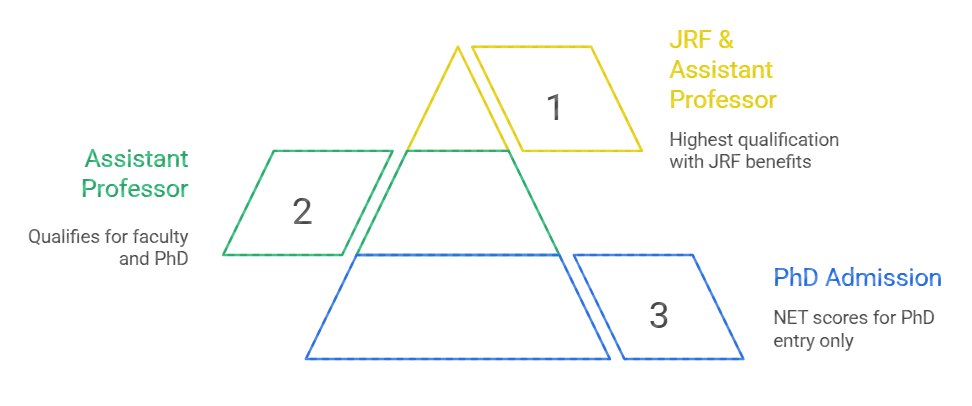
The UGC NET examination now qualifies candidates under three distinct categories, each with different benefits and implications for your academic career.
The first category is ‘Award of JRF and appointment as Assistant Professor,’ which is the highest level of qualification. Candidates in this category become eligible for the Junior Research Fellowship (with a monthly stipend of Rs. 37,000), can be appointed as Assistant Professors, and gain direct eligibility for PhD admission.
This category requires the highest performance in the examination.
The second category is ‘Appointment as Assistant Professor and admission to PhD,’ where candidates qualify for faculty positions and doctoral programmes but are not eligible for JRF benefits.
The third category is ‘Admission to PhD only,’ which is the newest addition, allowing candidates to use their NET scores specifically for PhD admission without qualifying for teaching positions or fellowship.
Understanding which category you are targeting is crucial because it determines the competitiveness level you need to achieve and the career pathways that will open for you.
Failing to meet UGC NET eligibility requirements can have serious consequences that go beyond mere application rejection.
According to the official NTA guidelines, candidature remains purely provisional, subject to fulfillment of eligibility criteria, and NTA does not verify information during online registration.
If ineligibility is detected at any stage, even after you have qualified for the examination, your candidature will be cancelled, and you may face legal action. This means even if you clear the exam with an excellent score, you cannot claim the JRF award, Assistant Professor eligibility, or PhD admission if you were never eligible in the first place.
The examination fee is non refundable, and more importantly, the time and effort invested in preparation would be wasted.
UGC NET Cut Off Marks
General and EWS Category Requirements (55% Marks)
Candidates belonging to the General (Unreserved) and General EWS (Economically Weaker Sections) categories must have secured at least 55% marks in their Master’s degree or equivalent examination from a university or institution recognised by the UGC.
This percentage requirement is strict and applied without rounding off, meaning 54.9% would not qualify.
The Master’s degree must be in subjects covered under Humanities and Social Sciences (including languages), Computer Science and Applications, Electronic Science, and other disciplines listed in the UGC NET subject list. For law aspirants, this means having an LLM degree with a minimum of 55% marks.
Reserved Category Requirements (50% Marks)
Candidates belonging to reserved categories, specifically Other Backward Classes (OBC) Non Creamy Layer, Scheduled Caste (SC), Scheduled Tribe (ST), Persons with Disability (PwD), and Third Gender are eligible with a reduced minimum of 50% marks in their Master’s degree or equivalent examination.
This 5% relaxation acknowledges the socio economic challenges faced by these communities.
It is essential to note that the OBC category specifically refers to the OBC NCL (Non Creamy Layer) as per the Central list available on the National Commission for Backward Classes (NCBC) website at www.ncbc.nic.in, State OBC lists do not automatically qualify for this relaxation.
Can Final Year Students and Awaiting Results Candidates Apply?
Two Year Completion Rule for JRF and Assistant Professor
Yes, candidates who are pursuing their Master’s degree or have appeared for their final year examination with results still awaited can apply for UGC NET.
However, their admission remains provisional, and they will only be considered eligible for JRF award or Assistant Professor eligibility after they pass their Master’s degree with the required percentage (55% for General/EWS, 50% for reserved categories).
The critical rule here is that such candidates must complete their Master’s degree examination within two years from the date of NET result declaration with the required percentage of marks, failing which they shall be treated as disqualified.
One Year Completion Rule for PhD Admission Only
For candidates who qualify under the ‘Admission to PhD Only’ category, there is a stricter timeline; they must complete their Master’s degree or equivalent examination within one year from the date of NET result declaration, as opposed to the two year window available for JRF and Assistant Professor categories.
This shorter deadline exists because PhD admission processes typically have annual cycles, and universities require candidates to have completed their qualifying degree before commencing doctoral research. Candidates must plan their examination attempts keeping these timelines in mind.
Are 4 Year Bachelor’s Degree Holders Eligible for UGC NET?
Under the UGC (Minimum Standards and Procedures for Award of Ph.D. Degree) Regulations, 2022, candidates who have completed a 4 year or 8 semester bachelor’s degree programme are now eligible to appear for UGC NET.
However, they must have secured a minimum of 75% marks in aggregate or its equivalent grade on a point scale. A relaxation of 5% marks is available for SC/ST/OBC (Non Creamy Layer)/Differently Abled and EWS category candidates. Final year students of such programmes can also apply provisionally.
Eligibility Limitations for Candidates Without Master’s Degree
While 4 year bachelor’s degree holders can appear for UGC NET, there is a significant limitation: candidates qualifying based on their undergraduate degree alone will be eligible for JRF award and PhD admission, but NOT for appointment as Assistant Professor.
To become eligible for Assistant Professor positions, candidates must eventually complete a Master’s degree.
This distinction is crucial for career planning. If your goal is teaching in universities and colleges, you will need to pursue post graduation regardless of your NET qualification based on your undergraduate degree.
UGC NET Age Limit
UGC NET JRF Age Limit
For candidates applying for Junior Research Fellowship (JRF), there is a maximum age limit of 30 years.
This age limit is calculated as on the first day of the month in which the examination concludes.
For UGC NET June 2025, this reference date would be 1st June 2025, meaning candidates must not have crossed 30 years of age on this date to be eligible for JRF.
In other words, if the examination concludes in June, your age is calculated as on 1st June 2025.
For instance, if you were born on 2nd June 1995, you would be 29 years old as of 1st June 2025 and therefore eligible for JRF. However, if you were born on 31st May 1995 or earlier, you would have crossed 30 years and would need age relaxation to qualify for JRF.
Age Relaxation Rules for Reserved Categories
SC/ST/OBC NCL/PwD/Third Gender Relaxation (5 Years)
Candidates belonging to the Scheduled Caste, Scheduled Tribe, Other Backward Classes (Non Creamy Layer as per the Central list), Persons with Disability, and Third Gender categories are entitled to a relaxation of up to 5 years in the upper age limit for JRF.
This means such candidates can be up to 35 years old (instead of 30) as on the reference date and still be eligible for Junior Research Fellowship. The relaxation is automatic upon declaring the correct category during application, but candidates must possess valid category certificates from competent authorities.
Women Candidates Relaxation (5 Years)
All women applicants, irrespective of their caste or community, are entitled to 5 years of age relaxation for JRF eligibility.
This means a woman candidate from the General category can be up to 35 years old and still apply for JRF.
This relaxation is provided as part of the government’s affirmative action policies to encourage women’s participation in research and higher education.
LLM Degree Holders Relaxation (3 Years)
Candidates who hold an LLM (Master of Laws) degree are entitled to an additional age relaxation of 3 years for JRF eligibility.
This specific provision recognises that law graduates typically complete their LLB after a 5 year integrated programme or a 3 year programme following graduation, and then pursue LLM, which naturally places them at a higher age compared to candidates in other streams.
For law aspirants appearing in UGC NET Law subject (Code 58), this relaxation is particularly beneficial. A General category male LLM holder can be up to 33 years old and still qualify for JRF.
Research Experience Relaxation (Maximum 5 Years)
Candidates with research experience can claim age relaxation limited to the period spent on research in the relevant or related subject of their post graduation degree, subject to a maximum of 5 years.
To avail this relaxation, candidates must produce a certificate from the appropriate authority, which should be a recognised Indian university, Institute of National Importance, duly approved foreign university, or a Public Sector Undertaking of the Central or State Government.
Importantly, the research should not have been carried out towards completion of graduation or post graduation degrees; it must be independent research work.
Armed Forces Service Relaxation
Candidates who have served in the armed forces are entitled to age relaxation of up to 5 years, subject to the length of their service in the armed forces up to the first day of the month in which the UGC NET examination is conducted.
This provision acknowledges the years spent in military service and provides an opportunity for defence personnel transitioning to academic careers.
The relaxation is calculated based on the actual period of service, with the maximum being 5 years, regardless of longer service periods.
Is There Any Age Limit for Assistant Professor
There is no upper age limit for candidates applying for UGC NET solely for Assistant Professor eligibility.
This means candidates of any age who meet the educational qualification requirements can appear for the examination and, upon qualifying, become eligible for appointment as Assistant Professor in universities and colleges.
This provision is particularly beneficial for working professionals who decide to pursue academic careers later in life, as well as for candidates who may have crossed the JRF age limit but still wish to enter the teaching profession.
Is There Any Age Limit for PhD Admission Through UGC NET?
There is no upper age limit for candidates applying for UGC NET for admission to PhD programs.
This means candidates of any age who meet the educational qualification requirements can appear for the examination and, upon qualifying, become eligible for PhD admission in universities across India.
Can Age Relaxations Be Combined?

A crucial rule that candidates must understand is that the total age relaxation from all grounds combined shall not exceed 5 years under any circumstances.
This means even if you belong to multiple categories eligible for relaxation (for example, an SC woman with LLM degree and research experience), the maximum relaxation you can claim is still capped at 5 years. You cannot add 5 years (SC) + 5 years (women) + 3 years (LLM) to get 13 years of relaxation.
The cap ensures uniformity while still providing meaningful support to candidates from diverse backgrounds.
What Are the Exemptions for an Assistant Professor?
PhD Holders Under UGC Regulations 2022
Candidates who have been awarded a doctoral degree in accordance with the UGC (Minimum Standards and Procedures for Award of Ph.D. Degree) Regulations, 2022, are exempted from the requirement of qualifying for NET/SET/SLET for recruitment and appointment as Assistant Professor or equivalent positions in universities, colleges, and institutions.
This exemption recognises that the rigorous research training during PhD, when conducted as per UGC standards, adequately prepares candidates for academic positions.
SET/SLET Qualified Candidates
SET Cleared Before 1st June 2002
Candidates who have cleared the State Eligibility Test (SET) accredited by UGC for Assistant Professor held prior to 1st June 2002 are completely exempted from appearing in UGC NET.
Such candidates are eligible to apply for Assistant Professor positions anywhere in India, their SET qualification is treated as equivalent to NET without any geographical restrictions. This broader validity was granted because SETs conducted before June 2002 followed more standardised national level criteria.
SET Cleared After 1st June 2002
For State Eligibility Tests held from 1st June 2002 onwards, the validity is restricted geographically.
Candidates who qualified SET after this date are eligible to apply for Assistant Professor positions only in universities and colleges situated in the State from where they cleared their SET.
For instance, if you cleared Maharashtra SET after June 2002, you can apply for teaching positions in Maharashtra institutions but would need to clear UGC NET for positions in other states. This distinction is crucial for candidates planning inter state career mobility.
UGC/CSIR JRF Qualified Before 1989
Candidates who passed the UGC or CSIR JRF examination prior to 1989 are also exempted from appearing in UGC NET for Assistant Professor eligibility.
This historical exemption acknowledges that the pre 1989 JRF examination had different eligibility and qualification criteria, and those who cleared it should not be required to appear for the current format of NET.
While this category now includes a very limited number of candidates due to the time elapsed, the provision remains in the official eligibility criteria.
Are Distance Education and Foreign Degree Holders Eligible?
Validity of Distance Education Master’s Degree
Yes, candidates who have obtained their Master’s degree through distance education mode from a UGC recognised university are eligible to appear for UGC NET.
The key requirement is that the university must be recognised by UGC (the list is available on the website ).
Foreign Degree Equivalence Through AIU
Candidates with post graduate diplomas, certificates, or degrees awarded by foreign universities or institutes must ascertain the equivalence of their qualification with a Master’s degree from recognised Indian universities.
This verification must be obtained from the Association of Indian Universities (AIU), New Delhi.
AIU is the designated authority for determining whether foreign qualifications are equivalent to corresponding Indian degrees, and its equivalence certificate is essential for establishing eligibility.
Step by Step Process for Obtaining AIU Equivalence
To obtain AIU equivalence, candidates should first visit the AIU official website and register themselves as a new user.
Thereafter, candidates need to fill out the application and upload copies of all academic documents, transcripts, the original degree certificate for verification, and pay the prescribed fee. The processing time for AIU equivalence typically ranges from 10 to 30 days.
For law degrees from foreign universities, candidates must additionally obtain recognition from the Bar Council of India (BCI).
It is advisable to initiate the equivalence process well in advance of NET application deadlines, as you cannot claim eligibility without this certification. Candidates should retain the original equivalence certificate carefully, as it will be required during appointment verification at universities.
Post Graduate Diploma Holders: Are They Eligible?.
Candidates with a postgraduate diploma or certificate course are generally not eligible for UGC NET unless their qualification has been officially recognized as equivalent to a postgraduate degree by the Association of Indian Universities (AIU).
You can verify your equivalency by going to the AIU official website. The AIU maintains an official list of diplomas and certificates that have been granted equivalence status.
If your diploma appears on this list, you are eligible to apply for UGC NET. If it is not listed, you cannot appear for the examination.
You may also consult your college principal or director, as they are typically aware of whether your institution’s diploma/certificate holds AIU equivalence certification.
Several premier institutions, such as the Indian Institutes of Management (IIMs), award 2 year post graduate diplomas rather than degrees.
While these might appear ineligible at first glance, the AIU has granted equivalence certificates to PG Diplomas from IIMs, making graduates eligible for UGC NET in relevant subjects such as Management (Code 17) or Human Resource Management (Code 55).
What Documents Are Required to Prove Eligibility?
Candidates appearing for UGC NET are not required to submit any documents at the time of application. The application process is entirely online, and no physical documents need to be sent to NTA. However, candidates must keep certain documents ready for verification at later stages and for their own reference.
Educational Qualification Documents
You should have your educational qualification certificates ready, including your Master’s degree certificate or provisional certificate, all semester mark sheets or consolidated mark sheet, and Bachelor’s degree certificate if you’re applying based on a 4 year undergraduate degree.
If you hold a post graduate diploma or certificate instead of a Master’s degree, you must obtain an equivalence certificate from the Association of Indian Universities (AIU) and keep this ready for verification.
Identity Proof
For identity verification, keep ready documents such as Aadhaar Card, Passport, PAN Card, Driving License, Voter ID Card, Bank passbook with photograph, or any other valid Government ID.
Date of Birth
Your Class 10th or Secondary School certificate will be required as proof of date of birth.
Category Certificates
If you belong to a reserved category, you’ll need the appropriate category certificates.
OBC candidates must have their OBC NCL (Non Creamy Layer) certificate as per the Central List, SC/ST candidates need their SC/ST certificate, and those claiming EWS benefits require an Economically Weaker Section certificate.
Persons with Disability should have their PwD certificate issued by a competent authority.
Application Related documents
For application related requirements, maintain printouts of your online application confirmation page, proof of fee payment, and download your admit card before the exam.
Additionally, keep 6 to 8 recent passport size colored photographs with white background ready, ensuring the photograph shows 80% of your face visible including ears, matching the one uploaded in your application form.
Common Mistakes to Avoid While Applying for UGC NET
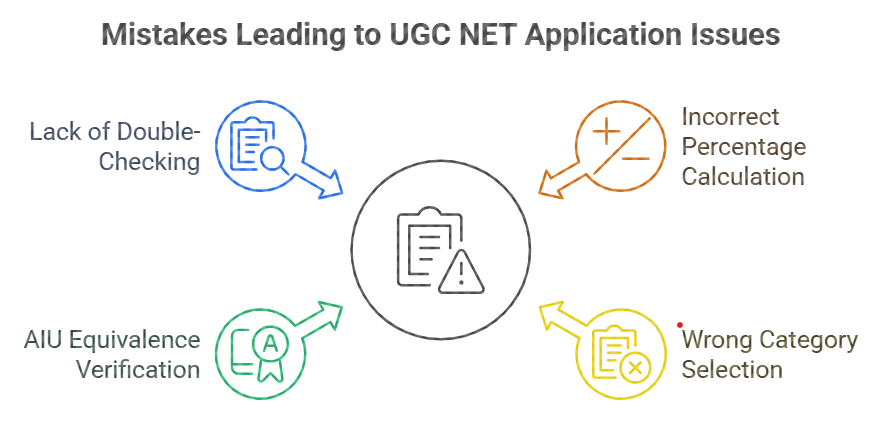
Many candidates make avoidable errors during the UGC NET application process that can lead to rejection or disqualification.
Understanding these common mistakes can help you navigate the application process smoothly and prevent unnecessary complications.
One of the most frequent eligibility related mistakes involves incorrect percentage calculation.
Many candidates round off their percentage, such as converting 54.6% to 55%, but UGC NET requires percentage without rounding off.
Another critical error is wrong category selection, where candidates select the OBC category when they belong to the State OBC list instead of the Central OBC NCL list, or fail to check if they fall under the Non Creamy Layer criteria.
Always verify your category against the Central List available on the NCBC website.
Candidates with diplomas or certificates often make the mistake of not checking AIU equivalence, assuming their diploma is equivalent to a Master’s degree without verification. Always check the AIU equivalence list on www.aiu.ac.in before applying.
The most critical reminder is that once you submit your application form, it cannot be withdrawn. Corrections are allowed only during the designated correction window for limited fields. Therefore, double check all details before final submission to avoid these common mistakes and ensure a smooth application process.
Conclusion
Understanding UGC NET eligibility criteria is the essential first step in your journey towards an academic career in India.
Whether you are aiming for the prestigious Junior Research Fellowship with its monthly stipend, seeking Assistant Professor eligibility to enter the teaching profession, or planning to use NET scores for PhD admission, ensuring you meet all eligibility requirements saves you from potential rejection and wasted effort.
The key parameters are educational qualification (55%/50% in Master’s), age limit for JRF (30 years with relaxations), and proper documentation. It must all be verified before you submit your application.
As you prepare for UGC NET, remember that NTA does not verify eligibility during the application; this responsibility rests entirely with you.
If you have any doubts about your eligibility, seek clarification from the information bulletin before investing months in preparation. With a clear understanding of eligibility and focused preparation, you can confidently pursue your goal of qualifying for UGC NET and building a successful academic career.
Frequently Asked Questions
Can Graduates Apply for UGC NET Exam?
No, candidates with only a Bachelor’s degree cannot apply for UGC NET. The minimum qualification is a Master’s degree or equivalent. However, candidates with a 4 year/8 semester bachelor’s degree with 75% marks (70% for reserved categories) can appear for NET for JRF and PhD admission only, and not for Assistant Professor.
Is Master’s Degree Compulsory for UGC NET?
For Assistant Professor eligibility, yes, a Master’s degree with minimum 55% marks (50% for reserved categories) is compulsory. For JRF and PhD admission, candidates with 4 year bachelor’s degrees with 75% marks are now also eligible under UGC Regulations 2022, though they cannot be eligible to become a Assistant Professor without a Master’s degree.
Can I Apply for UGC NET with 50% Marks in General Category?
No, candidates in the General (Unreserved) and General EWS categories must have a minimum of 55% marks in their Master’s degree without rounding off. The 50% relaxation is available only to OBC NCL, SC, ST, PwD, and Third Gender candidates.
What is the Maximum Age for UGC NET JRF?
The maximum age for JRF eligibility is 30 years as on the first day of the month in which the examination concludes. Age relaxation of up to 5 years is available for SC/ST/OBC NCL/PwD/Third Gender/Women candidates, 3 years for LLM holders, and up to 5 years for research experience or armed forces service. However, total relaxation cannot exceed 5 years.
Is There Any Limit on the Number of Attempts for UGC NET?
No, there is no limit on the number of attempts for UGC NET. Candidates can appear for the examination as many times as they wish, provided they meet the eligibility criteria (including the age limit for JRF). Since there is no upper age limit for Assistant Professor eligibility, candidates can continue appearing for NET throughout their careers.
Can B.Tech/M.Tech Students Apply for UGC NET?
Yes, M.Tech degree holders can apply for UGC NET in subjects like Computer Science and Applications (Code 87), Electronic Science (Code 88), or other relevant subjects matching their specialisation. B.Tech graduates must first complete M.Tech or another Master’s degree to be eligible. The 4 year B.Tech alone qualifies only for JRF/PhD admission if the marks are 75% or above.
Is PhD Required to Become an Assistant Professor?
No, PhD is not mandatory to become an Assistant Professor. Qualifying UGC NET or SET/SLET provides eligibility for Assistant Professor positions. However, PhD holders under UGC Regulations 2022 are exempted from the NET/SET requirement.
Can State OBC Candidates Apply Under OBC NCL Category?
State OBC candidates can claim OBC NCL benefits in UGC NET only if their community appears in the Central List of OBCs published by NCBC at www.ncbc.nic.in . Many communities listed in the State OBC lists are not in the Central list. Such candidates must apply under the General category for UGC NET purposes and will need 55% marks and follow the unreserved category cut offs.
What Happens If I Don’t Complete My Degree Within 2 Years?
If you are provisionally admitted to UGC NET as a final year student and fail to complete your Master’s degree with the required marks within 2 years from the NET result date, you will be disqualified.
Is UGC NET Valid for PhD Admission?
Yes, the UGC NET qualification is valid for PhD admission. JRF qualified candidates gain direct admission to PhD based on interview as per UGC Regulations.
Can Working Professionals Apply for UGC NET?
Yes, working professionals can apply for UGC NET provided they meet the eligibility criteria. There is no restriction based on employment status.
What is the Difference Between JRF and Assistant Professor Eligibility?
The key difference is that JRF has an age limit (30 years) while Assistant Professor has no age limit. JRF requires a higher score in UGC NET, whereas clearing NET alone qualifies you for Assistant Professor. Both require a Master’s degree, but Assistant Professor eligibility specifies 55% marks (50% for reserved categories).
Can Foreign Nationals Apply for UGC NET?
Foreign nationals can also apply for UGC NET, but their eligibility is subject to equivalency verification by AIU (Association of Indian Universities).
How Long is the UGC NET Certificate Valid?
UGC NET qualification for Assistant Professor eligibility is valid for life; there is no expiry. However, the JRF award letter has a validity of 3 years from the date of issue, within which the candidate must join a university or research institution to avail the fellowship. For PhD admission purposes, NET scores remain valid for one year from the date of result declaration.




 Allow notifications