

Discover who should take UGC NET exam, career outcomes after qualifying, candidate profiles, comparisons with SET and CSIR NET, and complete syllabus overview for Law graduates.
Table of Contents
“Is UGC NET actually meant for someone like me?”
If you’ve found yourself asking this question while scrolling through exam notifications or listening to friends discuss their preparation plans, you’re not alone.
Every year, lakhs of postgraduates across India face this exact dilemma, wondering whether investing months of dedicated preparation in this national level examination makes sense for their specific career goals.

The confusion is understandable because UGC NET isn’t just another competitive exam; it’s a gateway to a very specific set of career outcomes that may or may not align with what you’re looking for.
Here’s the straightforward answer: UGC NET is designed primarily for two purposes.
First, it determines your eligibility to become an Assistant Professor in Indian universities and colleges.
Second, for top performers, it opens the door to a Junior Research Fellowship, which provides financial support for pursuing a PhD.
If either of these outcomes excites you, then yes, this exam deserves your serious attention.
But if you’re considering UGC NET simply because “everyone else is doing it” or because you’re unsure about your next step after postgraduation, this guide will help you make a much more informed decision.
In this comprehensive guide, we’ll walk through exactly who UGC NET is designed for, the different candidate profiles who benefit most from this qualification, how it compares to alternatives like SET and CSIR NET, and what you can realistically expect after qualifying.
By the end, you’ll have a clear framework for deciding whether UGC NET aligns with your career aspirations, or whether your time and energy might be better invested elsewhere. Let’s dive in.
What is the Purpose of UGC NET?
The University Grants Commission National Eligibility Test, commonly known as UGC NET, serves as India’s benchmark examination for determining eligibility for academic positions in higher education.
Conducted twice a year by the National Testing Agency on behalf of UGC, this examination tests candidates across two papers:
Paper I, which assesses general teaching and research aptitude, and Paper II, which evaluates subject specific knowledge across 85 disciplines.
The exam exists because UGC recognized the need for a standardized assessment to ensure that individuals entering the teaching profession at universities and colleges meet a minimum threshold of competence.
Think of UGC NET as the qualifying gate that separates aspiring academics from those who can actually pursue academic careers in India.
Without this qualification, you cannot be appointed as an Assistant Professor in most universities and colleges across the country, regardless of how impressive your academic credentials might be.
This isn’t just bureaucratic formality; it’s a quality control mechanism ensuring that those who shape young minds at the higher education level have demonstrated both subject expertise and teaching aptitude through a rigorous, nationally standardized assessment.
The examination also serves a secondary but equally important purpose: identifying candidates worthy of research funding through the Junior Research Fellowship.
JRF recipients don’t just get a certificate; they receive substantial monthly stipends to pursue doctoral research, making higher education financially accessible for talented individuals who might otherwise struggle to fund their PhD.
This dual purpose makes UGC NET unique among Indian competitive examinations, serving both those who want to teach and those who want to research.
What Happens After Qualifying UGC NET?
When you appear for UGC NET, you’re not just competing for a pass or fail result. The examination creates a hierarchy of qualifications based on your performance, and understanding these categories is essential for setting realistic expectations about what doors will open for you after clearing the exam.
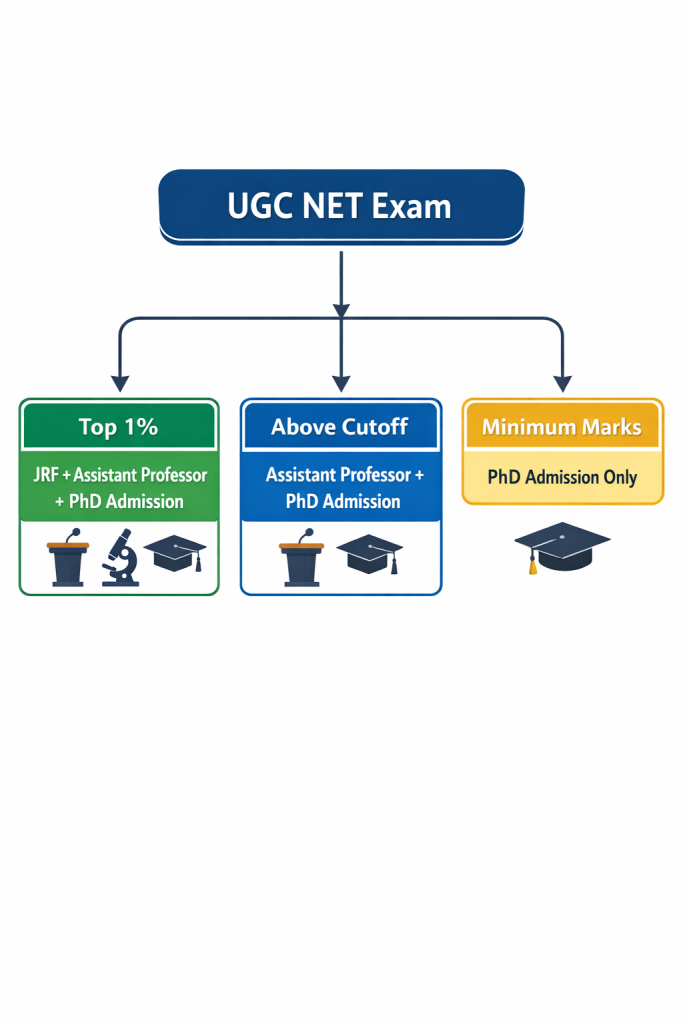
JRF with Assistant Professor Eligibility and PhD Admission
This is the gold standard of UGC NET results. If you rank among the top 1% of qualified candidates nationally, you receive JRF, which comes bundled with Assistant Professor eligibility and preferential consideration for PhD admission.
JRF holders receive a monthly fellowship of ₹37,000 for the first two years, which increases to ₹42,000 from the third year onwards, along with an annual contingency grant for research expenses.
This category essentially hands you three opportunities on a single platter: you can teach, you can research with funding, and you get priority in PhD admissions at top universities.
Assistant Professor Eligibility with PhD Admission
Candidates who clear the examination but don’t make it to the top 1% receive what was previously called “Lectureship” but is now termed Assistant Professor eligibility.
This qualification allows you to apply for teaching positions across Indian universities and colleges. Additionally, you become eligible for PhD admission, though without the financial support that JRF provides.
Many candidates in this category pursue PhD while working as Assistant Professors, balancing teaching responsibilities with doctoral research.
PhD Admission Only
Recent changes to UGC NET have introduced a third category where candidates who meet minimum qualifying marks but don’t cross the threshold for Assistant Professor eligibility still qualify for PhD admission in the subject concerned.
This category recognizes that some candidates may have research potential even if they haven’t demonstrated the comprehensive subject mastery required for teaching positions. However, like the previous category, this comes without fellowship support.
How NTA Determines Which Category You Qualify For?
The National Testing Agency uses a systematic process to categorize candidates after each UGC NET examination.
Your final ranking depends on your combined performance in both Paper I and Paper II, with Paper II carrying double the weightage since it tests your specialized subject knowledge. The total marks available are 300: 100 from Paper I and 200 from Paper II.
First, NTA determines whether you’ve cleared the minimum qualifying marks for your category.
General category candidates need at least 40% aggregate marks across both papers, while reserved category candidates (SC, ST, OBC NCL, PwD) require 35%.
Only after crossing this threshold are you considered for the next level of categorization.
From among all qualifying candidates, the top 1% nationally are awarded JRF based on merit, while the remaining qualified candidates receive Assistant Professor eligibility.
This means that even if you score well above the minimum qualifying marks, JRF isn’t guaranteed; it depends on how your performance compares to thousands of other candidates appearing in your subject.
Why UGC Made NET Mandatory for Academic Positions?
Maintaining Quality Standards in Higher Education
Before UGC NET became mandatory, universities and colleges had significant autonomy in hiring faculty, leading to inconsistent quality standards across institutions. A candidate with excellent marks from a prestigious university might be rejected, while someone with lesser credentials but better connections secured the position.
UGC NET changed this by establishing a uniform benchmark that every aspiring academic must clear, regardless of their educational background or institutional affiliations. This standardization ensures that students across India, whether at central universities or remote affiliated colleges, are taught by faculty who have demonstrated minimum competency levels.
Evolution of NET from Optional to Essential Qualification
When UGC NET was first introduced in 1989, it was one of several pathways to academic positions, not the only one. Universities could hire candidates based on their postgraduate performance, research publications, or other criteria.
However, as the higher education sector expanded rapidly in the 1990s and 2000s, concerns about faculty quality mounted. The UGC gradually tightened regulations, making NET qualification mandatory for Assistant Professor appointments in universities and colleges receiving grants from it.
The 2018 UGC Regulations cemented this position further, explicitly stating that candidates without NET or SET qualifications cannot be appointed as Assistant Professors except in specific circumstances, like PhD holders with publications.
Today, virtually every teaching position advertisement in higher education mentions “UGC NET qualified” as an essential eligibility criterion.
This evolution from an optional credential to a mandatory requirement reflects the examination’s growing importance in India’s academic landscape and explains why millions of postgraduates now consider UGC NET preparation essential for their career planning.
Who Should Take UGC NET? Identifying Your Ideal Candidate Profile
Not everyone with a postgraduate degree should automatically pursue UGC NET. This examination makes tremendous sense for certain individuals while being a questionable investment of time and energy for others.
Let’s explore five distinct candidate profiles to help you identify where you fit in this spectrum.
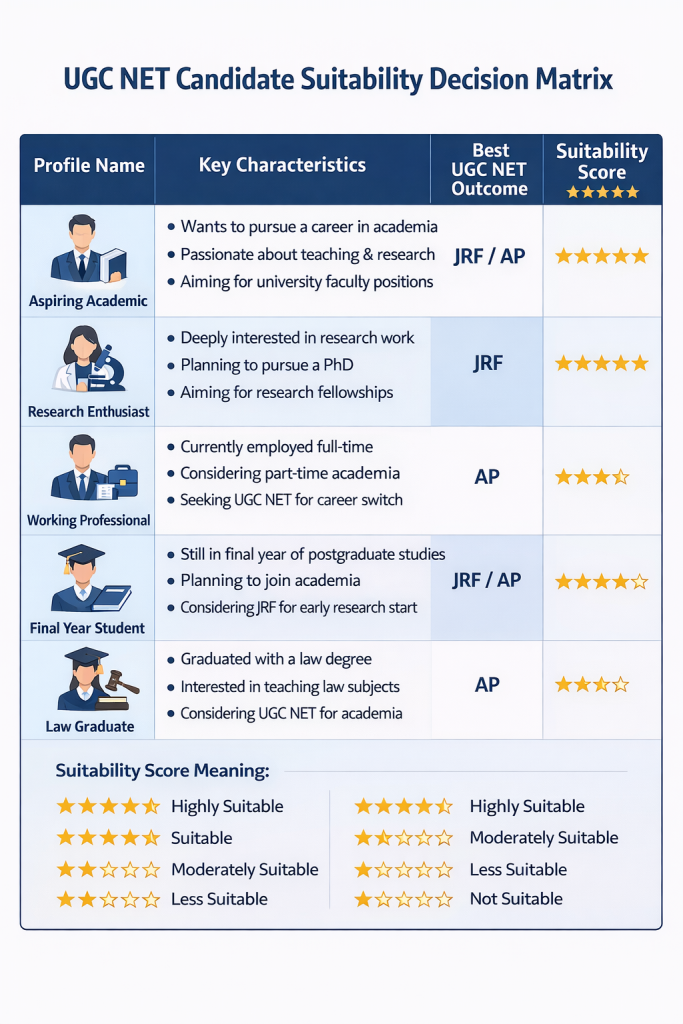
Profile 1: The Aspiring Academic Who Dreams of Teaching
If the thought of standing in front of a classroom, explaining complex concepts, and shaping young minds genuinely excites you, then UGC NET isn’t just recommended; it’s essential.
This profile includes individuals who have always seen themselves in academic settings, perhaps inspired by their own professors or drawn to the intellectual environment that universities offer.
Signs This Exam Is Perfect for You
You find yourself naturally explaining concepts to classmates and enjoying the process. During your postgraduation, you looked forward to seminars and presentations rather than dreading them.
You’ve considered pursuing further studies not for career advancement but because you genuinely love learning your subject. You’ve researched faculty positions and find the combination of teaching, research, and relative job security appealing. If three or more of these statements resonate with you, UGC NET aligns perfectly with your inclinations.
Career Timeline Expectations for Teaching Focused Candidates
Here’s a realistic timeline you should prepare for. After qualifying NET, securing an Assistant Professor position typically takes anywhere from six months to a couple of years, depending on your subject, location flexibility, and the availability of vacancies.
Government universities and colleges announce positions through official advertisements, followed by lengthy recruitment processes involving written tests, interviews, and verification procedures. Private institutions generally hire faster but may offer lower compensation and job security.
Plan your finances and expectations accordingly; an immediate appointment after qualification is rare rather than the norm.
What Teaching in Higher Education Actually Looks Like?
Teaching at universities differs significantly from school teaching. You’ll typically have 16 to 18 hours of weekly classroom engagement, but that’s just the visible part.
Beyond lectures, you’ll design syllabi, create examination papers, evaluate answer sheets, guide project students, participate in departmental meetings, and engage in research activities.
Many new Assistant Professors find the administrative responsibilities surprising. Understanding this reality beforehand helps you commit to UGC NET with accurate expectations rather than romanticized notions of academic life.
Profile 2: The Research Enthusiast Seeking Funded PhD Opportunities
If your postgraduate experience sparked a deep curiosity about unanswered questions in your field, and you find yourself reading research papers for genuine interest rather than assignment requirements, the JRF component of UGC NET deserves your serious attention.
This profile suits individuals who want to contribute to knowledge creation rather than just knowledge transmission.
Why JRF Makes Financial Sense for Doctoral Studies?
Pursuing a PhD without funding is financially challenging.
A typical doctoral program takes four to six years, during which you have limited earning capacity.
Without fellowship support, you either depend on family resources, work part time (which extends your PhD duration), or take educational loans. JRF changes this equation entirely.
At ₹37,000 monthly (increasing to ₹42,000 later), you receive enough to cover living expenses in most Indian cities, allowing you to focus entirely on your research. Over a five year PhD, JRF provides approximately ₹24 lakhs in fellowship alone, plus contingency grants for books, travel, and research materials.
JRF Fellowship Benefits: Beyond the Monthly Stipend
The financial benefits extend beyond the monthly fellowship. JRF holders receive House Rent Allowance if institutional accommodation isn’t provided, annual contingency grants of ₹10,000 to ₹20,000 depending on discipline, and access to institutional facilities at no cost.
Perhaps more importantly, JRF status enhances your academic credibility. When you apply to work with senior researchers or seek institutional affiliations, being a JRF holder signals that you’ve been nationally recognized for research potential. This opens doors that might otherwise remain closed.
Research Career Pathways After JRF Completion
Completing your PhD with JRF support positions you for multiple career trajectories.
The academic path leads to Assistant Professor positions, where your research experience becomes a significant advantage during hiring.
Alternatively, you can pursue postdoctoral fellowships in India or abroad, research positions at think tanks and policy institutes, or scientist positions at government research organizations like CSIR or ICMR.
Some JRF holders transition to industry research roles in sectors like pharmaceuticals, technology, or consulting, where their advanced research skills command premium compensation.
Profile 3: The Working Professional Considering Career Transition
You’ve spent years in industry, perhaps in corporate roles, legal practice, or other professional settings.
Now you’re contemplating a shift to academia, motivated by factors like desire for intellectual engagement, work life balance considerations, or passion for teaching. UGC NET can facilitate this transition, but approaching it strategically is crucial.
Career Transition Scenarios: Moving from Industry to Academia
Common transition scenarios include legal professionals moving to law school faculty positions, corporate executives transitioning to management education, and IT professionals shifting to computer science teaching.
Each transition has unique considerations. Your industry experience can be valuable in academic settings, particularly in professional courses where practical insights enhance theoretical teaching. However, academic hiring committees also value research publications and teaching experience, areas where industry professionals may need to build credentials post NET qualification.
Balancing Current Employment with NET Preparation
Preparing for UGC NET while working full time is challenging but achievable. Many successful candidates have managed this balance by dedicating early mornings or late evenings to study, utilizing weekends intensively, and leveraging their work commute for reading or revision. The key is consistency rather than marathon study sessions.
Allocate at least 2 to 3 hours daily over a six month period rather than attempting to cover the entire syllabus in the final weeks before examination. Consider whether your employer offers study leave or flexible working arrangements that could support your preparation.
Age Considerations and Timeline Planning
Here’s reassuring news: there’s no upper age limit for UGC NET if you’re targeting Assistant Professor eligibility.
You can attempt the examination at any age, post completion of your Master’s degree.
However, JRF has an age limit of 30 years (with relaxations for reserved categories). If JRF is your goal and you’re approaching this threshold, time your preparation and attempts carefully.
For those beyond JRF eligibility age, Assistant Professor qualification remains fully accessible and valuable for career transition purposes.
Profile 4: The Final Year Postgraduate Student Planning Ahead
If you’re currently completing your Master’s degree and already thinking about UGC NET, you’re demonstrating excellent foresight. Final year students occupy a unique position where they can build strong foundations for NET success while completing their academic requirements.
Strategic Timing: When to Attempt Your First UGC NET
You can appear for UGC NET even before completing your Master’s degree, provided you’re in your final year. This provisional eligibility allows you to attempt the examination while your subject knowledge is fresh from coursework.
Many successful candidates clear the NET in their first attempt during their final year of postgraduation. If you don’t clear it initially, you’ve identified your weak areas early and have subsequent attempts available.
The strategic advantage of early attempts cannot be overstated; waiting until after degree completion means your subject knowledge gradually fades and requires relearning.
Combining Master’s Studies with NET Preparation
Your postgraduate coursework and NET syllabus share significant overlap, particularly for Paper II. Leverage this by studying your Master’s subjects with NET requirements in mind.
When preparing for semester examinations, also solve previous year NET questions from those topics. This integrated approach means you’re essentially preparing for both simultaneously rather than treating them as separate endeavors.
For Paper I, dedicate separate time since teaching aptitude and research methodology may not be covered in your regular coursework.
Building Subject Expertise During Postgraduation
Use your postgraduation years to build comprehensive subject knowledge rather than just examination focused preparation.
Read beyond syllabus requirements, engage with contemporary debates in your field, and develop conceptual clarity rather than superficial familiarity. This approach serves you well for NET and beyond because academic careers require genuine subject expertise that candidates cannot fake through last minute cramming.
Your investment in deep learning during postgraduation pays dividends throughout your academic career.
Profile 5: The Law Graduate Seeking Academic Specialization
Law graduates occupy a distinctive position in the UGC NET landscape. With Subject Code 58 (Law) as a dedicated Paper II option, legal professionals have a clear pathway to academic careers in law schools, university law departments, and judicial academies across India.
Why Law Aspirants Have a Unique Advantage?
Your legal education has already equipped you with analytical reasoning, comprehension of complex texts, and structured argumentation skills; competencies that directly transfer to UGC NET preparation.
The Paper I syllabus covering teaching aptitude, research methodology, and logical reasoning aligns naturally with skills developed during your law degree. Additionally, the research component of legal education, including dissertation work and case analysis, prepares you well for research aptitude questions that many candidates from other disciplines find challenging.
LLM to Assistant Professor: The Career Pathway
For law graduates, the typical academic pathway involves completing LLM followed by the UGC NET qualification. With both credentials, you become eligible for Assistant Professor positions in law schools, university law faculties, and affiliated college law departments.
The demand for qualified law faculty has increased significantly with the proliferation of National Law Universities, private law schools, and expanded legal education programs at state universities. This demand supply gap means qualified candidates often have multiple appointment opportunities.
Research Opportunities in Legal Academia
Legal academia offers rich research possibilities that practicing lawyers rarely get to explore. As an academic, you can investigate doctrinal developments, undertake empirical legal research, contribute to law reform discussions, and publish in peer reviewed journals.
JRF qualification opens additional doors, including funded doctoral research at prestigious law schools and opportunities to work on externally funded research projects. The Law Paper II syllabus covers 10 comprehensive units spanning jurisprudence to comparative public law, ensuring that qualified candidates possess the breadth of knowledge necessary for diverse research pursuits.
UGC NET vs SET/SLET
Understanding how UGC NET compares to State Eligibility Test (SET), also known as State Level Eligibility Test (SLET), is crucial for candidates who want to optimize their preparation strategy or have specific geographic preferences for their academic careers.
UGC NET qualification holds validity across the entire country, allowing candidates to teach at institutions anywhere from Delhi University to Mumbai colleges or institutions in Manipur, as the NET certificate is recognized universally.
This all India validity makes UGC NET the preferred choice for candidates with geographic flexibility or those targeting positions at central universities and prestigious institutions that typically attract candidates from across the country. The national recognition also matters for candidates who are uncertain about where they will eventually settle.
In contrast, SET/SLET qualification is valid only within the state that conducted the examination, meaning candidates who clear Maharashtra SET, for instance, can apply only for positions in Maharashtra institutions. This geographic restriction limits employment options but also means candidates compete with a smaller candidate pool within that state. For candidates committed to working in a particular state due to family, language, or other personal considerations, SET offers a more focused pathway.
SET becomes strategically preferable in several scenarios, particularly for candidates who have attempted UGC NET multiple times without success, as SET offers an alternative pathway with potentially less competition since it attracts only state specific candidates.
The examination pattern and difficulty level also differ, with some candidates finding SET more manageable based on their preparation style. Additionally, SET is often scheduled at different times than UGC NET, allowing candidates to have multiple opportunities annually to secure teaching eligibility.
State universities and affiliated colleges within a particular state often have significant vacancies that national candidates don’t pursue due to geographic restrictions, and by qualifying SET, candidates position themselves strategically for these opportunities without competing against the entire national candidate pool. For candidates certain about living and working in a specific state, SET qualification might actually serve their career better than UGC NET.
There is no restriction preventing candidates from appearing for both UGC NET and SET examinations, and many strategic candidates do exactly this, maximizing their chances of securing teaching eligibility through one path or the other.
If examination schedules don’t clash, candidates can attempt both within the same year, and some candidates clear SET first, which allows them to start applying for state positions while continuing their UGC NET attempts for broader opportunities.
The preparation overlap between UGC NET and SET is substantial since both test similar subject knowledge and teaching aptitude, meaning investment in NET preparation largely transfers to SET preparation with minor adjustments for any state specific patterns. Holding both qualifications, while technically redundant for positions within that state, demonstrates commitment and competence that some hiring committees view favorably.
UGC NET vs CSIR NET
Another comparison that confuses many candidates involves the distinction between UGC NET and CSIR NET, and understanding when each examination applies prevents wasted preparation effort and missed opportunities.
UGC NET covers 85 subjects spanning humanities, social sciences, languages, commerce, performing arts, and several science subjects, with the examination conducted by NTA on behalf of UGC for all these disciplines.
CSIR NET, however, specifically covers five science disciplines: Chemical Sciences, Earth Sciences, Life Sciences, Mathematical Sciences, and Physical Sciences, with the Council of Scientific and Industrial Research administering this examination separately from UGC NET.
This distinction matters because candidates in science subjects often have a choice between the two examinations, as a Physics postgraduate can appear for either UGC NET (Physical Sciences) or CSIR NET (Physical Sciences).
The syllabi differ in emphasis and depth, with CSIR NET generally considered more research oriented and aligned with scientific research careers, while UGC NET balances teaching and research aptitude assessment.
For science stream candidates, the choice depends on career objectives, as both qualifications are recognized for academic appointments if the primary goal is becoming an Assistant Professor with a balance of teaching and research.
However, candidates specifically targeting research positions at CSIR laboratories, research institutes, or industry R&D divisions will find that CSIR NET carries more weight, with the JRF through CSIR NET specifically oriented toward research careers and recognized by CSIR laboratories for scientist positions.
Candidates should also consider the examination pattern and their preparation strengths, as CSIR NET follows a different structure with three parts requiring different approaches, and some candidates find one examination pattern more suited to their answering style than the other.
Since both examinations typically occur on different dates typically, candidates can attempt both if they are in an eligible science discipline, keeping their options open for whichever result favors them.
Can You Take PhD Admission Without UGC NET?
A common question among postgraduates is whether UGC NET is mandatory for PhD admission or if alternative pathways exist, and understanding this helps candidates evaluate whether UGC NET preparation is necessary for their specific educational goals.
Candidates can pursue PhD without UGC NET qualification, as the examination is not a prerequisite for doctoral admission, and universities conduct their own entrance examinations and interviews for PhD admission.
However, the critical difference lies in financial support, as without JRF, candidates won’t receive the monthly fellowship that makes full time research financially viable, meaning they must either self fund their doctoral studies, depend on family support, or pursue PhD part time while working elsewhere.
Candidates should consider the numbers carefully, as a five year PhD without fellowship requires managing living expenses, research costs, and opportunity costs of foregone income, while with JRF, candidates receive approximately ₹24 lakhs over five years while focusing entirely on research.
For candidates from modest financial backgrounds, this difference isn’t merely about comfort but about whether pursuing a PhD is feasible at all, and if financial support matters for doctoral plans, UGC NET JRF becomes virtually essential rather than optional.
PhD holders with JRF have certain advantages in academic job markets, as the fellowship indicates that national evaluators recognized their research potential, adding credibility to their candidature.
During PhD, JRF holders often have better access to conferences, publication opportunities, and research collaborations because they’re not distracted by financial concerns or part time employment, and these experiences accumulate into stronger academic profiles by the time they enter the job market.
However, the PhD degree itself carries significant weight regardless of how it was funded, and a PhD holder without prior NET can still clear NET afterward and become eligible for Assistant Professor positions.
The qualification isn’t about when candidates clear NET but whether they have it when applying for academic positions, and if the immediate goal is doctoral research and candidates are struggling with NET, pursuing PhD through university entrance and clearing NET later remains a viable, if longer, pathway to academic careers.
UGC NET Syllabus
Understanding the examination syllabus is fundamental to effective preparation. UGC NET comprises two papers: Paper I testing general teaching and research aptitude (common for all candidates) and Paper II testing subject specific knowledge (from 85 available subjects). Let’s break down what each paper covers.
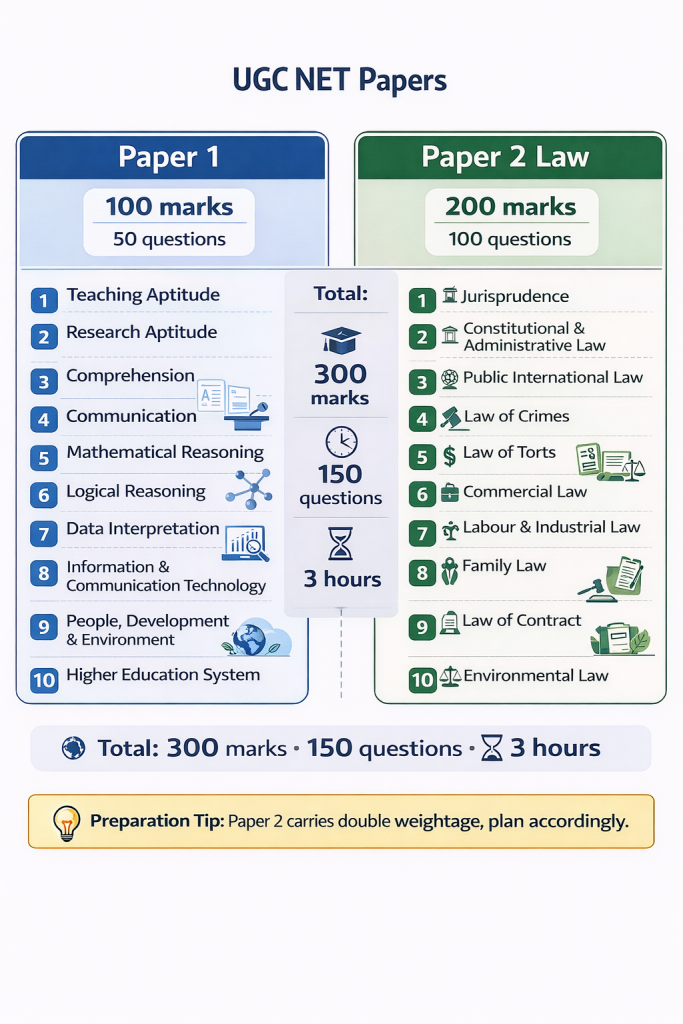
UGC NET Paper I Syllabus
Paper I assesses your aptitude for teaching and research careers across 10 comprehensive units. This paper is common for all candidates regardless of their subject specialization, contributing 100 marks through 50 questions to your total score.
Unit 1: Teaching Aptitude
It covers the nature, objectives, and characteristics of teaching at different levels. You’ll study teaching methods, learner characteristics, factors affecting teaching, and the evaluation process. Understanding the difference between memory, understanding, and reflective levels of teaching is crucial for questions in this unit.
Unit 2: Research Aptitude
It examines research methodology fundamentals including research types (fundamental, applied, action), research process stages, thesis writing, and research ethics. Candidates familiar with dissertation work find this unit relatively comfortable, but specific terminology and methodology classifications require dedicated study.
Unit 3: Comprehension
It presents passages followed by questions testing your ability to understand, analyze, and draw inferences from written text. This unit rewards reading speed and comprehension accuracy rather than specific knowledge.
Unit 4: Communication
It covers verbal and non verbal communication concepts, classroom communication strategies, barriers to effective communication, and mass communication fundamentals. Understanding communication models and their application in educational settings is essential.
Unit 5: Mathematical Reasoning and Aptitude
It tests number series, percentages, ratios, data analysis, and basic arithmetic operations. Candidates from non mathematical backgrounds often find this unit challenging and should allocate extra preparation time.
Unit 6: Logical Reasoning
It includes syllogisms, analogies, Venn diagrams, classification, and statement conclusion type questions. Regular practice with varied question types builds the pattern recognition skills necessary for this unit.
Unit 7: Data Interpretation
It presents data through tables, graphs, charts, and diagrams, followed by questions requiring analysis and calculation. Speed and accuracy in handling numerical information determine success here.
Unit 8: Information and Communication Technology (ICT)
It covers computers, internet, digital initiatives, e governance, and ICT in education. Contemporary developments like Digital India, SWAYAM, and cyber security concepts appear frequently.
Unit 9: People, Development, and Environment
It examines sustainable development, environmental issues, pollution, climate change, and related policies. International environmental agreements and Indian environmental legislation feature prominently.
Unit 10: Higher Education System
It tests knowledge about Indian higher education structure, governance bodies (UGC, NAAC, NIRF), NEP 2020 provisions, and quality assurance mechanisms. Recent policy changes make this unit dynamic and require updated study materials.
UGC NET Law Paper II Syllabus
For law graduates appearing with Subject Code 58, Paper II covers 10 units spanning the entire legal education curriculum. This paper contributes 200 marks through 100 questions, making it the decisive component for your final ranking.
Unit I: Jurisprudence
It examines legal theory foundations, including natural law, positivism, legal realism, and sociological jurisprudence. Concepts of rights, duties, legal personality, property, ownership, and liability form the core content. Analytical jurisprudence concepts developed by Austin, Hart, and Kelsen appear frequently in examinations.
Unit II: Constitutional and Administrative Law
It covers the Indian Constitution comprehensively including fundamental rights, directive principles, Union and State relations, judiciary, and emergency provisions. Administrative law topics include natural justice principles, delegated legislation, and judicial review of administrative actions.
Unit III: Public International Law and IHL
It addressesthe international legal order, including sources of international law, recognition, nationality, refugees, extradition, UN system, and dispute settlement. International Humanitarian Law provisions underthe Geneva Conventions and their implementation challenges complete this unit.
Unit IV: Law of Crimes
It examines general principles of criminal liability, including actus reus, mens rea, stages of crime, general exceptions, and specific offenses. Punishment theories and victim compensation provisions are also covered.
Unit V: Law of Torts and Consumer Protection
It covers tortious liability principles, specific torts (negligence, nuisance, defamation), strict and absolute liability, and state liability. Consumer Protection Act provisions, Motor Vehicles Act compensation mechanisms, and Competition Act fundamentals complete this unit.
Unit VI: Commercial Law
It addresses contract law essentials, specific contracts (bailment, pledge, agency, guarantee), Sale of Goods Act, partnership and LLP, negotiable instruments, and company law fundamentals covering incorporation, shares, directors, and meetings.
Unit VII: Family Law
It covers personal laws across Hindu, Muslim, Christian, and Parsi communities, including marriage, divorce, maintenance, adoption, guardianship, and succession. The Uniform Civil Code debate and recognition of foreign decrees add contemporary dimensions.
Unit VIII: Environment and Human Rights Law
It examines the environmental legislation framework, international environmental law, National Green Tribunal, and human rights concepts. Various national commissions (NHRC, NCW, NCSC, NCST) and their functions are also covered.
Unit IX: Intellectual Property Rights and Information Technology Law
It addresses copyright, patents, trademarks, geographical indications, and traditional knowledge protection. IT Act provisions covering digital signatures, cyber crimes, and electronic governance complete this unit.
Unit X: Comparative Public Law and Systems of Governance
It compares governmental forms, federalism models, rule of law concepts, separation of powers, and constitutional review systems across India, USA, UK, and other jurisdictions.
Conclusion
UGC NET serves very specific purposes in India’s higher education ecosystem: determining eligibility for Assistant Professor positions and identifying candidates worthy of research fellowships. Understanding whether this examination aligns with your career aspirations is far more important than simply following what others in your peer group are doing.
If you see yourself in academic settings, whether teaching undergraduate students, guiding research scholars, or contributing to your field through publications, UGC NET is non negotiable for your career.
The examination has evolved from an optional credential to an essential qualification that virtually every academic position requires. For research oriented candidates, the JRF component transforms doctoral studies from a financial burden into a funded opportunity for intellectual growth.
However, if your career vision lies outside academia, in corporate practice, litigation, entrepreneurship, or other professional domains, investing significant preparation time in UGC NET may not be the optimal use of your resources.
The examination’s value is directly tied to specific career outcomes, and pursuing it without clarity about those outcomes leads to frustration regardless of whether you qualify.
For those who’ve determined that UGC NET aligns with their goals, the path forward involves systematic preparation covering both Paper I and your chosen Paper II subject. LawSikho’s UGC NET preparation resources offer structured guidance specifically designed for law graduates navigating this examination, combining comprehensive content coverage with examination oriented practice.
Whatever your decision, make it informed by the realities we’ve discussed rather than assumptions or peer pressure. Your career deserves that clarity.
Frequently Asked Questions
Is UGC NET only for those who want to become professors?
While Assistant Professor eligibility is the primary outcome, UGC NET qualification has broader applications. The JRF component specifically targets research careers, and many qualified candidates work in research positions at think tanks, policy institutes, and government research organizations.
Some EdTech companies and publishing houses also value NET qualifications for content development roles. However, the examination is primarily designed for academic careers, and pursuing it for non academic purposes may not be the most efficient credential investment.
Can I take UGC NET if I am working in a corporate job?
Absolutely. There’s no restriction on employment status for UGC NET eligibility. Many candidates successfully prepare for and clear the examination while working full time jobs. The challenge lies in time management rather than eligibility.
What is the difference between qualifying for JRF and Assistant Professor eligibility?
JRF (Junior Research Fellowship) is awarded approximately to top 1% of qualified candidates and includes monthly fellowship of ₹37,000 to 42,000 for pursuing PhD, plus Assistant Professor eligibility and preferential PhD admission.
Assistant Professor eligibility (previously called Lectureship) is awarded to remaining qualified candidates above cutoff marks, allowing them to teach in universities and colleges but without research fellowship benefits. Both qualifications allow teaching, but JRF provides funded research opportunity.
Is there an age limit to appear for the UGC NET exam?
For Assistant Professor eligibility, there is no upper age limit. Candidates of any age with the required educational qualifications can appear and qualify.
However, for JRF, the upper age limit is 30 years as on the first day of the month in which the exam is conducted. Reserved categories (SC/ST/OBC/PwD) receive 5 year relaxation, making the JRF age limit 35 for them. Women candidates also receive 5 year relaxation for JRF.
Can final year Master’s students appear for UGC NET?
Yes, final year postgraduate students can appear for UGC NET under provisional eligibility.
Is UGC NET mandatory to teach in private colleges?
UGC NET or equivalent qualification is mandatory for Assistant Professor appointments in universities and colleges receiving UGC grants. Many private colleges fall under this category. However, some purely self financed institutions may hire faculty without NET qualification, though this practice is increasingly rare.
How many times can I attempt the UGC NET exam?
There is no limit on the number of attempts for UGC NET. You can appear for the examination as many times as you wish, subject to meeting the eligibility criteria for each attempt.
Is PhD necessary after qualifying for UGC NET for teaching positions?
PhD is not mandatory for initial appointment as Assistant Professor at entry level. UGC NET qualification alone makes you eligible for Assistant Professor positions.
Can engineering graduates appear for UGC NET?
Engineering graduates can appear for UGC NET if they have a postgraduate qualification. With M.Tech or M.E., you can appear for relevant subjects available in UGC NET.
Is coaching necessary to crack the UGC NET exam?
Coaching is not strictly necessary; many candidates clear UGC NET through disciplined self study using quality books, previous year papers, and online resources. However, coaching provides structured guidance, saves time in identifying important topics, offers regular testing opportunities, and provides doubt resolution that self study may lack.




 Allow notifications