
Best books for UGC NET Law Paper II with unit wise recommendations, detailed reviews of IFAS, Arihant, Trueman’s guides, and budget-friendly preparation strategies.
Table of Contents
If you have spent hours scrolling through Amazon reviews, comparing publisher descriptions, and second guessing every purchase, you’re not alone.
The UGC NET Law Paper II syllabus consists of massive units, from Jurisprudence’s philosophical depths to IPR’s technical provisions.
Every coaching institute recommends different books. Every topper’s interview lists a different combination.

And somewhere between the ₹300 NET guides and the ₹800 standard textbooks, your confusion only grows.
You need a strategic selection that gives you both conceptual depth for tough questions and MCQ practice for scoring marks quickly.
You need to understand that UGC NET Law is not your typical law examination, where you write long essays and demonstrate analytical skills.
Paper II consists of 100 multiple choice questions worth 200 marks, and each question tests your ability to recall specific provisions, identify correct legal principles, and distinguish between similar concepts.
You cannot rely solely on conceptual understanding; you need the kind of precise, factual knowledge that comes from targeted MCQ practice.
Units under UGC NET Law
The UGC NET Law Paper 2 syllabus covers 10 distinct units, each representing a major area of legal study.
From the philosophical depths of Jurisprudence to the technical provisions of IT Law, from the constitutional framework to international humanitarian law, you are essentially preparing for 10 mini examinations within one.
No single book can do justice to all these areas, which is why a strategic combination of resources becomes essential.
The UGC NET Law Books can be divided into two categories:
- Standard Law Textbooks for Conceptual Foundation
Standard law textbooks are the ones you probably studied during your LLB or LLM, authored by renowned legal scholars like MP Jain, KD Gaur, and Avtar Singh.
These books provide the conceptual depth you need to understand why certain legal principles exist and how they interconnect with each other. When the exam throws a tricky question that requires you to apply legal reasoning rather than just recall facts, your grounding in these standard texts will save you.
The problem with relying only on standard textbooks is that they are not designed for competitive examinations.
They contain far more information than you need for UGC NET, lack MCQ practice sections, and do not highlight the specific topics that appear frequently in the exam. Use them as your primary source for understanding concepts, but do not try to read them cover to cover for NET preparation.
- UGC NET Specific Guides
NET specific guides are published by companies like IFAS Publications, Arihant, and Trueman’s specifically for UGC NET aspirants.
These books condense the syllabus into exam relevant content, provide thousands of MCQs for practice, and include previous year questions with detailed explanations. They are designed to help you score marks in the actual examination rather than just understand the subject.
Common Mistakes Law Aspirants Make When Selecting Books
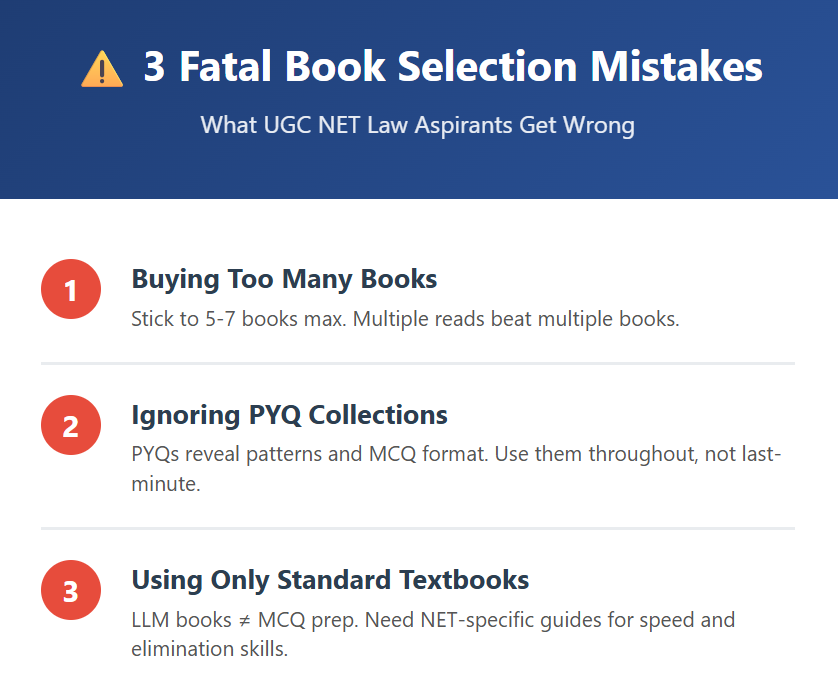
Buying Too Many Books Without a Reading Plan
The biggest mistake UGC NET aspirants make is treating book buying as preparation itself.
Collecting 15 different books gives you a false sense of progress while your actual preparation suffers.
Each unread book adds to your anxiety, and you end up with shallow knowledge across multiple sources rather than a thorough understanding from a few well chosen ones. Stick to 5 to 7 books maximum and read them multiple times rather than buying everything you see recommended online.
Ignoring the UGC NET Previous Year Question Collections
Some aspirants focus entirely on theory and concepts while ignoring PYQ collections, thinking they will solve past papers closer to the exam.
This approach backfires because previous year questions reveal the exam pattern, highlight frequently tested topics, and show you exactly how concepts are converted into MCQ format.
A good PYQ book should be your constant companion throughout preparation, not a last minute addition.
Using Only Standard Textbooks for MCQ Preparation
Your LLM textbooks are excellent for understanding legal principles, but they will not prepare you for the speed and precision required in a 100 question MCQ examination.
Standard textbooks encourage detailed, analytical reading, while UGC NET requires quick recall and elimination skills. You need NET specific guides that train your brain to think in MCQ format and help you practice under time pressure.
UGC NET Law Syllabus
Understanding the 10 Unit Framework
The NTA UGC NET Law Paper II syllabus is divided into 10 comprehensive units, each covering a major area of legal study.
Unit I covers Jurisprudence, including schools of thought, legal concepts, and contemporary issues like global justice.
Unit II deals with Constitutional and Administrative Law, one of the most important units, given its weightage.
Units III through X cover Public International Law and IHL, Law of Crimes, Law of Torts and Consumer Protection, Commercial Law, Family Law, Environment and Human Rights Law, IPR and IT Law, and Comparative Public Law and Systems of Governance, respectively.
Based on previous year question analysis, Constitutional and Administrative Law (Unit II) and Law of Crimes (Unit IV) consistently carry the highest weightage in UGC NET Law examinations. Jurisprudence (Unit I) is another unit where questions appear regularly, testing both theoretical understanding and application of legal concepts.
If you are short on time, prioritize these three units while ensuring at least basic coverage of the remaining seven.
How the Syllabus Should Influence Your Book Selection?
Matching Books to Specific Unit Requirements
Each unit has distinct requirements that should guide your book selection. Jurisprudence requires books with strong theoretical foundations and exposure to different schools of thought.
Constitutional Law needs comprehensive coverage of fundamental rights, directive principles, and recent amendments.
Criminal Law demands familiarity with both IPC provisions and the new Bharatiya Nyaya Sanhita (BNS). Your book combination should address these specific needs rather than providing generic coverage.
Why a Single Book Cannot Cover the Entire UGC NET Law Syllabus?
A single book cannot cover the entire UGC NET Law Syllabus because it is simply too vast and diverse for any single book to cover comprehensively. A book that explains Jurisprudence philosophically cannot simultaneously provide the technical detail needed for IPR provisions.
A guide that covers Constitutional Law thoroughly might give superficial treatment to International Humanitarian Law. This is why you need a strategic combination of standard textbooks for depth in high weightage areas and NET specific guides for breadth across the entire syllabus.
Best Books for UGC NET Law
Unit 1: Jurisprudence
Top 3 Jurisprudence Textbooks for UGC NET Law
For Jurisprudence, the most recommended book is “Jurisprudence: Legal Theory” by Dr. B.N. Mani Tripathi, which provides clear explanations of various schools of jurisprudence and legal concepts in a language that LLM graduates find accessible.
Another excellent option is “Jurisprudence and Legal Theory” by V.D. Mahajan, known for its systematic coverage of rights, duties, and legal personality.
For those who want a more international perspective, Dias’s “Jurisprudence” offers a comprehensive treatment of analytical, historical, and sociological approaches.
How to Study Jurisprudence for the MCQ Format?
Jurisprudence MCQs in UGC NET typically test your knowledge of specific jurists’ views, definitions of legal concepts, and distinctions between different schools of thought.
While studying, create flashcards matching jurists to their key theories, like Austin with “command theory” or Kelsen with “pure theory of law.”
Focus on understanding the key differences between Natural Law, Positivism, Sociological, and Realist schools, as questions frequently ask you to identify which school a particular statement belongs to.
Unit 2: Constitutional and Administrative Law Books
Best Constitutional Law Books for UGC NET
For Constitutional Law, M.P. Jain’s “Indian Constitutional Law” remains the gold standard, offering comprehensive coverage of fundamental rights, directive principles, and constitutional amendments.
The book is detailed and authoritative, making it ideal for building strong conceptual foundations. For a more concise alternative, V.N. Shukla’s “Constitution of India” provides excellent coverage in a more examination friendly format.
When studying Constitutional Law for UGC NET, pay special attention to landmark judgments like Kesavananda Bharati, Maneka Gandhi, and recent cases on privacy rights and Article 370.
The exam frequently tests your knowledge of specific constitutional provisions, their interpretations by the Supreme Court, and the evolution of constitutional doctrines. Keep a separate notebook for case names, their holdings, and the constitutional provisions they interpret.
Books for Administrative Law
For Administrative Law, I.P. Massey’s “Administrative Law” is the most comprehensive and widely recommended textbook. It covers principles of natural justice, judicial review, and administrative tribunals in detail.
C.K. Takwani’s “Lectures on Administrative Law” offers a more concise treatment that works well for quick revision. Focus on understanding the grounds of judicial review, the concept of legitimate expectation, and the role of various administrative bodies.
Unit 3: Public International Law and IHL Books
Best International Law TextbooksDr. S.K. Kapoor’s “International Law and Human Rights” is the most popular choice among UGC NET aspirants for this unit. The book covers sources of international law, recognition of states, nationality, extradition, and the UN system comprehensively.
For those seeking a more globally oriented perspective, Starke’s “Introduction to International Law” provides excellent coverage of fundamental principles and is particularly strong on treaty law and state responsibility.
Malcolm Shaw’s “International Law” is another authoritative reference, though it is more detailed than what most NET aspirants require. Use it selectively for topics where you need a deeper understanding, particularly for international humanitarian law provisions and the workings of international courts. Remember that UGC NET questions often test the basic principles and definitions rather than complex case analysis.
International Humanitarian Law (IHL) is a specialized area within Unit III that covers the Geneva Conventions, laws of armed conflict, and protection of civilians during war.
The International Committee of the Red Cross (ICRC) website offers free resources and publications on IHL that can supplement your textbook preparation.
Focus on understanding the key differences between the Geneva Conventions, the role of the ICRC, and contemporary challenges in IHL implementation.
Unit 4: Law of Crimes
Criminal Law Standard Textbooks
For Criminal Law, K.D. Gaur’s “Textbook on Indian Penal Code” provides comprehensive coverage of IPC provisions with detailed explanations of important case laws.
The book is particularly strong on general exceptions, offences against the human body, and property crimes. Ratanlal and Dhirajlal’s “The Indian Penal Code” is another authoritative text that has been updated over the decades and provides reliable coverage of criminal law principles.
Recent Developments in Criminal Law (BNS Coverage)
With the introduction of Bharatiya Nyaya Sanhita (BNS) replacing the Indian Penal Code, UGC NET aspirants need to stay updated on these new criminal laws.
While most standard textbooks are still being updated for BNS provisions, focus on understanding the key changes, new offences introduced, and modifications to existing provisions. The Ministry of Home Affairs website provides the official text of BNS for reference. For exam purposes, know both the old IPC provisions and their BNS equivalents.
Unit 5: Law of Torts and Consumer Protection Recommended Books
Books on Tort Law
R.K. Bangia’s “Law of Torts” is the most accessible and examination friendly textbook for this unit, covering all major torts with relevant case laws in a concise format.
The book includes chapters on negligence, nuisance, defamation, and strict liability that align well with the UGC NET syllabus. Ratanlal and Dhirajlal’s “The Law of Torts” provides more detailed coverage and is useful for a deeper understanding of complex concepts.
For UGC NET preparation, focus particularly on the principles of tortious liability, defences available in tort law, and the distinction between strict and absolute liability as established in Rylands v Fletcher and MC Mehta cases. Questions often test your understanding of remoteness of damages and the evolution of tort law in India.
Consumer Protection Act Best Study Materials
The Consumer Protection Act, 2019, replaced the earlier 1986 Act and introduced significant changes including the concept of product liability, mediation, and electronic filing. Study the new Act thoroughly, focusing on definitions of consumer, unfair trade practices, and the three tier redressal mechanism.
The National Consumer Disputes Redressal Commission website provides useful information on recent consumer cases and Act provisions.
For comprehensive preparation, use a combination of bare act reading and a commentary that explains the 2019 Act provisions with relevant case laws. Pay attention to the jurisdictional limits of different consumer forums, time limits for filing complaints, and the grounds for appeal at various levels.
Books for Motor Vehicles Act and Competition Act
The Motor Vehicles Act, 1988 provisions on third party insurance, no fault liability, and claims tribunals are frequently tested in UGC NET. Bare act reading supplemented by a commentary is sufficient for this area. Similarly, for the Competition Act, 2002, focus on understanding anti competitive agreements, abuse of dominant position, and the role of the Competition Commission of India.
These areas require knowledge of specific statutory provisions rather than extensive case law analysis. Create summary notes listing the key sections, penalties, and procedural requirements under each Act. Use the Competition Commission of India website for recent developments and significant cases.
Unit 6: Commercial Law Books
Contract Law and Sale of Goods Act: Top Books
Dr. Avtar Singh’s “Law of Contract and Specific Relief” is the definitive textbook for Indian Contract Act provisions, covering formation of contract, performance, breach, and remedies comprehensively. The book also covers the Specific Relief Act provisions that are part of the syllabus.
For the Sale of Goods Act, 1930, the same author’s “Principles of Mercantile Law” provides excellent coverage of conditions, warranties, and transfer of property in goods.
A.K. Jain’s “Law of Contract” offers a more concise treatment with a focus on leading cases and practical applications. For UGC NET, pay special attention to vitiating factors (coercion, undue influence, fraud, misrepresentation), different types of contracts (contingent, quasi contracts), and remedies for breach, including specific performance and injunction.
Company Law and Partnership Act Textbooks
For Company Law, focus on the Companies Act, 2013 provisions regarding incorporation, prospectus, shares and debentures, directors, and meetings. Avtar Singh’s “Company Law” provides comprehensive coverage aligned with the current law. Given the technical nature of company law, create summary sheets for different types of companies, classes of shares, and director responsibilities.
Partnership law under the Indian Partnership Act, 1932 and Limited Liability Partnership Act, 2008 requires understanding the essential elements of partnership, rights and duties of partners, and the distinction between general and limited liability partnerships. Use bare acts supplemented by brief commentaries rather than detailed textbooks for these areas.
Negotiable Instruments Act: Study Resources
The Negotiable Instruments Act, 1881 provisions on cheques, promissory notes, and bills of exchange are regularly tested in UGC NET. Focus on understanding the characteristics of negotiable instruments, the holder in due course concept, and the criminal liability provisions under Section 138 for dishonour of cheques. Avtar Singh’s “Negotiable Instruments” or the relevant chapters in his Mercantile Law book provide adequate coverage for examination purposes.
Unit 7: Family Law Books
Hindu Law and Muslim Law Textbooks
Paras Diwan’s “Modern Hindu Law” is the most comprehensive and examination friendly textbook for Hindu family law, covering marriage, divorce, adoption, guardianship, and succession. The book explains complex provisions with relevant case laws in an accessible language.
For Muslim Law, Mulla’s “Principles of Mahomedan Law” remains the authoritative reference, though the relevant chapters in Paras Diwan’s family law book provide sufficient coverage for UGC NET.
Dr. Poonam Pradhan Saxena’s “Family Law” is another excellent option that covers both Hindu and Muslim personal laws in a comparative framework. Focus on understanding the grounds for divorce, different theories of divorce (fault, consent, breakdown), and recent amendments like the Triple Talaq abolition for contemporary relevance.
Special Marriage Act and Uniform Civil Code
The Special Marriage Act, 1954 provisions for civil marriage, conditions for marriage, and registration requirements are regularly tested. Understand the key differences between marriage under personal laws and the Special Marriage Act, including the notice period requirement and objection procedures. Keep updated on judicial pronouncements regarding the rights of couples marrying under this Act.
The Uniform Civil Code is a contemporary topic that appears in various UGC NET questions. While there is no enacted UCC, understand the constitutional provision (Article 44), arguments for and against UCC, and recent judicial comments on the need for uniform civil law. This requires reading current affairs and judicial observations rather than any specific textbook.
Unit 8: Environment and Human Rights Law Books
Environmental Law Textbooks for UGC NET
For Environmental Law, P. Leelakrishnan’s “Environmental Law in India” provides comprehensive coverage of the constitutional framework, statutory provisions, and judicial activism in environmental protection. Focus on understanding the key legislations like the Environment Protection Act, Air Act, Water Act, and the role of the National Green Tribunal established under the NGT Act, 2010. The Ministry of Environment, Forest and Climate Change website provides updates on environmental policies and regulations.
Human Rights Law and Constitutional Provisions
For Human Rights Law, Dr. S.K. Kapoor’s “International Law and Human Rights” covers both international conventions (UDHR, ICCPR, ICESCR) and the Indian human rights framework. Understand the Universal Declaration of Human Rights provisions, the role of the National Human Rights Commission, and other commissions for women, minorities, and the scheduled castes.
The Protection of Human Rights Act, 1993 and its amendments form the statutory framework for human rights protection in India. Focus on the composition, powers, and functions of the NHRC and State Human Rights Commissions. Recent developments in human rights jurisprudence, particularly cases expanding the scope of Article 21, are important for examination purposes.
Unit 9: Intellectual Property Rights and IT Law Books
IPR Standard Textbooks
V.K. Ahuja’s “Law Relating to Intellectual Property Rights” is the most comprehensive and updated textbook for this unit, covering copyright, patents, trademarks, and geographical indications. The book explains registration procedures, infringement, and remedies in a systematic manner. For a more concise treatment, use the relevant chapters in any commercial law book supplemented by bare act reading.
Cyber Law and IT Act Resources
For Information Technology Law, Pavan Duggal’s “Textbook on Cyber Law” provides comprehensive coverage of the IT Act, 2000 and its amendments. Focus on understanding digital signatures, electronic governance provisions, cyber crimes and penalties, and the role of adjudicating officers. The evolving nature of cyber law means you should supplement textbook reading with recent Ministry of Electronics and Information Technology notifications.
Understanding the intermediary liability provisions, data protection framework, and recent amendments to the IT Act is crucial for this unit. Create summary notes covering the key sections, penalties for different cyber offences, and the jurisdictional issues in cyber crime cases.
Unit 10: Comparative Public Law and Systems of Governance Books
Books for Comparative Constitutional Law
M.P. Jain’s “Comparative Constitutional Law” provides excellent coverage of different governance systems, federalism models, and constitutional review mechanisms across countries. Focus on comparing the Indian system with the USA, UK, France, and Canada as specified in the syllabus. Understanding the presidential vs parliamentary systems, rigid vs flexible constitutions, and different models of judicial review is essential for this unit.
For comparative federalism, focus on the distribution of powers, residuary powers, and conflict resolution mechanisms in different federal systems. The American, Canadian, and Australian federal models are frequently compared with the Indian quasi federal structure in UGC NET questions.
Governance Systems Study Materials
This section requires an understanding of the rule of law concept in different jurisdictions, the separation of powers doctrine, and the role of ombudsman institutions. Compare the Lokpal in India with ombudsman systems in Sweden, the UK, and other countries. Right to Information laws across different countries and their effectiveness in ensuring transparent governance are also part of this unit.
Guides for UGC NET Paper 2 Law
Books for Previous Year Question
IFAS Publications’ “UGC NET Law Paper II” book has emerged as the bestseller for NET aspirants, containing solved papers from 2013 to 2025 with unit wise sorting and detailed explanations. The book covers over 3000 questions organized according to the 10 unit syllabus structure, making it easy to practice specific areas. At approximately ₹400 to 500, it offers excellent value for comprehensive PYQ coverage.
Arihant’s “NTA UGC NET/JRF/SET Law Solved Papers” is another reliable option with papers from 2012 to 2024 and 5 practice sets included. The book provides detailed explanations for each question, helping you understand not just the correct answer but why other options are incorrect. Arihant also publishes a separate study guide with theory content and approximately 4000 MCQs for those who need both content and practice in one book.
Comprehensive Study Guides Comparison
Arihant’s “NTA UGC NET/JRF/SET Paper II Law Study Guide” priced around ₹550 to 775 provides both theoretical content and practice questions for all 10 units. The book includes solved papers from 2019 to 2024, unit wise MCQs covering conceptual and application questions, and 3 model papers for self assessment. Its strength lies in combining content coverage with practice, making it ideal for aspirants who prefer a single comprehensive resource.
Trueman’s “UGC NET Law” is a trusted name that provides complete syllabus coverage with previous year questions. While it may not have the most updated PYQ collection, its theoretical content is reliable and examination focused. R Gupta’s “UGC NET Law Paper II Exam Guide” by Aproov Bhardwaj offers another budget friendly option with theory and MCQs, though some users have reported occasional errors in answer keys.
Free Online Resources for UGC NET Law
Official Sources for Free Study Material
The INFLIBNET website provides access to previous year UGC NET question papers with answer keys that you can download for free. Use these official papers to supplement your PYQ book and verify answers. The NTA UGC NET official website publishes the complete syllabus, exam pattern, and important notifications that should be your first reference for any examination related queries.
For Constitutional Law and recent amendments, the India Code portal provides free access to all central acts, including the Constitution of India, with up to date amendments. The Supreme Court of India website offers access to important judgments that are frequently tested in UGC NET. Using these free official resources alongside your purchased books can significantly reduce your preparation costs.
Using Bare Acts Effectively
Bare acts are the actual statutory texts without any commentary or explanation, and they are available for free or at very low cost. For subjects like Contract Law, Consumer Protection Act, and IT Act, reading the bare act alongside a brief commentary helps you understand the exact legal provisions that are tested in MCQ format.
Many questions in UGC NET simply require knowledge of specific sections, definitions, and procedural requirements that Bare Acts provide directly.
Download bare acts from the India Code portal or purchase affordable compilations like Universal’s or EBC bare act collections. Create your own annotations by marking frequently tested sections and adding brief notes. This approach is particularly useful for Commercial Law, IPR, and IT Law units where questions often test specific statutory provisions.
Conclusion
Selecting the right books for UGC NET Law Paper II is not about collecting the maximum number of resources but about strategically choosing books that align with your preparation timeline, budget, and learning style. The combination of standard law textbooks for conceptual depth and NET specific guides for examination practice creates the foundation for successful preparation. Remember that the quality of study matters far more than the quantity of books.
Start with a comprehensive PYQ collection like IFAS Publications to understand the exam pattern, add one good study guide like Arihant for content coverage, and supplement with standard textbooks for high weightage units like Constitutional Law and Criminal Law.
Use free official resources to reduce costs and stay updated with recent developments. Most importantly, complete what you start rather than accumulating unread books that only add to preparation anxiety.
Your focused effort on a few well chosen books will take you much further than scattered reading across dozens of resources.
Frequently Asked Questions
Which single book is best for UGC NET Law Paper II preparation?
If you can buy only one book, the IFAS Publications UGC NET Law Paper 2 PYQ book offers the best value with 12 plus years of previous questions, unit wise sorting, and detailed solutions. For those who need content coverage alongside practice, Arihant’s Study Guide provides both theory and approximately 4000 MCQs in a single volume.
Can I clear UGC NET Law with only previous year question papers?
While previous year questions are essential, relying solely on PYQs is risky. PYQs help you understand patterns and frequently tested topics, but UGC NET often introduces new questions from areas not covered in previous years. Combine PYQ practice with at least basic coverage of all syllabus topics through a good study guide for comprehensive preparation.
Are standard law textbooks necessary or can I rely only on NET guides?
NET guides provide exam focused content, but standard textbooks build the conceptual foundation that helps you tackle tricky and application based questions. For high weightage units like Constitutional Law, Criminal Law, and Jurisprudence, reading standard textbooks alongside NET guides significantly improves your understanding and scoring potential.
How many books should I ideally study for UGC NET Law?
A strategic combination of 5 to 7 books is optimal: one comprehensive PYQ book, one NET study guide, and 3 to 5 standard textbooks for high weightage units. Avoid collecting more books than you can realistically read and revise multiple times before the examination.
Which book is best for the Jurisprudence unit in UGC NET Law?
Dr. B.N. Mani Tripathi’s “Jurisprudence: Legal Theory” is the most recommended book for this unit. It covers all schools of jurisprudence, legal concepts, and contemporary issues in accessible language. Supplement this with the Jurisprudence chapter in your NET guide for MCQ practice.
Do I need separate books for all 10 units of Paper II?
No, you do not need 10 separate textbooks. A good NET guide covers all units at examination level. Add standard textbooks only for high weightage units like Constitutional Law, Criminal Law, and Jurisprudence. For lower weightage units like Comparative Public Law, NET guide coverage is usually sufficient.
Are there any Hindi medium books available for UGC NET Law?
Yes, several publishers, including Arihant and local publishers offer Hindi medium UGC NET Law books. However, the selection is more limited compared to English medium, and some standard law textbooks are available only in English. Check the medium of your examination and choose books accordingly.
How do I use previous year question papers effectively?
Start by solving PYQs unit wise without time limit to understand concepts and identify weak areas. Then practice complete papers under timed conditions to build speed. After each session, analyze your mistakes, note frequently tested topics, and revise the relevant concepts from your textbooks.
Can I prepare for UGC NET Law without coaching using only books?
Absolutely. Many successful candidates have cleared UGC NET Law through self study using the right combination of books. The key is disciplined preparation, regular practice with PYQs and mock tests, and consistent revision. Books combined with free online resources and official study materials can effectively replace coaching.
What is the best book for Constitutional Law in UGC NET?
M.P. Jain’s “Indian Constitutional Law” is the most comprehensive option, while V.N. Shukla’s “Constitution of India” offers examination focused coverage in a more concise format. For UGC NET specifically, combining either of these with the Constitutional Law chapters in your NET guide provides thorough preparation.
Should I buy physical books or use PDF versions?
Physical books are generally recommended for serious preparation as they allow better focus, easy annotation, and are available during offline study hours. However, PDF versions of bare acts and supplementary materials can complement your physical books. Avoid relying entirely on PDFs as screen fatigue affects long study sessions.
Which publisher’s UGC NET Law book has the most updated content?
IFAS Publications updates their PYQ book most frequently, with the latest edition covering papers up to June 2025. Arihant’s Study Guide includes solved papers up to 2024 and model papers based on current patterns. Always check the publication date and PYQ coverage years before purchasing any book.
How to choose between multiple books for the same unit?
Compare books based on syllabus coverage, clarity of explanation, inclusion of relevant case laws, and MCQ practice sections. Read online reviews and sample pages if available. Choose one primary book rather than studying multiple books for the same unit, as this ensures thorough preparation without confusion.



 Allow notifications