Download UGC NET Law previous year papers with complete PDF links and topic-wise analysis. Learn which units carry maximum weightage and prepare strategically.
Table of Contents
If you have been downloading UGC NET Law previous year papers and solving them randomly, hoping the patterns will somehow reveal themselves, you are not alone.
Most Law aspirants approach previous year questions as a numbers game: solve more papers, hope for the best. But here is what separates candidates who consistently score 150+ in Paper II from those struggling to cross the qualifying cutoff: the former understand exactly what NTA asks, while the latter are essentially preparing blind.
The problem with most previous year paper resources available online is that they are essentially PDF dumps.

You get hundreds of questions without any analysis, without any pattern recognition, and without any strategic guidance on where to focus your limited preparation time.
What you actually need is not more questions; you need to understand which units repeat, which topics within each unit carry maximum weightage, and how the UGC NET Law paper has evolved over the last five years. That understanding alone can transform your preparation from guesswork into strategy.
This guide provides exactly that: the first comprehensive topic wise analysis of UGC NET Law previous year papers.
You will learn which of the 10 Law units consistently get more questions, which sub topics within Constitutional Law, Jurisprudence, and Criminal Law are high frequency, and how to use this data to create a study plan that maximizes your score with minimum wasted effort.
Whether you have six months or sixty days, the insights here will help you prepare smarter, not just harder.
How to Crack UGC NET Law: Previous Year Paper Strategy?
Understanding how to strategically use previous year papers is the foundation of successful UGC NET Law preparation.
Unlike general reading, where you cover everything hoping something sticks, strategic previous year question analysis tells you exactly where NTA focuses its attention.
This section explains why pattern recognition through previous year questions gives you a decisive advantage over candidates who rely solely on textbook study.
Strategic Advantage of Pattern Recognition
Pattern recognition is your secret weapon in UGC NET Law preparation. When you analyze five years of previous papers systematically, you discover that NTA does not randomly pick questions from the syllabus.
Certain topics appear with clockwork regularity, while others barely get one question every few years. Recognizing these patterns allows you to allocate your study time proportionally to actual exam weightage rather than perceived importance.
Why Studying the Syllabus Alone Is Not Enough?
The official UGC NET Law syllabus lists 10 comprehensive units covering everything from Jurisprudence to Comparative Public Law.
If you treat all units equally, you will spend the same time on Intellectual Property Rights (which typically yields 6 to 8 questions) as Constitutional Law (which consistently contributes around 15 to 18 questions).
This equal treatment approach ignores the reality that NTA has clear preferences, and your preparation strategy should reflect those preferences.
How Previous Year Questions Show You Exactly What NTA Asks?
When you solve previous year papers topic wise rather than paper wise, distinct patterns emerge.
Take Constitutional Law as an example: questions on Fundamental Rights interpretation, particularly Articles 14, 19, and 21, appear in virtually every exam session.
The Basic Structure Doctrine, landmark judgments like His Holiness Kesavananda Bharati v State of Kerala [1973 SC] and Minerva Mills v. Union of India (1980 SC), and administrative law principles like natural justice form the core of what NTA repeatedly tests.
Similarly, in Jurisprudence, you will notice that Schools of Jurisprudence questions dominate. Natural Law versus Legal Positivism distinctions, Austin’s Command Theory, Kelsen’s Pure Theory, and the Sociological School perspectives appear consistently.
Once you recognize these patterns, your preparation becomes laser focused on topics that actually appear in exams rather than theoretical completeness that sounds impressive but does not translate into marks.
Unit Wise Analysis of UGC NET Law Previous Year Papers
This section provides the most comprehensive topic wise breakdown of UGC NET Law Paper II previous year questions available anywhere. Based on the analysis of papers, you will discover exactly which sub topics within each of the 10 Law units receive maximum attention from NTA.
Use this analysis to prioritize your preparation and allocate study time proportionally to actual exam weightage.
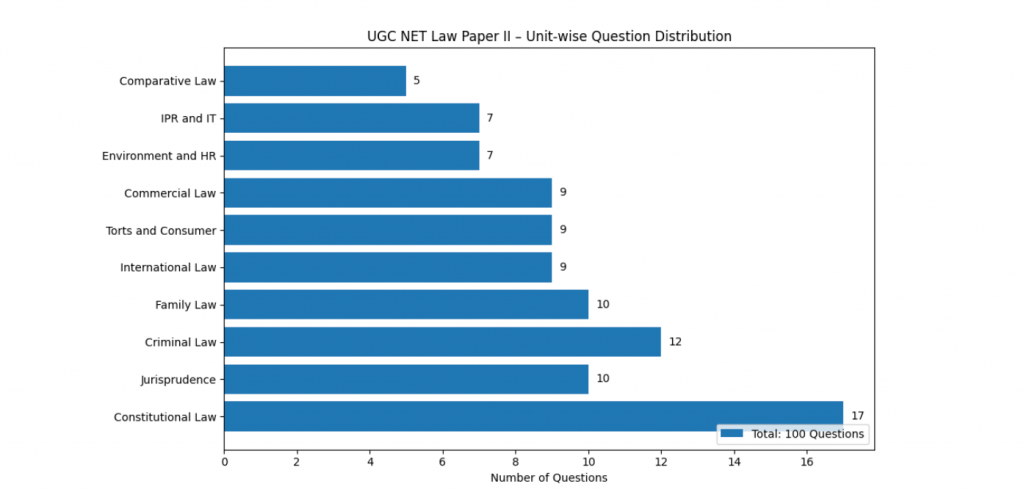
Unit 1: Jurisprudence Previous Year Question Trends
Jurisprudence forms the philosophical foundation of your legal knowledge and consistently contributes around 8 to 12 questions in UGC NET Law Paper II.
Questions in this unit test your understanding of legal theories, schools of thought, and analytical concepts that form the basis of all other legal subjects. Mastering Jurisprudence not only secures direct marks but also strengthens your conceptual clarity for other units.
Schools of Jurisprudence (Natural Law, Positivism, Realism)
The distinction between Natural Law School and Legal Positivism appears in almost every UGC NET Law paper.
You should thoroughly understand the core propositions of each school: Natural Law’s emphasis on morality and higher law, Austin’s Command Theory defining law as a sovereign’s command backed by sanction, Hart’s Rule of Recognition, and Kelsen’s Grundnorm concept.
Questions often ask you to identify which jurist belongs to which school or match theories with their proponents.
Hohfeldian Analysis and Rights Theory
Wesley Hohfeld’s analytical framework, distinguishing rights, duties, privileges, powers, immunities, and their correlatives, is a perennial favourite.
Previous year questions test whether you can correctly identify Hohfeldian correlatives (right-duty, privilege-no right, power-liability, immunity-disability) and apply them to legal scenarios. This seemingly complex topic becomes straightforward once you understand the logical relationships Hohfeld established.
Frequently Tested Jurisprudence Topics
Beyond the schools of thought, certain Jurisprudence topics appear with remarkable consistency.
The concept of legal personality, particularly the debate around corporate personality and its lifting, generates regular questions. Theories of punishment, including deterrent, reformative, and retributive approaches, appear frequently.
Ownership and possession distinctions, including Salmond’s analysis of possession elements (corpus and animus), form another high frequency area. Sources of law, both formal and material, and the hierarchy among legislation, precedent, and custom complete the commonly tested Jurisprudence topics.
Focus your preparation on these areas before moving to peripheral topics like Sociological Jurisprudence details.
Unit 2: Constitutional and Administrative Law Question Patterns
Constitutional and Administrative Law is the undisputed heavyweight of UGC NET Law Paper II, consistently contributing roughly 15 to 18 questions per exam.
The extensive question coverage reflects the foundational importance of constitutional principles in Indian legal education and the depth of jurisprudence developed by Indian courts over seven decades.
Fundamental Rights and Basic Structure Doctrine
Fundamental Rights interpretation, particularly the expansive reading of Articles 14, 19, and 21 by the Supreme Court, dominates Constitutional Law questions.
You should know the evolution of Article 21 from mere protection against executive action to encompassing the right to livelihood, education, privacy, and dignity.
The Basic Structure Doctrine, established in His Holiness Kesavananda Bharati v State of Kerala [1973 SC] and refined through subsequent cases, is perhaps the most frequently tested constitutional concept.
Questions test your knowledge of what constitutes basic structure (judicial review, federalism, secularism, democracy) and the limitations it places on Parliament’s amending power under Article 368.
Administrative Law Principles and Judicial Review
Administrative Law questions focus on principles of natural justice (audi alteram partem and nemo judex in causa sua), delegated legislation and its limits, and judicial review of administrative action.
The distinction between judicial review and appeal, grounds of judicial review (illegality, irrationality, procedural impropriety), and remedies like certiorari, mandamus, and prohibition appear consistently.
Tribunals and their constitutional status post the L. Chandra Kumar v. Union of India (1997 SC) judgment generate regular questions.
You should understand the difference between tribunals functioning under Article 323A (administrative tribunals) and Article 323B (other tribunals), and the Supreme Court’s pronouncements on their independence and judicial review.
Why This Unit Carries Maximum Weightage?
Constitutional Law’s dominance in UGC NET Law reflects its foundational role in Indian legal education. Every law student studies Constitutional Law extensively, making it a natural area for testing.
Additionally, the subject’s interconnection with current affairs through ongoing constitutional litigation makes it dynamically relevant. NTA recognizes that aspiring law professors must have rock solid constitutional foundations, which explains the heavy weightage.
Unit 3: Public International Law and IHL Previous Year Question Analysis
Public International Law typically contributes 8 to 10 questions in UGC NET Law Paper II.
This unit tests your understanding of how the international legal order functions, the sources and subjects of international law, and the principles governing state relations. International Humanitarian Law questions have increased in recent years, reflecting global concerns about armed conflict regulation.
Sources of International Law and Treaty Questions
Article 38 of the ICJ Statute listing sources of international law is fundamental knowledge that previous year questions repeatedly test.
You should understand the hierarchy and relationship between treaties, customary international law, general principles, and subsidiary sources like judicial decisions and scholarly writings.
Vienna Convention on the Law of Treaties provisions regarding treaty interpretation, reservations, and termination appear regularly.
Questions often distinguish between monist and dualist approaches to international law incorporation, asking how India (following dualism) treats international treaties versus customary law.
The principle of pacta sunt servanda and exceptions to treaty obligations form another frequently tested area.
International Organizations and Treaties
United Nations structure and functioning, particularly the Security Council’s powers under Chapter VII, the veto system, and the General Assembly’s role, generate consistent questions.
Specialized agencies like the ILO, the WHO, and UNESCO, and their relationship with the UN main body appear periodically.
Regional organizations, including the European Union’s legal framework and ASEAN’s institutional structure, are tested occasionally.
International Humanitarian Law Topics
International Humanitarian Law has gained prominence in recent UGC NET Law papers. Geneva Conventions of 1949 and their Additional Protocols, particularly the distinction between international and non international armed conflicts, appear regularly.
The principle of distinction between combatants and civilians, proportionality in attacks, and protection of cultural property under the Hague Conventions form the core IHL content.
The Rome Statute establishing the International Criminal Court and its jurisdiction over genocide, crimes against humanity, war crimes, and aggression generates questions testing both substantive law and jurisdictional issues. India’s position on the ICC and reasons for non ratification occasionally appear as application based questions.
Unit 4: Law of Crimes Question Trends
Law of Crimes consistently contributes around 10 to 14 questions in UGC NET Law Paper II, making it one of the highest weightage units.
Questions test your knowledge of general principles of criminal liability, specific offences under the Indian Penal Code (and now Bharatiya Nyaya Sanhita), and the procedural framework under CrPC/BNSS. This unit rewards candidates who understand both black letter law and judicial interpretations.
General Principles of Criminal Law
Fundamental concepts, including actus reus, mens rea, and the concurrence requirement, appear in virtually every exam.
Questions test whether you can distinguish between intention, knowledge, and negligence as forms of mens rea, and apply these distinctions to specific offence categories. The doctrine of transferred malice, constructive liability, and strict liability offences generates regular questions.
Stages of crime, from intention through preparation, attempt, and commission, form a perennial favourite.
Questions often ask you to identify which stage a particular act falls under and what liability attaches. Joint liability under Section 34 IPC (common intention) versus Section 149 IPC (unlawful assembly) distinctions appear consistently, testing whether you understand when each provision applies.
Stages of Crime and General Exceptions
General exceptions under Chapter IV of IPC (Sections 76 to 106) receive substantial coverage.
Questions test your understanding of when a mistake of fact provides a defence versus mistake of law, the requirements for private defence to apply, and the limits on the right to cause death in self defence.
Consent based defences under Section 87 (consent to non serious harm) and Section 90 (consent under fear or misconception) appear regularly.
Insanity defence under Section 84, following the M’Naghten Rules, generates questions testing the cognitive versus volitional incapacity debate. Intoxication as a defence under Sections 85 and 86, with the crucial distinction between voluntary and involuntary intoxication, completes the frequently tested general exceptions.
BNS Changes and Their Impact on Recent Papers
The Bharatiya Nyaya Sanhita, replacing the Indian Penal Code from July 2024, has begun influencing UGC NET Law questions.
While core principles remain unchanged, you should familiarize yourself with the new section numbering, newly introduced offences like terrorism (Section 113 of BNS), and modifications to existing offences. Questions may test your awareness of what has changed while continuing to test underlying principles that remain constant across both codes.
Unit 5: Law of Torts and Consumer Protection Questions
Law of Torts and Consumer Protection together typically contribute 8 to 10 questions in UGC NET Law Paper II.
This unit tests your understanding of civil wrongs, liability principles, and the consumer protection framework that has gained increased importance with the Consumer Protection Act 2019. Torts questions focus on established principles, while Consumer Protection questions often test recent amendments.
Tort Principles: Negligence, Strict Liability, Vicarious Liability Patterns
Negligence questions dominate Tort law coverage, testing the three element analysis: duty of care, breach of duty, and causation of damage.
The neighbour principle from Donoghue v. Stevenson and its application in Indian cases appear regularly. Defences to negligence, particularly contributory negligence and volenti non fit injuria, generate consistent questions.
Strict liability under Rylands v. Fletcher and its Indian modification in M.C. Mehta v. Union of India (1986 SC), establishing absolute liability for hazardous industries, form high frequency topics.
Questions often ask you to distinguish situations where strict liability applies from those requiring negligence proof. Vicarious liability, particularly employer liability for employee torts during the course of employment, completes the core Tort syllabus.
Consumer Protection Act 2019 Questions in Recent Papers
The Consumer Protection Act 2019, replacing the 1986 Act, has been heavily tested since its implementation.
Key changes, including the Central Consumer Protection Authority (CCPA), product liability provisions, e commerce regulations, and enhanced pecuniary jurisdiction of Consumer Commissions, appear in recent papers. You should understand the definition of consumer under the new Act, which now includes online transactions and unfair contracts.
The three tier consumer dispute redressal mechanism and jurisdictional limits for District, State, and National Commissions based on the value of goods and services generate practical application questions. Misleading advertisement provisions and penalties under the 2019 Act represent newer areas that recent papers have begun testing.
Unit 6: Commercial Law Previous Year Question Patterns
Commercial Law typically contributes 8 to 10 questions covering the Contract Act, the Sale of Goods Act, and the Negotiable Instruments Act.
This unit tests your understanding of commercial transactions that form the backbone of business activity. Questions often present practical scenarios requiring application of commercial law principles rather than mere definitional recall.
Contract Act Essentials and Case Based Questions
Indian Contract Act questions focus heavily on formation elements: offer, acceptance, consideration, and capacity. The distinction between void, voidable, and unenforceable contracts appears regularly.
Free consent provisions under Sections 13 to 22 of the Contract Act, particularly coercion versus undue influence distinctions, generate consistent questions.
Discharge of contracts through performance, breach, frustration, and agreement forms another high frequency area.
Remedies for breach, including damages calculation under Hadley v. Baxendale principles and the distinction between liquidated damages and penalty, appear in most papers. Specific performance availability and its discretionary nature under the Specific Relief Act complete frequently tested Contract topics.
Sale of Goods Act vs Negotiable Instruments: Question Distribution
Sale of Goods Act questions typically test the conditions versus warranties distinction, transfer of title and its exceptions (nemo dat quod non habet and its exceptions), and the unpaid seller’s rights, including lien, stoppage in transit, and resale. Implied conditions as to title, description, quality, and fitness for purpose generate regular questions.
Negotiable Instruments Act coverage focuses on negotiability concepts, holder versus holder in due course distinctions, and dishonour of cheques under Section 138 of the Negotiable Instruments Act.
The 2018 amendment introducing interim compensation and territorial jurisdiction clarifications has been tested in recent papers. Bills of exchange and promissory notes receive comparatively less coverage than cheques, given their practical importance.
Unit 7: Family Law Question Trends
Family Law consistently contributes approximately 8 to 12 questions covering Hindu Law, Muslim Personal Law, and special marriage legislation. This unit tests your knowledge of personal laws governing marriage, divorce, succession, and guardianship across different religious communities. Questions often require comparative analysis between different personal law systems.
Hindu Law Topics
Hindu Marriage Act questions dominate Family Law coverage. Conditions for a valid Hindu marriage under Section 5, particularly sapinda and prohibited relationship restrictions, appear regularly. Matrimonial remedies, including judicial separation, restitution of conjugal rights, and divorce grounds under Section 13, generate consistent questions. The distinction between divorce by mutual consent under Section 13B and contested divorce, including the cooling off period controversy, has been tested recently.
Hindu Succession Act questions focus on the 2005 Amendment granting daughters equal coparcenary rights in joint family property. The distinction between the Mitakshara and Dayabhaga schools and their succession implications, though less practically relevant post amendment, continues appearing in exam questions testing historical understanding.
Muslim Personal Law
Muslim Personal Law questions test talaq forms and their validity post the Muslim Women (Protection of Rights on Marriage) Act 2019, criminalizing triple talaq. The distinction between talaq-e-ahsan, talaq-e-hasan, and talaq-e-biddat, with the latter now being void and punishable, appears in recent papers. Khula (divorce at the wife’s instance) and mubarat (mutual divorce) provisions generate regular questions.
Muslim succession law, particularly the distinction between Sunni and Shia succession rules and the treatment of agnates, cognates, and distant kindred, forms another tested area. The Doctrine of Aul (reduction) and Radd (increase) in distributing estate shares appears occasionally in advanced questions.
Matrimonial Remedies and Succession: High Frequency Topics
Across personal law systems, certain topics appear with high frequency. Maintenance provisions under Section 125 CrPC (now BNSS) versus personal law maintenance rights, particularly for Muslim women post the Shah Bano controversy and subsequent legislation, generate regular questions.
Guardianship and custody principles, including the welfare of the child doctrine and distinctions between natural and testamentary guardianship, complete high frequency Family Law topics.
Unit 8: Environment and Human Rights Law Questions
Environment and Human Rights Law contributes roughly 6 to 8 questions testing your understanding of environmental protection legislation, sustainable development principles, and the human rights framework in India.
This unit has gained prominence following increased environmental litigation and human rights awareness, with recent papers showing higher coverage than historical averages.
Environmental Legislation and Principles
The Environment Protection Act 1986, as the umbrella legislation, forms the core of environmental law questions.
The precautionary principle, polluter pays principle, and sustainable development concept, as recognized by Indian courts in cases like Vellore Citizens’ Welfare Forum, appear regularly. Questions test whether you can apply these principles to fact situations involving industrial pollution or developmental projects.
Air (Prevention and Control of Pollution) Act 1981, Water (Prevention and Control of Pollution) Act 1974, and the role of Pollution Control Boards generate consistent questions. Environmental Impact Assessment requirements for developmental projects and public hearing provisions have appeared in recent papers reflecting current environmental governance concerns.
Human Rights Framework and NHRC Questions
The Protection of Human Rights Act 1993, establishing the National Human Rights Commission and State Human Rights Commissions, generates questions on their composition, functions, and limitations.
The distinction between NHRC’s recommendatory powers versus binding authority, and its inability to investigate matters after one year from occurrence, appears regularly.
International human rights instruments, including UDHR, ICCPR, ICESCR, and specialized conventions on torture, discrimination against women, and children’s rights, generate questions testing treaty provisions and India’s obligations.
The domestic incorporation of treaty rights through Article 21 interpretation, as seen in the Vishaka guidelines derived from CEDAW, represents a frequently tested intersection.
Unit 9: Intellectual Property Rights and IT Law
Intellectual Property Rights and Information Technology Law together contribute around 6 to 8 questions.
This unit tests your knowledge of IP protection mechanisms under Indian law and the evolving legal framework for digital transactions and cybercrimes. Questions often test recent amendments reflecting the dynamic nature of these fields.
Copyright, Patent, Trademark: Question Distribution
Copyright Act 1957 questions focus on authorship, term of protection, fair use exceptions, and moral rights. The distinction between economic rights (reproduction, communication, translation) and moral rights (attribution, integrity) appears regularly. Copyright in cinematograph films and sound recordings, particularly the separate layered rights structure, generates questions testing conceptual clarity.
Patents Act 1970 questions test patentability criteria under Sections 3 and 4 of the Patents Act 1970, particularly exclusions for mathematical methods, business methods, and computer programs per se. The product patent versus process patent distinction and compulsory licensing provisions under Section 84 of the Patents Act 1970 appear in most papers.
Trademark registration process, well known marks protection, and passing off action elements complete IP coverage.
Information Technology Act Provisions
IT Act 2000 provisions on electronic records, digital signatures, and cybercrimes have gained increased coverage. Sections 66 of the IT Act (computer related offences), 66C of the IT Act (identity theft), and 66D of the IT Act (cheating by personation) generate questions on cybercrime classification. Intermediary liability under Section 79 of the IT Act and the safe harbour conditions, particularly following the 2021 IT Rules amendments, represent current focus areas.
Data protection principles, though primarily governed by the Digital Personal Data Protection Act 2023, are tested through IT Act provisions and common law privacy principles. Reasonable security practices under Section 43A of the IT Act and data breach notification requirements appear in recent papers.
Unit 10: Comparative Public Law and Governance
Comparative Public Law and Governance typically contributes 4 to 6 questions, making it the lowest weightage unit in UGC NET Law Paper II. However, neglecting this unit entirely would be strategically unwise since even these questions can determine borderline qualification. Questions test your understanding of how different constitutional systems address similar governance challenges.
Comparative Constitutional Systems Questions
Comparison between the Indian, American, and British constitutional systems dominates this unit. Questions test differences in judicial review scope (the US model of diffused review versus the UK’s recent Supreme Court development), federal structures (Indian quasi federalism versus American dual federalism), and fundamental rights protection mechanisms.
The separation of powers doctrine and its varying implementation across jurisdictions generate regular questions. Presidential versus parliamentary systems, particularly the role of the executive in legislative processes and accountability mechanisms, complete commonly tested comparative topics.
Governance Frameworks
Governance related questions test democratic theory concepts, rule of law principles, and accountability mechanisms. Questions on separation of powers, checks and balances, and the judiciary’s role in maintaining constitutional governance appear periodically. The concept of constitutional morality as articulated in recent Indian judgments represents a newer area finding its way into exam questions.
How to Download UGC NET Law Previous Year Papers?
Accessing authentic previous year papers is your first step toward strategic preparation. This section provides step by step guidance on downloading UGC NET Law papers from official sources and identifies reliable alternative platforms. Using authentic papers ensures you practice with actual NTA questions rather than inaccurate reproductions that could mislead your preparation.
The National Testing Agency maintains an official repository of previous year papers that should be your primary source. Downloading from official channels guarantees authenticity and includes answer keys for self assessment. The process is straightforward once you know where to navigate.
Visit the official UGC NET website and look for the “Previous Year Question Papers” or “Downloads” section on the homepage. The interface may change periodically, but the download section typically remains accessible from the main navigation menu. Papers are usually available in PDF format, organized by exam cycle and subject.
Alternative Sources for UGC NET Law Previous Year Questions
While official NTA sources should be your primary resource, there are third party platforms that provide organized collections of previous year papers with added features like solutions and topic wise sorting.
INFLIBNET Centre, accessible at inflibnet.ac.in, maintains archives of UGC NET papers and answer keys as part of its academic support services.
When using third party sources, verify paper authenticity by cross checking a few questions against official NTA releases.
Reliable platforms like those mentioned above maintain accurate copies, but caution is warranted with lesser known sources that may contain errors.
High Weightage Topics in UGC NET Law: Previous Year Question Analysis
Strategic preparation requires knowing not just which units to prioritize but which specific topics within those units receive maximum attention.
This section organizes UGC NET Law topics into three tiers based on previous year question frequency analysis, allowing you to allocate preparation time proportionally to actual exam weightage. This tiered approach ensures you secure marks from high frequency topics before investing time in peripheral areas.

Tier 1 Priority Topics (Consistently High Frequency)
Tier 1 topics appear in virtually every UGC NET Law paper and should form the core of your preparation. Mastering these topics thoroughly can secure approximately 60 to 80 marks, providing a solid foundation regardless of what specific questions appear in your particular exam session.
Constitutional Law Core Concepts
Fundamental Rights interpretation, particularly Articles 14 (equality), 19 (freedoms), and 21 (life and liberty), forms the absolute core.
The Basic Structure Doctrine and its components, including judicial review, federalism, secularism, and democracy, appear without exception. Administrative law principles, especially natural justice requirements and judicial review grounds, complete the non negotiable Constitutional Law preparation.
Landmark judgments you must know include His Holiness Kesavananda Bharati v State of Kerala [1973 SC] (basic structure), Maneka Gandhi v. Union of India (1978 SC) (Article 21 expansion), K.S. Puttaswamy v. Union of India (2017 SC) (privacy), Navtej Singh Johar v. Union of India (2018 SC)(Section 377 of IPC), and Indian Young Lawyers Association v State of Kerala (2018 SC) (Sabarimala). These cases represent constitutional evolution and appear repeatedly in various question formats.
Jurisprudence Schools and Theories
Schools of Jurisprudence distinctions, particularly Natural Law versus Legal Positivism debates, appear in every exam. Austin’s Command Theory, Hart’s Rule of Recognition, Kelsen’s Pure Theory, and Pound’s Social Engineering concept form the theoretical core you cannot skip. Hohfeldian analysis of legal relations, distinguishing rights, duties, privileges, and powers, generates consistent questions.
The concept of legal personality, ownership versus possession distinctions, and theories of punishment represent additional high frequency Jurisprudence topics. Prepare these thoroughly before moving to specialized jurisprudential debates.
Criminal Law General Principles
General principles of criminal liability, including actus reus, mens rea, and their concurrence, appear reliably. Stages of crime from intention through attempt to commission, and the liability attaching at each stage, generate regular questions. General exceptions, particularly private defence, necessity, mistake, consent, and insanity defences, form the defensive principles.
Joint liability under common intention (Section 34 of IPC) versus unlawful assembly (Section 149 of IPC), abetment principles, and criminal conspiracy provisions represent additional high frequency Criminal Law topics. Familiarize yourself with the corresponding BNS section numbers for these principles.
Tier 2 Priority Topics (Moderate to High Frequency)
Tier 2 topics appear regularly but with slightly less consistency than Tier 1. These topics contribute approximately 40 to 50 marks and should receive focused attention after Tier 1 preparation is secure. Neglecting these topics entirely would create vulnerability, but obsessive detail is unnecessary.
Family Law Essentials
Hindu Marriage Act provisions, particularly valid marriage conditions and divorce grounds under Section 13, form the Family Law core.
The 2019 Muslim Women Act criminalizing triple talaq and valid talaq forms represent must know recent developments. Succession basics under Hindu and Muslim personal law, particularly the 2005 Amendment impact on a daughter’s coparcenary rights, complete essential Family Law preparation.
Contract Law Fundamentals
Offer, acceptance, consideration, and capacity as formation elements require a thorough understanding. Free consent vitiating factors under Sections 13 to 22 of the Contract Act, particularly coercion, undue influence, and misrepresentation distinctions, generate regular questions. Discharge of contracts and remedies for breach, especially damages calculation principles, complete Contract Law essentials.
Environmental Law Principles
The Environment Protection Act 1986 is umbrella legislation, and its relationship with specific pollution control Acts requires understanding.
The precautionary principle, polluter pays principle, and sustainable development, as recognized in Indian jurisprudence, form the conceptual core. Public trust doctrine and its application in environmental cases represent an additional important area.
Tier 3 Topics (Cover for Completeness)
Tier 3 topics receive comparatively lower coverage, but cannot be entirely ignored since even these questions can determine borderline qualification. Prepare these topics for basic competency rather than exhaustive mastery.
IPR Basics
Copyright subsistence and duration, patent validity criteria and exclusions under Sections 3 and 4 of the Patents Act 1970, and trademark registration and infringement basics represent the IPR core. The distinction between copyright, economic rights, and moral rights, and passing off action elements, is completely essential. Avoid excessive detail on procedural aspects.
Comparative Public Law
Indian Constitution comparisons with the US and UK systems, particularly regarding judicial review, federalism, and fundamental rights, form the tested core. Presidential versus parliamentary system distinctions and separation of powers implementation across jurisdictions complete Comparative Law essentials. Focus on broad structural comparisons rather than detailed foreign law provisions.
Strategic Preparation Using UGC NET Law Previous Year Papers
Having previous year papers is only half the equation; using them strategically determines whether they translate into exam success. This section provides a phase wise preparation methodology that transforms random paper solving into systematic pattern recognition and performance improvement.
Follow this approach to maximize the return on your previous year’s question practice investment.
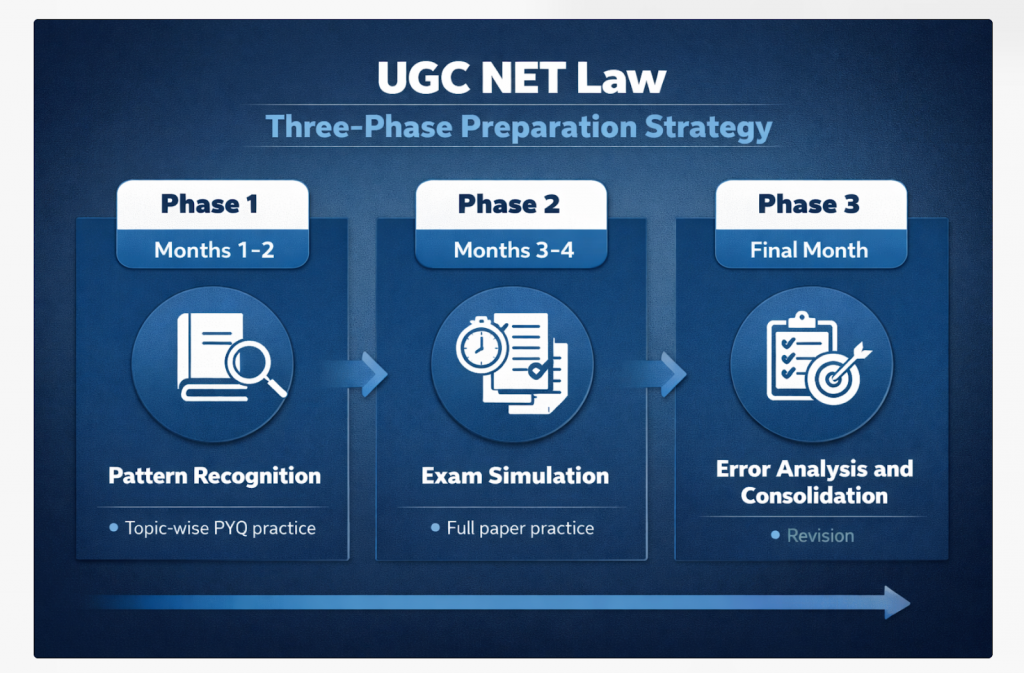
Phase 1: Topic Wise Previous Year Question Practice (First 2 Months)
The initial preparation phase should focus on topic wise question practice rather than full paper attempts. This approach helps you recognize patterns within each unit before tackling the complexity of complete papers. Reserve full length practice for later phases when your conceptual foundation is secure.
Solving Unit Wise Questions Before Full Papers
Gather all Constitutional Law questions from the last five years and solve them together as a single unit practice session. This concentrated approach reveals patterns invisible when questions are scattered across full papers.
You will notice that Fundamental Rights interpretation questions follow predictable formats, Basic Structure questions use similar framing, and administrative law questions test consistent principles.
Identifying Personal Weak Areas
Track your unit wise accuracy during topic wise practice. If you consistently score below 60% in a particular unit, that area needs concentrated attention before full paper practice begins.
Create a weakness log noting specific topics causing difficulty, and prioritize remedial study for those areas. This targeted approach prevents wasting time strengthening already strong areas while weaknesses persist.
Phase 2: Full Length Paper Practice (Month 3 to 4)
Once topic wise preparation is complete, shift to full length paper practice under exam conditions. This phase develops exam stamina, time management skills, and the ability to navigate between diverse topics without losing focus. Aim for at least 8 to 10 complete papers during this phase.
Simulating Exam Conditions
Solve previous year papers with strict timing: 180 minutes for 150 questions (Paper I and Paper II combined). Sit in a quiet environment without breaks, distractions, or reference materials.
This simulation builds the mental stamina required for the actual exam day when fatigue and pressure can undermine performance. Treat each practice paper as a dress rehearsal.
Time Allocation Strategy
Develop a time allocation approach that works for your strengths. Most successful candidates allocate approximately 50 to 60 minutes for Paper I’s 50 questions and 120 to 130 minutes for Paper II’s 100 questions.
Within Paper II, spend more time on high weightage units like Constitutional Law and Criminal Law while quickly processing familiar topics from lower weightage units.
Practice the strategic approach of attempting easier questions first within each paper section, marking uncertain questions for review, and returning to difficult questions only after completing easier ones. Since there is no negative marking in UGC NET, ensure you attempt every question, even if it requires educated guessing.
Phase 3: Revision and Error Analysis (Final Month)
The final preparation month should focus on error analysis and targeted revision rather than attempting new papers.
This consolidation phase transforms practice experience into exam ready confidence. Review your performance data systematically to guide final preparation.
Reviewing Incorrect Answers
For every incorrect answer during practice, identify the error cause: conceptual gap, careless mistake, time pressure, or unfamiliar question format. Conceptual gaps require focused study of the underlying topic.
Careless mistakes need awareness building through slower, more deliberate practice. Time pressure errors suggest the need for better time management rather than more content study.
Last Week Previous Year Question Revision Strategy
In your final week, solve one complete previous year paper daily to maintain exam readiness and momentum.
Focus these sessions on execution refinement rather than learning new content. Review only your summarized notes on high frequency topics, avoiding new material that might create confusion. Ensure you can confidently navigate the exam interface and manage time effectively.
Common Mistakes to Avoid When Solving UGC NET Law Previous Year Questions
Awareness of common preparation mistakes helps you avoid pitfalls that undermine otherwise solid preparation. These errors are preventable with conscious attention to your practice methodology.
Random Solving Without Pattern Analysis
Many candidates solve previous year papers without analyzing patterns across papers. They complete one paper, check answers, note their score, and move to the next paper without extracting strategic insights.
This approach wastes the primary benefit of previous year questions: pattern recognition. Always analyze which topics appeared, how questions were framed, and what patterns emerge across multiple papers.
Treating All Units as Equally Important
The equal preparation trap leads candidates to spend an identical time on each of the 10 Law units despite vastly different question contributions.
Constitutional Law’s approximately 15 to 18 questions deserve significantly more preparation time than Comparative Public Law’s 4 to 6 questions.
Use the tier based approach outlined earlier to allocate preparation time proportionally to actual exam weightage.
Conclusion
Strategic previous year question practice is what separates candidates who consistently qualify for UGC NET Law from those who repeatedly fall short.
The analysis in this guide reveals that not all units carry equal weightage: Constitutional Law, Jurisprudence, and Criminal Law together contribute approximately 40 to 50 questions, while Comparative Public Law and IPR together contribute barely around 10 to 14 questions. Preparing accordingly means allocating roughly 60% of your time to high weightage units.
Within each unit, certain topics repeat with remarkable consistency. Schools of Jurisprudence, Basic Structure Doctrine, Fundamental Rights interpretation, general principles of criminal liability, and Hindu Marriage Act provisions appear in virtually every exam.
Mastering these specific topics creates a scoring foundation regardless of what else appears in your particular exam session. The tiered approach ensures you secure marks from high frequency areas before investing time in peripheral topics.
Your preparation approach matters as much as what you study. Topic wise practice before full papers, strict exam simulation, systematic error analysis, and strategic time allocation transform random paper solving into targeted preparation.
Download the previous year papers from official sources, follow the three phase methodology outlined in this guide, and begin your preparation with confidence grounded in data driven strategy. The path to qualifying UGC NET Law is clear; your consistent effort along that path determines success.
Frequently Asked Questions
Where can I download UGC NET Law previous year papers for free?
You can download authentic UGC NET Law previous year papers from the official NTA website at ugcnet.nta.ac.in under the downloads or previous year papers section. INFLIBNET Centre also maintains archives of past papers with answer keys.
Which unit has the highest weightage in the UGC NET Law Paper II?
Constitutional and Administrative Law consistently carries the highest weightage, contributing approximately 15 to 18 questions per exam. This unit alone represents approximately 30 to 36 marks out of 200 in Paper II. Jurisprudence and Criminal Law follow as the second and third highest weightage units, respectively, each contributing 8 to 14 questions typically.
Are UGC NET Law questions repeated from previous years?
Exact question repetition is rare, but concept repetition is very common. The same legal principles, landmark cases, and theoretical frameworks appear repeatedly with different framing. Understanding concepts deeply prepares you for any question format. Approximately 20 to 30% of questions test concepts that have appeared in some form in previous papers.
What is the best way to analyze UGC NET Law previous year papers?
Solve papers topic wise rather than paper wise initially. Gather all Constitutional Law questions from five years and solve them together, then repeat for other units. This approach reveals patterns invisible when questions are scattered. Track unit wise accuracy, identify weak areas, and note which specific sub topics appear most frequently within each unit.
How has the UGC NET Law paper pattern changed over the years?
Before 2018, UGC NET had three papers, but post 2018, Paper II and Paper III merged into a single Paper II with 100 questions. Recent changes include increased emphasis on criminal law reforms and a greater focus on contemporary legal developments.
Are previous year papers with answers available for UGC NET Law?
Yes, NTA releases official answer keys after each exam, and these can be matched with previous year papers.
Which topics should I prioritize if I have only 2 months for UGC NET Law preparation?
Focus exclusively on Tier 1 topics: Constitutional Law (Fundamental Rights, Basic Structure, Administrative Law), Jurisprudence (Schools, Hohfeldian Analysis), Criminal Law (General Principles, Exceptions), and Family Law essentials. These high frequency topics can help you score around 100 to 120 marks if mastered thoroughly. Accept that comprehensive coverage is impossible in two months.
How do I use Previous Year Questions to identify high frequency topics in Law?
Create a topic frequency chart by going through five years of papers and tallying how often each sub topic appears. Topics appearing in 4 or 5 out of 5 years are high frequency and deserve maximum preparation time. Topics appearing in only 1 or 2 years can receive lighter coverage. This data driven approach replaces guesswork with strategic precision.
Is solving the last 5 years of papers enough for UGC NET Law?
Solving the last 5 years provides a solid foundation for pattern recognition and is sufficient for most candidates. However, extending to 7 to 10 years gives better insight into topic evolution and covers a wider range of potential questions. If time permits, the additional practice is beneficial but not essential for qualification.
What is the difficulty level of UGC NET Law Paper II?
UGC NET Law Paper II difficulty is moderate overall, with approximately 60% questions being straightforward, 30% requiring deeper analysis, and 10% being genuinely challenging. The difficulty lies more in the breadth of coverage across 10 units than in the complexity of individual questions. Thorough preparation of high weightage topics makes most questions manageable.
Can I clear the UGC NET Law without solving previous year papers?
While theoretically possible, clearing the UGC NET Law without previous year paper practice is significantly harder. Previous year questions reveal NTA’s testing patterns, question framing styles, and topic preferences that textbook study alone cannot provide. Candidates who skip PYQ practice often find the actual exam different from their expectations, affecting their performance.




 Allow notifications