
Complete UGC NET Research Methodology guide for Unit II. Learn research types, positivism vs post-positivism, research methods, thesis writing, ICT tools, and ethics with Previous Years Questions. Score 10-14 marks easily.
Feeling overwhelmed by Research Methodology for UGC NET? You’re not alone.
If you’re staring at terms like “positivism” and “post-positivism” wondering what they even mean, or if “thesis writing” sounds intimidating when you haven’t written one yet, take a breath.
Research Aptitude might seem like it’s designed for seasoned academics, but here’s the truth: it’s actually one of the most scoring sections in Paper I once you crack the basics.

This unit typically brings you 5 questions worth 10 marks, marks you absolutely don’t want to leave on the table. And the best part? Unlike some sections that test obscure facts, Research Aptitude tests logical thinking and concepts that genuinely matter if you’re heading into teaching or research.
Think of this guide as your friendly senior who’s already been through the exam, sitting down with you over coffee to explain things in plain language. No jargon overload. No assuming you know what “falsification” means (we’ll get to that). Just clear, practical explanations with examples that actually make sense.
Whether you’re aiming for Assistant Professor eligibility or that coveted JRF fellowship, understanding how research actually works, from picking a problem to writing it up, is non negotiable. So let’s break it down together, step by step, until Research Methodology becomes your confidence booster instead of your nightmare.
Ready? Let’s dive in.
UGC NET Research Aptitude: Overview
Understanding the Significance of Unit II in Paper I
Research Aptitude is one of the ten units in UGC NET Paper I, and it holds significant weight in determining your qualification. This unit evaluates your understanding of how knowledge is created through systematic inquiry, which is fundamental for anyone entering academia.
The UGC NET syllabus specifically includes topics like research meaning, types, methods, thesis writing, ICT applications, and research ethics under this unit.
How Many Questions Come from Research Aptitude?
Based on previous year paper analysis, Research Aptitude typically contributes 5 questions in Paper I, translating to 10 to 14 marks out of the total 100 marks. This makes it one of the higher weightage units, and preparing it thoroughly can significantly boost your Paper I score.
Since there is no negative marking in UGC NET, attempting all questions from this unit with proper preparation can add valuable marks to your total.
Topic Wise Weightage Distribution
Within Research Aptitude, questions are distributed across sub topics including research types and characteristics (1-2 questions), positivism and post-positivism (0-1 question), research methods (1-2 questions), steps of research (1 question), thesis writing and referencing (0-1 questions), ICT in research (0-1 question), and research ethics (1 question). Understanding this distribution helps you allocate your preparation time effectively and focus on high yield areas.
What Skills Does Research Aptitude Test?
Critical Thinking and Analytical Abilities
Research Aptitude questions are designed to test whether you can think critically about how knowledge is generated and validated. You need to analyze scenarios, identify appropriate research methods, and understand why certain approaches work better in specific situations.
This isn’t about memorizing definitions; it’s about developing a logical mindset that can evaluate research processes and their outcomes.
Understanding of Scientific Inquiry Process
This unit tests your grasp of how scientific inquiry works, from identifying a problem to drawing conclusions. You should understand why researchers follow systematic steps, how they ensure their findings are reliable, and what distinguishes good research from poor research.
These concepts form the foundation of academic work, whether you’re teaching students about research or conducting your own studies.
What is Research? Meaning, Types and Characteristics
Definition and Meaning of Research
Research is a systematic process of inquiry aimed at discovering new knowledge, verifying existing facts, or solving problems through careful investigation. Unlike casual observation or guesswork, research follows a structured methodology that ensures findings are reliable and can be verified by others.
The word “research” literally means “to search again,” suggesting a careful re-examination of existing knowledge to uncover deeper truths or new insights.
At its core, research is about asking questions and finding answers through evidence. Whether you’re investigating why certain teaching methods work better than others or examining historical legal judgments, the research process provides a framework for arriving at valid conclusions.
For UGC NET aspirants, understanding this foundational concept is crucial because many questions test whether you can distinguish research from everyday problem solving.
Scientific vs Non-Scientific Inquiry
Scientific inquiry is characterized by systematic observation, hypothesis testing, and evidence based conclusions that can be replicated by others. Non scientific inquiry, on the other hand, relies on intuition, tradition, authority, or personal experience without rigorous verification.
For UGC NET, you should understand that research follows the scientific approach, using established methods to ensure objectivity and reliability in findings.
Objectives of Research in Academia
The primary objectives of research in academia include expanding knowledge through new discoveries, testing and validating existing theories, solving practical problems, and developing new methods or tools.
Research also aims to train scholars in systematic thinking and contribute to the intellectual growth of disciplines. Understanding these objectives helps you appreciate why research methodology is a mandatory component of postgraduate and doctoral education.
Types of Research – UGC NET
Basic Research vs Applied Research (With Examples)
Basic research, also called pure or fundamental research, aims to expand theoretical knowledge without immediate practical application. For example, studying how memory formation works in the brain is basic research.
Applied research, in contrast, uses existing knowledge to solve specific practical problems. Developing a new teaching method based on memory research would be applied research. UGC NET often asks you to classify research examples into these categories.
Qualitative vs Quantitative Research: Key Differences
Qualitative research deals with non numerical data like interviews, observations, and text analysis to understand meanings and experiences.
Quantitative research works with numerical data and statistical analysis to establish patterns and test hypotheses.
While qualitative research asks “why” and “how,” quantitative research asks “how many” and “how much.” Many UGC NET questions require you to identify which approach suits a given research scenario.
Descriptive, Analytical, and Experimental Research
Descriptive research describes characteristics of a phenomenon without manipulating variables, such as surveys about student satisfaction.
Analytical research analyzes existing data to establish relationships between variables, like examining correlations between study hours and exam scores.
Experimental research involves manipulating independent variables to observe effects on dependent variables under controlled conditions. Each type serves different research purposes.
Fundamental vs Action Research
Fundamental research is conducted to develop theories and contribute to academic knowledge without immediate practical concerns. Action research, popular in education and social work, is conducted by practitioners to solve immediate problems in their own settings.
For instance, a teacher researching how to improve classroom engagement is conducting action research. UGC NET questions sometimes require distinguishing between these approaches.
Characteristics of Good Research
Systematic and Logical Methodology
Good research follows a systematic, step by step approach where each stage logically leads to the next. It begins with problem identification, proceeds through literature review and hypothesis formation, and concludes with data analysis and interpretation.
This systematic nature ensures that research can be understood, evaluated, and replicated by other scholars, which is essential for knowledge advancement.
Empirical, Objective, and Replicable Nature
Empirical research is based on observable evidence rather than mere speculation or argument.
Objectivity means the researcher’s personal biases don’t influence the findings.
Replicability ensures that other researchers following the same methods should arrive at similar results.
These characteristics distinguish scientific research from opinion based writing and are frequently tested in UGC NET.
Valid and Reliable Findings
Validity refers to whether research actually measures what it claims to measure, while reliability indicates consistency of results over repeated trials. Good research must demonstrate both: valid findings that accurately represent reality and reliable methods that produce consistent results.
Understanding these concepts is essential because UGC NET often tests your ability to evaluate research quality.
Previous Year Questions on Research Types and Characteristics
Previous UGC NET exams have frequently asked candidates to identify types of research from given scenarios or match research characteristics with their definitions. Questions like “Which type of research aims to solve immediate practical problems?” or “What characteristic ensures research findings can be verified by others?” are common.
Practicing such questions from the NTA’s previous year papers will help you recognize patterns and answer confidently.
What are Positivism and Post-Positivism in Research?
What is Positivism in Research?
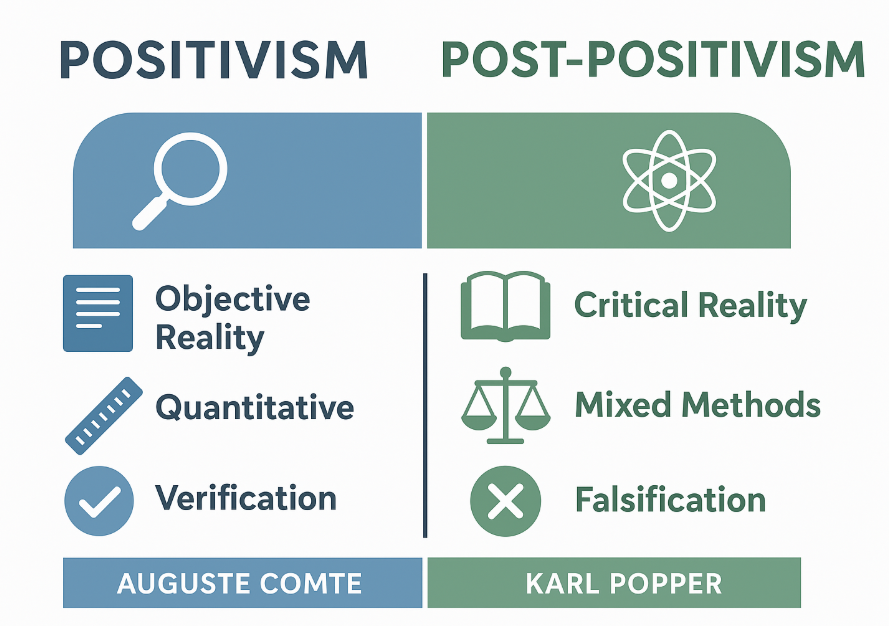
Positivism is a philosophical approach that believes true knowledge can only come from observable, measurable facts obtained through scientific methods. Positivist researchers maintain strict objectivity, using quantitative methods to discover universal laws that govern phenomena.
This approach dominated research in natural sciences and later influenced social science research methodology. For UGC NET, understanding positivism is essential as it forms the foundation of much research methodology.
Auguste Comte and Origins of Positivism
The term “positivism” was coined by French philosopher Auguste Comte in the 19th century. Comte believed that society and human behavior could be studied using the same scientific methods applied to natural phenomena.
He rejected metaphysical and theological explanations, arguing that only positive, observable facts should form the basis of knowledge. This philosophical shift laid the groundwork for modern empirical research methods.
Core Principles of Positivist Approach
The positivist approach rests on several key principles: knowledge must be based on observable facts, research should be objective and value free, scientific methods can discover universal laws, and the researcher should remain detached from the subject of study.
Positivists favor quantitative methods like experiments and surveys that produce numerical, measurable data. These principles are frequently tested in UGC NET through matching and assertion reasoning questions.
Examples of Positivist Research
A positivist study might measure the correlation between class size and student performance using standardized test scores across hundreds of schools. The researcher collects numerical data, applies statistical analysis, and draws objective conclusions without personal interpretation.
Medical research testing drug effectiveness through controlled trials is another example of positivist research, where variables are controlled and outcomes are measured objectively.
What is Post-Positivism in Research?
Post-positivism emerged as researchers recognized limitations in the strictly positivist approach, particularly in studying human behavior and social phenomena.
While post-positivists still value scientific inquiry, they acknowledge that complete objectivity is impossible and that all observation is influenced by the observer’s perspective. This approach allows for qualitative methods and recognizes that knowledge is probabilistic rather than absolute.
Why Post-Positivism Emerged: Limitations of Positivism
Positivism struggled to adequately explain complex human experiences, values, and social contexts that cannot be easily quantified. Critics argued that treating human subjects like natural phenomena ignores subjective meanings and cultural contexts.
Additionally, the notion that researchers can be completely objective was challenged, as personal backgrounds inevitably influence research choices. These limitations led to post-positivism’s more nuanced approach to knowledge creation.
Critical Realism and Falsification
Critical realism, a key post-positivist perspective, holds that reality exists independently of our perceptions but our understanding of it is always incomplete and potentially flawed. This view accepts that multiple valid interpretations of data are possible.
The concept of falsification, rather than verification, became important: instead of trying to prove theories true, researchers should attempt to disprove them. Theories that survive falsification attempts gain credibility.
Karl Popper’s Contribution
Philosopher Karl Popper significantly shaped post-positivist thinking through his falsification theory. Popper argued that scientific theories can never be definitively proven true, only proven false.
A theory’s scientific status depends on its ability to be tested and potentially falsified. This shifted the focus from accumulating evidence supporting theories to rigorously testing them. UGC NET sometimes asks about Popper’s contribution to research philosophy.
Positivism vs Post-Positivism: Comparison Table
| Aspect | Positivism | Post-Positivism |
| View of Reality | Single, objective reality exists | Reality exists but can never be fully known |
| Researcher’s Role | Completely detached and objective | Acknowledges inherent biases |
| Knowledge Claim | Absolute, verifiable facts | Probabilistic, open to revision |
| Preferred Methods | Quantitative, experimental | Mixed methods, includes qualitative |
| Goal | Discover universal laws | Understand phenomena with accepted limitations |
| Hypothesis Testing | Verification of theories | Falsification of theories |
When to Use Positivism in Your Research
Positivism is most appropriate when you’re studying phenomena that can be objectively measured and quantified, such as the relationship between variables in natural sciences or testing cause effect relationships through experiments.
Choose positivism when your research question requires statistical analysis, when you need to generalize findings to larger populations, or when you want to establish clear, replicable results. Most laboratory based scientific research follows this approach.
When Post-Positivism is More Appropriate
Post-positivism works better when studying complex social phenomena, human experiences, or situations where context significantly affects outcomes. If your research involves understanding perspectives, meanings, or processes that can’t be easily quantified, post-positivism offers more flexibility.
This approach is common in education research, social sciences, and mixed method studies where both numerical data and qualitative insights contribute to understanding.
UGC NET Previous Year Questions on Positivism
UGC NET has asked questions like “According to positivism, knowledge should be based on…” with options including observable facts, intuition, authority, and tradition. Matching questions pairing philosophers (Comte, Popper) with their contributions are also common.
Questions testing the difference between positivism and post-positivism in terms of objectivity and methodology appear frequently. Practice identifying these philosophical approaches in research scenarios.
What are the Different Research Methods?
What is Experimental Research Method?
Experimental research is a method where the researcher manipulates one or more variables to observe their effect on other variables under controlled conditions. This method is considered the gold standard for establishing cause effect relationships because it allows researchers to isolate the impact of specific factors.
In educational research, experiments might test whether a new teaching technique improves learning outcomes compared to traditional methods.
Independent, Dependent, and Control Variables
In experimental research, the independent variable is what the researcher manipulates (like teaching method), while the dependent variable is what gets measured as the outcome (like test scores). Control variables are factors kept constant to prevent them from affecting results (like student age or prior knowledge).
Understanding these variable types is crucial for UGC NET, as questions often ask you to identify variables in research scenarios.
Laboratory Experiments vs Field Experiments
Laboratory experiments are conducted in controlled settings where researchers can precisely manipulate variables and eliminate external influences.
Field experiments occur in natural settings like schools or workplaces, offering more realistic conditions but less control.
While laboratory experiments provide higher internal validity, field experiments offer better external validity or generalizability. UGC NET may ask you to compare these experimental types.
Advantages and Limitations
Experimental research’s main advantage is its ability to establish causation rather than just correlation. It provides high internal validity and allows precise measurement. However, limitations include artificial settings that may not reflect real world conditions, ethical constraints on manipulating certain variables, and the difficulty of controlling all relevant factors.
Recognizing these trade offs helps you evaluate when experiments are appropriate.
Descriptive Research Method Explained
Descriptive research aims to describe characteristics of a population or phenomenon without manipulating variables. It answers “what is” rather than “why” questions. This method is widely used in social sciences to understand current conditions, attitudes, or behaviors. Survey research, case studies, and observational studies all fall under descriptive research methods.
Survey Research and Questionnaires
Survey research collects data from a sample of respondents using standardized questionnaires to gather information about attitudes, opinions, or behaviors. Surveys can be administered through interviews, mail, online platforms, or telephone.
For UGC NET, understand that surveys are efficient for collecting data from large populations but may suffer from response bias and low response rates.
Case Study Method
Case study method involves intensive, in-depth investigation of a single case or a small number of cases. The “case” could be an individual, organization, event, or community. This method provides rich, detailed data and is useful for exploring complex phenomena in their real life context. However, findings from case studies cannot be easily generalized to larger populations.
Observational Research
Observational research involves systematically watching and recording behavior without intervention. It can be participant observation, where the researcher joins the group being studied, or non participant observation from outside. This method captures natural behavior but may be affected by observer bias or the Hawthorne effect, where subjects change behavior when they know they’re being observed.
Historical Research Method
Historical research investigates past events using available records and artifacts to understand what happened, why it happened, and its implications for the present. This method is essential in disciplines like history, law, and political science where understanding past developments informs current knowledge. Researchers must carefully evaluate sources for authenticity and accuracy.
Primary Sources vs Secondary Sources
Primary sources are original, first hand accounts from the time period being studied, such as diaries, official documents, photographs, or artifacts.
Secondary sources are interpretations or analyses of primary sources created later, like history textbooks or scholarly articles. Historical researchers prefer primary sources for direct evidence but use secondary sources for context and scholarly interpretation.
External and Internal Criticism
External criticism (or lower criticism) examines whether a document or artifact is genuine and authentic. It asks: Is this really from the claimed time period? Is the author who they claim to be?
Internal criticism (or higher criticism) evaluates the accuracy and meaning of the source’s content. It asks: Is the information truthful? Was the author in a position to know? Both are essential for validating historical evidence.
How to Verify Historical Data
Verifying historical data requires cross referencing multiple sources, examining the credibility of authors, considering potential biases, and placing information in its historical context. Researchers look for corroborating evidence from independent sources and remain skeptical of information that cannot be verified. This rigorous approach ensures historical research produces reliable conclusions.
Qualitative Research Methods
Qualitative research focuses on understanding meanings, experiences, and social contexts through non numerical data. It explores the “why” and “how” of human behavior rather than measuring “how much.”
This approach is particularly valuable when studying complex social phenomena, cultural practices, or personal experiences that cannot be reduced to numbers.
In-depth Interviews and Focus Groups
In-depth interviews involve detailed, one on one conversations where researchers explore participants’ perspectives, experiences, and meanings in depth. Focus groups bring together small groups of participants to discuss topics, generating data through group interaction and discussion. Both methods provide rich, detailed data but require skilled facilitation and careful analysis.
Ethnography and Content Analysis
Ethnography involves immersing oneself in a culture or community to understand its practices, beliefs, and social dynamics from an insider’s perspective.
Content analysis systematically examines communication materials like texts, images, or media to identify patterns, themes, and meanings.
Both methods are widely used in social sciences, media studies, and anthropology research.
When to Choose Qualitative Methods
Choose qualitative methods when exploring new or poorly understood phenomena, when context and meaning are important, when you need to understand participants’ perspectives in their own words, or when developing theories from data.
Qualitative research is also appropriate when sample sizes are small but deep understanding is needed. UGC NET may ask you to identify when qualitative approaches are most suitable.
Quantitative Research Methods
Quantitative research emphasizes numerical measurement, statistical analysis, and generalization of findings to larger populations. It tests hypotheses using standardized instruments, producing data that can be analyzed mathematically.
This approach is dominant in natural sciences and widely used in social sciences when researchers want to measure variables and establish relationships between them.
Statistical Analysis and Measurement
Quantitative research relies on statistical tools to analyze data and test hypotheses. Descriptive statistics summarize data (mean, median, mode), while inferential statistics (t-tests, ANOVA, regression) help draw conclusions about populations from samples.
Understanding basic statistical concepts is important for UGC NET, as questions may ask about appropriate statistical measures for different data types.
Data Collection Through Structured Tools
Quantitative data is typically collected through structured tools like standardized questionnaires, rating scales, and measurement instruments that produce numerical data.
These tools ensure consistency across respondents and allow statistical comparison. Likert scales, semantic differential scales, and multiple choice surveys are common examples of structured data collection instruments.
Qualitative vs Quantitative: Which is Better?
Neither approach is inherently better; the choice depends on research objectives, the nature of the phenomenon, and the questions being asked. Quantitative research provides breadth and generalizability; qualitative research provides depth and context.
Many contemporary researchers use mixed methods, combining both approaches to leverage their respective strengths. UGC NET frequently tests understanding of when each approach is appropriate.
Previous Year Questions on Research Methods
UGC NET has asked questions requiring identification of research methods from scenarios, such as “A researcher studies the effect of a new drug by giving it to one group and a placebo to another.
This is an example of…” Common questions also test knowledge of survey design, case study characteristics, and differences between qualitative and quantitative approaches. Practice matching research methods with their characteristics.
What are the Steps of the Research Process?
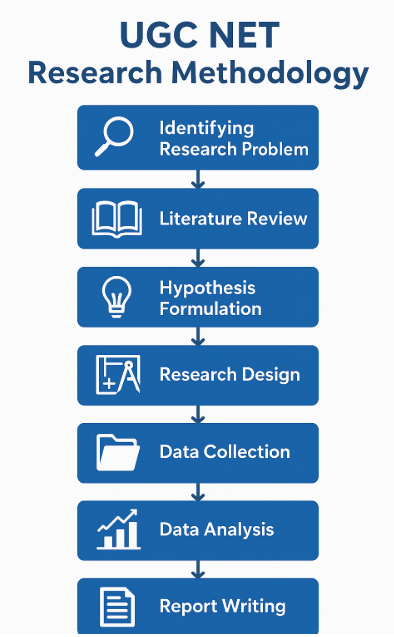
Step 1 – Identifying and Formulating Research Problem
The research process begins with identifying a problem that needs investigation. This isn’t just about choosing a topic; it’s about formulating a specific, researchable question that addresses a gap in existing knowledge.
A well defined research problem guides all subsequent steps, from literature review to methodology selection. For UGC NET aspirants, understanding this foundational step is crucial as questions often test proper problem formulation.
What Makes a Good Research Problem?
A good research problem should be specific enough to be manageable, yet significant enough to contribute to knowledge. It should be feasible given available time, resources, and access to data.
The problem should be original, not merely duplicating existing research, and should be stated clearly so others understand exactly what you’re investigating. Problems that are too broad or too narrow create difficulties in subsequent research stages.
Common Mistakes in Problem Selection
Common mistakes include choosing overly broad topics that cannot be adequately addressed, selecting problems based only on personal interest without considering feasibility, failing to verify whether the problem has already been solved, and formulating vague questions that don’t guide research effectively.
Another mistake is choosing topics without sufficient available literature or data sources. Awareness of these pitfalls helps researchers avoid them.
How to Narrow Down Your Research Topic
Start with a general area of interest, then progressively focus by reading existing literature, identifying gaps, and consulting with experts. Ask specific questions about aspects that interest you most. Consider practical constraints like time, resources, and access.
A topic like “education in India” is too broad; “impact of smartphone use on reading habits among Delhi University undergraduate students” is appropriately narrow and researchable.
Step 2 – Reviewing Related Literature
Literature review involves systematically searching, reading, and analyzing existing research related to your problem. This step helps you understand what is already known, identify gaps your research can fill, refine your research questions, and avoid duplicating previous work.
A thorough literature review also helps you choose appropriate methods and provides context for interpreting your findings.
Why Literature Review is Important
Literature review establishes the theoretical foundation for your research and demonstrates that you understand the field. It helps identify variables, concepts, and relationships that previous researchers have explored.
By analyzing existing studies, you can learn from their methodologies, avoid their limitations, and position your work within the broader scholarly conversation. UGC NET questions may test understanding of literature review’s purpose.
How to Search and Organize Sources
Use academic databases like Google Scholar, Shodhganga for Indian theses, JSTOR, and subject specific databases to find relevant literature. Use keywords related to your research problem and apply filters for publication date and source type.
Organize sources using reference management tools like Zotero or Mendeley. Create systematic notes capturing each source’s main findings, methodology, and relevance to your work.
Identifying Research Gaps
Research gaps are areas where existing literature is insufficient, contradictory, or outdated. Look for questions previous researchers suggest for future investigation, methodological limitations they acknowledge, populations or contexts not yet studied, and contradictions between different studies’ findings.
Your research should aim to address one or more of these gaps, contributing new knowledge to the field.
Step 3 – Formulating Research Hypothesis
A hypothesis is a tentative, testable statement predicting the relationship between variables. It transforms your research problem into a specific prediction that can be empirically tested.
Not all research requires hypothesis; exploratory and qualitative research often work with research questions instead. However, for quantitative research testing relationships, hypothesis formulation is essential.
Null Hypothesis vs Alternative Hypothesis
The null hypothesis (H₀) states that there is no significant relationship or difference between variables; any observed effect is due to chance.
The alternative hypothesis (H₁) states that a significant relationship or difference exists.
Statistical testing aims to determine whether evidence is strong enough to reject the null hypothesis in favor of the alternative. UGC NET frequently tests understanding of these hypothesis types.
Characteristics of a Good Hypothesis
A good hypothesis should be clear, specific, and stated in simple terms. It must be testable through data collection and analysis. It should predict a relationship between variables and be consistent with existing knowledge while proposing something that needs verification.
Good hypotheses are also falsifiable, meaning it must be possible for evidence to prove them wrong.
Directional vs Non Directional Hypothesis
A directional hypothesis specifies the expected direction of the relationship (for example, “increased study time will lead to higher test scores”).
A non-directional hypothesis predicts a relationship without specifying its direction (for example, “there is a relationship between study time and test scores”).
Directional hypothesis are used when previous research suggests a particular direction; non directional hypothesis are used when the direction is uncertain.
Step 4 – Designing Research Methodology
Research design is the blueprint for your study, specifying how you will collect and analyze data to answer your research questions. It includes decisions about research type (experimental, survey, case study), sampling methods, data collection tools, and analysis techniques. A well designed methodology ensures your research produces valid, reliable findings.
Choosing the Right Research Design
Select research design based on your research questions, hypothesis, and practical constraints. Experimental designs are best for testing cause effect relationships. Survey designs work well for studying attitudes and behaviors across populations.
Case study designs suit in depth exploration of specific instances. Consider whether quantitative, qualitative, or mixed methods best address your research objectives.
Research Tools and Instruments
Research tools are devices or techniques used to collect data. These include questionnaires, interview schedules, observation checklists, standardized tests, and measurement scales. Tools must be valid (measuring what they claim to measure) and reliable (producing consistent results).
Researchers may use existing validated instruments or develop new ones, which requires pilot testing to ensure quality.
Step 5 – Data Collection Methods
Data collection is the systematic process of gathering information relevant to your research questions. The quality of your findings depends heavily on how well data is collected. Researchers must decide what data to collect, from whom, using what methods, and over what time period. Proper planning prevents issues that could compromise research validity.
Primary Data Collection Techniques
Primary data is original data collected directly by the researcher for the specific study. Techniques include surveys and questionnaires, interviews (structured, semi structured, unstructured), observation (participant and non-participant), experiments, and focus group discussions. Each technique has strengths and limitations; selection depends on research objectives, population characteristics, and available resources.
Secondary Data Sources
Secondary data is information previously collected by others for different purposes. Sources include government statistics, organizational records, published research, census data, and databases like UGC’s data portal.
Secondary data saves time and resources but may not perfectly fit your research needs. Always evaluate secondary data for accuracy, relevance, and how recently it was collected.
Sampling Methods: Probability and Non Probability
Probability sampling (random, stratified, cluster, systematic) gives every population member a known chance of selection, allowing statistical generalization.
Non probability sampling (convenience, purposive, snowball, quota) doesn’t provide equal selection chances but is useful when probability sampling is impractical.
UGC NET frequently tests knowledge of different sampling methods and their appropriate applications.
Step 6 – Data Analysis and Interpretation
After collecting data, researchers must organize, analyze, and interpret it to answer research questions. Analysis transforms raw data into meaningful findings. The analysis method depends on whether data is quantitative or qualitative and on the specific research questions. Proper analysis ensures conclusions are supported by evidence.
Statistical Measures: Mean, Median, Mode, Standard Deviation
Mean is the arithmetic average, calculated by summing all values and dividing by the count. Median is the middle value when data is ordered. Mode is the most frequently occurring value. Standard deviation measures how spread out values are from the mean.
These descriptive statistics summarize data characteristics and are fundamental concepts for UGC NET questions on research methodology.
Qualitative Data Analysis Techniques
Qualitative data analysis involves organizing, coding, and identifying themes in textual or visual data. Techniques include content analysis (systematic categorization of text), thematic analysis (identifying patterns and themes), grounded theory (developing theory from data), and narrative analysis (examining stories and accounts).
Analysis software like NVivo can assist with managing large qualitative datasets.
How to Use SPSS and Excel for Analysis
SPSS (Statistical Package for Social Sciences) is professional software for statistical analysis, offering tests from basic descriptives to advanced multivariate analysis. Microsoft Excel provides basic statistical functions suitable for simpler analyses.
Both tools help researchers organize data, perform calculations, create visualizations, and test hypotheses. Familiarity with these tools is increasingly expected in academic research.
Step 7 – Report Writing and Conclusion
The final step involves communicating findings through a research report, thesis, or article. Good research report writing presents the entire research process clearly, from problem statement through methodology to findings and conclusions. The report should enable readers to understand what was done, why, and what was discovered.
Drawing Valid Conclusions
Conclusions must be directly supported by the data and analysis. Avoid overgeneralizing beyond what evidence supports. Acknowledge limitations that may affect conclusion validity. Compare findings with existing literature, noting agreements and contradictions.
Valid conclusions address the original research questions and hypotheses while recognizing boundaries of what the study can claim.
Recommendations and Limitations
Every study has limitations arising from methodology, sample, or scope. Honest acknowledgment of limitations strengthens credibility rather than weakening it. Recommendations should flow logically from findings and address practical implications and directions for future research. This section shows that researchers understand their work’s place in the broader knowledge landscape.
Previous Year Questions on Research Process Steps
UGC NET frequently asks candidates to arrange research steps in correct sequence or identify which step comes first in a given scenario. Questions like “Formulation of hypothesis comes after which step?” or “What is the correct order of research process?” are common.
Understanding the logical progression from problem identification through conclusion ensures you can handle such sequencing questions confidently.
How to Write a Thesis and Research Article?
What is the Standard Format of a Thesis?
A thesis is a comprehensive document presenting original research conducted for an academic degree. It demonstrates the candidate’s ability to identify a problem, conduct systematic investigation, and contribute new knowledge to their field.
The thesis format follows established conventions that ensure clarity, completeness, and scholarly rigor. Understanding thesis structure is tested in UGC NET under research aptitude.
Essential Components of a Thesis
A standard thesis includes: title page, declaration, certificate, acknowledgments, abstract, table of contents, list of tables and figures, introduction, literature review, methodology, results/findings, discussion, conclusion, references, and appendices. Each component serves a specific purpose. The abstract provides a brief overview; methodology details how research was conducted; discussion interprets findings in light of existing literature.
Shodhganga and Electronic Thesis Submission
Shodhganga is a digital repository of Indian electronic theses and dissertations maintained by INFLIBNET Centre under UGC. As per UGC Regulations 2016, that all universities must submit electronic versions of theses to Shodhganga to ensure open access and prevent duplication.
This initiative promotes visibility of Indian research and helps new researchers review existing work in their fields.
What is the Structure of a Research Article?
Research articles are shorter than theses and focus on communicating specific findings to the academic community. They undergo peer review before publication in academic journals. Articles must present information concisely while providing enough detail for readers to evaluate and potentially replicate the research.
IMRAD Format Explained
IMRAD stands for Introduction, Methods, Results, And Discussion, which is the standard structure for research articles in sciences and social sciences. The Introduction presents the problem and objectives. Methods describe how research was conducted.
Results present findings without interpretation. Discussion interprets findings, compares with existing literature, and acknowledges limitations. This format helps readers quickly locate specific information.
Difference Between Thesis and Research Article
A thesis is a comprehensive document submitted for a degree, covering extensive background, detailed methodology, and complete findings. An article is a concise publication in a journal, focusing on specific findings from research that may be part of a larger thesis.
Theses can exceed 100 pages; articles typically range from 3,000 to 8,000 words. Multiple articles may emerge from a single thesis.
What are the Different Referencing Styles?
Referencing styles are standardized formats for citing sources used in academic writing. Proper citation acknowledges others’ work, allows readers to locate sources, and prevents plagiarism. Different disciplines prefer different styles, so researchers must know which style their field uses. UGC NET tests knowledge of major referencing formats.
APA Style: Format and Examples
APA (American Psychological Association) style is widely used in social sciences, education, and psychology. In-text citations include author surname and year: (Sharma, 2023). Reference list entries follow the pattern: Author, A. A. (Year). Title of work. Publisher. APA emphasizes recency of sources and uses a specific format for different source types including books, journal articles, and websites.
MLA Style: Format and Examples
MLA (Modern Language Association) style is preferred in humanities, especially literature and languages. In text citations include author and page number: (Sharma 45). Works Cited entries follow: Author Surname, First Name. Title of Work. Publisher, Year. Unlike APA, MLA emphasizes page numbers for locating information and uses different formatting conventions for titles and publication details.
Chicago and IEEE Styles: When to Use Each
Chicago style, used in history and some humanities fields, offers two formats: notes-bibliography (using footnotes) and author-date (similar to APA).
IEEE (Institute of Electrical and Electronics Engineers) style, used in engineering and computer science, uses numbered citations in square brackets [1].
Knowing which style applies to your discipline prevents formatting errors that can affect paper acceptance.
Previous Year Questions on Thesis and Referencing
UGC NET has asked questions requiring identification of correct citation formats, such as “Which reference is written in MLA format?” with multiple options showing different arrangements. Questions on thesis components (“Which of the following is NOT part of a standard thesis?”) and IMRAD structure are also common.
Practice recognizing formatting differences between APA, MLA, and other styles.
How is ICT Applied in Research?
How Does ICT Help in Literature Review and Data Collection?
Information and Communication Technology (ICT) has revolutionized research by making information access faster, data collection easier, and collaboration seamless. Researchers today cannot effectively conduct studies without leveraging ICT tools for various stages of the research process. Understanding ICT applications in research is increasingly important for UGC NET Paper 1.
Google Scholar, Shodhganga, and Academic Databases
Google Scholar provides free access to scholarly literature across disciplines, helping researchers discover relevant articles, books, and theses. Shodhganga, maintained by INFLIBNET under UGC, is India’s repository of electronic theses.
Other databases include JSTOR, PubMed for medical research, and SSRN for social sciences. These platforms have transformed literature review from weeks in physical libraries to hours online.
Online Survey Tools: Google Forms and SurveyMonkey
Google Forms and SurveyMonkey enable researchers to create, distribute, and analyze surveys online efficiently. These tools allow reaching geographically dispersed respondents, automatic response collection, and basic analysis features.
They significantly reduce time and cost compared to paper-based surveys. For UGC NET, know that ICT has made primary data collection faster and more accessible.
What ICT Tools are Used for Data Analysis?
SPSS, MS Excel, and Statistical Software
SPSS (Statistical Package for Social Sciences) offers comprehensive statistical analysis capabilities from basic descriptives to advanced techniques like regression and factor analysis. Microsoft Excel provides basic statistical functions accessible to most users.
Other software includes R (open-source statistical programming), Stata, and SAS. These tools handle large datasets and perform complex calculations that would be impractical manually.
Qualitative Analysis Tools: NVivo and Atlas.ti
NVivo and Atlas.ti are software programs designed for qualitative data analysis, helping researchers organize, code, and analyze text, audio, video, and image data. They facilitate systematic coding of themes, visualization of relationships, and management of large qualitative datasets.
While not replacing researcher judgment, these tools make qualitative analysis more systematic and efficient.
How Does ICT Help in Reference Management and Writing?
Zotero, Mendeley, and Citation Managers
Zotero and Mendeley are reference management tools that help researchers collect, organize, cite, and share research sources. They automatically capture citation information from databases, store PDFs, generate bibliographies in various formats, and integrate with word processors.
These tools prevent citation errors and save significant time compared to manual reference management.
Grammarly and Plagiarism Detection Tools
Grammarly helps improve writing by checking grammar, spelling, and style. Plagiarism detection tools like Turnitin and Urkund compare submissions against databases of published works and other submissions to identify potential plagiarism.
As per UGC regulations, universities must check theses for plagiarism before acceptance. Understanding these tools is essential for modern researchers.
What is the Role of ICT in Research Dissemination?
ICT enables researchers to share findings globally through online journals, open access repositories, and academic social networks like ResearchGate and Academia.edu. E-journals and digital publishing have accelerated the dissemination process, allowing findings to reach audiences faster than traditional print journals. Video conferences and webinars enable presenting research without geographical constraints.
What are Research Ethics and Why are They Important?
What are the Core Principles of Research Ethics?
Research ethics are moral principles guiding how research should be conducted responsibly and with integrity. Ethical research protects participants from harm, ensures honesty in reporting, and maintains public trust in research findings. Understanding ethics is essential for anyone entering academia, as violations can end careers and damage institutions.
Honesty, Objectivity, and Integrity
Honesty means reporting methods and findings truthfully without fabrication (inventing data) or falsification (manipulating data). Objectivity requires minimizing bias in research design, analysis, and interpretation. Integrity involves keeping promises to participants, honoring agreements, and maintaining consistency between what you say and do. These principles form the foundation of trustworthy research.
Confidentiality and Respect for Participants
Researchers must protect participants’ privacy by keeping personal information confidential and reporting data in ways that prevent identification. Respect for participants includes obtaining informed consent, allowing withdrawal from studies, and protecting vulnerable groups like children or prisoners from exploitation.
Ethical research treats participants as autonomous individuals deserving dignity and protection.
What is Plagiarism and How to Avoid It?
Plagiarism is presenting someone else’s ideas, words, or work as your own without proper acknowledgment. It’s a serious ethical violation in academia that can result in degree cancellation, job loss, and permanent reputation damage. Understanding plagiarism types and how to avoid them is crucial for researchers and is tested in UGC NET.
Types of Plagiarism You Should Know
Types include: direct plagiarism (copying text verbatim without citation), self-plagiarism (reusing your own previously published work without disclosure), mosaic plagiarism (combining phrases from multiple sources without citation), and accidental plagiarism (failing to cite due to poor citation practices). Paraphrasing without citation is also plagiarism. Even unintentional plagiarism has consequences, so careful citation is essential.
UGC Regulations 2018 on Plagiarism
UGC’s 2018 regulations on academic integrity define plagiarism levels based on similarity percentage: Level 0 (up to 10%, minor similarities), Level 1 (10-40%, requires revision), Level 2 (40-60%, one-year debarment from submission), Level 3 (above 60%, registration cancellation).
All institutions must have policies for detection and penalties. These regulations are frequently tested in UGC NET.
While UGC 2018 regulations are still followed in UGC NET exams, individual universities may have slightly modified penalties for Level 1 and Level 2 plagiarism as per institutional policies.
What are the Consequences of Ethical Violations?
Academic Penalties and Career Impact
Consequences range from paper rejection and degree cancellation to termination from academic positions. UGC regulations specify penalties including revision requirements, submission debarment periods, and registration cancellation for serious plagiarism.
Beyond formal penalties, ethical violations damage professional reputation permanently, as academia values integrity highly and information spreads quickly.
How to Maintain Ethical Standards
Maintain ethics by understanding what constitutes violations, keeping meticulous records of sources, using plagiarism detection software before submission, obtaining proper approvals for human subjects research, and reporting findings honestly even when results are unexpected. When uncertain about ethical issues, consult guidelines, supervisors, or ethics committees. Prevention is far easier than addressing violations.
Previous Year Questions on Research Ethics
UGC NET frequently tests ethics through questions on plagiarism definitions, UGC regulation penalty levels, researcher responsibilities, and ethical principles. Questions like “According to UGC regulations, similarity above 40% corresponds to which plagiarism level?” or “Which of the following is NOT an ethical violation in research?” are common. Understanding both principles and specific regulations ensures you can answer confidently.
Conclusion
Research Aptitude in UGC NET Paper I tests your understanding of how knowledge is systematically created, validated, and communicated. From the philosophical foundations of positivism and post-positivism to practical aspects like ICT tools and referencing styles, this unit covers essential concepts every aspiring teacher and researcher needs to know.
By understanding research meaning, types, methods, and the systematic steps of the research process, you build a foundation that will serve you throughout your academic career.
The key to mastering Research Aptitude lies in understanding concepts rather than memorizing definitions. When you grasp why research follows systematic steps, how different methods suit different questions, and why ethics matter for credibility, answering UGC NET questions becomes straightforward.
Practice with previous year questions from NTA’s official portal, focus on understanding the logic behind each concept, and you’ll find this unit becomes one of your scoring areas in Paper I.
Frequently Asked Questions
How many questions come from Research Aptitude in UGC NET Paper I?
Research Aptitude typically contributes 5 questions in Paper I, worth 10 marks out of 100. This makes it one of the higher weightage units and a scoring section for well-prepared candidates.
What is the difference between positivism and post-positivism?
Positivism believes in objective, measurable reality and value free research, while post-positivism acknowledges that all observation is fallible and complete objectivity is impossible. Positivism favors quantitative methods; post-positivism accepts mixed methods.
What are the 7 steps of the research process?
The seven steps are: identifying and formulating research problem, reviewing related literature, formulating hypothesis, designing research methodology, collecting data, analyzing and interpreting data, and writing report with conclusions.
Which referencing style is used for social sciences in UGC NET?
APA (American Psychological Association) style is predominantly used in social sciences, education, and psychology. It emphasizes author date citations and follows specific formatting for different source types.
How do I prepare for Research Aptitude in 2 weeks?
Focus on understanding core concepts rather than memorizing. Cover research types, positivism vs post-positivism, research steps, and referencing styles first. Practice previous year questions daily and create quick revision notes on important terminology.
What is the difference between qualitative and quantitative research?
Quantitative research uses numerical data and statistical analysis to test hypotheses and generalize findings. Qualitative research uses non numerical data like interviews and observations to understand meanings and contexts. The choice depends on research questions.
What ICT tools should I know for UGC NET Paper I?
Know Google Scholar and Shodhganga for literature search, SPSS and Excel for data analysis, Zotero and Mendeley for reference management, and Turnitin for plagiarism detection. Understanding their purposes is more important than operational details.
What is Shodhganga and why is it important for research?
Shodhganga is India’s digital repository of electronic theses and dissertations maintained by INFLIBNET under UGC. It provides open access to Indian research, helps prevent duplication, and is mandatory for thesis submission as per UGC regulations.
How is plagiarism defined under UGC Regulations 2018?
UGC defines plagiarism levels by similarity percentage: Level 0 (up to 10%), Level 1 (10-40%), Level 2 (40-60%), Level 3 (above 60%). Penalties range from revision requirements to registration cancellation depending on the level.
What is the IMRAD format in research article writing?
IMRAD stands for Introduction, Methods, Results, And Discussion. It’s the standard structure for scientific research articles where Introduction presents the problem, Methods describes procedures, Results presents findings, and Discussion interprets them.
Can I score full marks in Research Aptitude with self-study?
Yes, Research Aptitude is highly scoring with self-study if you understand concepts clearly. Use standard books like Trueman’s UGC NET, practice previous year questions thoroughly, and focus on understanding rather than memorization.
What books are best for UGC NET Research Aptitude preparation?
Trueman’s UGC NET Paper I and Arihant’s UGC NET General Paper are comprehensive and widely recommended. For research methodology specifically, C.R. Kothari’s “Research Methodology” provides deeper understanding of concepts.
How are previous year questions helpful for Research Aptitude?
Previous year questions reveal exam patterns, frequently tested topics, and question styles. Many concepts repeat across years. Practicing PYQs helps you understand what examiners expect and improves time management during the actual exam.
What is the weightage of thesis writing questions in UGC NET?
Thesis writing and referencing styles typically contribute 1 to 2 questions (2-4 marks) in Paper I. Questions commonly test referencing format identification, thesis components, and IMRAD structure knowledge.





 Allow notifications