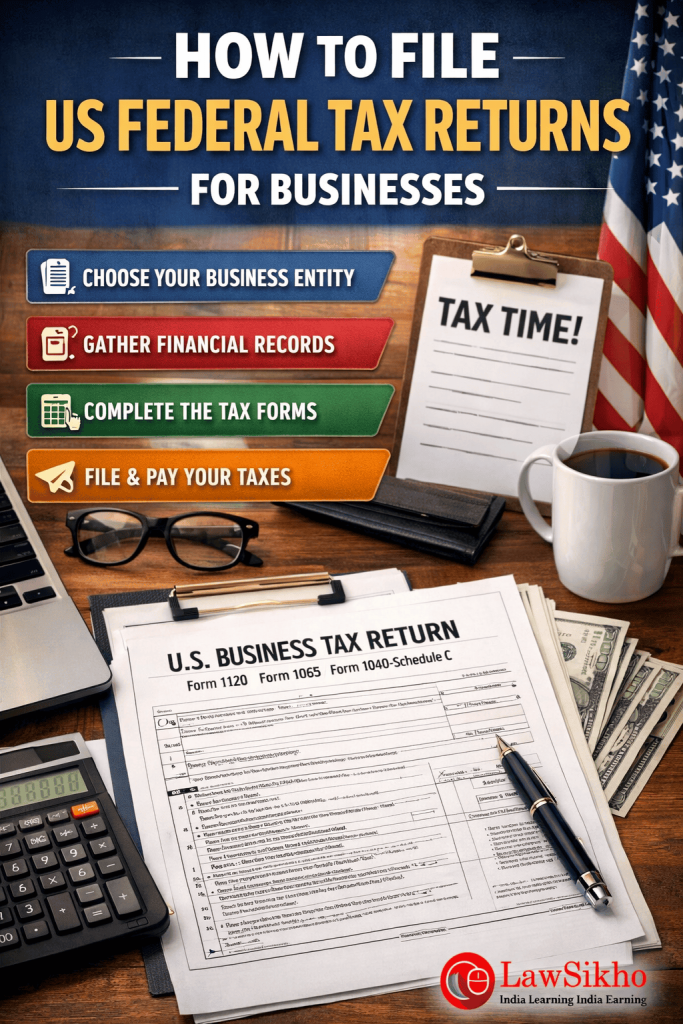

US federal tax return filing for businesses is simpler than it looks especially if you have an accounting or finance background in India. The words “US federal tax returns” can sound intimidating at first. But here’s the truth: for someone with an accounting or finance background in India, filing these returns is far less foreign than it seems. The structure is remarkably similar to the P&L statements and balance sheets you already know.
Table of Contents
Understanding US federal tax return filing for businesses starts with knowing which form applies to your client’s entity type.
Let’s walks you through everything you need to know about US federal tax return filing for businesses from choosing the right form to completing schedules. Businesses including which IRS form applies to which entity type, how to fill out Form 1120, and what it takes to file on behalf of US clients from India. Whether you’re exploring this as a career pivot or looking to expand your existing skills, this is your starting point.
US Federal Tax Return Filing for Businesses: Which Form Does Your Entity Use?
Every US business must file a federal income tax return, but the form it uses depends on its legal structure. Here’s a quick overview:

| Business Entity | IRS Form | Key Note |
| C Corporation (C-Corp) | Form 1120 | Files annually; pays corporate income tax |
| S Corporation (S-Corp) | Form 1120-S | Income passes through to shareholders via Schedule K-1 |
| Partnership / Multi-Member LLC | Form 1065 | Pass-through; each partner gets a Schedule K-1 |
| Sole Proprietor / Single-Member LLC | Schedule C (with Form 1040) | No separate return; LLC is disregarded for tax |
💡 Quick Tip: Make sure you identify the correct entity type before selecting a form. Using the wrong form is one of the most common beginner mistakes.
Form 1120: A Deep Dive into C-Corporation Tax Filing
If your client is a C-Corporation, US federal tax return filing for businesses means filing Form 1120 every year, regardless of whether the corporation made a profit.
If you’re working with a US C-Corporation client, Form 1120 (U.S. Corporation Income Tax Return) is the document you’ll be filing. It tells the IRS how much the corporation earned, what deductions it claims, and how much tax it owes. Even if the corporation earned zero dollars in a given year, it is still legally required to file Form 1120 (unless it’s a tax-exempt organization).
Step 1: Gather the Required Documents
Think of this like gathering all your ingredients before you start cooking. You’ll need:
- EIN (Employer Identification Number)
- Corporation name and registered address
- Date of incorporation
- Total business assets
- Gross receipts or sales figures
- Cost of goods sold (COGS)
- Liabilities and shareholder equity (including an updated capitalization table)
- Available tax deductions and credits
In certain circumstances, you may also need:
- Capital gains information
- Dividend, interest, and royalty income details
Most of this information can be found in the corporation’s financial statements or prior year tax returns.
Step 2: Understand the Form Structure
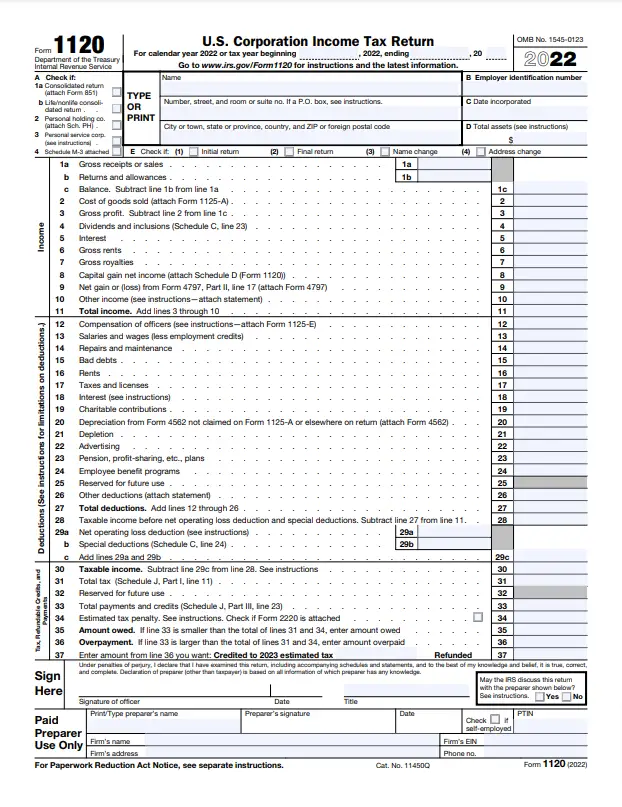
Form 1120 is structured very similarly to an Indian company’s P&L statement and balance sheet. Once you see it, you’ll recognize the logic immediately. You can access the official form directly on the IRS website.
Step 3: Fill in Income and Deductions
The main body of Form 1120 captures:
- Gross income (revenue, other income)
- Deductions (salaries, rents, depreciation, interest, etc.)
- Taxable income after deductions
- Tax owed, credits, and any estimated payments already made
Step 4: Complete the Relevant Schedules
Depending on the corporation’s situation, you’ll need to fill out one or more of the following schedules:
- Schedule C — Dividends and Interest Income
- Schedule J — Tax Computation and Payment
- Schedule K — Other Relevant Information
- Schedule L — Balance Sheet per Books
- Schedule M-1 — Reconciliation of Income (Book vs. Tax)
- Schedule M-2 — Analysis of Unappropriated Retained Earnings
The IRS provides detailed instructions for each line on the form. You can find the full Form 1120 instructions on the IRS instructions page.
Step 5: File the Return
C-Corporations can file Form 1120 by mail (address listed on the IRS website) or electronically. Note that businesses with total assets exceeding USD 10 million are required to e-file mandatorily.
💡 You do not need to use paid software like TurboTax. If the corporation’s income is below USD 84,000, free filing options are available through the IRS Free File programme. Fillable PDFs are also an option for straightforward returns. Once submitted, US federal tax return filing for businesses is complete for that tax year.
Beyond Federal Tax: Other US Tax Filings to Know
US federal tax return filing for businesses is just the starting point there are dozens of other filings to handle for US clients. Once you’re comfortable with the core forms, there’s a much larger universe of tax obligations you can handle for clients:
- State income tax returns (each US state has its own rules and forms)
- Franchise tax (charged by certain states just for the right to operate there)
- Payroll tax filings (Form 941, Form 940)
- Sales tax returns (filed at the state level)
The good news? All of these can be filed remotely from India.
How the Enrolled Agent Credential Unlocks US Tax Work from India
An Enrolled Agent (EA) is a federally licensed tax professional authorized by the US Internal Revenue Service (IRS). Unlike CPAs, the EA credential is not state specific it is recognized across all 50 US states, and it can be earned from anywhere in the world, including India.
With an EA credential, you can:
- File US federal and state tax returns on behalf of clients in your own name
- Represent clients before the IRS including at the appeals stage via virtual Zoom hearings
- Command significantly higher fees than unlicensed preparers
💡 Indian professionals who combine accounting skills with the EA credential are earning 3–5x more than they would in comparable domestic roles, by working with US clients remotely.
Why Indian Accounting Professionals Have a Natural Advantage
US tax return filing is not as foreign as it sounds to Indian accountants. Here’s why:
- Form 1120 maps closely to an Indian company’s P&L and balance sheet: Income, deductions, and net taxable income follow the same logic.
- Indian CAs and commerce graduates already understand double-entry bookkeeping, depreciation schedules, and reconciliation all of which appear on Form 1120.
- The EA exam tests tax law and IRS procedure not US-specific accounting software making it very accessible to Indian professionals.
This is exactly why US federal tax return filing for businesses is one of the fastest skills Indian accountants can get paid for internationally
Conclusion
Mastering US federal tax return filing for businesses is one of the highest-leverage skills an Indian accounting professional can build today. Start with Form 1120 for C-Corporations, understand the entity-to-form mapping, and build your way up to state filings and IRS representation.
If you want to go deeper and learn how to acquire your first US clients, consider exploring the Enrolled Agent pathway and connecting with communities of Indian professionals already doing this work. The opportunity is real, the skill is learnable, and the earning potential is significant





 Allow notifications