

To answer the question in the subject line: The biggest benefits are, of course, money, prestige, and fame. I’ll tell you more about each of these.
But let us start with the earnings.
The first thing you need to understand is that being an independent director is a part-time gig. You don’t get a salary; you get a sitting fee for attending meetings.
So how much can this be, and how much do you earn this way?
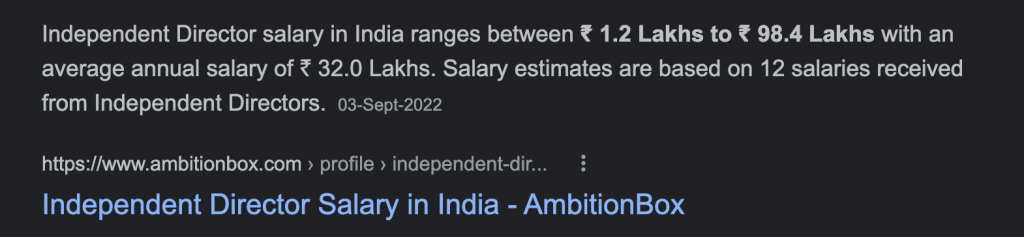
Here is the broad range of fees earned by independent directors.
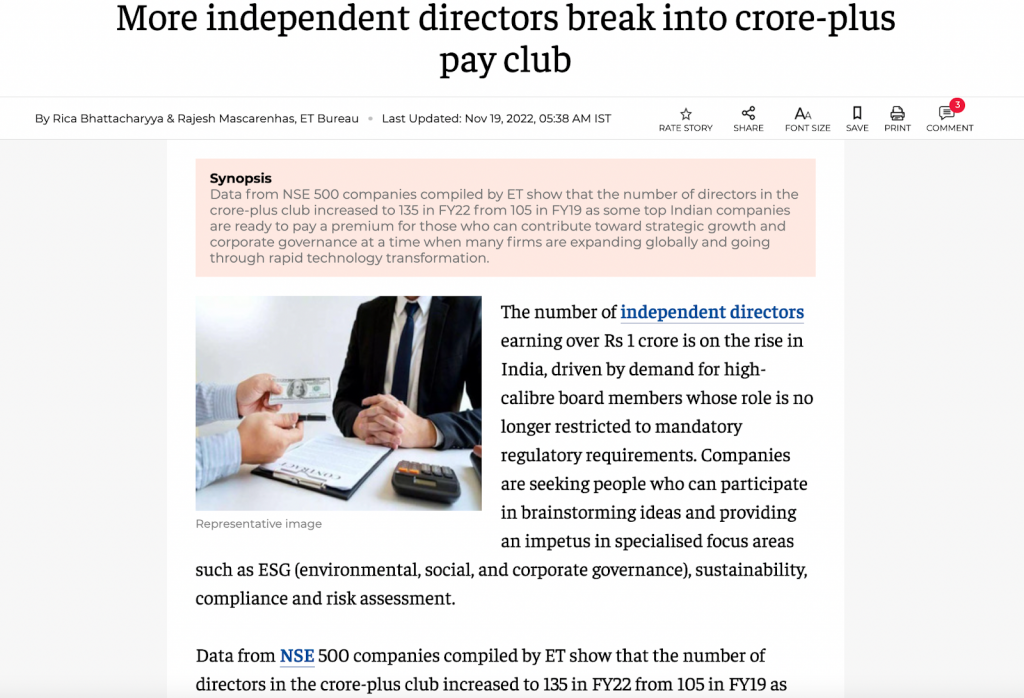
At the top end of the spectrum, the pay is extremely high.
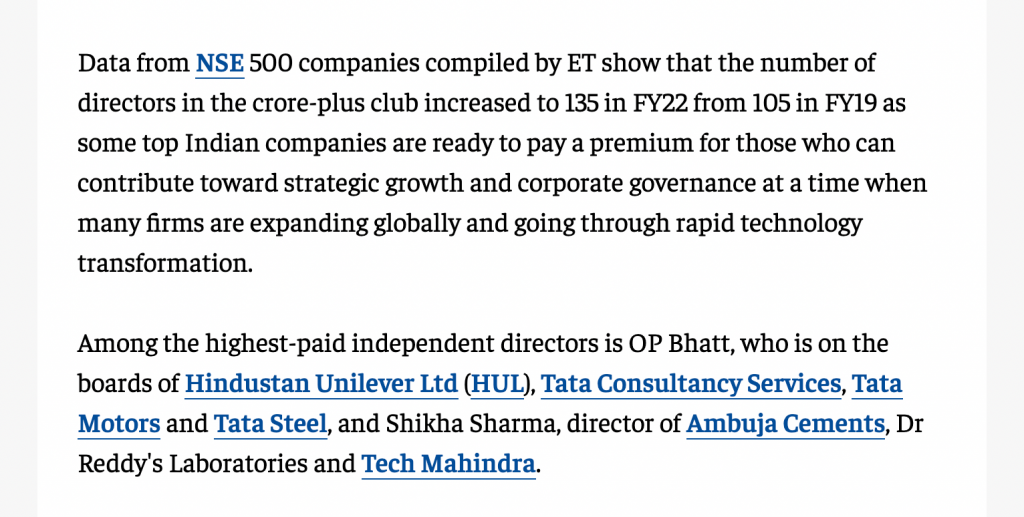
Here is some information on the earnings of a senior independent director who sits on the boards of many leading and high-profile companies in India.
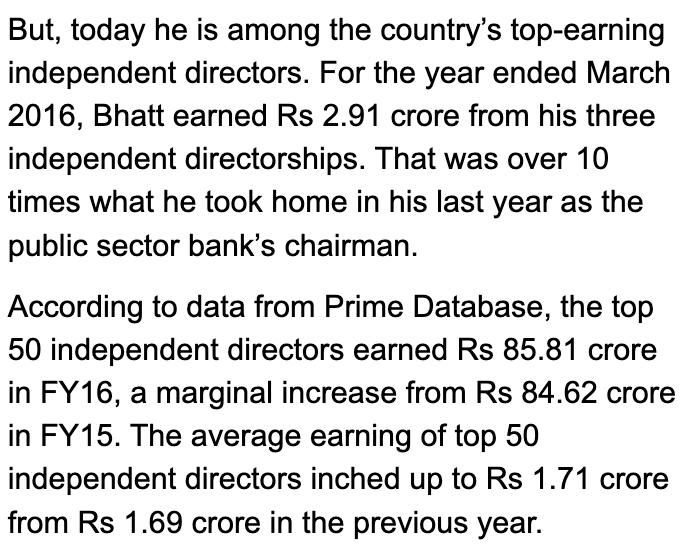
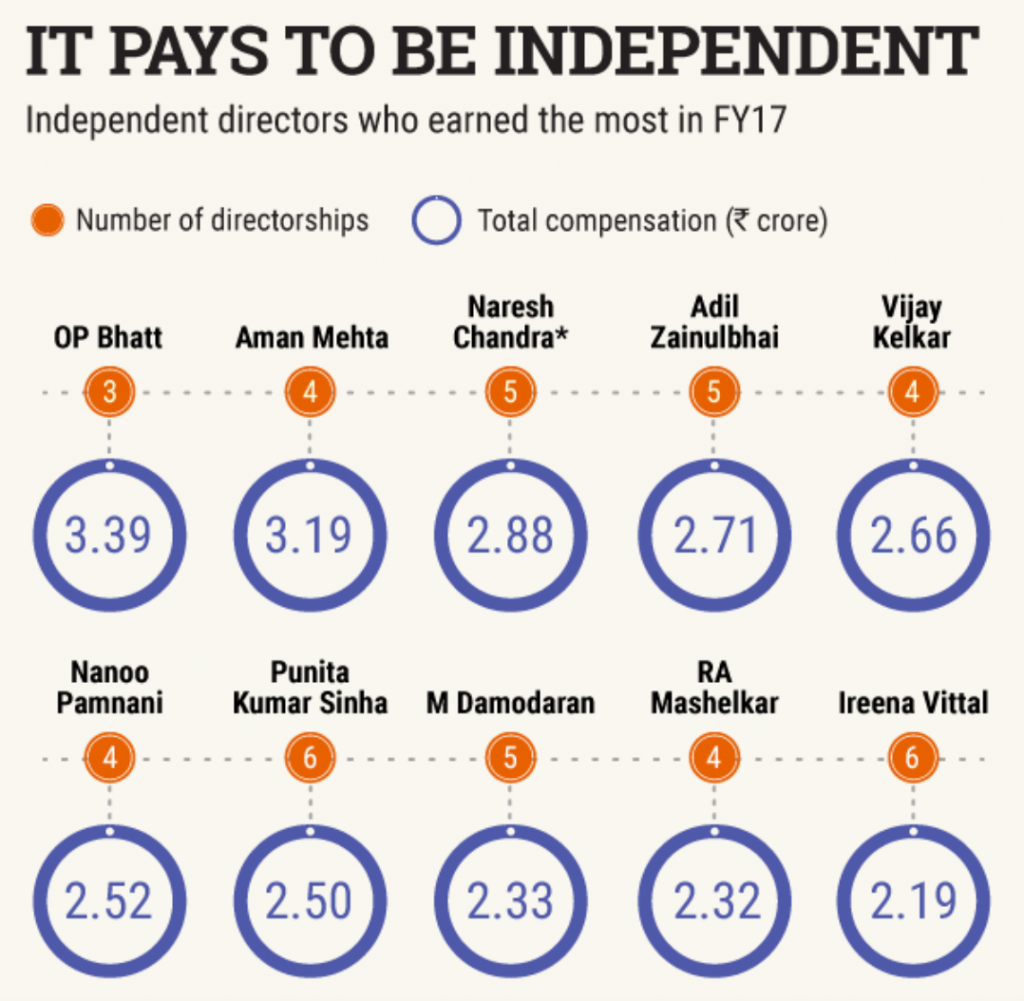
Earnings as an ID
Let me give you a very basic calculation for independent directors at an entry level. It is reasonable for independent directors to charge up to INR 50,000-1 lakh per meeting. The board of a company must meet at least once in every 3 months, and can meet more frequently.
Independent directors must also be present on the committees of the board, especially the audit committee, nomination committee, remuneration committee, and attend meetings of such committees as well.
The board meets at least 4 times a year, and the committees meet at least twice in a year. In addition, there is an exclusive independent directors’ only meeting to be held every year.
Assuming that you charge INR 50,000 per meeting and there are 9 meetings per year for a company on an average, which is reasonable.
If you are an independent director for 5 companies, you can earn INR 22.5 lakh, or almost INR 2 lakh per month! That too for part-time work, where you are primarily attending a few meetings.
This is only the starting point. As you build your track record, you can charge more. Maybe after 3-5 years, you could charge INR 1 or 2 lakh per meeting as well, and companies will pay because of the value that you bring to the board.
You can go on increasing your fee with more and more experience, as you seek out appointments on the boards of the largest and most valuable companies of India, who need your expertise.
Other benefits
The other benefits are recognition, prestige, fame and power. It is a big achievement to be associated with India’s largest and most prestigious companies. Major moves by such companies, even your appointment as independent director itself, are covered in the press.
You won’t have to worry about media coverage any more. Your actions at the meetings and their impact on corporate strategy at the board level will likely be reported by the media.
This not only brings you recognition, but if your conduct is principled and sound, this media coverage will amplify your goodwill and track record very rapidly
There are other benefits too. Being an independent director is at the top of the pyramid for multiplying your networking as well. You will be in the same boardroom as the top business leaders of the country, who trust you for your wisdom and the value that you add.
For example, Cyril Shroff and Zia Mody, managing partners of two of India’s biggest corporate law firms, are appointed as independent directors of many companies. Why do they choose to do it despite running law firms that rake in over INR 500 crore every year?
It is because there is no better networking opportunity than being an ID on a board. This way, they ensure revenue flow to their law firms. These are very valuable relationships and ensure a significant flow of work in the long term.
Of course, for the period of your appointment, you or your firm cannot work in a professional capacity with companies on whose boards you have been appointed. But you can get introductions through such networks to other reputed companies. The investors of one company are on the boards of other companies, too. And they have a huge say in which law firms get their work.
Being an ID puts you in a very exclusive club with many intangible benefits. Like investment opportunities that are not open or known to the general public. Perhaps you can tag along in certain strategic investments or angel investment funds that never open up to general investors.
Ashneer Grover, entrepreneur and former MD of BharatPe, was trying to access pre-IPO shares from Nykaa through Kotak Mahindra. Why was he angry and shouting at the banker in the video clip that went viral? It is because he did not want to miss the investment opportunity that he knew would make him a lot of money (he did miss it, which is why he was angry).
Your professional network as an ID can open up better job opportunities, too. If you are already working somewhere, you can get access to much more prestigious career opportunities as these business leaders can refer you to their friends and their network.
The position of being an independent director also lends very high credibility for any professional engagements in future. There is no other comparable position or achievement in the corporate world that requires you to have demonstrated a greater level of integrity and character, as an independent director.
Having such powerful connections and such a high credibility are very important for escaping the middle management trap. This has a force multiplier effect on your career. Suddenly, you are very much in demand.
You get to see the inner workings of a board and contribute to it. You help your board navigate the ups and downs. What a learning opportunity! You will be more respected for being a corporate insider.
Also, there is an opportunity for service and contribution. You are safeguarding the interests of the public who have invested in India’s largest and most reputed companies. You have the responsibility to ensure that management operates ethically and with integrity.
The impact is tremendous.
So do you see yourself becoming an Independent Director? Are you interested in this opportunity?
We can help you get there. Connect with us to know more. You can do so by joining our Telegram channel.
Become an Independent Director!
Independent Director Salary in India (2026): What the Data Actually Shows
The compensation of an independent director in India is not a fixed salary — it is a combination of sitting fees, commission, and in some cases, profit-linked remuneration. The total you earn depends on how many boards you sit on, the size of those companies, and whether they are listed or unlisted.
According to an Exec-Rem Advisors study reported by Business Standard, the median total compensation for independent directors at Nifty-50 companies reached approximately Rs 87.4 lakh in FY2024. At the higher end, 151 independent directors earned over Rs 1 crore annually by FY2023 (source: BoardStewardship.com), making independent directorship one of the most lucrative part-time roles available to senior professionals in India.
Here is what the actual numbers look like across different company tiers:
| Company Type | Sitting Fees Per Meeting | Meetings/Year (Avg) | Commission (Annual) | Total Annual Compensation |
|---|---|---|---|---|
| Nifty-50 / Large-cap Listed | Rs 50,000 – Rs 1,00,000 | 15-20 (board + committees) | Median Rs 74.10 lakh in FY24 | Rs 30 lakh – Rs 1.5 crore+ |
| Mid-cap Listed | Rs 30,000 – Rs 75,000 | 10-15 | Rs 5-20 lakh | Rs 10-30 lakh |
| Small-cap / SME Listed | Rs 10,000 – Rs 50,000 | 8-12 | Rare / minimal | Rs 2-8 lakh |
| Unlisted Public Company | Rs 10,000 – Rs 30,000 | 6-10 | Usually none | Rs 1-4 lakh |
These are per-company figures. An independent director holding 3-4 board positions multiplies these earnings accordingly. The Companies Act, 2013 allows you to hold up to 20 directorships in total under Section 165, with a maximum of 10 in public companies and 7 in listed companies under SEBI LODR Regulation 25.
Independent Director Sitting Fees — Legal Limits Under Companies Act
The sitting fee structure is governed by Section 197 of the Companies Act, 2013, read with Rule 4 of the Companies (Appointment and Remuneration of Managerial Personnel) Rules, 2014. The current cap is Rs 1,00,000 per board meeting and Rs 1,00,000 per committee meeting. Companies set their own sitting fee within this ceiling — not all companies pay the maximum. Independent directors who are members of the Audit Committee and the Nomination and Remuneration Committee attend both board and committee meetings, which increases total sitting fee income significantly.
Independent Director Remuneration and Commission Under Section 197
Beyond sitting fees, independent directors in listed companies often receive commission — a share of the company’s net profits approved by shareholders. The Nifty-50 median commission for independent directors reached Rs 74.10 lakh in FY2024, growing at approximately 17% CAGR since FY2019 (source: Exec-Rem Advisors / Business Standard). This commission is separate from and in addition to sitting fees.
The legal framework sets these limits under Section 197(1) of the Companies Act, 2013:
| Type | Limit | Approval Required |
|---|---|---|
| Sitting fees | Rs 1,00,000 per board meeting + Rs 1,00,000 per committee meeting (Rule 4) | Board resolution |
| Commission (company has MD/WTD) | Up to 1% of net profits | Special resolution by shareholders |
| Commission (company without MD/WTD) | Up to 3% of net profits | Special resolution by shareholders |
| Overall managerial remuneration cap | 11% of net profits — Section 197(1) | Shareholder approval |
| Stock options (ESOPs) | Prohibited for independent directors — Section 197(7) | N/A |
For listed companies, SEBI’s LODR Regulations additionally require full disclosure of all remuneration paid to independent directors in the annual report and the corporate governance report.
Schedule V Remuneration Brackets (When Company Has Inadequate Profits)
When a company has inadequate or no profits, Schedule V of the Companies Act prescribes maximum remuneration limits based on the company’s effective capital:
| Effective Capital of Company | Maximum Annual Remuneration |
|---|---|
| Negative or less than Rs 5 crore | Rs 60 lakh |
| Rs 5 crore to less than Rs 100 crore | Rs 84 lakh |
| Rs 100 crore to less than Rs 250 crore | Rs 120 lakh |
| Rs 250 crore and above | Rs 120 lakh + 0.01% of effective capital exceeding Rs 250 crore |
Tax Treatment of Independent Director Income
Sitting fees and commission received by independent directors are treated as professional income, not salary income, because you are not an employee of the company. This has three key implications:
TDS: Companies deduct TDS under Section 194J of the Income Tax Act (fees for professional/technical services) at 10% on sitting fees and commission. This is different from Section 192 (TDS on salary) because independent directors are not employees. There is no threshold limit — TDS applies from the first rupee. If you do not provide your PAN, TDS is deducted at 20% under Section 206AA.
GST: Independent directors providing services to companies are subject to GST at 18% under the Reverse Charge Mechanism (RCM). Under RCM, the company (not you) is liable to pay the GST to the government and may claim Input Tax Credit. You need GST registration if your aggregate turnover from directorship fees exceeds Rs 20 lakh in a financial year (Rs 10 lakh for special category states).
ITR Filing: Director fees are declared under “Income from Business or Profession” under Section 28 of the Income Tax Act, not under “Income from Salary.” You can claim legitimate business expenses against this income, including travel to board meetings, professional subscriptions, and reference materials.
From IICA Exam to First Board Appointment — Realistic Timeline
Passing the IICA Online Proficiency Self-Assessment Test (OPSAT) through the independentdirectorsdatabank.in portal is the regulatory gateway, but it does not automatically land you a board seat. The timeline from exam to first sitting fee payment varies based on your professional background.
For retired bureaucrats, senior CAs/CSs, and former banking executives, 2-4 months is typical. These professionals already have the network and domain credibility that Nomination and Remuneration Committees look for. For mid-career professionals entering independent directorship for the first time, 6-12 months is realistic. You need to complete your databank registration, build a visible profile with your domain specialisation, and actively network through IICA events, industry associations, and professional bodies like ICAI, ICSI, or bar councils.
Certain professionals are exempt from the OPSAT under Rule 6(4) of the Companies (Appointment and Qualification of Directors) Rules, 2014 — including those with 10 cumulative years as director/KMP in a listed company, and CAs, CSs, Cost Accountants, and Advocates with at least 10 years of practice. However, even exempt individuals must register in the Independent Directors Databank.
Disclaimer: This article is for informational and educational purposes only and does not constitute legal, tax, or financial advice. Compensation figures are based on publicly available annual report data (BoardStewardship.com) and industry research (Exec-Rem Advisors / Business Standard). Actual earnings vary significantly by company, role, and individual circumstances. Laws, rules, and tax regulations are subject to change. Consult a qualified professional for advice specific to your situation. Information is current as of March 2026.
Frequently Asked Questions
Do independent directors get paid in India?
Yes. Independent directors receive sitting fees for every board meeting and committee meeting they attend. Listed companies pay between Rs 10,000 and Rs 1,00,000 per meeting, which is the cap set by Rule 4 under the Companies Act, 2013. Many listed companies also pay annual commission from net profits, which requires shareholder approval through a special resolution. An independent director holding 3-4 board positions and attending all meetings typically earns Rs 15-40 lakh per year from sitting fees alone, with commission potentially doubling or tripling that amount at larger companies.
What is the average independent director compensation at Nifty-50 companies?
According to an Exec-Rem Advisors study, the median total compensation for independent directors at Nifty-50 companies reached Rs 87.4 lakh in FY2024. The median commission component alone was Rs 74.10 lakh, reflecting a 17% CAGR growth from FY2019. At the top end, independent directors at large-cap companies have been reported earning upwards of Rs 3-4 crore in a single year from a single board seat.
What is the maximum sitting fee an independent director can receive per meeting?
Rs 1,00,000 per board meeting and Rs 1,00,000 per committee meeting, as prescribed by Rule 4 of the Companies (Appointment and Remuneration of Managerial Personnel) Rules, 2014. Companies can set fees below this cap. Independent directors who sit on the Audit Committee, Nomination and Remuneration Committee, and Stakeholders Relationship Committee attend multiple types of meetings, increasing their total sitting fee income.
What is the commission limit for independent directors under the Companies Act?
Under Section 197(1), commission for independent directors cannot exceed 1% of the company’s net profits if the company has a managing director or whole-time director, or 3% if it does not. The overall cap on total managerial remuneration (including all directors) is 11% of net profits. Commission requires approval through a special resolution at the general meeting.
How many companies can an independent director serve on simultaneously?
Under Section 165 of the Companies Act, a person can hold directorships in up to 20 companies total, with a maximum of 10 public companies. SEBI LODR Regulation 25 further restricts listed company independent directorships to 7 (or 3, if the person is a whole-time director in any listed entity). Each additional board position generates separate sitting fees and potential commission.
Is GST applicable on independent director sitting fees?
Yes. Sitting fees and commission paid to independent directors attract 18% GST under the Reverse Charge Mechanism. The company paying the fee is responsible for depositing the GST, not the director. If your aggregate turnover from directorship fees exceeds Rs 20 lakh per year (Rs 10 lakh for special category states), you are required to obtain GST registration.
Are independent director fees taxed as salary or professional income?
Professional income. Since independent directors are not employees, TDS is deducted under Section 194J at 10% (not Section 192 for salary). There is no threshold — TDS applies from the first rupee. The income is declared under “Income from Business or Profession” (Section 28 of the Income Tax Act) in your ITR. You can claim legitimate business expenses against this income.
Can independent directors receive stock options (ESOPs)?
No. Under Section 197(7) of the Companies Act, 2013, independent directors are explicitly prohibited from receiving stock options. Their compensation is limited to sitting fees and commission. This restriction was designed to maintain independence from equity-linked incentives that could compromise objectivity in board decision-making.
What happens to independent director remuneration when the company has no profits?
When a company has inadequate or no profits, Schedule V of the Companies Act prescribes maximum remuneration limits based on the company’s effective capital — ranging from Rs 60 lakh (for companies with effective capital below Rs 5 crore) to Rs 120 lakh plus 0.01% of effective capital exceeding Rs 250 crore. Payment beyond these limits requires Central Government approval.
How has independent director compensation in India changed over recent years?
Compensation has grown significantly. The Nifty-50 median commission grew at approximately 17% CAGR from FY2019 (Rs 33.6 lakh) to FY2024 (Rs 74.10 lakh), according to Exec-Rem Advisors. The number of independent directors earning over Rs 1 crore annually rose from 67 in FY2018 to 151 in FY2023, as reported by BoardStewardship.com. This growth reflects increasing regulatory responsibilities, personal liability exposure, and the premium companies place on qualified board oversight.





 Allow notifications