
Last verified: June 2026
A mid-career advocate in a metro commercial practice once shelved a long-held plan to qualify in England and Wales. The reason wasn’t talent or money. It was the old route itself.
To become a solicitor through the LPC and the training-contract system, a foreign lawyer effectively needed a UK firm willing to take them on for two years on the ground. Arranging that from a chamber in Mumbai or a corporate desk in Gurugram was, for most people, close to impossible. So the file stayed shut for years.
Then the structure changed. In September 2021, the Solicitors Regulation Authority replaced the LPC and the QLTS with a single centralised assessment, and that change is exactly why understanding the SQE structure now matters so much to Indian lawyers. For the first time, the path to becoming a solicitor of England and Wales ran through one standardised, exam-based system that an Indian law graduate could largely prepare for from India.

No mandatory training contract gatekeeping the door. No firm sponsorship needed just to start. The advocate who’d shelved the plan suddenly had a route that began with something familiar: an exam.
That advocate’s situation isn’t unusual. Across India’s legal market, lawyers with an LLB and a few years of practice keep asking the same questions. What does this exam actually involve? Is it one paper or several?
What does it test, and how hard is it to pass? And the question underneath all of them: does any of this realistically apply to someone holding an Indian degree, sitting in an Indian city, with an Indian bar enrolment?
Here’s the thing about the SQE. It looks intimidating from the outside because it’s built in stages, with its own vocabulary: FLK1, FLK2, functioning legal knowledge, scaled scores, stations, QWE. Strip away the jargon, though, and the architecture is logical.
There’s a knowledge stage and a skills stage. One tests whether you know the law of England and Wales well enough to apply it. The other tests whether you can actually do a solicitor’s job: interview a client, draft a document, research a problem, argue a point.
What almost no guide does well is connect that architecture to the Indian reality. The deep UK explainers ignore India entirely. The India-focused blogs gloss over the exam mechanics. You end up reading five sources to assemble one answer, and you still can’t tell whether your Indian LLB even counts, or whether your years at the bar earn you an exemption.
If you’ve ever wondered exactly how the SQE is built: what SQE1’s FLK1 and FLK2 papers test, what the 16 SQE2 stations involve, how the marking works, and what the whole structure means for someone holding an Indian LLB, this is the map. We’ll walk the full architecture first, with the exact, sourced numbers. Then we’ll translate every piece of it into the India route: eligibility, QWE, exemptions, true cost in rupees, and the honest reality about working in the UK afterwards.
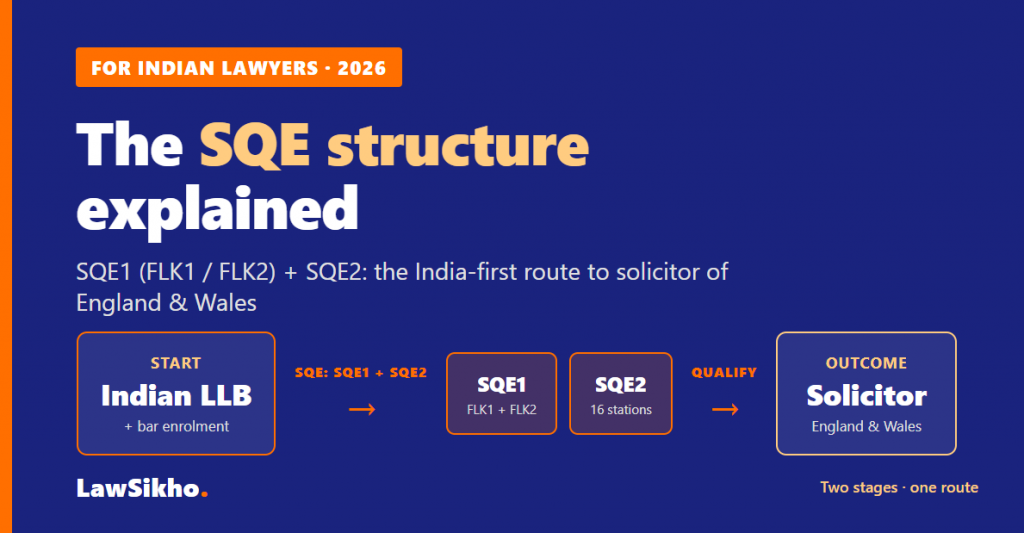
The SQE (Solicitors Qualifying Examination) is the single assessment route to becoming a solicitor of England and Wales. It has two stages: SQE1, which tests legal knowledge through two computer-based papers (FLK1 and FLK2, 180 single-best-answer questions each), and SQE2, which tests practical legal skills across 16 stations, 12 written and 4 oral.
That two-stage shape is the spine of everything below. Get it clear in your head, and the rest of the detail (the timing, the marking, the India route) hangs off it cleanly. Let’s start with the structure at a glance.
What is the SQE? The two-stage structure at a glance
Most people meet the SQE as a wall of acronyms and give up before they understand it. That’s a shame, because the structure is the easy part. Once you can hold the two stages in your head, every other detail finds its place. So before any of the numbers, fix the shape.
The SQE has two stages, and you sit them in order. SQE1 is the knowledge stage. It checks whether you know the law of England and Wales well enough to apply it to a problem, and it does so through two computer-based papers called FLK1 and FLK2.
SQE2 is the skills stage. It checks whether you can actually perform the tasks a junior solicitor performs, and it does so through 16 assessment stations split between written exercises and live oral exercises. Knowledge first, then skill. That’s the whole logic.
[INFOGRAPHIC: infographic-01]
The two stages: SQE1 (knowledge) and SQE2 (skills)
SQE1 and SQE2 reward completely different things, and that distinction shapes how you prepare for each. SQE1 rewards recall and applied reasoning under exam conditions: 360 multiple-choice questions across two papers, each with one best answer, sat closed-book. SQE2 rewards demonstrable competence: drafting a real document, researching a real problem, conducting a real client interview with a trained actor playing the client.
One is a test of what’s in your head. The other is a test of what your hands and your judgment can do with it.
Why does the split matter for an Indian lawyer specifically? Because your existing experience maps onto the two stages unevenly. Years at an Indian bar may sharpen the practical instincts SQE2 measures, yet SQE1 still demands fresh study of English law, which differs from Indian law in property, trusts, and procedure. Recognising that asymmetry early saves months of misdirected prep.
Why the SQE replaced the QLTS/LPC route in 2021 [HISTORICAL]
The SQE didn’t appear in a vacuum. Before September 2021, aspiring solicitors took the Legal Practice Course (LPC) and then secured a two-year training contract, while foreign-qualified lawyers used the Qualified Lawyers Transfer Scheme (QLTS). That system was fragmented and, for overseas candidates, heavily dependent on a UK firm’s willingness to provide training.
The SRA introduced the SQE to centralise and standardise qualification: one assessment, one provider, one consistent benchmark for everyone regardless of where they studied. For Indian lawyers, that shift quietly removed the single biggest structural barrier, the mandatory training contract, and replaced it with an exam they could largely tackle from home.
In practice, what experienced advisers tell Indian candidates is that the 2021 change did more than swap one exam for another. It moved the centre of gravity from “who will sponsor me” to “can I pass a standardised assessment”, which is a far more controllable variable for someone building a career from India.
A common question that comes up in forums is whether the old QLTS still exists as a backup. It doesn’t for new entrants. The QLTS closed to new candidates when the SQE launched, so anyone starting today is on the SQE route, full stop.
One trap catches people repeatedly: assuming old guidance still applies. Plenty of advice written before 2021 floats around online, describing training contracts and the LPC as if they were current requirements. They aren’t the route anymore, and following stale guidance wastes both time and money.
Who the SQE is for, and why it matters for Indian lawyers
The SQE is for anyone who wants to qualify as a solicitor of England and Wales, whether they trained in London or in Lucknow. For Indian lawyers, it matters because it’s the first qualification route in a generation that treats an overseas candidate’s path as a genuine option rather than an exception bolted onto a domestic system. An Indian LLB holder, an enrolled advocate, a corporate counsel with a few years in-house: each can use the same structure, with the India-specific adjustments we’ll cover later.
| Stage | What it tests | Format | Pass mark |
|---|---|---|---|
| SQE1 | Functioning legal knowledge (law applied to problems) | Two computer-based papers, FLK1 and FLK2; 180 single-best-answer questions each (360 total); closed book | Scaled score of 300/500 on each FLK |
| SQE2 | Practical legal skills (drafting, research, writing, interviewing, advocacy) | 16 stations: 12 written + 4 oral, across five half-days | Scaled score of 300/500 |
That table is the SQE in one frame. Everything from here is detail layered onto it. The first layer worth opening up is SQE1, because that’s where most Indian candidates begin and where the bulk of the study time goes.
SQE1 explained: FLK1 and FLK2
SQE1 is where the SQE structure gets its reputation for being a grind, and understanding its format is the difference between targeted preparation and panic. This is the knowledge stage, and it’s deliberately broad. The SRA wants evidence that you can apply the law of England and Wales across a wide range of practice areas, not just the ones you happen to like. That breadth is the challenge, and the format is built to enforce it.
What “functioning legal knowledge” means
FLK stands for Functioning Legal Knowledge, and the word “functioning” is doing real work in that phrase. The SQE doesn’t reward memorising statutes in the abstract. It rewards the ability to take a legal rule and apply it to a concrete client scenario to reach the right answer.
Each question typically presents a short factual situation and asks what the legally correct outcome or next step is. You’re not reciting law. You’re using it.
For an Indian lawyer, this is both reassuring and a warning. Reassuring, because applied legal reasoning is something practice already trains. A warning, because the law being applied is English law, and the right answer often turns on a rule that has no Indian equivalent, or worse, an Indian equivalent that points the opposite way.
180 single-best-answer questions per FLK paper (360 total)
The numbers are precise, and they’re worth committing to memory. SQE1 consists of two papers, FLK1 and FLK2. Each paper contains 180 single-best-answer multiple-choice questions, which means 360 questions in total across SQE1.
“Single best answer” describes the format: each question offers five possible answers, and exactly one is the best response. You’re not looking for the only correct option; you’re often choosing the strongest among several that could arguably work. That distinction trips up candidates who treat it like a school MCQ.
Think of it this way. A school exam asks you to spot the right answer among wrong ones. SQE1 frequently asks you to spot the best answer among several defensible ones, which is a finer, more lawyerly judgment, and exactly why the question style takes practice to master.
How a FLK day is structured: morning and afternoon, closed book
Each FLK paper is sat across a single day, split into two sessions. The 180 questions are divided into 90 in a morning session and 90 in an afternoon session. Each session runs for two hours and thirty-three minutes (153 minutes), with a scheduled break in between, which works out to about one minute and forty-two seconds per question.
The whole paper is closed book: no statutes, no notes, no reference materials. You carry the law in your head and apply it against the clock.
In practice, the timing is the silent difficulty. Candidates who know the law cold still falter because 102 seconds per question leaves no room to agonise. The skill SQE1 quietly tests, alongside knowledge, is decisiveness under a closed-book clock.
A question that surfaces constantly in candidate communities is whether the closed-book format means rote memorisation. It doesn’t, quite. You need the rules at your fingertips, yes, but the questions reward application, not regurgitation. Memorising without practising application is the most common way strong students underperform.
The pitfall worth flagging early: treating FLK1 and FLK2 as two separate hurdles you can pass one at a time in isolation. You can’t bank one and forget the other casually, and the sequencing of the two papers (covered next) catches people off guard.
When FLK1 and FLK2 are sat (FLK2 about a week after FLK1)
FLK1 and FLK2 aren’t sat on the same day, and they aren’t sat months apart either. In a typical sitting, FLK2 follows FLK1 by about a week. So the SQE1 experience is really two intense exam days separated by a short gap, not a single marathon and not a drawn-out campaign.
That compressed window matters for prep planning: you can’t realistically “cram FLK2 during the gap”, because the gap is too short and you’ll be recovering from FLK1. Both papers need to be exam-ready before FLK1 day.
What FLK1 tests vs what FLK2 tests
Knowing that SQE1 has two papers is one thing. Knowing which subjects live in which paper is what lets you build a study plan that doesn’t leave gaps. The two FLK papers cover different territory, and the division isn’t random: FLK1 leans toward the foundations and the contentious side of practice, while FLK2 leans toward property, private client, and the technical mechanics of running a solicitor’s office.
FLK1 subjects
FLK1 covers Business Law and Practice, Dispute Resolution, Contract, Tort, the Legal System of England and Wales, Constitutional and Administrative Law together with retained EU law, and Legal Services. If you map that against an Indian LLB, some of it feels familiar in shape (contract and tort exist in both systems), but the substance diverges sharply. English contract doctrine, the structure of the English court system, and the regulatory framework for legal services are all distinct from their Indian counterparts and need fresh study.
[INFOGRAPHIC: infographic-02]
FLK2 subjects
FLK2 covers Property Practice, Wills and the Administration of Estates, Solicitors Accounts, Land Law, Trusts, and Criminal Law and Practice. This is, for many Indian candidates, the harder paper, and not because it’s conceptually tougher. It’s harder because English land law and trusts have no clean Indian equivalent, and Solicitors Accounts (the rules governing how a solicitor handles client money) is a topic Indian practice simply doesn’t teach. Frankly, this gets overlooked: candidates pour time into the familiar-sounding FLK1 subjects and underestimate the genuinely foreign FLK2 material.
Ethics and professional conduct: examined across both, not separately
Here’s a structural detail people miss. There is no separate ethics paper. Ethics and professional conduct are examined pervasively across both FLK1 and FLK2, woven into questions throughout.
So a question dressed up as a dispute-resolution problem might actually turn on a conduct rule about conflicts of interest. The SRA treats professional ethics as the connective tissue of practice, not a standalone subject, and the assessment reflects that.
What experienced SQE mentors stress is that this pervasive ethics design rewards candidates who treat conduct as a live lens on every topic, not a chapter to revise at the end. Miss that, and you can lose marks on questions you thought were “about something else”.
A recurring community question is whether you can skip ethics revision if you’re strong on the black-letter subjects. You can’t. Because ethics is distributed across both papers, weak conduct knowledge bleeds into your score everywhere, and there’s no single section you can write off.
| FLK1 subjects | FLK2 subjects |
|---|---|
| Business Law and Practice | Property Practice |
| Dispute Resolution | Wills and the Administration of Estates |
| Contract | Solicitors Accounts |
| Tort | Land Law |
| Legal System of England and Wales | Trusts |
| Constitutional and Administrative Law and EU law | Criminal Law and Practice |
| Legal Services |
Ethics and professional conduct are examined across both FLK1 and FLK2, not as a separate paper.
Here’s the trap to avoid: building a revision timetable that front-loads the comfortable FLK1 topics and pushes Solicitors Accounts and Land Law to the end. Those unfamiliar FLK2 areas need the most runway, not the least.
- Business Law and Practice
- Dispute Resolution
- Contract
- Tort
- Legal System of England and Wales
- Constitutional and Administrative Law and EU law
- Legal Services
- Property Practice
- Wills and the Administration of Estates
- Solicitors Accounts
- Land Law
- Trusts
- Criminal Law and Practice
How SQE1 is marked: the 300/500 scaled score
Few parts of the SQE cause more confusion than the marking, and the confusion costs candidates real preparation mistakes. People hear “pass mark 300 out of 500” and immediately translate it to “I need 60%”. That translation is wrong, and believing it can quietly sabotage how you benchmark your readiness.
What a scaled score of 300/500 actually means
The pass mark for each FLK is a scaled score of 300 out of 500. A scaled score is not the same as the raw percentage of questions you answered correctly. The SRA converts your raw score (how many of the 180 questions you got right) into a scaled score that accounts for the difficulty of the particular questions you faced.
The 300/500 threshold sits on that converted scale, not on your raw count. So 300/500 is a standard of competence, expressed on a calibrated scale, not a simple “60% of questions correct” line.
Why “60%” is a myth: quintiles and difficulty adjustment [SECOND-ORDER]
Here’s why the 60% assumption is a myth with teeth. Because questions vary in difficulty between sittings, the raw number of correct answers needed to hit a scaled 300 shifts from one sitting to the next. A harder paper means fewer raw correct answers are needed for the same scaled score; an easier paper means more. The SRA also reports candidate performance in quintiles (fifths of the cohort), which tells you where you sat relative to peers, not against a fixed 60% bar.
The second-order consequence is the part most candidates miss: if you prepare to “just clear 60%”, you’re aiming at a moving target that may sit above or below 60% on the day, and you’ve given yourself no safety margin. The smarter approach is to prepare to be comfortably competent across the whole syllabus, so that wherever the threshold lands on your sitting, you’re clear of it.
You must pass both FLKs; results in about five to six weeks
Two more marking facts close out this section. First, you must pass both FLK1 and FLK2 to pass SQE1; a strong score on one cannot rescue a fail on the other. Second, SQE1 results are typically released about five to six weeks after the sitting. That gap matters for planning, because you generally need your SQE1 result before you can move on to SQE2, and the wait eats into your timeline.
A question candidates raise is whether a near-miss on one FLK lets you re-sit only that paper. In practice you re-sit the assessment you failed, but the attempts and time-window rules (covered shortly) govern how that works, and they’re stricter than most people assume. For a fuller view of the difficulty curve and how to get ahead of it, it’s worth reading about the practical challenges the SQE poses and how candidates work through them.
Where candidates slip is complacency about one paper. Those who feel strong in FLK1 sometimes coast, then discover the scaled score gave them less cushion than the raw count suggested. Treat both papers as equally capable of ending your SQE1 attempt.
SQE2 explained: the 16 stations (12 written + 4 oral)
If SQE1 asks what you know, SQE2 asks what you can do, and that shift is the single most important thing to grasp about the second stage. SQE2 doesn’t use multiple-choice questions. It puts you through 16 assessment stations that simulate the actual tasks of a practising solicitor, and it scores you on competence, not recall. The 16 stations break into 12 written and 4 oral.
[INFOGRAPHIC: infographic-03]
The four oral skills stations
The four oral stations are the part that unsettles candidates most, because there’s nowhere to hide behind a written answer. Two of the oral stations cover the client interview, where you interview a client (played by a trained actor) and then produce an attendance note recording the meeting and your legal analysis. The other two cover advocacy, where you make submissions as you would before a court or tribunal.
You’re assessed on your skills (how you listen, question, structure, and argue), applied to a legal matter. The actor isn’t there to trip you up; they’re there to make the simulation real.
For an Indian advocate used to live court work, the advocacy stations can feel like home turf, with one caveat: the procedure and etiquette are English, and you’re judged on the English conventions, not the ones you practise in an Indian courtroom.
The 12 written skills stations
The 12 written stations test four written skills across multiple practice contexts: case and matter analysis, legal research, legal writing, and legal drafting. In broad terms, you analyse a set of facts and advise on the matter, research a legal question and present findings, write a letter or note communicating advice, and draft a legal document such as a contract clause or a court form. These are the bread-and-butter outputs of a junior solicitor’s working week, reproduced under exam conditions.
What practitioners who’ve coached SQE2 candidates point out is that the written stations reward clarity and structure over legal fireworks. A clean, correctly formatted attendance note or a precisely drafted clause scores better than a brilliant but disorganised one. That’s a mindset shift for candidates trained to write dense, citation-heavy submissions.
The five practice contexts
The skills above are tested across five practice contexts: Criminal Litigation, Dispute Resolution, Property Practice, Wills and Intestacy together with Probate and Administration, and Business organisations. So a legal-drafting station might ask you to draft in a property context, while a research station might sit in a criminal-litigation context. You don’t get to specialise; SQE2 deliberately spreads the skills across the breadth of general practice.
A common question is whether you can choose your strongest practice areas for SQE2. You can’t. The assessment samples across all five contexts, which is why narrow specialists sometimes struggle more than well-rounded generalists.
The pitfall: assuming SQE2 is “easier” because it isn’t multiple-choice. It’s a different kind of hard. You can know the law and still lose marks for poor structure, weak client-handling, or a drafting error, because the skill itself is what’s being graded.
- Case and matter analysis
- Legal research
- Legal writing
- Legal drafting
- Client interview Interview a trained actor + write an attendance note
- Advocacy Make submissions as if before a court or tribunal
How SQE2 is structured across five half-days
The 16 stations don’t happen in one sitting. They’re spread across a structured assessment window, and knowing the shape of that window helps you understand the stamina the second stage demands. SQE2 is a marathon of applied performance, not a single sprint.
Five half-days: two oral days and three written days
SQE2 is assessed across five half-days. Two of those half-days are devoted to the oral stations (the interviews and advocacy), and three are devoted to the written stations. So the assessment unfolds over several days, each one demanding sustained focus under observation or against the clock. The spread is deliberate: it tests whether you can perform consistently, the way a real solicitor does across a working week, rather than peaking once.
Marking: scaled score 300/500; results in about 14 to 18 weeks
SQE2 is marked on the same scaled-score basis as SQE1, with a pass mark of 300 out of 500. The difference is what’s being scaled: in SQE2, assessors score your performance against competence criteria for each skill, and those scores feed the scaled total. Results take longer than SQE1, typically around 14 to 18 weeks after the assessment. That’s a meaningful wait, and it’s worth factoring into any plan that depends on being admitted by a particular date.
How SQE2 differs from SQE1 in what it rewards
The deepest structural contrast between the two stages is what they reward. SQE1 rewards accurate recall and fast applied reasoning; SQE2 rewards demonstrable skill and professional judgment. You can be a strong SQE1 candidate (sharp on rules, quick under the clock) and still need real preparation for SQE2, because performing a client interview or drafting a clean document is a different muscle. Treating the two stages as the same kind of challenge is a classic miscalculation.
A question that comes up is whether SQE1 preparation carries you through SQE2. It helps, because you need the underlying law, but it isn’t sufficient. The skills stations demand practice at the skills themselves, which no amount of multiple-choice drilling provides.
The pitfall worth naming: candidates who breeze through SQE1 sometimes underprepare for SQE2, assuming momentum will carry them. It won’t. The second stage punishes the unrehearsed, however strong their legal knowledge.
Sequencing, attempts and the 6-year window
The SQE isn’t just two exams; it’s two exams governed by rules about order, retries, and a clock that starts ticking the moment you begin. Misreading these rules can cost a candidate the whole qualification, so they deserve careful attention rather than a quick skim.
You must pass SQE1 before sitting SQE2
The default sequence is fixed: you must pass SQE1 before you can sit SQE2, unless you hold an exemption from SQE1. Knowledge stage first, skills stage second. This is why your SQE1 results timeline (those five to six weeks) feeds directly into when you can book SQE2. The only people who sit SQE2 without passing SQE1 are those granted an SQE1 exemption, which, as we’ll see in the India section, is rare for foreign-qualified lawyers.
Maximum three attempts per assessment
You get a maximum of three attempts at each assessment. That means up to three goes at SQE1 and up to three at SQE2. Fail an assessment three times, and you cannot re-sit it.
The cap is per assessment, so exhausting your SQE1 attempts is a different event from exhausting your SQE2 attempts, but either one can end the route. (For SQE1, the three-attempt cap applies to each FLK: you have three goes at FLK1 and three at FLK2.) Those three attempts must all fall within the six-year window described below.
The 6-year window from your first SQE assessment
There’s also a time limit, and it’s easy to overlook. You have a six-year window, running from the date you sit your first SQE assessment, to complete the whole SQE. The clock starts at your first sitting, not when you register or when you pass.
If you don’t complete both stages within those six years, or you exhaust your three attempts at an assessment, prior passes are not carried forward beyond the window. The practical reality is that this rewards a planned, continuous campaign over a stop-start one.
What experienced advisers tell candidates is to treat the six-year clock as shorter than it sounds. Between results waits, re-sits, and life, six years compresses fast. Starting SQE2 preparation before you have your SQE1 result (so you’re ready to book the moment you pass) is often the smart move.
A frequent community question is whether a break (for a job, a family event, a move) resets the clock. It doesn’t. The window runs continuously from your first assessment regardless of pauses, which is why long gaps are risky.
Watch for this one: sitting your first assessment before you’re truly ready, “just to start”, and burning both an attempt and clock time. The window starts when you sit, so don’t start until you mean it.
SQE exam dates and where Indian candidates sit the SQE
For an Indian candidate, two practical questions sit on top of all the structure: when can I sit this, and where? The answers contain one genuinely good piece of news and one constraint that catches people out, so it’s worth being precise.
SQE1 twice a year; SQE2 four times a year
The two stages run on different schedules. SQE1 is offered twice a year, typically in January and July. SQE2 is offered four times a year, typically in January, April, July, and October. So SQE2 gives you more frequent opportunities, while SQE1’s twice-yearly rhythm means a missed or failed sitting costs you roughly six months.
As an illustration of the cadence, a July SQE1 sitting typically runs FLK1 in mid-July and FLK2 about a week later, with each FLK spread across an assessment window of several days. Specific calendar dates change each cycle and must be confirmed against the SRA’s published booking windows before you plan around them.
SQE1 can be sat at Pearson VUE centres in India
Here’s the good news Indian candidates most want to hear. SQE1, being computer-based, can be sat at Pearson VUE test centres in India. You don’t have to fly to the UK to take the knowledge stage. The two FLK papers are delivered through Pearson VUE’s global network, and India has centres in major cities.
For the entire SQE1 stage (360 questions, two papers, the bulk of the qualification’s knowledge testing), you can stay in India.
The catch: SQE2’s oral assessment is UK-only
And now the constraint. SQE2’s oral stations cannot currently be sat in India. The oral assessment (the client interviews and advocacy) is delivered only at UK locations, which means you must travel to the UK for that part of the assessment. So the realistic picture is: SQE1 in India, SQE2 requiring a UK trip.
That single fact reshapes the cost and logistics of the whole route, and it’s the detail most generic guides bury. If you’re weighing how far you can get without leaving, it’s worth reading specifically about whether you can qualify without travelling to the UK, because the answer is nuanced rather than a flat yes or no.
A question candidates ask is whether the SQE2 written stations can be sat in India while only the orals are done in the UK. The current structure ties the SQE2 sitting to UK assessment locations, so the practical answer is to plan for a UK trip for SQE2 as a whole. Confirm the latest delivery arrangements with the SRA, as this is exactly the kind of logistical detail that evolves.
The pitfall: budgeting and scheduling as if the whole SQE can be done from India because SQE1 can. The UK trip for SQE2 is a real cost and a real visa-and-travel exercise, and pretending otherwise leads to a nasty surprise.
The sections above explained the SQE’s structure for everyone. The sections below translate that structure into the specific route an Indian law graduate or advocate takes, starting with whether your degree even qualifies you.
What the SQE means for Indian lawyers: eligibility
Before any of the exam structure matters to you personally, one question has to be answered: are you even eligible? This is where most Indian candidates’ anxiety lives, and where the misinformation runs thickest. The reassuring headline is that an Indian LLB can qualify you. The detail is where you need to be careful.
The Level 6 requirement: an Indian LLB can qualify
The SRA’s degree requirement is set at Level 6, which corresponds to a bachelor’s degree, in any subject. You do not need a law degree specifically to sit the SQE, though obviously a legal background helps enormously with the substance. An Indian LLB, being a bachelor’s-level qualification, can meet the Level 6 requirement, provided it’s shown to be equivalent to a UK degree.
Work experience equivalent to a UK degree can also satisfy this requirement in some cases. So the door is open to Indian graduates by design, not by exception.
UK ENIC statement of comparability: proving your degree’s equivalence
The bridge between your Indian degree and the SRA’s Level 6 requirement is usually a UK ENIC statement of comparability. UK ENIC is the UK’s national agency for recognising overseas qualifications, and it issues a statement confirming what your Indian degree is equivalent to in UK terms. For most Indian candidates, obtaining this statement is the practical first step that converts “I have an LLB” into “the SRA accepts that I meet the degree requirement”. It’s a paid service with a processing time, and it’s worth starting early because it gates everything downstream.
In practice, the ENIC statement is the document that quietly separates candidates who’ve done their homework from those who haven’t. The exam structure is identical for everyone, but the eligibility paperwork is where Indian candidates most often stall, simply because no one told them it was the first move.
A question that comes up repeatedly is whether you need a bridge course or conversion programme before the SQE. The short answer is no, not as a regulatory requirement. The SQE assumes you’ll prepare for its content however you choose, and there’s no mandatory pre-SQE course for foreign graduates. Many candidates take a prep course voluntarily, but that’s a study choice, not an eligibility hurdle.
Character and suitability plus the DBS check
Eligibility isn’t only about your degree. Everyone who wants to be admitted as a solicitor undergoes the SRA’s character and suitability assessment, which examines your honesty, integrity, and any relevant history. As part of this, you’ll go through a DBS (Disclosure and Barring Service) check, the UK’s criminal-records check. For most candidates this is a formality, but it’s a genuine gate: undisclosed issues can derail an application late in the day, so honesty on these forms is non-negotiable.
The pitfall here is treating eligibility as an afterthought to be sorted once you’ve passed the exams. The ENIC statement, the character and suitability assessment, and the DBS check all take time, and leaving them late can stall your admission even after you’ve cleared both SQE stages.
QWE for Indian lawyers: the 2-year rule and the qualified-advocate exemption
Passing the exams is necessary but not always sufficient. For most candidates, there’s a third requirement alongside SQE1 and SQE2: Qualifying Work Experience. And this is where the route splits sharply depending on your status in India, in a way that can save an experienced advocate two full years.
What Qualifying Work Experience is: two years FTE, across up to four organisations
Qualifying Work Experience, or QWE, is the SRA’s requirement that you complete two years of full-time-equivalent legal work experience before admission. The flexibility is the modern part: it can be gained across up to four different organisations, and it doesn’t have to be a single traditional training contract. Working in a law firm, an in-house legal team, a law centre, or a legal clinic can all count, provided the experience gives you exposure to the competences a solicitor needs and is signed off appropriately.
QWE can be gained in India if signed off by a solicitor of England and Wales
Here’s the part that surprises Indian candidates. QWE doesn’t have to be completed in the UK. Work experience gained in India can count toward your two years, provided it’s confirmed by a solicitor of England and Wales (or a compliance officer for legal practice) who can attest that you had the chance to develop the relevant competences. So an Indian lawyer working in a firm with a connection to an England-and-Wales solicitor (increasingly common in cross-border practices) may be able to accumulate qualifying experience without leaving the country.
The big one: qualified foreign lawyers are exempt from QWE
Now the rule that changes everything for many readers. Qualified foreign lawyers, which includes enrolled Indian advocates, are exempt from the QWE requirement entirely. If you’re already a qualified, enrolled advocate in India, you don’t need to demonstrate two years of QWE at all; you simply need to pass the relevant SQE assessments. That single exemption collapses what looks like a two-year barrier into “just clear the exams” for advocates who already hold a practising qualification back home.
“Law graduate” vs “qualified/enrolled advocate”: which status changes your route
This is why your status in India isn’t a technicality; it’s the fork in the road. A fresh Indian LLB graduate who hasn’t enrolled with a State Bar is, for SRA purposes, a law graduate, and will generally need to complete QWE. An enrolled advocate (someone who has cleared enrolment with a State Bar Council and is a qualified lawyer in India) is a qualified foreign lawyer, and is exempt from QWE.
The exam structure you face is similar, but the work-experience burden is completely different. Worth flagging: this distinction also feeds into the exemptions question we turn to next, because qualified-advocate status is what makes an SQE2 exemption realistic in the first place.
What experienced advisers emphasise is that many Indian candidates don’t realise their enrolled-advocate status is an asset in this process. They assume everyone faces the same two-year QWE wall. For enrolled advocates, that wall often isn’t there at all, which can shorten the route dramatically.
A common community question is whether you must hold an Indian bar registration before taking the SQE. You don’t need bar enrolment to sit the SQE itself; eligibility runs off the Level 6 degree requirement. But your enrolment status determines whether you’re treated as a law graduate (QWE required) or a qualified foreign lawyer (QWE exempt), so it materially affects your route even though it’s not a sitting prerequisite.
Here’s where plans go wrong: a graduate assuming they get the advocate’s QWE exemption, or an advocate assuming they still owe two years of QWE. Both misreadings are common, and both lead to a wrong plan. Check which category you genuinely fall into before mapping your timeline.
SQE exemptions for Indian lawyers: the decision framework
QWE is one exemption story. Exemptions from the exams themselves are another, and this is the most strategically loaded decision an experienced Indian advocate faces. Get it right and you can shorten the route. Misjudge it and you can waste an application, or worse, skip preparation you actually needed.
[INFOGRAPHIC: infographic-04]
Exemptions are granted per whole assessment
First, understand the unit of exemption. The SRA grants exemptions per whole assessment: you can be exempted from FLK1, from FLK2, or from SQE2, but exemptions operate at the level of these whole assessments, not individual subjects or stations. You don’t get a partial pass on a topic-by-topic basis. This all-or-nothing structure shapes the decision, because applying for an exemption is worth the effort only where you can plausibly demonstrate equivalence across the entire assessment.
SQE2 exemption: realistic for experienced advocates, but case-by-case
For experienced Indian advocates, the realistic prize is an SQE2 exemption. SQE2 tests practical legal skills, and a lawyer with substantial practice experience (commonly cited as roughly two or more years of post-qualification experience) may be able to show they already possess those skills. But here’s the crucial India-specific catch: India is not on the SRA’s list of pre-agreed exemption jurisdictions.
That means an Indian advocate must apply through the individual SQE2 exemption process, presenting their own evidence of equivalent competence, and the decision is made case-by-case rather than granted automatically. It’s attainable, but it’s discretionary and evidence-heavy, not a tick-box.
Why FLK/SQE1 exemptions are rare
Exemptions from SQE1 (the FLK papers) are much harder to obtain, and most foreign-qualified lawyers don’t get them. The reason is structural: SQE1 tests knowledge of English law specifically, and an Indian advocate’s training is in Indian law, so demonstrating equivalence on English property, trusts, and procedure is genuinely difficult. The upshot is that the overwhelming majority of Indian candidates, including experienced advocates, sit SQE1 regardless of their experience. The knowledge stage is the great leveller.
“Should I sit SQE1 even if SQE2-exempt?” The decision logic [FUTURE]
This brings us to the decision that trips up the most ambitious candidates. Suppose you’re an experienced advocate who could pursue an SQE2 exemption. Should you also try to skip SQE1, or just sit it? For almost everyone, the answer is: sit SQE1.
The combination most experienced Indian advocates land on is “SQE2 exemption application plus sit SQE1 normally”, because SQE1 exemptions are so rarely granted that chasing one usually wastes time you could have spent preparing. Early signals suggest the SRA is tightening its scrutiny of individual-equivalence evidence, demanding more rigorous proof before granting any exemption, which makes the speculative SQE1-exemption gamble even less attractive going forward.
A community question worth answering directly: can a two-year-PQE advocate count on an SQE2 exemption? Not “count on”, no. It’s realistically attainable, but it’s discretionary, decided on your individual evidence, and never guaranteed. Treat it as an application you build a strong case for, not an entitlement you claim.
The pitfall: assuming an exemption is automatic because you’ve heard “experienced lawyers get exempt from SQE2”. For Indian advocates specifically, it’s an individual application with no pre-agreed shortcut, and a thin evidence file gets refused.
(not yet enrolled)
(~2+ yrs experience)
The real cost of the SQE for an Indian lawyer (in INR)
Money is where the SQE route gets real, and where the glossy guides go quiet. Most sources quote the headline assessment fees and stop there. For an Indian lawyer earning and spending in rupees, the headline figure is only a fraction of the true cost, and knowing the full picture upfront prevents a painful mid-route surprise.
[INFOGRAPHIC: infographic-05]
Assessment fees: SQE1 and SQE2
Start with the official assessment fees. As of June 2026, SQE1 costs £1,934 (charged as £967 per FLK paper), and SQE2 costs £2,974. Together, the assessment fees come to roughly £4,908.
One date to note: the SRA has confirmed a fee increase from September 2026. From the start of the 2026/27 academic year, SQE1 rises to £2,006 and SQE2 to £3,086, taking the combined assessment fee to about £5,092. SQE fees rise most years, so always confirm the current-cycle numbers against the SRA before budgeting. Converted to rupees at the exchange rate prevailing when you pay, the assessment fee alone is a substantial sum, and it’s only the entry fee.
The hidden costs: prep, UK travel, admission, DBS
The costs most guides omit are the ones that often exceed the fees themselves. Preparation courses, which most candidates take given the breadth of English law involved, can run into thousands of pounds. The UK trip for SQE2’s oral assessment means flights, accommodation, and a UK visa, since SQE2 can’t be sat in India.
On top of that sit the SRA admission fee, the DBS check fee, and the UK ENIC statement fee for your degree equivalence. None of these are optional add-ons; they’re structural parts of the journey.
Budgeting the full journey realistically
The honest way to budget is to treat the £4,908 in assessment fees as perhaps half (or less) of your total outlay once prep, travel, visa, and admission costs are stacked on. For an Indian lawyer, the rupee figure for the complete journey can run well into the multiple lakhs, and that’s before any income forgone during preparation. The smarter strategy is to map the whole spend at the outset, including the UK trip, rather than discovering the hidden costs one invoice at a time.
| Item | Fee (£) | Approx. context | Notes |
|---|---|---|---|
| SQE1 assessment (FLK1 + FLK2) | £1,934 (rising to £2,006 from Sep 2026) | Convert to INR at payment-time rate | Core fee; £967 per FLK |
| SQE2 assessment | £2,974 (rising to £3,086 from Sep 2026) | Convert to INR at payment-time rate | Core fee |
| Preparation course | Varies (often several thousand £) | Convert to INR at payment-time rate | Hidden cost; optional but widely taken |
| UK travel for SQE2 orals | Varies (flights + stay + visa) | Adds significantly in INR | Hidden cost; SQE2 is UK-only |
| UK ENIC statement of comparability | Set fee | Modest in INR terms | Hidden cost; eligibility gate |
| SRA admission + DBS check | Set fees | Modest in INR terms | Hidden cost; required for admission |
The pitfall here is the classic one: budgeting only for the £4,908 in exam fees and being ambushed by the prep, travel, and admission costs that, stacked together, frequently outweigh the headline figure.
- Preparation course — often several thousand pounds (optional but widely taken)
- UK travel + stay + visa — SQE2 orals are UK-only, so a UK trip is unavoidable
- UK ENIC statement of comparability — proves your Indian degree meets Level 6
- SRA admission fee + DBS check — required to be admitted to the roll
SQE vs the old QLTS/LPC route: what changed for Indian lawyers
To appreciate why the SQE matters so much for Indian lawyers, it helps to see what it replaced. The route that existed before 2021 was a different animal, and the contrast explains exactly why the door opened wider for overseas candidates.
What the QLTS/LPC route demanded [HISTORICAL]
Before the SQE, the domestic path ran through the Legal Practice Course followed by a two-year training contract, while foreign-qualified lawyers used the Qualified Lawyers Transfer Scheme. The defining feature of the old domestic route was its dependence on a training contract: a UK firm had to commit to training you for two years. For an Indian lawyer with no UK firm willing to sponsor that period, the route was effectively blocked before it began. The QLTS softened this for already-qualified lawyers, but the system was fragmented and harder to prepare for from outside the UK.
What the SQE changed: centralised, exam-led, more India-accessible
The SQE replaced that patchwork with a single centralised, exam-led assessment that the same standardised way for everyone. The biggest practical change for Indian lawyers is the removal of the mandatory training-contract bottleneck from the core route, replaced by QWE that can be gained flexibly (and waived entirely for qualified advocates). Add the ability to sit SQE1 in India, and the route became something an Indian lawyer could realistically plan and largely execute from home, which the old system never was.
| Factor | QLTS/LPC route | SQE | What it means for Indians |
|---|---|---|---|
| Core requirement | LPC + two-year training contract (or QLTS) | Two centralised assessments (SQE1 + SQE2) | Standardised, predictable; no firm sponsorship needed to start |
| Training contract | Mandatory for domestic route | Replaced by flexible QWE (waived for qualified advocates) | Removes the biggest barrier for Indian candidates |
| Where you prepare/sit | UK-centred, training-contract-dependent | SQE1 sittable in India; SQE2 in UK | Most of the route is India-accessible |
| Structure | Fragmented across courses and schemes | One assessment, one provider | Easier to plan and budget from India |
Is the SQE actually easier for Indians? An honest read
So is the SQE genuinely easier for Indian lawyers? The honest answer is that it’s more accessible, not necessarily easier. The barriers that changed are structural (no training-contract dependency, India test centres, QWE flexibility), and those are real wins.
But the exam itself is demanding: 360 closed-book questions on English law, 16 skills stations, a scaled pass mark, and a UK trip for SQE2. The route opened up. The exam didn’t get softer. Anyone selling the SQE as an “easy” path is overselling it.
A comparison question candidates raise is whether someone who started under the old QLTS should switch to the SQE. Since the QLTS closed to new entrants, that choice doesn’t exist for people starting today; the SQE is the route. For anyone beginning now, the comparison is historical context, not a live decision.
The pitfall: reading “more accessible” as “easier” and under-preparing. Accessibility got you to the start line. The exam still has to be earned.
The honest reality: qualifying vs actually working in the UK
Here’s the part the consultant blogs tend to skip, because it complicates the sales pitch. Passing the SQE makes you a qualified solicitor of England and Wales. It does not, by itself, get you a job in the UK. Those are two different things, and conflating them is the single biggest source of disappointment among Indian candidates.
Qualification does not equal a UK job: visa sponsorship is the bottleneck
The real bottleneck isn’t the exam; it’s the visa. To work in the UK, a non-UK national typically needs an employer willing to sponsor a work visa. Qualifying as a solicitor doesn’t grant you the right to work in the UK, and it doesn’t oblige any firm to hire you.
So a candidate can clear SQE1, travel to the UK for SQE2, pass everything, be admitted to the roll, and still have no UK job and no automatic right to work there. The qualification is a credential, not a work permit.
Who sponsors, and what that means for the Indian pool
The firms that do sponsor work visas for overseas-qualified solicitors tend to be a specific slice of the market: mainly large US firms and Magic Circle firms with the budgets and the appetite for international talent. That narrows the realistic UK-employment pool considerably for Indian candidates. It’s not that no one sponsors; it’s that the sponsors are concentrated at the top end and competition for those roles is fierce.
Going in with clear eyes about this is far healthier than discovering it after spending lakhs on the route. For a deeper look at the relocation side, it’s worth reading about moving to the UK after clearing the SQE and what the realistic pathways look like.
The other payoff: dual-qualification as a hiring signal inside India [SECOND-ORDER]
But there’s a second-order payoff that often matters more than UK relocation, and it’s one most candidates underrate. A dual qualification (Indian advocate plus England-and-Wales solicitor) is an increasingly powerful hiring signal within India itself. Top Indian firms, the India offices of international firms, and cross-border advisory teams value lawyers who can work across both systems, even when the lawyer never relocates to the UK. So the credential’s value compounds at home, not just abroad, and for many Indian lawyers the realistic return on the SQE is a stronger India-based career rather than a UK move.
What practitioners observe is that the smartest Indian candidates treat the SQE as a career-positioning move within India’s globalised legal market, not solely as an emigration plan. That framing survives the visa reality intact, because it doesn’t depend on UK sponsorship at all.
A community question worth confronting: does passing the SQE guarantee a UK job? No. It’s a qualification, not employment, and the visa-sponsorship layer sits between you and a UK role. Anyone telling you otherwise is selling something.
The costly miscalculation: building the entire plan around UK relocation without accounting for visa sponsorship, then feeling misled when the job doesn’t follow the qualification. Plan for the credential’s value in India too, and the route makes sense regardless of how the UK job market breaks.
Your step-by-step route from an Indian LLB to solicitor of England and Wales
We’ve covered the structure, the marking, the India specifics, the cost, and the honest reality. Now let’s assemble it into a single sequence, so you can see the whole journey from an Indian LLB to admission as a solicitor of England and Wales as one connected path rather than scattered facts.
Here’s the route, step by step:
- Confirm your Level 6 eligibility and obtain a UK ENIC statement of comparability for your Indian degree, so the SRA accepts that you meet the degree requirement.
- Decide your status, law graduate or qualified/enrolled advocate, and on that basis work out whether you need QWE and whether an SQE2 exemption is realistic for you.
- Register with the SRA and begin the character and suitability assessment plus your DBS check early, because these take time.
- Prepare for SQE1, covering the full breadth of FLK1 and FLK2 subjects (including the unfamiliar English land law, trusts, and Solicitors Accounts material).
- Sit FLK1 and FLK2 by booking a Pearson VUE test centre in India, then wait roughly five to six weeks for your SQE1 result.
- Prepare for and sit SQE2 in the UK (planning the travel and visa), or, if you’re an experienced advocate, apply for the individual SQE2 exemption instead.
- Complete your two years of QWE if you’re in the law-graduate category, remembering it can be gained in India when signed off by a solicitor of England and Wales, or skip this entirely if you’re a QWE-exempt qualified advocate.
- Apply for admission to the roll of solicitors of England and Wales, and you’re qualified.
Realistic timeline: how long the whole route takes
How long does this take end to end? For a qualified advocate using the QWE exemption and sitting both stages, the route can run a couple of years, gated mainly by the SQE1 and SQE2 sitting schedules, the results waits, and your own preparation time. For a fresh graduate who also needs two years of QWE, the timeline stretches accordingly, since the work-experience requirement runs alongside or after the exams.
The six-year window gives you room, but a focused candidate typically wants to be done well inside it. To understand the bigger career picture this route unlocks, it’s worth reading about what the SQE route can open up for Indian lawyers once you’ve mapped your own timeline.
A question candidates ask is where to find reliable India-specific guidance, given how much of the online material is either UK-generic or sales-driven. The honest answer is to anchor on primary sources (the SRA and Kaplan for the exam, UK ENIC for equivalence) for the rules, and use practitioner-led education to build the actual skills the exams test.
The pitfall: doing the steps out of order, especially leaving the ENIC statement, character and suitability, and DBS check until after the exams. Sequence them early, and admission follows smoothly once you’ve passed. Leave them late, and you’ll clear both stages only to stall at the admission gate.
Frequently asked questions
1. What is the SQE and how is it structured?
The SQE (Solicitors Qualifying Examination) is the single assessment route to becoming a solicitor of England and Wales, introduced by the SRA in 2021. It’s structured in two stages: SQE1 tests legal knowledge through two computer-based papers (FLK1 and FLK2), and SQE2 tests practical legal skills across 16 stations. You sit SQE1 first, then SQE2.
2. What is the difference between SQE1 and SQE2?
SQE1 is the knowledge stage: 360 single-best-answer multiple-choice questions across two closed-book papers, testing whether you can apply the law of England and Wales. SQE2 is the skills stage: 16 stations (12 written, 4 oral) testing whether you can actually draft, research, write, interview, and advocate. SQE1 measures what you know; SQE2 measures what you can do.
3. What does FLK1 and FLK2 stand for, and how many questions are in each?
FLK stands for Functioning Legal Knowledge. SQE1 has two FLK papers, FLK1 and FLK2, each containing 180 single-best-answer multiple-choice questions, for 360 questions in total. Each paper is sat across one day in a morning session of 90 questions and an afternoon session of 90 questions, closed book.
4. What exactly does SQE2 test, is it written, oral, or both?
Both. SQE2 has 16 assessment stations: 12 written and 4 oral. The written stations test case and matter analysis, legal research, legal writing, and legal drafting. The oral stations test client interviewing (with a trained actor as the client) plus an attendance note, and advocacy. It’s a test of practical legal skills, not multiple-choice knowledge.
5. Is an Indian LLB recognised by the SRA for the SQE?
Yes, an Indian LLB can satisfy the SRA’s Level 6 (bachelor’s degree) requirement, provided you show it’s equivalent to a UK degree, usually via a UK ENIC statement of comparability. The SRA’s degree requirement accepts a qualification in any subject at Level 6, so a law degree isn’t strictly mandatory, though it obviously helps with the content.
6. Do I need a UK ENIC statement of comparability to sit the SQE?
In practice, yes, for most Indian candidates. The UK ENIC statement of comparability is the standard way to prove your Indian degree meets the SRA’s Level 6 requirement. It’s a paid service with a processing time, so it’s wise to obtain it early, as it gates the rest of your eligibility.
7. Do I need to be enrolled with a State Bar in India before taking the SQE?
You don’t need Indian bar enrolment to sit the SQE itself; eligibility runs off the Level 6 degree requirement. However, your status matters for the rest of the route: an enrolled advocate counts as a qualified foreign lawyer (exempt from QWE), while an unenrolled graduate generally needs to complete two years of QWE. So enrolment shapes your route even though it’s not a sitting prerequisite.
8. What is the QWE requirement, and can I complete it in India?
Qualifying Work Experience is two years of full-time-equivalent legal work experience, gained across up to four organisations. It can be completed in India, provided it’s signed off by a solicitor of England and Wales who confirms you had the chance to develop the relevant competences. Importantly, qualified foreign lawyers (enrolled Indian advocates) are exempt from QWE entirely.
9. Can I sit the SQE in India, or do I have to travel to the UK?
You can sit SQE1 in India, at Pearson VUE test centres, because it’s computer-based. SQE2’s oral assessment, however, is currently delivered only in the UK, so you must travel to the UK for SQE2. In short: SQE1 in India, SQE2 in the UK. Confirm the latest delivery arrangements with the SRA, as logistics can change.
10. How many attempts do I get, and what is the 6-year time limit?
You get a maximum of three attempts at each assessment (SQE1 and SQE2). You must complete the whole SQE within a six-year window that starts from the date you sit your first SQE assessment. Exhaust your three attempts at an assessment, or run out of time, and you cannot continue on that basis. Reconfirm the current wording with the SRA’s Assessment Regulations.
11. Do I need to pass SQE1 before I can sit SQE2?
Yes. You must pass SQE1 before sitting SQE2, unless you hold an SQE1 exemption, which is rare for foreign-qualified lawyers. Because SQE1 results take around five to six weeks, this sequencing affects when you can book SQE2, so plan your timeline around the results wait.
12. Is the SQE pass mark of 300/500 the same as scoring 60%?
No, and this is a common misconception. The 300/500 pass mark is a scaled score, not a raw percentage. The SRA adjusts for the difficulty of the particular questions you faced, so the raw number of correct answers needed to reach a scaled 300 shifts from sitting to sitting. Preparing to “just hit 60%” aims at a moving target; aim to be comfortably competent across the whole syllabus instead.
13. Can an Indian advocate with 2+ years’ experience get an SQE2 exemption?
Possibly, but it’s not automatic. SQE2 exemptions are realistically attainable for experienced foreign-qualified lawyers (around two or more years of post-qualification experience is commonly cited), but India is not on the SRA’s pre-agreed exemption list. So an Indian advocate must apply through the individual SQE2 exemption process and build a case on their own evidence, with the decision made case-by-case.
14. Do I still need to sit SQE1 if I get an SQE2 exemption?
Usually yes. SQE1 exemptions are rarely granted to foreign-qualified lawyers, because SQE1 tests English law specifically and demonstrating equivalence is difficult. So even an advocate who secures an SQE2 exemption typically still sits SQE1. The common, sensible combination is to apply for the SQE2 exemption while planning to sit SQE1 normally.
15. Is the SQE easier than the old QLTS/LPC route for Indian lawyers?
It’s more accessible, not necessarily easier. The SQE removed the mandatory training-contract bottleneck, lets you sit SQE1 in India, and offers flexible QWE (waived for qualified advocates), all genuine improvements for Indian candidates. But the exam itself is demanding: 360 closed-book questions, 16 skills stations, a scaled pass mark, and a UK trip for SQE2. The barriers fell; the exam didn’t get softer.
16. How much does the SQE cost for an Indian lawyer in total?
As of June 2026, the assessment fees alone are about £4,908 (SQE1 at £1,934 plus SQE2 at £2,974), rising to about £5,092 from September 2026 (SQE1 £2,006 plus SQE2 £3,086). Fees rise most years, so confirm current figures with the SRA. On top of that come prep courses, UK travel and visa for SQE2, the UK ENIC statement, and SRA admission plus DBS fees. The full journey in rupees can run well into the multiple lakhs once everything is stacked together.
17. Does passing the SQE guarantee me a job in the UK?
No. Passing the SQE qualifies you as a solicitor of England and Wales, but it does not grant the right to work in the UK or oblige any firm to hire you. To work in the UK you typically need an employer to sponsor a work visa, and the firms that sponsor overseas-qualified solicitors are mainly large US and Magic Circle firms. The qualification is a credential, not a work permit.
18. How long does the whole route from an Indian LLB to solicitor take?
It varies with your status. A qualified advocate using the QWE exemption and sitting both stages can complete the route in roughly a couple of years, gated mainly by sitting schedules, results waits, and preparation time. A fresh graduate who also needs two years of QWE takes longer. The six-year window gives room, but a focused candidate usually finishes well inside it.
Sources and last-verified note
This guide draws on the Solicitors Regulation Authority (SRA) SQE assessment specifications and regulations, Kaplan (the SRA’s appointed SQE assessment provider), and the UK ENIC service for degree comparability, alongside specialist SQE-provider summaries. Last verified: June 2026, against the SRA’s published SQE specifications, results-and-resits rules, assessment regulations, and fee schedule. The assessment fees quoted (SQE1 £1,934 / SQE2 £2,974) are the figures in force up to September 2026; the SRA has confirmed an increase from September 2026 (SQE1 £2,006 / SQE2 £3,086). Exam fees, dates, and exemption policy change periodically; confirm current details directly with the SRA and Kaplan before you rely on them.
This article is for informational and educational purposes only and does not constitute legal advice, nor immigration or qualification advice. SQE rules, fees, eligibility, and exemption policy are set by the SRA and change over time. For guidance on your specific situation, verify the current rules directly with the SRA and consult a qualified professional.




 Allow notifications