

Last verified: 2026-06-22
There is a forum thread on Legally India that you could mistake for two people arguing about two different exams. A practising advocate posts to reassure everyone: with two years of post-qualification experience, an Indian lawyer can “comfortably” secure an SQE2 exemption, just follow the SRA’s steps and you’re most of the way to qualifying as a solicitor of England and Wales. A few comments down, the mood flips. Another commenter insists, flatly, that an Indian law degree “is not a recognised qualifying degree” and that this blocks the whole route before it even starts. Both sound confident. Both have sourced their claim from somewhere. And both, in their own way, are partly right and badly incomplete.
That thread is a small picture of a much larger confusion, and it sits directly behind the SQE vs AIBE choice every Indian lawyer eventually has to make: UK or India. Before you can sensibly compare the SQE (the route to becoming a solicitor of England and Wales) with the AIBE (the gateway to practising as an advocate in India), you have to clear away a fog of half-truths. Recognition. Exemptions. Cost. And the biggest one of all, the question almost nobody in that thread thought to ask: does passing the SQE actually let you work in the UK?
Here’s the part both camps missed. The Solicitors Regulation Authority treats you very differently depending on how you enter. A foreign-qualified lawyer (someone already admitted to practise, say an enrolled Indian advocate) is in a different category from a foreign-educated student (someone holding only an Indian law degree). The advocate who promised “comfortable” exemptions was describing the first category. The commenter who said “you’re blocked” was half-describing the second. Neither distinction is hard once you see it. But you can read ten threads and never have anyone name it.

So let’s name it, and then go further. Because the SQE vs AIBE choice, UK or India, doesn’t actually come down to which exam is harder or which title sounds more impressive at a dinner party. It comes down to your goals, your budget, your risk tolerance, and your timeline. For a fresh graduate with no savings and no visa sponsor, the “prestigious” route can be a financial trap. For a corporate lawyer with cross-border ambitions, skipping the SQE can be a ceiling. The right answer depends entirely on who you are.
And for a surprising number of people, the right answer isn’t “either/or” at all. It’s “both, in this order.” There’s a sequencing strategy that most guides never mention, one that uses your Indian practice to feed your UK qualification rather than treating them as rival paths. We’ll get to it.
This guide does the thing those forum threads can’t: it routes you. We’ll lay out both exams plainly, table them head to head, expose the visa bottleneck nobody decision-frames honestly, and then point you to the right path based on your actual situation. Here’s the short answer, before we get into who should pick what.
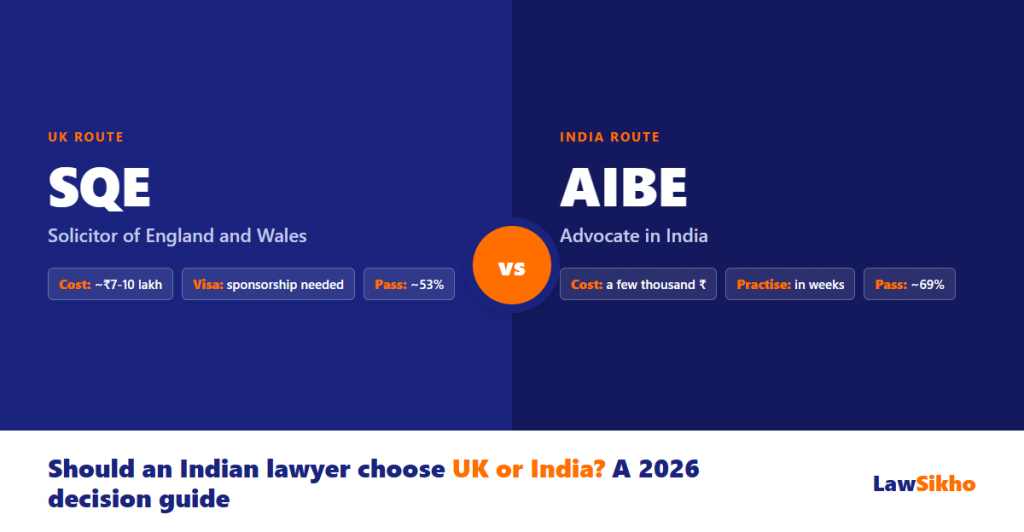
The SQE qualifies you as a solicitor of England and Wales; the AIBE lets you practise as an advocate in India. Choose the SQE if you have UK visa sponsorship and the budget for a higher-cost, higher-pay route. Choose the AIBE if you want to practise in India affordably and almost immediately. Many lawyers do both: AIBE first, SQE later.
That’s the compressed verdict. The rest of this guide unpacks it, route by route, cost by cost, persona by persona, so you can find your own answer rather than borrow someone else’s from a forum.
SQE vs AIBE: the choice in one minute
Most people researching SQE vs AIBE arrive with the wrong question. They want to know which is “better.” That framing assumes the two exams compete for the same prize. They don’t. One opens England and Wales; the other opens India. The real question is which jurisdiction you want to practise in, and what you’re willing to spend in money, time, and risk to get there.
So here is the whole decision compressed into a single table. Read it top to bottom before anything else, because every section that follows is just this table with the reasoning filled in.
| Factor | SQE (UK) | AIBE (India) |
|---|---|---|
| What it qualifies you for | Solicitor of England and Wales | Advocate in India (Certificate of Practice) |
| Where you can work | The UK, but only with a work visa and firm sponsorship | India, in any court once enrolled |
| Cost to enter | ~£4,908 in SRA fees plus prep (roughly ₹7-10 lakh all in) | ₹750 enrollment plus ~₹3,560 AIBE fee |
| Difficulty and pass rate | SQE1 around 53% (Jan 2026); high stakes per attempt | Open-book, ~69% pass (AIBE XX); low stakes per attempt |
| Timeline | ~2-3 years including 2 years of qualifying work experience | Weeks after you enrol with a State Bar Council |
| Who it suits | Cross-border and corporate ambitions, with budget and a visa path | Lawyers who want to practise in India affordably and soon |
Worth flagging: those are entry figures and headline numbers. Costs balloon if you fail and resit, and the UK timeline assumes you can find qualifying work. We’ll pressure-test all of it.
Two exams, two completely different goals
The SQE is the Solicitors Qualifying Examination, the centralised assessment the SRA uses to admit new solicitors of England and Wales. The AIBE is the All India Bar Examination, conducted by the Bar Council of India, which certifies your Certificate of Practice under the Advocates Act, 1961. They are not substitutes. Passing one does nothing for the other. A solicitor of England and Wales cannot walk into a Delhi courtroom, and an enrolled Indian advocate cannot advise a client in London on English law. Different exams, different regulators, different countries.
How to read this comparison
Because the two exams unlock different jurisdictions, “which is better” is a category error. The useful question is: better for what, and for whom? A litigation-minded graduate in Indore and a corporate associate in Mumbai eyeing a secondment to London are not making the same decision, even though they’re Googling the same phrase. So as you read, keep your own variables in front of you: where do you want to live and work, what can you spend, and how much downside risk can you carry if things don’t go to plan? The persona matrix near the end of this guide turns those variables into a verdict. Everything between here and there gives you the facts to fill them in.
| Factor | SQE (UK) | AIBE (India) |
|---|---|---|
| Qualifies you as | Solicitor of England and Wales | Advocate in India (Certificate of Practice) |
| Where you can work | The UK, but only with a work visa and firm sponsorship | India, in any court once enrolled |
| Cost to enter (2026) | ~£4,908 in SRA fees plus prep (roughly ₹7-10 lakh all in) | ₹750 enrolment plus ~₹3,560 AIBE fee |
| Pass rate | SQE1 around 53% (Jan 2026); high stakes per attempt | Open-book, ~69% pass (AIBE XX); low stakes per attempt |
| Timeline | ~2-3 years, including 2 years of qualifying work experience | Weeks after you enrol with a State Bar Council |
The India route: AIBE and enrolling as an advocate
Here’s a strange gap in how Indian lawyers research their own profession. Spend an hour reading about the SQE and you’ll drown in detail. Try the same for the AIBE and the picture gets surprisingly thin, given that the AIBE is the exam almost every Indian law graduate will actually sit. So this section gives the India route the depth it deserves, because for a large share of readers, this is the answer, not the SQE.
The situation that triggers the question is simple. You finish your LLB, you want to start practising, and you discover that the law degree alone doesn’t let you stand up in court. There’s a step in between. That step is the AIBE.
What the AIBE actually is, and what it is not
The AIBE is an open-book examination of 100 multiple-choice questions, with no negative marking, conducted by the Bar Council of India under the Advocates Act, 1961. Clearing it earns you the Certificate of Practice. The format is deliberately accessible: you’re allowed to carry bare acts and materials into the hall, and the test is designed to confirm a baseline of practical legal knowledge rather than to fail large numbers of candidates.
Now, here’s the myth worth killing early. A lot of people believe the AIBE is what grants you the right to appear in court, and that without it you have no standing at all. That’s not quite how it works. The right to appear flows from enrolment with a State Bar Council; the AIBE certifies your right to continue practising as a matter of the Certificate of Practice. Enrolment and certification are two different gates. People conflate them constantly, and it’s the source of the “is the AIBE even useful?” complaint you’ll see on Quora. The AIBE isn’t useless. It’s just not the gate people assume it is.
So can you appear in any court in India once you’ve enrolled and cleared the AIBE? In practical terms, enrolment as an advocate plus the Certificate of Practice is what puts you on the rolls and lets you appear, subject to the ordinary rules each forum applies. That’s the whole point of the qualification: it’s a national right of audience, not a court-by-court permission slip.
Is the AIBE mandatory? What you can and can’t do without it
For a law graduate who wants to practise, yes, the AIBE matters. The sequence runs like this: you complete your LLB, you enrol with a State Bar Council, and then you must clear the AIBE to hold a valid Certificate of Practice. Skipping it isn’t a path to courtroom practice. A common question on Quora is whether someone can represent a client in court with only an LLB and no AIBE, and the honest answer is that an LLB by itself does not make you an advocate entitled to appear. The degree qualifies you to enrol; enrolment plus the AIBE qualifies you to practise.
What can you do in the gap, while you’re enrolled but haven’t yet cleared the exam? Plenty, actually. Provisionally enrolled advocates are typically permitted to practise within the window the rules allow, and the months before your AIBE attempt are when most juniors learn the craft: drafting, research, watching seniors in court, building a file. The AIBE isn’t a wall you hit on day one. It’s a checkpoint you clear within the permitted window.
And what about that window? A frequently raised worry is what happens if you don’t appear in the AIBE within roughly two years of registering with the State Bar Council. The practical concern here is keeping your Certificate of Practice in good standing, so the sensible move is not to treat the exam as something you can defer indefinitely. (The exact timing rules can vary, so confirm the current position with your State Bar Council rather than relying on forum lore.) Treat the AIBE as a near-term task, not a someday task, and the window question never becomes your problem.
Fee, pattern, and 2026 cadence
The numbers are modest by any standard. The AIBE fee is reported at around ₹3,560 for the general category, with a lower fee for SC/ST candidates. The pattern is 100 multiple-choice questions, open book, no negative marking, spanning a broad list of subjects from constitutional law to professional ethics. Compared with the cost and stakes of the UK route, this is a different universe of risk.
On cadence: AIBE XX was held on 30 November 2025, with a reported pass rate of 69.21%. AIBE XXI is scheduled for 7 June 2026. So the exam runs on a regular cycle, and a graduate enrolling now isn’t waiting long for the next sitting. The Bar Council has also moved to allow final-year students to sit the exam and to hold it twice a year, with the Supreme Court having approved the BCI’s revised guidelines. The time from graduation to a valid Certificate of Practice now shrinks further, which only strengthens the India route’s already-strong speed advantage. (Confirm the exact eligibility and scheduling details on the official AIBE notification before you plan around them.)
The pitfall to avoid here is underestimating the exam because it’s open-book. “Open book” tempts people to skip preparation, then they discover the paper rewards candidates who know where to find answers fast, not those who plan to read every bare act cover to cover under time pressure. Familiarity with your materials beats raw possession of them.
The UK route: the SQE and qualifying as a solicitor
The flip side of the choice is England and Wales, reached through the SQE. We’ll keep this short on purpose, because the structure, eligibility mechanics, and full cost of the SQE already have dedicated, detailed homes on this site. Re-explaining them here would waste your time and bury the parts of this comparison that are genuinely original. So: the summary, then the links to go deeper.
SQE in four sentences (and where to go deeper)
The SQE has two stages. SQE1 tests functioning legal knowledge across two papers (FLK1 and FLK2) through multiple-choice assessments; SQE2 tests practical legal skills through written and oral exercises. On top of the exams, you need two years of qualifying work experience (QWE) and you must satisfy the SRA’s character and suitability requirements before admission. If you want the full breakdown of how SQE1 and SQE2 are structured, the dedicated guide walks through each component.
On eligibility, the headline is encouraging for Indian lawyers. Since September 2021, Indian LLB holders have been able to take the SQE without a UK degree, which is the structural change that made the route realistic for graduates from India. You don’t need to be a UK citizen or have studied in Britain to sit the exam. A non-law graduate can also pursue the route, though they’ll typically need to bridge the knowledge gap before SQE1. How do you become a lawyer in England with a foreign degree, and how long does it take? The exam stages plus the two-year QWE requirement mean the realistic timeline runs to roughly two to three years for most candidates, depending on how QWE is sequenced.
Do you need an LLM or a bridge course?
This is where misconceptions cluster, so it’s worth being blunt. You do not need an LLM to sit the SQE. You do not need a formal “bridge course.” An LLM is a study choice some people make, often to deepen knowledge or for personal reasons, but it is not an SRA requirement and it is not a shortcut to qualification. The SQE replaced the older LPC and QLTS routes precisely to create a single, exam-based assessment, so the old assumptions about mandatory prep courses no longer hold.
And here is the line that matters more than any of the study logistics: an LLM is not a work permit. Studying in the UK, or qualifying through the SQE, does not by itself give you the right to work there. That distinction is the hinge of this entire comparison, and it’s the one the visa section is built around. Hold that thought.
Cost head-to-head: what each route really costs in 2026
Money is where the SQE vs AIBE decision stops being abstract. The two routes don’t just cost different amounts; they belong to different financial categories. One is a small administrative fee. The other is an investment that can run into lakhs and needs a return to justify it. Treat them the same way and you’ll make a bad call. So let’s model this as what it actually is: a decision about how much capital you’re putting at risk and what you expect back.
The India route is now remarkably cheap
The India route just got dramatically cheaper, and most people haven’t updated their mental model. On 30 July 2024, in Gaurav Kumar v. Union of India, the Supreme Court held that under Section 24 of the Advocates Act, 1961, State Bar Councils cannot charge more than ₹750 (general) or ₹125 (SC/ST) as an enrolment fee. Before that ruling, states were charging anywhere from ₹15,000 to ₹42,000, sometimes more once “miscellaneous” charges were piled on. That’s a structural change in the cost of becoming an advocate, not a minor adjustment.
Add the AIBE fee of roughly ₹3,560 to the capped enrolment fee, and the core statutory cost of entering Indian practice sits at a few thousand rupees. Yes, there are incidental costs (travel, materials, the income gap of early practice), and those vary by city and circumstance. But the gate itself is now almost free by professional-exam standards. For a budget-constrained graduate, that single ruling changes the math of the whole UK-or-India decision.
The UK route: exam fees, prep, and the hidden costs
The UK route is a different order of magnitude, and the headline exam fee is only the start. The SRA’s combined SQE1 and SQE2 fees are around £4,908, rising to about £5,092 from September 2026. That’s just the assessment. On top sit the prep costs, which is where candidates get blindsided: structured SQE preparation through providers can run anywhere from roughly £2,000 to £6,000 depending on the course and provider. There can also be an ENIC or qualification-recognition cost to get your Indian degree assessed for equivalence. None of this is optional padding; it’s the realistic spend to be ready.
Then there’s the cost nobody budgets for: failure. If you don’t clear a stage, you pay again to resit, and a single failed attempt can mean several thousand pounds more, before counting the extra prep. Stack the fees, the prep, the recognition cost, and a possible resit, and the all-in figure for the UK route lands in the ₹7-10 lakh range for many Indian candidates. For the full INR cost breakdown for Indian candidates, the full INR cost breakdown for Indian candidates lays out every line item. The point for this comparison is the scale: this is a serious financial commitment, not a registration fee.
The pitfall here is treating the SRA fee as “the cost.” It isn’t. People budget £4,908, then get hit by prep fees, recognition fees, and the resit risk, and the real number is multiples of what they planned for. Budget for the full picture, including the possibility of a second attempt, or don’t start.
Cost-of-decision table
Side by side, the contrast is stark. This table shows the realistic total cost to enter each route in 2026.
| Cost component | India route (AIBE) | UK route (SQE) |
|---|---|---|
| Entry/enrolment fee | ₹750 (general), ₹125 (SC/ST) | SRA SQE1 + SQE2: ~£4,908 (rising to ~£5,092 from Sep 2026) |
| Exam fee | ~₹3,560 (AIBE, general) | Included above |
| Preparation | Self-study; bare acts; modest | ~£2,000-£6,000 (provider courses) |
| Recognition/equivalence | Not applicable | ENIC/recognition cost may apply |
| Cost if you fail and resit | Low; re-sit at modest fee | Several thousand pounds per resit, plus prep |
| Realistic all-in | A few thousand rupees | Roughly ₹7-10 lakh |
So which route is “expensive”? Only one of them carries a five-to-seven-figure-rupee commitment and a real chance of throwing good money after bad. That doesn’t make it the wrong choice. It makes it a choice you should only make with the next two sections, risk and ROI, fully in view.
Difficulty and risk: pass rates side by side
“Which is harder, the SQE or Indian law exams?” is the wrong question dressed as the right one. Difficulty isn’t a single number; it’s a function of what you’re optimising for and what each attempt costs you if it goes wrong. A hard exam you can resit cheaply is a different risk from a hard exam that costs thousands and can dent your career. So let’s look at the pass rates as a risk comparison, not a bragging-rights contest.
SQE pass rates and the resit trap
The SQE1 pass rate has been volatile, and the trend is sobering. It came in around 53% overall (with first-time candidates faring better) in January 2026, after dropping to a record low of 41% in July 2025. SQE2 has held up far better, at roughly 78% in October 2025. The catch is the resit picture: candidates who fail SQE1 and try again do badly, with only around one in ten passing on the second attempt. So the “set up to fail” fear you see on forums isn’t pure paranoia. The first attempt genuinely matters, and the odds of recovery after a miss are not friendly.
There’s a second-order consequence most cost discussions skip. A failed first attempt isn’t only a resit fee. If you’re relying on a training contract or a job offer that’s conditional on qualifying within a timeframe, a failure can jeopardise that offer, not just your wallet. The financial sting is visible; the career risk is the one that quietly does more damage. Plan as if the first attempt is the only attempt, because functionally, it nearly is.
AIBE difficulty in context
The AIBE sits at the other end of the risk spectrum. It’s open-book, the reported pass rate for AIBE XX was around 69%, and the stakes of any single attempt are low: the fee is modest and a resit doesn’t threaten a job offer or a five-figure investment. Is it “easier” than the SQE? In raw pass-rate terms, yes. But the more useful framing is that the AIBE is a low-risk gate and the SQE is a high-risk one. The downstream effect of that difference is huge: a budget-constrained graduate can attempt the AIBE without betting their finances, while the same person attempting the SQE is putting real capital and possibly a job on the line with every sitting. Same word, “difficulty,” two completely different consequences.
Exemptions for Indian advocates: the rule everyone gets wrong
Remember the forum thread from the opening? This is the section that resolves it. The whole argument, one camp promising easy exemptions, the other insisting the door is shut, collapses once you understand a single distinction the SRA draws. Get this right and the exemption question stops being mysterious.
Foreign-qualified lawyer vs foreign-educated student
Here’s the distinction the thread missed. The SRA treats a foreign-qualified lawyer differently from a foreign-educated student. If you’re already qualified and practising, an enrolled Indian advocate, you fall into the foreign-qualified lawyer category, and that’s the category where exemptions from parts of the SQE can come into play, assessed case by case based on what your existing qualification and experience cover. If you hold only an Indian law degree and have never qualified to practise, you’re a foreign-educated student, and you generally sit the full SQE like any other candidate.
So both forum camps were describing real things, just for different people. The advocate talking about “comfortable” SQE2 exemptions was (loosely) describing the foreign-qualified lawyer path. The commenter saying the Indian degree “isn’t recognised” was gesturing at the foreign-educated student reality, where the degree gets you eligibility to sit, not a shortcut around the exam. Does your degree’s recognition status block you? It affects whether you can claim an exemption, not whether you can take the SQE at all. That’s the nuance both sides flattened. The mechanics of how exemptions are assessed are detailed in the SQE eligibility and exemption requirements for Indian lawyers guide; what matters for your decision is knowing which category you’re in.
Has anyone actually been exempted?
The honest answer, and the one the optimistic forum posts skip, is that exemptions are assessed case by case and are not guaranteed. A practising Indian advocate with the right experience may qualify for an exemption from parts of SQE2; that is a real possibility, not a myth. But “may qualify, case by case” is not the same as “will comfortably get exempted by following a checklist.” The SRA looks at what your qualification and experience actually cover and decides on the individual application. So if you’re a 2+ PQE advocate, treat an exemption as a possible bonus to apply for, not a certainty to plan your finances around. The people who get burned are the ones who assumed the exemption was automatic and budgeted accordingly. Set your expectations to “apply and see,” and you won’t be caught out.
The visa reality: passing the SQE is not a right to work in the UK
This is the single most important section in this guide, and it’s the one almost every comparison glosses over. You can do everything right, pass SQE1, pass SQE2, complete your QWE, get admitted as a solicitor of England and Wales, and still not be allowed to work in the UK. The title and the right to work are two different things. Miss this and you can spend lakhs qualifying for a job you can’t legally take.
Qualified but stuck: why sponsorship is the real gate
Passing the SQE makes you a qualified solicitor. It does not, by itself, give you the right to live and work in the UK. For that, as an Indian national, you typically need a work visa, and the main route is the Skilled Worker visa, which requires a UK employer that is both willing and licensed to sponsor you, and able to meet the applicable salary threshold. As of mid-2026, the general Skilled Worker threshold is £41,700 a year (or the going rate for the role, whichever is higher), so a sponsoring firm has to pay at least that. No sponsor, no visa. No visa, no UK job, no matter how impressive your qualification. (You should confirm the current Skilled Worker salary threshold on gov.uk, as these figures change.)
This creates a cohort that the optimistic guides pretend doesn’t exist: the “qualified but stuck.” These are Indian lawyers who passed the SQE, hold the solicitor title, and then discover that securing sponsorship is a separate and much harder battle than the exam ever was. The exam is a known quantity with a syllabus. Sponsorship depends on a firm choosing you and being able to clear the salary bar. For a fuller picture of what clearing the SQE can and can’t do for moving to the UK, the dedicated career guide is worth reading before you commit. The headline for your decision: budget your expectations, not just your money. The title is achievable; the job is the gamble.
Which firms can actually sponsor you
So which firms can realistically sponsor an Indian junior? This is where expectations need a reality check. High-street and smaller boutique firms often can’t easily meet the salary threshold for a sponsored newly qualified solicitor, which means they’re frequently not viable sponsors for someone needing a visa. The firms that can comfortably clear the threshold tend to be the US firms in London and the larger City firms, including the Magic Circle, and those roles are intensely competitive, drawing top candidates from around the world. The realistic scope of UK jobs open to an Indian graduate who needs sponsorship is therefore narrower than the “pass the SQE and work in London” pitch suggests.
Do foreign firms actually hire Indian lawyers at all? Yes, they do, and Indian lawyers do make it into Magic Circle and US firms. But the path usually runs through strong academics, relevant experience, and often a foot already in the door through internships, secondments, or prior work with the firm’s network, not through the SQE pass alone. The exam is necessary; it is nowhere near sufficient.
The rising-threshold trend makes this harder, not easier. As UK salary thresholds for sponsored workers climb, the pool of firms that can afford to sponsor an entry-level foreign lawyer shrinks. So if your entire reason for taking the SQE is to work in the UK, the sober move is to line up the sponsorship reality before you spend the money, not after.
Can you do both? AIBE first, then SQE, in what order
Here’s the reframe most guides never offer: the SQE vs AIBE choice doesn’t have to be a choice at all. For a lot of Indian lawyers, the smartest answer is “both,” and the order matters more than people realise. Done in the right sequence, your Indian practice doesn’t compete with your UK ambitions, it funds and feeds them.
Why “both” is often the smartest answer
Dual qualification, advocate in India and solicitor of England and Wales, is a hedge. It keeps the Indian door open (where you can practise affordably and immediately) while building toward the UK option, without betting everything on a single jurisdiction or a single visa outcome. And there’s a structural reason the sequence works in your favour: the two years of qualifying work experience the SQE requires can be earned in India. QWE doesn’t have to be served at a UK firm; it can be accrued through legal work that’s signed off by a solicitor of England and Wales, including work done from India. So can you dual-qualify as both advocate and solicitor? Yes, and the Indian leg can actively count toward the UK one.
The recommended sequence
If you’re going to do both, here is the order that lets each step pay for and enable the next:
- Clear the AIBE and enrol as an advocate. This is cheap, fast, and gives you a live qualification and a way to start earning.
- Practise in India and accrue your QWE. Two years of qualifying work experience, signed off by an England and Wales solicitor, can be built while you work at home.
- Sit SQE1 and SQE2. Approach the exams as an established professional with income and experience behind you, not as a student spending savings on spec.
- Seek admission and UK visa sponsorship, or simply dual-qualify and keep the UK option in reserve as a hedge.
The beauty of this sequence is that it removes the worst version of the UK gamble, sinking lakhs into the SQE with no income and no fallback. By the time you sit the exam, you’re already practising and earning. The UK route becomes an upgrade you’re funding, not a bet that could leave you stranded.
What a foreign-qualified solicitor can and can’t do in India
One reason the “both” strategy holds up is that a UK qualification alone doesn’t let you practise Indian law. A solicitor of England and Wales cannot appear in Indian courts or advise clients on Indian law unless they’re also enrolled as an advocate in India, because rights of practice in India flow from enrolment with a Bar Council under the reciprocity framework the BCI applies. So can an Indian lawyer practise abroad at all? Yes, by qualifying in that jurisdiction, the SQE for England and Wales being one route. But can you practise in India and work remotely as a UK solicitor on the strength of the SQE alone? Not for Indian-law work, you’d need the Indian enrolment for that, and not for UK practice without satisfying UK work-authorisation rules. The two qualifications cover two jurisdictions, which is precisely why holding both, rather than assuming one covers the other, is the genuinely useful position.
Salary and ROI: is the UK route worth the cost?
This is where the sunk-cost stories live. There’s a well-known account of a career-changer, around 30, who had already paid roughly £4,812 toward SQE2 and tuition on a tight budget, then sat there wondering whether to keep going or walk away. That tension, money already spent, outcome uncertain, is the real ROI question. Not “does the UK pay more?” (it does), but “will the higher pay actually recoup what I put in, and how long will that take?”
What each route pays
The pay gap is real and large in nominal terms. A newly qualified solicitor in England and Wales can earn anywhere from around £35,000 at a high-street firm to £150,000 or more at US firms in London, with the average across the top 100 firms reported at roughly £118,000, though that figure is heavily skewed toward City firms. In India, a junior advocate’s income varies enormously: roughly ₹20,000 to ₹50,000 a month in district and Tier-2 settings, ₹50,000 to ₹1,00,000 in Tier-1 cities, and considerably less for many freshers in their first year or two. (Both sets of figures are portal estimates and vary widely, so treat them as ranges, not promises.) On headline numbers, the UK clearly pays more. So what kind of jobs do SQE-qualified Indian lawyers get, when they get them? Solicitor roles at the firms that sponsor, which, per the visa section, skew toward City and US firms.
The payback-period model
Headline salary is the wrong lens. The right one is payback period: how many years of the UK pay premium does it take to recoup the full cost of getting there, including the visa-and-sponsorship risk that the money might not convert into a job at all? Frame it that way and the decision stops being about prestige. If you clear the SQE, secure sponsorship, and land a City-firm salary, the payback can be fast and the route is clearly worth it. If you spend ₹7-10 lakh and end up qualified-but-stuck without a sponsor, the payback period is infinite, you’ve bought a title, not an income. The honest ROI answer is conditional: the UK route is worth it if the visa-and-job piece lands, and a poor investment if it doesn’t.
Which brings us back to that career-changer counting their sunk cost. The right time to reassess isn’t after you’ve spent another lakh chasing a stage you keep failing; it’s before each new spend, asking whether the path to a sponsored job is realistically still open. The capped India fee plus rising SQE fees has quietly flipped the ROI math for budget-constrained graduates: entering Indian practice now costs a few thousand rupees, while the UK route gets pricier each year, which is exactly why the “AIBE first, earn, then SQE” sequence de-risks the whole investment. Sunk cost is a feeling, not a reason. Decide each step on the road ahead, not the money already gone.
The decision matrix: which route fits you
Everything so far has been inputs. This is the output. Instead of a generic “it depends,” here’s how the SQE vs AIBE choice actually resolves for five common situations. Find the one closest to yours, then read the verdict. Most readers will see themselves in one of these, and the routing changes completely depending on which.
| Persona | Choose UK (SQE) if | Choose India (AIBE) if | Do both if |
|---|---|---|---|
| Fresh LLB graduate | You have funding and a credible sponsorship path lined up | You want to start practising affordably and soon (almost everyone here) | You plan to qualify in India now and add the SQE later, once QWE and budget exist |
| Advocate, 2+ years PQE | You have cross-border or City ambitions and capital | India remains your primary practice | You’re the strongest “both” candidate, and best-positioned to apply for SQE2 exemptions |
| Litigation-bound lawyer | Rarely, only for specific cross-border work | Court practice in India is your goal (this is your home) | Only if you develop genuine international ambitions later |
| Corporate / cross-border aspirant | The SQE adds real, marketable value to your profile | You’ll work in Indian corporate practice without UK plans | Dual-qualify as a hedge; this profile gains the most from “both” |
| Budget-constrained candidate | Only with sponsorship already secured, never on spec | AIBE now, the capped fee makes this almost free to enter | AIBE first, then SQE later once you’re earning, never lakhs upfront |
Fresh LLB graduate
If you’ve just finished your LLB, the default answer is the AIBE, and for most people it isn’t close. It’s cheap, it’s fast, and it lets you start practising and earning while you figure out your longer game. The SQE can come later, once you’ve built QWE and have either savings or a sponsorship path. Spending lakhs on the UK route as a fresh graduate with no income and no visa sponsor is the classic high-risk mistake. Qualify at home first; keep the UK as a planned next move, not an opening bet.
Advocate with 2+ years PQE
If you’re already a practising advocate with two or more years of experience, you’re in the strongest position of anyone reading this. You’re the best-placed candidate to apply for SQE2 exemptions (case by case, no guarantees, but a real possibility), and you’re the ideal “do both” profile: you already have the Indian qualification, you may have QWE-eligible experience, and adding the SQE genuinely broadens your options. Should you do the SQE or just keep practising in India? If you have cross-border ambitions and the budget, the SQE is a strong addition. If you’re content in Indian practice, there’s no need.
Litigation-bound lawyer
If your goal is courtroom litigation in India, the AIBE is your route and the SQE is largely beside the point. Indian litigation lives on Indian enrolment; a solicitor of England and Wales can’t appear in Indian courts. The only reason a litigation-focused lawyer should look at the SQE is a genuine, specific cross-border ambition, an international arbitration practice, say, or a planned move abroad. Absent that, the UK investment buys you little for the career you actually want. Stay focused on the qualification that lets you do your job.
Corporate / cross-border aspirant
If you’re aiming at corporate, transactional, or cross-border work, this is where the SQE earns its cost. A solicitor qualification of England and Wales is a recognised, marketable credential in international corporate practice, and it can meaningfully strengthen your profile with both global firms and Indian corporate teams that work cross-border. For this persona, dual-qualifying as a hedge often makes the most sense: keep the Indian qualification, add the SQE, and position yourself for work that travels. This profile gains the most from “both.”
Budget-constrained candidate
If money is tight, the answer is clear and a little uncompromising: AIBE now, SQE only if and when sponsorship is lined up. The capped enrolment fee plus a modest AIBE fee means entering Indian practice costs a few thousand rupees, you can start your career without financial risk. The SQE, by contrast, is a several-lakh commitment with a real chance the job doesn’t materialise. Should you sink lakhs into the SQE on spec, hoping a UK firm appears later? No. And if you’ve already started and money is running out, reassess honestly: don’t keep spending because you’ve already spent. Walk the funded path now; add the expensive one only when it’s de-risked.
Common myths about SQE and AIBE
A handful of myths cause most of the bad decisions in this space. They spread on forums because they sound plausible and nobody checks them. Here are the three that do the most damage, paired with the reality.
“An LLM in the UK lets me work there”
This is the costliest misconception of the lot. An LLM is a postgraduate degree, a study qualification. It is not a work permit, not a route to qualification as a solicitor, and not a guarantee of a job. Plenty of Indian lawyers do an LLM in the UK and then discover that working there still requires the SQE (to qualify) and a Skilled Worker visa with sponsorship (to be employed). Does a UK LLM let you work there? No. It lets you study there, on a student visa, and that’s a separate thing from the right to take a job after.
“I need a bridge course before the SQE”
No formal “bridge course” is required to sit the SQE. The SRA doesn’t mandate one. Preparation courses exist and many candidates find them useful, especially for unfamiliar areas of English law, but “useful prep” and “mandatory bridge” are different claims. You can prepare for the SQE through self-study or a provider course of your choosing; there is no compulsory pre-SQE qualification gating your way in. Don’t let anyone sell you a “required” course that the regulator doesn’t actually require.
“My Indian degree isn’t recognised, so I’m blocked”
This is the half-truth from the opening forum thread, and the nuance is everything. Recognition status affects whether you can claim an exemption from parts of the SQE; it does not block you from sitting the SQE in the first place. Indian LLB holders have been eligible to take the SQE since September 2021. So “not recognised” doesn’t mean “barred”, it means “no exemption shortcut, take the full exam like everyone else.” The door isn’t locked. It just doesn’t have a side entrance for most foreign-educated students.
Frequently asked questions
1. What is the difference between the SQE and the AIBE? The SQE is the Solicitors Qualifying Examination, the route to becoming a solicitor of England and Wales. The AIBE is the All India Bar Examination, which certifies your Certificate of Practice as an advocate in India. They qualify you for two different jurisdictions and are not substitutes for each other.
2. Is the AIBE mandatory for a law graduate in India? For a law graduate who wants to practise, yes. You enrol with a State Bar Council after your LLB, then clear the AIBE to hold a valid Certificate of Practice. An LLB alone does not make you an advocate entitled to appear in court.
3. What is the AIBE exam fee and pattern? The AIBE fee is reported at around ₹3,560 for the general category, with a lower fee for SC/ST candidates. The exam is open-book, with 100 multiple-choice questions and no negative marking, spanning a broad range of legal subjects. Confirm the current fee on the official AIBE notification before applying.
4. Can I take the SQE with a 3-year Indian LLB? Indian LLB holders have been eligible to sit the SQE since September 2021, without needing a UK degree. Eligibility to sit is one thing; whether you qualify for any exemption is assessed separately and case by case. Verify the current eligibility position with the SRA before you apply.
5. Can I qualify as a solicitor in England without visiting the UK? Much of the SQE can be sat from India through Pearson VUE test centres, but parts of SQE2 (the oral assessments) must be taken in England or Wales, so at least one UK trip is typically required. The dedicated guide on whether you can qualify as a solicitor without visiting the UK covers the current arrangements in detail.
6. Can I sit the SQE in India? SQE1 and the written parts of SQE2 can be sat in India at Pearson VUE centres. The oral components of SQE2 generally must be taken in the UK. Check the current testing arrangements on the SRA’s site, as availability can change.
7. How many times can I attempt the SQE? The SRA permits a limited number of attempts per assessment over a set period; confirm the current limit on the SRA’s official pages before planning resits. The practical point is that resitters do poorly, only about one in ten pass SQE1 on a second attempt, so the first attempt is the one that counts.
8. How much does the SQE cost for an Indian candidate in 2026? The SRA’s combined SQE1 and SQE2 fees are around £4,908, rising to roughly £5,092 from September 2026. Add preparation (about £2,000-£6,000), possible recognition costs, and resit risk, and the all-in figure for many Indian candidates lands in the ₹7-10 lakh range.
9. How long does the whole SQE process take? Realistically around two to three years for most candidates, driven mainly by the two-year qualifying work experience requirement plus the time to prepare for and pass both assessments. The exact timeline depends on how you sequence QWE against the exams.
10. What happens if I don’t appear in AIBE within two years of state bar registration? The practical concern is keeping your Certificate of Practice in good standing, so the AIBE is best treated as a near-term task rather than something deferred indefinitely. The specific timing rules can vary, so confirm the current position with your State Bar Council.
11. Can my work experience in India count toward QWE? Yes. Qualifying work experience for the SQE can be earned anywhere in the world, including India, provided it’s signed off by a solicitor of England and Wales. This is what makes the “AIBE first, then SQE” sequence work: your Indian practice can count toward the UK route.
12. Which should I do first, AIBE or SQE? For most people, the AIBE first. It’s cheap and fast, lets you start practising and earning, and your Indian experience can count toward the QWE the SQE needs. Sitting the SQE later, as an earning professional rather than a cash-strapped student, removes the worst financial risk of the UK route.
13. Can I hold both Indian and England-and-Wales qualifications? Yes. Dual qualification, advocate in India and solicitor of England and Wales, is entirely possible and is often the smartest hedge for lawyers with cross-border ambitions. Each qualification covers its own jurisdiction; holding both keeps more doors open.
14. Does passing the SQE let me work in the UK? No, not by itself. Passing the SQE makes you a qualified solicitor, but working in the UK as an Indian national typically requires a Skilled Worker visa with sponsorship from a UK employer that can meet the salary threshold. The title and the right to work are two separate things.
15. If I qualify abroad, can I come back and practise in India, and which exam? To practise Indian law and appear in Indian courts, you need to enrol as an advocate with a State Bar Council and hold the Certificate of Practice via the AIBE, regardless of any foreign qualification. A foreign solicitor qualification alone does not authorise Indian-law practice.
16. Is an Indian law degree recognised in the UK? Indian LLB holders can sit the SQE, so the degree is sufficient for eligibility. Recognition status mainly affects whether you can claim an exemption from parts of the SQE, not whether you can take the exam at all. An equivalence assessment (ENIC) may be relevant for some applications.
17. Does passing the SQE still require visa sponsorship? Yes. Qualifying as a solicitor and being legally able to work in the UK are different. As an Indian national you’d generally need a sponsoring employer and a Skilled Worker visa, and securing that sponsorship is often harder than passing the exam. Confirm current visa rules on gov.uk.
18. Can a foreign-qualified solicitor advise on Indian law or appear in Indian courts? No, not on the strength of a foreign qualification alone. A solicitor of England and Wales must also be enrolled as an advocate in India to advise on Indian law or appear in Indian courts, under the Bar Council of India’s reciprocity framework. This is a key reason dual qualification, not substitution, is the useful goal.
This article is for informational and educational purposes only and does not constitute legal advice. Exam fees, pass rates, eligibility rules, and visa salary thresholds change frequently; verify all figures against the official SRA, Bar Council of India, and gov.uk sources before acting. For specific legal guidance, consult a qualified legal professional.


