
Last verified: June 2026
On 1 July 2024, India retired three of its oldest criminal codes. The Indian Penal Code, the Code of Criminal Procedure, and the Indian Evidence Act, all of them in service for over a century and a half, were switched off and replaced overnight by the Bharatiya Nyaya Sanhita, 2023, the Bharatiya Nagarik Suraksha Sanhita, 2023, and the Bharatiya Sakshya Adhiniyam, 2023. For most people sitting an entrance exam that summer, it was a news headline. For anyone preparing for the Rajasthan Judicial Services (RJS) Exam 2026, it quietly rewrote half the question paper.
That is the part a lot of aspirants still haven’t fully absorbed. The criminal-law portion of RJS, which carries serious weight in both prelims and mains, is now built around the new codes. Yet a large share of the bare acts, guidebooks, and second-hand notes circulating in coaching circles were drafted for the old regime. So you have two groups of candidates preparing for the same exam from two different rulebooks. One group is revising sections that no longer carry those numbers. The other has rebuilt its criminal-law base on the new codes and is sitting on marks the first group is about to concede.
Here’s the thing about timing. RJS is conducted by the High Court of Rajasthan, not RPSC (that single confusion derails more first-time aspirants than any syllabus gap). The most recent recruitment cycle, which advertised 44 Civil Judge posts, has already run its course and declared its final result, and the next cycle’s notification is awaited on hcraj.nic.in rather than already live. That actually puts most readers in the best possible position: you’re preparing in the build window, before a notification compresses everything into a frantic application-and-revision sprint. This is the moment to build the map from scratch, so that when the next notification drops you’re revising, not scrambling.

What this guide does is pull the whole thing into one place. Eligibility and the age window. The three-stage pattern with marks for each stage. The full syllabus, including the new criminal codes and the Rajasthan-specific local Acts almost nobody teaches in an LL.B. The corrected post-SNJPC civil judge salary (the figure on several competitor pages is years out of date). Cutoff trends and the brutal “lost years” backlog. FIRAC and judgment-writing for mains. A month-by-month timeline. The Rajasthani-dialect interview that catches out even local candidates. And a cross-state comparison no other guide bothers to give you. Where a 2026-cycle figure has not yet been officially notified, this guide says so plainly rather than recycling last cycle’s numbers as if they were fresh.
The aspirants who clear RJS aren’t usually the ones who knew some secret. They’re the ones who understood the current shape of the exam precisely, mapped their own months against it, and treated the new-codes shift as an advantage rather than a shock. So let’s get the current map exactly right, starting with what this exam actually is.
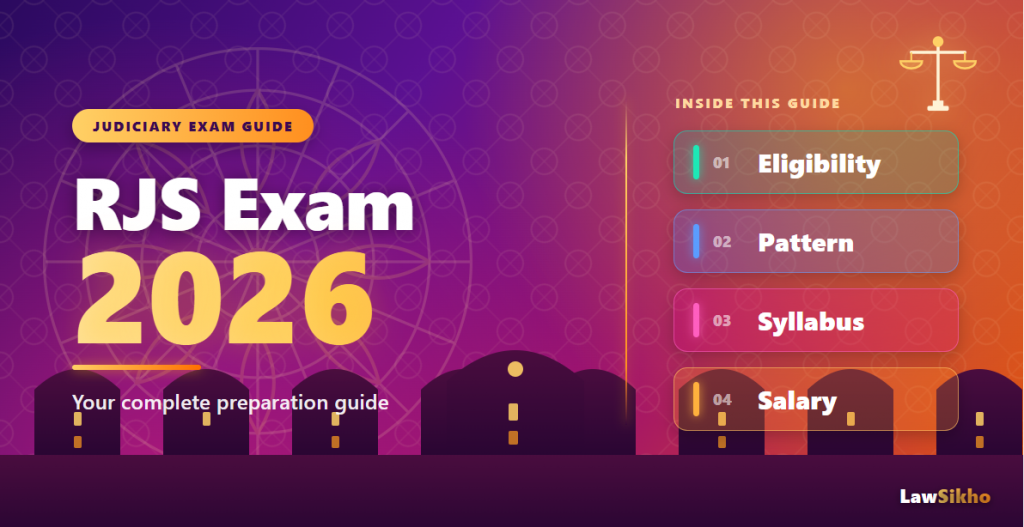
The Rajasthan Judicial Services (RJS) Exam 2026 recruits Civil Judges for Rajasthan through a three-stage process, prelims, mains and interview, conducted by the High Court of Rajasthan, not RPSC. Eligible candidates hold an LL.B. and are aged 21 to 40. The syllabus now tests the new BNS, BNSS and BSA 2023 criminal codes.
That paragraph is the exam in a nutshell. The rest of this guide unpacks every part of it that an aspirant actually needs to act on, from who can apply to how the merit list is really built. Let’s start with the basics.
Rajasthan Judicial Services (RJS) Exam 2026: what it is and who conducts it
Most aspirants meet this exam through a fog of half-right information picked up from forums and coaching ads. Before you build a single revision plan, it pays to fix the basics, because two of them (who runs the exam and which codes it now tests) are exactly where the early mistakes cluster. So what is the Rajasthan Judicial Services (RJS) Exam 2026, in plain terms, and who actually conducts it?
It is the recruitment exam for the Civil Judge cadre in Rajasthan, the entry door to the state’s subordinate judiciary. Clear it, and you join the bench as a Civil Judge (Junior Division). The selection runs in three stages and is administered by the High Court of Rajasthan. That last point matters more than it looks, and we’ll come back to it.
What the RJS exam is and the full form of RJS
RJS stands for Rajasthan Judicial Service. It’s the competitive examination through which the state fills entry-level judicial posts in its district and subordinate courts, the Civil Judge cadre. A successful candidate isn’t appointed as a lawyer or a clerk; they’re appointed as a judicial officer who hears and decides cases.
Think of it this way. Where the RAS exam produces administrators for the executive side of the Rajasthan government, RJS produces judges for the judicial side. Different branch, different exam, different conducting body. The two get confused constantly, and that confusion is the single most common starting error, which is why it’s worth nailing down first.
Who conducts RJS: the High Court of Rajasthan, not RPSC
Here’s the correction that saves a lot of wasted searching. RJS is conducted by the High Court of Rajasthan, through its recruitment portal at hcraj.nic.in, not by the Rajasthan Public Service Commission. RPSC runs RAS and a range of other state services, so aspirants who first encounter “Rajasthan government job” naturally assume RPSC handles the judiciary too. It doesn’t.
Why does this trip people up so reliably? Because most state recruitment in India does route through the state PSC, so RJS feels like an exception, and it is. The notification, the syllabus, the admit card, and the results all come from the High Court, not the Commission. Bookmark the right source now (the full myth, and a few of its cousins, get the proper treatment under H2-11).
The three-stage selection at a glance
RJS selection moves through three stages in sequence: a Preliminary examination, a Mains examination, and an Interview or viva. You can’t skip a stage, and each one filters the field down before the next. Prelims is a screening gate. Mains is where the heavy lifting happens. The interview is the final, smaller, high-stakes filter.
One detail that changes how you should prepare: the prelims is qualifying only. Your prelims marks get you into the mains, but they don’t carry into the final merit list. We’ll unpack the full structure, marks and durations under H2-3, because how the merit is built should shape where you put your hours.
Why RJS 2026 is different: the BNS, BNSS and BSA 2023 shift
This is the part that makes the 2026 cycle genuinely different from every cycle before 2024. Since 1 July 2024, the Bharatiya Nyaya Sanhita, 2023, the Bharatiya Nagarik Suraksha Sanhita, 2023, and the Bharatiya Sakshya Adhiniyam, 2023 have been in force, replacing the IPC, the CrPC, and the Indian Evidence Act respectively. The criminal-law portion of the RJS syllabus now tests these new codes as primary law.
And there’s a second-order effect most aspirants underweight: pre-2024 study material has quietly become a liability. If your notes still say “Sec. 302 IPC” for murder or “Sec. 161 CrPC” for police statements, you’re revising the right concept under the wrong code and the wrong number. The candidates who switched early to the new codes gain a disproportionate edge, because the new framework is examinable now and the old numbering will cost you in a paper that rewards precision. The practical reality is that the new codes are the cheapest marks in the exam for anyone who simply prepares from the current text rather than an outdated one.
RJS exam 2026 eligibility: age, qualification and who can apply
Before a single hour of syllabus revision matters, one question decides everything: are you even eligible to sit RJS? Aspirants lose entire cycles not because they couldn’t crack the paper, but because they misread the qualification or the age window and applied (or didn’t apply) on a wrong assumption. So who exactly can apply for the RJS exam 2026, and what are the real eligibility rules?
In short: you need a law degree, you need to fall within the age band, and you need to satisfy the advocate-enrolment condition under the Advocates Act, 1961. Each of those has edges that matter, and the edges are where the confusion lives. Let’s take them one at a time.
Educational qualification: which LL.B. counts
The core qualification is a professional LL.B. from a university recognised by the Bar Council of India. That’s the substance of it. Whether you earned it through the three-year LL.B. after graduation or the five-year integrated programme straight after school makes no difference to your eligibility; both routes are valid for RJS.
What does matter is that the degree be a recognised, BCI-approved law degree rather than an academic-only qualification. A practising advocate in Jaipur preparing for the bench and a fresh five-year graduate from a national law university in another state stand on the same footing here, as far as the qualification box is concerned. The decisive figures (the exact wording of “recognised university” and any cut-off on degree completion) should always be confirmed against the latest High Court of Rajasthan notification [VERIFY: confirm on hcraj.nic.in], because notification language can tighten between cycles.
Advocate enrolment and whether a final-year student can apply
This is where the single most common eligibility question sits: do you need to be an enrolled advocate to apply for RJS, and can a final-year LL.B. student get in? The eligibility framework ties to enrolment or eligibility for enrolment as an advocate under the Advocates Act, 1961, so the honest answer is that you should confirm the precise wording for the 2026 cycle on the official notification [VERIFY: confirm on hcraj.nic.in] rather than rely on a forum thread.
A common question aspirants raise is whether a final-year LL.B. student, who hasn’t yet enrolled, can still apply in anticipation of completing the degree. Several state judicial recruitments allow conditional applications subject to producing the degree by a stated date, but the exact provision varies by notification, so a final-year candidate must read the eligibility clause line by line. Worth flagging: don’t assume the rule from another state’s exam carries over to Rajasthan. It often doesn’t.
Age limit and category relaxation
The age window for RJS sits between 21 and 40 years, calculated as on a fixed reference date (commonly 1 January of the relevant cycle year), with the usual upper-age relaxation of five years for reserved categories, SC, ST, OBC, MBC, EWS and women candidates [VERIFY: confirm the reference date and relaxation specifics on hcraj.nic.in]. So a 39-year-old general-category candidate is cutting it fine; a reserved-category candidate of the same age has more runway.
Why is the reference date worth checking so carefully? Because a difference of a few months around your birthday can flip you from inside the window to outside it, and the cut-off is computed against a fixed date, not your age on exam day. The mistake we see most often is candidates assuming the age is measured on the date of the exam or the date of application. It isn’t. Confirm the reference date and the relaxation table on the official notification before you decide you’re in or out.
3-year LL.B. vs 5-year LL.B.: does it matter for RJS?
Let’s settle this one cleanly, because it generates a lot of anxious forum posts. For RJS eligibility, the three-year LL.B. and the five-year integrated LL.B. are treated alike. Neither route gives you a structural advantage at the eligibility gate, and neither bars you.
The real difference is one of preparation runway, not eligibility. A five-year student has had more years steeped in law and may reach the exam younger; a three-year graduate often arrives with a prior degree and sometimes work experience. Both can clear RJS. So if you’re a final-year student worrying that your three-year LL.B. somehow counts for less, stop worrying about the route and start worrying about the syllabus. That’s where the cycle is won or lost.
RJS exam pattern 2026: prelims, mains and interview structure
You can know the entire syllabus and still misallocate your effort if you don’t understand how the marks are actually counted. That’s the quiet trap in RJS: the prelims looms large in every aspirant’s anxiety, yet it contributes nothing to the final score. So what is the RJS exam pattern 2026, stage by stage, and which marks actually decide your rank?
The exam runs in three stages: Preliminary, Mains, and Interview. The prelims screen you in. The mains and interview, taken together, build your merit. Get that hierarchy straight and your study plan almost writes itself.
Prelims: objective, qualifying and not counted in merit
The Preliminary examination is an objective, OMR-based paper of 100 marks, set over a duration of two hours, with roughly 70% of the weight on law and the remaining 30% on language proficiency in Hindi and English. Here’s the part that reshapes how you should treat it: prelims is qualifying only. Your prelims marks decide whether you reach the mains, but they do not carry into the final merit list.
What does that mean in practice? It means you prepare prelims to clear a threshold, not to top it. Scoring 95 versus scraping past the cutoff has the same effect on your final rank: none, beyond getting you through. One detail aspirants ask about constantly is whether there’s negative marking in prelims. For RJS, the scheme of examination provides for no negative marking in the prelims, so there’s no penalty for a wrong answer, which means leaving a question blank costs you the same as guessing it wrong. Confirm this against the scheme in the current notification, then guess freely on questions you can narrow down.
Mains: the 300-mark descriptive stage
The Mains is where the real scoring happens, and it’s descriptive, not objective. It carries 300 marks in total, split across Law Paper I (100 marks), Law Paper II (100 marks), a Hindi essay paper (50 marks), and an English essay paper (50 marks), with three hours for each law paper and two hours for each essay paper. This is the stage that separates candidates who know the law from candidates who can write it.
And this is also the answer to “prelims vs mains, which stage is harder?” Prelims is harder to qualify under time pressure with a wide objective net; mains is harder to score in, because it demands structured, written legal reasoning rather than recognition. Most serious aspirants find mains the genuinely decisive stage, which is why H2-7 is devoted entirely to answer-writing.
Interview and viva: 35 marks
The final stage is the interview, or viva voce, carrying 35 marks, and the final merit list is built purely from the mains 300 plus this interview 35. It isn’t a quiz on bare-act sections. The panel assesses your scholastic record, your personality and bearing, your awareness of current affairs, and, distinctively for Rajasthan, your familiarity with Rajasthani dialects and local customs. That last element catches a lot of candidates off guard, and it gets a full section of its own under H2-9.
Thirty-five marks may sound minor against a 300-mark mains, but on a tight merit list they’re decisive. The reality is that candidates clustered within a handful of marks of each other after mains can be reordered entirely by interview performance, so treating the viva as an afterthought is a costly mistake.
How attempts work
The number of permitted attempts at RJS is governed by the conducting body’s rules and is tied to the age window rather than a fixed attempt cap in the way some central exams work; the precise position should be confirmed on the official notification [VERIFY: confirm attempt rules on hcraj.nic.in]. The pitfall here is assuming RJS works like the UPSC civil services attempt system. It doesn’t necessarily, and guessing wrong can change your whole multi-year plan.
For most aspirants, the practical constraint isn’t a stated attempt limit at all; it’s the upper age ceiling of 40, which naturally bounds how many cycles you can sit. So the smarter way to think about attempts is to count backwards from your age-out date and plan your cycles accordingly.
Here is the pattern in a single view. The marks and durations below follow the recent scheme of examination; reconfirm them against the current notification on hcraj.nic.in, since a scheme can change between cycles.
| Stage | Type | Marks | Duration | Counts in merit? |
|---|---|---|---|---|
| Preliminary | Objective / OMR | 100 | ~2 hours | No (qualifying only) |
| Mains: Law Paper I | Descriptive | 100 | ~3 hours | Yes |
| Mains: Law Paper II | Descriptive | 100 | ~3 hours | Yes |
| Mains: Hindi essay | Descriptive | 50 | ~2 hours | Yes |
| Mains: English essay | Descriptive | 50 | ~2 hours | Yes |
| Interview / Viva | Oral | 35 | Panel | Yes |
Objective screening test. Qualifying only, so the score is not added to your final merit. It exists to shortlist candidates for mains. Descriptive papers: Law Paper I (100), Law Paper II (100), Hindi essay (50) and English essay (50). This is where your merit score is actually built. Personality and aptitude assessment, including local awareness. The final differentiator between closely ranked candidates. Prelims marks are excluded from the final ranking. Appointment follows from the merit list against available vacancies. Mark figures reflect the most recent published scheme. Confirm exact marks and durations on the official notification at hcraj.nic.in for the cycle you are applying to.Prelims (100 marks)
Mains (300 marks)
Interview / Viva (35 marks)
Final merit = Mains (300) + Interview (35)
RJS syllabus 2026: prelims and mains, subject by subject
A vague sense of “the syllabus is huge” is how aspirants drift for months without a plan. The RJS syllabus is large, but it’s finite and structured, and the 2026 version carries one decisive update that older guides miss. So what does the RJS syllabus 2026 actually cover, prelims and mains, subject by subject?
Broadly, it spans substantive and procedural law, a strong language component, and a tier of Rajasthan-specific local Acts. The headline change is that the criminal-law content now runs on the new codes. Let’s break it down.
Prelims syllabus and the language component
The prelims syllabus is built mostly around law (roughly 70% of the paper) with a language proficiency component (roughly the remaining 30%) covering Hindi and English. The law portion draws on the core substantive and procedural subjects, civil and criminal, that a Civil Judge is expected to apply daily: contract, civil procedure, criminal law and criminal procedure, evidence, and the major statutes a trial court touches.
What surprises some candidates is how much the language section can swing a qualifying score. Because prelims is qualifying only, you don’t need to top it, but you do need to clear it, and the language component is often where well-prepared law candidates lose easy marks by not practising Hindi and English usage. Treat language as a scoring opportunity, not a formality.
Mains syllabus: Law Papers I and II plus essays
The mains syllabus deepens everything from prelims into descriptive territory across two law papers plus two essay papers. Law Paper I and Law Paper II distribute the substantive and procedural subjects (the civil and criminal sides, evidence, and the relevant special and local laws), each demanding written application rather than recognition. The Hindi essay and English essay papers test composition and reasoning in both languages.
The shift from prelims to mains isn’t about new topics so much as a new depth. A topic you could clear with a single correct option in prelims must now be written out as a structured, reasoned answer in mains, often applied to a fact pattern. That’s why the syllabus and the answer-writing method (H2-7) can’t be prepared in isolation from each other.
The new criminal codes: BNS, BNSS and BSA 2023
This is the freshness fault line, and it’s worth being precise. Since 1 July 2024, the criminal-law portion of the RJS syllabus is tested on the Bharatiya Nyaya Sanhita, 2023 (replacing the IPC), the Bharatiya Nagarik Suraksha Sanhita, 2023 (replacing the CrPC), and the Bharatiya Sakshya Adhiniyam, 2023 (replacing the Indian Evidence Act). These aren’t optional add-ons; they’re now the primary criminal law a Civil Judge applies, so they’re examinable as the main text.
So what changed for RJS, concretely? The concepts substantially carry over, theft is still theft, but the section numbers, the structure, and several definitions have moved, and a handful of new and reorganised provisions have appeared. Looking ahead, early signals from coaching analysis of recent papers suggest question framing on the new codes is likely to deepen toward application-based questions as case law and interpretation accumulate, rather than staying at provision-recall. The practical handling tip, especially if your old books still teach IPC and CrPC, is to prepare from a current bare act of the new codes and use an old-to-new mapping to translate any notes you can’t replace yet. We’ve laid the mapping out in the table below.
| Old code (pre-1 July 2024) | New code (in force since 1 July 2024) | What it means for RJS |
|---|---|---|
| Indian Penal Code, 1860 (IPC) | Bharatiya Nyaya Sanhita, 2023 (BNS) | Substantive offences now examined under BNS; section numbers and some definitions have changed |
| Code of Criminal Procedure, 1973 (CrPC) | Bharatiya Nagarik Suraksha Sanhita, 2023 (BNSS) | Criminal procedure, arrest, bail, trial process now examined under BNSS |
| Indian Evidence Act, 1872 | Bharatiya Sakshya Adhiniyam, 2023 (BSA) | Law of evidence, including electronic records, now examined under BSA |
Rajasthan-specific local laws
Here’s the quiet scoring moat almost nobody talks about. RJS tests a set of Rajasthan-specific local Acts that you almost certainly never studied in an LL.B. anywhere in the country: the Rajasthan Rent Control Act, 2001, the Rajasthan Court Fees and Suits Valuation Act, 1961, the Rajasthan Land Revenue Act, 1956, and the Rajasthan Excise Act, 1950, among others. These are bare-act based, which means the marks reward careful reading rather than deep doctrine.
Why is this such a leverage point? Because these “boring” Acts are rarely taught and easily skipped, so the candidates who actually sit with the bare acts open a quiet gap on everyone who treats them as low-priority. Out-of-state aspirants and even many Rajasthani candidates concede these marks by default. Which Rajasthan local laws are in the syllabus, then? Start with the four named above, confirm the current list on the official notification, and treat them as high-return, low-glamour scoring, because that’s exactly what they are.
RJS civil judge salary 2026 and the full career ladder
If you’re weighing RJS against a litigation practice or a corporate job, the salary question is doing a lot of the deciding, and this is precisely where the internet will mislead you. Several guides still quote a pay figure that’s years out of date. So what is the RJS civil judge salary in 2026, and what does the career ladder above it look like?
The honest, current answer is that the entry pay is far higher than the stale figures suggest, thanks to a national pay overhaul, and the progression above it is structured and steady. Let’s correct the number first, because it changes the whole calculation.
Entry pay under the SNJPC
Under the Second National Judicial Pay Commission (SNJPC), the entry pay scale for a Civil Judge (Junior Division) sits at Rs. 77,840 to Rs. 1,36,520 per month, plus Dearness Allowance, House Rent Allowance and other allowances [VERIFY: confirm the current DA% on law.rajasthan.gov.in]. That’s the figure to anchor on.
Now a necessary correction, because this is where competitor pages go wrong. The older figure of around Rs. 27,700 to Rs. 44,700 that still circulates on several sites, sometimes mislabelled as the current scale, is the superseded pre-SNJPC pay; it’s outdated and should not be used as the current entry pay. Historically, the SNJPC revision raised civil judge entry pay from that roughly Rs. 27,700 band to the Rs. 77,840 scale, a material jump that changed the career’s financial attractiveness. How does RJS pay compare to other states’ civil judge salaries? Because the SNJPC scale is a national framework adopted across states, Rajasthan’s entry pay is broadly in line with other states that have implemented it, with differences mainly in state-specific DA and allowances. For how the post-SNJPC civil judge salary is structured across India, see how the post-SNJPC civil judge salary is structured across India.
Realistic in-hand and the probation period
A scale isn’t an in-hand figure, so what does a Rajasthan civil judge actually take home? Once DA, HRA and allowances are added and statutory deductions are taken out, the monthly in-hand for a new Civil Judge (Junior Division) lands meaningfully above the basic scale, though the precise figure depends on the current DA percentage and the posting location’s HRA slab. New appointees also typically serve a probation period before confirmation, during which the role is fully judicial but the appointment isn’t yet permanent.
The takeaway for anyone doing the maths against private practice is that the headline scale understates the package, because the allowance stack on top is substantial. The figure that matters for a life decision is the all-in monthly in-hand plus the security and pension that come with a judicial post, not the bare scale.
The career-progression ladder
The career path above the entry post is well-defined. A Civil Judge (Junior Division) progresses, over time and through departmental promotion and limited competitive routes, to Senior Civil Judge, then to Additional District Judge, and onward to District Judge, with the senior-most district judiciary roles feeding into elevation considerations. Each rung carries a higher SNJPC pay band and greater judicial responsibility.
What’s the difference between a Civil Judge (Junior Division) and a District Judge in pay and timeline? A District Judge sits several rungs up, on a considerably higher pay band, typically reached after years of service and promotions, so the entry pay is a floor, not a ceiling. The progression is steady rather than spectacular, which is exactly what many aspirants are looking for: a clear, rising ladder with a known shape. The ladder is set out in the infographic for this section.
Is RJS worth leaving a job or litigation for?
This is the honest, uncomfortable question, and it deserves a straight answer rather than cheerleading. For someone in early, low-paying litigation or an unsatisfying job, the post-SNJPC pay overhaul has genuinely shifted the cost-benefit. The civil judge entry package, plus job security, pension, and a defined promotion ladder, now competes with what most young advocates earn in their first several years at the bar. That wasn’t as true under the old Rs. 27,700 scale.
A common question aspirants raise is whether to leave a job or litigation to prepare full-time. The decision turns on your runway: your age against the 40-year ceiling, your savings, and how realistically you can prepare while working. Comparing civil judge against advocate as a career, the bench offers stability, structured progression and pension; successful litigation offers a higher ceiling but a far riskier, slower-building path. Neither is universally “better.” For many aspirants, especially those who value certainty and a defined ladder, the post-SNJPC RJS package now makes the bench a genuinely competitive choice rather than a financial sacrifice.
Scale figures follow the Second National Judicial Pay Commission (SNJPC), accepted by the Supreme Court. Confirm the exact Rajasthan-adopted figure and the current DA percentage on the official pay order.Civil Judge (Junior Division)
Senior Civil Judge
Additional District Judge
District Judge
RJS cutoff and competition: how tough is the exam really?
Every aspirant wants a single number that says “this is what you need to score.” RJS doesn’t quite work that way, but the historical cutoffs and the competition story tell you plenty about how tough the exam really is. So how hard is RJS, and what have the cutoffs actually looked like?
The short version: it’s competitive, the cutoffs are real but category-dependent, and a recent gap in the exam calendar made the most recent cycles unusually brutal. Let’s look at the numbers we can stand behind, and flag the ones that are only predictions.
Previous-year cutoffs
The most reliable public cutoff data comes from the 2021 cycle, the last full cycle with widely reported figures. In that cycle, the prelims cutoffs were reported around 72 for General, 67 for OBC-NCL, and 55 for SC; the mains cutoffs were reported around 148 for General, 140.5 for OBC-NCL, 122 for SC, and 120 for ST. Treat these as historical reference points, not a promise for 2026, because cutoffs move with vacancy count, paper difficulty, and the size of the applicant pool.
What can you actually do with old cutoffs? Use them to set a working target band, not a guarantee. A General-category aspirant who consistently clears comfortably above the historical prelims band in mocks is in a safer zone than one hovering at it. That’s the legitimate use of cutoff data: calibration, not prophecy.
Expected 2026 cutoff
You’ll see “expected RJS 2026 cutoff” figures floating around coaching pages, often a General-category band in the low 80s. Here’s the honest framing: any 2026 cutoff is a prediction, a coaching estimate, not data. The actual cutoff won’t exist until the results are processed. So treat any “expected cutoff” as a rough planning band at best, and never as a settled number to optimise against.
The pitfall is anchoring your entire prep to a predicted figure and then under- or over-calibrating. The smarter posture is to aim comfortably above the historical band and let the real cutoff fall where it falls. You can’t control the cutoff; you can control how far clear of it you sit.
The “lost years” and the backlog
Here’s a piece of recent history that explains a lot of the current intensity. RJS was not conducted in 2022 and 2023. Two full cycles simply didn’t happen, and when recruitment resumed, a multi-year backlog of aspirants who’d been waiting converged on the available cycle. The result was a sharply intensified competition for a small number of posts.
Picture the effect concretely. An aspirant who’d planned to sit in 2022, plus one who’d aimed for 2023, plus the fresh 2024 cohort, all funnelled into resumed cycles competing for a limited vacancy count. Was RJS really not held in 2022 and 2023? Yes, and that gap is precisely why the recent applicant-to-seat pressure has felt so severe. The aspirants who understood this didn’t panic; they simply recognised that the field was deeper than usual and prepared to clear a higher bar.
Applicant-to-vacancy reality
So how competitive is RJS in raw ratio terms? Honestly, no reliably sourced applicant-to-vacancy number stands up to scrutiny, so it’s better to describe the reality qualitatively than to invent a ratio. Thousands of law graduates apply; a few hundred clear prelims; a small fraction reach the final merit list against a vacancy count that has run small in recent cycles (the most recent cycle advertised 44 Civil Judge posts). Confirm the vacancy count for the next cycle on hcraj.nic.in when its notification is released, because the number moves cycle to cycle. The funnel is steep, especially after the backlog years.
The practical lesson isn’t to be intimidated by the ratio; it’s to recognise that the marginal candidates fall away at predictable points, weak language prep at prelims, no answer-writing practice at mains, a casual interview. Win those margins and the raw ratio matters far less than it looks.
RJS mains answer writing: FIRAC and judgment-writing methodology
Here’s a pattern that frustrates strong candidates every cycle: they know the law cold and still lose marks in mains. The reason is almost never knowledge. It’s structure. So how do you prepare for RJS mains answer writing, and what methods actually move your score?
The mains rewards how you organise and apply law on paper, not just whether you can recall it. Two tools do most of the heavy lifting: FIRAC for problem questions, and a disciplined judgment-writing format for the civil paper. Let’s work through both.
Why candidates who know the law still lose marks
Why do candidates score low in mains despite knowing the law? Because they write what they know as an undifferentiated essay, a flood of remembered provisions, instead of structuring an answer the examiner can mark. An examiner reading a fact-pattern answer is looking for issue identification, the applicable rule, and reasoned application leading to a conclusion. A wall of correct-but-unstructured law buries those marks.
The mistake we see most often is treating “I know this topic” as the finish line. It’s the starting line. Two candidates with identical knowledge can be twenty marks apart purely on structure, and on a merit list where the prelims doesn’t count, those twenty marks are your rank. Structure beats recall, every time.
The FIRAC method for problem questions
For problem questions, FIRAC gives you a repeatable spine: Facts, Issue, Rule, Application, Conclusion. You open by stating the material facts crisply, frame the precise legal issue, set out the governing rule (the section, now under the new codes where criminal law is involved), apply that rule to the specific facts in front of you, and close with a clear conclusion. The power of FIRAC is that it forces application, the step weak answers skip.
Here’s what that looks like in practice. Given a fact pattern about a disputed contract or an offence, you don’t start writing everything you know about contract or that offence; you isolate the one issue the facts raise, state the rule that governs it, and then spend most of your answer on the application, the bridge from rule to facts. That application paragraph is where mains marks live. Build the habit in mocks until the structure is automatic under time pressure.
Judgment-writing and the CPC Order 20 format
The civil paper often asks you to write a judgment, and this is a genuinely distinct skill. How do you write a judgment in the civil paper? You follow the structure that the Code of Civil Procedure, 1908 contemplates for judgments, the Order 20 framework: a concise statement of the case, the points for determination (the issues), the decision on each point with reasons, and the relief granted. Examiners assess whether you’ve framed the issues correctly, reasoned each one, and arrived at a coherent decree.
The candidates who do this well aren’t necessarily the ones with the most case law at their fingertips; they’re the ones who internalised the format so it organises their thinking. A judgment that drifts, missing the points-for-determination structure or failing to grant clear relief, loses marks even when the law cited is sound. Practise the Order 20 skeleton until issue-framing and reasoned findings come naturally.
Hindi essay vs English essay: where to focus
The mains carries both a Hindi essay and an English essay, and there’s a counterintuitive insight here that English-medium aspirants routinely miss. The Hindi proficiency and essay component is widely reported as the easier scoring area, not the harder one. Which essay should you focus on? If you’re English-medium and instinctively neglecting Hindi essay drafting, you’re leaving merit-list marks on the table, because the Hindi paper is often where disciplined practice yields the cleanest returns.
The second-order effect is real: aspirants who assume Hindi will sink them over-invest in English and under-practise Hindi composition, then lose marks they could have banked. The fix is unglamorous, practise Hindi essay structure and legal vocabulary deliberately rather than avoiding it, and treat both essays as scorable rather than treating one as a threat.
How to prepare for RJS 2026: a month-by-month study timeline
A syllabus list isn’t a plan. The aspirants who clear RJS don’t just know what to study; they know in what order, and when. So how do you actually prepare for RJS 2026, mapped across a real timeline rather than a vague “study hard”?
The cycle is roughly ten to twelve months end to end, and it sequences naturally: build the prelims base, deepen into mains, drill answer-writing, revise, then prepare for the interview. Here’s how to lay it out, and how to compress it if a notification lands and you’re staring at a short last leg.
Mapping the cycle to subjects
How long does it take to prepare for RJS? For most candidates starting fresh, a realistic full cycle is about ten to twelve months. The sensible sequence runs roughly like this: the early months go to building the prelims base across the core bare acts and the language component; the middle months deepen into mains-level substantive and procedural law plus the local Acts; a dedicated block goes to answer-writing (FIRAC and judgment-writing); then a revision-plus-previous-year-papers phase; and finally interview and current-affairs preparation once mains is done. You can apply a month-by-month judiciary preparation timeline and adapt its structure to the Rajasthan syllabus.
The infographic for this section lays the phases out visually. If a notification has landed and you’re inside the final couple of months, you compress, not restart: you’re past base-building, so the weeks should go to high-yield revision, timed answer-writing, previous-year papers, and the new-codes and local-law gaps that are cheapest to close fast.
Best books and bare acts, and using previous-year papers
What are the best books for RJS preparation? The honest answer is that for a bare-act-driven exam, the bare acts themselves are your primary texts, current editions of the new criminal codes (BNS, BNSS, BSA 2023), the core civil and procedural Acts, and the Rajasthan local Acts, supplemented by a small number of standard reference commentaries for concepts you find hard. Resist the temptation to collect ten books per subject; depth in the bare act beats breadth across guides.
Previous-year papers are arguably your single most valuable resource, because RJS runs on a stable, predictive pattern. Working through past papers shows you how questions are actually framed, which topics recur, and how the new codes are being tested in recent cycles. Use them not as a final test but as a steering tool throughout, to direct your revision toward what the exam actually asks.
Revising 30+ bare acts and the local laws
How do you revise 30-plus bare acts without burning out? Not by reading each one cover to cover, repeatedly, in a panic. The method that works is spaced, active revision: cycle through the acts on a rotating schedule, test yourself with previous-year questions rather than re-reading passively, and weight your time toward the high-frequency provisions the papers actually hit. A short, frequent pass beats a long, rare one.
The Rajasthan local laws deserve a specific tactic, because you never studied them in an LL.B. How do you manage local laws you’ve never seen? Treat them as pure bare-act work: read the actual text of the Rent Control, Court Fees, Land Revenue and Excise Acts, focus on the provisions that generate questions, and don’t wait for a guidebook to digest them for you. They’re finite, they’re scorable, and most of your competition is skipping them, which is exactly why they’re worth your hours.
Handling the BNS/BNSS/BSA transition with old books
If your study material still teaches IPC and CrPC, how do you handle the transition? Two moves. First, make a current bare act of the new codes your primary text for criminal law, so what you commit to memory is examinable now. Second, use an old-to-new mapping (like the one under H2-4) to translate any older notes you can’t immediately replace, so years of prior preparation aren’t wasted but are re-anchored to the new numbering.
The risk to avoid is the worst of both worlds: half-revising the old codes and half-revising the new, ending up confident in neither. Pick the new codes as your source of truth, map the old material onto them, and stop revising IPC and CrPC section numbers as if they’ll appear on the paper. They won’t.
Self-study vs coaching: an honest call
Can you crack RJS without coaching? Yes, candidates do it every cycle through disciplined self-study, especially those who are good at structuring their own revision and getting their answers evaluated somehow. Self-study works when you can stay accountable, source good materials, and crucially, get honest feedback on your written answers, which is the hardest piece to replicate alone.
So where does coaching earn its place? Mainly in structure and feedback: a sequenced plan, answer-writing evaluation, and the discipline of a cohort. The honest framing is that the question isn’t “coaching or no coaching” in the abstract; it’s “do I have a reliable way to get my written answers evaluated and my schedule structured?” If you do, self-study is viable. If you don’t, that’s the specific gap a good course fills, and it’s worth the cost precisely because answer-writing feedback is where most solo aspirants stall.
Build the core bare acts and lock in the Hindi and English language component early, since prelims tests both law and language. Go deep on substantive and procedural law, and add the Rajasthan local Acts that mains specifically tests. Practise FIRAC for problem questions and CPC Order 20 judgment-writing until the structure becomes automatic. Focus on high-frequency topics, solve previous-year papers under timed conditions, and tighten your weak areas. Prepare current affairs, and build familiarity with the Rajasthani dialect and local customs that the viva often probes.Prelims base
Mains depth
Answer writing
Revision and previous papers
Interview and current affairs
RJS interview preparation: the Rajasthani-dialect and local-customs twist
Most aspirants prepare for the interview as if it were a generic personality round. For RJS, that’s a mistake, because the viva carries a genuinely distinctive Rajasthan element that catches even local candidates off guard. So what should your RJS interview preparation actually cover?
The 35-mark viva tests more than poise. It explicitly reaches into your scholastic record, your awareness of current affairs, and your familiarity with Rajasthani dialects and local customs. That last dimension is where RJS differs from almost every other state judiciary interview. Let’s break the viva down.
What the 35-mark viva assesses
What is asked in the RJS interview? The panel assesses your scholastic record (your academic and legal background), your personality and judicial temperament, and your awareness of current affairs, alongside legal understanding. It isn’t a section-number quiz; it’s an assessment of whether you carry yourself like someone fit to sit on a bench and decide disputes.
The reality that catches candidates out is how much weight bearing and composure carry in a short oral round. Thirty-five marks decided in a brief interview can reorder a tight merit list entirely, so the viva is not a formality to coast through after mains. It’s a distinct stage that rewards specific preparation.
The Rajasthani-dialect and local-customs dimension
Here’s the twist that’s nearly unique to RJS. The interview explicitly assesses familiarity with Rajasthani dialects and local customs, a dimension that surprises out-of-state aspirants and, frankly, plenty of urban Rajasthani candidates too. Picture an English-medium graduate from a metro, strong on black-letter law, who’s never had to engage with Marwari or Mewari speech or the everyday customs of rural Rajasthan; in the viva, that gap shows.
Why does the Rajasthan judiciary care? Because a Civil Judge in a district court hears litigants, witnesses and lawyers who speak local dialects and live by local customs, and a judge who can’t follow them is at a practical disadvantage in the courtroom. Do you need to know Rajasthani dialects for the interview? You don’t need fluency, but you should be familiar enough to engage, which is exactly the kind of preparation that out-of-state candidates tend to neglect until it’s too late. Build some genuine familiarity early rather than cramming it in the final week.
How current must current-affairs prep be?
How current does your current-affairs preparation need to be for the interview? Current enough to discuss recent legal and general developments intelligently, the kind of major national and Rajasthan-specific news a thinking law graduate should be aware of, rather than encyclopaedic recall of every headline. The panel is testing awareness and judgment, not a memory test.
In practice, the candidates who do well treat current affairs as continuous low-level reading across the prep cycle, then sharpen it in the weeks before the viva once mains is done. The goal is to hold an informed conversation about a recent development and connect it to law or governance, not to recite dates. Depth of understanding on a few significant issues beats shallow coverage of everything.
RJS dates and timeline 2026: prelims, mains and results
For a next-cycle aspirant, the timeline shows the shape of what’s coming, and knowing it lets you peak your preparation at the right moment. So what does an RJS cycle look like, from notification to final result?
As things stand, the next cycle’s notification is awaited on hcraj.nic.in rather than already live, so the honest framing is preparation, not a live application window. The most reliable way to picture the calendar ahead is to look at how the most recent completed cycle actually ran, then watch the official portal for the next notification. Here’s that sequence, with each stage’s typical gap flagged.
How a recent cycle ran, and what to watch for
The cleanest reference is the most recent completed cycle. It was notified in late February, the application window ran through March, the Preliminary exam was held in late July, prelims results followed within weeks, the Mains came in mid-October, mains results in November, and the interviews and final result landed in December. That whole arc, notification to final result, ran inside a single calendar year. Use it as a template for the rhythm of the next cycle, not as a set of dates to bank on.
When is the next RJS prelims exam, in one line? Not yet officially notified, so watch hcraj.nic.in for the formal notification and exam-date notice [VERIFY: confirm next-cycle dates on hcraj.nic.in once the notification is released]. Treat the pattern below as the shape of a cycle, not a promise of specific dates. The typical sequence is set out in the table.
| Stage | Typical timing in a cycle | Status for the next cycle |
|---|---|---|
| Notification | Released by the High Court of Rajasthan | Awaited [VERIFY] |
| Application window | Roughly one month after notification | Awaited [VERIFY] |
| Preliminary exam | A few months after applications close | Awaited [VERIFY] |
| Mains exam | Around one to two months after prelims | Awaited [VERIFY] |
| Interview / viva | After mains results | Awaited [VERIFY] |
Results and the application fee for next-cycle planners
When are RJS results typically declared? Prelims results usually follow within weeks of the prelims, with mains results some weeks after the mains, and the final merit list after the interview, though exact timelines shift each cycle and should be tracked on the official portal. For next-cycle planners, the application fee follows the standard category-wise structure used by the High Court of Rajasthan’s recruitment; confirm the exact fee for your category on the official notification when the next cycle opens [VERIFY: confirm the application fee on hcraj.nic.in].
The reason the fee and results timing matter to next-cycle aspirants is planning, not nostalgia. Knowing roughly when notification, application, prelims, mains and results fall lets you reverse-engineer a study timeline that peaks at the right moments, which is exactly what H2-8 is built to help you do.
What to do in the final run-up to prelims
Once a notification lands and you’re staring at the last couple of months before prelims, what should you actually do? Compress and prioritise. Lock your revision onto high-frequency topics and previous-year papers, run timed objective practice to build prelims speed, close the cheapest gaps first (the new-codes numbering and the local Acts), and keep the language component sharp because it’s an easy place to leak qualifying marks. This isn’t the phase for starting new subjects.
The honest discipline of the last leg is subtraction, not addition. The candidates who clear from here aren’t the ones cramming a new treatise; they’re the ones revising what they already know to the point of speed and certainty. Protect your prelims qualifying margin first, because nothing else matters if you don’t clear the gate. And the work you do now, in the build window before any notification, is exactly what makes that last leg calm rather than frantic.
RJS vs MP, UP and Delhi judiciary, and common myths to drop
Aspirants weighing the judiciary route almost always ask how RJS stacks up against neighbouring states, and they carry a few stubborn myths that quietly damage their preparation. So how does RJS compare to MP, UP and Delhi judiciary, and which myths should you drop right now?
The short version: the exams share a three-stage skeleton but differ in language, conducting body and local-law load, and several widely believed “facts” about RJS are simply wrong. Let’s settle both.
RJS vs MP, UP and Delhi judiciary
Which state judiciary is better or easier, RJS or MP, UP, or Delhi? There’s no universal “easier,” because difficulty depends on language comfort, local-law familiarity, and competition in a given cycle. What you can compare cleanly is structure. The Madhya Pradesh and Uttar Pradesh exams have their own state-specific local laws and language weightings, while Delhi’s judicial service leans more English-medium and draws a national applicant pool. RJS is distinctive for its Rajasthani-dialect interview element and its specific local Acts.
If you’re genuinely choosing between states, weigh language and home advantage heavily, an aspirant comfortable in Hindi and familiar with Rajasthan has a real edge in RJS that they wouldn’t carry into Delhi. For a fuller picture of a sibling state, see the approach we lay out for the MP judicial services exam, our Delhi judicial services exam breakdown, and the UP PCS (J) route. The comparison table below lines them up side by side.
| State | Conducting body | Language option | Stages | Notable feature |
|---|---|---|---|---|
| Rajasthan (RJS) | High Court of Rajasthan | Hindi and English | Prelims, Mains, Interview | Rajasthani-dialect and local-customs viva; Rajasthan local Acts |
| Madhya Pradesh | MP High Court | Hindi and English | Prelims, Mains, Interview | MP-specific local laws and language weighting |
| Uttar Pradesh (PCS-J) | UPPSC / High Court route | Hindi and English | Prelims, Mains, Interview | Large applicant pool; UP local laws |
| Delhi (DJS) | Delhi High Court | Primarily English | Prelims, Mains, Interview | English-medium lean; national applicant pool |
RJS vs RAS, and civil judge vs advocate
Two related decisions confuse law graduates. First, RJS vs RPSC RAS, which is the better path? They’re different careers entirely: RJS makes you a judge in the subordinate judiciary, RAS makes you a state administrative officer. For a law graduate who wants to adjudicate and use their legal training directly, RJS is the natural fit; RAS suits those drawn to general administration. Neither is “better” in the abstract; they lead to different jobs.
Second, civil judge vs advocate, which career and pay? As covered under H2-5, the bench offers stability, a defined ladder and pension on the post-SNJPC scale, while litigation offers a higher ceiling but a slower, riskier climb. For a law graduate weighing certainty against upside, that’s the real trade-off, and the post-SNJPC pay has narrowed the gap that once made litigation the only “ambitious” choice.
Myth-busting
Time to drop the myths that quietly sabotage preparation. Myth one: “RJS is conducted by RPSC.” False, it’s conducted by the High Court of Rajasthan; RPSC runs RAS and other services. Myth two: “you can’t crack RJS without coaching.” False, disciplined self-study clears it every cycle, provided you solve the answer-evaluation problem. Why do most candidates fail RJS on the first attempt? Usually not for lack of knowledge but for weak answer-writing, neglected local laws, an underprepared interview, or revising the wrong (old) criminal codes.
Myth three: “Hindi is the hard part.” False, the Hindi essay is widely reported as the easier scoring area; it’s English-medium aspirants neglecting Hindi who concede marks. Is RJS harder for Hindi-medium or English-medium students? Each has a different soft spot: Hindi-medium candidates may need to firm up English composition, while English-medium candidates routinely underprepare the Hindi essay and the dialect interview. Myth four: “old IPC and CrPC notes are fine.” False since 1 July 2024, the new codes are now examinable, and old notes are a liability unless re-mapped.
How RJS has changed in five years
How has RJS changed compared to five years ago? Three big shifts. The criminal-law syllabus moved to the BNS, BNSS and BSA 2023 codes, the most significant content change in decades. The pay structure was overhauled under the SNJPC, lifting civil judge entry pay from the old roughly Rs. 27,700 band to the Rs. 77,840-plus scale and materially improving the career’s appeal. And the two “lost years” of 2022 and 2023, when no exam was held, created a backlog that intensified competition through the resumed cycles.
Taken together, these aren’t cosmetic tweaks; they change how you should prepare, what the career is worth, and how hard the field is. An aspirant preparing from a five-year-old guide, with old codes, a stale salary figure, and no sense of the backlog, is preparing for an exam that no longer exists. The current map is the one that matters, and that’s the whole point of this guide.
Frequently asked questions
1. What is the RJS exam and who conducts it? The RJS exam is the recruitment examination for the Civil Judge cadre in Rajasthan’s subordinate judiciary. It’s conducted by the High Court of Rajasthan through hcraj.nic.in, not by RPSC. Selection runs through three stages: a Preliminary exam, a Mains exam, and an Interview.
2. What is the full form of RJS? RJS stands for Rajasthan Judicial Service. It’s the competitive exam through which Rajasthan recruits entry-level judicial officers, appointed as Civil Judge (Junior Division), for its district and subordinate courts. It’s distinct from RAS, which is the state’s administrative service exam.
3. Who is eligible for the RJS exam 2026? You generally need a professional LL.B. from a BCI-recognised university and must fall within the age band of 21 to 40 years, alongside the advocate-enrolment framework under the Advocates Act, 1961. Both 3-year and 5-year LL.B. degrees are valid. Confirm exact eligibility on the official notification at hcraj.nic.in.
4. What is the age limit for RJS 2026? The age limit is 21 to 40 years, calculated as on a fixed reference date (commonly 1 January of the cycle year), with five years of upper-age relaxation for SC, ST, OBC, MBC, EWS and women candidates. Because the reference date is fixed, verify it and the relaxation table on the official notification before assuming you qualify.
5. Is a 3-year LL.B. valid for RJS, or only the 5-year integrated degree? Both are valid. A three-year LL.B. taken after graduation and a five-year integrated LL.B. are treated equally for RJS eligibility, as long as the degree is from a recognised, BCI-approved institution. The route you took doesn’t give or remove any structural advantage at the eligibility gate.
6. Do I need to be an enrolled advocate to apply for RJS? Eligibility ties to enrolment or eligibility for enrolment as an advocate under the Advocates Act, 1961. The precise wording, including whether a final-year student can apply conditionally, varies by notification, so confirm the 2026 cycle’s exact clause on hcraj.nic.in rather than relying on another state’s rule.
7. How many vacancies are there in RJS 2026? The most recent completed cycle advertised 44 vacancies in the Civil Judge cadre, with a category-wise split across UR, SC, ST, OBC, EWS and MBC plus a women’s reservation. The next cycle’s vacancy count has not yet been notified and can differ, so confirm the figure directly on hcraj.nic.in once that notification is released.
8. How many marks is the RJS prelims, mains and interview? The Preliminary exam is 100 marks, the Mains is 300 marks total (Law Paper I 100, Law Paper II 100, Hindi essay 50, English essay 50), and the Interview is 35 marks. The final merit list is built from the mains 300 plus the interview 35; prelims marks do not count. Reconfirm the scheme on the official notification, as stage marks can change between cycles.
9. Are RJS prelims marks counted in the final merit? No. The prelims is qualifying only; it screens you into the mains but its marks don’t carry into the final merit list. Your rank is built from the mains and interview scores. That’s why you should prepare prelims to clear the threshold comfortably, not to maximise it at the cost of mains preparation.
10. Is there negative marking in RJS prelims? No. The RJS scheme of examination provides for no negative marking in the Preliminary exam, so a wrong answer carries no penalty. That makes it sensible to attempt every question rather than leave blanks, especially the ones you can narrow to two options. Confirm the rule against the scheme in the current notification before exam day.
11. What is the RJS civil judge salary per month in 2026? Under the Second National Judicial Pay Commission, the entry pay for a Civil Judge (Junior Division) is Rs. 77,840 to Rs. 1,36,520 per month plus DA, HRA and allowances. The older figure of around Rs. 27,700 to Rs. 44,700 still seen on some pages is the superseded pre-SNJPC scale and shouldn’t be used.
12. What is the RJS 2026 prelims exam date? The next cycle’s prelims date has not yet been officially notified, and the dates circulating on some coaching pages are recycled from the most recent completed cycle rather than confirmed for the next one. Watch hcraj.nic.in for the formal notification and exam-date notice before locking your schedule around any date.
13. When will RJS 2026 results be declared? Prelims results typically follow within weeks of the prelims, mains results some weeks after the mains, and the final merit list after the interview. Exact dates shift each cycle, so track the official High Court of Rajasthan recruitment portal for the formal result announcements rather than relying on predicted timelines.
14. What are the best books for RJS preparation? For a bare-act-driven exam, the bare acts are your primary texts: current editions of the new codes (BNS, BNSS, BSA 2023), the core civil and procedural Acts, and the Rajasthan local Acts, supplemented by a few standard commentaries for hard concepts. Previous-year papers are arguably your most valuable resource throughout.
15. Can I crack RJS without coaching by self-study? Yes, disciplined self-study clears RJS every cycle. The decisive factor isn’t coaching itself but whether you can structure your schedule and get honest evaluation of your written mains answers. If you can solve the answer-feedback problem on your own, self-study is viable; if you can’t, that’s the specific gap coaching fills.
16. Do you need to know Rajasthani dialects for the RJS interview? The viva explicitly assesses familiarity with Rajasthani dialects and local customs, which surprises out-of-state and even urban candidates. You don’t need fluency, but you should be familiar enough to engage, because a Civil Judge in a district court deals with local litigants and witnesses daily. Build that familiarity early rather than cramming it.
17. What is the expected RJS 2026 cutoff? Any “expected 2026 cutoff” is a coaching prediction, not data, and shouldn’t be treated as a settled number. As historical reference, the 2021 cycle saw prelims cutoffs around 72 (General), 67 (OBC-NCL) and 55 (SC). Use such figures to set a target band, not as a guarantee for 2026.
18. Is the RJS exam tough or easy? RJS is competitive but beatable with structured preparation. The difficulty is amplified by the backlog from the 2022 and 2023 “lost years,” when no exam was held. Most candidates who fall short do so on answer-writing, neglected local laws, an underprepared interview, or revising the old criminal codes rather than the new BNS, BNSS and BSA 2023.
Sources and official references
The figures and rules in this guide should always be cross-checked against primary government sources, especially because the next RJS cycle’s notification is still awaited. These are the authoritative references to rely on:
- High Court of Rajasthan, recruitment portal (hcraj.nic.in): official RJS notifications, the detailed exam scheme and syllabus, admit cards, answer keys and results.
- Rajasthan Law and Legal Affairs Department (law.rajasthan.gov.in): the Rajasthan Judicial Service Rules, 2010, eligibility conditions, and the state laws (such as the Rajasthan Tenancy Act and the Rajasthan Rent Control Act) tested in mains.
- Rajasthan Public Service Commission (rpsc.rajasthan.gov.in): useful for general context, though note that the High Court of Rajasthan, not RPSC, conducts the RJS exam.
- India Code, Legislative Department (indiacode.nic.in): the official bare texts of the Bharatiya Nyaya Sanhita 2023, Bharatiya Nagarik Suraksha Sanhita 2023, Bharatiya Sakshya Adhiniyam 2023 and the Advocates Act, 1961.
- Supreme Court of India (sci.gov.in): the orders implementing the Second National Judicial Pay Commission (SNJPC) recommendations, which set the current civil judge pay scale.
Legal disclaimer: This article is for informational and educational purposes only and does not constitute legal advice. For specific legal guidance, consult a qualified legal professional. All 2026 specifics, including vacancies, dates, marks, salary and cutoffs, should be confirmed on the official High Court of Rajasthan recruitment site, hcraj.nic.in, before you act on them.




 Allow notifications