
Last verified: 2026-06-30
For years, Indian commercial parties watched perfectly valid arbitration agreements stall at the courthouse door. Not because the dispute lacked merit. Not because the arbitrator was unavailable. But because the underlying contract carried the wrong stamp, or no stamp at all. A respondent who wanted to delay could seize on that single fiscal defect and freeze the whole thing before it started.
The problem had a precise legal source. A five-judge bench of the Supreme Court (NN Global, 2023) had held that an unstamped arbitration agreement was unenforceable, which meant courts could refuse to appoint an arbitrator until the stamp duty question was sorted out. Think about what that did to the process. The very first stage, the agreement, became a chokepoint. A party with a strong claim could find itself stuck for years arguing about a few hundred rupees of stamp duty, while the merits of the dispute sat untouched.
That defeated the entire point. Arbitration is supposed to be the faster, more private alternative to litigation. A fiscal technicality at Stage 1 was quietly handing respondents a delay tactic the legislature never intended. Commercial parties, in-house teams, and the lawyers advising them all felt it. And the uncertainty rippled outward: if the agreement itself could be neutralised on stamping grounds, how confident could anyone be about the rest of the lifecycle?

Then, in December 2023, the position reversed. A seven-judge Constitution Bench of the Supreme Court, in In Re: Interplay, overruled NN Global. The court held that an unstamped or insufficiently-stamped arbitration agreement is not void and not unenforceable. Stamping is a curable, fiscal defect: something the tribunal can deal with later, not a death sentence for the arbitration. The agreement lives. The process moves forward. The stamp can be paid when the time comes.
That saga is the clearest illustration of why understanding the whole arbitration process matters, and why getting each stage right, starting with the agreement, is worth real attention. A reader who knew how Stage 1 actually worked would have read the unstamped-agreement panic correctly: as a procedural detour, not a verdict on the dispute. This guide walks through the arbitration process in India step-by-step, from the clause in your contract all the way to enforcing the award, and links to LawSikho’s deep-dive guides at each stage so you can go further wherever you need to.
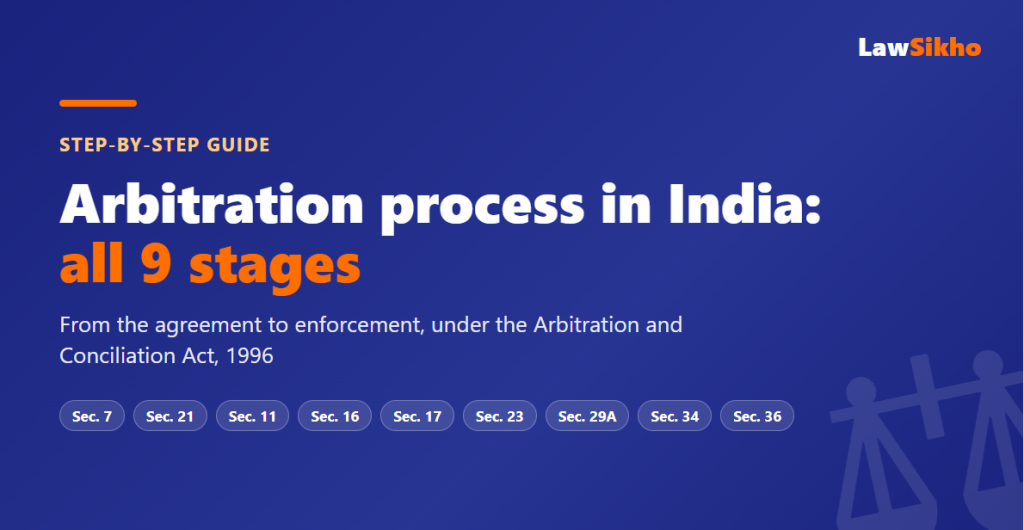
The arbitration process in India is governed by the Arbitration and Conciliation Act, 1996 and runs through nine stages: a valid arbitration agreement, invocation by notice, appointment of the arbitrator(s), the tribunal ruling on its own jurisdiction, interim measures, exchange of pleadings, hearings and evidence, the arbitral award, and finally any challenge to and enforcement of that award.
Each stage has its own rules, its own pitfalls, and its own deadline traps. The sections below take them in order, then move to the cross-cutting questions (seat versus venue, ad-hoc versus institutional, cost, timeline, and whether you even need a lawyer) that decide how an arbitration actually plays out.
What are the steps in the arbitration process in India?
If you strip the arbitration process in India down to its spine, it runs through nine stages. Each one maps to a specific part of the Arbitration and Conciliation Act, 1996, and each one is a place where things can either move smoothly or go badly wrong.
- Confirm a valid arbitration agreement exists (Sec. 7).
- Invoke arbitration by serving a Sec. 21 notice on the other side.
- Appoint the arbitrator(s) by agreement or through the court (Secs. 10-11).
- Let the tribunal rule on its own jurisdiction (Sec. 16).
- Seek interim measures if assets or the status quo need protecting (Secs. 9 and 17).
- Exchange the statement of claim and the statement of defence (Sec. 23).
- Hold hearings and lead oral and documentary evidence (Secs. 18-19, 24-27).
- Receive the reasoned arbitral award within the statutory clock (Secs. 29A, 31).
- Challenge the award if there are grounds (Sec. 34) and enforce it (Sec. 36).
Here’s how to read the rest of this guide. The first ten sections below walk these nine stages in order, because that’s how an arbitration actually unfolds: chronologically, from the clause in your contract to the day you execute the award. Where LawSikho already has a deep-dive guide on a stage (clause drafting, Sec. 17 interim relief, the statement of claim, the Sec. 34 challenge), this pillar gives you the essentials and links down to that guide, so you can decide how deep you want to go.
After the nine stages, the guide shifts to the cross-cutting questions: seat versus venue, ad-hoc versus institutional, how arbitration compares to litigation, what it really costs, how long it takes, and whether you need a lawyer. Those aren’t stages in the timeline, but they shape every stage. Skip ahead using the table of contents if you already know which one you need.
One thing worth flagging before we start. The nine-stage list looks linear, and on paper it is. In practice, several stages overlap (interim measures can run alongside pleadings, jurisdiction objections surface mid-hearing), and a single misstep early, a defective notice, a sloppy seat clause, can echo all the way to enforcement. So treat the stages as a sequence to understand, not a rigid checklist to rush through.
Stage 1: the arbitration agreement (Sec. 7)
Every arbitration stands on one foundation: a valid arbitration agreement. No agreement, no arbitration. This is the document that takes the dispute out of the civil courts and routes it to a private tribunal, so if it’s flawed, everything built on top of it wobbles. That’s why a respondent’s first move is almost always to attack the agreement.
What makes an agreement valid
Under Section 7 of the Arbitration and Conciliation Act, 1996, the arbitration agreement must be in writing and must record the parties’ intention to refer present or future disputes to arbitration. It can sit as a clause inside a larger contract, or stand alone as a separate agreement. “In writing” is read generously: a signed document, an exchange of letters or emails, or even a statement of claim and defence in which one party alleges an agreement and the other doesn’t deny it can all qualify. What it cannot be is purely oral.
The stamping question
For a while, a missing stamp could sink the whole thing. That changed with In Re: Interplay Between Arbitration Agreements under the Arbitration and Conciliation Act 1996 and the Indian Stamp Act 1899, (2024) 6 SCC 1. A seven-judge bench held that an unstamped or insufficiently-stamped arbitration agreement is not void and not unenforceable. Stamping is a curable fiscal issue: the tribunal (or the court) can direct that the deficient duty be paid, and the arbitration proceeds. So if someone tells you your arbitration is dead because the contract wasn’t stamped, that’s no longer the law. The defect gets cured; the process continues.
Who is bound
The default rule is simple: the parties who signed the agreement are bound by it. But Indian law also recognises that, in limited circumstances, a non-signatory can be drawn in. In Cox & Kings Ltd. v. SAP India Pvt. Ltd., 2023 SCC OnLine SC 1634, the Supreme Court worked through the group-of-companies doctrine, holding that a non-signatory within the same corporate group may be bound where the conduct shows a mutual intention to arbitrate and active involvement in the underlying contract. It isn’t automatic, and it isn’t a free pass to rope in any related entity. The intention has to be real and demonstrable.
Common drafting mistakes
So what trips people up at Stage 1? Vague clauses, mostly. A clause that names a city but doesn’t say whether it’s the seat or just the hearing venue. A clause silent on the number of arbitrators, or on whether an institution administers the process. A clause that points to rules that don’t exist or to an institution that’s been renamed. Each gap becomes a fight later. The fix is to get the clause right at the contract stage, which is exactly what a careful drafter does. For the full treatment, see LawSikho’s guide on how to draft a watertight arbitration clause. Is a perfect clause worth the extra hour at signing? Almost always, because the alternative is paying counsel to argue about it for months.
Stage 2: invoking arbitration, the Sec. 21 notice
You have a valid agreement and a dispute has crystallised. Nothing happens until you formally start the process. That trigger is the notice of arbitration, and the moment it lands matters more than most people realise. Get the timing wrong and an otherwise strong claim can die before it’s heard.
When arbitration legally commences
Under Section 21 of the Arbitration and Conciliation Act, 1996, arbitral proceedings in respect of a particular dispute commence on the date the respondent receives the request to refer that dispute to arbitration, unless the parties have agreed otherwise. So commencement is tied to receipt, not to dispatch and not to the date the tribunal is constituted. That single date does a lot of work, because it’s the reference point for limitation. The day the respondent gets the notice is the day the clock is treated as stopped for the claim.
What the notice should contain
A Sec. 21 notice isn’t a formality to fire off in two lines. A well-drafted invocation identifies the arbitration agreement being relied on, describes the dispute with enough precision that the respondent knows what’s being claimed, states the relief sought, and proposes the arbitrator or the appointment mechanism. The better the notice, the cleaner the appointment stage and the harder it is for the respondent to claim ambiguity later. In practice, lawyers treat the notice as the first pleading in everything but name.
The limitation trap
Here’s where it gets serious. Arbitration must be invoked within the limitation period, three years for most contractual claims, under the Limitation Act, 1963 (read with Sec. 43 of the Arbitration Act, which applies the Limitation Act to arbitrations). The Sec. 21 notice is what stops that clock. Miss the window and you can have a watertight agreement, a real grievance, and no remedy, because the claim is time-barred. This front-loads diligence onto the very start of the process: a claimant who sits on a dispute, hoping to negotiate, can negotiate the claim straight into the limitation bar. Worth flagging: limitation runs from when the cause of action arose, not from when you finally got annoyed enough to act.
Stage 3: appointing the arbitrator(s) (Secs. 10-11) and jurisdiction (Sec. 16)
With the notice served, the parties need a tribunal. Who decides the dispute is arguably the single most consequential choice in the whole process, more important than most procedural points, because the arbitrator’s competence, availability, and independence shape everything that follows. India’s law gives the parties wide freedom here, then provides a fallback when they can’t agree.
How many arbitrators
Under Section 10 of the Arbitration and Conciliation Act, 1996, the parties are free to decide the number of arbitrators, provided the number is not even. Why the odd-number rule? To avoid deadlock: an even-numbered panel can split evenly with no majority. If the parties say nothing, the Act defaults to a sole arbitrator. For most commercial disputes, a sole arbitrator is faster and cheaper; three-member tribunals are common in larger, higher-stakes matters where each side wants to nominate.
The appointment mechanism
The first route is agreement: the parties appoint by the method their clause specifies. If that fails, Section 11 of the Arbitration and Conciliation Act, 1996 kicks in, and a party can apply to the Supreme Court or High Court (or a designated arbitral institution) to make the appointment. At this stage, the court’s enquiry is narrow. Under Sec. 11(6A), the court confines itself to the prima facie existence of an arbitration agreement and leaves deeper questions to the tribunal. The idea is to get a tribunal in place quickly, not to litigate the dispute in disguise.
Independence and disclosure
An arbitrator must be independent and impartial, and must disclose anything that could raise justifiable doubts. The Fifth Schedule lists grounds that guide whether such doubts exist; the Seventh Schedule lists relationships that make a person ineligible outright (for example, being an employee or having a controlling interest in a party). The Fourth Schedule sets out an indicative fee model. A common question parties raise is whether a person their opponent has worked with before can sit as arbitrator. The answer depends on which schedule the relationship falls under, ineligibility under the Seventh is non-waivable, while a Fifth Schedule concern can sometimes be addressed by disclosure and consent.
Kompetenz-kompetenz (Sec. 16)
There’s a question that sits between appointment and the merits: what if a party says the tribunal has no jurisdiction at all? The answer is the doctrine of kompetenz-kompetenz. Under Section 16 of the Arbitration and Conciliation Act, 1996, the tribunal rules on its own jurisdiction, including on any objection to the existence or validity of the arbitration agreement. So a party that thinks the tribunal shouldn’t be hearing the matter raises that objection before the tribunal first, not by rushing to court. The tribunal decides it, and if the objection fails, the usual route is to challenge later under Sec. 34, not to derail the arbitration mid-stream. This is what keeps jurisdiction fights from becoming an early-exit hatch for a reluctant respondent.
Stage 4: interim measures, Sec. 9 (court) vs Sec. 17 (tribunal)
Arbitration takes time, and time is exactly what lets a determined opponent dissipate assets, transfer the disputed property, or change the status quo so the eventual award is worth nothing. So what protects you while the arbitration runs? Interim measures. Indian law offers two doors: the court and the tribunal.
When you need interim protection
The classic situations are preserving assets so there’s something to recover against, securing the amount in dispute, restraining a party from invoking a bank guarantee, or holding a status quo (say, on shares or property) until the tribunal decides. The need can arise before the tribunal exists, while it’s hearing the matter, or even after the award until enforcement. Speed usually matters: by the time you realise you need protection, the asset may already be moving.
Section 9: the court route
Section 9 of the Arbitration and Conciliation Act, 1996 lets a party ask a court for interim measures before, during, or after the arbitral proceedings (up until enforcement). It’s the natural choice before the tribunal is constituted, because there’s no tribunal to ask yet. But the 2015 amendment added discipline: once the tribunal is in place, Sec. 9(3) tells the court not to entertain a Sec. 9 application unless the Sec. 17 remedy before the tribunal would be inefficacious. Translation: don’t run to court for something the tribunal can handle.
Section 17: the tribunal route
Section 17 of the Arbitration and Conciliation Act, 1996 gives the tribunal its own power to grant interim measures, and post-2015 those orders are enforceable as if they were orders of a court. That changed the game. Before, a tribunal’s interim order had teeth only if a party respected it; now it carries the force of a court order. Once the tribunal exists, Sec. 17 is usually the right route: faster, cheaper, and decided by the people already across the dispute. For how the tribunal actually frames and grants relief, see LawSikho’s deep dive on the interim measures the tribunal can grant under Section 17. The common mistake? Reflexively heading to court when the tribunal is sitting right there and can act faster.
Stage 5: pleadings, statement of claim and defence (Sec. 23)
Once the tribunal is constituted, the dispute has to be framed in writing. Pleadings are where each side sets out its case, and they do more than narrate facts: they fix the boundaries of what the tribunal can decide and, since the 2019 amendment, they start the clock on the award. Sloppy pleadings cost you twice, once in the hearing and again if the award gets challenged.
The statement of claim
Under Section 23 of the Arbitration and Conciliation Act, 1996, the claimant files a statement of claim setting out the facts supporting the claim, the points at issue, and the relief or remedy sought, with the documents relied on. This is the claimant’s case, fully assembled. Anything not pleaded here is hard to introduce later, so the statement of claim has to be both comprehensive and disciplined: cover the case, but don’t pad it with claims you can’t prove.
The statement of defence and counterclaim
The respondent answers with a statement of defence, admitting or denying the claimant’s points and pleading its own version of the facts. Crucially, a counterclaim travels with the defence, the respondent can mount its own affirmative claim within the same proceeding, provided it falls within the arbitration agreement. That keeps related disputes in one forum instead of spawning a second arbitration.
Timelines and amendments
The 2019 amendment did something important here: it anchored the Sec. 29A award clock to the completion of pleadings, so the moment pleadings close has direct timeline consequences (more on Sec. 29A at Stage 7). Pleadings can usually be amended or supplemented during the proceedings, unless the tribunal considers it inappropriate given the delay. For the mechanics of building these documents (and the growing use of AI-assisted drafting), see LawSikho’s guide on drafting the statement of claim and defence. A practical reality worth naming: many first-time parties underestimate how much of the outcome is locked in at the pleadings stage, long before anyone walks into a hearing.
Stage 6: hearings and evidence (Secs. 18-19, 24-27)
This is the stage most people picture when they think “arbitration”, the hearing, with witnesses and cross-examination. But arbitration hearings don’t look like a courtroom, and that surprises people. The tribunal runs a more flexible process, shaped largely by the parties, within a few non-negotiable guardrails.
The procedural ground rules
Two provisions anchor everything. Under Section 18 of the Arbitration and Conciliation Act, 1996, the parties must be treated with equality and each must be given a full opportunity to present its case, this is the due-process backbone, and breaching it is a classic ground to set the award aside later. Under Section 19 of the Arbitration and Conciliation Act, 1996, the tribunal is not bound by the Code of Civil Procedure, 1908 or the law of evidence, and the parties are free to agree the procedure. So the parties largely design their own process: timelines, document production, whether hearings are in person or virtual.
Oral and documentary evidence
Can you lead evidence and cross-examine in arbitration? Yes. Witnesses typically give evidence-in-chief by affidavit and are then cross-examined; documents are produced and proved. The tribunal can proceed even if a party defaults, under Sec. 25, a claimant who doesn’t file its claim risks termination, and a respondent who doesn’t file a defence doesn’t automatically lose but the tribunal continues. Under Sec. 26, the tribunal can appoint its own expert on a technical question, which is common in construction and engineering disputes.
Court assistance for evidence
Sometimes the tribunal needs the muscle of a court, because a tribunal can’t compel a third party. Under Sec. 27, the tribunal (or a party with the tribunal’s approval) can apply to the court for assistance in taking evidence, for example, to summon a witness who won’t appear voluntarily or to compel production of a document held by a non-party. The court lends its coercive power; the tribunal stays in charge of the merits.
Confidentiality
A frequent question from commercial parties is whether arbitration is actually private. Under Sec. 42A, introduced in 2019, the arbitrator, the institution, and the parties must keep the proceedings confidential, except where disclosure is necessary to enforce or challenge the award. So the privacy is real but not absolute, the moment you go to court to enforce or set aside, parts of the dispute can surface in the public record. For sensitive commercial matters, that carve-out is worth planning around.
Stage 7: the arbitral award (Secs. 29A and 31)
The award is the destination, the binding decision that resolves the dispute. But getting there on time is its own discipline, because Indian law puts the tribunal on a clock, and a tribunal that ignores it can lose the very power to decide. Two provisions govern this stage: one on what the award must contain, and one on when it must be delivered.
What an award must contain (Sec. 31)
Under Section 31 of the Arbitration and Conciliation Act, 1996, the award must be in writing and signed by the members of the tribunal (a majority signature suffices if the reason for any omission is stated). It must state the reasons on which it’s based, unless the parties have agreed no reasons are needed or it’s an award on agreed terms (a settlement). It must state its date and the seat of arbitration, and it deals with the costs of the arbitration. A reasoned award isn’t a formality: thin or contradictory reasoning is one of the openings a challenge exploits.
The Section 29A clock
This is the provision that keeps tribunals honest. Under Section 29A of the Arbitration and Conciliation Act, 1996, the award in matters other than international commercial arbitration must be made within 12 months from the date of completion of pleadings, extendable by up to 6 months by the consent of the parties. Beyond that, only a court can extend time, and if no extension is obtained, the tribunal’s mandate can terminate. The 12-month clock is a domestic-arbitration rule. Since the 2019 amendment, international commercial arbitrations are carved out of that strict cap: the tribunal is asked only to endeavour to make the award within 12 months of completed pleadings, with no automatic loss of mandate for overrunning. So the hard 12 (plus 6) month limit, and the mandate-termination risk that comes with it, bites on domestic arbitrations, while international commercial arbitrations run on a softer, best-endeavour timeline.
Interim award vs final award
Not every award is the last word. The tribunal can make an interim award on any matter on which it can make a final award, deciding a discrete issue (say, liability, or a jurisdiction point, or a part of the claim) before the rest. An interim award is binding on what it decides and is enforceable and challengeable like any award. The final award then wraps up whatever remains. This is a useful case-management tool: resolve the threshold question first, and the rest of the dispute may settle.
[BOX] When the clock runs out
Here’s the part that punctures the “arbitration is always fast” assumption. A tribunal that drifts past the Sec. 29A deadline without securing an extension can lose its mandate by operation of law. The parties then find themselves back in court, applying for an extension, sometimes facing a substitution of arbitrators, after months of work. The promise of speed evaporates into exactly the kind of court detour arbitration was meant to avoid. One downstream effect is quietly reshaping the market: this 29A discipline is part of why serious commercial users are drifting toward institutional arbitration, where administered timelines and active case management make a lapsed mandate far less likely.
Stage 8: challenging the award, setting aside under Sec. 34 (and Sec. 37 appeals)
An award is binding, but it isn’t beyond challenge. The losing party can ask a court to set it aside, and this is where many parties misunderstand what arbitration buys them. The grounds are deliberately narrow, the window is short, and a court won’t simply re-decide the dispute because one side is unhappy with the result. This pillar names the grounds; for the full filing walkthrough, the dedicated guide goes deeper.
The narrow grounds (Sec. 34)
Under Section 34 of the Arbitration and Conciliation Act, 1996, a court can set aside an award only on specific grounds: the arbitration agreement was invalid; a party wasn’t given proper notice or a fair opportunity to present its case; the award decides matters beyond the scope of the reference; the tribunal or the procedure wasn’t in accordance with the parties’ agreement; the dispute wasn’t capable of settlement by arbitration (non-arbitrability); or the award conflicts with the public policy of India. For domestic awards, there’s an additional ground: patent illegality appearing on the face of the award. The contours of “public policy” and “patent illegality” were worked out in Associate Builders v. Delhi Development Authority, (2015) 3 SCC 49 and then tightened, post-2015, in Ssangyong Engineering & Construction Co. Ltd. v. NHAI, (2019) 15 SCC 131, which applied the narrower modern standard.
It is not a merits appeal
This is the misconception that costs parties the most. A Sec. 34 court does not sit in appeal over the award. It does not re-appreciate the evidence, re-weigh the witnesses, or substitute its own view of the contract. “The arbitrator got it wrong” is simply not a ground. The award can be legally erroneous and still survive, because the bargain you struck when you chose arbitration was finality, not a second bite. If you wanted a full appeal on merits, arbitration was the wrong forum.
The time limit
Move fast. An application to set aside must be made within three months from the date the party received the award, and a court may condone a further 30 days for sufficient cause, “but not thereafter”. That last phrase is doing real work: the outer limit is hard. Once three months plus the condonable 30 days have passed, the door is shut, no matter how good the grounds.
Section 37 appeals
A further appeal lies under Sec. 37 from an order setting aside (or refusing to set aside) an award, but the appellate channels are deliberately limited, the Act doesn’t allow an endless ladder of appeals. For the complete grounds, the standard the court applies, and the step-by-step filing process, see LawSikho’s guide on the full grounds and procedure to set aside an award under Section 34.
| Factor | Ad-hoc | Institutional |
|---|---|---|
| Administration | Parties and tribunal run it themselves | An institution administers it under its rules |
| Cost | Lower visible cost, no institutional fee | Higher fee, but predictable and bundled |
| Speed and timeline | Depends on party cooperation | Rules-driven and actively managed |
| Default appointment | May require a court application (Sec. 11) | Institution appoints under its rules |
| Case management | Left to the parties | Built into the institution’s process |
| Best for | Smaller, cooperative, document-light disputes | High-value, contested or cross-border disputes |
Stage 9: enforcement and execution of the award (Sec. 36)
Winning the award is not the same as getting paid. Enforcement is where the award turns into money, property, or compliance, and it’s the stage where a lot of victories stall because the winning party assumed the award would enforce itself. It won’t. But the law here is more favourable to the award-holder than most people expect, especially after 2015.
No automatic stay anymore
Here’s the myth worth killing. Filing a Sec. 34 challenge does not, by itself, stay enforcement of the award. Under Section 36 of the Arbitration and Conciliation Act, 1996, as it stands after the 2015 amendment, the mere filing of a setting-aside application no longer operates as an automatic stay. The losing party must file a separate application for a stay, and the court can grant one only on conditions it thinks fit. So a respondent can’t just file a Sec. 34 petition and sit on the money indefinitely, that loophole is closed.
Enforced as a court decree
Once the time to challenge has expired, or a challenge has been made and refused, the award is enforced under the Code of Civil Procedure, 1908 in the same manner as if it were a decree of the court. That’s a powerful position: the award-holder walks into execution proceedings with effectively a decree in hand, able to attach property, garnish accounts, and use the court’s execution machinery. The award stops being a piece of paper and becomes an enforceable judgment.
Conditions and limitation
When a court does grant a stay, it can require the losing party to deposit the award amount or furnish security, so a stay isn’t free. And there’s a generous window to enforce: an arbitral award is executed as a decree, and the limitation for executing a decree runs to 12 years. The common pitfall is the opposite, complacency, an award-holder who waits years, assuming the award never expires, can still run into limitation and execution-procedure traps. Move on enforcement with the same urgency you’d give any judgment.
Seat vs venue of arbitration
Two parties write “arbitration shall be held at Mumbai” into their contract and assume it means nothing more than where they’ll meet. Then a dispute erupts and, suddenly, that one word decides which High Court can supervise the arbitration and hear any challenge. Seat versus venue is the single most misunderstood concept in Indian arbitration, and getting it wrong reshapes the entire supervisory framework around your case.
The distinction
The seat fixes the juridical home of the arbitration: it determines which courts have supervisory jurisdiction, including the power to hear a Sec. 34 challenge and grant Sec. 9 relief. The venue is merely the physical location where hearings happen. They can be the same city or different cities, parties can have a Mumbai seat with hearings conducted in Delhi or online, and the seat still controls. The seat is law; the venue is logistics.
The practical stakes
Why does this matter so much? Because naming a city loosely can hand exclusive supervisory jurisdiction to courts you never intended to involve. Picture the dispute mentioned above: one side argues the named city was just a convenient meeting point, the other argues it was the seat that locks jurisdiction into that city’s courts. The fight isn’t about the merits at all, it’s about which court even gets to hear the case, and it can run for months before the real dispute is touched. That’s pure avoidable cost, born of one ambiguous clause.
The test: when a venue becomes the seat
Indian courts resolved this with a workable test. In BGS SGS Soma JV v. NHPC Ltd., (2020) 4 SCC 234, the Supreme Court held that where a contract names a single place for the arbitration without any contrary indicator, that place is the seat, not merely the venue, applying the Shashoua principle. And a designated seat behaves like an exclusive-jurisdiction clause: in Indus Mobile Distribution Pvt. Ltd. v. Datawind Innovations Pvt. Ltd., (2017) 7 SCC 678, the court confirmed that once the parties choose a seat, the courts of that seat have exclusive jurisdiction, even if no part of the cause of action arose there. So a clause that names one place, with nothing contradicting it, generally fixes the seat.
Domestic vs international scope
The seat concept also draws the line between Indian-seated and foreign-seated arbitrations. In Bharat Aluminium Co. v. Kaiser Aluminium Technical Services Inc., (2012) 9 SCC 552, a Constitution Bench held that Part I of the Act (which includes Sec. 9 and Sec. 34) does not apply to arbitrations seated outside India, applied prospectively to agreements made after the decision. That was a turning point: before BALCO, Indian courts had been reaching into foreign-seated arbitrations; after it, the seat genuinely determined which legal regime governed supervision. For a business choosing a seat, that’s the difference between Indian court oversight and a foreign court’s.
Seat vs venue at a glance
| Aspect | Seat | Venue |
|---|---|---|
| What it fixes | The juridical home of the arbitration | The physical place hearings are held |
| Legal effect | Determines supervisory court jurisdiction (Sec. 9, Sec. 34, Sec. 37) | No effect on jurisdiction |
| Can it change? | Fixed by the agreement; stable | Can shift for convenience (or be virtual) |
| Why it matters | Decides which courts supervise and hear challenges | Decides logistics only |
| Drafting tip | Name the seat expressly and unambiguously | Optional; label it clearly as “venue” if different |
Ad-hoc vs institutional arbitration in India
Before the first hearing, parties face a structural choice that colours the whole arbitration: do they run it themselves, or hand the administration to an institution? This is the ad-hoc versus institutional decision, and in India it’s increasingly tilting one way. Knowing the trade-offs lets you choose deliberately instead of by default.
What each means
In an ad-hoc arbitration, the parties and the tribunal run the process themselves: they set the procedure, fix the timetable, handle the logistics, and agree the arbitrator’s fees directly. In an institutional arbitration, a recognised institution administers the arbitration under its published rules, appointing arbitrators where needed, managing timelines, fixing fees on a schedule, and handling the paperwork. One is do-it-yourself; the other is managed.
The trade-offs
Cost is the usual headline: ad-hoc avoids institutional fees, so it looks cheaper, but that saving can vanish if the parties have to litigate procedural fights an institution would have absorbed. Institutional arbitration brings rules-based case management, default appointment when a party stonewalls, scrutiny of the draft award in some institutions, and predictable fee scales. Ad-hoc offers maximum flexibility and lower visible cost, but leaves more to the parties’ goodwill. A workable rule of thumb: choose institutional if the dispute is high-value, cross-border, or likely to be contested at every turn; choose ad-hoc if it’s smaller, the parties are cooperative, and a trusted sole arbitrator can run a lean process.
India’s institutions
India now has serious institutional options. The Mumbai Centre for International Arbitration (MCIA), the Delhi International Arbitration Centre (DIAC), the India International Arbitration Centre (IIAC, a statutory body), and the Indian Council of Arbitration (ICA) all administer arbitrations under their own rules. Government policy has been pushing institutional arbitration hard, the aim being to make India a credible arbitration hub and to cut the delay that plagues ad-hoc proceedings. One second-order effect: as institutional work grows, the skills in demand are shifting, junior lawyers increasingly need fluency in institution rules and case-management platforms, not just the bare Act.
Ad-hoc vs institutional decision table
| Factor | Ad-hoc | Institutional |
|---|---|---|
| Administration | Parties and tribunal manage it | Institution administers under its rules |
| Visible cost | Lower (no institutional fee) | Higher fee, but predictable and bundled |
| Speed and timelines | Depends on party cooperation | Rules-driven, actively managed |
| Default appointment | May need a court (Sec. 11) | Institution appoints under its rules |
| Case management | Left to the parties | Built into the institution’s process |
| Best for | Smaller, cooperative, document-light disputes | High-value, contested, or cross-border disputes |
Arbitration vs litigation, conciliation and mediation
Arbitration is one option among several for resolving a commercial dispute, and it isn’t always the right one. Choosing it blindly, or avoiding it blindly, both cost money. So how does it stack up against going to court, and against the softer forms of alternative dispute resolution?
Arbitration vs litigation
The pitch for arbitration over litigation is real: privacy (court files are public, arbitral proceedings are confidential under Sec. 42A), a tribunal the parties choose rather than a judge assigned by roster, limited appeals, and easier cross-border enforcement of awards under the New York Convention framework. But the honest counterpoint matters too. Arbitration is not automatically faster or cheaper. As the Sec. 29A discussion showed, timelines slip, and arbitrator and counsel fees can dwarf court fees. Is arbitration faster than going to court? Often, but not always, and a contested matter that ends in a Sec. 34 challenge plus a Sec. 37 appeal can rival litigation for length.
Arbitration vs conciliation vs mediation
The key divide is binding versus non-binding. Arbitration ends in a binding award the courts will enforce. Conciliation (also under the Arbitration and Conciliation Act, 1996) and mediation are settlement-driven: a neutral helps the parties reach their own agreement, and there’s no imposed decision unless and until the parties sign a settlement. The Mediation Act, 2023 now gives mediated settlements their own enforceable status, narrowing the old gap. Think of it this way: arbitration decides for you; conciliation and mediation help you decide for yourselves.
Which to choose
For a commercial party, a quick framework helps. If the relationship is worth preserving and there’s room to compromise, mediation first is often smart and cheap. If the dispute is purely about who’s right and you need a binding, enforceable outcome with privacy, arbitration fits, provided your contract has a sound arbitration clause. And if the matter needs interim coercive relief against third parties or raises issues a private tribunal can’t decide (non-arbitrable matters), the courts may be unavoidable. The forum should follow the dispute, not the other way round.
How long does arbitration take and how much does it cost?
These are the two questions clients ask first and competitors answer worst. “How long” and “how much” deserve honest, India-specific answers, even though the honest answer is “it depends”. What follows is the realistic picture, with figures clearly flagged as indicative, because exact costs turn on the tribunal, the institution, and the complexity of the matter.
The timeline reality
On paper, Sec. 29A sets the ceiling: an award within 12 months of completed pleadings, plus a 6-month consent extension, so 18 months as the legal outer limit for many matters before a court extension is needed. Reality is messier. Add the pre-pleadings phase (notice, appointment, jurisdiction skirmishes), then a possible Sec. 34 challenge (three months to file, then court time), then a possible Sec. 37 appeal, and a contested arbitration can run several years from notice to final enforcement. That’s the second-order truth the “arbitration is fast” marketing skips: the statutory clock governs the award, not the whole dispute lifecycle.
The cost components
Cost has several moving parts: arbitrator fees (the Fourth Schedule gives an indicative fee model tied to the sum in dispute, which courts and institutions often use as a reference, though it is not a mandatory ceiling on what parties can agree), institutional administration fees if you go institutional, counsel fees (usually the largest line item in a contested matter), and venue, transcription, and administrative costs. The Fourth Schedule sets out fee bands that scale with the amount in dispute, but the actual figure turns on the tribunal, the institution’s own rule book, and what the parties agree, so treat any specific rupee figure as indicative only. As a rough orientation, a straightforward sole-arbitrator matter costs far less than a three-member institutional arbitration in a high-value cross-border dispute, but treat every number as a planning estimate, not a quote.
Who pays
Under Sec. 31A, the tribunal has the discretion to decide who bears the costs, and the default principle is “costs follow the event”, the losing party typically pays the winner’s reasonable costs, though the tribunal can depart from that based on conduct, offers to settle, and proportionality. A common misconception is that each side simply bears its own costs, as informally happens in some court matters. Not so in arbitration: a party that fights a hopeless point can end up funding the other side’s bill. Budget for that risk before you dig in on a weak position.
Do you need a lawyer for arbitration in India?
People often assume arbitration, being private and less formal than court, is something they can handle themselves. Sometimes that’s true. Often it isn’t. The honest answer turns on the complexity and value of the dispute, not on any legal barrier to self-representation.
The legal position
There’s no statutory bar to representing yourself. Parties may appear in person or be represented by a person of their choice, and the Act doesn’t require that the representative be an enrolled advocate. So a company can, in principle, send a manager rather than counsel, and an individual can argue their own case. The door is legally open.
The practical reality
Open door, hard road. The pleadings have to be precise, the evidence has to be led and tested, jurisdiction objections have to be handled under Sec. 16, and any Sec. 34 challenge or Sec. 36 enforcement is squarely a litigation exercise in court. Each of these is technical, and a misstep, an under-pleaded claim, a missed limitation date, a botched cross-examination, can quietly lose a winnable case. For complex or high-value matters, effective representation isn’t a luxury; it’s the difference between an award you can enforce and an expensive lesson.
When self-representation can work
There’s a genuine niche for it. Small, document-heavy, low-value disputes with a cooperative counterparty and a sensible sole arbitrator can sometimes be run without full-time counsel, especially where the facts are admitted and only a number is in dispute. Even then, getting a lawyer to vet the arbitration clause, the notice, and the final award is cheap insurance. The mistake we see most often is self-representing through the easy stages and then facing a sophisticated Sec. 34 challenge alone, where the gap in expertise suddenly matters most.
How the law has changed: the 2015, 2019 and 2021 amendments (and the 2024 Bill)
The arbitration process you’ve just walked through isn’t static. The 1996 Act has been amended three times in the last decade, and a further set of changes sits in draft. Knowing what changed and when helps you read older judgments and commentary correctly, because a case decided under the pre-2015 regime may state the law that no longer applies.
The 2015 amendment
This was the big one. It introduced the Sec. 29A timeline, added Sec. 9(3) to discipline court interim relief once a tribunal exists, created a fast-track procedure under Sec. 29B, narrowed the “public policy” ground for setting aside awards, and changed Sec. 36 so that filing a challenge no longer automatically stays enforcement. Most of the modern, pro-arbitration character of Indian law traces back to 2015.
The 2019 amendment
The 2019 changes were more institutional. They provided for an Arbitration Council of India, enabled appointment of arbitrators through designated institutions under Sec. 11, introduced the confidentiality obligation in Sec. 42A, and re-anchored the Sec. 29A clock to the completion of pleadings rather than the tribunal’s constitution. Internationally-flavoured matters and institutional arbitrations were given some breathing room on the strict timeline.
The 2021 amendment
The 2021 amendment did two notable things. It provided for an unconditional stay of an award where the court is satisfied that the arbitration agreement or the award was induced by fraud or corruption, a carve-out from the post-2015 “no automatic stay” position. And it omitted the Eighth Schedule, which had tried to prescribe arbitrator qualifications, a regime widely criticised as too restrictive.
What’s proposed next
Now the forward look, and this needs a clear health warning. The Draft Arbitration and Conciliation (Amendment) Bill, 2024 is a proposal, not law. As of June 2026 it has not been enacted, so nothing in it is in force, and you should treat every feature below as a possibility under consultation, not a current rule. The Bill, as circulated, proposes statutory recognition of emergency arbitrators, an Appellate Arbitral Tribunal, removal of “conciliation” references (following the Mediation Act, 2023), and tighter court timelines. If the Appellate Arbitral Tribunal idea is enacted, it could redraw the Sec. 34 challenge workflow significantly, a second-order shift that would push practitioners trained only on court-centric challenges to re-skill. Early signals suggest the institutional and timeline themes have momentum, but until the Bill passes, the law remains the 1996 Act as amended through 2021. Will the 2024 Bill become law in its current form? No one can say yet, so draft and advise on the law as it stands today.
Frequently asked questions
1. What are the steps in the arbitration process in India? The process runs through nine stages: confirming a valid arbitration agreement (Sec. 7), invoking arbitration by notice (Sec. 21), appointing the arbitrator(s) (Secs. 10-11), the tribunal ruling on its jurisdiction (Sec. 16), seeking interim measures (Secs. 9 and 17), exchanging pleadings (Sec. 23), holding hearings and leading evidence (Secs. 24-27), receiving the award (Secs. 29A, 31), and challenging (Sec. 34) and enforcing it (Sec. 36).
2. How do you start or invoke arbitration in India? You start arbitration by serving a notice of arbitration on the other party under Sec. 21. The proceedings legally commence on the date the respondent receives that request to refer the dispute, unless the parties have agreed otherwise. The notice should identify the agreement, describe the dispute, state the relief sought, and propose the arbitrator or appointment method.
3. What makes a valid arbitration agreement under Section 7? Under Sec. 7, the agreement must be in writing and must record the parties’ intention to refer disputes to arbitration. It can be a clause within a contract or a standalone agreement. An exchange of letters or emails, or pleadings in which the agreement is alleged and not denied, can satisfy the “in writing” requirement. A purely oral agreement will not.
4. Is an unstamped arbitration agreement valid and enforceable? Yes. After the seven-judge Supreme Court decision in In Re: Interplay (2023), an unstamped or insufficiently-stamped arbitration agreement is not void and not unenforceable. Stamping is treated as a curable fiscal defect that the tribunal or court can address; it no longer blocks the appointment of an arbitrator or the start of the arbitration.
5. Who appoints the arbitrator if the parties cannot agree? First, the parties appoint by the method in their clause. If that fails, a party can apply under Sec. 11 to the Supreme Court or the relevant High Court (or a designated arbitral institution), which makes the appointment. At that stage the court looks only at the prima facie existence of an arbitration agreement under Sec. 11(6A), leaving deeper questions to the tribunal.
6. What is the limitation period to commence arbitration? Arbitration must be commenced within the limitation period that would apply to the claim in court, generally three years for most contractual claims, under the Limitation Act, 1963, read with Sec. 43 of the Arbitration Act. The Sec. 21 notice is what stops the clock. A claim invoked after limitation has expired can be dismissed as time-barred even if the agreement is otherwise valid.
7. What disputes cannot be referred to arbitration? Certain categories are treated as non-arbitrable because they affect rights in rem or public interest, for example, criminal matters, insolvency, certain matrimonial disputes, and some statutory remedies reserved for special forums. If a dispute is non-arbitrable, an award on it can be set aside under Sec. 34. The precise boundaries continue to be refined by the courts.
8. Is an arbitration award final and binding? Yes. An arbitral award is final and binding on the parties, and once the time to challenge it lapses (or a challenge fails), it is enforceable as a decree of the court. The only route to disturb it is a setting-aside application under Sec. 34 on narrow grounds, not a general appeal on the merits.
9. How is an arbitral award enforced in India? Once the period to challenge under Sec. 34 has expired, or a challenge has been refused, the award is enforced under the Code of Civil Procedure, 1908 in the same manner as a court decree (Sec. 36). The award-holder can use execution remedies such as attachment of property and garnishee orders. Filing a Sec. 34 challenge does not automatically stay enforcement.
10. How long does arbitration take in India? Sec. 29A sets a target of 12 months from completion of pleadings, extendable by 6 months by consent, so roughly 18 months for the award before a court extension is needed. In practice, the full lifecycle, including pre-pleadings steps and any Sec. 34 challenge or Sec. 37 appeal, can run considerably longer. Arbitration is often faster than court, but not automatically.
11. How much does arbitration cost in India? Costs include arbitrator fees (the Fourth Schedule gives an indicative model tied to the amount in dispute), any institutional fees, counsel fees, and administrative costs. These vary widely with the value and complexity of the dispute and the tribunal chosen, so any figure should be treated as indicative. A simple sole-arbitrator matter costs far less than a high-value, three-member institutional arbitration.
12. Do you need a lawyer for arbitration in India? There is no legal requirement to be represented by an advocate; parties may appear in person or through a representative of their choice. In practice, pleadings, evidence, jurisdiction objections, and any Sec. 34 or Sec. 36 court proceedings are technical, so complex or high-value disputes effectively need counsel. Small, cooperative, low-value matters can sometimes be run without full-time representation.
13. What is the difference between the seat and venue of arbitration? The seat is the juridical home of the arbitration; it fixes which courts have supervisory jurisdiction (including over a Sec. 34 challenge). The venue is just the physical location of hearings, which can differ from the seat or be virtual. Where a clause names one place without contrary indicators, courts generally treat it as the seat, which carries exclusive supervisory jurisdiction.
14. What is the difference between ad-hoc and institutional arbitration? In ad-hoc arbitration, the parties and tribunal run the process themselves, setting procedure, timelines, and fees. In institutional arbitration, a recognised institution (such as MCIA, DIAC, IIAC, or ICA) administers it under published rules, with default appointment, fee schedules, and case management. Ad-hoc looks cheaper; institutional offers structure and is increasingly preferred for high-value, contested matters.
15. What is the difference between arbitration and conciliation or mediation? Arbitration ends in a binding award that courts will enforce. Conciliation and mediation are settlement-driven: a neutral helps the parties reach their own agreement, with no decision imposed on them. The Mediation Act, 2023 gives mediated settlements their own enforceable status. In short, arbitration decides the dispute for you; conciliation and mediation help you settle it yourselves.
16. Is arbitration faster than going to court in India? Often, but not always. The Sec. 29A clock pushes tribunals to deliver an award within 12 (plus 6) months of completed pleadings, which is usually quicker than crowded court dockets. But a contested arbitration followed by a Sec. 34 challenge and a Sec. 37 appeal can take years, so the speed advantage is real for the award stage, not guaranteed for the whole lifecycle.
17. On what grounds can you challenge an arbitral award under Section 34? The grounds are narrow: an invalid arbitration agreement, lack of proper notice or a fair hearing, the award going beyond the scope of the reference, an improperly constituted tribunal or procedure, non-arbitrability, or conflict with the public policy of India. For domestic awards, patent illegality on the face of the award is an additional ground. A court will not re-examine the merits.
18. What is the time limit to challenge an arbitral award? An application to set aside must be filed within three months of receiving the award. A court may condone a further 30 days for sufficient cause, “but not thereafter”, making the outer limit hard. Once that period passes, the award can no longer be challenged, however strong the grounds might have been.
19. Does filing a Section 34 challenge automatically stay enforcement of the award? No. Since the 2015 amendment to Sec. 36, merely filing a setting-aside application does not stay enforcement. The party challenging the award must file a separate stay application, and the court may grant a stay only on conditions, such as depositing the award amount or furnishing security.
Key takeaways
- The arbitration process in India runs through nine stages, from a valid agreement (Sec. 7) to enforcement of the award (Sec. 36), each tied to a specific provision of the Arbitration and Conciliation Act, 1996.
- Stage 1, the agreement, anchors everything; after In Re: Interplay (2023), an unstamped agreement is enforceable, and the stamping defect is curable.
- The Sec. 21 notice both starts the arbitration and stops the limitation clock, so a late or defective notice can sink an otherwise strong claim.
- Seat is not the same as venue: the seat fixes which courts supervise the arbitration and hear a challenge, while the venue is only where hearings happen.
- Sec. 29A puts the tribunal on a 12 (plus 6) month clock; a tribunal that misses it can lose its mandate and force the parties back to court.
- A Sec. 34 challenge is a narrow, time-barred setting-aside remedy, not a merits appeal, and post-2015 it does not automatically stay enforcement under Sec. 36.
- Institutional arbitration is increasingly the default for serious commercial disputes, and the Draft Amendment Bill, 2024 remains a proposal only, not enacted law.
References
Case Law
- Associate Builders v. Delhi Development Authority, (2015) 3 SCC 49: scope of public policy and patent illegality as Sec. 34 grounds; limited merits review.
- Bharat Aluminium Co. v. Kaiser Aluminium Technical Services Inc., (2012) 9 SCC 552: Part I does not apply to foreign-seated arbitrations, applied prospectively to agreements made on or after 6 September 2012.
- BGS SGS Soma JV v. NHPC Ltd., (2020) 4 SCC 234: when a single named place is the juridical seat (Shashoua principle); seat vests exclusive supervisory jurisdiction.
- Cox & Kings Ltd. v. SAP India Pvt. Ltd., 2023 SCC OnLine SC 1634: five-judge Constitution Bench, decided 6 December 2023; group-of-companies doctrine and binding of non-signatories.
- In Re: Interplay Between Arbitration Agreements under the Arbitration and Conciliation Act 1996 and the Indian Stamp Act 1899, (2024) 6 SCC 1: seven-judge Constitution Bench, decided 13 December 2023; an unstamped or insufficiently-stamped arbitration agreement is not void or unenforceable (curable defect); overruled NN Global.
- Indus Mobile Distribution Pvt. Ltd. v. Datawind Innovations Pvt. Ltd., (2017) 7 SCC 678: designation of a seat operates as an exclusive-jurisdiction clause for the seat courts.
- Ssangyong Engineering & Construction Co. Ltd. v. NHAI, (2019) 15 SCC 131: applied the post-2015 narrowed public policy and patent illegality standard for setting aside.
Statutes
- Arbitration and Conciliation Act, 1996: sections cited: 7, 8, 9, 10, 11, 16, 17, 18, 19, 21, 23, 24 to 27, 29A, 29B, 31, 31A, 34, 36, 37, 42A, 43; Schedules 4, 5 and 7; as amended by the Arbitration and Conciliation (Amendment) Acts of 2015, 2019 and 2021.
- Limitation Act, 1963: limitation period to commence arbitration (read with Sec. 43 of the Arbitration Act); Article 136 (12-year period to execute a decree).
- Code of Civil Procedure, 1908: execution of an arbitral award as a decree (Sec. 36 of the Arbitration Act).
- Mediation Act, 2023: enforceability of mediated settlements (comparison context).
Secondary sources
- Promises and Pitfalls of the Draft Arbitration and Conciliation (Amendment) Bill, 2024, SCC Times: status and key proposals of the Draft Bill (proposed only, not enacted).
- Inviting comments on the draft Arbitration and Conciliation (Amendment) Bill, 2024, Press Information Bureau: official release of the Draft Bill for public consultation on 18 October 2024.
This article is for informational purposes only and does not constitute legal advice. For specific legal guidance, consult a qualified legal professional.




 Allow notifications