
Most lawyers today believe they are using AI in law practice simply because they’ve tried ChatGPT once or twice. But here’s the truth that’s just the beginning.
AI is not just a tool for drafting legal notices. It is a system that can transform how legal work is done, from research to client communication.
And here is the part that nobody tells you:
In a chat window, you cannot go beyond level 1. The tool itself is the ceiling.

In this blog, you’ll discover the 5 levels of AI in law practice, understand where you currently stand, and learn how to move towards automation, efficiency, and scalability.
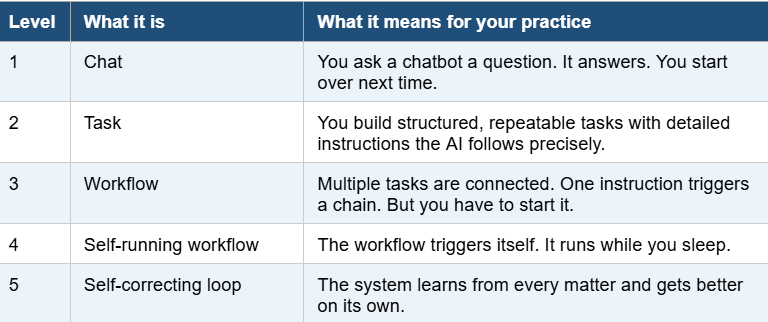
The 5 Levels of AI Adoption in Legal Practice
Level 1: Chatbots in AI for Law Practice
At Level 1, most Indian lawyers believe they’re using AI because they interact with tools like ChatGPT to draft legal documents. But this is not real AI adoption. It’s just chatting with a chatbot.
What Does This Mean for Your Law Practice?
AI tools for lawyers at this level are essentially limited to providing generic responses. They do not have access to specific case facts, jurisdiction details, or client preferences. Every new session starts from scratch, and the results often need significant manual editing to be useful.
Challenges of Level 1 AI in Law Practice:
- Generic output with no context to your jurisdiction or client’s case.
- Missing key legal nuances such as court rules or local amendments.
- Time-consuming revisions because the tool lacks domain-specific knowledge.
Real-Life Examples of Level 1 Challenges:
- A trial litigator misses the deadline under Section 138 NI Act.
- A law firm associate overlooks important clauses like indemnity in a contract.
- An in-house counsel receives a contract draft with the wrong jurisdiction specified.
The core problem here is that the AI tool lacks critical context. AI adoption in law practice requires more than just a chatbot.
Level 2: Task Automation with AI for Lawyers
Level 2 represents the shift from simple chats to creating structured, repeatable tasks. This is where AI can be genuinely useful in legal tasks.
What is Level 2 AI?
Instead of typing one-off requests, at Level 2, you build detailed prompts and templates that AI follows. These templates include frameworks, checklists, red flags, and formatting preferences, ensuring that AI consistently follows your preferred methodology.
How Level 2 AI Transforms Your Legal Practice:
- Research agents conduct legal research using your defined methodology.
- Drafting agents write documents in your style, using your firm’s preferred clause structures.
- Review agents flag inconsistencies, missing clauses, or outdated references.
- Formatting agents apply court-specific formatting.
Real-Life Examples of Level 2 in Law Practice:
- Bail application drafting is ready in minutes instead of hours.
- Due diligence tasks that previously took two days are now completed in three hours.
- Contract reviews become standardized and consistent.
The Limitation of Level 2 AI:
While AI can now handle tasks more efficiently, you’re still the engine driving the system. Every task must be manually executed, which means your billable hours remain constrained.
Level 3: Workflow Automation in Legal Practice
At Level 3, AI stops being a tool and becomes part of a connected system. This is where you connect multiple tasks into workflows.
How Does Workflow Automation Help?
In Level 3, workflows are automated. One instruction triggers a chain of actions where output flows automatically between connected tasks.
What Workflow Automation Looks Like in Practice:
- Research: The AI conducts legal research based on case facts.
- Drafting: It automatically drafts documents using your predefined format.
- Review: The system reviews the drafts for inconsistencies, factual errors, and missing references.
Use Cases for Level 3 AI in Legal Practice:
- Arbitration drafting workflows: Streamline the process from research to drafting and final review.
- M&A due diligence automation: Automate compliance checks and document reviews.
- Contract lifecycle management: Automate contract reviews, redlines, and approval workflows.
While this step introduces automation, it still requires you to manually trigger the workflow. However, it marks a significant improvement over manually executing individual tasks.
Level 4: Self-Running Workflows in Law Practice
Level 4 represents a big leap forward—AI systems that run autonomously without any manual intervention.
What Makes Level 4 Special?
At this level, AI automates the triggers that start workflows, meaning tasks run automatically based on pre-defined conditions.
What Self-Running Workflows Look Like:
- Case briefs generated every morning based on updates from eCourts.
- Contracts automatically reviewed when received via email.
- Compliance tracked without needing manual follow-ups.
Advanced AI Possibilities for Law Firms:
- AI answering client calls when you’re in court.
- AI handling client intake, scheduling, and follow-ups.
- Automated legal updates sent to clients without manual effort.
This level of AI helps free up time for lawyers, allowing them to focus on higher-value tasks like client relationships and strategic decisions.
Level 5: Self-Correcting Learning Loop in AI for Lawyers
Level 5 is the pinnacle of AI adoption in law practice. At this level, the AI learns from past cases, improving its performance with every task it handles.
How Does Level 5 AI Work?
The system not only automates tasks but also learns from every case, adapting to your drafting style, improving research accuracy, and refining strategies over time.
How AI Learning Benefits Your Legal Practice:
- Research agents improve by identifying patterns in case law and prioritizing relevant case law.
- Drafting agents adapt by learning your preferences for clause structures and language.
- Case outcomes are tracked, allowing the AI to offer more effective arguments based on historical success.
Why Level 5 AI is a Game-Changer:
Every matter the AI handles makes it smarter, leading to more efficient operations and better outputs. Over time, this creates a powerful institutional asset that continually improves without any extra effort on your part.
Why Most Lawyers Are Stuck at Level 1
If you’re using ChatGPT or similar tools for drafting legal documents and wondering why the output feels mediocre, it’s because these tools are limited to Level 1. At this level, you can’t build workflows, automation, or learning systems.
The Result of Staying at Level 1:
- 40–60% rework: A high percentage of AI-generated output requires corrections.
- Generic output: The results lack your firm’s unique approach and expertise.
- No scalability: You cannot scale your practice by relying on chatbots alone.
The Dream Law Firm is Now Possible
With AI tools becoming more advanced and accessible, even solo lawyers can now build systems that automate tasks like research, drafting, and document review. These systems not only automate repetitive tasks but learn and improve over time.
Your First Steps to Adopt AI in Law Practice
- Level 1 to Level 2: Start by building structured templates for your most common tasks (e.g., bail applications, due diligence, contract reviews).
- Level 2 to Level 3: Connect tasks into workflows to streamline operations.
- Level 3 to Level 4: Automate triggers so workflows run without manual intervention.
- Level 4 to Level 5: Add a memory layer that helps the system learn from past matters.
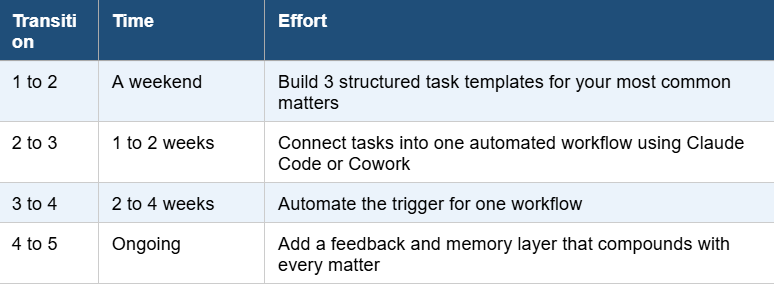
The Opportunity Window
- Most lawyers are at Level 1.
- Few are at Level 2.
- Very few are at Level 3 and beyond.
Early adopters of AI in law practice will gain a significant competitive advantage. This advantage isn’t just speed; it’s about building a knowledge base and systems that get smarter over time.





 Allow notifications