

International law careers for Indian lawyers have never looked more promising and the shift happening right now is bigger than most people realise. While headlines obsess over visa restrictions and trade wars, a quieter, more structural change is creating unprecedented demand for Indian legal professionals globally. Five forces are converging at once, producing a window of opportunity that has never existed before.
Table of Contents
If you are an Indian lawyer, law graduate, or paralegal actively pursuing international law careers for Indian lawyers, this article explains exactly what is happening, why it matters, and how to position yourself.
The 5 Market Forces Creating This Opportunity
These five dynamics are not isolated trends they are reinforcing each other to create a structural, long-term demand shift. Understanding these forces is the first step toward building international law careers for Indian lawyers that are globally competitive.
1. The US Legal Talent Crunch
96% of US legal hiring managers say they struggle to find skilled talent, with 50% planning to add permanent headcount in 2025. The US Bureau of Labor Statistics projects 38,000 paralegal openings annually — yet paralegal unemployment sits at just 2%. Translation: nearly every qualified professional is already employed. That leaves a massive gap that domestic hiring cannot fill, making offshore talent the only realistic path forward for US firms.

2. The UK’s 10,000-Professional Shortfall
The UK legal sector is losing talent faster than it can replace it. 37% of Gen Z legal professionals considered leaving their roles in the past year. Cost-of-living pressures are pushing UK lawyers to seek higher salaries globally, compounding a shortfall of approximately 10,000 legal professionals — particularly in intellectual property and regulatory compliance. Remote work has expanded options for UK professionals, and firms are responding by tapping global talent pools, especially India. This shortage is directly fuelling international law careers for Indian lawyers in the UK market.

3. Asia-Pacific Companies Expanding West
Companies from Hong Kong, China, and Singapore are actively expanding into Europe and North America. They face immediate compliance hurdles — FDA approvals in the US, ESG disclosure requirements in Hong Kong, cross-border M&A filings in multiple jurisdictions. These firms need professionals who understand both Eastern business culture and Western regulatory systems. Indian lawyers, trained in common law and fluent in English, fit this brief perfectly. This demand is creating new international law careers for Indian lawyers with Asia-Pacific facing companies.
4. Cross-Border Trade Demands Dual Legal Expertise
When Asian businesses transact with Western markets, they need professionals who understand US law (FDA, SEC, capital markets regulations) AND UK law (international contracts, financial services). These are different legal systems serving different functions, and companies cannot afford professionals who understand only one. Indian lawyers who build dual expertise are effectively the only readily available talent pool in the world that can bridge this gap.
5. Foreign Law Firms Can Finally Enter India — The Big 4 Parallel
In a landmark decision, the Bar Council of India has allowed foreign law firms to practice in India for the first time in 77 years. This is not a minor regulatory update — it is a structural market opening.
Remember what happened when Deloitte, PwC, KPMG, and EY entered India? They created an entirely new category of professionals: globally-trained Indians serving both local and international clients. Salaries jumped 3–4x for those who were ready. Now it is law’s turn.
India’s legal market is worth $45.2 billion. Foreign firms like Clifford Chance, Freshfields, and Linklaters are entering — but they can only practice corporate and transactional work (not litigation), which means they must partner with Indian legal professionals. Industry estimates project 10,000+ bilingual legal professionals hired by 2027.
Your Unique Advantage? When Clifford Chance, Freshfields, or Linklaters set up their India desks, they face an immediate challenge:
• They need talent that can bridge Indian and US/UK legal systems
• They need professionals who can serve their global clients’ India-related matters
• They need teams that understand international standards while navigating Indian regulations

This Creates Three Opportunities for You:
- Join Foreign Firms Directly: Starting salaries of ₹20-40 LPA for those with US/UK law knowledge
- Become Their Remote Resource: Serve foreign firms that haven’t yet entered India
- Be the Bridge Professional: Help Indian companies work with these foreign firms
The professionals who prepare NOW, who understand both Indian and international law, won’t just have jobs. They’ll be the architects of India’s integration into the global legal economy.
Remote Legal Work: Your Access to 50,000+ Global Firms
Foreign firms entering India is only half the story of international law careers for Indian lawyers.
While a handful of global firms are setting up physical offices in Mumbai, Bangalore, and Delhi, thousands of other US and UK law firms are doing something even more significant: they are hiring Indian legal talent remotely and they never need to open a single India office to do it. This is what makes international law careers for Indian lawyers a remote reality, not just a dream.
COVID permanently proved that legal work can be done from anywhere. Time zone differences that once seemed like obstacles became advantages: Indian professionals can complete work while US and UK firms sleep, enabling round-the-clock operations. Technology eliminated the need for physical presence. And the cost-benefit equation became impossible to ignore.
You are not limited to the 30–40 foreign firms entering India. You have access to 50,000+ law firms globally who need skilled legal professionals but will never open an India office.
What About H1B Restrictions and the HIRE Act?
H1B Costs Make Remote Hiring the Smart Choice
Tightening H1B visa regulations might look like bad news for Indian professionals. It is actually accelerating demand for remote Indian talent.
• US firms now face $100,000+ total costs to sponsor a single H1B visa (legal fees, filing costs, employer contributions)
• Processing times stretch 6–12 months with uncertain outcomes
• The H1B lottery success rate sits at approximately 25%
• Immigration complexity is pushing forward-thinking firms to rethink their talent strategies entirely
Instead of navigating visa complexities, forward-thinking firms are discovering they can:
- Access top Indian talent immediately without visa constraints
- Save 60-70% on talent costs while maintaining quality
- Build 24/7 operational capabilities leveraging time zone advantages
- Scale teams up or down without immigration hurdles
A US paralegal in New York earns $60,000–90,000 per year. The same firm can engage a skilled Indian paralegal remotely for a fraction of that cost — while the Indian professional earns 2–3x the average Indian legal salary. Both sides win. This cost dynamic is one of the strongest drivers of international law careers for Indian lawyers today.
The HIRE Act: A Political Proposal, Not a Real Threat
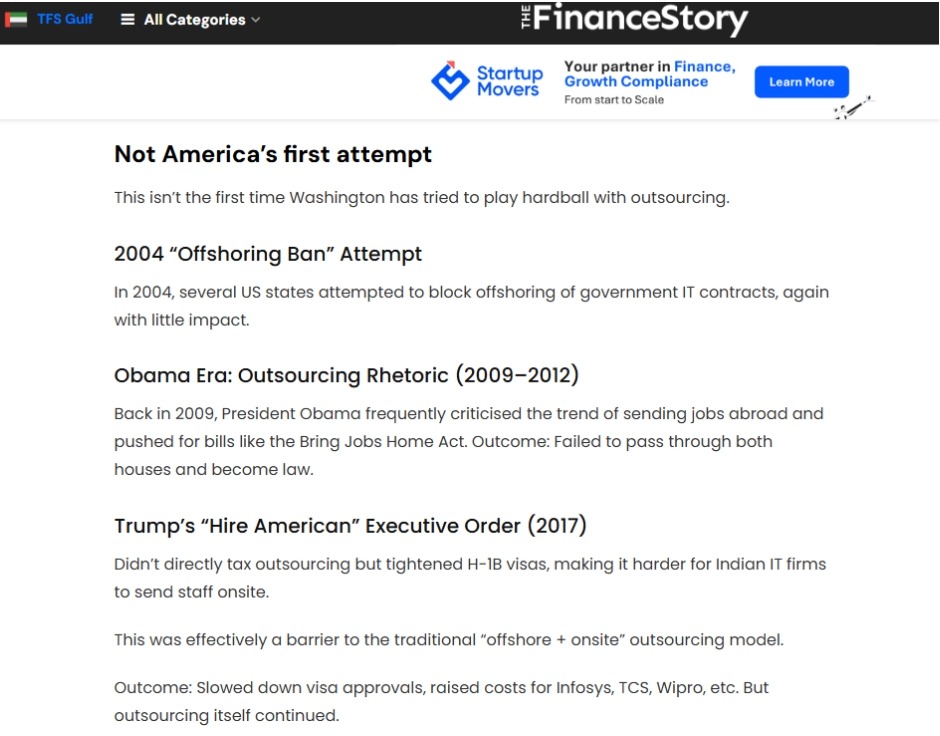
Senator Bernie Moreno’s proposed HIRE Act would impose a 25% excise tax on outsourcing payments. This has understandably caused concern. Here is the reality: it is currently just a proposal from a minority politician that has not even been introduced as a formal bill. The likelihood of passage through Congress is very low.

Even in the unlikely scenario it does pass, the math still works in India’s favour. A US professional costs approximately five times more than an Indian professional. Even with a 25% offshoring tax applied, US firms would still be paying roughly 1.25x the Indian cost — far cheaper than hiring locally. Companies would still save 60–70% on talent costs.
The Indian Advantage, Why No One Else Can Fill This Gap
When it comes to international law careers for Indian lawyers, no other talent pool in the world holds the same natural advantages.
• Common Law Heritage: India’s legal system shares foundational DNA with both UK and US systems unlike civil law jurisdictions in Europe or Asia
• Language Proficiency: Native level English communication, essential for serving US and UK clients directly
• Educational Excellence: Strong analytical, research, and drafting skills from India’s competitive legal education system
• Time Zone Leverage: India’s IST timezone enables genuine 24/7 operations with US and UK firms
• Tech-Savvy Workforce: High comfort with legal tech platforms, document management tools, and remote collaboration software
• Dual Market Access: With foreign firms entering India, professionals can serve both incoming global firms AND Indian firms going international
These six advantages make international law careers for Indian lawyers not just possible but highly competitive on the global stage. This is precisely why international law careers for Indian lawyers represent one of the most compelling professional opportunities of this decade.
Three Career Paths Opening Right Now
This opportunity is not abstract. There are three concrete international law careers for Indian lawyers and legal professionals available right now:
1. Join Foreign Firms Directly: In India Firms like Allen & Overy, Clifford Chance, and Linklaters entering India are actively recruiting professionals with US/UK law knowledge. Starting salaries for qualified candidates: ₹20–40 LPA.
2. Become a Remote Legal Resource — Serve US and UK law firms that have no India presence. These 50,000+ firms need skilled paralegals, contract reviewers, legal researchers, and compliance professionals they can engage without visa complications.
3. Be the Bridge Professional — Help Indian companies navigate work with foreign firms. As Indian businesses increasingly partner with global legal practices, they need internal professionals who understand international legal standards.
FAQ: International Law Careers for Indian Lawyers
Do Indian lawyers need additional qualifications to work with US or UK law firms?
Not necessarily a foreign law degree but you do need working knowledge of US or UK legal systems, familiarity with the relevant practice areas (contracts, compliance, corporate law), and proficiency with the legal tech tools those firms use. Targeted training programmes can bridge this gap significantly faster than a full foreign LLM. This makes international law careers for Indian lawyers far more accessible than most people assume.
Can Indian lawyers work remotely for US and UK firms without relocating?
Yes. The remote legal services model has become mainstream post-COVID. Many Indian legal professionals are already serving US and UK clients from India, handling contract drafting, legal research, due diligence, compliance documentation, and paralegal support. No visa is required for this work.
Which practice areas have the highest demand for Indian legal professionals internationally?
The strongest demand currently sits in corporate law, contract drafting and review, intellectual property, regulatory compliance (especially FDA and SEC-related work), cross-border M&A support, and legal research. Data privacy (GDPR, CCPA compliance) is an emerging high-demand area as well.
How does the Bar Council of India ruling affect employment prospects?
The Bar Council’s decision to allow foreign law firms to practice in India means those firms will need to hire Indian lawyers for their India-related work. This creates direct employment opportunities in India with global firms on top of the existing remote work opportunities with firms that will never physically enter India.
Is the HIRE Act a threat to remote legal jobs in India?
The HIRE Act is currently a legislative proposal that has not been formally introduced as a bill, and faces very low probability of passing Congress. Even if enacted, the cost economics of remote Indian legal talent would remain compelling — US firms would still save 60–70% compared to hiring locally.
Conclusion: The Window Is Open — Be Ready When They Call
Five structural forces are converging simultaneously: a US talent shortage that domestic hiring cannot solve, a UK retention crisis, Asian companies expanding west, cross-border trade demanding dual legal expertise, and foreign law firms entering India for the first time in 77 years. These are not temporary fluctuations. They represent a permanent restructuring of how global legal work gets done.
Indian lawyers sit at the exact intersection where all five forces meet. Common law background, English fluency, cost competitiveness, time zone advantage, and deep familiarity with both Indian and international legal environments — no other talent pool combines all of these.
The professionals who build international law expertise now will not just find jobs. They will become the architects of India’s integration into the global legal economy. The path to international law careers for Indian lawyers is clearer today than it has ever been.
The path to international law careers for Indian lawyers has never been clearer — or more urgent.





 Allow notifications