
Most lawyers in India build their practice entirely on referrals. Someone who knows someone who needs a lawyer. It works until it doesn’t.
Referrals are unpredictable. They come in waves and then they dry up without warning. You have no control over when the next one arrives, what kind of matter it will be, or whether it matches your practice area at all. You cannot build a sustainable, scalable legal practice on something you cannot control or plan around.
But lawyers also face a second constraint: they cannot advertise.
The Bar Council of India places clear restrictions on how lawyers can promote themselves. So what is the alternative? How does a lawyer grow their practice without referrals and without advertising?

The Distinction Most Lawyers Miss
Here is what most lawyers in India do not realise.
The Bar Council of India prohibits solicitation. It does not prohibit sharing your knowledge with the world.
These are two very different things. Solicitation means directly approaching a potential client and asking for their business. Sharing your expertise through writing, speaking, publishing, and educating is something else entirely.
What Lawyers Can Legally Do to Build Visibility
All of the following are well within Bar Council guidelines and, more importantly, within your constitutional right to freedom of expression:
1.Write articles on legal developments
- In your practice area published on platforms like LiveLaw, Bar and Bench, iPleaders, or your own website. A well-researched article on a niche legal topic positions you as the go-to expert in that area without asking anyone for business.
2.Publish guest posts
- On platforms that your potential clients read not just legal publications, but industry publications, startup blogs, finance portals, and HR platforms depending on your practice area.
3.Appear on podcasts
- That reaches your ideal clients startup podcasts, entrepreneur shows, finance content creators. One podcast episode can introduce you to hundreds of potential clients in a single session.
4.Send educational newsletters
- To businesses in your target segment. A monthly email that explains one compliance issue, one regulatory update, or one legal risk in plain language keeps you top of mind without ever sounding like a sales pitch.
5.Take guest lectures
- At colleges, startup accelerators, industry associations, and trade bodies. Speaking in front of 50 founders is worth more than cold-calling 500 of them.
6.Post useful content on LinkedIn.
- A short post analysing a recent Supreme Court judgment, a thread on a regulatory change, a checklist of things businesses get wrong each piece of content reaches your network and beyond.
None of this is advertising. All of it is education. And all of it is protected under your right to freedom of expression.
What This Actually Looks Like in Practice
These are not abstract ideas. Here is what education-led client acquisition looks like for real lawyers:
The Startup Lawyer
- A startup lawyer writes a 600-word article on what founders commonly get wrong in their shareholders’ agreements, the clauses they overlook, the rights they accidentally sign away, the disputes that follow.
- A CA who reads it refers to three clients. A founder who reads it books a call directly. No advertising. No cold pitch. Just one useful article.
The Litigator
- A litigator publishes a short LinkedIn post analysing a recent Supreme Court judgment on anticipatory bail what it means, how it changes the current position, and what it implies for pending matters.
- A senior advocate notices it and invites them to assist on a matter. One post. One opportunity that no referral could have predicted or delivered.
The Corporate Lawyer
- A corporate lawyer sends a monthly newsletter to 200 SME owners in their city explaining one compliance requirement every month in plain language, with practical steps attached.
- Three of them become retainer clients within six months. The newsletter takes two hours a month to write.
- In each case, the dynamic is the same: the client comes to you. Not because you advertised. Because you were visible, useful, and credible in exactly the place your potential clients were looking.
Now Add AI to This
Here is where the equation shifts significantly.
Until recently, the bottleneck was time. Writing a well-researched article takes five evenings. Building a newsletter system takes a weekend.
Maintaining consistent LinkedIn presence requires discipline most lawyers simply do not have alongside active billable work.
AI changes that:
- A week’s worth of educational content can be drafted in one afternoon instead of five evenings
- A professional website for your practice can be researched, structured, and built over a weekend
- An email nurture sequence that automatically follows up with enquiries can be set up once and run entirely without your involvement
- Tools like Apollo.io can identify exactly the kind of businesses that need your specific expertise by industry, size, city, and growth stage and help you reach out with targeted, educational content rather than a sales pitch
The strategy itself, education-led, content-driven, visibility-first has always been available to lawyers. AI removes the execution bottleneck that stopped most from actually doing it.
15 Ways Indian Lawyers Can Find Clients Within BCI Rules
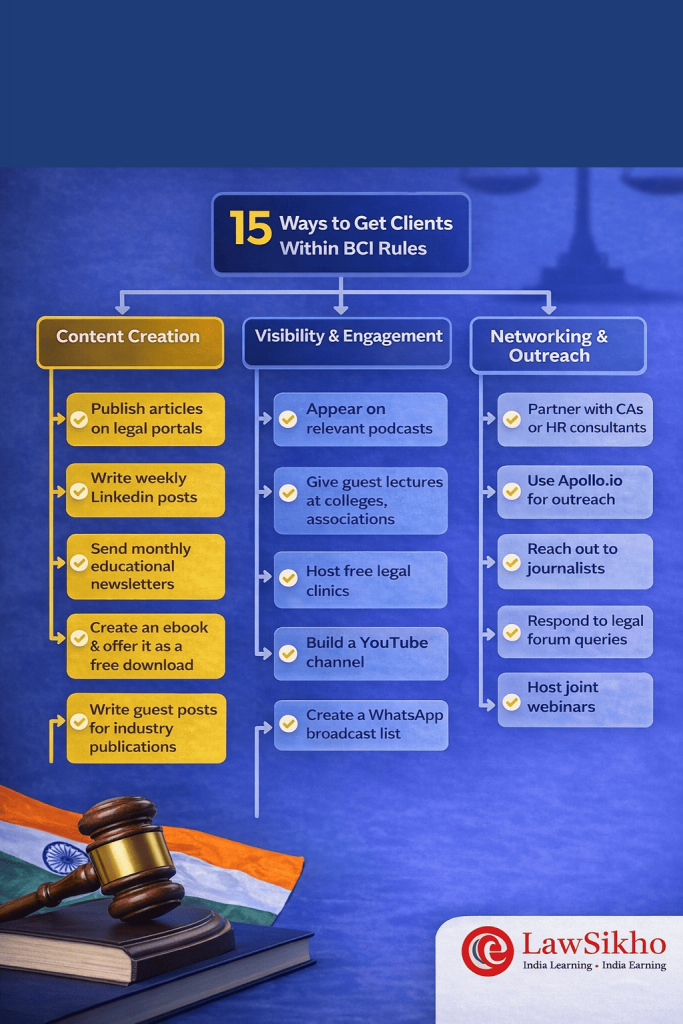
1.Publish articles on legal portals
Such as Live Law, Bar and Bench, and iPleaders in your specific practice area.
2.Write a weekly LinkedIn post
Analysing a recent judgment, regulatory update, or legislative development.
3.Send a monthly educational newsletter
To businesses, founders, or professionals in your target client segment.
4.Write guest posts for industry publications
That your potential clients actually read not just legal publications.
5.Build a YouTube channel
Explaining legal concepts relevant to your practice area in plain language.
6.Appear as a guest on podcasts
That reach your ideal client base startup podcasts, finance podcasts, HR podcasts.
7.Take guest lectures
At law colleges, startup accelerators, trade associations, or industry chambers.
8.Host free legal clinics
For housing societies, Lions Club chapters, or Rotary Clubs in your city.
9.Respond to queries
On legal forums, Reddit, LinkedIn groups, and online communities to build organic visibility.
10.Build a website
With free downloadable resources checklists, explainer guides, FAQs tailored to your target clients.
11.Create a free ebook
On a legal topic your clients frequently encounter and offer it as a download.
12.Set up a WhatsApp broadcast list
For existing clients and prospects and send monthly legal updates.
13.Reach out to journalists
Covering your practice area with useful data, case context, or expert commentary.
14.Partner with CAs, Company Secretaries, or HR consultants
For joint webinars or co-authored content.
15.Use tools like Apollo.io
To identify target businesses by industry, size, or location and reach out with educational content, not a sales pitch.
The First Mover Advantage Is Still Available
- Most lawyers in India have not systematised any of this. No newsletter. No consistent LinkedIn presence. No published articles. No outreach strategy.
- Which means if you start now even with one piece of content per month, one newsletter per quarter, one guest post per year you have a genuine first mover advantage in your practice area.
- The lawyers who move early will own the search rankings, the podcast appearances, the LinkedIn presence, and the inbound enquiries that follow.
- The Bar Council restricts how lawyers acquire clients. It does not restrict how lawyers build credibility, demonstrate expertise, or become the most visible and trusted voice in their practice area.
- Solicitation is prohibited. Education is a constitutional right.
Conclusion:
Building a legal practice does not require violating BCI rules it requires using them smartly. While solicitation is restricted, sharing knowledge is not, and that is where the real opportunity lies. By consistently educating your audience and showcasing your expertise, you build trust, visibility, and authority. Over time, this shifts your practice from depending on referrals to attracting clients organically. The key is simple: focus on education, stay consistent, and let your expertise bring clients to you.





 Allow notifications