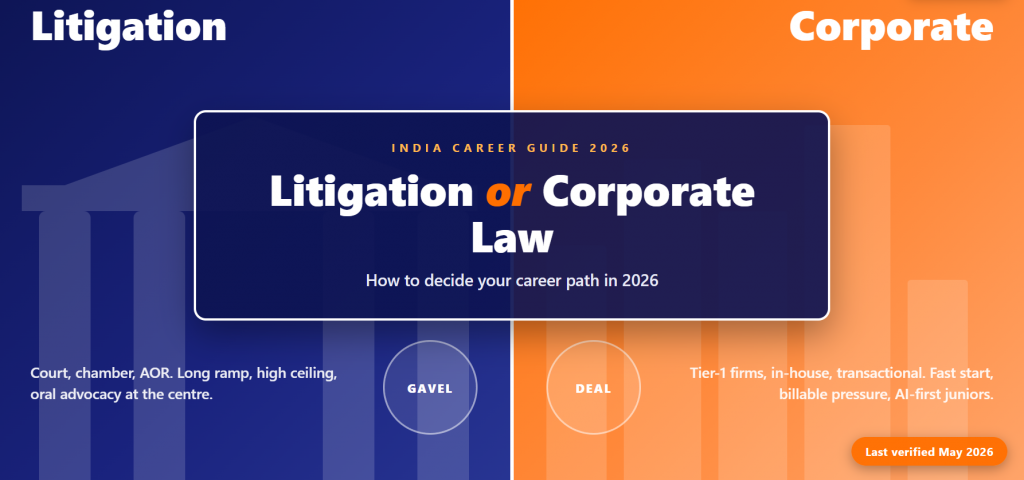

Last verified: May 9, 2026
INR 70,352 crore. That is roughly USD 8.5 billion, the value of the joint venture that a leading Indian conglomerate and a global entertainment company put on paper in February 2024 when they agreed to combine their India broadcasting and streaming businesses. The deal cleared the Competition Commission of India in August 2024 after a remedies-driven review and effected later that year. It was, by most measures, the largest media transaction India had ever seen.
Two armies of lawyers worked it. One corporate, one litigation, both billing the same calendar. If you’re still asking “litigation or corporate law: how to decide your career path in 2026,” this transaction is your answer in miniature. The choice isn’t binary, but it’s real, and the wrong call can cost you a decade.
The corporate-side army did what corporate lawyers do at scale. A panel of seven law firms (a mix of Indian tier-1 firms and global counsel split across the buyer side, the seller side, and one partnered party) drafted the joint venture agreements, ran due diligence on hundreds of underlying contracts, structured the combination under sections 230 to 232 of the Companies Act, 2013, and prepared the antitrust filings before the Competition Commission of India. Regulatory drafting, conditions precedent, and a scheme of arrangement before the National Company Law Tribunal filled their nine months. None of it happened in a courtroom.
The litigation-side army did the other half. Channel-partner objections had to be answered. The NCLT scheme-sanction hearings had to be argued, and senior counsel had to be briefed for any potential challenge.
The CCI’s remedies-driven review wasn’t a paper exercise either, it required disputes lawyers to negotiate behavioural undertakings the regulator demanded before clearance. Same deal, same client, completely different skill set, and (worth flagging) almost no overlap in the actual day-to-day craft.
Here’s the synthesis. The transaction closed because both armies did their jobs. Every lawyer on either side once stood where you stand now: third year of law school, final-year LL.B, or one to two years post-qualification, and made a choice.
Some made it consciously. Most drifted into whichever first job landed. And in 2026, with M&A booming and a documented shortage of young litigators, drifting is a more expensive mistake than it has ever been.
The choice is real, but it isn’t permanent, and it isn’t binary. Some of the most interesting careers in 2026 sit at the seam between the two: arbitration, in-house disputes, regulatory enforcement defence, white-collar advisory. Here is what the data, the regulator filings, and a decade of practitioner experience say about how to decide, starting with the comparison every reader wants in one paragraph.
Litigation in India means representing clients in courts and tribunals; corporate law means advising businesses on transactions, compliance, and regulatory work. In 2026, corporate fresher pay at tier-1 firms (INR 16-22 LPA) is roughly 3-10x litigation chamber-junior pay (INR 1.5-7 LPA), but top senior counsel routinely earn INR 25-30 lakhs per Supreme Court appearance.
The honest answer to “which is better” depends on tolerance for risk, family financial cushion, geographic preference, and how you handle public speaking versus long-form writing. Here’s the full breakdown, starting with the one-paragraph TL;DR and ending with a 7-question self-assessment you can score in five minutes.
Litigation or corporate law: the decision in one paragraph
You’re at the decision point and overwhelmed. So what does the litigation or corporate law trade-off actually boil down to? Every senior gives different advice, every blog post says “follow your passion,” and the salary numbers floating on Quora are five years stale.
The one-paragraph answer
Here’s the thing. The short answer is this: pick litigation if you can tolerate 18 to 36 months of low or unpredictable income and you want to argue, advise, and own a case file from start to finish. Pick corporate if you want a structured ramp, predictable year-1 income, and you’d rather draft and advise than argue.
Worth flagging the real-world anchor: NLSIU’s 2024 placement report shows roughly 78% of placed students went to domestic law firms, 12% to global firms, 8% to in-house roles, and only about 2% to judicial services or independent practice combined. That’s not a verdict on litigation, it’s a signal of what the supply curve looks like in 2026.
The seniors’ framing
In practice, senior partners describe the choice as “less binary than the previous generation.” The bridge paths (arbitration, in-house disputes, regulatory enforcement) are now legitimate first-choice destinations, not consolation prizes. A common question on Legally India (informally called “the eternal Quora question”) is which side actually has the higher ceiling. Honestly, both ceilings are high. The slopes differ.
The pitfall here is treating any one-paragraph answer (including this one) as an oracle. Best depends on tolerance, network, geography, and what you’re built for. Read past this section before you decide. And if you only read one more, make it H2.7 (the self-assessment).
But here’s the thing nobody tells you in college. The “best” path 10 years ago is not the best path now. The shape of corporate practice has shifted three times since 2015, and the litigation supply gap is a 2024-2026 phenomenon, not a permanent feature. Plan against current conditions, not your senior’s nostalgia.
What does a litigator actually do?
Most students think litigation means arguing in court. Honestly, they miss roughly 80% of the actual work, which is why so many bright entrants quit chambers within 18 months. And the mismatch between the imagined day and the lived day is brutal. Better to know now.
A typical week in chambers
Here’s what that actually looks like. A junior in a senior counsel’s chambers in Delhi or Mumbai will typically work three hearing days and two drafting days. Court vacations (May and December for the Supreme Court, regional patterns for High Courts) reset the rhythm. Mondays are matter-conferences, Tuesdays and Wednesdays often hearing days, Thursdays drafting marathons, Fridays catch-up and client calls.
So is it always like this? Not at all, criminal practice is intense in different ways, and original-side commercial work follows its own clock.
Here’s what that actually looks like. The deliverables are research notes, written submissions, lists of dates, draft pleadings, and reply affidavits. Drafting is the craft. Oral submission is the visible 10%, and clerks file, juniors brief, and the senior speaks (mostly).
The work itself: pleadings, drafting, oral submissions, ADR
A litigator’s core toolkit covers pleadings (plaints, written statements, applications), drafting under the relevant procedural codes, oral submissions, examination and cross-examination of witnesses, and increasingly Alternative Dispute Resolution sittings (mediation, conciliation, arbitration). Post-2021, virtual hearings via the e-Courts infrastructure mean a junior in Indore can second a senior counsel arguing in the Supreme Court without flying to Delhi. And that’s a quiet but massive shift in the geography of litigation.
ADR exposure is no longer optional. Commercial disputes increasingly route through arbitration, and a litigator who can’t draft a Section 17 application or argue an interim under the Arbitration and Conciliation Act loses ground.
Civil vs criminal vs constitutional vs commercial litigation
Within litigation, the sub-choice matters more than students realise. Civil disputes resolution is the broadest bucket: contract disputes, property, family, recovery suits. Criminal litigation is a separate world, with bail practice, trial work, and high stakes per matter.
Constitutional litigation is rarer, harder to enter, and concentrated at High Courts and the Supreme Court. Commercial litigation overlaps with corporate disputes, IBC work, and arbitration.
Here’s the thing: a practising junior in Bengaluru told a Legally India thread that “your first chamber decides the next 5 years.” That’s slightly overstated, but the principle holds. Civil-side training builds different muscles from criminal-side, and pivoting later costs you 12 to 18 months.
Where litigators actually work
Four broad employers exist: senior counsel chambers (the apprenticeship model), disputes teams at law firms (a hybrid of corporate-firm hours and litigation work), Advocate-on-Record offices for Supreme Court practice, and independent practice (typically year 5+). Disputes teams pay closer to corporate associate rates but the work is still litigation-shaped. A Legally India thread (Topic 179355) asked whether a disputes team at a firm is “real litigation.” The honest answer is yes, with caveats: less courtroom time, more brief preparation, more behind-the-scenes negotiation, and a steadier paycheque.
A senior litigator’s perspective (10/90 oral-prep ratio). “Look, the part students see on YouTube and on Twitter, the courtroom rhetoric, that’s about 10% of my week. The other 90% is reading the brief, three times. Drafting. Re-drafting. Re-reading the brief. Walking through the case file with the junior who has to find the one paragraph that disposes of the matter. After AOR qualification, the volume increases but the ratio doesn’t change much. If you’re choosing litigation because you want to argue, fine, but understand you’ll do nine units of preparation for every unit of argument. The juniors who survive the first 18 months are the ones who fall in love with preparation.”
A common community question is whether litigation is good for introverts. Surprisingly, yes. Written-heavy disputes work, advisory drafting, and chamber research suit a quieter temperament more than the public image suggests. The pitfall here is glamour bias: students chase the courtroom-rhetoric image they’ve seen in films, then quit when 90% of the work is silent.
What does a corporate lawyer actually do?
Students conflate “corporate law” with M&A and miss the rest of the practice entirely. The practical reality is that M&A is one of five major corporate-practice families. Knowing the others changes how you choose firms, sub-specialties, and exit options.
A typical week at a tier-1 firm
Here’s what that actually looks like. A first-year associate at a Mumbai or Delhi tier-1 firm starts the week with a status call on live transactions, drops into due-diligence work for a few hours, drafts NDA edits or share-purchase-agreement schedules, and joins client calls in the afternoon. By Thursday, the regulatory filings (RBI, SEBI, MCA, CCI) consume the morning. And Fridays close out condition-precedent checklists and prepare for weekend pushes when transactions sign on Mondays. Bottom line: the rhythm is dense, predictable, and almost entirely paper-driven.
The deliverables are real. NDAs, term sheets, due-diligence reports, share purchase agreements, shareholders’ agreements, regulatory filings, and conditions-precedent matrices. A junior associate may not see the inside of a courtroom for 18 months. And some never do.
The five corporate-practice families
Tier-1 corporate practice typically clusters into five families: M&A (deal structuring, due diligence, definitive agreements), banking and finance (term sheets, security creation, syndicated lending), capital markets (IPO drafting, preference issuances, ECB and FCCB work), employment and ER (executive compensation, ESOP design, employment-policy compliance), and regulatory (DPDP Act compliance, competition filings, sectoral approvals). Within tier-1 firms, you’ll typically rotate between two or three before specialising at year 3.
Now, here’s where it gets interesting. The 2024 numbers explain why corporate has been hiring. India recorded 2,186 deals worth USD 116 billion in 2024 across M&A, PE, IPO and QIP transactions (a 76% surge in deal values year on year per Grant Thornton’s annual dealtracker; the Bain India M&A Report corroborated the same bullish 2024-25 outlook). And the DPDP Act compliance work, the September 2024 Competition Act material-influence amendment, and IFSCA’s 2025 GIFT City regulations have all pushed corporate-side regulatory work into a hiring boom.
In-house counsel vs law-firm corporate associate
In-house has quietly become the third path. NLSIU’s 2024 placement report shows roughly 8% of placed students going directly into in-house roles at startups, listed companies, and large conglomerates, with NALSAR and other top NLUs tracking similar patterns, compared with much lower in-house placement a decade ago. The pay at year 1 is generally lower than tier-1 firms (INR 6 to 14 LPA range), but year-3 numbers can be competitive, hours are typically more humane, and the work is broader (regulatory + transactional + commercial advisory).
A common Quora question is whether in-house counts as a “corporate” career. The short answer: it does, and increasingly, it’s a primary first job rather than an exit path.
GIFT City and cross-border corporate practice
GIFT City has emerged as a serious cross-border corporate option, with the IFSCA Capital Market Intermediaries Regulations (April 2025) and the IFSCA Global In-House Centres Regulations (December 2025) creating a domestic platform for international transactional work. By 2030, expect a meaningful slice of Indian corporate lawyers working US, UK, or Singapore matters from GIFT or remotely. And we’ll come back to the AI dimension of this in H2.10.
A tier-1 corporate partner’s perspective (the AI-leverage shift). “Honestly, the year-1 associate I hire today is expected to ship roughly three times the deliverables of the first-year I hired in 2018. That’s not a culture problem, it’s an AI-leverage problem. Contract review, NDA first-drafts, basic due diligence, comparison sheets, all of that is now AI-first work. The associate’s job has shifted up the value chain to judgement, structuring, and client interface. That’s exciting if you’re built for it. It also explains why so many fourth-year associates are burnt out, because the speed expectation has compressed the learning curve in a way the firm structures haven’t fully absorbed yet.”
A common community question (raised across Topics 198999 and 171637 on Legally India) is whether tier-1 burnout by year 4 is exaggerated. It isn’t. Billable hours, weekend pushes, and AI-compressed timelines are a real cocktail.
The pitfall is assuming all corporate firms work this way. Tier-2 firms, in-house, and back-office regulatory teams operate on very different rhythms.
How litigation and corporate practice in India have evolved (2015 to 2026)
Quick context before we go deeper. The comparison your senior was making in 2015 is not the comparison you’re making in 2026. The choice landscape has shifted three times in a decade, and the path-of-least-resistance advice from a 2018 graduate is no longer reliable. So the historical lens matters before any decision.
2015 to 2018: the corporate placement boom and the NLU pipeline
By 2018, NLU corporate placements at tier-1 firms had crossed INR 16 to 20 LPA fresher packages. The pipeline pulled most NLU graduates into corporate by default. Litigation looked, on the year-1 numbers, like a worse deal. And many talented students skipped chambers without ever testing them.
2020 to 2023: COVID, virtual hearings, in-house teams expanding
COVID changed the geography of litigation. Virtual hearings rolled out across district courts, High Courts, and the Supreme Court via the eCommittee SCI infrastructure. A litigator in a tier-2 city could now appear in matters that previously required relocation to Delhi or Mumbai. Simultaneously, the in-house counsel ecosystem expanded sharply (startups, ESG, data privacy, AI governance), creating a third path that absorbed corporate-trained associates and gave them a softer landing than full firm life.
2024 to 2026: M&A surge, AOR exam visibility, the first AI inflection
Now, here’s where it gets interesting. 2024 changed the math again. The deal-activity surge (USD 116 bn aggregate transaction value across M&A, PE, IPO and QIP, a 76% YoY jump per Grant Thornton’s annual dealtracker) created a corporate hiring boom. The September 2024 Competition Act amendment introducing the material-influence test added a new layer of regulatory work.
The June 2025 AOR exam (207 candidates qualified per the Supreme Court of India’s official notification) made the litigation senior-track more visible to ambitious juniors. And in early 2026, AI moved from experiment to strategic plan inside large firms, with Microsoft Source Asia (January 2026) framing AI literacy as table stakes for new associates.
So what does this mean for you in plain English? Every five years, the comparison reshapes. The single biggest evolution between 2015 and 2026 is that the “in-house third path” is now genuinely competitive at the entry level, and hybrid careers (arbitration, regulatory, white-collar) have professionalised into legitimate first-choice destinations. Senior partners describe this as a generational shift, not a marginal change.
A common question raised in industry forums is whether the year-1 salary gap between corporate and litigation is narrowing. Frankly, it isn’t. If anything, it has widened slightly since 2018, because tier-1 firms have pushed fresher packages upward while chamber stipends have stayed sticky. But the year-7 to year-10 ceiling for independent litigators has risen too, with senior counsel routinely commanding INR 25 to 30 lakh per Supreme Court appearance.
The pitfall here is generational advice transfer. Your senior’s 2018 advice was correct in 2018. It’s not entirely wrong in 2026, but it’s not optimised for current conditions either. So plan against the present, not the past.
Side-by-side: litigation vs corporate law on six axes
Let’s be honest: every existing comparison post is a wall of text. Readers want one screen. So here it is, on six axes that actually matter, with India-specific INR figures anchored to 2024-2026 data.
Reading the comparison table
| Axis | Litigation | Corporate law |
|---|---|---|
| Day-to-day work | Pleadings, oral submissions, court appearances, ADR sittings | Contract drafting, due diligence, regulatory filings, client calls |
| Year-1 salary (INR) | 1.5 to 7 LPA (chamber stipend) / 6 to 14 LPA (disputes team) | 8 to 22 LPA (tier-1) / 4 to 10 LPA (tier-2) / 6 to 14 LPA (in-house) |
| Year-5 salary (INR) | 6 to 25 LPA (independent / chamber) / 18 to 35 LPA (disputes team) | 18 to 45 LPA (tier-1 senior associate) / 14 to 30 LPA (in-house) |
| Year-10 salary (INR) | 25 lakh per appearance (senior counsel top quartile) / 12 to 30 LPA (median) | 50 LPA to 1.5 crore+ (partner / senior in-house) |
| Work hours per week | 50 to 70 (highly variable; 0 in court vacations) | 60 to 80 (tier-1) / 45 to 55 (in-house) |
| Geographic flexibility | High post-virtual hearings (tier-2 city viable from year 3) | Concentrated in Mumbai, Delhi NCR, Bengaluru for tier-1 |
Now, here’s where it gets interesting. The table compresses tier variance. Within “corporate” alone, the spread between tier-1 and a regional in-house role can be 4x at year 1.
Within “litigation,” the spread between a chamber junior and an independent practitioner with a corporate-disputes book can be 10x by year 7. Treat the table as a starting point, not the finishing line.
Where the table is honest, where it lies
The figures are anchored to NLSIU 2024-25 placement data (INR 20 L median, 78% to firms), NALSAR 2024-25 (INR 65 L highest), Grant Thornton’s 2024 annual dealtracker (industry-wide hiring tailwind), and the Supreme Court’s June 2025 AOR results (207 qualified). For senior counsel per-appearance economics, public reporting puts top counsel at INR 25 to 30 lakhs per Supreme Court hearing.
Practitioners caution that the table lies in two directions. It overstates the ceiling for median litigation careers (the 25-lakh-per-appearance number is top quartile, not median). And it understates the variance inside corporate: not all corporate is tier-1, and a tier-3 corporate firm in a tier-2 city pays differently from an in-house role at a listed conglomerate. Worth flagging on the litigation side too: the chamber-junior 1.5 to 7 LPA range captures the typical band, but a small handful of marquee senior counsel chambers pay materially more (closer to 12 to 15 LPA at the top end) for juniors they recruit selectively. Treat the upper bound as conservative.
So is the table useful? Yes, as a heuristic. As a verdict? No.
The pitfall here is picking based on the table alone. Salary is one of six axes that matter, and even on salary, the year-1 figure misleads more than it informs. H2.6 unpacks the 10-year curve, and H2.7 gives you a 7-question self-assessment that filters the table through your own circumstances. Worth flagging: read both before deciding.
NLSIU 2024: 78% domestic firms, 12% global, 8% in-house, 2% judiciary or independent.
NALSAR 2024-25: highest 65 LPA. NLSIU 2024-25: median 20 LPA.
AOR June 2025: 207 candidates qualified.
Indian M&A 2024: 2,186 deals, USD 116 bn, 76% YoY surge.
Sources: NLSIU and NALSAR placement reports 2024-25; SCI AOR June 2025; Grant Thornton annual dealtracker 2024.
Salaries and the 10-year career curve
Every competitor post comparing litigation or corporate law gives one number. The real question is what the curve looks like over a decade. The honest comparison runs across six paths: tier-1 corporate, tier-2 corporate, in-house, chamber junior (litigation), independent practice (litigation), and hybrid arbitration. Salary trajectories diverge sharply, then partially reconverge.
Year-1 reality
Here’s what that actually looks like. At year 1, the spread is at its widest. A tier-1 corporate associate in Mumbai or Delhi typically earns INR 16 to 22 LPA. Tier-2 firms pay INR 4 to 10 LPA. In-house roles at large conglomerates start INR 6 to 14 LPA.
A chamber junior in a senior counsel’s office earns INR 1.5 to 7 LPA, often closer to a stipend than a salary. A disputes team at a law firm pays closer to corporate associate rates (INR 6 to 14 LPA). An independent litigator earns whatever clients pay, which in year 1 is usually INR 0 to 4 LPA.
| Path | Year-1 INR range | Source anchor |
|---|---|---|
| Tier-1 corporate (Mumbai / Delhi NCR) | 16 to 22 LPA | NLSIU 2024 / NALSAR 2024-25 placement reports |
| Tier-2 corporate | 4 to 10 LPA | Aggregator placement data |
| In-house counsel (large corporate) | 6 to 14 LPA | Industry hiring patterns 2024-25 |
| Chamber junior (litigation) | 1.5 to 7 LPA | Practitioner forum disclosures |
| Disputes team at law firm | 6 to 14 LPA | Tier-1 / tier-2 firm hiring data |
| Independent practice (year-1) | 0 to 4 LPA | Practitioner disclosures |
Year 3 to year 5: the divergence
Between year 3 and year 5, the corporate curve flattens slightly but stays steep. Tier-1 senior associates touch INR 30 to 45 LPA by year 5. Tier-2 firms reach INR 12 to 22 LPA. And in-house roles cross INR 20 to 30 LPA at the senior counsel grade.
Litigation diverges in a different shape. Chamber juniors who have stayed and built specialisation typically earn INR 6 to 18 LPA at year 5. The disputes team route reaches INR 18 to 28 LPA.
Independent practitioners with a niche (insolvency, arbitration, regulatory) start commanding fees that put gross earnings between INR 8 and 25 LPA, with much higher variance than the corporate side. Some independents are still thin at year 5. Others have already crossed the chamber-junior ceiling.
Year 7 to year 10: the litigation ceiling
Now, here’s where the picture genuinely shifts. Between year 7 and year 10, an independent senior counsel with a healthy SC and HC book can earn INR 25 to 30 lakhs per Supreme Court appearance, with retainerships from corporates and arbitration clauses adding to the year. The top quartile of independent litigators at year 10 can match or exceed a tier-1 corporate partner’s CTC (typically INR 1 to 3 crore plus). Equity partnership at tier-1 firms typically arrives between year 9 and year 13.
But here’s the catch. The bottom quartile of independent litigators at year 10 may not have crossed INR 6 LPA. Averages hide failure rates. The “year 7 inflection” is real for the top quartile and aspirational for the median.
A common Legally India question (Topic 171254) asks how many years until pay parity. The honest answer: parity at the median is roughly year 8 to 10 between tier-1 corporate and disputes-team litigation, and roughly year 10 to 12 between corporate and independent practice (if you make it).
| Path | Y1 | Y3 | Y5 | Y7 | Y10 |
|---|---|---|---|---|---|
| Tier-1 corporate | 16 to 22 | 22 to 32 | 30 to 45 | 45 to 70 | 60 LPA to 1.5 cr+ |
| Tier-2 corporate | 4 to 10 | 7 to 15 | 12 to 22 | 18 to 35 | 25 to 60 LPA |
| In-house | 6 to 14 | 12 to 20 | 18 to 30 | 28 to 50 | 40 LPA to 1 cr+ |
| Chamber junior (litigation) | 1.5 to 7 | 3 to 10 | 6 to 18 | 10 to 30 | 15 to 50 LPA |
| Independent practice | 0 to 4 | 2 to 8 | 8 to 25 | 15 to 60 | 30 LPA to 3 cr+ (top quartile) |
| Hybrid arbitration | 6 to 14 | 12 to 22 | 20 to 40 | 35 to 70 | 50 LPA to 2 cr+ |
(Figures in INR lakhs per annum unless noted; ranges reflect tier and city variance.)
In practice, senior counsel describe the year-7 inflection as the moment “your reputation starts compounding.” That’s not romanticism, it’s a descriptive observation about how independent practice scales. A common community question is whether the parental dependence in early-career litigation is “5 to 10 years” (raised in Legally India Topic 249436). For most chamber juniors without a family network, financial cushion is meaningful through year 3 to 5, not year 10. And after year 5, the curve usually self-funds (with caveats).
The pitfall here is reading any number as a forecast. Every figure in this section is a 2024-2026 indicative range, drawn from public placement reports, news features, and practitioner forums. Individual offers will vary widely. Salary is one input to the decision, not the decision.
Want to break into tier-1 corporate practice with the regulatory and transactional skills firms now hire for? LawSikho’s Executive Certificate Course in Corporate Practice is built for law students and 0 to 3 PQE associates. You’ll learn deal structuring, due diligence, regulatory filings, and the workflow that makes a tier-1 associate productive in the first 90 days. Mentored by senior corporate counsel; live case-walkthroughs from 2024-26 deals. [Explore the course →]
How to decide: a 7-question self-assessment
Every existing post says “if you love arguing, choose litigation.” Frankly, that’s useless and unfalsifiable. The seven questions below are tied to evidence-based fit signals (writing volume, oral fluency, geography tolerance, network, financial cushion). Answer them honestly.
The seven questions
- Can you tolerate 18 to 36 months of low or unpredictable income? This is a hard yes/no for litigation. If “no” because of family financial obligations, corporate-first is the rational call.
- Do you have a family-legal-network or a chamber spot you can step into? A “yes” massively reduces litigation’s downside risk. A “no” doesn’t disqualify you, but it changes the strategy (read H2.11).
- Do you write 1,500-plus words a day comfortably? Not aspire to. Actually do, in coursework, journalism, or personal blogging. Writing volume is the highest signal of corporate fit because the work is overwhelmingly written.
- Can you speak extempore for 10-plus minutes under hostile questioning? Moot court counts. Debate counts. Family arguments don’t, judges and opposing counsel are different. Honest “yes” is a strong litigation signal.
- Do you find process and structure energising or draining? Corporate practice is process-heavy. Templates, checklists, time-recording, due-diligence frameworks. If structure energises you, you’re built for corporate. If it drains you, chambers may feel freer.
- Are you willing to live in Mumbai, Delhi NCR, or Bengaluru for 3 to 5 years? Tier-1 corporate is concentrated in these cities. Litigation can be done elsewhere from year 3 thanks to virtual hearings, but the early apprenticeship years still benefit from metro presence.
- Do you want to argue, or do you want to advise? This is the meta-question. Litigators argue. Corporate lawyers advise. In-house counsel do both, in different proportions. There’s no wrong answer, but there is a self-honest one.
Scoring: how to read your own answers
Bottom line: a “yes” to questions 1, 2, 4, and 7-argue-side suggests litigation. A “yes” to 3, 5, 6, and 7-advise-side suggests corporate. Mixed answers suggest a hybrid path (H2.9). And five or more “yes” responses on either side is a directional read, not a binding answer.
Practitioners who’ve mentored juniors say the financial cushion question (Q1) is the single highest-weight predictor of litigation success. Not talent. Not pedigree. Cushion.
The reason is structural: if you can afford 36 months of low income, you can choose the right chamber rather than the first one. A common question on Legally India (Topic 249436) is how many years of dependence early-career litigation actually requires. The realistic answer is 24 to 60 months without a family network, faster with one.
The four terminal paths
Here’s the thing. The seven answers map to four terminal paths: pure litigation (chambers, AOR track, independent practice), pure corporate (tier-1 firm, partnership track), in-house counsel (corporate-trained, broader role, more humane hours), and hybrid (arbitration, in-house disputes, regulatory enforcement defence). And don’t force a binary if your answers are mixed.
The pitfall is treating the quiz as a verdict. Five “yes” responses on the corporate side don’t disqualify you from litigation, they tell you the headwind direction. Lots of successful litigators started as corporate associates and pivoted at year 3 to 5. The quiz is a heuristic, not a binding instruction.
If your seven answers point to litigation, the question is no longer “should I,” it’s “how fast can I get court-ready.” LawSikho’s Diploma in Litigation and Trial Advocacy covers civil procedure, drafting pleadings, oral submissions, evidence, and ADR, the full stack a junior actually uses. Live mock-court sessions, drafting feedback from practising counsel, and an AOR-track elective for year 5+ aspirants. [Explore the diploma →]
Personality and skills fit: which traits match which path
Trait-based advice in existing posts is folk wisdom. “Argumentative people choose litigation.” Frankly, that’s useless. The honest version of this question maps behaviours to outcomes, with concrete anchors for what each trait actually looks like in practice.
Litigation traits
In practice, the litigator’s core trait is comfort with conflict, which is not the same as enjoying conflict. It looks like staying calm when the bench is hostile, when opposing counsel is rude, or when a client is panicking. Add tolerance for ambiguity (cases drag, dates are postponed, files lose paragraphs, witnesses don’t show), comfort with public speaking under pressure, and what experienced practitioners call a “hunter’s patience”: you wait, sometimes for years, for the moment the bench listens.
Think of it this way: a litigator’s “comfort with conflict” looks like delivering bad news to a client without flinching. If conflict drains you, even when you’re in the right, chambers will be a brutal environment.
Corporate traits
The corporate lawyer’s core trait is process orientation. Templates, checklists, version control, billing logs, conditions-precedent matrices: this is where the work lives. Add written precision (a misplaced “or” instead of “and” in a definitive agreement can cost crores), stamina for long sessions (20 to 30 hours of continuous due-diligence is not unusual on a closing weekend), and an unflashy patience for detail.
Think of it this way: the corporate associate’s “stamina” looks like reviewing 800 contracts for change-of-control clauses without skipping the boilerplate. If detail drains you, tier-1 firm life will burn you out by year 4 (Topic 198999).
Overlap traits
Both paths reward curiosity (the willingness to learn how a sector works, what a regulator wants, why a clause exists), ethical clarity (clients pressure both kinds of lawyers to bend rules, daily), and client management (translating jargon, managing expectations, delivering bad news with grace). And these are non-negotiable on either side.
In our view, the trait that “saves a junior” in the first 18 months on either path is the same: the ability to admit you don’t know something, ask the right person, and learn fast. Based on what we’ve seen, senior counsel and corporate partners independently flag this as the single highest-correlation trait with longevity. A common Quora question is whether litigation is good for introverts, and the answer is surprisingly yes for written-heavy disputes work, less so for jury-trial-style criminal practice.
The pitfall is trait determinism. Both paths are wide enough that any well-formed trait set finds a fit. A quiet, written-heavy person can become a brilliant disputes-team litigator. An argumentative, extempore person can become a great M&A negotiator.
So is your trait list a verdict? No. It’s a starting bias.
Hybrid and pivot paths: the false-binary section
Every competitor treats the choice as binary. But the reality in 2026 is that six legitimate hybrid paths exist, and several of them pay better than either pure path. So this is the section that didn’t exist 10 years ago.
Arbitration practice
Worth flagging: this is the cleanest “best of both” hybrid. Arbitration practice combines corporate-style commercial reasoning with litigation-style oral advocacy in a private forum. Domestic arbitration runs under the Arbitration and Conciliation Act, 1996, with international work increasingly anchored to Singapore, London, and (post-IFSCA 2025 regulations) GIFT City.
Arbitration practitioners draft, advise, and argue. The case file is closer to a transaction. The hearing is closer to a court.
Year-1 entry pay for an associate in a tier-1 firm’s arbitration team is in the same band as corporate (INR 14 to 20 LPA), with year-7 numbers reaching INR 35 to 70 LPA. And senior arbitration counsel command per-hearing fees comparable to senior counsel in court.
In-house disputes teams
Here’s what that actually looks like. A second hybrid that has professionalised in 2024-2026. Large Indian corporates and conglomerates now run in-house disputes-and-regulatory teams that handle litigation and arbitration internally, briefing external counsel only for SC and HC appearances. The role is part-litigator (case strategy, witness preparation, briefings), part-corporate (commercial advice, settlement negotiation), and increasingly part-regulator-facing (CCI, SEBI, DGGI, NCLT).
Pay is closer to in-house corporate scales but the work is unambiguously disputes-shaped.
Regulatory enforcement defence
A growing third hybrid covering CCI investigations, SEBI enforcement, DGGI tax disputes, NCLT corporate insolvency proceedings, and competition-tribunal work. The skill set is litigation-shaped (oral advocacy, written submissions, expert evidence) but the substance is corporate (markets, antitrust, securities, tax). And boutique regulatory firms and tier-1 firms’ regulatory practices both hire here, with year-1 pay in the INR 12 to 18 LPA band.
White-collar criminal advisory and PE/VC litigation
A fourth hybrid sits at the intersection of criminal practice, corporate misconduct, and investor-protection litigation. Promoter prosecutions, SFIO investigations, FIR-stage advisory, and oppression-and-mismanagement disputes all live here. The catch? The work is rare, high-stakes, and pays accordingly.
GIFT City cross-border practice
A fifth path, increasingly visible. The IFSCA Global In-House Centres Regulations (December 2025) and IFSCA Capital Market Intermediaries Regulations (April 2025) have created a domestic platform for international transactional and disputes work. By 2030, GIFT City may host a meaningful slice of cross-border corporate practice with India-based pay closer to international scales. Early signals only, but worth flagging.
The recap from the intro is the exemplar: the USD 8.5 bn media JV needed both armies, and the practitioners with crossover capability (corporate-disputes hybrids, regulatory-litigation hybrids) commanded a premium across the seven-firm panel. Hybrid practitioners, in our view, will be the highest-leverage skill set of the next 10 years.
A community question raised on Legally India (Topic 177968) is whether a “sustainable middle path that pays decently” exists. The short answer: yes, all five hybrids above qualify, and arbitration is probably the cleanest entry point.
The pitfall here is trying to start hybrid. Most hybrids require 3 to 5 years of pure-track foundation first. You can’t run an arbitration practice without first knowing how a contract is drafted (corporate side) and how a hearing is argued (litigation side).
Choose a pure path for the foundation, then pivot. Read this in the broader internal context of the arbitration practice career path for a deeper roadmap if arbitration is your direction.
An in-house General Counsel’s perspective (the both-armies premium). “If you ask me, the most useful skill in the next 10 years is the ability to do both jobs at once. I started at a tier-1 firm doing M&A, did 4 years of court-facing disputes work, and now run an in-house team that handles regulatory enforcement, commercial disputes, and transactional advisory. The reason hybrid practitioners are paid a premium is simple: when a USD 8 billion deal needs both a contract drafted and a CCI undertaking negotiated and an NCLT hearing argued, hiring three different people creates coordination cost. Hiring one person who can do all three creates leverage. The companies that figured this out by 2024 are still hiring against this thesis. The catch? You can’t fake hybrid. You need real years on both sides. There’s no shortcut.”
Transaction-leaning
How AI is reshaping both paths in 2026
AI is changing both paths, but the change is asymmetric. Frankly, no comparison post in the SERP analyses how. This is the hardest-to-write section, because the data is moving fast, but the asymmetry thesis is now well-supported by industry signals.
The asymmetry thesis
Corporate juniors are being compressed. Litigation juniors are being augmented. The difference matters for a 10-year career bet.
Microsoft Source Asia (January 2026) framed the shift bluntly: lawyers who use AI are “faster, more accurate, and more competitive” across all practice areas. But the workflow effect is uneven. Contract review, due diligence, NDA first-drafts, and standard agreement comparisons are now AI-first work, and tier-1 partners (see the practitioner perspective in H2.3) say the productivity expectation on a year-1 associate has compressed dramatically against the 2018 baseline.
Courtroom advocacy, oral submissions, cross-examination, judge-reading, and chamber relationships are not AI-first. They remain human-craft.
So what does this mean for you? Corporate juniors are doing more, faster, with smaller teams (the partner expert insert in H2.3 captures this). Litigation juniors are gaining leverage on research and drafting (Vidhi-style citation pulls take minutes instead of hours), but their core craft is preserved.
What AI now does well in corporate practice
Concretely, current generative AI tools handle: contract review against checklists, NDA first-drafts, due-diligence summary tables, comparative clause analysis, regulatory-filing first cuts, and risk-flag matrices. A capable junior using these tools can output the equivalent of two associates’ work in 2018. And that’s not hyperbole, it’s an observed productivity differential.
Banking-finance work has automated faster than M&A. Capital-markets disclosure drafting has automated faster than employment-law advisory. The pace varies by practice family.
What AI cannot yet do in litigation
Live oral submission. Reading a bench. Cross-examining a witness who is shading the truth. Negotiating a settlement at a coffee table after a hearing.
Building a chamber relationship over years. None of these have a credible AI substitute in 2026, and credible signals from the bench (a Supreme Court bench’s February 2026 remarks on AI-drafted petitions and “alarming” fake citations; the Bombay High Court’s January 2026 order imposing INR 50,000 costs on a litigant for relying on AI-generated fake case law) have flagged that AI in litigation is currently more risk than augmentation when used carelessly.
| Corporate task | AI exposure | Litigation equivalent | AI exposure |
|---|---|---|---|
| Contract first-draft | High | Pleadings drafting | Medium (boilerplate only) |
| Due diligence summary | High | Case research / citation pull | Medium-high |
| Regulatory filing first cut | High | Affidavit drafting | Medium |
| Comparative clause analysis | High | Cross-examination | Low |
| NDA review | Very high | Oral submission | Very low |
| Client memo | Medium | Bench reading / strategy | Very low |
Bottom line: what this means for the litigation or corporate law decision is simple. If you bet on corporate, you’re betting on AI-leverage as your core advantage and accepting the compression that comes with it. If you bet on litigation, you’re betting that human craft (advocacy, judgement, relationships) compounds over a 10-year career. And both are reasonable bets in 2026.
A common community signal across industry sources (Microsoft Source Asia, lawmento.com trend analysis from May 2026) is that AI fluency is now a hireability differentiator, not a bonus. Worth flagging: whichever path you pick, build the AI-leverage muscle.
The pitfall is assuming “AI-proof equals better career.” It doesn’t. The litigation supply shortage (The Week, September 2025) creates demand-side opportunity, but the income distribution within litigation is bimodal.
The top quartile thrives. The bottom quartile struggles. AI doesn’t change that, it amplifies it (the top will use AI well, the bottom won’t).
The first-generation lawyer / non-NLU lens
So does the litigation or corporate law calculus actually look the same for a first-generation reader without a family legal network? Let’s be honest: it doesn’t. The “average advice” in this comparison doesn’t apply equally to readers without family legal networks. Network capital, college tier, and gender all shift the math. Skipping this section is a tell that an article was written for a privileged subset only.
Network capital and how it skews the math
Here’s the thing. Litigation rewards network capital more than corporate does, especially in the first 5 years. Court clerks, court-staff relationships, senior counsel chamber spots, and informal mentoring all flow through networks that first-generation lawyers don’t inherit. Virtual hearings (post-2021) have lowered the procedural barrier. But they haven’t lowered the relationship barrier.
Corporate, by contrast, is more meritocratic at the entry point. Tier-1 firms hire through structured campus processes, AIBE clearance, and aptitude rounds. Network helps, but in our view it’s less load-bearing than chamber selection.
Strategy if you are first-gen
The pragmatic strategy for many first-generation lawyers is corporate-first, capital build, optional pivot. Spend 3 to 5 years at a tier-1 or tier-2 firm. Save 15 to 20 lakhs of net cushion. Build drafting, regulatory, and commercial skills.
Then optionally pivot to disputes (in-house disputes team, hybrid arbitration, or full litigation). The math now works in a way it didn’t 10 years ago because: corporate exit packages are larger, litigation can be done from a tier-2 city via virtual hearings, and AI lowers the marginal cost of independent practice.
A six-month roadmap for non-NLU graduates covers the placement-strategy mechanics in detail.
Female first-gen lawyers: the additional friction
A Legally India thread (Topic 402832) flagged that first-generation female lawyers face additional friction in litigation, beyond the network gap. Court culture, late-evening chamber hours, and travel expectations stack onto household expectations in ways that male peers often don’t experience. The corporate-first strategy gains additional weight here. Tier-1 firms aren’t perfect on gender either, but the friction is more manageable in the early years.
Based on what we’ve seen, practitioners who switched mid-career say what worked was building a niche (insolvency, arbitration, regulatory) inside a corporate firm first, then pivoting. The niche transfers. The seniority transfers. And the financial cushion transfers.
A common question is whether the network gap closes naturally over time. The practical reality is: it doesn’t, until you build it intentionally. Joining bar associations, paying for premium conferences, mentoring junior students, and writing in industry forums are the slow-but-steady ways to build network capital from zero. Worth flagging that this work is unglamorous and easy to skip; treat it as a five-year compounding investment.
The pitfall here is assuming “first-gen” means “disadvantaged forever.” It doesn’t. It means the strategy is different. Plan for the gap, work it, and the long-term outcomes can be indistinguishable from family-network peers by year 10.
Practical roadmap if you choose litigation
So what does a year-by-year litigation roadmap actually look like, beyond the standard “just join chambers” advice every senior gives? Roadmap-vague advice in existing posts is the modal failure. Honestly, that’s not actionable. Here is a year-by-year roadmap with concrete actions.
Year 0 to 2: chamber selection, junior years, court familiarity
Here’s what that actually looks like. Apply to 8 to 12 chambers. Senior counsel chambers in your city of choice (Delhi, Mumbai, Bengaluru, Chennai, Kolkata) are the canonical apprenticeship. Disputes teams at law firms are the alternative if financial cushion is thin.
Attend at least 60 court days a year as a junior. Read every brief twice. Draft, get red-marked, redraft. The first 24 months are about absorbing process, not making points.
If criminal practice is your direction, a chambers-first apprenticeship under a senior bail-and-trial counsel is the canonical entry point, and the year-1 economics differ slightly from civil-side juniors.
Year 3 to 5: building a practice, ADR exposure, tier-2-city option
Year 3 is the sub-specialty decision. Insolvency, arbitration, criminal, constitutional, commercial, family, consumer: each has a different rhythm and different ceiling. Pick one, or pick two adjacent ones.
Build ADR exposure (mediation, conciliation, arbitration sittings) because commercial disputes increasingly route through ADR. Tier-2 city practice becomes viable from year 3 thanks to virtual hearings via the eCommittee SCI infrastructure.
Year 5 to 7: AOR exam (eligibility, structure, June 2025 results)
The Advocate-on-Record exam is the gateway to independent Supreme Court practice. Eligibility: 4 years of advocacy enrolled with a State Bar Council, of which at least 1 year must be training under an existing AOR. The June 2025 exam saw 207 candidates qualify per the Supreme Court of India’s official notification.
The exam has four papers covering practice and procedure of the Supreme Court, drafting, professional ethics, and leading cases. Pass rates fluctuate, but candidates who treat it like a postgraduate qualification (12 to 18 months of dedicated preparation) consistently fare better than those who treat it as a check-box.
Year 7+: senior counsel / independent practice trajectory
Beyond year 7, the path forks again. Apply for senior counsel designation (the formal “senior advocate” gown). Build a chamber. Take retainerships.
Argue. The income curve from this point is largely a function of reputation, which compounds with delivery.
Chamber heads consistently say what they look for in a junior: reliability (turn up on time, every time), drafting craft (clean pleadings without typos), and what they call “the second brain” (anticipating the next question, the next dependency, the next risk). In our view, it’s not about brilliance. It’s about being someone the senior can trust with the brief.
A community thread (Topic 171254) tracks year-by-year progression in detail. The headline is that pay parity with tier-1 corporate happens around year 8 to 10 if you’re in the top half of the distribution. The pitfall here is the AOR exam itself: failure rates are real, and re-attempt strategy matters.
If you don’t qualify in your first attempt, the path forward is more practice, more drafting, and a structured re-prep cycle. Failure isn’t disqualifying. Drift is.
Practical roadmap if you choose corporate
So is the corporate path really as linear as the firm-tier-equals-destiny narrative suggests? Not quite. Corporate roadmaps look linear, but the practice-area choice at year 3 reshapes the trajectory more than the firm-tier choice at year 0. And this is where most students underweight the planning.
Year 0 to 2: placement strategy (NLU vs non-NLU), tier-1 vs tier-2 firms
The short answer: NLU graduates get tier-1 access through structured campus placements. Non-NLU graduates get tier-1 access through (a) internships that convert, (b) lateral moves at year 2 to 3, or (c) AIBE-cleared direct applications. The non-NLU route is harder but not closed: most tier-1 firms now publicly hire from non-NLU institutions every year, even if NLU campus placements still account for the majority of A0 hires. And tier-2 firms, in-house roles, and boutique practices are the alternative entry points and pay reasonably (INR 4 to 14 LPA at year 1).
The full corporate lawyer pathway in India for 2026 walks through the placement mechanics in detail.
Year 3 to 5: practice-area choice (M&A, banking-finance, regulatory)
Year 3 is the depth-vs-breadth decision. M&A, banking and finance, capital markets, regulatory, employment, IP-corporate: the choice you make here shapes year-7 onwards. M&A is the prestige path with the highest variance.
Banking and finance is the bread-and-butter scale path. Regulatory is the highest-growth path post-2024 (CCI, SEBI, DPDP, IFSCA). Capital markets is the deepest specialisation.
A senior partner’s line that captures it: “Year 3 is when you stop being a junior who does corporate and start being a junior who does M&A or banking or capital markets.” And that sentence rewires the rest of the decade.
M&A as a sub-specialty within corporate practice and banking and finance as a corporate sub-specialty cover the two most common sub-specialty pivots.
Year 5 to 7: senior associate, in-house pivot, partnership conversations
Year 5 to 7 is when partnership conversations begin and when in-house pivots get tempting. Senior associate at a tier-1 firm earns INR 30 to 50 LPA. In-house at a comparable seniority earns INR 25 to 45 LPA but with substantially more humane hours. The choice is rarely just about money, it’s about lifestyle, learning curve, and 10-year ceiling.
Certifications and continuing legal education
Specialised certifications (M&A, capital markets, regulatory practice, contract drafting) signal commitment and accelerate sub-specialty placement. We’d recommend picking one that aligns with your year-3 sub-specialty bet, since LawSikho’s executive certificates and diplomas cover most of the 2024-2026 hiring patterns.
A community thread (Topic 276685) compares tier-1 vs tier-2 vs chamber starts in detail. The summary: tier-1 has the highest 10-year ceiling but also the highest burnout rate (Topic 198999 documents year-4 burnout in painful detail). Tier-2 firms offer better hours, lower year-1 pay, and a slower but more sustainable curve.
The pitfall here is treating the firm-tier choice as the most important year-0 decision. Practice-area fit at year 3 matters more.
Switching tracks: corporate to litigation, and back
So what if you make the wrong call at year 0 and want to switch later? Every reader’s quiet fear is being “stuck” in the wrong path. Here’s the thing: the honest answer is that switches happen, in both directions, and they cost roughly 12 to 24 months of transition pain plus a financial cushion you build deliberately.
Corporate to litigation (the dominant switch direction)
The dominant switch direction is corporate to litigation, usually between year 3 and year 7. The playbook is documented across Legally India threads (Topics 285008, 177911, 249436): build a 15 to 20 lakh financial cushion during corporate years, identify a chamber or disputes team for the soft landing, move when the cushion is built, and accept 12 to 24 months of income drop during transition. A regional law school graduate who joined a Legal 500-featured Mumbai firm and left within a year for independent litigation (a path documented in industry forum entries) made the switch viable by treating the corporate stint as deliberate capital build.
And hybrid bridges work too. Disputes teams at law firms, in-house disputes roles, and arbitration practices all serve as soft launches that ease the corporate-to-litigation transition without the full income cliff.
Litigation to corporate (rarer)
Litigation to corporate is rarer but not impossible. The candidates who succeed bring three things: an existing client book that their corporate destination values (regulatory experience, sector expertise), a record of clean drafting, and a willingness to retrain on the deal-making rhythm. Year 3 to 5 of litigation is the sweet spot for this switch. And beyond year 7, the muscle has set, and corporate firms hire for partnership-track, not associate-track, at that seniority.
When to switch and when not to
Switch when the path is genuinely wrong, not when the year-1 reality is hard. The first 24 months on either path are brutal. A common Quora question is whether you “lose your advocacy edge” after 5 years of corporate.
The honest answer: you lose some sharpness on extempore work and bench-reading, but you gain drafting craft, commercial sense, and regulatory familiarity that translates into better-prepared advocacy when you do return to court. The trade is real, but it’s not a one-way loss.
Worth flagging what practitioners who switched mid-career wish they had known: the cushion target should be 24 months of personal expenses, not 18, because the litigation income curve has more lag than they expected. The mistake we see most often: undershooting the cushion. The pitfall is switching too early (without the cushion built) or too late (after the muscle has set). And the 12-to-24-month financial-cushion build during the corporate years is the lever, not heroism.
Common mistakes when choosing between the two
What are the mistakes that quietly cost readers a decade in the wrong path? The mistake we see most often is that “wrong” choices follow predictable patterns. And naming the patterns out loud is half the corrective.
Choosing on glamour
The courtroom-rhetoric trap pulls students into chambers where the actual day is research and drafting. Films and TV shows do most of the damage. Worth flagging: cross-check the day-to-day reality (H2.2) before romanticising. A junior who wanted “Suits but with Indian courts” is a junior who quits in 18 months.
Choosing on family pressure without ground-truthing
Family pressure runs in both directions. Some families push corporate (predictable income, brand-name firms). Some families push litigation (legacy chamber, family practice).
A smarter strategy is to ground-truth at least two firms or chambers in each direction before you commit. A two-week internship beats a two-hour family discussion for clarity.
Optimising for year-1 salary instead of year-7 ceiling
The single most expensive mistake. Year-1 salary is salient and easy to compare. Year-7 ceiling is invisible but determines lifetime earnings.
A INR 18 LPA tier-1 fresher who burns out at year 4 and earns INR 20 LPA in-house at year 7 has a different 30-year curve than a INR 6 LPA chamber junior who AOR-qualifies at year 6 and crosses INR 50 LPA at year 9. Both are reasonable. Just don’t confuse the two by looking only at year 1.
Treating in-house as a fallback when it is now a primary path
The 2024-2026 NLSIU placement data shows roughly 8% of placed graduates going directly into in-house roles, with similar patterns across other top NLUs, materially up from a decade ago. That’s not a fallback number. That’s a primary path. And if you treat in-house as “what corporate associates do when they fail at firms,” you’ll miss that some of the best post-2023 careers started in-house at year 1 and never left.
A common Quora theme is “how do I tell my family I’m choosing litigation.” Our recommendation: reframe the litigation or corporate law conversation around year-7 to year-10 outcomes, not year-1 income, and ground the choice in the data (NLSIU placement, AOR results, salary curves) rather than vibes. The pitfall is the meta-mistake: refusing to choose, drifting into whichever first job offer arrives. And drift is the most expensive option of all, and the easiest to slip into.
A decision checklist: the pull-out box
Are you actually ready to commit, or are you still stalling? Before you commit to either path, run through these 12 prompts. Tick the ones you can answer “yes” to honestly.
Self-knowledge prompts
- I have an honest read on my financial cushion (the 18 to 36 month tolerance question).
- I have read this post’s H2.7 self-assessment and scored my own answers.
- I know my year-1 INR target and my year-10 ceiling target (separately, not blended).
- I have a family-legal-network read (yes / no / partial).
- I have a geography preference (metro / tier-2 / tier-3 / remote).
- I am choosing actively, not by default.
Ground-truthing and planning prompts
- I have ground-truthed at least two corporate firms and two litigation chambers (internships, conversations, day-shadows).
- I have spoken to at least one practitioner in each path (chamber junior, corporate associate, in-house counsel, hybrid practitioner).
- I have a fallback path identified (in-house, hybrid, switch) if my first choice doesn’t fit.
- I have a 90-day re-evaluation date set in the calendar (mark it).
- I have a learning plan lined up (course, AOR prep, certification, sub-specialty deep-dive).
- I have read at least one practitioner’s transition essay or community thread.
If you can tick eight or more, you’re ready to commit to a 24-month bet. If fewer, do the missing work first, and the decision will follow.
The most interesting careers in 2026 sit at the seam between corporate and litigation: arbitration, regulatory enforcement defence, in-house disputes, white-collar advisory. LawSikho’s Diploma in Advanced Contract Drafting, Negotiation and Dispute Resolution is the bridge course: contract drafting and negotiation on the corporate side, arbitration and dispute resolution on the litigation side. Practitioners who can do both command a premium across hiring tiers. [Explore the diploma →]
Frequently asked questions
Q1. What is the difference between litigation and corporate law in India?
Litigation in India means representing clients in courts and tribunals (drafting pleadings, oral submissions, ADR). Corporate law means advising businesses on transactions, compliance, and regulatory work (contracts, due diligence, regulatory filings). A single transaction can need both, as the 2024 USD 8.5 bn media JV showed, but the day-to-day craft is genuinely different.
Q2. What does a litigation lawyer actually do day-to-day?
About 90% of a litigator’s week is preparation: reading the brief, drafting pleadings, researching authorities, briefing the senior. Roughly 10% is oral submission. A typical week splits into three hearing days and two drafting days, with court vacations resetting the rhythm. The mix shifts toward more chamber research as you become a junior counsel rather than a clerk.
Q3. What does a corporate lawyer actually do day-to-day?
A corporate lawyer at a tier-1 firm typically spends Mondays on transaction status calls, Tuesdays and Wednesdays on due-diligence and drafting, Thursdays on regulatory filings (SEBI, RBI, MCA, CCI), and Fridays closing condition-precedent checklists. Deliverables are NDAs, term sheets, due-diligence reports, definitive agreements, and regulatory submissions. Court appearances are rare, and weeks of pure drafting are common.
Q4. Is in-house counsel a third option between corporate and litigation?
Yes, and it has become a primary path, not a fallback. NLSIU’s 2024 placement report shows roughly 8% of graduates going directly into in-house roles, with similar patterns across other top NLUs and materially higher than a decade ago. In-house counsel does both transactional and disputes work, with hours that are typically more humane than tier-1 firms and a year-3 to year-5 ceiling that has become competitive with firm associates.
Q5. Do you need an NLU degree to succeed in corporate law?
No, but it’s the smoothest path into tier-1 firms. Most tier-1 firms hire from non-NLU institutions every year, typically routed through internships that convert or year-2 lateral moves, even though NLU campus placements still account for the majority of A0 entry hires. The NLU brand front-loads the placement advantage, but post-year-5, performance and sub-specialty depth matter more than the degree origin.
Q6. Does college tier matter more for corporate or litigation?
Corporate. Tier-1 firms run structured NLU campus placements, so college tier directly shapes year-1 access. Litigation is a chamber-and-network business, where college tier helps with the first introduction but the chamber’s verdict in year 1 matters more than the degree. Year-7 outcomes in litigation correlate weakly with college tier.
Q7. How do I become an Advocate-on-Record (AOR) in India?
Eligibility requires 4 years of advocacy with a State Bar Council, of which at least 1 year must be formal training under a registered AOR. After that, you sit for the AOR exam (four papers covering Supreme Court practice, drafting, ethics, and leading cases). The Supreme Court of India publishes notifications and results on sci.gov.in. AOR qualification opens independent Supreme Court practice.
Q8. What is the AOR exam pass rate (June 2025 result)?
The June 2025 AOR exam saw 207 candidates qualify, per the Supreme Court of India’s official results notification. Pass rates fluctuate by sitting and aren’t published in headline form, but candidates who prepare for 12 to 18 months treat-it-like-a-postgraduate-qualification consistently fare better than candidates who treat it as a check-box exam.
Q9. Should a fresh law graduate choose litigation or corporate law in 2026?
It depends on financial cushion (18 to 36 months tolerance), writing-vs-speaking preference, geography willingness, and whether you want to argue or advise. Run the 7-question self-assessment in H2.7. A cushion of less than 24 months without family network usually points to corporate-first; strong cushion or chamber access usually points to litigation.
Q10. Can a corporate lawyer switch to litigation later?
Yes, and it’s the dominant switch direction. The standard playbook is 3 to 5 years at a tier-1 or tier-2 firm to build a 15 to 20 lakh cushion, then a 12 to 24 month transition into a chamber, disputes team, or independent practice. Hybrid bridges (in-house disputes, arbitration practice) ease the transition.
Q11. Can a litigator switch to corporate law?
Yes, but it’s rarer and easier between year 3 and year 5 of litigation. The candidates who succeed bring sector expertise, clean drafting craft, and willingness to retrain on the deal rhythm. Beyond year 7, the switch typically happens at the partnership-track or in-house leadership level, not the associate level.
Q12. How many years until pay parity between corporate and litigation?
For tier-1 corporate vs disputes-team litigation: pay parity at the median is around year 8 to 10. For tier-1 corporate vs independent practice: parity at the median is around year 10 to 12, with the top quartile of independent litigators reaching parity earlier. The bottom quartile of independent practice may never reach parity.
Q13. Litigation or corporate law: which earns more in India?
The short answer: in year 1, corporate earns 3 to 5 times more (INR 8 to 22 LPA vs INR 1.5 to 7 LPA). By year 10, the picture inverts at the top of the distribution: senior counsel earn INR 25 to 30 lakhs per Supreme Court appearance, while tier-1 partners earn INR 1 to 3 crore plus per annum. Median outcomes are closer; ceiling outcomes diverge.
Q14. Which has better work-life balance, corporate or litigation?
The short answer: neither, in different ways. Tier-1 corporate runs 60 to 80 hour weeks with predictable structure. Litigation runs 50 to 70 hour weeks with high variance (court vacations are real downtime; trial weeks are brutal). In-house counsel typically runs 45 to 55 hour weeks with the most predictable rhythm.
Match the variance pattern to your tolerance.
Q15. Litigation vs corporate law: what is the salary at year 1, 3, 5, 10?
Tier-1 corporate: 16 to 22 / 22 to 32 / 30 to 45 / 60 LPA to 1.5 crore plus (Y1/Y3/Y5/Y10). Chamber-junior litigation: 1.5 to 7 / 3 to 10 / 6 to 18 / 15 to 50 LPA. Independent practice: 0 to 4 / 2 to 8 / 8 to 25 / 30 LPA to 3 crore plus (top quartile). All figures in INR per annum.
Q16. Which path has more job security after 5 years?
In practice, corporate has more job security in years 1 to 4 (predictable salary, contract structure). Litigation has more autonomy security from year 5 onward (no firm can fire you from your own practice). The “secure” path depends on what you optimise for: predictable income (corporate / in-house) or freedom from employer dependency (litigation, post-establishment).
Q17. How does AI change the litigation vs corporate decision in 2026?
The short answer: asymmetrically. AI compresses corporate junior work (contract review, due diligence, NDA drafts are now AI-first) and augments litigation junior work (research and drafting). Tier-1 partners now expect a year-1 associate to ship significantly more output than the 2018 baseline, with AI fluency cited as the productivity differentiator.
Litigation craft (oral submission, judge-reading, cross-examination) remains human-only. Both bets are reasonable; the asymmetry is real.
Q18. Are corporate law jobs being automated faster than litigation?
Yes, on the entry-level task layer. Contract drafting, NDA review, due-diligence summaries, and regulatory-filing first cuts are increasingly AI-leveraged. Litigation entry-level work (research, citation pulls, drafting) is also being augmented but the core craft (oral advocacy, witness work, bench reading) is not credibly automatable in 2026. Net effect: corporate juniors are doing more, faster; litigation juniors are doing the same work, faster.
This article is for informational and educational purposes only and does not constitute legal advice. Career outcomes vary by individual circumstance, market timing, and effort. Salary figures cited are 2024-2026 indicative ranges drawn from public placement reports, news features, and practitioner forums; individual offers will vary. For specific legal guidance, consult a qualified legal professional. Last verified May 9, 2026.
If you are weighing litigation against a corporate path, factor in the new 3-year practice rule for civil judge aspirants, which now requires three years at the Bar before you can sit most judicial-services exams.




 Allow notifications