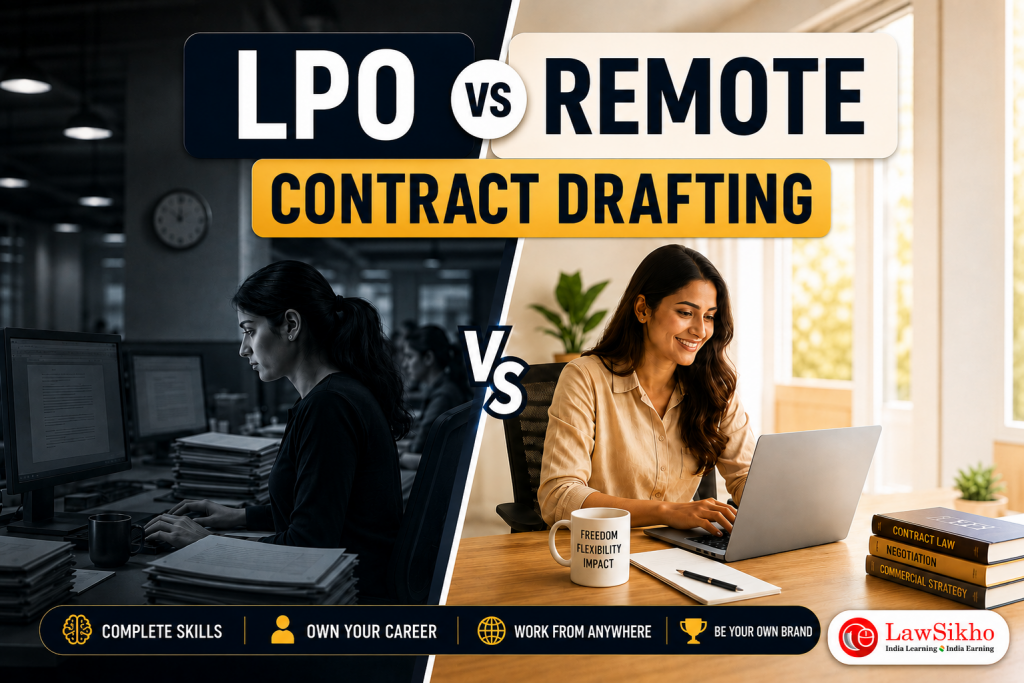

Legal Process Outsourcing (LPO) and remote contract drafting are both popular strategies for handling legal documentation, but they differ significantly in scope, structure, and delivery.
Table of Contents
Introduction
If you are working in an LPO and wondering whether remote contract drafting for international clients is just the same job with a different label, the answer is no. The two look similar from the outside, but the work, the pay, and the career trajectory could not be more different. Here is a Legal Process Outsourcing (LPO) in India with their scope and opportunities.
It also compares LPO vs remote contract drafting with real numbers, a five-year income view, and the specific reasons LPO experience often hurts more than it helps when you try to move on. By the end, you will know exactly which path builds a career and which one keeps you stuck. Here is a proven ways Contract Drafting Can Transform a Lawyer’s Career

What Actually Happens When You Join an LPO
You join. The salary sits between ₹25,000 and ₹40,000 a month, as confirmed by Ambition Box listings for LPO roles. Not great, but it is something.

Here is what nobody tells you on day one.
The work is fragmented. You are not drafting full contracts. You might be reviewing clause 3 across 50 contracts, formatting footnotes, or running a narrow research point. Assembly line stuff. You do not handle clients, you do not draft contracts end to end, and you do not own deals.
Career growth is shallow. Where do you go from here? Senior document reviewer. That is the ceiling for most people, and it just means you supervise others doing the same fragment work.
Someone else owns the client relationship. The LPO charges the US client around $50 per hour for your work. You earn roughly ₹200 per hour, which is about $2.20. The math does not add up in your favour.
You are also not building your own track record. The end client does not know your name. Every output goes under the LPO’s brand, not yours. As Shiksha’s overview of LPOs in India explains, the model is built around delivering scale to foreign firms, not around developing the careers of the lawyers inside.
It is a bit like working in a car manufacturing plant where you install the same bolt on every vehicle. You are not learning how cars work. You could not build one yourself. Customers do not know your name. And this is by design.
The Pay Gap LPOs Don’t Want You to Calculate
Here is the math that should make you uncomfortable.
A lawyer in an LPO earns roughly ₹35,000 a month. The LPO bills the same lawyer’s time to a US client at around $2,500 a month. At today’s exchange rate, that is about ₹2,20,000. The LPO keeps ₹1,85,000. You keep ₹35,000.
Key takeaway: For every ₹1 the LPO pays you, it earns roughly ₹5 from your work.
“But They Provide Clients, Training, and Infrastructure”
This is the standard defence. Let us break it down honestly.
Clients:
- You’re doing the work for SMEs who would happily pay YOU $15-20/hour directly
- These clients are on Upwork, Clutch, and LinkedIn publicly accessible
- The LPO’s “client acquisition” is just cold emailing at scale
Training:
- You learned formatting guidelines and document management software
- Did they teach you how to draft a complete contract? No.
- Did they teach you how to understand commercial intent? No.
- Did they teach you how to negotiate? No.
Infrastructure:
- A laptop, internet connection, and Zoom account
- You probably already have these
- If not, the cost is ₹50,000 one time recoverable in your first two freelance projects
What LPO “Training” Actually Looks Like
Here is the typical four week induction:
- Week 1: Software systems and document naming conventions
- Week 2: How to use the review checklist
- Week 3: Escalation procedures when you find issues
- Week 4: You are “trained” and you start production work
This is not training. This is factory floor onboarding. And it is structured this way on purpose. If LPOs taught you the full contract drafting workflow, client communication, and pricing, you would leave within a year and become their direct competition.
Why LPOs Keep You Dependent
LPOs deliberately give you fragmented work because if you learned the complete process, you wouldn’t work there anymore.
Think about it:
- Why don’t they train you on client communication?
- Why don’t they teach you end-to-end deal management?
- Why don’t they show you how to price your services?
Because the day you figure that out, you become their competition.
Why LPO Experience Hurts You in Job Interviews
Many candidates assume LPO time gives them “international experience” that opens doors at law firms or in-house teams. The opposite tends to happen.
A Typical LPO to Law Firm Interview
Example: Imagine a situation where you go for a Job Interview
Interviewer: “I see you worked at this LPO for two years. Tell me about a complex contract you drafted.”
You: “Well, I mostly did document review and…”
Interviewer: “Did you draft any contracts from scratch?”
You: “Not exactly from scratch, but I worked on sections of…”
Interviewer: “Have you handled client negotiations?”
You: “No, we did not interact with clients.”
Interviewer: “Tell me about a deal you managed end to end.”
You: [uncomfortable silence]
You have years of experience but no concrete competence the interviewer can verify.
How a Direct Contract Drafter’s Interview Goes
Compare that with someone who drafted contracts for three or four startups directly:
Interviewer: “Tell me about your experience.”
Them: “I drafted a complete co-founders agreement for a fintech startup raising Series A. The founders had different vesting schedules and IP concerns. I also negotiated the terms with the investor’s counsel. Here is the executed agreement and a testimonial from the founder.”
The candidate with three or four complete contracts beats the candidate with two years of LPO time, every single time. One has demonstrated end-to-end capability. The other has demonstrated the ability to follow instructions inside a process owned by someone else.
The 5 Year Math: LPO vs Remote Contract Drafting
Let us run a five-year comparison using realistic assumptions.
The LPO Career Path
Starting pay around ₹30,000-40,000 per month, with the standard 10% annual hike Indian salary surveys typically show:

- Year 1: ₹3.6 L annually
- Year 2: ₹3.96 L annually
- Year 3: ₹4.35 L annually
- Year 4: ₹4.8 L annually
- Year 5: ₹5.28 L annually
- Total: approximately ₹22 L
- Skills built: Fragment assembly
- Career Growth: Senior Document Reviewer
You join. The salary is ₹30,000-40,000 per month. it is confirmed by Ambition Box listings for LPO roles. Not great, but it is something.

The Remote Contract Drafting Path
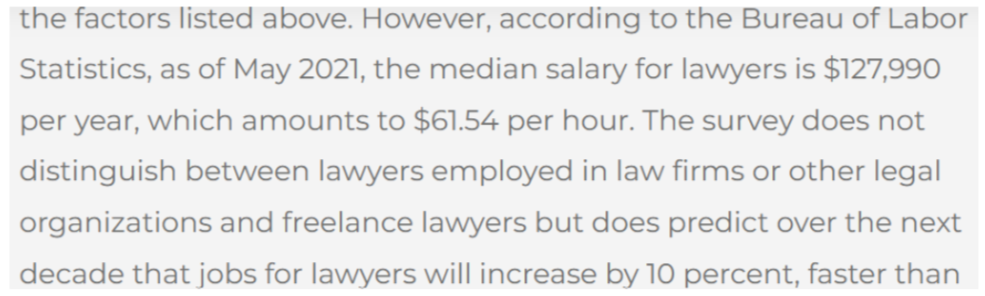
Assuming you bill just 100 hours a year at $60 per hour (a conservative rate for direct international work, as visible on platforms like LawClerk’s freelance lawyer rate guide), with the same 10% annual growth:
- Year 1: ₹5.36 L annually (assuming that a freelancer works for just 100 hours @60$ per hour)
- Year 2: ₹5.89 L (assuming a 10 percent hike)
- Year 3: ₹6.48 L (assuming a 10 percent hike)
- Year 4: ₹7.13 L (assuming a 10 percent hike)
- Year 5: ₹7.84 L (assuming a 10 percent hike)
- Total: approximately ₹32.7 L
- Skills built: complete contract lifecycle
- Career destination: sought after specialist with your own client base
The gap is roughly ₹10 lakhs over five years, and that assumes you stay solo. If you build a small team or stabilize above 100 billable hours from year three, the gap widens significantly.
Both paths require 9 to 10 hours a day. Same time investment. Radically different outcomes.
Why Indian Lawyers Don’t Need an LPO Middleman
You might ask: if it is this straightforward, why does everyone not do it?
Because the LPO appears to provide three things you do not have on your own: clients, skills, and credibility. The honest answer is that you can build all three yourself in less time than you would spend climbing the LPO ladder.
- Clients – they already have US/UK clients
- Skills – supposedly they train you (they don’t, really)
- Track record – they have credibility
The Real Problem and Solution
The actual issue isn’t that you need an LPO. The issue is that you don’t know, In an LPO, you’re learning fragments. To work directly with clients, you need to know how to draft an entire contract from understanding what the client needs, to drafting, to reviewing, to handling execution formalities. Here is a complete picture of how, LPO vs Remote Contract Drafting works.
It just takes 6 months.
1. A 6-Month Roadmap to Replace Your LPO Job
If you commit two hours a day alongside your existing work, six months is enough to build a working remote contract drafting practice.
Months 1-2: Foundation
- Understanding commercial intent (why contracts exist in the first place)
- Risk analysis from the client’s perspective
- The 20 essential clauses every contract needs
- Drafting your first 10 simple contracts end to end
Months 3-4: Specialisation
- Industry specific contracts (tech, services, manufacturing)
- International versus domestic considerations
- Client interview skills
- Negotiation fundamentals
Months 5-6: Mastery
- Complex multi-party agreements
- Cross border deals and enforcement issues
- Building your personal brand on LinkedIn
- Direct client acquisition channels
The contrast with LPO learning is stark. LPO training teaches you “here is how to review clause 7.” Complete training teaches you “here is how to draft an entire shareholders agreement, negotiate it, and ensure it is enforceable across three jurisdictions.”
2. How to Build a Track Record
Your work in an LPO is invisible. The end client does not know your name. Every contract you touch goes out under the LPO’s brand, not yours. After two years, you cannot point to a single agreement and say “I drafted this from start to finish.”
But if you draft even 10-15 complete contracts even for free or low pay initially, even for small startups and get testimonials? That’s a portfolio. That’s proof you can do the work.
What Your Portfolio Should Contain
Your portfolio is not just contracts. It is the full proof package:
- 3-5 startups who need basic agreements (offer to help for testimonials)
- 10-15 complete, polished contracts you drafted end to end
- 2-3 published articles on contract drafting topics that demonstrate expertise
- An active LinkedIn presence showing case studies and sample clauses
3. How to Find Your Own Clients
LPOs convince you that international clients are impossible to reach without them. The opposite is true. The market is enormous and publicly accessible.
There are 34.8 million small businesses in the United States, according to the U.S. Small Business Administration, and another 1.29 million in Canada per the Government of Canada’s SME data. Most cannot afford lawyers at $300 an hour, but they regularly need contracts drafted, reviewed, and negotiated.
If you can deliver a solid contract for $50-100 instead of $1,500, you are solving a real problem.
These clients are reachable on:
- Upwork and Fiverr for inbound freelance work
- LinkedIn for direct outreach to founders and operations leads
- Clutch.co for business directories and small firm listings
- Startup communities and accelerators
- Small US/UK/Canadian law firms looking for affordable paralegal support
What Your Pitch Should Look Like
A clean direct pitch has four parts:
- “I draft complete contracts for your business.”
- “Here are five similar contracts I have done.” (your portfolio)
- “Here is what my clients say about the work.” (testimonials)
- “My rate is $15-20 per hour, still significantly below local counsel.”
That is it. No mystique, no middleman, no pitch deck.
The Two Paths: Which Will You Choose?
The LPO Treadmill (24 Months, No Real Skill Gain)
- Months 1-6: Learn formatting and how to stay in your lane
- Months 7-12: Get slightly faster at reviewing clause 7
- Months 13-24: Maybe get promoted to Senior Reviewer
- Month 25 onwards: Realise you are two years in and still cannot draft a complete contract
- Exit options: Another LPO, maybe
The Independent Professional Path (12 Months to ₹60K-80K)
- Months 1-3: Learn to draft 15 fundamental contracts end to end
- Months 4-6: Draft real contracts for 3-5 clients, even pro bono initially
- Months 7-9: Build portfolio, collect testimonials, start charging properly
- Months 10-12: ₹60,000-80,000 per month with a growing client base
- Year 2 onwards: Scale to ₹1.5L-2L per month, choose your clients, control your time
- Exit options: Boutique law firms fighting to hire you, in-house roles at premium packages, or your own practice
Five Career Outcomes LPO Lawyers Can Unlock by Learning Contract Drafting
We have helped many professionals who were working in LPOs to start their own freelance practice, get jobs in law firms or reputed companies as in-house counsels, and in some cases start their own law firms.
It typically takes 6-12 months if you invest two hours a day alongside your existing LPO hours. Here are five outcomes that become realistic:
- Move into in-house counsel jobs that pay materially more than your LPO package
- Build international remote freelancing directly with your own clients and earn 3x more
- Stop working night shifts if you are stuck on US time zones
- Get freedom and autonomy, with growth in a meritocratic environment
- Move into top Indian law firm jobs using your international experience as leverage
LPO vs Remote Contract Drafting: Quick Comparison Table
| Factor | LPO Job | Remote Contract Drafting |
| Monthly income (Year 1) | ₹30,000-40,000 | ₹40,000-60,000+ |
| Work type | Fragmented review | End-to-end drafting |
| Client relationship | Owned by employer | Owned by you |
| Skill built | Process compliance | Full contract lifecycle |
| Career ceiling | Senior reviewer | Independent practice or premium in-house role |
| Track record | Invisible | Portfolio under your name |
| Exit options | Another LPO | Law firms, in-house, own practice |
| Time required | 9-10 hours/day | 9-10 hours/day |
Frequently Asked Questions
Is remote contract drafting better than an LPO job for freshers? For most freshers, yes. LPO work teaches you process discipline but not contract drafting itself. A fresher who spends six months learning end-to-end drafting and builds a small portfolio typically out earns an LPO peer by year two and has stronger exit options.
Can I switch from an LPO to remote contract drafting? Yes. Many lawyers make the switch within 6-12 months by investing two hours a day in learning complete contract drafting alongside their LPO job, then taking on small direct clients before quitting.
How much can a freelance contract drafter earn from international clients? Entry rates of $15-20 per hour are realistic for Indian lawyers with a portfolio. Experienced drafters charge $40-60 per hour or more, which works out to ₹60,000-2,00,000 per month depending on hours billed.
Will LPO experience help me get an in-house counsel job? Usually not on its own. Hiring managers want to see contracts you have drafted from scratch, deals you have managed, and negotiations you have led. LPO work rarely produces these proof points, which is why direct freelance contract drafting often opens better doors.
Where do I find international clients without an LPO? Upwork, LinkedIn outreach to founders, Clutch.co, startup communities, and small US/UK law firms looking for paralegal support. None of these channels are gated.
Conclusion: Build the Career, Not the Cog
The choice between LPO vs remote contract drafting is not really about pay alone. It is about whether you spend the next five years building skills, a portfolio, and clients in your own name, or installing the same bolt on someone else’s car. Both, LPO vs remote contract drafting paths cost the same hours. Only one compounds. If you want a clear, structured way to learn complete contract drafting and start working directly with international clients




 Allow notifications