

In February 2020, the Second National Judicial Pay Commission issued a revised pay proposal for all judicial officers in the lower judiciary, whereby salaries would increase to three times the existing pay scales.
As per the pay commission’s report, judges in lower courts will now draw INR 80,000-1 lakh per month, while District Court judges will earn a little over INR 2 lakh per month.
The implementation of the proposal across the country will take a while, but it indicates the Government’s efforts to make the lower judiciary more financially rewarding as a profession. Which is why we feel this is the right time to host a bootcamp on ‘How to crack Indian Judiciary exams’.
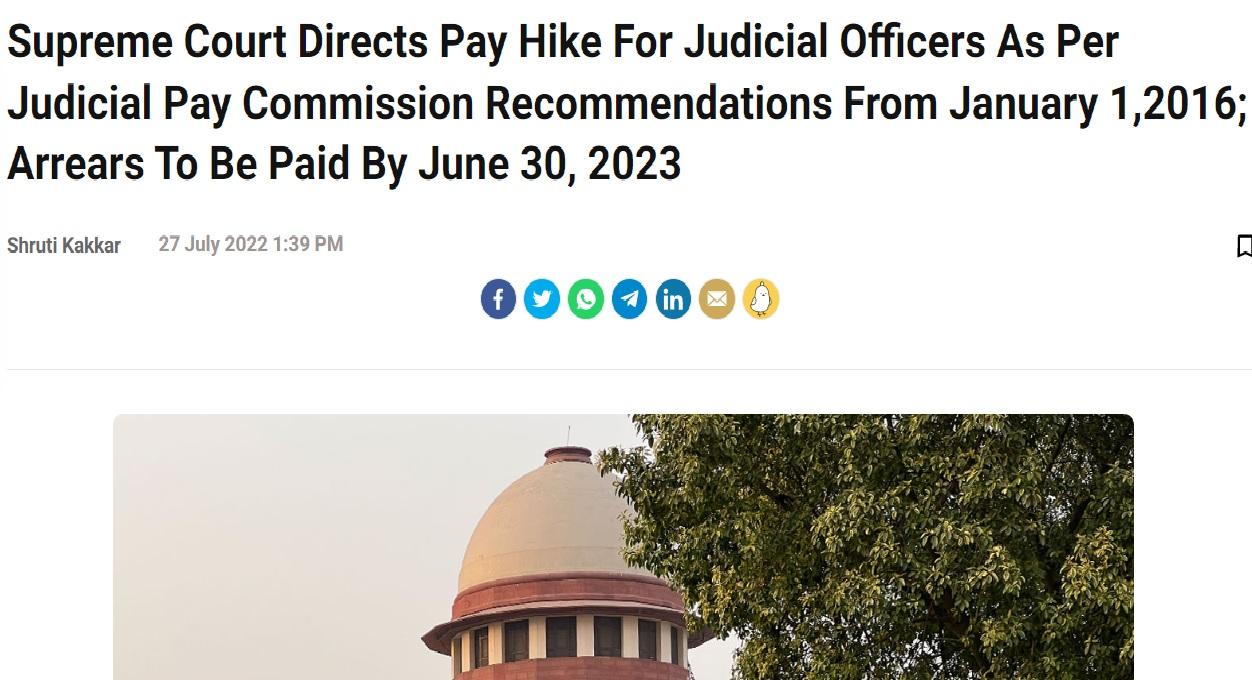
Source: LiveLaw.in, accessed October 29, 2022

Is it only about the money?
There’s a reason we have begun this message with pay scales. Ask any law student or legal professional, and they will say that one of the main reasons for them not attempting the Indian Judiciary exams is the low pay for judicial officers and judges, compared to those for corporate lawyers, for example.
What is the point, they will ask, of investing so much time and hard labour in clearing this very difficult set of exams when the returns are so slim?
Well, that question has been definitely answered by the second pay commission’s report. To expand on what we began with, here’s a breakup of the new salary structure:
| Position | Earlier pay (INR) | Proposed pay (INR) |
| Junior Civil Judge/First Class Magistrate | 27700 – 44700 | 77840 – 1,36,520 |
| Junior Civil Judge/First Class Magistrate (ACP after first 5 years) | 33090 – 45850 | 92960 – 1,36,520 |
| Junior Civil Judge/First Class Magistrate II (ACP 5 years after 1st ACP) | 39530 – 54010 | 1,11,000 – 1,63,030 |
| Senior Civil Judge | 39530 – 54010 | 1,11,000 – 1,63,030 |
| Senior Civil JudgeACP after first 5 years | 43690 – 56470 | 1,22,700 – 1,80,200 |
| Senior Civil JudgeII ACP* 5 years after 1st ACP | 51550 – 63010 | 1,44,840 – 1,94,660 |
| District Judge | 51550 – 63070 | 1,44,840 – 1,94,660 |
| District Judge – Selection Grade (after 5 years of Entry Grade) | 57700 – 70290 | 1,63,030 – 2,19,090 |
| District Judge (Super Time Scale – 3 years after Selection Grade) | 70290 – 76450 | 1,99,100 – 2,24,100 |
*ACP – Assured Career Progression
But is the judiciary only about an improved pay scale? What about power? The ability to make a difference in society? The security of a government job? Pride and social prestige?
Aren’t these equally attractive reasons to opt for a career in the lower judiciary?
Plus, depending on how early you start and your performance, you can retire as a judge of a High Court or even the Supreme Court.
To take just two examples, Justice Prafulla Chandra Pant entered the Uttar Pradesh Judicial Service in 1976 (clearing the Uttar Pradesh Munsif Services Examination 1973) and retired as Supreme Court Judge in 2017, going on to serve as an honourable member of the National Human Rights Commission from 2019-21.
Again, Justice M. Fathima Beevi began her career as Munsiff in the Kerala Subordinate Judicial Services in May 1958. She was promoted as Subordinate Judge in 1968, Chief Judicial Magistrate in 1972, and District & Sessions Judge in 1974. Elevated to the High Court as a Judge on August 4, 1983, she became a permanent HC judge on May 14, 1984. She retired in April 1989, but was further elevated to the Supreme Court as a judge in October, from where she retired in 1992.
Who is to say that their career trajectories cannot be yours too?
The many other benefits
As a judge, you are entitled to such amazing perks as a government residence, security, an assistant, car and conveyance, electricity and telephone allowance, medical allowances, additional funds for your own education, allowances for the education of children, soft loans to build a house, etc.
We will reserve a detailed discussion for the bootcamp, but consider these examples:
- When it comes to residential accommodation, the minimum plinth area for a District Judge is 2500 sq. ft, while that for a Civil Judge is 2000 sq. ft
- A furniture grant of INR 1.25 lakh is provided every five years to judicial officers subject to proof of purchase
- State governments allot annual funds for maintenance of residences to each judicial officer as per rank. Additional annual funds of upto INR 10 lakh are allocated for general maintenance of officers and staff residences, court etc
- The Principal DJ, Family Judge, and CJMs are provided with bungalows (6 BHK generally, or a minimum of 5 BHK)
- All judicial officers receive a fixed medical allowance of INR 3,000 per month. All officers including pensioners/ family pensioners are entitled to treatment at government empanelled private medical facilities, for which they will be reimbursed on submission of bills
We could go on in this vein for a long time, but you get the idea. Honestly, we cannot think of too many private sector jobs that would offer you such a balanced lifestyle, combined with regular working hours, low stress, abundant court holidays, and such steady career progression.
Not everybody is made for the high-stress, relentlessly target-driven life of a corporate lawyer or in-house counsel, where the endless working hours and lack of work-life balance often lead to total burnout.
Civil Judge Salary in India 2026
The civil judge salary in India is determined by the Second National Judicial Pay Commission’s revised pay scales, which apply across most states. If you are preparing for a state judiciary exam, these are the figures you will actually earn once selected.
Civil judges in the lower judiciary are divided into two grades — Junior Division and Senior Division — with salary progression tied to years of service and Assured Career Progression (ACP) milestones.
Civil Judge (Junior Division) Salary Per Month
A civil judge in the junior division starts at a basic pay of ₹77,840 per month. After five years of service, the ACP mechanism kicks in and the pay band moves to ₹92,960. After a second ACP milestone (five years after the first), the basic pay advances to ₹1,11,000. The full range for this grade is ₹77,840 to ₹1,36,520.
The in-hand salary after adding Dearness Allowance, House Rent Allowance, and other state-specific allowances typically works out to ₹85,000 to ₹1,20,000 per month for a junior civil judge depending on the state of posting.
Civil Judge (Senior Division) Salary Per Month
Promotion to Senior Civil Judge brings a pay scale of ₹1,11,000 to ₹1,63,030 at entry. After the first ACP (five years in), this rises to ₹1,22,700 to ₹1,80,200. After the second ACP, the range moves to ₹1,44,840 to ₹1,94,660. The in-hand salary at the senior division level ranges from approximately ₹1,20,000 to ₹1,70,000 per month across states.
| Position | Pay Scale (₹/month) |
|---|---|
| Junior Civil Judge / First Class Magistrate | ₹77,840 – ₹1,36,520 |
| Junior Civil Judge (ACP after 5 years) | ₹92,960 – ₹1,36,520 |
| Junior Civil Judge (2nd ACP) | ₹1,11,000 – ₹1,63,030 |
| Senior Civil Judge | ₹1,11,000 – ₹1,63,030 |
| Senior Civil Judge (ACP after 5 years) | ₹1,22,700 – ₹1,80,200 |
| Senior Civil Judge (2nd ACP) | ₹1,44,840 – ₹1,94,660 |
Beyond the base salary, every civil judge receives the full perks package: government residence, medical allowance of ₹3,000 per month, furniture grant of ₹1.25 lakh every five years, travel allowance, electricity and telephone reimbursement, and children’s education allowance. The non-monetary benefits make the effective compensation significantly higher than the nominal figures suggest.
📌 If clearing a state judiciary exam is your goal, understanding the full compensation package — salary, perks, pension, and career trajectory — is the starting point. LawSikho’s Judicial Services Examination Preparation programme is built by practitioners who have cracked these exams and now coach candidates on the exact skills the exam tests. It covers substantive law, answer writing, and interview preparation — with mentorship throughout.
👉 Explore the programme
Judicial Magistrate Salary in India 2026
The judicial magistrate salary in India sits in the same pay band as the Civil Judge (Junior Division). Both the Judicial Magistrate First Class (JMFC) and the Civil Judge Junior Division are entry-level positions in the subordinate judiciary, and their salaries follow the same structure under the Second National Judicial Pay Commission framework.
A Judicial Magistrate First Class (JMFC) starts with a basic pay of ₹77,840 per month, rising to a maximum of ₹1,36,520 within the junior grade. The Chief Judicial Magistrate (CJM) occupies a higher position. Following a Supreme Court direction in January 2024, CJMs are entitled to an additional ₹1,000 per month over and above the standard scale, reflecting the additional administrative and supervisory responsibility they carry.
| Post | Pay Scale (₹/month) | Note |
|---|---|---|
| Judicial Magistrate First Class (JMFC) | ₹77,840 – ₹1,36,520 | Entry-level, same as Junior Civil Judge |
| Additional Chief Judicial Magistrate (ACJM) | ₹1,11,000 – ₹1,63,030 | Senior designation |
| Chief Judicial Magistrate (CJM) | ₹1,22,700 + ₹1,000 additional | SC direction Jan 2024 |
All judicial magistrates receive the standard allowances package: Dearness Allowance, House Rent Allowance or government accommodation, medical allowance of ₹3,000 per month, travel allowance, and access to government-empanelled private hospitals for reimbursed medical care.
High Court Judge Salary and Supreme Court Judge Salary in India 2026
Constitutional court judges — those serving in the High Courts and the Supreme Court — are paid from the Consolidated Fund of India, which means their salaries are not subject to a vote in Parliament and remain insulated from political pressures. The figures below are fixed under the High Court Judges (Salaries and Conditions of Service) Act, 1954 and the Supreme Court Judges (Salaries and Conditions of Service) Act, 1958.
| Position | Monthly Salary (₹) |
|---|---|
| Chief Justice of India | ₹2,80,000 |
| Supreme Court Judge | ₹2,50,000 |
| Chief Justice of a High Court | ₹2,50,000 |
| High Court Judge (Puisne Judge) | ₹2,25,000 |
Beyond the salary, High Court and Supreme Court judges are entitled to furnished official residences, a personal staff (clerk, orderly, driver), fully covered medical treatment for themselves and their families, travel at government expense, and a substantial pension after retirement. Retired Supreme Court judges are also entitled to secretarial assistance and a furnished office for the remainder of their lives.
Appointment to the High Court or Supreme Court does not happen through a public exam — it is made by the President of India on the recommendation of the collegium. A career that begins as a Junior Civil Judge in the subordinate judiciary can, over three to four decades of service, lead to elevation to a High Court as an Additional Judge and eventually as a permanent judge.
State-Wise Judge Salary Variations
The Second National Judicial Pay Commission sets a national floor for judicial salaries, but the actual in-hand salary varies by state because Dearness Allowance rates, HRA classifications, and state-specific allowances differ. States are categorised by their city classifications (X, Y, Z) for HRA purposes, which affects take-home pay significantly.
A civil judge posted in a metro city (Class X) — such as Delhi, Mumbai, Bengaluru, or Chennai — draws a higher HRA than one posted in a smaller district. Additionally, some states have implemented their own supplementary allowances over and above the national commission’s recommendations, making those postings more attractive.
| State | Junior Civil Judge Approx. In-Hand (₹/month) |
|---|---|
| Delhi | ₹1,00,000 – ₹1,20,000 |
| Karnataka | ₹90,000 – ₹1,10,000 |
| Tamil Nadu | ₹88,000 – ₹1,05,000 |
| Kerala | ₹88,000 – ₹1,08,000 |
| Punjab | ₹85,000 – ₹1,00,000 |
| Haryana | ₹85,000 – ₹1,00,000 |
| Maharashtra | ₹92,000 – ₹1,12,000 |
For the most current and authoritative figures for your target state, check the official notification of the relevant High Court or the state’s Finance Department. Salary structures are revised periodically as Dearness Allowance is revised twice a year, typically in January and July.
📌 Most judiciary aspirants underestimate how much preparation the judicial services exams demand beyond knowing the bare acts. LawSikho’s Judicial Services Examination Preparation programme teaches you how to answer the way examiners expect — through structured assignments evaluated by practitioners, not MCQ banks.
👉 Check eligibility and fees
Disclaimer: This article is for informational and educational purposes only and does not constitute legal advice. Laws, rules, and procedures are subject to change. Salary figures cited are based on the Second National Judicial Pay Commission report and publicly available state government data. Actual in-hand salaries vary by state, city classification, and year of service. For the most current information, check official state judiciary notifications. Information is current as of March 2026.
Frequently Asked Questions on Judge Salary in India
What is the salary of a district judge in India per month?
A district judge earns between ₹1,44,840 and ₹2,24,100 per month. Entry-grade district judges start at ₹1,44,840–₹1,94,660 per month. After five years they move to selection grade (₹1,63,030–₹2,19,090), and after a further three years to super time scale (₹1,99,100–₹2,24,100).
What is the salary of a civil judge per month in India?
A Junior Civil Judge earns ₹77,840 to ₹1,36,520 per month as basic pay. A Senior Civil Judge earns ₹1,11,000 to ₹1,94,660 per month. The actual in-hand salary after Dearness Allowance, HRA, and other allowances typically falls between ₹85,000 and ₹1,70,000, depending on grade, years of service, and state of posting.
What is the salary of a judicial magistrate in India?
A Judicial Magistrate First Class (JMFC) earns ₹77,840 to ₹1,36,520 per month — the same band as the Junior Civil Judge. The Chief Judicial Magistrate (CJM) earns ₹1,22,700 per month plus an additional ₹1,000 per month as directed by the Supreme Court in January 2024, reflecting additional supervisory responsibility.
What is the salary of a High Court judge in India?
A High Court puisne judge earns ₹2,25,000 per month. The Chief Justice of a High Court earns ₹2,50,000 per month. These figures are governed by the High Court Judges (Salaries and Conditions of Service) Act, 1954, and salaries are charged to the Consolidated Fund of India.
What is the salary of the Chief Justice of India?
The Chief Justice of India earns ₹2,80,000 per month. Other Supreme Court judges earn ₹2,50,000 per month. These salaries are fixed under the Supreme Court Judges (Salaries and Conditions of Service) Act, 1958.
What perks and allowances do judges get in India?
Beyond the base salary, judges receive: government residence (minimum 2,000 sq. ft. for civil judges, 2,500 sq. ft. for district judges), fixed medical allowance of ₹3,000 per month plus reimbursement at government-empanelled private hospitals, furniture grant of ₹1.25 lakh every five years, travel allowance and conveyance, electricity and telephone reimbursement, children’s education allowance, soft loans for house construction, and a lifelong pension on retirement.
What is the eligibility to become a judge in India?
To sit for a state judicial services exam: LLB from a recognised university, enrolment as an Advocate under the Advocates Act 1961, minimum three years’ active practice as an advocate (in most states), Indian citizenship, and age between 21 and 35 years with relaxations for reserved categories. The selection process runs across three stages: Preliminary exam, Mains, and Interview.
Can a civil judge become a Supreme Court judge?
A career in the subordinate judiciary — starting as a Junior Civil Judge — can lead to elevation to the High Court as an Additional Judge and subsequently as a permanent judge. High Court judges are eligible for elevation to the Supreme Court on the collegium’s recommendation. The full journey typically spans three to four decades of service.
📌 A judicial career offers one of the most stable and socially meaningful career paths in Indian law — steady salary progression, government perks, and the opportunity to rise to the High Court or Supreme Court. LawSikho’s Judicial Services Examination Preparation programme is built for candidates who want structured preparation, mentorship, and practical answer-writing training — not just theory.
👉 See what’s included





 Allow notifications