
Last verified: April 28, 2026
In August 2024, Cyril Amarchand Mangaldas published the composition of its 2024 fresher class. The firm had hired 114 freshers, and the non-NLU strategy that landed close to half of those seats was not luck. Roughly 30 came from “Other law schools” (the residual bucket outside the named NLUs), 11 from a non-NLU private institution, and 10 from a Mumbai government law college.
That puts about 51 of 114 fresher seats, close to half, with candidates who never wrote CLAT or never made the NLU cut. The number is higher than most non-NLU students believe, and it changes the conversation.
But the placement gap between NLU and non-NLU candidates remains brutal. Law Drishti’s 2025 tier comparison reports an 80%+ Tier-1 placement rate at the top NLUs against a 10% to 30% conversion rate at non-NLU institutions. So the door has opened, yes; the queue outside it has not gotten shorter. The reader feels both truths at once: it is possible, and it is hard.
On 30 July 2024, the Supreme Court of India, while hearing Gaurav Kumar v. Union of India (also reported by Bar and Bench), observed that “individuals from marginalised sections, first-generation lawyers and law graduates without a degree from a National Law University face greater challenges in gaining acceptance in senior lawyers’ chambers and law firms.” The bench made the observation in the context of a petition on State Bar Council enrolment fees, but the wider acknowledgement matters. The structural gap is no longer anecdotal. It is on the record.
Those 30+ “Other law schools” hires at the 2024 Cyril Amarchand fresher cohort did not break that gap by accident. They executed a recognisable pattern across roughly six months: rolling internship, drafting portfolio, targeted outreach, conversion playbook, and one of four pre-decided routes.
This post is the operational version of that pattern. It assumes the reader is at a Tier-2 or Tier-3 college, in the 3rd, 4th, or 5th year of an LLB programme, with limited campus support and zero NLU contacts.
Six months. Four routes. One offer.
Before the calendar, the diagnostic. What exactly is the non-NLU strategy 2026, and which of the four routes fits the reader’s timeline?
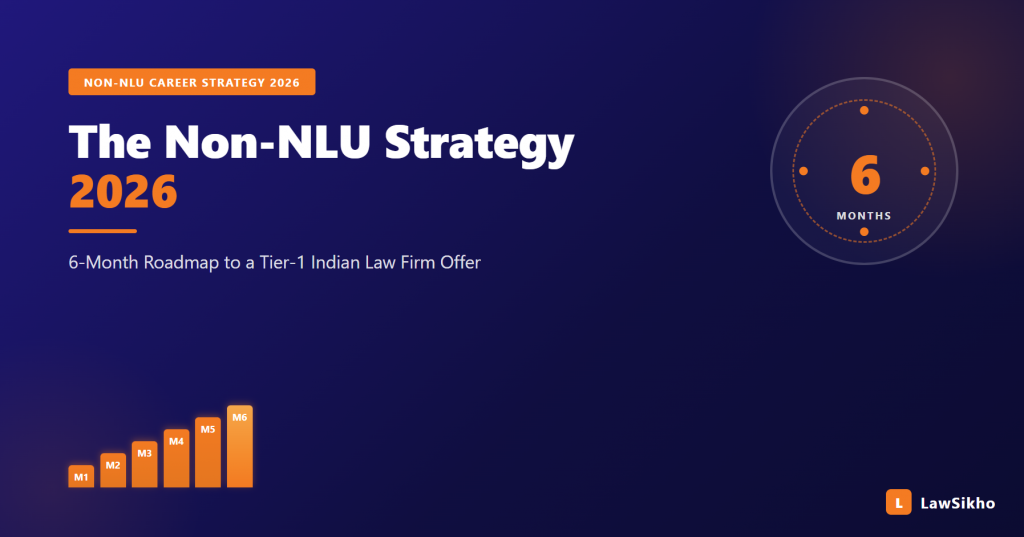
The non-NLU strategy 2026 is a six-month execution plan for average-college LLB students to land a Tier-1 Indian law firm offer through skills, track record, and one of four hiring routes: PPO via rolling internship, lateral via boutique firm, in-house counsel crossover, or niche specialisation in IBC, M&A, IP, or fintech.
That is the headline. The longer answer is where the work is. Below: what non-NLU means in 2026 hiring, what the data really says about the bias, which Tier-1 firms hire non-NLU candidates and into what practice areas, the prerequisites before week 1, the 6-month month-by-month roadmap, the track-record portfolio, the four routes mapped clearly, skill-build comparisons, geographic playbooks, salary trade-off math, rejection-and-recovery, the interview playbook, and 18 FAQs that close every loose end.
1. What is the non-NLU strategy in 2026, and why does it work now?
The strategy works now because the structure of Tier-1 hiring has changed faster than the perception of it. Three years ago, “non-NLU” meant being on the outside of a closed campus pipeline. The top firms ran Day-Zero recruitment cycles at five or six National Law Universities; everything else was a side door. That side door has widened, and most non-NLU students are still treating it as a wall.
Here’s the thing: the change isn’t ideological. Firms didn’t open up because of fairness. They opened up because the pipeline mathematics shifted. The largest Tier-1 firms now hire upwards of 100 freshers per year (Cyril Amarchand hired 114 in 2024 per the LawBhoomi disclosure), and the named NLUs cannot fill that demand at the quality bar firms want.
So the door opened, the work expanded, and the candidate pool got broader. What hasn’t changed is the screening filter at the door: drafting quality, internship trajectory, and the ability to read a commercial document. A non-NLU candidate who satisfies that filter is a hire. A non-NLU candidate who doesn’t, isn’t.
The 2024 Cyril Amarchand fresher class made this explicit. Roughly 51 of 114 seats went to non-NLU candidates, and the firm publicly disclosed the composition. That’s not a leak; that’s a signal.
The signal is that pedigree has been demoted, and portfolio has been promoted. The reader who internalises that shift early gets a six-month head start on peers who are still chasing the wrong thing.
So what does this mean for you? It means the next six months work harder for you than the previous three years of LLB study did. The legal substance you’ve been building (contracts, torts, evidence, criminal procedure) is now scaffolding for a portfolio. The portfolio is the actual hire signal.
What “non-NLU” actually means in the 2026 hiring market
“Non-NLU” is a category of exclusion, not a category of inclusion. In 2026 firm-hiring vocabulary, it means any LLB programme outside the 25-NLU network. That bucket includes well-regarded private schools (Symbiosis Law School Pune, Jindal Global Law School, NMIMS Mumbai, NMIMS Bangalore, ICFAI Hyderabad), respected government colleges (Government Law College Mumbai, Faculty of Law Delhi University, Campus Law Centre Delhi, ILS Pune, Bharati Vidyapeeth Pune), and a long tail of Tier-2 and Tier-3 colleges across cities like Lucknow, Indore, Bhubaneswar, Chandigarh, Cochin, and Kochi. The bucket is wide, and the experience inside it is uneven.
Within “non-NLU”, there is a Tier-2 layer and a Tier-3 layer. Tier-2 captures the strong private and elite government colleges (SLS Pune, JGLS Sonipat, GLC Mumbai, ILS Pune, NMIMS, Christ Bangalore). Tier-3 captures the regional state-affiliated colleges and lesser-known private institutions.
The hiring data treats them differently. SLS Pune and JGLS now produce regular Tier-1 PPOs. Tier-3 colleges produce them rarely, and the path through is longer.
In practice, though, the Tier distinction inside non-NLU is doing less work than most students think. What’s doing more work is the candidate’s individual artefact stack, which is a function of the next six months and not the previous three years.
A common question students raise is whether NMIMS Bangalore students or Christ Bangalore students count as “Tier-2 non-NLU” the same way SLS Pune and JGLS do. The honest answer is yes for hiring filters, with one caveat: the closer you are to a Tier-1 firm office (Mumbai, Delhi NCR, Bangalore), the easier the off-season internship density gets. Geography is doing more work than the institution name. We’ll cover this city-by-city in section 9.
The pitfall is treating the Tier-2 to Tier-3 distinction as fixed. It is not. A Tier-3 college student with five drafting samples, two published articles, and three internship completions ends a six-month sprint above a passive SLS Pune student with none of those. Hiring partners see the artefacts; they don’t see the prospectus.
Why 2026 is structurally different from 2018
The non-NLU pathway was anecdotal in 2018 and operational in 2026. That shift didn’t happen overnight. Between 2015 and 2018, Tier-1 firms (CAM, SAM, AZB, Khaitan, Trilegal, JSA) hired predominantly through Day-Zero campus visits to NLSIU, NALSAR, NUJS, NLIU, NLU Delhi, GNLU, and NLU Jodhpur. Off-campus PPO conversions happened, but they were rare enough to be talked about by name. From 2018 to 2020, an iPleaders piece dated August 2018 explicitly documented the PPO route as the “more sure shot” path even for top NLU students; long-term internships at GLC Mumbai, CLC Delhi, and Symbiosis Pune began producing consistent Tier-1 conversions through rolling internships rather than campus pipelines.
Then 2020 hit, and COVID-induced virtual internships democratised access. A Tier-2 city candidate could intern remotely at a Mumbai or Delhi firm without paying rent in either city. Geographic disadvantage shrank.
From 2022 to 2024, the boutique-firm explosion (LawKNIT, Pioneer Legal, Triumvir Law, Vertices, Argus, DMD Advocates, ANM Global, Emerald) created new launching pads. Each boutique was a place a non-NLU candidate could lateral from, into Tier-1, at 2 to 4 years PQE. That lateral pathway has formalised by 2026.
In 2024, the Cyril Amarchand 30-non-NLU intake became the public benchmark. SLS Pune landed Linklaters and Baker McKenzie PPOs. And on 30 July 2024, the Supreme Court’s observation in Gaurav Kumar v. Union of India put the non-NLU disadvantage on the constitutional record.
The conversation moved from “is the bias real?” to “what’s the playbook against it?”.
So when someone says “the non-NLU strategy worked in 2024”, they’re describing the second derivative. The first derivative changed in 2020. The structural shift is roughly four years deep, and it’s compounding.
The four hiring routes at a glance
There isn’t one path; there are four. Each has a different timeline, math, and skill emphasis. We map them in detail in section 7, but the headline view matters now because it shapes what you do in months 1 to 3.
Route 1 is the rolling internship to PPO route at Tier-1, the highest ceiling and hardest path. Route 2 is the Tier-2 or boutique start to Tier-1 lateral at 18 to 24 months. Route 3 is the in-house counsel role to Tier-1 lateral at 18 to 24 months.
Route 4 is niche specialisation (IBC, M&A, IP, fintech, data privacy) to indispensable-hire status. The smart reader picks one as primary and one as backup before week 1.
This is the broader playbook for top-firm hiring, narrowed for non-NLU candidates and time-boxed to a six-month sprint. The narrowing matters because the generic advice (network, intern, perform) loses traction without a calendar.
2. The non-NLU disadvantage, and what the data really says
The non-NLU disadvantage is real, and it is also smaller than the forum threads make it sound. Both can be true. The trick is to size the bias correctly so it doesn’t expand into an excuse, and so it doesn’t shrink into denial.
Reddit and Legally India threads on non-NLU hiring read like a chorus of form-rejection emails. One verbatim line shows up repeatedly: “Regret we don’t have such vacancy but kept your application.” Most readers experience the bias first as a stack of those mails, and only later as a structural pattern. The pain is concrete; the data is more nuanced.
Let’s be honest about what the bias actually is. It’s a screening shortcut, not a hiring philosophy. Tier-1 firms receive thousands of applications per cycle. A recruiter’s job is to filter to a manageable interview pool fast.
NLU pedigree is a fast filter. It is not the only filter. A non-NLU candidate with a strong portfolio bypasses the pedigree filter because the portfolio offers the same screening shortcut at higher resolution. That’s the operational truth.
The problem is that most non-NLU candidates respond to the bias with frustration, not with portfolio engineering. The frustration is justified, but it doesn’t move the needle. The work does.
What the Supreme Court said in Gaurav Kumar v. UOI and what it means operationally
On 30 July 2024, while hearing Gaurav Kumar v. Union of India (also reported by Bar and Bench), the Supreme Court of India observed that “individuals from marginalised sections, first-generation lawyers and law graduates without a degree from a National Law University face greater challenges in gaining acceptance in senior lawyers’ chambers and law firms.” The bench was deciding a petition on State Bar Council enrolment fees and made the observation alongside the substantive ruling on the cap on enrolment charges under Section 24 of the Advocates Act, 1961. The case was not about hiring directly. The observation, however, is on the record.
What does that mean for you operationally? Three things. First, the structural gap is now constitutionally acknowledged, which gives non-NLU candidates a public reference point in conversations with mentors, alumni, and even hiring managers. Second, the Court’s framing centres “first-generation lawyers” and chamber-acceptance, signalling that the gap is broader than law-firm intake alone.
Third, no specific remedy follows from an observation like this; it is descriptive, not prescriptive. The reader cannot wait for a policy fix to land.
In practice, the observation is a tailwind for credibility, not a substitute for execution. Use it in your cover letters once (cite the Court, then move on to your portfolio); don’t lean on it as the central pitch.
A common question is whether mentioning the observation in an interview signals victimhood or sophistication. The answer is sophistication if framed correctly: “the structural gap is recognised; here is how I have closed it on my end.” The answer is victimhood if you spend more than two sentences on the bias.
The pitfall is treating the SC observation as an end-state. The bench named the problem; the candidate has to solve it. Read the Bar and Bench piece once for context, then move on.
The placement-rate gap in numbers
The numbers are stark, and they are clarifying. The table below pulls verified placement data from Law Drishti’s 2025 tier comparison, the LawBhoomi 2024 Cyril Amarchand cohort report, and SLS Pune’s 2024 placement disclosures.
| Institution category | Tier-1 placement rate (2024-25) | Median fresher package | Notes |
|---|---|---|---|
| Top NLUs (NLSIU, NALSAR, NUJS, NLIU, NLU Delhi, GNLU) | 80%+ | Rs 12-20 LPA (Tier-1 band) | Day-Zero recruitment plus PPO route |
| Top non-NLU (SLS Pune, JGLS, GLC Mumbai) | 30-50% | Rs 8-18 LPA | Rolling internship plus PPO route; SLS Pune 2024 placement report lists Baker McKenzie and Linklaters London among international internship recruiters |
| Mid non-NLU (Christ, NMIMS, ILS Pune, ICFAI Hyderabad) | 15-25% | Rs 6-11 LPA | Off-campus and PPO heavy |
| Tier-3 non-NLU (regional state colleges, lesser-known private) | 5-10% | Rs 2-5 LPA | Mostly Tier-3 firm or in-house entry; lateral pathway active |
| Cyril Amarchand 2024 fresher cohort composition | n/a | n/a | 114 freshers; ~51 from non-NLU institutions, including ~30 from “Other law schools” |
The 80%+ vs 10-30% number is not the whole story. Two things are buried inside it. First, NLU placement rates are inflated by Day-Zero numbers; the actual non-Day-Zero NLU rate is closer to 50-60%.
Second, the non-NLU 10-30% range mixes top non-NLU (30-50% Tier-1) with Tier-3 colleges (5-10%). The honest comparison is top NLU at 70-80% versus top non-NLU at 30-50%, and that’s a much smaller gap.
The reader’s job is to be in the top non-NLU 30-50% bracket regardless of which non-NLU they attend. The way into that bracket is the next six months.
A common question is whether the gap is shrinking or widening. The trend is shrinking at the top of non-NLU, widening at the bottom. SLS Pune and JGLS are converging upward; Tier-3 colleges are roughly flat. This is the executor-vs-non-executor gap inside non-NLU, and it’ll widen further through 2027.
The pitfall is reading the 80% vs 10-30% headline and concluding the door is closed. The data inside the headline says the door is open if you are in the top half of execution.
Three myths to retire before week 1
The first myth is that NLU is destiny. It isn’t. The 2024 Cyril Amarchand cohort has 51 non-NLU candidates. SLS Pune sent students to Linklaters and Baker McKenzie.
The destiny narrative is decade-old data restated as gospel.
The second myth is that no contacts means no career. It doesn’t. Cold-emailing partners (5 per week, structured), LinkedIn DMs (5 per week, with one-line context), and Bar and Bench / LiveLaw publications break the contact gap inside three months. Contacts are a manufactured asset, not an inherited one.
The third myth is that Tier-1 is the only worthwhile target. It isn’t. And a Tier-2 boutique with deep IBC or M&A work plus a documented 18-month lateral pathway out-converts a Tier-3 Tier-1 with low-quality work. Aim well; the destination is the trajectory, not the brand on the door.
The pitfall, if you accept these three myths, is that you waste month 1 on grief instead of on the CV. Don’t.
3. Which Tier-1 firms hire non-NLU candidates, and into which practice areas
Most non-NLU students assume Tier-1 hiring is a closed door at every firm equally. It isn’t. The door opens at different angles at different firms, and the practice area matters as much as the firm name. The reader who picks the right firm-practice combination saves themselves three months of misdirected outreach.
Practice area is doing more work than firm choice on the non-NLU intake question. M&A, IBC, dispute resolution (commercial), IP, and fintech / data privacy absorb non-NLU candidates fastest. Tax, capital markets, banking & finance run NLU-heavier in 2024-25, though the gap is narrowing.
Why the difference? M&A and IBC are skill-intensive workstreams where drafting and redlining can be measured directly; capital markets has historically had a longer apprenticeship and tighter campus channels.
In our view, the best route for a non-NLU candidate in 2026 is M&A or IBC entry, with dispute resolution and fintech as backups. The reasons are mechanical: the artefact (drafted SPA clause, redlined IBC application, arbitration memo) is the proof, and the proof is the hire. Capital markets work is more closed-shop in the short run.
The 2024 Cyril Amarchand benchmark
Cyril Amarchand Mangaldas hired 114 freshers in 2024. The composition, per LawBhoomi’s August 2024 report, broke down approximately as follows: ~30 from “Other law schools” (the residual non-NLU bucket), 11 from JGLS Sonipat, 10 from GLC Mumbai, and the rest distributed across the named NLUs (NLSIU, NALSAR, NUJS, NLIU, GNLU, NLU Jodhpur, NLU Delhi). Roughly 66 of the 114 (58%) came through the PPO route rather than Day-Zero.
That is the single most important data point in this entire post. It says two things: (a) the largest Tier-1 firm in India publicly hires from non-NLU institutions at scale, and (b) a clear majority of those hires now come through PPO conversion, not campus visits.
What does that mean for the reader? It means the rolling-internship-to-PPO route, route 1 in our four-routes framework, is the highest-volume path for a non-NLU candidate in 2026. It also means the candidate must aim at a long internship at CAM (or peer firm) somewhere in months 3-5 of the sprint. We map the timing in section 5.
A common question is whether other firms have published similar diversity data. Most haven’t. CAM is the public benchmark; SAM, AZB, Khaitan, Trilegal, JSA disclose less granular data but follow similar patterns based on Legally India 434169 thread reportage.
The pitfall is fixating on the 30 “Other law schools” number as the goal. The real goal is being in the candidate-quality band CAM and peers select from. That band is six months of artefact production away.
Tier-1 firm-by-firm intake snapshot
The table below summarises publicly stated or industry-reported non-NLU openness across the major Tier-1 firms.
| Firm | Approx fresher intake per year | Non-NLU openness signal | Practice areas with documented non-NLU intake |
|---|---|---|---|
| Cyril Amarchand Mangaldas (CAM) | ~110-120 | High (publicly disclosed 2024 cohort composition) | M&A, IBC, GC, capital markets, IP |
| Shardul Amarchand Mangaldas (SAM) | ~80-100 | Medium-high (multiple non-NLU PPOs documented) | M&A, dispute resolution, banking |
| AZB & Partners | ~60-80 | Medium-high (PPO-heavy intake; named non-NLU partners over 15+ years) | M&A, PE/VC, capital markets, GC |
| Khaitan & Co | ~60-80 | Medium (501+ fee-earner firm; lateral-friendly) | M&A, dispute resolution, IP, IBC |
| Trilegal | ~50-70 | Medium-high (IPO mandate leader; lateral & PPO-active) | Capital markets, M&A, dispute resolution |
| J Sagar Associates (JSA) | ~50-70 | Medium (boutique-feel + PPO route active) | Banking, M&A, dispute resolution, infra |
| S&A Law Offices | ~30-50 | Medium (named non-NLU partner reference) | M&A, dispute resolution, GC |
| L&L Partners | ~40-60 | Medium-high (lateral hiring active) | M&A, dispute resolution, regulatory |
Two cautions. First, intake numbers move year to year; treat the bands as direction, not contract. Second, “non-NLU openness” is a composite read of public statements, alumni patterns, and forum reportage. It is not a guarantee.
In practice, the reader should pick three firms from the high-openness column and concentrate outreach. Five firms is the maximum; three is better. The math is simpler than students think: 5 cold emails per week to partners at three firms over 16 weeks is 240 touchpoints. That’s a working pipeline.
A common question is whether boutique-adjacent Tier-1 firms (Pioneer Legal, LawKNIT, DMD Advocates, ANM Global, Emerald) count as “Tier-1” for trajectory purposes. Strictly, they don’t; the Tier-1 brand label is reserved for the eight firms above. But for a non-NLU candidate, a boutique-Tier-1 trajectory is a legitimate route 2 path.
The pitfall is over-applying. A candidate who sends 50 generic applications to all eight firms in week 1 burns the audience. Three firms, three months, three deepening relationships. That works.
Magic Circle India desks
Linklaters India desk, Baker McKenzie India desk, and Allen & Overy India desk are the three Magic Circle India operations most non-NLU students underestimate. The SLS Pune 2024 placement report lists Baker McKenzie and Linklaters London among international internship recruiters, alongside Tier-1 Indian recruiters such as Khaitan & Co, AZB, and Trilegal, closing the “Magic Circle is NLU-only” myth. The publicly reported SLS Pune 2024-25 placement rate is 94% with average packages around Rs 13 LPA and a domestic top package of Rs 22 LPA.
So is the Magic Circle reachable for a non-NLU student? Yes, with caveats. The Magic Circle India desks run smaller intakes than Indian Tier-1 firms (5 to 15 freshers per desk per year). The screening is sharper.
English fluency, international-deal vocabulary, and cross-border M&A familiarity are non-negotiable. The artefact stack you’d build for a Tier-1 Indian firm transfers; you’d add cross-border IP, US securities, and EU competition law exposure as differentiators.
A common question is whether SLS Pune’s outcomes generalise to JGLS Sonipat or NMIMS Mumbai. They do, partly. JGLS has a similar Magic Circle pattern; NMIMS Mumbai is closer to mid-non-NLU at Indian Tier-1 with rare Magic Circle outcomes. The college matters; the candidate matters more.
The pitfall is treating Magic Circle as the prestige goal without the work. A non-NLU candidate who lands a Linklaters PPO worked harder, not less, than the equivalent Indian Tier-1 hire. There are also alternative international trajectories from India for the reader who is mapping a longer arc.
Tier-1 vs Tier-2 vs Tier-3 vs in-house decision matrix
The table below is the working decision matrix for the reader who has not yet picked a target tier.
| Dimension | Tier-1 firm | Tier-2 firm | Tier-3 firm | In-house counsel |
|---|---|---|---|---|
| Median fresher salary | Rs 12-20 LPA (top end at largest firms) | Rs 6-11 LPA | Rs 2-5 LPA | Rs 5-12 LPA |
| Hours per week | 60-90 | 50-70 | 45-60 | 45-55 |
| Annual fresher intake (per firm) | 60-110 | 20-50 | 5-20 | 1-5 |
| Work mix | M&A, capital markets, GC | Boutique specialism (M&A, IBC, IP) | Generalist commercial | Compliance, contracts, vendor mgmt |
| Lateral mobility ceiling | Tier-1 partner track | Tier-1 lateral at 18-24 mo | Tier-2 lateral at 18-24 mo; rare Tier-1 at 24-36 mo | Tier-1 at 24-36 mo if specialised |
| Realistic non-NLU conversion (top non-NLU) | 30-50% | 50-65% | 70-80% | 25-40% |
| Realistic non-NLU conversion (Tier-3 college) | 5-10% | 25-40% | 50-65% | 15-25% |
The matrix is the answer to the question “which tier should I aim at?”. For a top non-NLU student (SLS Pune, JGLS, GLC Mumbai), Tier-1 is the right primary target with a Tier-2 boutique backup. For a Tier-3 college student, a Tier-2 boutique start with a Tier-1 lateral target at 18-24 months is the higher-probability path. We dig into the math in section 7 and section 10.
The pitfall is mismatching tier and college position. A Tier-3 college student aiming exclusively at Tier-1 in months 1 to 6 burns runway and demoralises themselves. The same student aiming at Tier-2 boutique with a documented 18-month lateral path lands a job and a trajectory.
4. Prerequisites: what the reader must have before week 1
The sprint starts only when the prerequisites are in place. Skipping prerequisites is the single most common failure mode in non-NLU strategy execution. A candidate who starts month 1 outreach without a working CV burns three weeks before realising the issue.
The prerequisites are seven items. They are operational, not aspirational. They are pass-fail.
A common question is how long the prerequisite phase takes. Most students need 10-14 days. A few need 4-5 weeks if the CV and LinkedIn are starting from zero. Either way, the prerequisites are a hard gate; do not advance to month 1 outreach without all seven.
Year-of-study readiness: 5-year vs 3-year LLB
A 5-year integrated LLB student has internship runway in years 3, 4, and 5. But the 3-year LLB student has runway only in years 1 and 2 (effectively the second half of year 1 onwards), with the final year compressing into job-search and AIBE prep. The two timelines need different starting positions.
For 5-year LLB students, the right months for this six-month sprint are typically late 4th year through early 5th year, or the 5th-year main run. Earlier sprints (3rd-year start) work but tend to peak too soon. For 3-year LLB students, the sprint should run alongside the second-year coursework, with month 6 ending at or close to graduation.
In practice, year-of-study readiness is also about portfolio readiness. A 3rd-year 5-year LLB student with no internship experience is not ready for month 1; they need a foundation phase before the sprint. A 4th-year student with one internship and a working CV is ready.
The honest test is: do you have one internship completed (any tier), one drafting sample, and a LinkedIn profile? If yes, start. If no, build for 4-6 weeks first.
A common question is whether 3-year LLB graduates are at a disadvantage. The hiring data says no; the runway constraint says yes. Tier-1 firms have hired 3-year LLB candidates consistently. The constraint is that the runway is shorter, so the sprint has to be tighter and the prerequisites more advanced before week 1.
The pitfall is mismatching year-of-study and sprint start. A 5-year LLB student starting in 3rd year with zero internships often runs out of momentum by month 4. Wait one year and start with one internship in the bank.
The minimum portfolio before sprint start
Seven items must be in place. Here they are, in order.
- Working CV (one page). Tier-1 firm CVs are one page. Two pages signal lack of editing. Use a clean format: name, contact, education (institution + year + CGPA), internships (firm + role + 2-3 deliverable bullets), publications, moots, certifications.
- LinkedIn profile audit-clean. Headline reads as practitioner, not student. Photo professional. About section names target practice area. Experience entries match the CV. Recommendations from at least two internship supervisors.
- Three baseline drafting samples. One NDA (mutual), one employment contract clause set, one SPA clause set (anonymised). These are not full SPAs; they are working drafts that show competence.
- Two academic publications or moot memos. Even college journal pieces count. Substance matters more than venue at this stage.
- One internship completion letter with substantive work descriptions (not “the intern shadowed senior associates”). Get the supervisor to specify deliverables.
- Email signature with credentials. Year, institution, target practice area in two lines. No design templates.
- Drafting sample naming convention. “Lastname_NDA_Mutual_v1.pdf”, not “draft1final.pdf”. Hiring partners notice file hygiene.
You’ll need all seven to start. Six is not enough. The seventh (the file naming) sounds trivial and isn’t; hiring partners regularly comment on portfolio organisation in interviews.
A common question is whether a Tier-3 college student needs the same prerequisites as a SLS Pune student. Yes. The prerequisites are the floor regardless of college. The college changes the firm-tier outreach pattern (covered in section 7), not the prerequisite checklist.
The pitfall is treating the prerequisite list as flexible. It isn’t. Skipping any item means month 1 produces less; the sprint compounds; the gap widens. Get the seven done, then start.
AIBE timing and credentialing
The All India Bar Examination is administered by the Bar Council of India Trust two to three times a year. Clearing AIBE earns the Certificate of Practice that lets a candidate formally hold themselves out as an advocate. For non-NLU candidates, AIBE is a credential equaliser that partially neutralises the pedigree gap.
Time AIBE so that the certificate lands within 6-9 months of LLB graduation. For 5-year LLB students, that’s typically the AIBE cycle in the calendar quarter immediately after final-semester results. For 3-year LLB students, the timing is tighter; sit AIBE at the earliest available cycle after enrolment. Don’t skip cycles to optimise prep; the test is moderate difficulty and clears with 4-6 weeks of focused preparation.
The credential matters because Tier-1 firm offer letters increasingly reference AIBE clearance as a six-month deliverable. A non-NLU candidate who walks into the offer cycle with AIBE already cleared has a measurable signalling advantage. NLU candidates often deprioritise AIBE; the non-NLU candidate’s prompt clearance reads as professional discipline.
A common question is whether to delay AIBE if the firm offer letter doesn’t require it immediately. The answer is no. Clear it. And the math is simple: the downside of clearing early is two months of focused study, while the downside of delaying is that the firm starts treating the clearance as a question mark.
The pitfall is treating AIBE as optional in the non-NLU strategy. It isn’t optional in 2026. State Bar Council enrolment plus AIBE clearance is the legal floor for advocate status, and Tier-1 firm hiring increasingly assumes both within the offer’s first six months.
Want to walk into a Tier-1 firm interview with five drafting samples a senior partner can actually open? LawSikho’s Diploma in Advanced Contract Drafting, Negotiation and Dispute Resolution gives you the exact skills that out-signal pedigree. The programme covers commercial contract structures, redlining methodology, and live arbitration drafting, with mentorship from practising corporate lawyers. Explore the course.
5. The 6-month non-NLU roadmap, week by week
Most advice on non-NLU hiring is calendar-free. Generic advice (network, intern, perform) is correct and useless. The reader needs a calendar that says what to do in week 4 and week 16, not what to do “during your final year”. The roadmap below is that calendar.
The structure is simple: six monthly blocks, each with a single primary deliverable, a portfolio artefact, an outreach action, and a milestone test at the end of the month. Miss the milestone test, and the next month’s plan changes. Hit it, and you compound.
What gives this calendar its bite is the rolling-internship spine. The reader is never not interning during months 2-5. That continuous internship arc is what produces the artefacts and the references.
Without it, the rest of the structure collapses into wishful thinking. So before reading the months, lock the internship pipeline; the rest of the calendar slots into it.
A common question is whether the calendar can compress to four months or stretch to nine. Four-month sprints work only if prerequisites are over-built (e.g., five drafting samples already done, two internships completed). Nine-month stretches work but tend to lose intensity in months 6-7. Six months is the sweet spot for most readers, which is why the Cyril Amarchand 2024 PPO data clusters around six-month internship-conversion windows.
Month 1: Foundation
The single goal in month 1 is “starting position locked”. By the end of week 4, you should have a working CV, a clean LinkedIn, three drafting samples, a target list of 30 firms, and an internship at a Tier-3 boutique or in-house team starting in week 3.
Week 1: lock the CV (one page, clean format, no design templates). Audit LinkedIn (headline, photo, About, Experience, two recommendations). File the three baseline drafting samples in a labelled folder.
Week 2: build the target firm list. 30 firms across Tier-2, Tier-3, and one or two Tier-1 candidates. Get partner names from each firm’s website (associates and partners with 5-12 years PQE are the right outreach target). Build a working spreadsheet: firm, partner name, practice area, email, last contact date, status.
Week 3: start the internship. Tier-3 boutique or in-house team is fine; the work matters more than the brand at this stage. Get on a real workstream within the first week (drafting, research memos, client communication review). Document every deliverable.
Week 4: send the first batch of cold emails. Five emails per week, to partners at the target list. Cold email template: 60-80 words, subject line specific (e.g., “M&A internship inquiry with drafting sample”), one short paragraph on you, one short paragraph on why this firm specifically, attached drafting sample, no resume in the first email (link in signature instead).
Milestone test for month 1: do you have an active internship, three drafting samples on file, and 5 cold emails sent? If yes, advance. If no, repeat week 1-4 before moving on. Don’t fake progress; the calendar is honest with you.
Month 2: First internship and outreach machine
Month 2 is when the outreach machine becomes a habit. The first internship is running; the artefacts are accumulating. The cold-email cadence settles into 5 partners per week, and the LinkedIn DM cadence runs in parallel.
Cold email cadence. Five partners per week means 20 per month. Templates evolve with feedback.
The rule: never re-email a partner who hasn’t replied within three weeks; instead, re-engage with a new artefact (a published article, a fresh drafting sample, a moot result). Re-engagement after substantive new work is welcome; nagging without new substance is not.
LinkedIn DM cadence. Five partners per week, separate from cold-email targets where possible. LinkedIn DMs work better when paired with a comment on the partner’s recent post. The flow: read three of their posts, comment substantively on one, then DM with a one-line ask (a 15-minute call, a question on their practice area, a draft for review).
The cover letter that beats NLU bias has a specific structure. First paragraph: one sentence on what attracted you to this firm specifically (not “your reputation in M&A”; instead, “your work on the X transaction made me read three articles on cross-border IP for tech companies”). Second paragraph: one specific drafting deliverable with a one-line outcome (“I drafted a mutual NDA for a Series A startup; the version was used in their cap-table closing”).
Third paragraph: a one-line ask. No “thank you for considering my application” bloat.
A common question is whether cold email beats LinkedIn DM beats alumni intro. The data says alumni intro is highest-conversion when available, then warm-introduction-via-existing-internship-supervisor, then LinkedIn DM with a substantive comment thread, then cold email. The non-NLU candidate often has weak alumni networks; the structured-LinkedIn-comment-then-DM approach closes that gap fastest.
Milestone test for month 2: have 20 cold emails gone out, have you had at least 2 substantive replies, and is the first internship producing artefacts? If yes, advance. If no, reconsider the targeting (firm fit, partner fit, practice area fit) before month 3.
Month 3: Track record
Month 3 is when the artefact stack becomes externally visible. By the end of month 3, you should have one published article (Bar and Bench, LiveLaw, or iPleaders), one moot submitted, three drafting samples polished, and one off-season internship at a Tier-1-adjacent boutique completed.
Publication first. Pick a topic that’s adjacent to your target practice area (M&A, IBC, IP, fintech). Pitch a 1,200-1,500-word piece to Bar and Bench, LiveLaw, or iPleaders.
Pitch templates are free; the editorial bar is real but not impossible. Two to three pitches typically yield one acceptance. Once published, the article becomes a portfolio artefact and a re-engagement asset for cold-email follow-ups.
Moot court next. One NLU-hosted moot, one international (Vis, Jessup) if reachable. The non-NLU candidate aiming at corporate firms should pick commercial-law moots over criminal or constitutional moots.
The moot memo is the artefact; the moot result is the bonus. Even a quarter-final exit produces a referenceable memo.
Drafting samples polished. By end of month 3, the three drafting samples should be sharper, with track-changes visible (showing your edits to a base contract). Add comments inline to demonstrate commercial reading. Build a drafting portfolio that reads like a working lawyer’s, not a student’s homework.
The off-season internship at a Tier-1-adjacent boutique is the pivot artefact. Off-season means non-summer, non-winter; the boutique has lower intern volume and you’d get more substantive work. Pick a boutique with a documented Tier-1 lateral track (LawKNIT, Pioneer Legal, Triumvir Law, DMD Advocates, ANM Global, Emerald). Two to four weeks is enough.
A common question is what “off-season” specifically means. May to July and December to January are typical peak seasons. Off-season is February to April and August to November. A non-NLU candidate has a structural advantage off-season because firms have lower intern competition then; the trade-off is you’d be balancing internship and coursework.
The pitfall in month 3 is publication procrastination. The article does not need to be perfect. It needs to be live. Aim for three drafts in two weeks and a “good enough” submission; the editor will tighten it.
Month 4: The Tier-1 attempt
Month 4 is the Tier-1 attempt. Apply to assessment internships at three Tier-1 firms by week 14-16. Submit the AI-augmented research memo. Redline one full SPA.
The artefact stack is now operational, and the attempt is calibrated.
Assessment internships are a specific Tier-1 firm format: a 4-6-week internship with a structured evaluation, where the firm decides at the end whether to extend a Pre-Placement Offer. CAM, SAM, AZB, Khaitan, Trilegal, JSA all run them, with intake windows that vary. Apply to three; over-apply and the audience burns. The application is your CV plus one drafting sample plus a 200-word interest note.
AI-augmented research deliverables are the 2026 differentiator most non-NLU candidates skip. Use Westlaw, Manupatra, plus a generative AI tool (with source-checking) to produce a 6-8-page research memo on a recent Indian regulatory issue. The memo demonstrates AI fluency and ethical use; both are screening filters that are likely to harden by 2027.
Show the prompts, show the verification, show the human judgement. Don’t fake it.
Redlined SPA. By month 4, you should be able to take a base SPA template (12-15 pages) and run a substantive redline on representations and warranties, indemnities, conditions precedent, and termination. The redline doesn’t need to be complete; it needs to show commercial reading. This is the artefact a Tier-1 hiring partner will open first.
Practitioner’s Perspective
What experienced practitioners observe across non-NLU assessment-internship reviews at Tier-1 corporate practices is that the first thing opened is the candidate’s drafting sample, not the CV. A senior partner at a Tier-1 firm with 8+ years involved in fresher hiring will spend roughly 90 seconds on the drafting sample before deciding whether to read the CV.
The practical takeaway: in month 4, polish the drafting sample to the point where it reads as practitioner-quality on first scroll, with comment annotations showing commercial reading. Anchor the choice with the public 2024 Cyril Amarchand cohort data (~51 of 114 freshers from non-NLU institutions); the firm hires non-NLU portfolios that read first as deal documents, not as student exercises.
Interview prep starts in week 16 in parallel. PPO interview prep includes: two mock interviews (one with a senior associate, one with a corporate-counsel professional), a written deal-summary exercise, a CGPA-question reframe drill, and a “tell me about a hard problem you solved” answer with three specific examples.
A common question is whether assessment internship application requires a referral. The data says strong-referral candidates have a 2-3x higher PPO conversion rate. The non-NLU candidate who has built referrals through months 2-3 (boutique-firm seniors, published-article editors, moot judges) lands the assessment internship faster.
The pitfall in month 4 is over-applying. Three Tier-1 attempts is the right number. Five is too many; the audience overlap is real, and a known-rejection at one firm propagates through industry conversations. But the right depth at three firms beats a scatter at eight every time.
Month 5: Conversion or pivot
Month 5 is conversion or pivot. The PPO interview cycle peaks here. The reader either converts the Tier-1 PPO, or pivots to one of the three remaining routes: Tier-2 boutique start, in-house counsel role, or niche specialisation track.
Pivot decisions in month 5 are not failures; they are calibrations. And the candidate who runs three Tier-1 attempts, gets two interviews, and converts zero, is in better shape than the candidate who never attempted. The artefacts, the portfolio, and the references are all banked. The route shifts; the trajectory holds.
If pivoting to Route 2 (Tier-2 or boutique), target the boutique-Tier-1 candidates from the boutique-firm rankings: LawKNIT, Pioneer Legal, Triumvir Law, DMD Advocates, ANM Global, Emerald. Apply with the Tier-1-attempt artefact stack. The boutique conversion rate at this point should be 50-65% for top non-NLU.
If pivoting to Route 3 (in-house counsel), target large in-house teams at corporates with active legal hiring (Reliance Industries, Tata Sons subsidiaries, Aditya Birla Group, fintech and SaaS companies with 200+ employees). The in-house route values commercial reading and contract fluency; your artefact stack maps directly.
If pivoting to Route 4 (niche specialisation), pick one of IBC, M&A, IP, fintech, data privacy, climate, or sports law. Spend month 6 on one deep-dive deliverable in that niche (a regulatory-update piece, a sector-mapping memo, a deal-comparison analysis). Niche specialisation is route 4; we cover it in section 7.
A common question is whether the Tier-1 PPO interview can be re-attempted in month 9 or month 12. The answer is yes, but typically only at a different Tier-1 firm or in a different practice area. Re-attempts at the same firm are unusual and usually require a 12-18 month gap.
The pitfall in month 5 is route-hopping mid-month. Pick one pivot route by week 19 and run with it. Reconsidering routes in week 23 means month 6 produces nothing.
Month 6: Lock the offer or rejection-recovery
Month 6 is the lock or the recovery loop. If the Tier-1 PPO converts, the work is acceptance, onboarding, and the 12-month plan. If it doesn’t, the work is the recovery loop: pause, audit, rebuild, redeploy.
Acceptance protocol. Take 48-72 hours to read the offer letter; don’t rush. Confirm joining date, stipend during the gap (if any), AIBE deadline reference, sector or practice area allocation, and the 12-month review milestones. Negotiate gently if the offer is below the publicly disclosed range for that firm-tier; firm offers are surprisingly elastic on joining bonus and relocation, less so on base.
If all three Tier-1 attempts say no, the recovery loop runs week 21-24. Pause: take 7-10 days off outreach to clear head and write a structured post-mortem (what worked, what didn’t, what you’d do again). Audit: have three external readers (a senior associate, a published-article editor, a moot judge) review the application packet and identify the gap.
Rebuild: address the top one or two identified gaps in weeks 22-23. Redeploy: send the upgraded packet to three new firms (Tier-2 boutique with documented lateral, in-house teams with strong commercial work, niche-specialisation boutique).
Don’t accept a Tier-3 dead-end role in week 24 just to have a job. A high-trajectory boutique role, a strong in-house position, or even an additional 6-month sprint with sharper targeting beats a mediocre Tier-3 starter for the 18-month lateral math. We’ll cover the math in section 10.
A common question is what to do if there’s a personal financial constraint that demands an immediate offer. The honest answer is to take the best available offer and reframe it as 18-month lateral fuel; the artefact stack still compounds. The constraint changes the route, not the destination.
The pitfall in month 6 is post-rejection grief that bleeds into months 7-9 of inaction. The recovery loop is two weeks, not two months. Run it tight.
Table 3: The 6-month Gantt as a snippet-friendly list.
| Month | Deliverables | Internship target | Portfolio artefact | Outreach action |
|---|---|---|---|---|
| 1 | CV, LinkedIn, 3 drafting samples, target list | Tier-3 boutique or in-house, week 3 start | Working CV plus three drafting samples | 5 cold emails per week, week 4 start |
| 2 | Cold-email cadence + LinkedIn DM cadence | Tier-2 or Tier-3 rolling internship | 2 deliverable redlines from internship | 5 emails + 5 DMs per week |
| 3 | Article published, moot submitted, 3 samples polished, off-season Tier-1-adjacent boutique | Off-season Tier-1-adjacent boutique | Published article + moot memo | Re-engage 10 partners with article |
| 4 | Apply to 3 Tier-1 assessment internships, AI memo, full SPA redline | Tier-1 assessment internship slot | AI-augmented research memo + SPA redline | Targeted referrals via boutique seniors |
| 5 | PPO interview cycle, route pivot decision | PPO interview slot | Interview deck + case-study summaries | Three internship references confirmed |
| 6 | Lock offer or rejection-recovery loop | Final PPO conversion or boutique start | Final portfolio audit (7 artefacts) | Thank-you notes, 12-month milestones |
The Gantt visual makes the calendar memorable. The six months become a single-screen artefact the reader can save and reference weekly. That is the engagement-intent goal of this post: research-session reading that becomes a year-long reference.
The Non-NLU Strategy 2026: Six-Month Gantt
6. The track-record portfolio: what the reader actually produces
The track-record portfolio is the non-NLU candidate’s substitute for pedigree. The institution shrinks; the artefact grows. By month 6, the portfolio should produce, on demand, a polished version of every screening question a Tier-1 hiring partner asks.
What does “track record” actually mean here? It means a curated, dated, anonymised, labelled set of deliverables that demonstrate drafting fluency, commercial reading, research depth, and AI competence. Not volume; depth. Five excellent samples beat fifteen mediocre ones every time.
In our view, the single biggest mistake non-NLU candidates make is treating the portfolio as a side project. It is the project. Every other component (CV, LinkedIn, internship references) is downstream of the portfolio. A great CV without supporting artefacts is a billboard with no product behind it.
A common question students raise is whether a candidate can build a portfolio without internship access. The honest answer is no; an internship-free portfolio reads as homework, not work product. Get one internship in the bank by end of month 1, then build the portfolio.
The 5-7 drafting samples that move the needle
The five drafting samples that out-perform every other portfolio variant are: (a) a mutual NDA, (b) an employment contract clause set, (c) an SPA term sheet (sanitised), (d) an arbitration clause set with seat / venue / institutional rules variations, and (e) a full-form SPA redline (anonymised, with track-changes and inline comments). Add two if you can: an IBC application or a fintech-regulatory note.
The mutual NDA is the lowest-cost, highest-completion-rate sample. Pick a 4-6-page structure with mutual definitions, scope, exceptions (publicly known information, independent development, regulatory disclosure), permitted disclosures, term, and breach remedies. Show one redline iteration where you tightened a definition or a remedy clause.
The employment contract clause set is the practical-litigation primer. Cover at-will, notice period, non-compete (with the Indian Contract Act Section 27 caveat), confidentiality, IP assignment, and termination. The clauses don’t need to be a full agreement; they need to be substantively defensible.
The SPA term sheet is the deal-vocabulary signal. Cover purchase price (with adjustment mechanism), conditions precedent, representations and warranties (sellers, business, target), indemnification, post-closing covenants, and termination. Sanitise: no real party names, no real numbers, but realistic structure.
The arbitration clause set is the dispute-resolution signal. Three variations: ad hoc Indian seat (Mumbai), institutional Indian seat (Delhi International Arbitration Centre), institutional cross-border (SIAC Singapore seat). Show why each variation is chosen for a different commercial context.
The full-form SPA redline is the apex artefact. Take a base SPA (12-15 pages), redline 4-6 substantive provisions with track changes and inline comment annotations explaining the commercial rationale. This is the sample a senior partner will open first; it is also the sample that takes the longest to build (10-15 hours of focused work).
A common question is whether the samples should be from real internship work (sanitised) or self-built. Both work; sanitised internship work is preferred where confidentiality permits because the work is grounded in a real fact pattern. Self-built samples should be tagged as illustrative.
The pitfall is volume over depth. Eight mediocre samples lose to five excellent ones every time. The hiring partner reads two and decides; depth wins.
Publications and moots
Publications and moots are the two artefact categories that travel best across firm-tier and practice-area variations. A Bar and Bench article on a cross-border M&A regulatory issue lands at CAM, SAM, AZB, and Trilegal; a Vis moot semi-final memo lands at Indian Tier-1 and Magic Circle India desks alike.
Publication targets, ranked by signal strength: Bar and Bench (highest, news-grade), LiveLaw (high, analytical), iPleaders (high, practitioner-skewed), LawSikho blog (good, especially for cross-promotion), college law journals (moderate), personal LinkedIn long-form (moderate, builds presence). Aim for at least two publications by month 6, ideally one external (Bar and Bench / LiveLaw / iPleaders) and one platform-cross-promoted.
Moot strategy. Two moots minimum, one NLU-hosted (for proximity to NLU peers), one commercial / corporate (for practice-area signal). Vis Moot, Jessup, Frankfurt Investment Arbitration Moot, and the Indian commercial moots (NLU Delhi commercial moot, Surana Mahesh commercial moot) are the strongest signals. International moots are reachable for non-NLU students through the right team building and travel logistics.
In practice, the moot result matters less than the moot memo. A quarter-final exit at Vis Moot with a polished memo on, say, “the seat-of-arbitration choice in cross-border SAFTAs” is a hire-quality artefact. A finalist position with a generic memo is not.
A common question is what role moot court plays for a non-NLU student aiming at corporate firms. The role is artefact production plus signal of commercial reading. Don’t moot for the trophy; moot for the memo and the partner-introduction opportunity at the moot venue.
The pitfall is over-mooting. Three or four moots in 18 months produces good artefacts; eight moots produce burnout and shallow memos. Quality, not quantity.
AI and legal-tech as portfolio amplifier
AI is no longer optional in the 2026 non-NLU portfolio. Convergence Now and Law.com (March 2026) report that AI-specialty lateral hires grew 68% at the largest US firms across 2024-2025; associate-level AI lateral hires grew 106%. India will follow with a 12-18 month lag, which means the screening filter starts hardening around mid-to-late 2027.
What does AI fluency look like in the non-NLU portfolio? Three things. First, an AI-augmented research memo: 6-8 pages on a recent Indian regulatory issue (DPDP Act, SEBI ICDR Amendment 2026, NCLT IBC procedural updates). Show the prompts, show the verification, show the human judgement layer.
Second, a redlined contract that uses an AI tool for first-pass clause comparison; show where you accepted the AI suggestion and where you overrode it. Third, a one-page note explaining your AI-tool-use ethics policy: source-checking, confidentiality, transparency in deliverables.
The ethical use point matters. Hiring partners are increasingly wary of candidates who present AI-generated work as their own. The non-NLU candidate who uses AI visibly and transparently out-signals both the candidate who hides AI use and the candidate who avoids AI entirely.
A common question is whether AI legal tech will kill entry-level jobs before the non-NLU candidate can land one. The honest answer is yes, partially: routine document review and first-pass research will compress. The work that doesn’t compress is commercial judgement, AI-output review, client-facing work, and specialised drafting. The candidate who builds those skills is more hireable; the candidate who builds AI-replicable skills is less.
The pitfall is treating AI as a shortcut. AI accelerates artefact production; it doesn’t replace the judgement layer. A candidate who submits an AI-generated memo without verification gets caught and burns the reference. The discipline is: AI for speed, human judgement for accuracy, transparency in disclosure.
Why the artefact will out-signal pedigree by 2027
Here’s the structural shift most non-NLU students miss. The NLU brand was a screening signal in an information-poor environment; in 2026, hiring partners can read a candidate’s portfolio in 15 minutes and assess fit better than the brand can predict it. The information environment has changed; the hiring filter is changing with it.
The institution shrinks. The artefact grows. By 2027, the candidate’s documented work product (drafting samples, published articles, AI-augmented research memos, moot memos, deal-summary blog posts) will out-signal the prospectus on their LinkedIn header.
NLU candidates whose portfolio is invisible will lose ground to non-NLU candidates whose portfolio is visible. This isn’t a prediction; this is the trajectory of the hiring data 2018-2024.
The non-NLU candidate who internalises this shift in month 1 wins the six-month sprint. The candidate who treats it as theory loses to the candidate who treats it as operations.
What the non-NLU candidate brings to month-6 Tier-1 interviews
- Drafting fluency
- Redlining
- Legal research with AI tools
- Commercial reading of clauses
- Basic deal-flow vocabulary
- AIBE clearance
- 5 drafting samples
- 2 published articles
- 2 moot memos
- 1 AI-augmented research memo
- 3 internship completion letters
- 1 boutique-firm reference
- 1 LinkedIn profile audit-clean
7. The four hiring routes for non-NLU candidates: choose your path
There isn’t one hiring route for non-NLU candidates; there are four. Most students treat hiring as a single funnel and fail because the funnel doesn’t fit their college position, geography, or skill stack. The four-route framework is the corrective: pick the route that fits your starting position and run it deliberately.
Each route has a different timeline, different math, different skill emphasis, and different risk profile. The choice is not which is “best”; the choice is which is best for you in the next six months. We map all four below, with the comparison table at the end.
In our view, the most common mismatch is non-NLU students who pick Route 1 (PPO at Tier-1) by default because it’s the most aspirational, not because it fits their position. A Tier-3 college student in a Tier-2 city is more often a Route 2 (boutique to Tier-1 lateral) candidate than a Route 1 candidate. The artefact stack and the trajectory are the same; the timing is two years longer and the conversion rate is higher.
A common question is whether routes can be combined or run in parallel. The honest answer is no, not in the same six months. You can hold one as primary and one as backup, but trying to run two simultaneously dilutes the artefact production and the outreach focus.
Route 1: Rolling internship to PPO at Tier-1
Route 1 is the highest-ceiling, hardest path. The candidate runs a rolling internship arc through months 2-5, lands an assessment internship at a Tier-1 firm in month 4, converts to a PPO in month 5, and joins as an A0 in month 6 or after final-semester exams. The 2024 Cyril Amarchand data shows roughly 58% (66 of 114) of fresher hires came through this PPO route, which makes it the highest-volume path even at the top firm.
Volume is misleading without conversion math. Tier-1 fresher intake varies by firm: CAM is the largest at 114 in 2024, and AZB, SAM, Khaitan, Trilegal, JSA each run smaller cohorts. Community discussions on Legally India 434169 suggest collective fresher hiring across the major Tier-1 firms tracks in the low hundreds per year. CAM’s own 2024 disclosure shows roughly 58% (66 of 114) of fresher hires came through PPO conversion.
Non-NLU PPO conversions in 2024 sit at roughly 35-45% of the CAM cohort (per the LawBhoomi benchmark and SLS Pune outcomes). Translated across the major Tier-1 firms, the realistic non-NLU PPO opportunity is in the dozens to low hundreds annually. That’s the addressable market the reader is competing in.
Who fits Route 1? A top non-NLU student (SLS Pune, JGLS, GLC Mumbai, NMIMS Mumbai) with strong artefact stack by month 3 and at least one Tier-2 internship completed. Tier-3 college students fit Route 1 only if the artefact stack is exceptional (5+ drafting samples, two published articles, two moots, AI-augmented memo) by month 3.
Asian Legal Business 2024 reportage shows AZB and CAM both shifting structurally toward PPO-heavy intake over Day-Zero campus visits. The trajectory is likely to continue through 2027, which structurally favours non-NLU students who can run extended rolling internships. The Day-Zero candidate gets one shot per year; the rolling-internship candidate gets four shots.
A common question is whether Route 1 conversion rates are improving year-over-year. Anecdotal data says yes; CAM’s 30 “Other law schools” intake in 2024 was higher than equivalent figures in 2022. The trajectory is positive but not rapid. Don’t bank on a 2026 jump; bank on solid execution at 2024-level conversion rates.
The pitfall in Route 1 is over-application without depth. Three Tier-1 firms is the right outreach pool; five is too many. The application packet must be sharper at month 4 than at month 1.
Route 2: Tier-2 or boutique start to Tier-1 lateral at 18-24 months
Route 2 is the highest-probability path for the median non-NLU student. The candidate joins a Tier-2 firm or a Tier-1-adjacent boutique at month 6, builds 18-24 months of substantive work, and laterals into Tier-1 at the 18-month mark. The lateral pathway is well-documented in 2024-25 industry reportage and increasingly formalised across the major Tier-1 firms.
LawFuel’s 2025 data shows global lateral hiring up 16.4% with small-firm lateral hires growing at 44%. India is following the trend; the Asian Legal Business 2024 lateral roundups document monthly partner moves from boutiques to Tier-1 firms. By 2027, the boutique-to-Tier-1 lateral path will likely be a documented norm rather than the exception, which is good news for any non-NLU candidate who chooses Route 2 in 2026.
Boutique selection matters. And boutique selection is not about brand prestige; it’s about lateral track record. The 2024 ALB India boutique rankings list LawKNIT, Pioneer Legal, Triumvir Law, Vertices, Argus, DMD Advocates, ANM Global, and Emerald among the strongest non-Tier-1 hiring destinations with documented Tier-1 lateral pipelines. Pick by practice area fit (M&A, IBC, IP, fintech) rather than brand prestige; the 18-month lateral math depends on the work you do, not the firm name.
Who fits Route 2? Mid non-NLU students (Christ, NMIMS, ICFAI, ILS Pune, Bharati Vidyapeeth) and ambitious Tier-3 college students. The route also fits SLS Pune and JGLS students who chose Route 1 and didn’t convert; the artefact stack still works, the timing shifts.
A common question is whether the 18-month lateral target is realistic at any boutique or only at the named ones. The honest answer is the named ones. A boutique without a documented Tier-1 lateral pattern is a longer path; the candidate would do better to switch to Route 3 or 4 in month 12 if no lateral conversation is starting by then.
The pitfall in Route 2 is treating the boutique as the end-state. The boutique is route fuel, not destination. Build the artefact stack at the boutique, document deliverables, maintain Tier-1 firm relationships through articles and outreach, and run the lateral conversation actively at month 12.
Route 3: In-house counsel role to Tier-1 lateral at 18-24 months
Route 3 is underused by non-NLU candidates. The candidate joins a corporate’s in-house legal team (large company with 200+ employees, ideally a fintech, SaaS, pharma, or banking enterprise), builds commercial-counsel chops over 18-24 months, and laterals into Tier-1 either as an associate or into a specialised practice area (general corporate, regulatory, or sector-specific work).
Why Route 3 works for non-NLU candidates. In-house counsel work is heavy on contract review, vendor management, regulatory compliance, and cross-functional commercial reading. The artefact stack from months 1-6 (drafting samples, AI memos, redlined contracts) maps directly to in-house screening filters. In-house teams are also less brand-conscious about hiring institutions; a candidate’s deliverable quality matters more.
Asian Legal Business 2024 lateral roundups show consistent in-house-to-firm crossover. A non-NLU candidate with 18-24 months at, say, Reliance Industries Legal, Tata Sons subsidiaries, Aditya Birla Group, a fintech (Paytm, Razorpay, Pine Labs), or a SaaS company (Freshworks, Zoho, Postman) commands a credible Tier-1 lateral application by 2-year mark. The lateral is typically into general corporate, regulatory, or sector practice.
Who fits Route 3? The non-NLU candidate who is geographically constrained (a Tier-2 city candidate without easy access to Mumbai or Delhi firms), or who has stronger commercial-business fluency than firm-style transactional fluency, or who values 45-55 hour weeks over 60-90 hour weeks for the first 18-24 months. The route is also a strong fit for candidates with a non-law undergraduate background (engineering, finance, MBA) who can pair commercial fluency with legal training.
A common question is whether in-house counsel work counts as “real legal work” for Tier-1 hiring. The hiring data says yes, increasingly. The in-house lateral is treated more or less equivalently to the boutique lateral, and the cap on Tier-1 lateral seniority is similar (associate or senior associate level). Reaching this hub via the corporate-lawyer career hub makes the trajectory clearer.
The pitfall in Route 3 is going in-house at a small under-resourced legal team. A single-counsel team at a 50-person company doesn’t produce the deal-flow needed for Tier-1 lateral. Aim at 5+ counsel teams.
Route 4: Niche specialisation to indispensable hire
Route 4 is the asymmetric path. The candidate picks a niche practice area (IBC, M&A in a specific sector, IP, fintech regulation, data privacy, climate / ESG, sports law, gaming regulation), spends 12-18 months becoming the cohort’s deepest student of that niche, and ends up as an “indispensable hire” filter for any firm with active work in that niche.
BW Legal World’s 2025 reportage identifies M&A, PE/VC, dispute resolution, infrastructure, tax, and regulatory advisory as the year’s growth practices, with technology law, data privacy, IP, ESG, capital markets, and white-collar / investigations as adjacent specialised areas in rising demand. Fintech and data privacy are likely 2026-2027 growth zones in line with these trends. A non-NLU candidate with documented depth in any of these areas can be hired for skill-fit even when general candidates are filtered out.
The math on Route 4 is different. Volume is lower; conversion rate per applied position is higher. A candidate with three published pieces, one full-form deliverable, and one boutique internship in DPDP-Act compliance work will out-convert ten generalist applicants for a fintech-regulatory associate slot at any Tier-1 firm. The institution doesn’t matter at this point; the niche fluency does.
Practitioner’s Perspective
What lateral hires from non-NLU origins observe across 2026 firm-side hiring conversations is that AI compresses generalist work and elevates specialist work. A senior partner with hiring authority at a Tier-1 boutique-adjacent firm will increasingly screen first for niche fluency (IBC, fintech regulation, DPDP compliance) over generalist credentials.
Two specific specialisations the reader can act on this quarter: DPDP Act compliance (substantive obligations effective from 13 May 2027 per the published timeline; every Significant Data Fiduciary will need a Data Protection Officer plus external counsel), and fintech regulation (RBI sandbox alumni plus the digital lending norms create active hiring demand). Institution shrinks. Artefact grows.
Who fits Route 4? Non-NLU candidates with strong subject-matter curiosity (a candidate who actually finds IBC procedural work interesting, or who reads SEBI ICDR amendments cover-to-cover) and the patience for a 12-18-month deep dive. Candidates without subject-matter conviction should not pick Route 4; the depth requires sustained interest.
A common question is whether to pick the niche before month 1 or to discover it through internships in months 1-3. The honest answer is most candidates discover the niche by month 3; locking it before month 1 is fine but not necessary. What matters is that by month 4, the niche is locked and the artefact production aligns to it.
The pitfall in Route 4 is mistaking a “trendy” niche for a “deep” niche. Climate / ESG is trendy and growing; the depth is shallow because the regulatory framework is still forming. IBC is less trendy and far deeper; 2-year experts are routinely hired into Tier-1 work. Pick depth over trend.
Table 4: The four hiring routes compared.
| Dimension | Route 1: Rolling internship to PPO | Route 2: Boutique to Tier-1 lateral | Route 3: In-house to Tier-1 lateral | Route 4: Niche specialisation |
|---|---|---|---|---|
| Time horizon | 6 months | 24-30 months | 24-30 months | 18-24 months |
| Difficulty | Highest | Medium-high | Medium | Medium-high (subject-matter heavy) |
| Realistic conversion (top non-NLU) | 30-45% | 60-75% | 50-65% | 50-70% |
| Realistic conversion (Tier-3 college) | 5-10% | 35-50% | 30-45% | 40-60% |
| Skill emphasis | Drafting + commercial reading | Substantive work + lateral signal | Commercial counsel + business fluency | Niche depth + publication record |
| Best fit | Top non-NLU + strong artefact stack | Mid non-NLU; constrained Tier-3 | Geographically flexible candidate | Subject-matter-curious candidate |
| Backup route | Route 2 or 4 | Route 3 or 4 | Route 2 or 4 | Route 2 or 3 |
The table is the working choice for the reader. Pick one as primary; pick one as backup; commit to that pair through month 5 before reconsidering.
This is exactly the kind of corporate-practice fluency covered in depth in LawSikho’s Executive Certificate Course in Corporate Practice. You’ll learn deal structuring, board resolutions, and SEBI compliance workflows, with live case studies and practitioner feedback. See the full curriculum.
8. Skill-building options compared: what gives the highest ROI
The reader’s biggest mid-sprint question is usually about credentials. Should you do an LLM at a top NLU? An LLM abroad? A LawSikho diploma?
Self-directed learning? Here’s the thing: each option has a different cost, time, and outcome profile. The wrong choice locks 1-2 years of runway and Rs 20-40 lakh of capital into a credential that doesn’t unlock the route you actually want.
In our view, most non-NLU candidates over-invest in degrees and under-invest in artefact production. An LLM at a top NLU is a genuine credential, but it does not unlock Tier-1 hiring at the conversion rate the cost would suggest. Frankly, a LawSikho diploma is faster, cheaper, and produces directly hireable artefacts; it works as a route accelerator but not as a brand replacement.
The decision tree is simple if you’re honest about your goal. If the goal is academic pivot (litigation chamber, judicial-clerkship track, academia), the LLM makes sense. If the goal is firm hiring, the diploma plus self-directed AI-augmented learning beats the LLM on ROI almost every time.
So what does this mean for you? The practical reality is that certifications signal seriousness and demonstrate skill acquisition; they do not replace artefact production. Pair a certification with a portfolio item that demonstrates the skill in practice, and the combination signals authentically. Bottom line: pick the credential that produces work product, not just a line on the CV.
Diploma vs one-year LLM at a top NLU vs LLM abroad
The table below compares the four major skill-building paths on cost, time, and outcome.
Table 8: Skill-building paths compared.
| Option | Cost (approx) | Time | Hireability uplift (Tier-1 firm) | Best fit |
|---|---|---|---|---|
| LawSikho-style diploma (M&A, contract drafting, corporate practice) | Rs 60,000 to Rs 1,50,000 | 6-12 months | Moderate (artefact production amplifier) | Non-NLU candidate during sprint |
| One-year LLM at a top Indian NLU (NLSIU, NALSAR, NUJS) | Rs 3-5 lakh | 1 year | Moderate (brand uplift; not transformative) | Academic pivot or specific niche |
| Self-funded LLM abroad (US, UK, Singapore Tier-1 schools) | Rs 30-60 lakh + opportunity cost | 1 year + visa runway | Moderate-high if returning to India; lower for first-job impact | Long-term international or US firm route |
| Self-directed plus AI-augmented learning | Rs 5,000 to Rs 30,000 (tools and books) | Continuous | Variable (depends entirely on artefact production discipline) | Self-disciplined candidate with internship access |
The diploma is the highest-ROI path for a non-NLU candidate inside the six-month sprint. It is short, focused, and produces directly transferable drafting and redlining skills. The LLM-at-NLU is a brand-transfer signal that helps less than candidates assume; the cost of the year off-runway is high. The LLM-abroad is a long-term play that pays off in years 5-10, not in the immediate hiring cycle.
A common question is whether a LawSikho diploma plus the six-month sprint substitutes for an LLM. For first-job firm hiring purposes, the practical answer is yes, more often than not. For academia or judicial clerkship purposes, no.
The pitfall is taking on debt for an LLM that doesn’t unlock the route. A self-funded LLM abroad at Rs 35 lakh, with 18-month opportunity cost, is rational only if the candidate’s target is US firm hiring or returning to India 2-3 years later for senior-track lateral work. For first-Tier-1-job-in-India purposes, the diploma plus internship plus artefact production is the cleaner math.
When the LLM is and isn’t worth it
Let’s be honest about when the LLM at a top Indian NLU is worth it. Three specific cases. First, the candidate is shifting from a non-law undergraduate background and needs the academic credibility for a regulatory or policy career. Second, the candidate is targeting a specific niche (DPDP, IP, taxation) where an Indian Tier-1 NLU LLM has known specialisation. Third, the candidate is rebuilding a career arc after a 2-3-year break and wants the structured year of academic immersion.
The LLM at a top NLU is not worth it when the goal is direct Tier-1 firm hiring. The brand transfers some signal, but the year of opportunity cost (no internship, no rolling artefact production, no firm-side relationship building) is real. Based on what we’ve seen, a non-NLU candidate who runs the six-month sprint, lands a boutique role, and laterals at 18 months is typically two years ahead of the same candidate who took the LLM detour.
LLM abroad math. A self-funded Tier-1 US LLM (Harvard, Yale, Columbia, NYU, Berkeley, Penn, Chicago, Stanford) costs Rs 35-50 lakh for tuition plus 18 months of living costs and opportunity cost, totalling Rs 60-80 lakh in lifetime cost. The realistic Indian-firm hiring uplift on first job is moderate; the realistic US-firm hiring uplift is significant only if the candidate clears the US bar exam and stays. UK and Singapore LLMs are similar math at lower price points (Rs 25-40 lakh fully loaded).
Is it worth the financial cost? For 8-10% of non-NLU candidates with a clear US/international career trajectory, yes. For the median non-NLU candidate aiming at Indian Tier-1 firms, no.
A common question is whether the LLM-from-abroad-then-Indian-Tier-1 lateral path is real. The hiring data says it works at 5-7 years PQE for senior-associate or counsel roles, not at 0-PQE for fresher hires. Don’t take a Rs 50 lakh LLM hoping it shaves the first-job hurdle; it doesn’t.
The pitfall is treating the LLM as a “safe” option. There is no safe option in non-NLU strategy; there are calibrated bets. The LLM is a high-cost bet that pays off on a long horizon.
The diploma plus sprint is a low-cost bet that pays off on a short horizon. Pick by horizon, not by perceived safety.
Self-directed plus AI-augmented learning
Self-directed learning is the option most non-NLU candidates underestimate. The 2026 information environment makes self-directed plus AI-augmented learning genuinely viable for the disciplined candidate. The constraint isn’t access to material; it’s discipline and accountability.
What does self-directed plus AI-augmented learning look like? Three pillars. First, structured reading: 5-7 books across contract drafting (a recognised redlining handbook, a contemporary legal-writing style guide, the iPleaders contract drafting volume), corporate-practice fundamentals (a leading Companies Act 2013 commentary, a current SEBI LODR commentary), and dispute resolution (a standard treatise on Indian arbitration).
Second, AI-augmented practice: redline an SPA or a shareholder agreement weekly, use a generative AI tool for first-pass clause review, document your overrides. Third, public deliverables: publish one piece every 4-6 weeks on LinkedIn or a personal blog; these compound into a portfolio without needing institutional gatekeeping.
The iPleaders 2018 step-by-step blueprint for top-firm hiring is still useful as a structural template; a 2019 LinkedIn pulse piece from a practising Supreme Court advocate offers a useful 7-step outreach taxonomy. Both are 7-9 years old; pair them with current AI-augmented practice and they hold up. The LawSikho course path layers structured artefact production on top, which is the biggest single accelerator if the budget permits.
A common question is whether self-directed alone (without diploma or LLM) can produce Tier-1 hiring. The honest answer is rarely. Self-directed learning produces strong artefacts; what it doesn’t produce is supervised feedback, structured deadlines, and peer accountability. A candidate with strong internal discipline can pull it off; most can’t, and the diploma is the cheapest accountability layer.
The pitfall is treating self-directed learning as freedom. It isn’t; it’s exposure. Without structure, most candidates produce 30-50% of the deliverable volume they think they will. Build accountability via a peer group, a paid course, or a public weekly publication commitment.
9. Geographic strategy: city by city
Does geography decide the outcome? Not quite. Geography matters more than students think and less than they fear. A Mumbai or Delhi NCR candidate has internship density on tap; a Tier-2 city candidate has lower density but does not have a closed door. The strategy adapts; the destination doesn’t.
The 2020-2022 virtual internship era was permanent for non-NLU candidates. Remote internships at Mumbai or Delhi firms are now common, and any candidate with stable internet plus a quiet workspace can intern at a top firm without paying rent in either city. That said, the in-person internship is still where the relationships compound. Plan for one or two in-city internships during the six-month sprint, even if the rest are remote.
In our view, the geographic strategy is less about choosing the right city and more about choosing the right cadence between remote and in-person. A Tier-2 city candidate who runs four months of remote internships plus two weeks in Mumbai for a final-month boutique sprint outperforms a Mumbai candidate who runs all six months in-person but coasts on geographic advantage.
A common question is whether to physically move to Mumbai or Delhi for the sprint. The data says yes if you can; the rent-and-living cost (Rs 25,000-40,000 per month in either city) is a real constraint. A 4-week intensive in-city stay in months 4-5 captures most of the geographic compounding without the full-cost relocation. We’ll cover the trade-offs by city below.
Mumbai playbook
Mumbai is the densest non-NLU corporate hiring city in India. And the density is not just real estate; it’s relationship density. Government Law College Mumbai (GLC), ILS Pune (commute fallback for South Mumbai firms), KC Law, NMIMS Mumbai, and Symbiosis Pune (Mumbai-adjacent for Bandra and BKC firms) collectively produce more non-NLU Tier-1 hires than any other geographic cluster.
GLC Mumbai’s 2024 hiring data corroborates this: 10 of the Cyril Amarchand 114 fresher seats went to GLC, and the firm has been consistent on GLC intake across recent years. The proximity advantage is real: most Tier-1 firms (CAM, AZB, Khaitan, Trilegal, JSA) have offices in BKC, Worli, or South Mumbai, all within commuting distance from GLC, KC Law, NMIMS, and Symbiosis-Pune via the Mumbai-Pune Expressway.
The off-season Mumbai internship density is a particular advantage. Between February and April, and again between August and November, Mumbai firms run lower intern volumes; the candidate who applies in those windows often gets more substantive work and faster partner exposure. SLS Pune candidates routinely use this window for Tier-1 boutique-adjacent internships.
The Mumbai geographic disadvantage is cost. Rent in BKC, Bandra West, or South Mumbai for a 6-month internship runs Rs 25,000-50,000 per month. A non-NLU candidate from outside Mumbai often opts for shared accommodation in the suburbs (Andheri, Mulund, Vikhroli) at Rs 12,000-18,000 per month, with longer commutes. Build the cost into the six-month plan.
A common question is whether to relocate to Mumbai for the full six months or only for months 4-5. The data says months 4-5 is the cleanest math. Months 1-3 can run remote; months 4-5 are the assessment-internship and PPO interview window where in-person presence compounds.
The pitfall is moving to Mumbai in month 1 without an internship offer in hand. A candidate paying rent for three weeks before a confirmed start date burns runway. Confirm the internship; then move.
Delhi playbook
Delhi NCR is the second densest non-NLU hiring cluster. Campus Law Centre Delhi (CLC), Faculty of Law DU, Amity Law School (Noida), and Jindal Global Law School (Sonipat, with daily commute to Delhi) anchor the Delhi non-NLU pipeline. The Tier-1 firms with strong Delhi presence are AZB, Khaitan, Trilegal, JSA, S&A Law Offices, and L&L Partners; Cyril Amarchand and SAM run smaller Delhi offices but the volume is lower than Mumbai.
JGLS Sonipat is the JGLS-Mumbai-or-JGLS-Delhi commute question. JGLS-Delhi commuters get about 60% of the geographic advantage of CLC or Faculty of Law DU candidates; the daily 90-minute one-way commute is real but doable for in-city internships during semester breaks. JGLS Sonipat 2024 placement data shows Tier-1 outcomes consistent with mid-tier non-NLU expectations.
The Delhi non-NLU candidate’s strategic advantage is the regulatory-and-policy proximity. SEBI is in Mumbai but RBI, MCA, CCI, and many Tribunal benches (NCLAT, SAT in different periods) are in Delhi. A non-NLU candidate aiming at regulatory or competition-law work has stronger workstream access in Delhi than in Mumbai.
A common question is whether GLC Mumbai or Symbiosis Pune is a better launchpad than CLC or Faculty of Law DU. The hiring data says GLC and SLS Pune outperform CLC by a small margin on Tier-1 PPO conversion (largely due to the Mumbai geographic advantage), but the gap is narrower than students assume. The candidate’s individual portfolio is the deciding factor; the city is supporting infrastructure.
The pitfall in Delhi is the Amity / Sonipat commute drift. A candidate who chooses Amity Noida or JGLS Sonipat for the 5-year integrated LLB but plans to commute daily to Delhi firms during internships often loses 2-3 hours per day in transit. Build the time loss into the schedule, or plan for short-stay in-Delhi accommodation during peak internship windows.
Other-city playbook
Pune (Symbiosis, ILS, Bharati Vidyapeeth), Sonipat (JGLS), Bangalore (Christ University, KLU, NMIMS Bangalore), and the Tier-2 cities (Lucknow, Indore, Bhubaneswar, Chandigarh, Cochin / Kochi) each have their own logic. The common thread is that geography shrinks under a remote-internship plus in-city-burst plan; passive students remain stuck whether they are in Bangalore or Bhubaneswar.
Pune has the second-strongest non-NLU corporate-track infrastructure after Mumbai. SLS Pune produces more Tier-1 PPOs per cohort than any non-Mumbai non-NLU campus. ILS Pune is older and more traditional; Bharati Vidyapeeth Pune is widening its corporate-side outcomes. The Pune-Mumbai commute (3-4 hours by Expressway, daily Volvo bus services) makes Pune effectively a Mumbai-region campus for internship purposes.
Bangalore’s non-NLU layer (Christ University, KLU, NMIMS Bangalore) has a different practice-area gravity. Bangalore firms skew toward technology, fintech, IP, and startup-side work; the non-NLU candidate aiming at Bangalore-Tier-1 outcomes should weight portfolio toward fintech regulation, IP, and SAFE / convertible note drafting. Bangalore’s Tier-1 hiring concentration is lower than Mumbai’s, but the boutique pipeline (technology-and-fintech-focused firms) is rich.
The Tier-2 city non-NLU candidate (Lucknow, Indore, Bhubaneswar, Chandigarh, Cochin) sees the door opening at the same rate but with weaker local infrastructure for execution. The structural shift here is the executor-vs-non-executor gap widening within non-NLU, not between NLU and non-NLU. A Lucknow candidate who runs the six-month sprint with discipline outperforms an Indore candidate who waits for the local infrastructure to improve; the local infrastructure isn’t going to improve.
A common question is whether Mumbai vs Delhi vs Bangalore is the right order of preference for a non-NLU corporate-track candidate. The honest answer is: Mumbai if M&A or capital markets is the goal; Delhi if regulatory or competition law; Bangalore if fintech, IP, or technology. Pick by practice area, not by perceived city brand.
Table 6: City-by-city geographic playbook.
| City | Top non-NLU schools | Tier-1 firm proximity | Best practice areas | Cost-of-runway (1 month) | Off-season advantage |
|---|---|---|---|---|---|
| Mumbai | GLC, ILS Pune, KC Law, NMIMS, Symbiosis Pune (commute) | Highest (CAM, SAM, AZB, Khaitan, Trilegal, JSA, S&A) | M&A, Capital markets, GC | Rs 25,000-50,000 | Strong (Feb-Apr, Aug-Nov) |
| Delhi NCR | CLC, Faculty of Law DU, Amity Noida, JGLS (Sonipat commute) | High (AZB, Khaitan, Trilegal, JSA, S&A, L&L) | Regulatory, Competition, Disputes | Rs 20,000-40,000 | Moderate |
| Pune | SLS Pune, ILS Pune, Bharati Vidyapeeth | Moderate (Mumbai commute viable) | M&A, IP, Disputes | Rs 12,000-22,000 | Strong (Mumbai overflow) |
| Sonipat | JGLS | Medium (Delhi commute) | M&A, IP, Regulatory | Rs 10,000-18,000 (campus) | Moderate |
| Bangalore | Christ, KLU, NMIMS Bangalore | Medium (Bangalore Tier-1 offices) | Fintech, IP, Technology | Rs 18,000-32,000 | Strong (technology hiring cycle) |
| Tier-2 cities | Regional state colleges, lesser-known private | Low | Practice-area neutral; remote | Rs 8,000-15,000 | Discipline-dependent |
The pitfall in geographic strategy is treating the city as destiny. It isn’t. A Bhubaneswar candidate with five drafting samples, two published articles, and a remote-internship at a Mumbai boutique is more hireable than a Mumbai candidate without artefacts. The artefact compounds; the geography supports.
10. The salary trade-off: when to take Rs 3-6 LPA vs hold for Rs 16-20 LPA
The salary trade-off is the question students ask each other in private and almost never in public. And the silence around it is part of why the math gets botched.
Should you take a Rs 3-6 LPA Tier-3 firm offer in month 5 if no Tier-1 PPO has materialised? Or hold out and risk an offer-less month 6? The math on this question matters, and the framework is more straightforward than it seems.
Let’s be honest: the question is harder than the math because the emotional cost of holding out is real. A peer at SLS Pune or NLSIU is taking a Rs 18 LPA offer and walking into a BKC office; the non-NLU candidate sitting on a Rs 4 LPA Tier-3 offer is staring at a Rs 1.5 lakh per month gap. The pay-gap pain is voiced repeatedly in Legally India 182383, where a verbatim “Rs 22K vs Rs 1L+” thread captures the texture.
The framework below isn’t pain-relief; it’s decision support. And used right, it’s the difference between a strategic 18-month lateral and a 5-year stagnation in low-quality work.
In our view, most non-NLU candidates over-accept Tier-3 offers in month 5-6 because the immediacy of the cash overrides the trajectory math. Some over-hold for Tier-1 and end up with no offer by month 8. Both errors are common; the framework below addresses both.
Tier-1 vs Tier-2 vs Tier-3 vs in-house salary table
The salary data below pulls from Law Drishti’s 2025 tier comparison, the LawBhoomi CAM 2024 disclosed packages, and forum-aggregated data from Legally India.
Table 7: Salary, hours, and lateral mobility by firm-tier.
| Firm-tier | Median fresher salary (Rs LPA) | Hours per week | Work quality | Lateral mobility ceiling (3-5 years) |
|---|---|---|---|---|
| Tier-1 (CAM, SAM, AZB, Khaitan, Trilegal, JSA, S&A, L&L) | 12-20 (top end at the largest firms) | 60-90 | High (Tier-1 transactions) | Tier-1 partner track or senior counsel |
| Tier-1 lateral (3-5 years PQE) | 22-40 | 60-90 | High | Tier-1 senior associate / counsel |
| Tier-2 (boutique with Tier-1 work or large mid-firm) | 6-11 | 50-70 | High to medium | Tier-1 lateral at 18-24 months |
| Tier-3 (small commercial firm, generalist) | 2-5 | 45-60 | Medium to low | Tier-2 lateral at 18-24 months |
| In-house counsel (large corporate, 200+ employees) | 5-12 | 45-55 | Medium (commercial) | Tier-1 lateral at 24-36 months |
| Litigation chamber (with commercial fluency layer) | 1.5-4 (stipend) | 50-70 | Variable (depends on chamber) | Senior counsel chamber or Tier-2 lateral |
The Tier-1 vs Tier-3 salary spread is roughly 4-5x. The hours spread is roughly 1.5x. The work-quality spread is the widest variable: Tier-1 work compounds skill faster than Tier-3 work for an equivalent number of hours. The lateral mobility ceiling is the long-game variable; it sets the 5-year-out earning curve.
A common question is what the realistic salary for a non-NLU graduate’s first job is. The honest median answer is in the Rs 6-12 LPA range, with top non-NLU candidates landing Tier-1 at the upper end of the Rs 12-20 LPA Tier-1 band (LawBhoomi reported CAM disclosed packages clustering at the top of that range in 2024) and Tier-3 college candidates landing Tier-3 firms at Rs 2-6 LPA. The framework below tells you which end of that range to optimise for.
The pitfall is comparing Tier-3 firm salary to Tier-1 firm salary in absolute terms without including the 18-month lateral compounding. The 5-year-out comparison is closer than the 1-year comparison.
The 12-month exit reality
Community discussions on Legally India 265525 indicate that a significant portion of campus recruits leave Tier-1 firms within the first 12 months. One commenter on the thread observed: “50% of NLU campus recruited folks will leave in less than 12 months, more before 2 years are over.” That figure is community-anecdotal rather than firm-published, but the underlying pattern (high early attrition driven by hours, work intensity, and cultural fit) is consistent with practitioner reports across forums.
What does this mean for the non-NLU candidate’s accept-or-decline math? Three things. First, a Tier-1 PPO at Rs 18 LPA is best treated as a 12-18 month commitment with material exit risk, not a 5-year guarantee. If you accept, plan the 12-month exit option (lateral readiness, savings buffer, alternative trajectory) from day 1.
Second, a Tier-3 offer at Rs 4 LPA with strong work and a documented lateral path can be functionally competitive in expected value with a Tier-1 offer at Rs 18 LPA once early-attrition risk is factored in, particularly after adjusting for hours and burnout. Third, the in-house counsel offer at Rs 8 LPA with 45-55 hour weeks has the lowest variance and is structurally underrated by ambition-driven candidates.
In practice, the 12-month exit question changes the framing of “should I take this offer?” to “is this offer survivable for 12-18 months?”. If yes, accept and run lateral planning on day 1. If no, decline and run the recovery loop.
A common question is whether early attrition is a Tier-1-only phenomenon. Practitioner reports suggest higher-tier firms see higher early attrition than mid-tier or in-house roles, partly because of hours, partly because the candidates who attract Tier-1 offers also have stronger outside options. The relative ordering matters more than precise percentages, which are not consistently disclosed by firms.
The pitfall is treating the early-exit pattern as a reason to avoid Tier-1 entirely. It isn’t. Tier-1 exits are usually voluntary lateral moves to Tier-1 boutique-adjacent firms, in-house counsel roles at top corporates, or international offices. Attrition is real but the destinations are usually upward-trajectory.
The break-even framework
The break-even framework asks one question: at what trajectory inflection point does a Rs 3-6 LPA Tier-3 offer become equivalent in expected value to holding out for a Rs 16-20 LPA Tier-1 offer in month 8 or 9?
The math runs as follows. A Tier-1 PPO at Rs 18 LPA over 5 years compounds to roughly Rs 25-32 LPA at year 5 (assuming standard increments and one Tier-1 lateral move at year 3). A Tier-3 firm at Rs 4 LPA over 5 years, with an 18-month Tier-2 lateral and a 36-month Tier-1 lateral, compounds to roughly Rs 18-25 LPA at year 5. The Tier-1 PPO holds the 5-year edge by Rs 6-10 LPA per year; the Tier-3 path is closer than candidates assume but still trails meaningfully.
When does the Tier-3 offer make rational sense? Three conditions, all required. First, the work is Tier-2 quality (substantive M&A, IBC, or commercial drafting at the Tier-3 firm; not generalist documentation work).
Second, there’s a documented 18-month lateral path to a Tier-2 boutique with Tier-1 work. Third, the candidate has the financial buffer to decline a high-quality Tier-3 offer if condition 1 or 2 fails the test in month 6-8 of the role.
When is the Tier-3 offer a trap? Two conditions. First, the work is generalist commercial documentation with no clear specialisation track. Second, the firm has no documented junior-associate-to-Tier-2 lateral history (check Legally India and ALB India for evidence).
If both flags are red, a Tier-3 offer locks the candidate into a low-trajectory year that’s hard to recover from.
A common question is whether the “no offer in month 8” outcome is survivable. Yes, with adjustment. Run a four-week tightening of the application packet (the recovery loop from H3-11.2), redirect to Route 2 or 4, and target a quality Tier-2 boutique by month 9-10. The Rs 1-2 lakh of opportunity cost across months 8-10 is recoverable through the lateral compounding.
The pitfall is the binary framing: Tier-1 PPO or nothing. The framing is wrong. Tier-2 boutique with high-quality work plus a documented lateral pathway is a 90th-percentile outcome for non-NLU candidates and beats a Tier-1 PPO with bad cultural fit by year 5. Pick by trajectory, not by year-1 number.
11. Rejection and recovery: what to do after the third “no”
Let’s be honest: rejection is the lived reality of the non-NLU sprint. Form-rejection emails arrive at week 6, week 10, week 14, and week 18; the verbatim “Regret we don’t have such vacancy but kept your application” line appears in inbox after inbox. Three rejections in a row is a normal experience; six rejections in a row needs a structured response. The response is the recovery loop.
Here’s the thing most operational guides skip: the emotional cost of rejection. It compounds week-on-week if not actively managed. By the third rejection, a candidate’s outreach quality drops; by the fifth, the cover letters become defensive.
And the cover letters reading defensively is what triggers the next form-rejection. The recovery loop is the structural fix.
In our view, rejection-recovery is the single most under-trained skill in the non-NLU strategy. The mistake we see most often is candidates skipping the loop and just sending more applications. A candidate who runs the loop tightly (one full cycle in 7-10 days) recovers; a candidate who skips it loses 3-4 weeks. The loop is described below.
A common question is how to manage the no-contacts, no-nepo disadvantage. The answer is structural: by the time you’re at the third rejection, you’ve manufactured 15-20 partner-level relationships through the months 2-3 outreach machine. The contacts exist; they need re-engagement, not creation.
The diagnostic
What is the third rejection actually telling you? Four diagnostic categories, each pointing to a different fix.
Category 1: portfolio gap. The drafting samples aren’t sharp enough, or there are too few, or the AI memo is missing. Fix in weeks 22-23 of the recovery loop: rebuild two samples, add one new artefact.
Category 2: practice-area mismatch. You’re applying to capital markets at a firm that absorbs zero non-NLU into capital markets. Fix: shift to M&A, IBC, dispute resolution, or a niche specialisation in the same firm or peer firms.
Category 3: outreach miscalibration. Cold emails are going to wrong-PQE partners (too senior), or the cover letter isn’t connecting to firm-specific work, or LinkedIn DMs are happening without comment-thread warmups. Fix: re-target, re-template, re-warmup.
Category 4: timing mismatch. You’re applying off-cycle (end of fresher cycle, no open seats). Fix: reapply in the next intake window, often 4-6 weeks later, with a sharper packet.
A common question is why form rejections happen despite a strong CV. The honest answer is that “strong CV” is the candidate’s self-assessment; the firm’s assessment is often based on the portfolio first and the CV second. Rebuild the portfolio; the CV mostly looks fine.
The pitfall is treating all four categories as one (and applying the wrong fix). Diagnose first; rebuild specifically.
The 4-step recovery loop
The 4-step recovery loop runs in 7-10 days. Don’t drag it; tight loops compound.
Step 1: pause (days 1-3). Stop outreach. Stop applications. Read three external resources (one industry analysis like ALB India, one peer testimonial from candidates who reached Tier-1 from non-NLU per non-NLU candidates who reached Tier-1 firms via this route, one specific firm’s career page).
Write a 1-page post-mortem: what worked, what didn’t, what you’d do again.
Step 2: audit (days 3-5). Have three external readers review the application packet (CV, cover letter, drafting sample, LinkedIn). Ideal readers: a senior associate at a Tier-2 firm, a published-article editor or moot judge, and a peer candidate who has converted a similar offer.
Capture their feedback in writing. Identify the top one or two gaps.
Step 3: rebuild (days 5-8). Address the top one or two gaps. Don’t try to fix everything; pick the two highest-impact changes (often: sharpen one drafting sample plus rewrite the cover letter opening). Re-record the artefacts.
Step 4: redeploy (days 8-10). Send the updated packet to three new firms. Don’t resend to firms that have already rejected you (with one exception: if the firm has a different practice-area opening 3+ months later). Run the new outreach with the same 5-emails-per-week cadence.
Run the loop once. But if the next batch of three responses doesn’t yield at least one substantive reply within 3 weeks, run the loop again with a different reader pool and a different practice-area angle.
A common question is whether to take a break after the recovery loop or push through. Take 2-3 days of low-engagement work (reading, drafting practice, no outreach) between loops; don’t take 2-3 weeks. Momentum compounds; pauses extend.
The pitfall is treating the recovery loop as ineffective after one cycle. One cycle is rarely enough; two cycles is usually the right amount. Three cycles indicates a deeper diagnostic need (maybe shift route entirely).
Backup pathways that are not failure
Now, here’s where it gets interesting. Three pathways are not failure; they are calibrated alternatives. Most candidates frame them as fallbacks; they should be framed as deliberate routes.
Pathway 1: high-trajectory boutique start with documented Tier-1 lateral. LawKNIT, Pioneer Legal, Triumvir Law, DMD Advocates, ANM Global, Emerald are the named-strong-lateral firms; there are 20-30 boutiques across India with similar profiles. Joining a Tier-2 boutique with Tier-1 work and an 18-month lateral path is a 90th-percentile non-NLU outcome.
Pathway 2: in-house counsel role at a top corporate. Large fintech, SaaS, pharma, or banking enterprises run 5-10 person legal teams with strong commercial work. The 24-month lateral to Tier-1 from a strong in-house role is documented and growing.
Pathway 3: niche specialisation track. IBC, fintech regulation, DPDP compliance, IP, or sports / gaming regulation. 18-24 months of deep work in a niche makes a candidate an “indispensable hire” for any firm with active work in that niche.
Litigation as a fallback gets a separate note. Urban litigation increasingly demands firm-style commercial fluency (NCLT, CCI, SAT, IBC tribunals); the litigation-firm divide is collapsing. A non-NLU candidate who joins a senior counsel chamber with commercial-litigation depth has a reversible pathway back to firm-side work at 3-5 years.
A common question is whether to consider district-court litigation as a backup. The honest answer is rarely; the trajectory back into firm-side work from district-court litigation is harder, slower, and lower-probability. Senior counsel chamber with commercial focus is the better litigation backup.
The pitfall is treating the backup pathway as a defeat. It isn’t. The backup is route 2, 3, or 4 of the four-routes framework, run deliberately. The artefact stack carries; the trajectory holds; the offer is real.
12. Interview playbook: handling the college, CGPA, and “where are you from” questions
So how does the Tier-1 interview actually go for a non-NLU candidate? The Tier-1 interview is where the non-NLU candidate’s six months of work gets stress-tested. And the test is fairer than most students assume.
Three question types come up almost every time: where did you study, what’s your CGPA, and walk me through this drafting sample. The first two questions are pedigree probes; the third is the actual screen. The candidate who handles all three well converts.
The non-NLU candidate fears being sandbagged on pedigree. The fear is mostly disproportionate. Senior partners use pedigree questions as warm-ups, not as decision points.
The decision point is the drafting sample walkthrough and the deal-vocabulary check. Get those right; the pedigree questions handle themselves.
In our view, the biggest interview mistake non-NLU candidates make is over-explaining the college choice or the CGPA. A 30-second answer is the right length. But 90 seconds reads as defensiveness. The reframe is to artefact: “I went to X college; here’s the drafting sample I built during my second-year internship at Y firm.” The interview moves on.
A common question is how to handle the unspoken “you’re not from an NLU” filter. The honest answer is that the filter exists at the screening stage, not at the interview stage. And by the time you’re in the interview, you’ve passed the filter; the interviewer is now assessing fit and capability. Don’t bring up the filter; let the artefacts speak.
“Where did you study?”: redirect to portfolio in 30 seconds
The 30-second answer template. “I studied at [non-NLU institution] in [city]. During the LLB, I focused on [target practice area, e.g., M&A and IBC] through [internship at firm + drafting samples + published article]. The [drafting sample / article] is in the packet; I’m happy to walk through it.”
Three things to nail. First, name the institution clearly without apology. Don’t say “I went to a small college called…” or “I’m from a Tier-3 college”. Just name it.
Second, redirect to artefacts in the same breath. The redirect is the move; the institution is a label. Third, end with an artefact-walkthrough offer; this puts you in the driver’s seat for the next 5-10 minutes.
A common question is whether to mention the SC observation in Gaurav Kumar v. UOI during the interview. The honest answer is no in most cases; the observation is for cover letters, not for interviews. In interviews, your artefacts do the talking.
The pitfall is over-redirecting. A candidate who refuses to name the institution and pivots aggressively reads as evasive. Name, then redirect. Smooth, not abrupt.
“Your CGPA is X, explain”
The CGPA question comes in two variants. Variant 1: “Your CGPA is 6.8. Explain.” Variant 2: “Your CGPA is 7.4. Walk me through it.” Both deserve a 45-second structured answer.
Structure: acknowledge briefly, contextualise specifically, redirect to portfolio. “My CGPA reflects [specific factor: time spent on internships, participation in moots, employment alongside study, family circumstances]. The trade-off was deliberate; here’s what I built with that time: [drafting samples, articles, moot results]. Happy to walk through the full portfolio.”
The contextualisation step matters. “I prioritised internships over class rank” is a defensible choice if backed by 4-5 internships and a strong portfolio. “I had family circumstances” is defensible if true and stated briefly. “I didn’t take academics seriously” is not defensible.
A common question is whether to mention the CGPA before being asked. The hiring data says no in 9 out of 10 cases. Wait for the question; if it doesn’t come, don’t volunteer it. If it does come, answer in 45 seconds and move on.
The pitfall is apologising for the CGPA. Don’t. The CGPA is a data point; the portfolio is the answer. A 6.8 with five drafting samples and two published articles beats a 7.8 with neither.
M&A and corporate-law-specific interview prep
The M&A interview at a Tier-1 firm follows a predictable pattern. First, deal vocabulary check: definitions of conditions precedent, indemnification baskets, tax indemnities, escrow mechanics. Second, deal logic: walk me through how a Series A SPA differs structurally from a Series C SPA.
Third, regulatory: what is the FDI thresholds for [pharma / banking / telecom / e-commerce]. Fourth, commercial-reading: take this clause and tell me what it allocates to whom and why.
Prep targets for M&A-specific interview. Read three recent Indian deal announcements (the 2024 Hyundai IPO, the 2024 Reliance reorganisation, the 2024 ZEE-Sony deal collapse) cover-to-cover; understand the deal logic and the regulatory hooks. Prepare a 90-second walk-through of one deal with the deal-vocabulary stack. Practice five M&A drafting questions: a buyer-favourable indemnity cap, a seller-favourable representation qualifier, an earn-out mechanism, a non-compete restriction, a closing condition.
The corporate-law interview at Tier-1 is broader. Add Companies Act 2013 board governance (Section 149 independent director composition, Section 188 related-party transactions), SEBI LODR (Regulation 17 board composition, Regulation 23 related-party transactions), and FEMA inbound investment basics. The reader doesn’t need to memorise every section; the reader needs to handle one section per topic at conversational depth.
A common question is whether to prepare for litigation-side questions in a corporate-law interview. Surprisingly, yes; senior partners at corporate practices often probe litigation-strategy fluency to assess commercial reading. Prepare two NCLT case patterns and one CCI investigation pattern at 60-second depth.
The pitfall in interview prep is depth without breadth. A candidate who knows M&A cold but freezes on a Companies Act 2013 question reads as narrowly trained. The right depth is “one layer deep on five questions” rather than “five layers deep on one question”.
Professionals who master M&A and institutional finance work are among the highest-paid legal practitioners in India. LawSikho’s Diploma in M&A, Institutional Finance and Investment Laws has helped 2,000+ professionals build this expertise. You will gain deal-structuring fluency, regulatory confidence, and the kind of portfolio that converts assessment internships into PPOs. Join the next batch.
13. Frequently asked questions
The 18 FAQs below close the loose ends. Each answer is 60-70 words, designed for FAQ schema markup and snippet capture.
Can a non-NLU student get a job at a Tier-1 Indian law firm?
Yes. The 2024 Cyril Amarchand Mangaldas fresher cohort included roughly 51 non-NLU candidates out of 114 freshers, including ~30 from “Other law schools” outside the named NLUs and JGLS. Top non-NLU institutions like SLS Pune logged Tier-1 PPOs at Linklaters and Baker McKenzie. The path requires a six-month execution sprint: portfolio production, rolling internships, targeted outreach, and one of four hiring routes (PPO, lateral, in-house, niche).
What is a Pre-Placement Offer (PPO) and how does a non-NLU student get one?
A Pre-Placement Offer is a job offer extended at the end of an assessment internship, typically a 4-6-week structured internship where the firm evaluates the candidate for full-time hire. Roughly 58% of the 2024 Cyril Amarchand fresher class came through PPO conversion. A non-NLU student secures one by running rolling internships through months 2-3, applying to assessment internships in month 4, and converting through interview prep in months 4-5.
What are off-season internships and how do non-NLU students use them?
Off-season internships run between February and April, and August and November, when firms have lower intern volumes and provide more substantive work. Non-NLU students use off-season windows for two reasons: lower competition for partner attention and faster deliverable production. The off-season Tier-1 boutique-adjacent internship in month 3 is a critical pivot artefact; it sets up the month 4 Tier-1 assessment internship application.
What does the Supreme Court’s 2024 observation in Gaurav Kumar v. UOI mean practically?
The 30 July 2024 observation acknowledged that “first-generation lawyers and law graduates without a degree from a National Law University face greater challenges in gaining acceptance in senior lawyers’ chambers and law firms.” It is descriptive, not prescriptive; no specific remedy follows. Practically, it gives non-NLU candidates a credible reference point in cover letters and conversations, but it does not substitute for portfolio production. Cite once; execute throughout.
How important is the AIBE for non-NLU career prospects?
The All India Bar Examination is increasingly important. Tier-1 firm offer letters reference AIBE clearance as a six-month deliverable. For non-NLU candidates, AIBE is a credential equaliser that partially neutralises the pedigree gap.
Time clearance for the cycle immediately after final-semester results. Don’t delay; firms read prompt clearance as professional discipline. AIBE is the legal floor for advocate status alongside State Bar Council enrolment.
What are the must-have skills on a non-NLU CV in 2026?
Six skills: drafting fluency (NDA, employment, SPA), redlining methodology, legal research with AI tools (source-checked), commercial reading of clauses, basic deal-flow vocabulary (M&A, IBC), and AIBE clearance or scheduled attempt. The CV should signal these through internships, drafting samples, and a published article or moot result. Avoid generic descriptors like “research and analytical skills”; lead with specific deliverables and verifiable outputs.
Tier-1 firms hire only 60-70 interns per year. What does that mean for me?
Community discussions on Legally India 434169 suggest the major Tier-1 firms collectively hire in the low hundreds per year, with intake skewed toward the largest firm (CAM hired 114 freshers in 2024 per LawBhoomi). Roughly 58% of CAM’s 2024 hires came through PPO conversion, with non-NLU candidates filling about 45% of the cohort.
The volume is constrained but real. Concentrate outreach on three firms, not eight; depth converts better than breadth.
Do Tier-1 firms offer assessment internships directly to non-NLU candidates?
Yes. Cyril Amarchand, SAM, AZB, Khaitan, Trilegal, JSA all run assessment internships open to non-NLU candidates. Application is typically off-campus through firm career portals, with a CV plus drafting sample plus 200-word interest note.
Timing matters: assessment internship windows usually open in months 4-5 of the academic year. Apply to three firms, not five; over-application burns the audience.
How do I structure a 6-month plan to apply to Tier-1 firms as a non-NLU final-year student?
Six monthly blocks: month 1 foundation (CV, LinkedIn, three drafting samples, target list), month 2 first internship plus outreach machine (5 emails plus 5 DMs per week), month 3 track record (publication, moot, off-season Tier-1-adjacent internship), month 4 Tier-1 attempt (assessment internship applications, AI memo, full SPA redline), month 5 conversion or pivot (PPO interview, route decision), month 6 lock or recovery loop.
How do I cold-email a Tier-1 firm partner without burning my chances?
Five emails per week, to partners with 5-12 years PQE (associates and partners). Subject line specific (e.g., “M&A internship inquiry with drafting sample”). 60-80-word body: one paragraph on you, one paragraph on why this firm specifically, attached drafting sample. No generic resume in first email; signature link instead. Don’t re-email without new substance; re-engage only after a published article, fresh sample, or moot result.
How do I prepare for a Tier-1 M&A interview as a non-NLU candidate?
Read three recent Indian deals (Hyundai Motor India IPO October 2024, Jio Financial Services demerger from Reliance Industries 2023, Sony-ZEE merger termination January 2024) cover-to-cover. Prepare a 90-second walk-through of one deal. Practice five drafting questions: indemnity caps, representation qualifiers, earn-out mechanisms, non-competes, closing conditions.
Add Companies Act 2013 board governance basics and SEBI LODR Regulation 17 / 23 fluency. The right depth is “one layer deep on five questions”, not “five layers deep on one”.
How do I use LinkedIn for non-NLU recruitment?
Five DMs per week, paired with substantive comments on partner posts. Read three of the partner’s posts before DMing. Comment substantively on one (not “great post”). Then DM with a one-line ask: a 15-minute call, a question on practice area, or a draft for review.
Headline reads as practitioner. Photo professional. About section names target practice area. Recommendations from at least two internship supervisors.
NLU vs non-NLU placement statistics: what’s the actual gap?
Top NLUs (NLSIU, NALSAR, NUJS, NLIU, NLU Delhi, GNLU) post 80%+ Tier-1 placement rates, per Law Drishti’s 2025 data. Top non-NLU institutions (SLS Pune, JGLS, GLC Mumbai) post 30-50%. Mid non-NLU posts 15-25%. Tier-3 colleges post 5-10%.
The honest comparison is top NLU at 70-80% vs top non-NLU at 30-50%, a smaller gap than headline numbers suggest. Execution closes the rest.
Tier-1 vs Tier-2 vs Tier-3 firm salary comparison?
Per Law Drishti’s 2025 tier comparison, Tier-1 fresher band: Rs 12-20 LPA (with the top end at the largest firms), 60-90 hours per week. Tier-2 boutique: Rs 6-11 LPA, 50-70 hours. Tier-3 firm: Rs 2-5 LPA, 45-60 hours. In-house counsel at large corporate: Rs 5-12 LPA, 45-55 hours.
The Tier-1 to Tier-3 spread is roughly 4-5x on salary and 1.5x on hours; the work-quality and lateral-mobility spreads are wider and matter more for the 5-year compounding curve.
PPO vs campus vs lateral: highest-probability path for non-NLU?
For top non-NLU students (SLS Pune, JGLS, GLC Mumbai), the rolling-internship-to-PPO route is highest-volume per the 2024 Cyril Amarchand benchmark. For mid non-NLU and Tier-3 college students, the boutique-to-Tier-1 lateral at 18-24 months is highest-probability. Campus placement is the lowest-volume non-NLU path because few non-NLU campuses have direct Tier-1 Day-Zero relationships. Pick by college position and artefact stack.
How do non-NLU students lateral into Tier-1 firms after 2-4 years?
The 18-24-month lateral is the most-documented path. The candidate joins a Tier-2 boutique with Tier-1 work or a strong in-house counsel team, builds 18-24 months of substantive deliverables, maintains Tier-1 firm relationships through publications and outreach, and applies for senior associate slots through firm career portals or recruiter introductions. The artefact stack from the six-month sprint carries; the trajectory compounds.
Which Tier-1 firm has the highest non-NLU intake in 2024-25?
Cyril Amarchand Mangaldas, by public disclosure. The 2024 fresher cohort included ~30 from “Other law schools”, 11 from JGLS, and 10 from GLC Mumbai, putting roughly 51 of 114 fresher seats with non-NLU candidates. Other Tier-1 firms (SAM, AZB, Khaitan, Trilegal, JSA) follow similar patterns based on Legally India 434169 forum reportage but disclose less granular data. CAM is the public benchmark.
Can a non-NLU student get a Magic Circle training contract in India?
Yes, increasingly. SLS Pune’s 2024 batch logged PPOs at Linklaters and Baker McKenzie India desks. Allen & Overy India desk runs similar smaller intakes.
Magic Circle India desks hire 5-15 freshers per year per desk; screening is sharper on English fluency, cross-border M&A vocabulary, and international-deal exposure. The artefact stack for an Indian Tier-1 firm transfers; add cross-border IP, US securities, EU competition law as differentiators.
The non-NLU strategy 2026 is six months, four routes, and one offer; the door is selectively open and the lever is execution. The 2024 Cyril Amarchand fresher data, the 30 July 2024 Supreme Court observation in Gaurav Kumar v. UOI, and the boutique-to-Tier-1 lateral pipeline together make 2026 structurally different from 2018.
The candidate who runs the calendar deliberately, builds the portfolio with depth, picks one of the four routes by month 5, and handles rejection with the recovery loop, lands the offer. The institution shrinks; the artefact grows.
Last verified: April 28, 2026. This article is for informational and educational purposes only and does not constitute legal or career advice. Hiring outcomes depend on individual factors not addressed here. For specific legal guidance, consult a qualified legal professional. For specific career guidance, consult a practising legal-career mentor or counsellor.
Students targeting the judiciary should also understand how the 2025 judgment changed civil judge eligibility, because entry into Civil Judge (Junior Division) now runs through three years of practice.




 Allow notifications