
Last verified: 2026-06-03
A woman who had been stalked, and whose modesty had been outraged, sat in a trial court and watched the man she accused walk free. The court acquitted him. The State did not appeal. For most of independent India’s legal history, that silence would have been the end of the road, because the victim of a crime was treated as a witness and a spectator, never a party with a voice of her own.
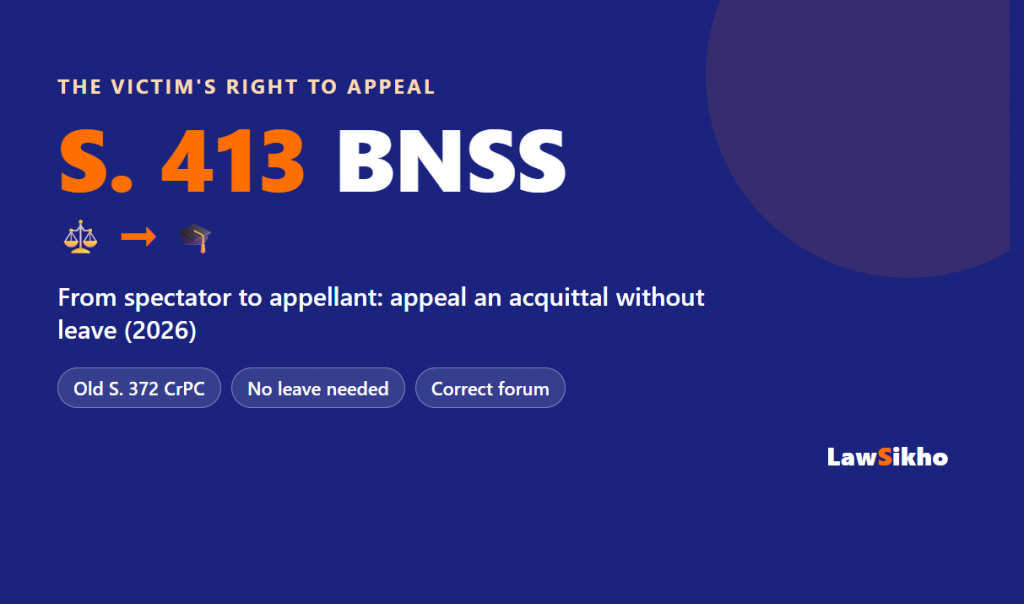
She did something the old Code never clearly allowed an ordinary victim to do on her own. She filed an appeal against the acquittal under Section 413 of the Bharatiya Nagarik Suraksha Sanhita, 2023 (BNSS), the provision that replaced Section 372 of the Code of Criminal Procedure, 1973 (CrPC). This was the victim’s right to appeal in action, exercised by the victim herself, without waiting for a public prosecutor to act for her.

Then came the hard questions. Did she need the court’s permission, what lawyers call leave, before she could even be heard? Which court should she go to: the Sessions Court, or straight to the High Court, and had she filed too late?
Subscribe to read the full article
Get unlimited access to every LawSikho blog post for just Rs 100.
Subscribe for Rs 100Already a subscriber? Log in




 Allow notifications