
Last verified: June 2026
A few years ago, members of a company secretaries’ discussion group spotted something that should not have been possible. The official source on independent directors, the IICA databank portal, was showing a confused exemption figure. The page muddled the director and KMP tenure thresholds, at a point when the relaxed three-year track had already come into force alongside the older ten-year one. For a working professional trying to figure out whether the independent director proficiency test exemption even applied to them, that one stale number was enough to send the whole decision off a cliff.
Think about who reads a page like that. A chartered accountant with twelve years behind her, wondering if she has to sit an online test to join a board. A finance director with four years at a listed company, unsure whether his experience counts. They land on a government-linked portal, trust the figure they see, and walk away with the wrong answer. If the official site can get it wrong, what hope do the dozens of secondary blogs have?
And that is the real problem here. The exemption rules were relaxed twice, once in 2020 and again in 2021. Most of the content floating around the internet never caught up. Search this topic today and you will still find pages quoting a 60% pass mark and a one-year window to clear the test, and many present a ten-year director tenure as the only way to escape it. The pass mark and the window are simply outdated. The ten-year director route still exists, but a far easier three-year track now sits beside it, and most pages miss that. The current numbers are different, and the gap between what is published and what is true has been costing qualified people real clarity for years.

So here is the question that actually matters to you. Am I exempt, and if I am, what do I do to claim it? Not the syllabus. Not the registration steps. Just the one thing: does the rule let me skip the test, and how do I make the portal recognise that? This post answers exactly that, keyed to the figures that apply in 2026, sourced rather than guessed.
There is one trap that catches even people who genuinely are exempt. They assume that being exempt from the test means they can skip the whole databank process. It does not. That single misunderstanding is responsible for more confusion than any threshold number, and it is the first thing we settle below. Get that one distinction right and most of the rest falls into place. Get it wrong and you can be exempt on paper yet still ineligible for appointment.
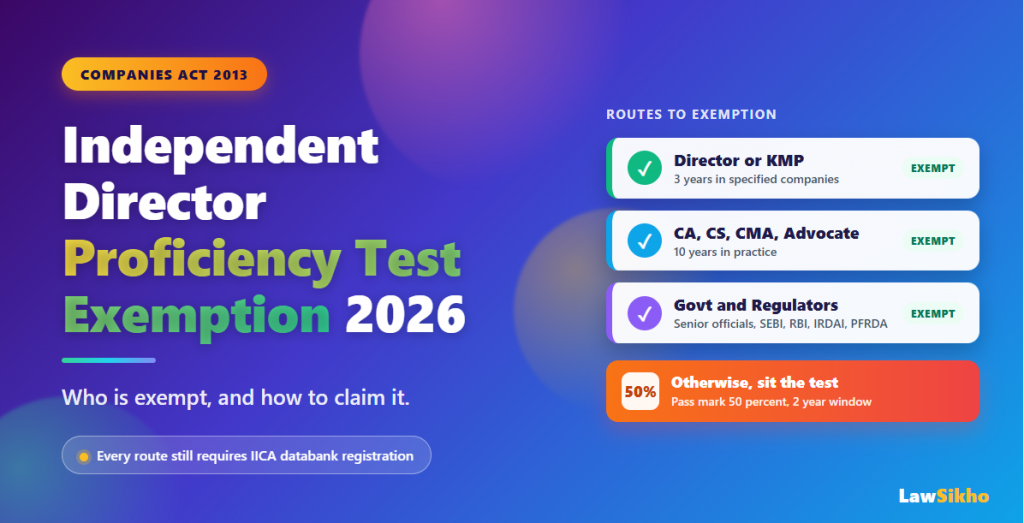
Two groups are exempt from the independent director online proficiency self-assessment test (OPSAT): directors or KMPs with at least three years’ service in specified companies, and advocates, CAs, CSs, or cost accountants with at least ten years in practice. Critically, exemption waives only the test. Every independent director must still register on the IICA databank.
That last point is where most people go wrong, so it is worth settling before anything else. The sections below move from the core misconception, through who qualifies and how to prove it, to the exact steps for claiming the waiver and what happens if you are not exempt at all.
Exemption waives the test, not databank registration: the #1 misconception
Here is the single most important sentence in this entire post: the exemption applies only to the OPSAT test, not to databank registration. If you qualify for any exemption category, you do not have to sit the online proficiency self-assessment test. You still have to enter your name and details in the independent directors databank. There is no exemption from that. As the official position puts it, no exemption has been provided from the requirement of entering one’s name and details in the databank.
Why do so many people conflate the two? Because both requirements arrived together. The same set of rules that introduced the databank under Section 150 of the Companies Act, 2013 also introduced the proficiency test, so it feels natural to assume that escaping one means escaping both. It does not work that way. Registration is the gate; the test is a separate hurdle inside that gate, and only the hurdle is waived for some people.
What the exemption actually does (and does not do)
The exemption does one thing: it removes the obligation to clear the self-assessment test. That is the whole of it. It does not register you automatically. It does not confirm that you meet the independence criteria under Section 149(6) of the Companies Act, 2013. And it certainly does not mean a company can appoint you without your name appearing in the databank first.
So what does this mean for you in practice? Even if you are a CA with twenty years of practice, or a director who has spent a decade on listed boards, your first action is the same as everyone else’s: register on the databank. We do not re-teach that process here, because it is a topic in its own right. If you need the account-creation, fees, and portal walkthrough, follow the guide that does it properly and complete the databank registration walkthrough before you worry about the test at all.
Does test exemption make you appointment-ready?
The trap, then, is assuming exemption equals appointment-ready. It doesn’t. A person can be perfectly exempt from the test and still be ineligible to be appointed, simply because they never registered. The exemption is a convenience, not a shortcut around the system. If you are mapping out where this fits in the larger sequence of becoming a board member, it helps to see the full pathway to becoming an independent director laid out end to end, with this exemption sitting as one step inside it.
A common question practitioners raise is whether the exemption ever expires or has to be re-confirmed. The short answer is that the exemption attaches to your category, not to a calendar; we cover what happens at renewal and when your category changes in the claim-mechanics section below. For now, the takeaway is simple. Register first. Worry about the test second. And never assume the two are the same decision.
Who is exempt from the proficiency test? The exemption categories (2026)
Who actually gets to skip the online proficiency self-assessment test? Exemptions fall into two broad tracks, plus a set of government and regulator sub-categories. The first track is for people with director or KMP experience. Here there are two doors: a three-year route in a defined set of companies, and an older ten-year route in a narrower set. The second track is for professionals in long-standing practice: ten years as an advocate, chartered accountant, company secretary, or cost accountant. Meet the conditions of any one of these and the test is waived. You only ever need to satisfy one.
That is the framing most competitor pages never state cleanly. They list categories in a wall of text and leave you to figure out which door is yours. The point worth holding onto is that these are alternative routes, not cumulative requirements. A ten-year advocate does not also need three years as a director. A long-serving KMP does not need a professional qualification. Either path, on its own, is enough.
The table below sets out the categories side by side so you can locate yourself quickly. Note the source column: every limb here traces back to Rule 6 of the Companies (Appointment and Qualification of Directors) Rules, 2014, framed under Section 150 of the Companies Act, 2013.
| Category | Who qualifies | Minimum tenure | Entity or pay-scale scope | Source |
|---|---|---|---|---|
| Director / KMP track (3-year) | Anyone who has served as a director or KMP | At least 3 years (in aggregate) | Listed public company; unlisted public company with paid-up capital ₹10 crore or more; body corporate listed on a recognised exchange in a FATF-member State; foreign-incorporated body corporate with paid-up capital US$2 million or more; statutory corporation under a Central or State Act carrying on commercial activity | Rule 6(4), AOQD Rules 2014 |
| Director / KMP track (10-year) | Anyone who has served as a director or KMP | At least 10 years | Listed public company; or unlisted public company with paid-up capital ₹10 crore or more | Rule 6(4), AOQD Rules 2014 |
| Professional track | Advocate, CA, CS, or cost accountant in practice | At least 10 years | In practice in that profession | Rule 6(4), AOQD Rules 2014 |
| Central / State government officers | Officers in the pay scale of Director or equivalent or above, with relevant experience in commerce, corporate affairs, finance, industry, public enterprises, or government-company affairs | No minimum tenure stated | Central or State Government ministry or department | Rule 6(4), AOQD Rules 2014 |
| MCA / Finance / Commerce / Heavy Industries seniors | Officers in the pay scale of Director or above, with experience in corporate, securities, or economic laws | No minimum tenure stated | Ministry of Corporate Affairs, Finance, Commerce and Industry, or Heavy Industries and Public Enterprises | Rule 6(4), AOQD Rules 2014 |
| Financial-sector regulators | Chief General Manager or above with relevant regulatory experience | No minimum tenure stated | SEBI, RBI, IRDAI, or PFRDA | Rule 6(4), AOQD Rules 2014 |
The 3-year director and KMP track
This is the broad, most-used exemption, and it is the one most secondary pages get wrong on the numbers. You qualify if you have served, in aggregate, for at least three years as a director or as key managerial personnel in any one of a defined set of entities.
Which entities count? A listed public company does. So does an unlisted public company, but only if its paid-up share capital is ₹10 crore or more. A body corporate listed on any recognised stock exchange in a country that is a member of the Financial Action Task Force counts too, as does a body corporate incorporated outside India with paid-up share capital of US$2 million or more. Finally, a statutory corporation set up under an Act of Parliament or a State Legislature and carrying on commercial activities qualifies. This is the three-year limb of Rule 6(4) of the Companies (Appointment and Qualification of Directors) Rules, 2014.
There is a second director and KMP door alongside this one, and it is the route the older guides describe. If you have served, in aggregate, for at least ten years as a director or KMP in a listed public company, or in an unlisted public company with paid-up share capital of ₹10 crore or more, you are also exempt. This ten-year limb is narrower on entity scope than the three-year limb (it does not extend to the FATF-listed, foreign US$2 million, or statutory-corporation entities), but it remains live in the current rule. For most people the three-year track is the easier door, which is exactly why surfacing only the ten-year figure, as so many stale pages do, talks qualified candidates out of an exemption they hold.
Picture a working director of a mid-sized listed company in Mumbai who’s sat on the board for four years. That person is squarely within this track, no professional qualification required. The same goes for a chief financial officer (a KMP under the Act) of an unlisted public company whose paid-up capital crosses the ₹10 crore line. The experience does not have to be glamorous; it has to be in a qualifying entity, for the qualifying length, in a qualifying role.
Does private limited company experience count? No. The list is specific, and a private limited company isn’t on it unless it happens to fall within one of the named limbs (which, by definition, it doesn’t as a plain private company). The same caution applies to foreign directorships: they count only where the overseas body corporate meets the US$2 million paid-up threshold or the FATF-member-listing condition. A directorship in a small foreign entity below that line does not get you there.
The 10-year professional track
This is the category most people search for, and the one most often confused with the three-year track. You qualify if you have been in practice for at least ten years as an advocate of a court, a chartered accountant in practice, a cost accountant in practice, or a company secretary in practice. That is it. No company-size thresholds, no entity scope to worry about. The variable that matters is the length and continuity of your practice.
The word “in practice” is doing real work here. A chartered accountant who qualified twelve years ago but spent most of that time in a salaried, non-practising role is in a grey zone that the professional track was not obviously written for. What experienced practitioners watch for is the practising-membership record, the certificate of practice, the bar enrolment, the institute membership in good standing, because that record is what evidences the ten years cleanly. The clearer your continuous-practice paper trail, the easier this track is to prove.
And worth flagging: this track is what AI Overviews and most thin pages surface first, which is exactly why so many readers think professionals are the only people who get exempted. They are not. The director and KMP track sits right alongside it and catches a far larger population of working operators.
Government and regulator categories
Beyond the two main tracks, the rule carves out exemptions for certain public servants and regulators, and none of these limbs carries a stated minimum number of years. Broadly, a person who has held office in the pay scale of Director or equivalent or above in a Central or State Government ministry or department, with relevant experience in commerce, corporate affairs, finance, industry, or public enterprises (or in the affairs of a government company or statutory corporation), falls within this group. So does a senior officer in the pay scale of Director or above in the Ministry of Corporate Affairs, the Ministry of Finance, the Ministry of Commerce and Industry, or the Ministry of Heavy Industries and Public Enterprises, with experience in corporate, securities, or economic laws.
Financial-sector regulators get their own limb. A person who has served as a Chief General Manager or above in the Securities and Exchange Board of India, the Reserve Bank of India, the Insurance Regulatory and Development Authority of India, or the Pension Fund Regulatory and Development Authority, with relevant regulatory experience in corporate, securities, or economic laws, is exempt from the test.
A note on a point that trips up readers of older guides. A separate ten-year director and KMP limb does exist in the current rule, distinct from the three-year track and from the ten-year professional track. It is narrower on entity scope, covering ten years of service as a director or KMP in a listed public company or an unlisted public company with paid-up capital of ₹10 crore or more. The thing to understand is that this older route was never removed; the 2020 amendment added the easier three-year track beside it. So you now have, on the director and KMP side alone, two valid doors: three years in the wider set of entities, or ten years in the narrower set. Pick whichever you satisfy.
A frequent community question is whether anyone other than a prospective independent director needs this test at all. The answer sharpens the whole topic: the OPSAT requirement is built specifically around the independent directors databank, so it is the people heading for independent directorships who face it. If you want to see how that role sits against other board positions, it helps to understand how independent directors differ from other board members, because the test obligation is one of the practical lines that separates them.
3-year director track vs 10-year professional track: which applies to you?
Is it three years or ten? This is the single most common point of confusion, and the answer is cleaner than the noise suggests. The two doors most people are choosing between are the three-year director and KMP route and the ten-year professional-practice route. Three years is the director and KMP figure for the wider set of qualifying entities. Ten years is the professional figure for advocates, CAs, CSs, and cost accountants.
They are separate doors, you walk through whichever one you satisfy, and satisfying either is enough. You never need both. There is also the narrower ten-year director and KMP route covered above, but for most working people the comparison that matters is three-year-director versus ten-year-professional.
So why does everyone mix them up? Mostly because thin content lists “three years” and “ten years” in the same breath without saying which attaches to which population. A reader skims, sees two numbers, and assumes one of them is a typo or that both apply at once. Neither is true. The figures map to different kinds of experience, and you only ever need to satisfy one limb.
If you are a professional who is also a director
Plenty of people sit in both camps. A chartered accountant who has also served on a board. A company secretary who later became a KMP. If that’s you, here is the good news: you qualify under whichever track you satisfy first, and you don’t have to meet both. A CA with eleven years of practice is exempt on the professional track even if she has only spent two years as a director. A CS with fifteen years’ practice doesn’t suddenly need three years on a board.
In practice, this means you should claim the track you can prove most cleanly, not the one that feels most impressive. If your ten years of practice are easy to document, lead with the professional track. If your director tenure in a qualifying company is the cleaner record, lead with that. The rule does not reward you for over-qualifying; it just needs one satisfied limb.
Which track is easier to evidence
The real question, for most people, is not “which track do I qualify for” but “which track can I prove without friction.” And the two tracks differ sharply on that. The professional track is generally the easier to evidence, because a single document usually does the job: your bar enrolment certificate, your ICAI, ICSI, or ICMAI membership record, or your certificate of practice. These are dated, institutional, and hard to dispute.
The director and KMP track takes more assembling. You are typically proving tenure through appointment letters, board resolutions, DIR-12 filings, and the company’s own records, and you may need to stitch together service across more than one qualifying entity to reach three years. The better approach, in our view, is to pull these records together before you start the claim rather than scrambling for them mid-process. A common question we see is whether part-time or overlapping service counts, and that is exactly where the edge cases below earn their keep.
The legal framework: Rule 6(4), Section 150, and the governing notifications
Section 150 and Rule 6(4): the authority chain
Which rule actually governs this exemption? The authority chain runs in three links. It starts with Section 150 of the Companies Act, 2013, which creates the databank and the qualification machinery for independent directors. That section is operationalised by Rule 6 of the Companies (Appointment and Qualification of Directors) Rules, 2014. And the exemption list itself, the part you care about, lives in Rule 6(4) and its provisos.
Why does the precise citation matter to a reader rather than just a lawyer? Because the figures you find online are only as trustworthy as the version of the rule they were copied from. The thresholds in Rule 6(4) were amended, and an article written against the pre-amendment text will confidently quote numbers that are no longer law. When you can name the governing provision, you can check any figure against the current consolidated rule instead of trusting a reprint.
The amendment trail
The current shape of Rule 6(4) is the product of two relaxations. The Companies (Appointment and Qualification of Directors) Fifth Amendment Rules, 2020, notified by G.S.R. 774(E) dated 18 December 2020, did the heavy lifting: it dropped the pass mark to 50%, extended the window to clear the test to two years, and introduced the three-year director and KMP track that so much of this post turns on. A further amendment in 2021, notified by G.S.R. 579(E) dated 19 August 2021, broadened the professional exemption to advocates, chartered accountants, cost accountants, and company secretaries with at least ten years in practice, and clarified the government and regulator limbs. The original December 2019 regime was markedly stricter, and these two notifications softened it within about eighteen months. Later amendments to these rules, in 2022 through 2025, dealt with KYC, forms, and the restoration of removed names, not the 50% pass mark, the two-year window, or the three-year and ten-year exemption tracks, which remain in force in June 2026.
That two-step history is precisely why dated secondary content is so unreliable on this topic. A page published in early 2020 was correct when written and wrong within a year. A page that copied an even older notification was wrong from the start. The only safe reference point is the consolidated current text of the rule plus the amendment notifications that produced it.
How to claim the exemption on the IICA portal
Knowing you are exempt is half the job. Making the portal recognise it is the other half, and this is where the informational question turns transactional. The exemption is not something you apply for in the abstract; it is something you assert during your databank profile, after which the system treats the test as available but not compulsory for you. Here is the sequence.
- Confirm which exemption limb you fall under, using the categories and the three-year-versus-ten-year distinction above. You need to know your door before you knock on it.
- During databank profile creation or update, select the applicable exemption category in your profile. This is the step that tells the system which limb you are claiming.
- Upload the supporting proof for that limb. For the professional track, that typically means your bar enrolment or your ICAI, ICSI, or ICMAI membership or practice certificate. For the three-year director and KMP track, that typically means appointment letters and board records evidencing qualifying service. The official FAQ does not spell out the exact accepted documents for each limb, or whether the system validates them automatically, so confirm the document list for your limb with the IICA helpdesk before you submit.
- Confirm that your profile then shows the proficiency test as accessible but not mandatory. Per the official FAQ wording, exempt persons will be able to access and take the test, but it is not mandatory for them.
That fourth step matters more than it looks. Exempt doesn’t mean the test vanishes from your screen; it means the test stops being a gate. If you can still see the test, that’s expected. What you are checking is that the system no longer treats clearing it as a condition of staying in the databank.
Is the exemption applied automatically or self-declared?
This is one of the most-asked questions, and an honest answer beats a confident guess. The position we can confirm is that the exemption is tied to what you select and declare in your profile, with supporting proof. Whether the system auto-validates your professional membership behind the scenes or relies purely on your declaration and uploaded documents is the kind of mechanical detail the official FAQ does not spell out. The authoritative route to confirm it for your specific case is the IICA databank helpdesk (1800-102-3145, or [email protected]), which exists precisely for these profile-level queries.
A quick note on fees, since it comes up often: the exemption is about the test obligation, not a separate paid product, so the question of “is there a fee difference if I’m exempt” turns on databank registration and membership, not on the test waiver itself. We do not cover the fee schedule here because it belongs with the registration walkthrough, not the exemption decision.
Do you re-claim at renewal or if your category changes?
The exemption attaches to your qualifying status, which raises two practical questions. First, do you re-assert it at renewal? Your profile and its declared category persist with your databank record, so the exemption is not a one-time token that evaporates; but your records should stay current and accurate at every renewal cycle. Second, and more interesting, what if your category changes? Suppose you claimed the professional track and then left practice, or you claimed the director track on the strength of an ongoing role that has since ended.
The honest position is that your declarations are supposed to reflect your actual status, so a material change in your category is something you should keep your profile honest about rather than ignore. The official FAQ does not spell out how the portal treats a mid-cycle category change, so if your situation is shifting, the helpdesk is again the right place to confirm what re-declaration, if any, the portal expects. The mistake to avoid is claiming a limb you no longer satisfy and assuming nobody will ever check.
Edge cases that trip people up
Most pages stop at the headline categories. But the real questions practitioners ask live in the edges: the overlapping roles, the near-misses, the service that happened years ago. This is where being exempt or not exempt actually gets decided for a lot of people, and where the thin competitor content goes silent. Let’s work through the ones that come up most.
The concurrent-directorship single-count rule
Here is a counting trap that catches people who should know better. If you served as a director or KMP in two or more companies at the same time, that overlapping period counts only once toward your three years. You cannot add the two roles together to manufacture six years out of three. The rule computes a single qualifying period, not a sum of concurrent appointments. In the words of the rule, any period during which an individual was acting as a director or KMP in two or more companies or bodies corporate or statutory corporations at the same time is counted only once.
Why does this matter so much? Because someone with three simultaneous directorships across three years might assume they have nine years of qualifying service and are comfortably exempt under any reading. In counting terms, they have three. That is still enough for the three-year track, so the outcome is fine here, but the same person reasoning their way toward a supposed ten-year limb on doubled-up math would be badly mistaken.
Partial tenure and the near-miss problem
“I have nine years as an advocate, surely that’s close enough?” It is not. The minimums are hard floors, not targets to round up to. Ten years means ten years for the professional track, and three years means three for the director track. There is no rounding, no “almost there” discretion built into the rule.
That said, aggregation can help you reach the floor honestly. The director track is measured in aggregate across qualifying entities, so service that is split across, say, a listed company and a qualifying unlisted public company can be combined to cross the three-year line (remembering the single-count rule for any overlap). What you cannot do is combine non-qualifying service, or part-time stints that never amounted to a genuine directorship or KMP role, to pad the number. The arithmetic is generous about combining real qualifying service and unforgiving about everything else.
KMP-only service and older directorships
Two related worries come up constantly. First, what if you were never a director, only a KMP? KMP service in a qualifying entity counts toward the three-year track in its own right; you don’t need a board seat to use this door. A long-serving company secretary or chief financial officer of a qualifying company can reach the threshold on KMP service alone. Second, does old service count, or only recent years? The rule asks for a total period of qualifying service reckoned as on the date your name is included in the databank, and it sets no recent-window cut-off. Pre-2019 directorship in a qualifying company therefore counts toward the total, provided the entity met the qualifying conditions for the relevant period. If your record relies heavily on decade-old service, keep the supporting documents clean, because that tenure is what you will be evidencing.
The pitfall in this corner is assuming the rules are stricter than they are and disqualifying yourself unnecessarily. We have seen capable KMPs assume they needed a formal directorship, and seasoned directors assume only their last few years counted. Both walked away from exemptions they likely held.
Can the exemption be revoked, and does it affect appointment?
Two final edge questions, both about the limits of what the exemption does. Can it be revoked or challenged later? The exemption rests on facts you declared (your tenure, your practice), so if those facts were misstated, the basis for the exemption is shaky, and you should expect your declarations to be accurate and defensible. The deeper point, flagged in professional commentary, is that enforcement and verification of these declarations sit in a somewhat ambiguous zone, which is all the more reason to claim only a limb you genuinely satisfy.
And does the exemption affect your eligibility to be appointed at all? No, and this is a crucial boundary. The exemption relates to the test, not to the broader independence criteria under Section 149(6) of the Companies Act, 2013. You can be fully exempt from the OPSAT and still fail to qualify as an independent director because of a disqualifying relationship or interest. Test exemption and appointment eligibility are two different assessments. Clearing one tells you nothing about the other.
If you are NOT exempt: what sitting the test involves
What if none of the doors above are yours? Then you sit the test, and the stakes are worth knowing precisely, because this is exactly where stale numbers do the most damage.
The current pass mark, window, and attempts
The current pass mark is 50% in aggregate, not the 60% figure that older pages still quote. You get a two-year window from the date your name is included in the databank to clear it, not the one year that pre-amendment content shows. And there is no cap on attempts: you can take the test as many times as you need within that window.
What happens if you miss the two-year window
The consequence of missing the window is the part people underestimate. If you do not clear the test within two years of your name being included in the databank, your profile is deleted permanently, regardless of whether you took a one-year, five-year, or lifetime membership, and you have to register all over again. That’s the real bite. It isn’t a gentle reminder; it’s a reset.
This is where the “I registered but didn’t realise the clock was ticking” trap lives. A non-exempt appointee who registers, assumes the test is optional, and lets two years drift by does not get a warning so much as a deletion. The window starts running from databank inclusion, not from some later convenient date, so the time to plan your attempt is at registration, not in year two.
We deliberately stop at the stakes here, because preparation is its own subject and we won’t duplicate it. If you are non-exempt and need to actually clear the test, the right next step is to learn how to prepare for the proficiency test, which covers the syllabus, pattern, and study approach in the depth they deserve. Treat the figures above as your deadline math, and treat that guide as your preparation plan.
What changed in 2026, and why old guides mislead you
Why do you keep seeing different pass marks and time windows on different sites? Because the rules moved and most content did not. This section is the freshness check: the current figures, the history that produced them, and a frank account of why so much of what ranks for this topic is simply out of date.
Then vs now
When the proficiency test regime came into force in December 2019, it was strict. The original settings were a 60% pass mark, a one-year window to clear the test, and a ten-year tenure as the director route out of it. Within about eighteen months, the demanding dials had been loosened. The 2020 Fifth Amendment cut the pass mark to 50%, doubled the window to two years, and added the three-year director track beside the existing ten-year one; the 2021 amendment broadened the professional and regulator exemptions. The table makes the shift concrete.
| Parameter | Original (Dec 2019) | Current (2026) |
|---|---|---|
| Pass mark | 60% aggregate | 50% aggregate |
| Window to clear the test | 1 year from databank inclusion | 2 years from databank inclusion |
| Director / KMP exemption tenure | 10 years only | 3 years (wider entity set) or 10 years (narrower set) |
| Attempts | Limited | Unlimited within the window |
Why so many sources are wrong
The mechanics of stale ranking explain the mess. A page that quoted the December 2019 regime was accurate on its publication date and never revised. Search engines kept ranking it because it had aged into authority, links, and traffic, none of which update when the underlying law does. So a reader in 2026 lands on a confident 2020 article quoting 60% and one year, with no visible signal that the numbers expired. That is how even the official IICA databank could, at one point, surface an outdated exemption figure, which is the very episode that opened this post.
The fix is not cleverness; it is dating. The reason a correctly dated, sourced page earns outsized trust on a topic like this is precisely that the niche is polluted with un-dated reprints. Frankly, this gets overlooked: when every competing page is silent about which version of the rule it reflects, the page that says “current as of 2026, here is the governing notification” wins on credibility alone.
Future outlook
A few forward signals are worth naming, with the caveat that these are outlook, not law. The broader governance push under the SEBI LODR framework is likely to keep funnelling more professionals into the databank, which means exemption queries are likely to rise, not fall. Practitioners expect that proof of professional membership could eventually be auto-validated through institute linkages (ICAI, ICSI, ICMAI), reducing the manual-declaration friction described above, though there is no confirmed mechanism for that yet. And continued pressure on the independent-director talent pool may prompt further broadening of the exemption categories over time. Read all three as informed speculation to monitor, not as anything you can rely on today.
There is a quieter second-order effect hiding in the three-year track. By making three years of director or KMP service enough, the rule quietly converts a large pool of working operators, ex-promoters, and KMPs into exempt candidates, not just the long-practising professionals everyone pictures. Over time, that nudges the demographic of who actually becomes an independent director toward people with operating experience, which is a subtle but real consequence of a threshold change that looks purely administrative.
Frequently asked questions
Who is exempt from the independent director proficiency self-assessment test? Two main groups. People with director or KMP experience, either three years in a wider set of specified companies (listed public companies, larger unlisted public companies, and certain foreign and statutory bodies) or ten years in a narrower set (a listed or larger unlisted public company), and professionals with at least ten years in practice as an advocate, CA, CS, or cost accountant. Certain senior government officers and financial-sector regulators are also exempt. Everyone exempt must still register on the databank.
Proficiency test versus databank registration: what is the difference? Registration is mandatory for every prospective independent director and means entering your name and details in the IICA databank. The proficiency test is a separate online self-assessment that some registrants must clear. Exemption removes the test obligation only. It never removes the registration requirement.
What is the current pass mark, 50% or 60%? It is 50% in aggregate. The 60% figure is the original pre-amendment number from the December 2019 regime and is no longer current. If a source still quotes 60%, it has not been updated since the 2020 relaxation.
Are CAs, CSs, CMAs, and advocates exempt from the proficiency test? Yes, provided they have been in practice for at least ten years in their profession. The exemption covers advocates of a court, chartered accountants in practice, company secretaries in practice, and cost accountants in practice. The qualifying variable is continuous practice, not just holding the qualification.
How many years of practice do professionals need, is it 10 years? Yes. The professional track requires not less than ten years in practice. Nine years does not qualify; the minimum is a hard floor, not a figure to round up to.
Does experience in an unlisted public company count, and what paid-up capital is required? It can. An unlisted public company counts toward the three-year director and KMP track only if its paid-up share capital is ₹10 crore or more. Below that threshold, the unlisted public company experience does not qualify on its own.
Are government officers exempt from the test? Certain senior officers are. Broadly, officers in the pay scale of Director or equivalent or above in a Central or State Government ministry, with relevant experience in commerce, corporate affairs, finance, industry, or government-company affairs, fall within the exemption. Confirm the exact qualifiers against the current rule for your specific post.
Are SEBI, RBI, IRDAI, or PFRDA officials exempt? Senior regulatory officers are. A person who has served as Chief General Manager or above in SEBI, RBI, IRDAI, or PFRDA, with relevant regulatory experience, is within the exemption. As with the government category, verify the precise seniority and experience conditions against the governing rule.
Do I still need to register on the databank if I am exempt from the test? Yes, without exception. Exemption waives only the proficiency test. Registration and empanelment in the databank remain mandatory for everyone who wants to be appointed as an independent director, exempt or not.
How do I claim the exemption on the IICA portal? You assert it through your databank profile: confirm your exemption limb, select that category during profile creation or update, upload the supporting proof for that limb, and confirm the system then treats the test as accessible but not mandatory. For limb-specific document queries, the IICA helpdesk is the authoritative route.
What proof or documents do I need to upload to claim exemption? For the professional track, typically your bar enrolment or institute membership or practice certificate. For the three-year director and KMP track, typically appointment letters and board records evidencing qualifying service. The exact accepted documents and whether they are auto-validated or self-declared should be confirmed with the IICA helpdesk before you submit.
Which MCA notification or Rule governs the exemption? The exemption lives in Rule 6(4) of the Companies (Appointment and Qualification of Directors) Rules, 2014, framed under Section 150 of the Companies Act, 2013. The current thresholds reflect the Companies (Appointment and Qualification of Directors) Fifth Amendment Rules, 2020 and a further 2021 amendment.
Is it 3 years or 10 years for the director/KMP exemption? Both exist as separate director and KMP routes. Three years qualifies you if the service is in the wider set of entities (listed public company, unlisted public company with paid-up capital of ₹10 crore or more, FATF-listed body corporate, foreign body corporate with US$2 million paid-up capital, or a commercial statutory corporation). Ten years qualifies you through the narrower set (a listed public company, or an unlisted public company with paid-up capital of ₹10 crore or more). Separately, ten years in practice as an advocate, CA, CS, or cost accountant is the professional route. You only need to satisfy one of these.
Why do different websites show different pass marks and time windows? Because the rules were relaxed in 2020 and 2021, and a lot of older content was never updated. Pages quoting 60% and a one-year window reflect the original December 2019 regime. The current figures are 50% and a two-year window. Always check the date and the governing notification behind any figure.
How long do I get to pass the test, one year or two years? Two years from the date your name is included in the databank. The one-year window is the original pre-amendment figure and no longer applies.
How many attempts do I get? There is no limit on the number of attempts within the two-year window. You can take the test as many times as you need to reach the 50% aggregate before the deadline.
What happens if I do not pass within two years? Your databank profile is deleted permanently, regardless of the membership tenure you chose, and you must register again from scratch. The two-year clock runs from databank inclusion, so it is easy to lose track of if you assume the test is optional.
If I served as a director in two companies at once, do those years double-count? No. Service in two or more companies simultaneously is counted only once for the qualifying period. You cannot add overlapping roles together to inflate your total, though you can aggregate non-overlapping service across qualifying entities.
References
Statutes
- Section 150, Companies Act, 2013. Databank and qualification machinery for independent directors.
- Rule 6, Companies (Appointment and Qualification of Directors) Rules, 2014. In particular Rule 6(4) and its provisos and Explanation (exemptions, 50% pass mark, two-year window).
Notifications
- Companies (Appointment and Qualification of Directors) Fifth Amendment Rules, 2020, notified by G.S.R. 774(E) dated 18 December 2020. Reduced the pass mark to 50%, extended the window to two years, and introduced the three-year director/KMP exemption track.
- Companies (Appointment and Qualification of Directors) Amendment Rules, 2021, notified by G.S.R. 579(E) dated 19 August 2021. Introduced the ten-year exemption for advocates, chartered accountants, cost accountants, and company secretaries in practice.
Case Law
N/A: regulatory topic, no case law.
This article is for informational purposes only and does not constitute legal advice. For specific legal guidance, consult a qualified legal professional.




 Allow notifications