
Last verified: 2026-06-24
In August 2020, an Indian retail conglomerate announced that it would sell its retail business to a rival conglomerate’s retail arm for roughly Rs 24,713 crore. It was the kind of deal that reshapes a sector. But one shareholder was furious. A global e-commerce investor, which held a minority stake in a promoter entity of the retail group, believed the sale breached contractual rights it had negotiated years earlier. So it did something that still surprises practitioners new to arbitration: it did not run to an Indian court for an injunction. It rushed instead to an emergency arbitrator at a Singapore arbitral institution. That single forum choice sits at the heart of Section 9 and Section 17 of the Arbitration and Conciliation Act, 1996, and the question of where you go for urgent interim relief.
On 25 October 2020, the emergency arbitrator issued an interim order restraining the mega-deal. Here’s what made it explosive: that order came from a private, tribunal-side decision-maker sitting abroad, not from an Indian judge. The side that wanted the deal to proceed argued the order was worthless in India. Their reasoning sounded technical but cut deep. Indian law, they said, recognised only court-granted interim relief under Section 9 and tribunal-granted interim relief under Section 17, with no statutory slot anywhere for a creature called an “emergency arbitrator”. If the law had no box to put the order in, how could anyone enforce it?
The fight climbed all the way to the Supreme Court of India. And in August 2021, the Court gave an answer that every arbitration practitioner now has to know. It held that the emergency arbitrator’s order was, in substance, an order under Section 17 of the Arbitration and Conciliation Act, 1996, and that it was enforceable under Section 17(2) as if it were an order of a court. The ruling in Amazon.com NV Investment Holdings LLC v. Future Retail Ltd., (2022) 1 SCC 209 did not invent a new remedy. It mapped a real-world commercial order onto the existing Section 9 and Section 17 architecture, and in doing so confirmed how much teeth tribunal-side interim relief now carries.

Strip away the billions and the headlines, and what’s left is the everyday question that lands on a junior advocate’s desk on a Friday evening. A client’s counterparty is about to dissipate assets, sell disputed property, or breach an exclusivity clause. You need urgent protection. Do you race to the court under Section 9, or move the tribunal under Section 17? And once you pick, will the order you win actually hold when the other side ignores it? This guide answers exactly that, with a side-by-side comparison table and a decision framework you can use the next time the clock is running.
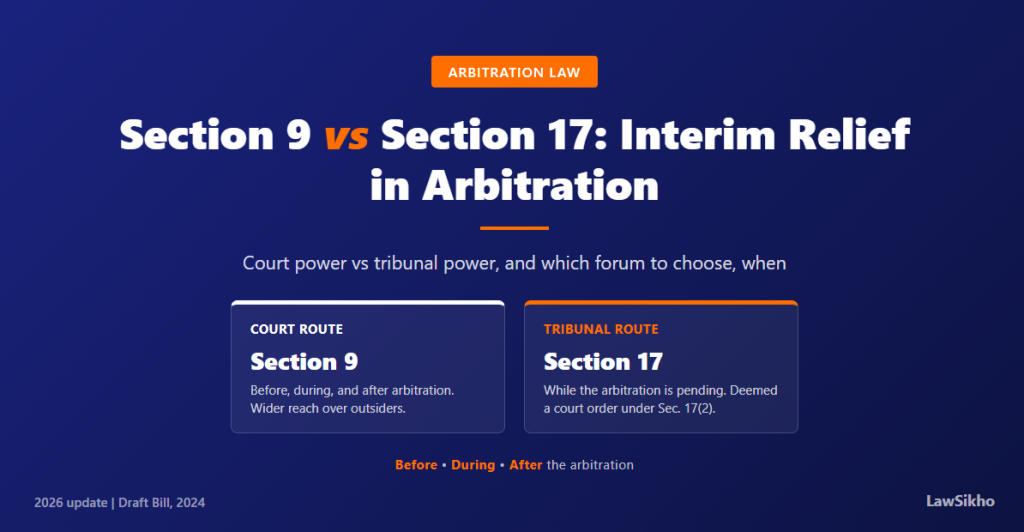
Section 9 of the Arbitration and Conciliation Act, 1996 lets a party seek interim relief from a court before, during, or after arbitration (until the award is enforced). Section 17 lets the arbitral tribunal grant the same interim measures, but only while the arbitration is pending. Since 2015, a Sec. 17 order is enforceable like a court order.
That one-paragraph answer is the spine of the whole comparison. The sections below unpack each route in turn, lay out where they overlap and where they part ways, and end with a practical decision tree for choosing the right forum at the right moment.
Section 9 and Section 17: court power vs tribunal power
Why does a litigant need interim protection at all? Because a final award, however favourable, is useless if the asset it was meant to secure has vanished. Arbitration takes time. During that time, a determined counterparty can sell the disputed flat, transfer money offshore, dismantle plant and machinery, or breach the very obligation in dispute. Interim relief is the legal seatbelt that keeps the dispute worth fighting until the tribunal can decide it.
The Act gives a party two doors to that protection, and understanding the split between them is half the battle. One door opens to a court. The other opens to the tribunal itself.
Section 9 in one line: interim relief from the court
Section 9 of the Arbitration and Conciliation Act, 1996 empowers a court to grant interim measures of protection in aid of arbitration. Think of it as borrowing the coercive muscle of the judicial system for an arbitral dispute. A party can ask the court to secure the amount in dispute, restrain a transfer, appoint a receiver, or preserve property, and the court issues that order with all the force a court order carries.
Section 17 in one line: interim relief from the tribunal
Sec. 17 lets the arbitral tribunal grant the same broad menu of interim measures, but it acts in its own name, within the arbitration it is conducting. Before 2015, this power was real but largely toothless. After 2015, a tribunal’s interim order stands on near-equal footing with a court’s (we’ll get to exactly how that works in the enforcement section below).
Why two routes exist
So why not just have one? The architecture reflects a basic asymmetry of power. Courts have always carried inherent coercive authority over everyone within their jurisdiction. A tribunal, by contrast, is a creature of party consent: it exists only because the parties agreed to it, and its authority runs only to those parties. The two-route design exists so that a party can get urgent relief whether or not a tribunal is up and running yet, and whether the threat comes from inside the arbitration or from a stranger to it. In practice, that timing difference (court power exists from day one; tribunal power only once the tribunal is born) is the single biggest reason the two sections are not interchangeable.
Section 9 vs Section 17: the head-to-head comparison
If you remember one section of this guide, make it this one. The most common mistake junior practitioners make is treating Section 9 and Section 17 as the same remedy with a different letterhead. They are not. They differ on forum, on timing, on reach over outsiders, and (historically) on enforceability. Here’s the comparison laid out the way a senior disputes lawyer carries it in their head.
| Factor | Section 9 (Court) | Section 17 (Tribunal) |
|---|---|---|
| Forum | A court, as defined in Sec. 2(1)(e) of the Act | The arbitral tribunal hearing the dispute |
| When available | Before arbitration begins, during the arbitration, and after the award until it is enforced | Only while the arbitration is pending (tribunal constituted, award not yet enforced) |
| Stage of proceedings | Pre-arbitration, mid-arbitration, post-award (pre-enforcement) | Mid-arbitration only |
| Scope of powers | Full menu: injunction, securing the amount in dispute, receiver, preservation, interim custody, securing evidence | Broadly the same menu post-2015; Sec. 17(1) mirrors Sec. 9 powers |
| Against third parties / non-signatories | Wider reach; a court can bind parties outside the arbitration agreement | Limited; a tribunal binds only parties to the arbitration |
| Enforceability | Enforceable as a court order in the ordinary way | Deemed an order of the court and enforceable under the CPC by virtue of Sec. 17(2) (post-2015) |
| Appeal route | Appeal lies under Sec. 37(1)(b) | Appeal lies under Sec. 37(2)(b) |
| Timing / urgency suitability | Best when no tribunal exists yet, or when coercive reach over outsiders is needed | Best once the tribunal is functional and the target is a party to the arbitration |
Where they overlap
The overlap is bigger than most people expect, and that’s deliberate. Both a court under Section 9 and a tribunal under Section 17 can grant an interim injunction, order attachment or securing of the amount in dispute, direct preservation of property, appoint a receiver, and order interim custody. After the 2015 amendment equated the powers, the catalogue of reliefs is essentially shared. If you are asking “can the tribunal even grant this?”, the answer for the standard interim measures is almost always yes.
Where they diverge
The divergences are where cases are won and lost. Section 9 has three things Section 17 structurally cannot match. First, it operates in the pre-arbitration window, before any tribunal exists. Second, it survives into the post-award window, up to enforcement. Third, it carries coercive reach over non-parties, because a court’s authority does not depend on anyone’s consent.
Pulling the other way, Sec. 9(3) restricts court access once the tribunal is constituted (that fault-line gets its own section below). In short: Section 9 is wider in time and reach; Section 17 is the natural home once the tribunal is alive and the dispute stays among the parties.
Which is stronger?
A common question, and the honest answer disappoints people who want a winner. Neither section is universally stronger. Asking “which is stronger?” is like asking whether a wrench is stronger than a screwdriver. The better question is which tool fits the stage you’re at and the target you’re aiming at.
A court order under Section 9 carries broader reach and works before a tribunal exists. A tribunal order under Section 17 is faster to obtain once the tribunal is seized, and post-2015 it enforces almost as readily. The right answer is situational, which is exactly why this guide ends with a decision framework rather than a verdict.
When can a court grant interim relief under Section 9?
The defining feature of Section 9 is its timing flexibility. A court can grant interim relief at three distinct moments in the life of a dispute, and knowing which window you’re standing in changes everything about your strategy.
Before arbitration begins: the pre-arbitration window
You can approach the court for Section 9 relief even before a single arbitral notice has been served, provided a valid arbitration agreement exists and you genuinely intend to arbitrate. This was settled long ago. In Sundaram Finance Ltd. v. NEPC India Ltd., (1999) 2 SCC 479, the Supreme Court confirmed that a court can grant interim relief under Section 9 before arbitral proceedings have formally commenced, so long as the applicant manifestly intends to take the dispute to arbitration. That 1999 ruling is foundational: it created the pre-tribunal safety net that Section 17, by its nature, can never provide. The historical significance is worth pausing on, because for over two decades it has anchored the rule that urgent relief should not have to wait for the slow machinery of constituting a tribunal.
The 90-day trap under Section 9(2)
Here’s a pitfall that competitors mention but almost never explain. If you obtain pre-arbitration relief under Section 9, Sec. 9(2) requires you to commence the arbitration within 90 days of the order (or within such further time as the court may allow). Miss that window, and your hard-won interim order lapses. The relief was always meant as a bridge to arbitration, not a substitute for it. We see this trip up parties who treat a favourable Section 9 order as the end of the fight rather than the beginning, then watch their protection evaporate because no arbitral notice went out in time.
During the arbitration, and the Section 9(3) restriction
Once the tribunal is constituted, Section 9 doesn’t simply switch off, but it does get restricted. Sec. 9(3) says a court “shall not entertain” a Section 9 application after the tribunal is constituted, unless the Section 17 remedy would be inefficacious. This is the single most litigated timing question in the whole comparison, and it deserves its own treatment (we break down the “entertain” doctrine and the inefficacious-remedy escape hatch in the Section 9(3) fault-line section below).
After the award but before enforcement
Section 9 has a long tail. Even after the tribunal has delivered its award, a party can seek Section 9 relief right up until the award is enforced as a decree under Sec. 36 of the Act. Why would you need it then? Because the gap between winning an award and actually executing it is exactly when a losing party is most tempted to move assets beyond reach. The post-award Section 9 window keeps the award worth something while you convert it into a recoverable decree.
Foreign-seated arbitrations
Can you use Section 9 when the seat of arbitration is abroad? Yes, unless the parties have agreed to exclude it. The proviso to Sec. 2(2) of the Act extends Section 9 to international commercial arbitrations seated outside India, unless the parties expressly or impliedly opt out. So an Indian party in a Singapore-seated arbitration can still ask an Indian court to secure assets located in India, which is precisely the kind of cross-border reach a foreign tribunal struggles to project onto Indian soil.
Which court has jurisdiction
The “Court” for a Section 9 application is defined in Sec. 2(1)(e), and which forum you file in depends on whether the arbitration is domestic or international. We won’t walk through the filing mechanics here, because that’s a drafting-and-procedure exercise in its own right. If you’ve decided Section 9 is your route and you now need to know how to actually draft a Section 9 petition, that step-by-step belongs in our dedicated guide on how to actually draft a Section 9 petition. This hub stays focused on the strategic choice between forums.
When can the arbitral tribunal grant interim measures under Section 17?
If Section 9 is defined by flexibility, Section 17 is defined by a single hard boundary: the tribunal can only act while it exists and the arbitration is live. That constraint is not a weakness so much as a different design. The tribunal already knows the dispute intimately, which often makes it the faster and more informed forum once it’s seized.
Only while the arbitration is on foot
A tribunal’s Section 17 power switches on the moment the tribunal is constituted and runs until the arbitration concludes (with a short tail until the order is enforced). It cannot reach back into the pre-arbitration period, and it cannot operate after the mandate ends. This is the mirror image of Section 9’s timing range. Where the court covers before, during, and after, the tribunal covers during only.
The same menu of measures as a court
Post-2015, Sec. 17(1) was rewritten so that the tribunal’s interim powers broadly track the court’s powers under Section 9. The tribunal can order an injunction, secure the amount in dispute, appoint a receiver, direct preservation or interim custody of property, and secure evidence. So when a client asks whether the tribunal “can do what a judge can do” for interim protection, the practical answer for measures against a party to the arbitration is yes, the catalogue is essentially the same.
Can it act very early?
A surprisingly common worry is whether you have to wait for the first substantive hearing before the tribunal will grant anything. You don’t. A tribunal can entertain an urgent Sec. 17 application early, even before the first full hearing, if the urgency justifies it. Think of it this way: the tribunal’s job is to keep the dispute meaningful until it can decide the merits, and that job starts the day it’s constituted, not the day the evidence opens.
How a party actually moves the tribunal
Moving the tribunal for interim relief is a procedural skill: framing the application, marshalling the urgency, and pleading the measure precisely. We deliberately don’t teach the drafting mechanics in this comparison hub. If you’ve settled on the tribunal route and want the how-to, our guide on drafting an application under Section 17 walks through it. Here, the point to lock in is the when and the why, not the how.
How Section 17 orders are enforced
Enforceability is the heart of the Section 9 versus Section 17 debate. A tribunal can grant the most elegant interim order in the world, but if the other side can ignore it without consequence, the order is theatre. For nearly two decades, that was very nearly the position.
The old problem: a toothless tribunal order
Before the 2015 amendment, a tribunal’s interim order had no direct enforcement mechanism. If a party flouted it, the aggrieved side had to route the breach through the High Court under the cumbersome Sec. 27(5), which dealt with representations to the court for contempt-style assistance. It was slow, indirect, and uncertain. The harsh reality? A tribunal order was often a request the other side could decline. The story behind Alka Chandewar v. Shamshul Ishrar Khan, (2017) 16 SCC 119 illustrates the problem starkly: a sole arbitrator’s interim order barred the disposal of certain flats, and the restrained party went ahead and sold several flats anyway, exposing how little the order could compel without a real enforcement route.
The 2015 cure: Section 17(2)
The 2015 amendment fixed this directly by inserting Sec. 17(2): any order issued by the tribunal under Section 17 is deemed to be an order of the court and is enforceable under the Code of Civil Procedure, 1908, in the same manner as if it were an order of the court. The Supreme Court, resolving the older confusion in the Alka Chandewar ruling, confirmed that this insertion cured precisely the enforcement lacuna that the old Section 27(5) route had failed to close. After 2015, a Section 17 order carries the enforcement weight of a court order. That single change is what makes the tribunal a serious forum rather than a polite one.
Where enforcement still bites in practice
Parity on paper is not parity in every situation, and assuming otherwise is a real pitfall. A court order under Section 9 still projects more easily onto outsiders: banks, the police, government agencies, and other non-parties tend to respond to a judicial order more readily than to a tribunal’s. A tribunal binds the parties before it; its reach over a stranger to the arbitration is structurally thinner.
This is the residual gap, and it has a second-order consequence most practitioners underestimate: the tribunal’s limited reach over third parties quietly pushes a whole category of urgent relief (anything needing coercive cooperation from non-parties) back toward Section 9, even years after the enforcement gap was supposedly closed. So when your relief depends on a bank freezing an account or an authority withholding a registration, the court route often remains the surer bet.
The Section 9(3) fault-line: court access after the tribunal is constituted
This is the core timing differentiator, and it confuses more practitioners than any other part of the comparison. The question sounds simple: once the tribunal exists, can you still go to court under Section 9? The answer is a careful “sometimes”, and the careful part is where the value sits.
The rule
Section 9 sub-section (3) provides that once the arbitral tribunal has been constituted, a court “shall not entertain” a Section 9 application unless it finds that circumstances exist which may not render the Section 17 remedy efficacious. On its face, that reads like a hard switch: tribunal exists, court door closes. Read that way, it would force every interim fight to the tribunal the moment it’s constituted. But that’s not how the Supreme Court has interpreted it.
What “entertain” actually means
The pivotal ruling here is ArcelorMittal Nippon Steel India Ltd. v. Essar Bulk Terminal Ltd., (2022) 1 SCC 712, where a Section 9 application had been fully argued and judgment reserved by a commercial court, and only then did the tribunal get constituted. Did Sec. 9(3) require the half-decided court matter to be abandoned and sent to the tribunal? The Supreme Court said no. It held that “entertain” means the court has applied its mind to the merits of the application.
A Section 9 application that the court has already taken up for consideration (heard, reserved) before the tribunal was constituted is not barred by Sec. 9(3). The bar bites at the threshold of consideration, not after the court has already engaged with the matter. That distinction is the difference between losing your court relief and keeping it.
When is the Section 17 remedy “inefficacious”?
Even where the tribunal is constituted, Sec. 9(3) leaves a deliberate escape hatch: the court may still entertain a Section 9 application if the Section 17 remedy would be inefficacious. What makes the tribunal remedy inefficacious? The recurring scenarios are: relief needed against third parties or non-signatories (whom the tribunal cannot bind), a tribunal that is non-functional or whose members are indisposed, extreme urgency that the tribunal cannot match, and foreign-seated arbitrations where projecting relief onto Indian assets needs a court. This is the practitioner’s route back to Section 9 after the tribunal forms, and pleading it well is a genuine skill.
Does Section 9(3) completely bar the court?
No, and this is the misreading that costs cases. Sec. 9(3) channels; it does not lock the door. It expresses a legislative preference that once a tribunal exists, the parties should ordinarily use it, but it preserves court access for the situations where the tribunal cannot deliver effective relief. Treating it as an absolute bar leads parties to surrender court relief they were entitled to keep. Treating it as no bar at all leads them to file Section 9 applications that get thrown out. The truth sits precisely in the middle, and the cases above mark out the lines.
Section 9, the CPC and Order 38 Rule 5: how wide is the court’s discretion?
Here’s a question that splits even seasoned counsel, and it’s exactly the kind of depth competitors bury or skip. When a party asks a Section 9 court to secure the amount in dispute (attachment-style relief, freezing assets so a future award isn’t hollow), must the court apply the strict standard of Order 38 Rule 5 of the Code of Civil Procedure, 1908? Order 38 Rule 5 governs attachment before judgment in ordinary civil suits, and it sets a demanding bar.
The question
The tension is real. Section 9 gives a court wide discretion to secure the amount in dispute. Order 38 Rule 5 ordinarily requires the applicant to show that the defendant is about to dispose of or remove property with intent to obstruct or delay execution. So does a Section 9 court have to find that strict intent-to-defeat element, or does its arbitration-specific discretion run wider? Two Supreme Court decisions pulled in different directions before a High Court reconciled them.
The wider view
In Essar House Pvt. Ltd. v. ArcelorMittal Nippon Steel India Ltd., 2022 SCC OnLine SC 1219, the Supreme Court took the broader line: a court exercising Section 9 power to secure the amount in dispute is not strictly bound by the rigour of Order 38 Rule 5. A strong prima facie case coupled with a strong possibility of asset diminution can suffice, and proof of actual attempts to dispose of property is not an absolute precondition. On this view, Section 9 discretion is shaped by, but not handcuffed to, the CPC. It’s an arbitration-friendly reading that treats the court’s protective jurisdiction as broader than a routine civil attachment.
The stricter view
Pulling the other way, Sanghi Industries Ltd. v. Ravin Cables Ltd., 2022 SCC OnLine SC 1329 took a more conservative line. It held that the basic principles and preconditions for attachment before judgment under Order 38 Rule 5 must be satisfied before a court secures the amount in dispute under Section 9, and that a mere strong possibility of asset diminution is not enough on its own. For practitioners, this is the conflicting-views problem: two benches, two emphases, and a client asking which standard their judge will actually apply.
The reconciliation
The Delhi High Court offered a workable synthesis in Vivek Jain v. Prepladder Pvt. Ltd., 2023 SCC OnLine Del 6370. The reconciliation is that Section 9 discretion is flexible but not unmoored: the fundamental principles underlying Order 38 Rule 5 inform and guide the court’s exercise of power, without strictly fettering it. CPC principles are a compass, not a cage. That’s the practical takeaway most readers come for, and it carries a second-order effect lenders and counterparties miss: because Section 9 attachment discretion is broader than a textbook civil attachment, interim relief becomes a live deal-risk variable. A counterparty’s ability to freeze assets early shifts how cautious sophisticated parties must be about their own exposure before a dispute even crystallises.
Practical decision framework: which forum, when
This is the payoff section, the part no competitor lays out cleanly. Everything above feeds into one practical question a practitioner faces in real time: court or tribunal, right now? Here’s the decision logic, reduced to the branches that actually decide it.
| Scenario | Recommended forum | Why |
|---|---|---|
| Tribunal not yet constituted (or none possible yet) | Section 9 (court) | The tribunal doesn’t exist, so it cannot grant relief; only the court can |
| Tribunal constituted and functional; relief targets a party | Section 17 (tribunal) | Faster, the tribunal knows the dispute, and Sec. 17(2) makes the order enforceable |
| Tribunal constituted but Sec. 17 remedy inefficacious (third parties, non-functional tribunal, extreme urgency, foreign seat) | Section 9 via the Sec. 9(3) exception | The court door reopens where the tribunal cannot deliver effective relief |
| Pre-arbitration urgency, speed beats everything | Section 9 (mind the 90-day rule under Sec. 9(2)); consider an emergency arbitrator if the clause provides one | Only the court (or an emergency arbitrator) can act before the tribunal exists |
| Post-award, before enforcement | Section 9 (court) | The tribunal’s mandate is ending; Section 9 still runs until enforcement under Sec. 36 |
Reading the tree
Walk it from the top. Is there a functioning tribunal? If not, you’re in Section 9 territory, full stop. If yes, ask who you’re targeting and how urgently.
A party, with a tribunal that can convene? Section 17. A non-party, a dead tribunal, a genuine emergency, or a foreign seat? You’re back to Section 9 through the inefficacious-remedy gateway. It really does collapse to those few questions once you’ve internalised the timing and reach differences from the sections above.
Carrying relief from court to tribunal
A practical question that comes up constantly: if you won interim relief from the court before the tribunal existed, do you have to re-apply to the tribunal once it’s constituted? Broadly, the court order continues until varied, but the cleaner long-term position is often to seek a fresh Section 17 order from the tribunal so the relief lives in the forum that now owns the dispute. That re-application is a drafting exercise rather than a strategic one, and the mechanics belong with the Section 17 application how-to covered earlier; the strategic point here is simply that the relief can be carried over, not abandoned.
Does filing under Section 9 waive arbitration?
No, and it’s worth saying plainly because nervous clients ask it often. Seeking interim relief from a court under Section 9 does not abandon or waive the arbitration agreement. Section 9 exists precisely to support arbitration, not to substitute for it. Going to court for protective relief is using the arbitration framework as designed, not stepping outside it.
How long does Section 9 take in court?
Honestly? It varies, and anyone quoting you a firm number is guessing. A genuinely urgent Section 9 application can be heard quickly, sometimes within days, where the court is persuaded of the urgency and the risk to assets is immediate. A contested application with full pleadings and arguments can take considerably longer. The realistic expectation is that urgency drives speed: the stronger your case for imminent harm, the faster a court tends to move. Don’t bank on speed alone, though, which is one reason parties with the option increasingly weigh the emergency-arbitrator route.
Where the emergency arbitrator fits, and the proposed Section 9-A
Remember the story that opened this guide? That billion-rupee fight was, at its core, about where the emergency arbitrator sits in the Section 9 and Section 17 architecture. It’s worth understanding because it’s becoming the third option practitioners reach for, and the law around it is actively evolving.
What an emergency arbitrator is
An emergency arbitrator is a decision-maker appointed by an arbitral institution (such as SIAC, MCIA, or DIAC) to grant urgent interim relief before the main tribunal is constituted. It fills the very gap that makes Section 9 necessary: the dangerous window after a dispute erupts but before a full tribunal can be assembled. If your arbitration clause adopts institutional rules that provide for it, you can get tribunal-style relief in days, without going to court at all.
Is the order enforceable in India?
For an India-seated arbitration, yes. This is exactly what the Supreme Court settled in Amazon.com NV Investment Holdings LLC v. Future Retail Ltd., (2022) 1 SCC 209: an emergency arbitrator’s order is treated as an order of the arbitral tribunal under Sec. 17(1), and is therefore enforceable under Sec. 17(2) as if it were an order of the court. The emergency arbitrator’s relief plugs straight into the Section 17 enforcement machinery rather than floating in a legal vacuum. That ruling is what gave emergency arbitration real teeth for India-seated disputes.
The forward-look: proposed Section 9-A
There’s a freshness signal here that competitors mostly lack. The Draft Arbitration and Conciliation (Amendment) Bill, 2024 (released by the Department of Legal Affairs for public consultation in October 2024) proposes statutory recognition of emergency arbitrators, allowing an arbitral institution to appoint one before the tribunal is constituted, with the resulting order carrying the effect of a Section 17 order (confirmable, modifiable, or vacatable by the tribunal once formed). Fair warning: this is a proposed provision in a draft Bill, not law. It has not been enacted, it has not been introduced in Parliament, and the text may change.
But the direction of travel is clear, and early signals suggest the legislature wants to move urgent interim relief away from the courts and toward tribunals and emergency arbitrators. A likely second-order effect is a drafting shift, with sophisticated parties increasingly baking institutional rules and emergency-arbitrator clauses into their contracts.
Is emergency arbitration worth it for an India-seated dispute?
The trade-off is speed and confidentiality against cost and a still-maturing enforcement track record. For an India-seated arbitration under institutional rules, the Amazon route gives you a real, enforceable path through Sec. 17(2), which strengthens the case for using it where the contract provides for it. For purely domestic, lower-value disputes, a straightforward Section 9 court application may be simpler and cheaper. The honest answer is that emergency arbitration earns its keep where speed and a single, confidential forum matter, and where the institutional rules and seat make the Section 17 enforcement bridge available.
Appeals: Section 37(1)(b) vs Section 37(2)(b)
Here’s a clean differentiator competitors barely touch: if you lose an interim-relief application, what’s your appeal route? It depends entirely on which forum issued the order, and the Act splits the two neatly.
Appeal from a court’s Section 9 order
An order granting or refusing interim relief under Section 9 of the Arbitration and Conciliation Act, 1996 is appealable under Sec. 37(1)(b) of the Act. So a Section 9 order made by a court travels up the ordinary appellate channel that Section 37(1)(b) provides for court orders.
Appeal from a tribunal’s Section 17 order
An order of the tribunal granting or refusing interim measures under Section 17 is appealable under Sec. 37(2)(b), which routes the appeal to the court. Note the symmetry: a tribunal order is not unappealable. The other side cannot simply ignore it on the theory that “you can’t appeal a tribunal’s interim order”, because you can, under Section 37(2)(b).
No second appeal, but an SLP lies
Section 37 bars a second appeal from an order passed in appeal under the section. That said, it does not take away the right to approach the Supreme Court by way of a special leave petition under Article 136 of the Constitution. So the ceiling on interim-relief appeals is one statutory appeal plus the discretionary SLP route, a clean comparison that, frankly, gets overlooked in most write-ups on this topic.
What interim measures can be granted
A quick reference, because readers often arrive asking simply “what can I even ask for?” The menu of interim measures is broad, and post-2015 it’s largely shared between the two forums.
The menu
The interim measures available under Section 9 (and broadly under Section 17) include:
- An interim injunction restraining a party from a specified act (such as transferring disputed property or breaching an exclusivity term)
- Attachment or securing of the amount in dispute, so a future award isn’t rendered hollow
- Appointment of a receiver to manage or hold disputed property
- Preservation, interim custody, or sale of goods that are the subject of the dispute
- Securing of evidence relevant to the arbitration
- Interim payment or protection of property pending the final award
Same menu, two forums
The key point for the comparison is that this catalogue is broadly the same whether you go to the court under Section 9 or the tribunal under Section 17. Post-2015, the difference between the two routes is not what you can ask for. It’s the reach of the order (over non-parties) and the stage at which the forum is available. Same menu, in other words; different kitchens, with different opening hours and different delivery range.
Practitioner realities and common pitfalls
Theory only takes you so far. These are the mistakes that actually cost parties relief, drawn from how the Section 9 versus Section 17 choice plays out in practice.
Treating Section 9 as wasted effort once the tribunal exists
The most common misconception is that once a tribunal is constituted, going to court under Section 9 is pointless. It isn’t. As the Section 9(3) discussion above shows, the inefficacious-remedy exception keeps the court door open for third parties, non-functional tribunals, extreme urgency, and foreign-seated disputes. Writing off Section 9 the moment the tribunal forms means surrendering a remedy you may still be entitled to. That’s a self-inflicted wound.
The 90-day lapse trap
Worth repeating because it keeps catching people: if you win pre-arbitration relief under Section 9, Sec. 9(2) gives you 90 days to commence the arbitration, and missing that deadline can cause the relief to lapse. Diarise it the moment the order is passed. Treating the interim order as the finish line rather than the starting gun is one of the cleanest ways to lose protection you already had in hand.
A tribunal order the other side ignores
What do you do when the tribunal grants relief and the counterparty simply ignores it? Post-2015, you have a real answer. Because Sec. 17(2) deems the order an order of the court, you enforce it under the CPC the way you’d enforce a court order (the Alka Chandewar v. Shamshul Ishrar Khan, (2017) 16 SCC 119 enforcement route discussed earlier). The old helplessness of a flouted tribunal order is gone; the remedy is now execution, not a plea for contempt assistance through a roundabout route.
Forum-shopping that backfires
Why do parties oscillate between Section 9 and Section 17? Usually because they’re chasing whichever forum looks more favourable at a given moment, rather than choosing on stage and target. The practical reality is that ad hoc forum-shopping signals weakness and wastes the court’s and the tribunal’s patience. A party that files Section 9 after the tribunal is constituted, without a genuine inefficacious-remedy argument, often gets shown the door and loses credibility for the next application. Choose the forum on the framework above, not on the mood of the moment, and you’ll spend your capital where it counts.
Frequently asked questions
1. What is the difference between Section 9 and Section 17 of the Arbitration and Conciliation Act? Section 9 lets a party seek interim relief from a court; Section 17 lets the arbitral tribunal grant similar interim measures. Section 9 is available before, during, and after the arbitration (until enforcement), while Section 17 operates only while the arbitration is pending. Since 2015, a Sec. 17 order is enforceable as if it were a court order.
2. What is Section 17(2) of the Arbitration Act? Sec. 17(2), inserted by the 2015 amendment, provides that an interim order passed by the arbitral tribunal under Section 17 is deemed to be an order of the court and is enforceable under the Code of Civil Procedure, 1908, as if it were a court order. It is the provision that gave tribunal interim orders real enforcement teeth.
3. What does “entertain” mean under Section 9(3)? “Entertain” means the court has applied its mind to the merits of the Section 9 application. Under Sec. 9(3), the court should not entertain a Section 9 application after the tribunal is constituted, but if the court has already taken up and considered the application before constitution, the bar does not apply.
4. What is the “efficacious remedy” test under Section 9(3)? Even after the tribunal is constituted, a court may entertain a Section 9 application if it finds that circumstances exist which may render the Section 17 remedy inefficacious. Typical inefficacious-remedy situations include relief against third parties, a non-functional tribunal, extreme urgency, and foreign-seated arbitrations.
5. When can a court grant interim relief under Section 9? A court can grant Section 9 relief at three stages: before the arbitration begins (pre-arbitration), during the arbitration (subject to the Sec. 9(3) restriction once the tribunal is constituted), and after the award but before it is enforced under Sec. 36. This three-window availability is what distinguishes Section 9 from Section 17.
6. When can an arbitral tribunal grant interim measures under Section 17? A tribunal can grant Section 17 measures only while the arbitration is pending, that is, from the moment it is constituted until the award is enforced. It cannot act in the pre-arbitration window or after its mandate ends. Within that period, it can grant interim relief even early, on an urgent application.
7. What is the 90-day rule under Section 9(2)? Sec. 9(2) provides that where a court grants interim relief before the commencement of arbitral proceedings, the arbitration must be commenced within 90 days of the order (or within such further time as the court allows). If the party fails to commence arbitration in time, the interim relief can lapse.
8. Can interim relief under Section 9 be sought for a foreign-seated arbitration? Yes, unless the parties have excluded it. The proviso to Sec. 2(2) extends Section 9 to international commercial arbitrations seated outside India, unless the parties have agreed (expressly or impliedly) to opt out. This lets a party secure India-located assets in support of a foreign-seated arbitration.
9. Are the powers of the tribunal under Section 17 the same as the court under Section 9? After the 2015 amendment, the tribunal’s interim powers under Sec. 17(1) broadly mirror the court’s powers under Section 9 for the standard interim measures. The catalogue of reliefs is essentially shared. The practical differences lie in reach over non-parties (wider for the court) and the stage at which each forum is available.
10. Can you go to court under Section 9 after the tribunal is already constituted? Sometimes. Sec. 9(3) restricts court access once the tribunal is constituted, but it is not an absolute bar. The court can still entertain a Section 9 application where it has already applied its mind before constitution, or where the Section 17 remedy would be inefficacious.
11. Which court has jurisdiction for a Section 9 application? The “Court” is defined in Sec. 2(1)(e), and the appropriate forum depends on whether the arbitration is domestic or an international commercial arbitration. For the precise filing forum and the drafting of the petition, see the dedicated Section 9 petition guide; this hub focuses on the strategic forum choice.
12. Can interim relief be granted before arbitration begins? Yes. A court can grant Section 9 relief before arbitral proceedings commence, provided a valid arbitration agreement exists and the applicant genuinely intends to arbitrate. This pre-arbitration window is unique to Section 9; a tribunal, which does not yet exist at that stage, cannot grant Section 17 relief.
13. Is a Section 17 tribunal order as enforceable as a Section 9 court order? On paper, post-2015, very nearly. Sec. 17(2) deems a tribunal order an order of the court, enforceable under the CPC. In practice, a court order under Section 9 still projects more easily onto non-parties such as banks, the police, and government agencies, so enforcement against outsiders remains easier through the court route.
14. Section 9 or Section 17, which is faster to get interim relief? It depends on the stage. Before a tribunal exists, only Section 9 (or an emergency arbitrator) can act, so Section 9 is effectively the faster, indeed the only, route. Once a functional tribunal is in place, Section 17 is often quicker because the tribunal already knows the dispute and there’s no separate court queue.
15. Can an emergency arbitrator’s award be enforced in India? For an India-seated arbitration, yes. The Supreme Court has held that an emergency arbitrator’s order is an order under Sec. 17(1) and is enforceable under Sec. 17(2) as if it were a court order. This applies where the parties have adopted institutional rules that provide for emergency arbitration.
16. What is the proposed Section 9-A in the 2024 Bill? The Draft Arbitration and Conciliation (Amendment) Bill, 2024 proposes a new Section 9-A that would statutorily recognise emergency arbitrators, letting an institution appoint one before the tribunal is constituted, with the order carrying the effect of a Section 17 order. It is a proposed provision, not yet law, and its final form may change.
17. What happens if I get Section 9 relief but don’t start arbitration in 90 days? The interim relief can lapse. Sec. 9(2) ties pre-arbitration court relief to commencing the arbitration within 90 days of the order (or such further time as the court allows). Failing to commence in time risks losing the protection you obtained, so the deadline should be tracked from the date of the order.
18. After the award, can I still use Section 9 or only Section 36 enforcement? You can still use Section 9. The section remains available after the award is passed, up until the award is enforced as a decree under Sec. 36. This post-award window protects against asset dissipation in the gap between winning the award and actually executing it.
19. Does Section 9(3) completely bar the court once the tribunal is formed? No. Sec. 9(3) channels interim relief toward the tribunal once it is constituted, but it preserves court access where the court has already considered the application or where the Section 17 remedy would be inefficacious. It is a preference, not an absolute prohibition.
Key takeaways
The whole comparison reduces to a few durable points:
- Section 9 is the court route, available before, during, and after the arbitration (until enforcement). Section 17 is the tribunal route, available only while the arbitration is pending.
- Post-2015, the catalogue of interim measures is broadly shared, and Sec. 17(2) makes tribunal orders enforceable as court orders. Enforceability parity is high but not total: courts still reach non-parties more easily.
- Sec. 9(3) channels relief to the tribunal once it’s constituted; it does not bar the court. “Entertain” turns on whether the court has applied its mind, and the inefficacious-remedy exception is the escape hatch back to court.
- An emergency arbitrator’s order, for an India-seated arbitration, is treated as a Sec. 17(1) order and enforced under Sec. 17(2). The proposed Section 9-A (2024 Bill) may formalise this, but it is not yet law.
- Appeals split cleanly: Sec. 37(1)(b) for a court’s Section 9 order, Sec. 37(2)(b) for a tribunal’s Section 17 order, with an Article 136 SLP as the ceiling.
- When in doubt, run the decision framework: no tribunal yet means Section 9; functional tribunal and a party target means Section 17; tribunal present but remedy inefficacious means Section 9 via the 9(3) exception.
For practitioners who want to turn this knowledge into a specialisation, there’s a clear path to building a career in arbitration practice. And once the dispute moves past interim relief, the next stage is often challenging the eventual award under Section 34, which runs on its own distinct rules.
References
Case Law
- Alka Chandewar v. Shamshul Ishrar Khan, (2017) 16 SCC 119 (Supreme Court of India, 2017)
- Amazon.com NV Investment Holdings LLC v. Future Retail Ltd., (2022) 1 SCC 209 (AIR 2021 SC 3723; Supreme Court of India, 2021)
- ArcelorMittal Nippon Steel India Ltd. v. Essar Bulk Terminal Ltd., (2022) 1 SCC 712 (Supreme Court of India, 2021)
- Essar House Pvt. Ltd. v. ArcelorMittal Nippon Steel India Ltd., 2022 SCC OnLine SC 1219 (Supreme Court of India, 2022)
- Sanghi Industries Ltd. v. Ravin Cables Ltd., 2022 SCC OnLine SC 1329 (Supreme Court of India, 2022)
- Sundaram Finance Ltd. v. NEPC India Ltd., (1999) 2 SCC 479 (AIR 1999 SC 565; Supreme Court of India, 1999)
- Vivek Jain v. Prepladder Pvt. Ltd., 2023 SCC OnLine Del 6370 (Delhi High Court, 2023)
Statutes
- Code of Civil Procedure, 1908 (Order 38 Rule 5; attachment before judgment)
- Arbitration and Conciliation Act, 1996 (sections cited: 2(1)(e), 2(2) proviso, 9, 9(2), 9(3), 17, 17(1), 17(2), 27(5), 36, 37(1)(b), 37(2)(b); as amended by the Arbitration and Conciliation (Amendment) Act, 2015)
- Draft Arbitration and Conciliation (Amendment) Bill, 2024 (released for public consultation, October 2024; proposes statutory recognition of emergency arbitrators; not yet enacted)
This article is for informational purposes only and does not constitute legal advice. For specific legal guidance, consult a qualified legal professional.




 Allow notifications