
Last verified: 26 June 2026
By LawSikho
The SQE1 preparation strategy that actually worked for one full-time trainee in personal injury practice had nothing to do with an expensive prep course. It had everything to do with a 6-month study plan that survived a working week. Flashcards at 8am, before the inbox opened. MCQs at lunch, phone propped against a coffee cup. A hard 9pm cutoff, every night, no exceptions.
By the time the trainee sat the exam, the self-made flashcard deck ran to roughly 6,800 minutes of recorded study, all of it built around the official syllabus rather than a paid platform. No classroom. No tutor on speed-dial. Just a system that ran on its own momentum, day after day, through deadlines and tired evenings and the occasional skipped session that got made up the next morning. And it passed first time.

Here’s why that matters to you, specifically, as a practising Indian lawyer. You already have a practice. You have court dates that move without warning, drafting deadlines that don’t, and clients who do not care that you have an English exam in four months. You can’t quit to study for half a year in a library. So the question was never “can I find 500 free hours somewhere.” The real question is whether you can build a study system that keeps running through a busy week, the kind of week where everything overruns.
That trainee’s answer was yes. And the structure underneath it is the same structure this guide gives you, re-engineered for an Indian lawyer rather than a UK paralegal.
Now, here’s where it gets interesting. Prep specialists who watch year-long plans up close describe a predictable energy curve: excitement for the first six weeks, a long plateau, then drift, then panic. Spread the same material over twelve months and you peak twice, badly, and never on exam day. Compress it into six and you peak once, on the morning it counts. That single insight is why a 6-month window, not a “more is safer” 12-month one, is the structural choice for most working candidates.
You’ll feel overwhelmed at the start. Everyone does. Two FLKs, fourteen-odd subjects, 360 questions, an unfamiliar legal system, and a day job, all at once: of course it feels like too much. But the candidates who pass are not the ones who feel calm. Many report sitting the exam at 51% to 75% confidence and passing anyway. What separates them is not certainty. It’s a plan they trusted enough to follow when motivation dipped.
You need a system, not just hours. Here is what that system looks like in six months.
To prepare for SQE1 in six months, a working Indian lawyer should commit 12 to 15 hours a week across roughly 330 to 500 study hours, split about 35% reading, 45% questions and mocks, and 20% flashcards, front-loading the hardest England and Wales subjects, sitting the first full mock by month four, and booking a Pearson VUE seat before anything else.
That last point trips up more candidates than any syllabus topic. The rest of this guide builds the plan out in full: what SQE1 tests, where to spend your hours, the week-by-week schedule, the question-bank and mock strategy, and the India-specific decisions no UK guide will ever make for you.
What SQE1 actually tests (and what it does not)
Before you can plan six months around an exam, you need a clean picture of the target. Most failed plans go wrong here, not because the candidate misread the syllabus, but because they never quite fixed in their mind what SQE1 is testing and at what scale. So let’s set the boundaries fast, then move on. This is an orienting section, not a structure explainer.
SQE1 is the first stage of the Solicitors Qualifying Examination, the standardised route to becoming a solicitor of England and Wales, set by the Solicitors Regulation Authority. It tests Functioning Legal Knowledge through multiple-choice questions, nothing more exotic than that. If you want the full breakdown of how SQE1 and SQE2 fit together across the whole qualification route, that explainer covers it. This guide assumes you already know you’re sitting SQE1 and stays focused on passing it.
What does SQE1 not do? It doesn’t test skills. No interviewing, no advocacy, no live drafting. That’s SQE2’s job. SQE1 is pure applied knowledge under time pressure, which is good news, because applied knowledge under time pressure is exactly the kind of thing a structured plan can train.
FLK1 vs FLK2: the two assessments at a glance
SQE1 splits into two assessments, FLK1 and FLK2 (the Functioning Legal Knowledge papers). Each contains 180 single best answer multiple-choice questions, for 360 questions in total. A single best answer question gives you one scenario and five options, only one of which is the best answer. It’s closed book throughout, so there’s no statute to flip to mid-question.
Two features change how you should prepare. First, there’s no negative marking, which means you answer every question, even the ones you’re guessing on (more on the pacing implications later). Second, ethics and professional conduct aren’t a standalone section. They’re examined pervasively, woven through scenarios across both FLK1 and FLK2, so you can’t quarantine ethics into one weekend and forget it.
Is SQE1 harder than an Indian law-school exam? In a specific way, yes. It isn’t conceptually deeper than what you sat for your LLB. It’s the sheer volume of black-letter rules you must recall and apply under a strict clock, with no open book to rescue you, that makes it punishing.
Format, timing, and pass mark in one screen
Here’s the shape of exam day. Each FLK is delivered in two sessions of 90 questions each, with roughly 2 hours 33 minutes per session, which works out to about 1.7 minutes per question. SQE1 runs across two days, with around 10 hours of total examination time. That stamina demand is real, and it’s why mocks aren’t optional.
The pass mark is scaled, not a fixed percentage you can chase. Your raw score is converted to a scaled score out of 500, and you need 300, with a separate pass mark set for each FLK by the Assessment Board per sitting to keep standards consistent across cycles. In raw terms, historic pass marks have sat around 56% to 63%, roughly 101 to 113 correct out of 180. The national first-time pass rate hovers near 58%, with sitting pass rates generally in the 53% to 60% band.
What experienced mentors tell candidates is to stop fixating on the exact pass mark and start targeting a comfortable buffer above it. If your mocks settle at 60% or higher, you’re in a safe zone regardless of how the Board scales that sitting. Aim to clear the bar with room, not to scrape it.
Before you build the plan: book your seat first (Step 0)
Why does a study-plan guide open the planning section with a logistics warning? Because the single fastest way to wreck a flawless 6-month plan is to assume a seat will be waiting for you when you’re ready. It won’t, necessarily. Booking is Step 0, before you open a single textbook, and most candidates discover this the hard way.
Here’s the second-order trap UK guides never flag. India does have SQE test centres, which is true and reassuring right up until you try to book one. The cities listed for the FLK1 and FLK2 written assessments are Bengaluru, Chennai, Gurugram, Hyderabad, Mumbai, and New Delhi. But inclusion is not guaranteed for any given assessment window. Some cities operate only at certain times of year, subject to Pearson VUE capacity, so the centre near you may simply not have a seat on your target date.
India’s Pearson VUE cities, and the “not guaranteed per window” trap
Treat the city list as a starting point, not a promise. The only authoritative source is the live SRA booking and assessment-dates tool at the moment you book. A candidate who builds a perfect plan around a Mumbai sitting, then finds no Mumbai seat for that window, has two bad options left: travel to whichever Indian city does have capacity, or defer the entire plan to the next sitting. Both cost you, one in money and disruption, the other in months.
The practical lesson mirrors the one Indian advocates already know from court listings: secure the slot first, plan around it second. Check the live tool early, see which cities are actually open for your window, and book before you commit emotionally to a date.
IST and GMT: booking windows, sitting times, and results timing from India
The time-zone gap is a small thing that causes outsized stress. SQE1 sittings, booking windows, and results releases run on UK time, so a deadline that reads “5pm” is 5pm GMT or BST, not IST. The practical effect is that booking windows can close late at night India time, and results land at odd hours for you. Set the reminders in IST yourself so a UK-clock deadline doesn’t slip past you while you sleep.
A common question is when the sittings even happen. SQE1 runs at fixed windows each year rather than on demand, so you don’t pick any date you like, you pick from the published sitting windows. Check the current SRA assessment dates when you plan, because the exact windows shift year to year.
How far in advance to book, and working backwards to your start date
So how far ahead should you book? Far enough to get the seat you want, which in practice means booking as soon as the window for your target sitting opens, not weeks before it. Then work backwards. If your plan is six months, count back six months from the sitting date, and that’s your start line. Don’t forget the rupee side of this either; the the real INR cost of the SQE for Indian lawyers is worth pricing into your timeline before you commit, because exam fees and any prep spend land at the front of the plan.
What experienced candidates do is reverse-engineer the whole calendar from exam day. Sitting date fixed, seat booked, then Phase 4 taper, then mocks, then consolidation, then foundation, all slotted backwards. Plan forwards from “today” and you drift; plan backwards from “exam day” and every week has a job.
How the SQE1 syllabus breaks down, and where Indian lawyers should spend their hours
Most candidates study the syllabus in the order the SRA lists it. That’s the first mistake, and for an Indian lawyer it’s an expensive one. The order you study in should follow your difficulty, not the regulator’s table of contents. So this section does two things: it maps what’s actually on each FLK, then it re-ranks those subjects by how hard they are for someone trained in Indian law.
Why does the re-ranking matter so much? Because the standard UK plan front-loads the subjects a UK law graduate finds hard, and assumes the candidate already absorbed English Land Law and the England and Wales legal system at university. You didn’t. Your knowledge base is inverted relative to theirs, and a plan that ignores that wastes your scarcest resource, which is time.
FLK1 subjects and question weighting
FLK1 covers Business Law and Practice, Dispute Resolution, Contract, Tort, the Legal System of England and Wales (bundled with Constitutional and Administrative Law and EU Law), and Legal Services. Money laundering content appears only in FLK1, so don’t go hunting for it in FLK2. Ethics, as noted, runs through everything.
On weighting, the SRA specifies ranges, not fixed counts, and the exact numbers shift per sitting. As a working guide drawn from published readings of those ranges, most core subjects carry roughly 25 to 36 questions (about 14% to 20%) within their FLK, the Legal System and Legal Services cluster sits lower at around 22 to 29 (12% to 16%), and ethics surfaces across 18 to 36 questions (10% to 20%) pervasively. Treat these as planning estimates, not guarantees.
FLK2 subjects and question weighting
FLK2 covers Property Practice, Wills and Administration of Estates, Solicitors Accounts, Land Law, Trusts Law, Criminal Liability, and Criminal Law and Practice. The same weighting logic applies: ranges, not fixed counts, with core subjects clustering around the 14% to 20% band each within FLK2 and the same pervasive ethics thread running through the scenarios.
Notice what dominates FLK2: property, land, trusts, wills, and solicitors’ accounts. For a UK graduate, several of these are familiar from a law degree. For an Indian lawyer, this is where the cold-start problem bites hardest, which is exactly why the next sub-section reorders the lot.
Which subjects are hardest for an Indian lawyer
Will your Indian LLB and practice help? Partly, and knowing exactly where is the whole game. Contract and tort principles transfer reasonably well; the doctrines rhyme with what you already know, even if the case names differ. Those are partial transfers you can move through faster.
The genuine cold starts are English Land Law, Trusts Law, Solicitors Accounts, Wills and Administration of Estates, and the England and Wales legal system itself, including its constitutional and administrative framework. None of these maps cleanly onto Indian law. English land law in particular runs on concepts (estates, interests, registration regimes) that simply don’t exist in the same form back home. So front-load these. Give them your freshest hours, in the first phase, when your discipline is highest and your fatigue lowest.
The second-order effect here is subtle but worth naming. Because your hard list is the inverse of a UK graduate’s, the time you’d “save” by studying in the SRA’s listed order is an illusion; you’d be spending early energy on contract (which transfers) and arriving at land law exhausted in month five. Re-sequencing by Indian difficulty isn’t a preference. It’s the efficient allocation of a fixed 330 to 500 hours.
| Subject | FLK | Question weight per sitting | Difficulty for an Indian lawyer |
|---|---|---|---|
| Business Law and Practice | FLK1 | ~25 to 36 (14 to 20%) | Medium (partial transfer) |
| Dispute Resolution | FLK1 | ~25 to 36 (14 to 20%) | Medium |
| Contract | FLK1 | ~25 to 36 (14 to 20%) | Lower (transfers well) |
| Tort | FLK1 | ~25 to 36 (14 to 20%) | Lower (transfers well) |
| Legal System of E&W + Constitutional/Admin/EU | FLK1 | ~22 to 29 (12 to 16%) | HIGH (cold start, front-load) |
| Legal Services (+ money laundering, FLK1 only) | FLK1 | ~22 to 29 (12 to 16%) | Medium |
| Property Practice | FLK2 | ~25 to 36 (14 to 20%) | HIGH (cold start, front-load) |
| Land Law | FLK2 | ~25 to 36 (14 to 20%) | HIGHEST (cold start, front-load) |
| Trusts Law | FLK2 | ~25 to 36 (14 to 20%) | HIGH (cold start, front-load) |
| Wills and Administration of Estates | FLK2 | ~25 to 36 (14 to 20%) | HIGH (cold start, front-load) |
| Solicitors Accounts | FLK2 | ~25 to 36 (14 to 20%) | HIGH (cold start, front-load) |
| Criminal Liability + Criminal Law and Practice | FLK2 | ~25 to 36 (14 to 20%) | Medium (partial transfer) |
| Ethics and Professional Conduct | FLK1 + FLK2 | ~18 to 36 (10 to 20%) | Medium (woven throughout) |
The 6-month SQE1 study plan, month by month (for a working Indian lawyer)
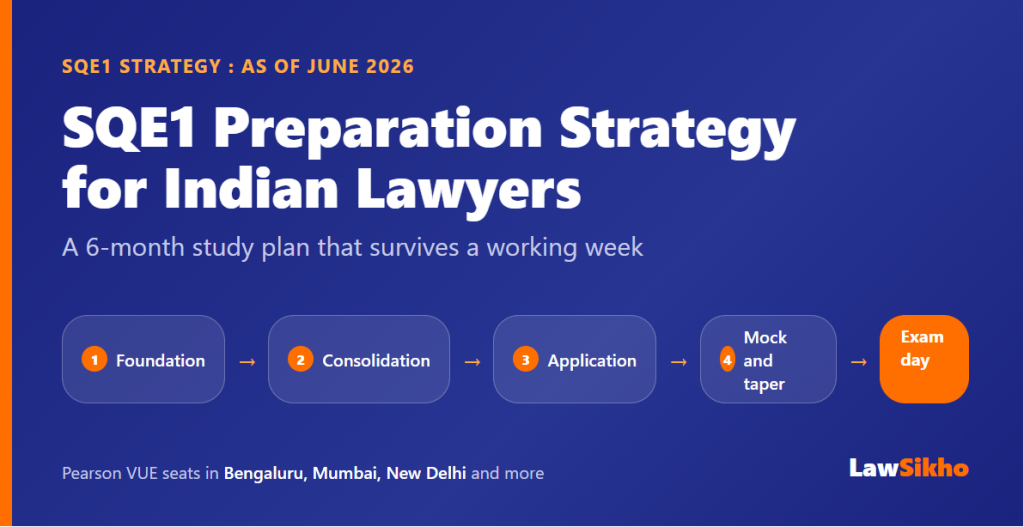
This is the spine of the whole guide. Everything before it was setup; everything after it is refinement. So how do you prepare for SQE1 in six months when you’re already working full time in Indian practice? You run four phases across roughly 26 weeks, at 12 to 15 hours a week, with the hours weighted toward questions rather than reading and the hardest subjects loaded first.
The overall ratio to hold in your head is about 35% reading, 45% questions and mocks, and 20% flashcards across the plan. That ratio shifts as you go: reading-heavy at the start, almost entirely questions and mocks by the end. The first full mock lands around month four, not month six, which is the timing most self-studiers get wrong. Here’s what the six months look like.
| Phase | Weeks | Focus | Hrs/wk | Reading / Questions / Flashcards | Milestone |
|---|---|---|---|---|---|
| Phase 1: Foundation | 1 to 8 | Hardest England and Wales subjects first; build the flashcard deck | 12 to 15 | 55 / 25 / 20 | Cold-start subjects covered once |
| Phase 2: Consolidation | 9 to 12 | Shift to question-led learning; topic-by-topic MCQs; start the error log | 12 to 15 | 30 / 50 / 20 | All subjects covered; error log running |
| Phase 3: Application | 13 to 17 | First full mock (~week 17); timed sessions; weak-subject loop | 13 to 15 | 20 / 60 / 20 | First full mock sat and reviewed |
| Phase 4: Mock-and-taper | 18 to 26 | 6+ full mocks; exam stamina; taper into the sitting | 13 to 15 | 10 / 75 / 15 | 6+ mocks done; confident taper |
Phase 1: Foundation (Months 1 to 2, weeks 1 to 8)
Phase 1 is reading-heavy by necessity, because you can’t drill questions on rules you’ve never met. Spend these eight weeks meeting the hardest England and Wales subjects for the first time: land law, trusts, solicitors’ accounts, wills, the legal system. Read actively, not passively, which means you’re making flashcards as you go, not highlighting and hoping.
By the end of week eight you should have covered every cold-start subject at least once and have a living flashcard deck. Don’t aim for mastery yet. Aim for a first full pass and a deck you can drill later. Resist the urge to “finish understanding” land law before moving on; you’ll return to it through questions, and that’s where it sticks.
Phase 2: Consolidation (Month 3, weeks 9 to 12)
Phase 2 is where the plan tilts toward questions. You’ve read the material once; now you learn it properly by attempting MCQs topic by topic and seeing where you actually stand. Reading drops to roughly 30% of your hours, questions rise to about 50%, flashcards hold at 20%.
This is also where the error log is born, and it’s non-negotiable. Every question you get wrong, you log: the topic, the rule you missed, and why you missed it. The log becomes your personalised revision list, far more useful than re-reading a chapter you mostly know. By the end of month three, every subject across both FLKs should have been covered at least once and tested through questions.
Phase 3: Application (Month 4, weeks 13 to 17)
Phase 3 is when you stop studying topics in isolation and start sitting the exam in miniature. Around week 17 you sit your first full mock, under timed conditions, both sessions, no notes. It will feel rough. That’s the point: better to meet the stamina wall and the pacing problem now, with weeks to fix them, than on exam day.
After that first mock, your weak subjects announce themselves, and you run a weak-subject loop: target the lowest-scoring areas, drill them hard, re-test. Questions now dominate at roughly 60% of your hours. The mock isn’t a verdict; it’s a diagnostic. Read it as data, fix what it shows, move on.
Phase 4: Mock-and-taper (Months 5 to 6, weeks 18 to 26)
The final phase is almost entirely about exam simulation and stamina. You sit six or more full mocks across these weeks, reviewing each one against your error log, watching your scores climb toward and past that 60% buffer. Reading shrinks to a trickle, used only to patch specific gaps the mocks expose.
Then you taper. In the last week or two, you ease off intensity rather than cramming harder, because a rested brain recalls better than an exhausted one. Trust the work. The candidates who panic-cram in the final week tend to walk in frazzled and underperform what their mocks promised.
A realistic weekday and weekend template around Indian practice
So how does 12 to 15 hours a week survive a litigation calendar? Through fixed, protected blocks rather than “whenever I get time,” because whenever-I-get-time becomes never. The template below is the working spine.
| Slot | Weekday | Weekend |
|---|---|---|
| Before work (7:00 to 8:00am) | 45 to 60 min: flashcards + 20 to 30 MCQs | Optional lie-in; longer afternoon block instead |
| Lunch (quick block) | 20 to 30 min: flashcard review on phone | n/a |
| Evening (hard cutoff by 9 to 9:30pm) | 45 to 60 min: reading or topic questions | n/a |
| Weekend deep block | n/a | 2 to 3 hrs each day: full topic study or a timed mock |
The hard cutoff matters as much as the start time. A fixed end (say 9:30pm) protects sleep and stops study bleeding into a guilt-ridden, low-quality midnight slog.
So how do you balance this with court dates and drafting deadlines? You build in a non-negotiable minimum, even on the worst weeks: 20 minutes of flashcards counts as keeping the streak alive. A court-date week where you only manage the minimum is a survivable week. A week where you do nothing because you couldn’t do everything is the one that breaks plans.
Is a 6-month plan really better than a 9-month or 3-month plan? For a working lawyer, yes, and here’s the comparison in one view: three months is too compressed to absorb cold-start subjects around a job and invites burnout; nine to twelve months invites the drift-and-panic curve and lets life erode momentum; six months is long enough to learn properly and short enough to sustain focus. It’s the working professional’s sweet spot.
Question-bank and mock-exam strategy
Reading feels productive. Questions are productive. That gap is where most SQE1 plans quietly fail, and it’s why this section gets its own space rather than being folded into the plan above. If you take one strategic decision from this guide, make it this: your preparation is question-led, with reading in a supporting role.
Why do questions beat re-reading? Because SQE1 tests applied recall under time, and you can only train applied recall under time by, well, answering questions under time. Re-reading builds a comforting sense of familiarity that evaporates the moment a single best answer question asks you to choose between five plausible options. Familiarity isn’t recall.
How many practice MCQs you actually need
The consensus across serious candidates and providers is that you should work through somewhere between 2,000 and 3,000-plus practice MCQs before sitting SQE1. That sounds enormous until you spread it across six months: a few hundred a month from Phase 2 onward gets you there comfortably. The number isn’t arbitrary; it’s roughly what it takes to meet every topic in enough variations that the patterns become automatic.
The point isn’t to “complete” a question bank like a checklist. It’s to expose yourself to enough scenario variety that no exam-day question feels structurally unfamiliar, even if the specific facts are new. Volume plus review, not volume alone.
How many full mocks, and when to sit your first
Plan for at least six full mocks, with your first sat by around month four, not saved for the final fortnight. A full mock means both sessions, timed, closed book, in one sitting, mimicking the real 90-questions-in-2h33m pressure. Single-question practice and full mocks do different jobs: questions build recall, mocks build stamina and pacing. You need both, and you need the mocks early enough to fix what they reveal.
On pacing, the arithmetic is unforgiving but learnable: 90 questions in about 2 hours 33 minutes is roughly 1.7 minutes each. The technique that works is to never stall. If a question is eating more than two minutes, flag it, put down your best guess, and move on, because there’s no negative marking, so a guess can only help. Answer every single question. A blank is a guaranteed zero; a guess is a free shot.
How do you know you’re on pace to pass? Watch your mock percentages trend, not any single score. If your timed full mocks are landing at 60% and climbing across Phase 4, you’re tracking toward a pass with a buffer. If they’re stuck in the low 50s in month five, that’s your signal to intensify the weak-subject loop, not to panic.
Revision techniques that move the needle: flashcards, active recall, weak subjects
Here’s the thing about SQE1 revision: the volume of discrete rules, thresholds, and time limits you must hold in memory is genuinely large, and ordinary re-reading won’t hold it. So this section is about the techniques that actually shift retention, the ones the passing candidates use, rather than the ones that merely feel like studying.
The two that matter most are active recall and spaced repetition. Active recall means testing yourself rather than reviewing notes; spaced repetition means reviewing each item at lengthening intervals, just before you’d forget it. Together they’re the most evidence-backed way to memorise high-volume factual material, which is precisely what SQE1 throws at you.
Active recall and spaced repetition for high-volume rules
How do you memorise so many rules, thresholds, and time limits? Turn them into cloze deletion cards, the fill-in-the-blank kind, where the card hides the one fact you need to produce. “Notice to quit for a periodic tenancy requires ___” forces you to generate the rule, not recognise it. Generation is what burns it in.
Use spaced repetition to schedule the reviews, so the system surfaces the cards you’re about to forget and quietly retires the ones you know cold. That’s far more efficient than re-reading a chapter where 80% is already solid just to catch the 20% that isn’t. Let the algorithm find your 20%.
Anki vs Quizlet vs provider flashcards, and the ~50/day cap
Which app? Anki is the strongest for serious spaced repetition; its scheduling algorithm is built precisely for this and it’s free on desktop. Quizlet is friendlier and fine for lighter use; the trainee in our opening built a large deck on it and passed, so it plainly works. Provider flashcards save you build time but cost money and fit your gaps less precisely. Any of them beats no system; the best one is the one you’ll actually open daily.
Now the warning that saves plans: cap your new cards at roughly 50 a day. Here’s why. Spaced repetition compounds, so every new card returns for review later, and if you add 200 new cards a day in a burst of enthusiasm, the daily review pile snowballs into the hundreds within a fortnight and collapses under its own weight. A steady ~50/day keeps reviews sustainable across six months. Slow and steady genuinely wins this one.
How to attack your weakest subjects without ignoring strong ones
So how do you revise your weakest subjects? Through your error log and your mock data, which together point straight at them, no guessing required. Allocate extra question reps to the lowest-scoring topics while keeping a maintenance trickle on your strong ones, because a strong subject left untouched for two months quietly decays.
The mistake to avoid is the comfort trap: drilling the subjects you’re already good at because it feels rewarding to score well. That’s revision as ego management, not exam preparation. Spend your hardest, freshest attention on the topics that scare you. Comfort is not progress.
Materials and budget: what you actually need
There’s a quiet anxiety underneath a lot of SQE1 prep: the fear that without an expensive course, you’ll miss something and fail. So let’s deal with the materials question honestly, because the trainee in the opening passed with self-made flashcards and syllabus textbooks, no enrolled course at all. Discipline, not spend, was the deciding factor.
What do you actually need at minimum? A complete set of study materials covering the SRA syllabus (textbooks or a structured self-study set), at least one quality question bank, and a flashcard tool. That’s the viable core. Everything beyond it is optimisation, not necessity.
One question bank vs many
Do you need several question banks? Usually not, and chasing many is often counterproductive. One good question bank, worked through thoroughly and reviewed properly via your error log, beats three banks skimmed and half-finished. Depth of engagement with your questions matters more than the sheer count of banks you own. Finish and review one before you even consider a second.
The exception is variety near the end: if you’ve genuinely exhausted one bank and have weeks left, a second source of fresh questions can stop you memorising answers rather than reasoning. But that’s a Phase 4 luxury, not a Phase 1 shopping list.
Do you need an expensive prep course?
This is the question that keeps candidates up at night, so here’s the straight answer: no, an expensive prep course is not required to pass SQE1. Self-study is genuinely viable, and plenty have done it, the opening trainee included. What self-study demands instead of money is discipline, structure, and the willingness to test yourself honestly when no tutor is checking.
That said, be honest about your own temperament. A common worry on forums is whether free resources are enough. They can be, but the false economy to watch is choosing pure self-study to save on prep, then failing and paying a full resit fee, which is far more expensive than any course discount. If structure is your weak point, a structured programme can be cheaper than a failed sitting. Match the route to your discipline, not to your pride.
Budgeting in INR
Don’t re-derive your costs from scratch here; the SQE has a real rupee total that deserves its own planning. Exam fees, any prep spend, forex on GBP payments, and travel if your city has no seat all add up, and they’re worth totalling in INR before you start (the dedicated cost breakdown linked earlier does exactly that). Price the whole thing up front, so the budget doesn’t ambush you mid-plan. Knowing the number before you begin is part of the plan, not separate from it.
India-specific decisions: exemptions, SQE2, and where to sit
Here’s where this guide does something no UK-written plan can: it accounts for the decisions that are specific to you as an Indian lawyer, and that actually reshape how you spend your six months. The biggest of these is the SQE2 exemption, because whether you’re chasing it changes how single-minded your SQE1 prep can be.
The second-order effect is the one to grasp first. If you’re exempt from SQE2, then SQE1 is the only assessment standing between you and qualification, which means all six months can concentrate on SQE1 rather than splitting attention. UK guides never make this point, because their readers are sitting both stages. For a meaningful slice of Indian candidates, the plan can be SQE1-only, and that focus is an advantage.
Should a 2+ PQE Indian lawyer chase the SQE2 exemption?
If you have two or more years of post-qualification experience as an Indian advocate, you may be able to apply for an exemption from SQE2, assessed case by case on your evidence. Should you? In most cases where you qualify, yes, because SQE2 is the more expensive stage and the only component that forces a UK trip for the oral assessment. Removing it both cuts cost and frees your study calendar.
The detail matters, though, and it’s worth getting right before you build your timeline. The SQE2 exemption route for Indian lawyers sets out who qualifies, what counts as post-qualification experience, and how long the SRA takes to decide, which can be months. Lodge that application early, because its timeline runs in parallel with your study and you don’t want it gating your qualification date.
Do you study SQE2 alongside SQE1, or focus only on SQE1?
For almost everyone, the answer is focus on SQE1 first. Trying to prepare for both stages at once dilutes the very focus that a 6-month SQE1 plan depends on, and SQE2 is a skills assessment that’s better tackled once your knowledge base is proven. If you’re pursuing the exemption, this is moot for now; if you’re not, sequence them, SQE1 then SQE2, rather than studying in parallel.
Worth flagging too: SQE1 is only one component of qualification. There’s also the qualifying work experience requirement running on its own track, which your existing Indian practice may help satisfy. Knowing the full picture stops you treating SQE1 as the finish line when it’s really the first hurdle.
Sitting SQE1 in India vs travelling to the UK
Is it worth sitting SQE1 in India versus flying to the UK? For nearly every Indian candidate, sit it in India. SQE1 is computer-based and delivered identically at Pearson VUE centres worldwide, so the exam you sit in Hyderabad is the exam you’d sit in London, minus the airfare, accommodation, and disruption. There’s no quality or recognition difference; a pass is a pass.
The only reason to consider travelling is the capacity trap from Step 0: if no Indian city has a seat for your window, a UK seat might be your fastest route to your target date rather than deferring six months. Weigh that case by case. Default to India; treat a UK sitting as the exception forced by booking logistics, not the norm.
Common mistakes: why people who “studied a lot” still fail SQE1
Plenty of people who fail SQE1 studied hard. That’s the uncomfortable truth this section exists to confront, because hard work aimed in the wrong direction still misses. So why do people who “studied a lot” still fail? Almost always for the same handful of structural reasons, and every one of them is avoidable once you can see it.
The common thread is mistaking input for output. Hours logged, chapters read, notes made, these feel like progress and produce a comforting sense of effort. But the exam doesn’t reward effort; it rewards correct answers under time. The candidates who fail despite working hard usually optimised for the feeling of studying rather than the result.
Over-reading and under-practising
This is failure mode number one, by a distance. Over-reading and under-practising means spending your hours absorbing material passively when you should be testing yourself actively, and it’s seductive precisely because reading is comfortable and questions are exposing. Every hour you re-read a chapter you mostly know is an hour not spent finding out what you don’t know.
The fix is the question-led structure this guide keeps pushing: roughly 45% of your total hours on questions and mocks, rising sharply in the back half. If your prep is 70% reading by month four, you’re heading for trouble regardless of how many hours you’ve logged. Drill more, read less, as you go.
Back-loading mocks and ignoring weak subjects
The second pattern is saving mocks for the final fortnight and avoiding the subjects you’re worst at. Both are forms of postponing discomfort, and both punish you. Back-loaded mocks mean you discover your pacing and stamina problems with no time left to fix them. Ignored weak subjects mean you walk in strong on what you’d have passed anyway and weak on what actually sinks you.
The discipline that fixes both is in the plan: first mock by month four, and a weak-subject loop driven by your error log. Confront the hard subjects and the timed conditions early, while there’s still runway to improve. Discomfort now buys confidence later.
Burnout, the 12-month drift trap, and protecting momentum
The third failure is slower and sadder: burnout and drift, usually on an over-long timeline. Stretch the plan to twelve months and you invite the energy curve from the opening, excitement, plateau, drift, panic, with life steadily eroding the edges. By month nine, many candidates have quietly stopped, then cram in a panic and underperform.
How do you avoid burnout in a 6-month plan? Through the same fixed blocks, hard cutoffs, and non-negotiable minimum that protect momentum on bad weeks, plus the taper that prevents an exhausted finish.
And remember the confidence point from the opening: you do not need to feel certain to pass. Candidates pass at 51% to 75% confidence all the time. Waiting to feel ready is its own trap. Trust the plan, sit the exam, and let your mock scores, not your nerves, tell you where you stand.
After SQE1: how this fits your England and Wales qualification
Passing SQE1 is a milestone, not a finish line, so it’s worth knowing what sits on either side of it: where this exam came from, where the route is heading, and what your next step is. A little context here helps you place SQE1 inside the longer arc of qualifying, rather than treating it as an isolated hurdle.
Understanding the bigger picture also steadies the nerves. SQE1 can feel like the whole mountain when you’re inside the six months. Zoom out, and it’s one well-defined stage in a standardised, internationally open route that thousands of lawyers, including a growing number from India, are now walking.
A short history: how the SQE replaced the LPC and QLTS
SQE1 vs the old LPC, what changed? Quite a lot. The Solicitors Qualifying Examination went live in September 2021, replacing the Legal Practice Course (LPC) and the QLTS as the main route to qualifying as a solicitor of England and Wales. It was approved by the Legal Services Board in October 2020 after years of consultation, and it deliberately standardised qualification into a single centralised exam.
Why does that history matter to you? Because the old QLTS route recognised lawyers only from certain jurisdictions, whereas the SQE opened the door to lawyers from all jurisdictions, India included. The exam you’re preparing for is, in a structural sense, the thing that made an England and Wales qualification realistically accessible to an Indian advocate in the first place.
Where the route is heading
What’s coming next? A few signals are worth holding lightly, in cautious terms. A ten-year transition period runs to 2031, after which the SQE becomes the sole route in, so the LPC-era alternatives are closing for good. Demand from internationally-qualified lawyers, India prominent among them, is widely expected to keep rising as that transition completes.
On the exam itself, the SRA’s ongoing evaluation is likely to bring delivery and fairness refinements over the next few years, but the FLK1 and FLK2 multiple-choice core looks entrenched rather than at risk of redesign. Early signals also point to expanding test-centre capacity in India as the candidate base grows. None of this is guaranteed, but the direction of travel is toward more access, not less.
Your next step: SQE2, QWE, and the window
So what’s immediately after SQE1? Once you pass, the path forks toward SQE2 (unless you’re exempt) and your qualifying work experience, with both feeding into eventual admission. Keep the timing rules in view: you must pass both SQE1 and SQE2 within a six-year window, with up to three attempts per stage, so there’s room to recover from a setback without it being fatal.
When you’re ready to look ahead, planning your SQE2 assessment prep is the natural next read, especially if you’re not taking the exemption. And if you fail one FLK rather than both, you resit only the failed FLK, not the whole of SQE1, which is exactly the kind of detail that turns a scary setback into a manageable one.
Your SQE1 6-month prep checklist
Here’s the whole plan distilled into a scannable list you can return to. Treat it as the recap, not the substitute for the detail above.
- Book your Pearson VUE seat first (Step 0), checking the live tool for an open Indian city in your window.
- Work backwards from the sitting date to set your 6-month start line.
- Decide your exemption position: if 2+ PQE, lodge the SQE2 exemption application early.
- Re-sequence subjects by Indian difficulty: front-load land law, trusts, solicitors’ accounts, wills, and the England and Wales legal system.
- Phase 1 (weeks 1 to 8): read the hardest subjects, build your flashcard deck, ~50 new cards a day.
- Phase 2 (weeks 9 to 12): shift to question-led learning and start your error log.
- Phase 3 (weeks 13 to 17): sit your first full timed mock by ~week 17 and run the weak-subject loop.
- Phase 4 (weeks 18 to 26): sit 6+ full mocks, target 60%+, then taper into the sitting.
- Hit roughly 2,000 to 3,000+ practice MCQs across the plan; review every wrong answer.
- Protect a non-negotiable minimum block (20 minutes) on court-date and deadline weeks.
- Answer every exam question (no negative marking); flag and move on past time-sinks.
- Keep total study near 12 to 15 hrs/week across ~330 to 500 hours.
Frequently asked questions about SQE1 preparation
How many questions are in SQE1? SQE1 has 360 questions in total, split as 180 single best answer multiple-choice questions in FLK1 and another 180 in FLK2. Each question gives one scenario and five options, with one best answer. It’s closed book throughout.
How long is each SQE1 session? Each FLK is delivered in two sessions of 90 questions, with roughly 2 hours 33 minutes per session, which is about 1.7 minutes per question. SQE1 runs across two days, with around 10 hours of total examination time. That stamina demand is exactly why early full mocks matter.
Is SQE1 open or closed book? SQE1 is entirely closed book. You can’t consult statutes, notes, or any reference material during the assessment, so everything has to come from memory under time. That’s the core reason active recall and spaced repetition matter more than re-reading.
Is there negative marking in SQE1? No, there’s no negative marking in SQE1. A wrong answer costs you nothing beyond the mark you’d have got for a right one, so you should answer every single question, including pure guesses. Leaving a blank is a guaranteed zero; a guess is a free attempt.
What subjects are in FLK1 vs FLK2? FLK1 covers Business Law and Practice, Dispute Resolution, Contract, Tort, the Legal System of England and Wales (with Constitutional, Administrative and EU Law) and Legal Services, plus money laundering. FLK2 covers Property Practice, Wills and Administration of Estates, Solicitors Accounts, Land Law, Trusts, Criminal Liability, and Criminal Law and Practice. Ethics runs pervasively through both.
What is the SQE1 pass mark? The pass mark is a scaled score of 300 out of 500, with a separate pass mark set for each FLK by the Assessment Board per sitting to keep standards consistent. In raw terms, historic pass marks have sat around 56% to 63%, roughly 101 to 113 correct out of 180. Because scaling varies, aim for a comfortable buffer rather than the exact threshold.
What is the SQE1 pass rate? The national first-time pass rate hovers around 58%, with individual sitting pass rates generally in the 53% to 60% range. These shift slightly per cycle. The figure to take from this isn’t fear; it’s that disciplined, question-led preparation reliably lands candidates on the right side of it.
How many times can I sit SQE1? You get up to three attempts at each stage, and you must pass both SQE1 and SQE2 within a six-year window. If you fail just one FLK rather than both, you resit only the failed FLK, not the whole of SQE1. That structure leaves real room to recover from a setback.
How many hours of study does SQE1 actually need? The SRA does not set a fixed number of preparation hours, but the widely cited benchmark across prep providers and successful candidates is roughly 300 to 500 hours for SQE1, with those further from recent law study sitting toward the upper end. Spread across six months at 12 to 15 hours a week, that lands you comfortably in range. The hours matter less than how you spend them: question-led practice beats passive reading hour for hour.
Can I self-study for SQE1 without a prep course? Yes, self-study is genuinely viable, and many candidates pass with syllabus materials, a question bank, and self-made flashcards, no enrolled course. What it demands instead of money is discipline and honest self-testing. The risk to weigh is a failed sitting, since a resit fee can cost more than a course would have.
How many practice MCQs should I do before SQE1? Aim for somewhere between 2,000 and 3,000-plus practice MCQs across your preparation. Spread over six months from the consolidation phase onward, that’s a few hundred a month. The goal is enough scenario variety that no exam-day question feels structurally unfamiliar, paired with proper review of every wrong answer.
How many full mock exams should I sit before SQE1? Plan for at least six full mocks, with your first by around month four rather than the final fortnight. A full mock means both sessions, timed and closed book, in one sitting. Mocks build the stamina and pacing that single-question practice can’t, and sitting them early leaves time to fix what they reveal.
Is a 6-month plan better than a 12-month plan? For most working lawyers, yes. A twelve-month plan invites the drift-and-panic energy curve and lets life erode momentum, while three months is too compressed to absorb cold-start subjects around a job. Six months is long enough to learn properly and short enough to sustain focus, the working professional’s sweet spot.
SQE1 vs LPC, what changed? The SQE replaced the LPC and the QLTS in September 2021 as the main route to qualifying as a solicitor of England and Wales. The key shift for you is that the old QLTS recognised lawyers only from certain jurisdictions, whereas the SQE opened the route to lawyers from all jurisdictions, including India. It standardised qualification into a single centralised exam.
FLK1 vs FLK2, which is harder for Indian lawyers? For most Indian lawyers, FLK2 is the tougher of the two, because it concentrates the genuine cold starts: English Land Law, Trusts, Solicitors Accounts, and Wills. FLK1’s contract and tort content transfers more readily from Indian training. That’s why a sensible plan front-loads the FLK2-heavy cold-start subjects rather than studying in the SRA’s listed order.
Can I sit SQE1 in India, and in which cities? Yes, SQE1 is computer-based and delivered at Pearson VUE centres in India, in cities listed as Bengaluru, Chennai, Gurugram, Hyderabad, Mumbai, and New Delhi. But inclusion isn’t guaranteed for every window and seats are limited, so check the live booking tool and book early. The exam is identical to the one sat in the UK.
What happens if I fail FLK1 or FLK2, do I resit both? No, if you fail only one FLK, you resit just that FLK, not the whole of SQE1. You keep the pass on the FLK you cleared. You’re working within up to three attempts per stage and a six-year window to pass both SQE1 and SQE2, so a single-FLK setback is manageable rather than catastrophic.
Sources and references
Every figure and rule in this guide is drawn from the Solicitors Regulation Authority (the body that sets and runs the SQE) and its official assessment material. These primary sources are worth bookmarking, because exam windows, fees, and centre availability shift each cycle, and the SRA pages are always the current word.
- SQE1 Assessment Specification (SRA): the FLK1 and FLK2 subject breakdown, the single-best-answer format, and the 180-questions-per-FLK structure.
- Understanding your SQE1 results (SRA): the scaled pass mark of 300 out of 500 and the per-FLK, compensatory standard-setting method.
- SQE assessment day (SRA): session length of roughly 2 hours 33 minutes, 90 questions per session, and the two-day format.
- SQE Assessment Regulations (SRA): the three-attempts-per-stage rule and the six-year window to pass both SQE1 and SQE2.
- SQE1 and SQE2 written assessment locations (SRA): the Indian test-centre cities, with the caveat that inclusion is not guaranteed for every window.
- SQE assessment dates and booking windows (SRA): the fixed annual sittings and booking windows you plan Step 0 around.
- Preparing to take your SQE assessment (SRA): the SRA’s position that how you prepare is up to you, and that it sets no fixed number of study hours.
- SQE1 January 2026 Statistical Report (SRA): the most recent pass-rate data (58% first-time, 53% overall).
- The SQE four years on: facts and figures (SRA): uptake since the SQE replaced the LPC and QLTS route in September 2021.
- Working full-time, no prep course, and I passed SQE1 (Legal Cheek, July 2025): the first-hand account behind this guide’s opening, on self-studying SQE1 around a full-time job.
This article is for informational and educational purposes only and does not constitute legal advice. For specific legal guidance, consult a qualified legal professional.




 Allow notifications