
Last verified: 17 June 2026
Since the Solicitors Qualifying Examination replaced the old transfer scheme in September 2021, the Solicitors Regulation Authority has granted exactly one individual exemption from SQE1. One. In nearly five years, across thousands of foreign-qualified applicants, a single person has been excused from the knowledge exam. That one statistic reshapes how SQE eligibility for Indian lawyers actually works, because it moves the real difficulty onto a single exam that seniority and experience cannot buy you out of.
Picture a commercial litigator with eight years at the bar in Delhi. She has argued before the High Court, led a disputes team, and handled cross-border contracts that would make a London associate sweat. She assumes, reasonably, that the SRA will look at her track record and wave her past the written papers. Then she reads the fine print.
Her experience can waive the two years of work experience that fresh graduates must complete. It can, with enough post-qualification practice, earn her an exemption from the skills assessment. But SQE1, the multiple-choice knowledge exam on English and Welsh law? She sits it like everyone else.

This is the part most guides get backwards. They tell Indian advocates that “experienced lawyers can get exemptions” and leave it there, as if the whole exam machine bends to a good CV. It doesn’t. The exemption door that’s actually open is narrow and specific, and the door that everyone assumes is open (skip the knowledge exam) is effectively shut.
Here’s why that matters for your planning. If you’re an enrolled advocate, you don’t need to spend two years collecting work placements. That’s a genuine shortcut, and a valuable one.
But you do need to master English contract, tort, property, criminal, public, and business law well enough to pass an exam with a pass rate that has swung between 41 and 56 percent in recent sittings. For a lawyer trained on the Indian Contract Act and the Bharatiya Nyaya Sanhita, that’s a real climb.
And the rewards on the other side are concrete. Dual qualification opens cross-border advisory work, international arbitration desks, and the kind of India-UK practice that pays in a currency that holds its value. Indian lawyers who’ve made this jump aren’t theoretical. They sit in magic-circle firms, in-house teams at multinationals, and boutique practices that bill London rates for India-facing work.
The route is real. It just isn’t the route most people think it is.
This guide maps which of the three routes is yours, what each one requires, what it costs in 2026, and how to apply for the one exemption that’s genuinely within reach.
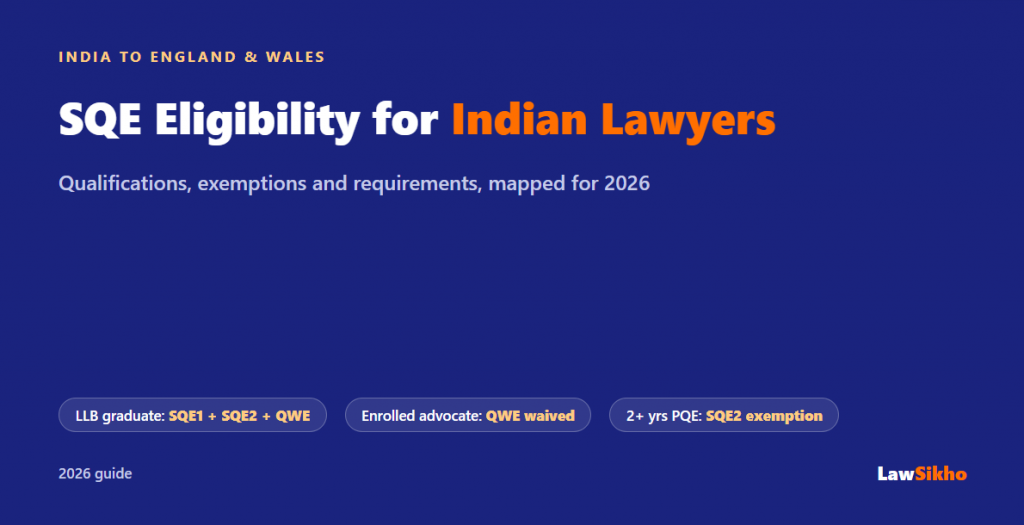
Any Indian law graduate can sit the SQE; there is no nationality bar and no pre-approval needed to register. Indian LLB graduates must pass SQE1 and SQE2 and complete two years of qualifying work experience. Enrolled Indian advocates skip the two-year work-experience requirement and may seek an SQE2 exemption, but almost everyone must still pass SQE1.
The rest of this guide breaks down each scenario, the exam structure, the exemptions you can actually get, the 2026 fees, and a step-by-step on applying through mySRA. Start with the section that matches your status.
SQE eligibility for Indian lawyers: who can sit the exam, in three scenarios
The first question every Indian lawyer asks is some version of “am I even allowed to do this?” The answer is yes, and it’s simpler than most people fear. There’s no nationality requirement, no minimum experience to register, and no need for the SRA to pre-approve you before you book an exam. What trips people up isn’t whether they’re eligible. It’s which of three very different routes applies to them.
To qualify as a solicitor of England and Wales through the SQE, you must meet four requirements. You need a degree or an equivalent Level 6 qualification (in any subject, not necessarily law). You must pass SQE1. You must pass SQE2, or hold a valid exemption from it. And you must satisfy the SRA’s character and suitability assessment.
An Indian LLB or a three-year graduate degree plus a law qualification comfortably clears the academic bar.
So where does the confusion come from? It comes from blurring three categories of Indian applicant that the SRA treats very differently. Here’s the clean version.
| Your status | SQE1 | SQE2 | Two-year QWE | Can seek an exemption? |
|---|---|---|---|---|
| LLB student or fresh graduate | Required | Required | Required | No, QWE is not waived |
| Enrolled Indian advocate | Required | Required (or exemption) | Waived | SQE2 only, with enough PQE |
| Advocate with 2+ years PQE | Required | May be exempted | Waived | SQE2 exemption is realistic |
Read that table twice, because it answers more questions than any other paragraph in this guide.
Scenario one: the Indian LLB student or fresh graduate
If you’ve finished your LLB but haven’t enrolled with a State Bar Council, or you’re still a student, you’re a “foreign-educated” candidate, not a “qualified lawyer.” That distinction costs you the work-experience waiver. You’ll need SQE1, SQE2, and two full years of qualifying work experience, plus character and suitability. It’s the longest route, but it’s open to you from the day you graduate, and your work experience can be gathered flexibly (more on that below).
Scenario two: the enrolled Indian advocate
Once you’re enrolled with a State Bar Council and hold the right to practise, the SRA treats you as a “qualified lawyer.” This is where the first real shortcut appears. The SRA’s own guidance is blunt about it: “Unlike other SQE candidates, qualified lawyers do not need two years’ qualifying work experience.” You still sit SQE1 and SQE2 (or get the SQE2 exemption), but those two years of placements simply fall away. For a practising advocate, that’s a meaningful saving of time and money.
Scenario three: the experienced advocate with 2+ years PQE
If you’re an enrolled advocate with at least two years of post-qualification experience, you unlock the one exemption that’s genuinely attainable: the SQE2 skills exemption. You skip the 16 skills assessments and focus your energy on SQE1. What you don’t get, and this is the heart of the whole article, is an SQE1 exemption. That stays on your plate no matter how senior you are.
In practice, the mistake we see most often is an advocate assuming scenario three means “I barely have to do anything.” It doesn’t. It means you’ve cleared the work-experience hurdle and the skills hurdle, leaving one large, unavoidable knowledge exam.
Worth flagging early: a certificate of good standing from your Bar Council and clean disclosure records will matter at the character stage, regardless of which scenario is yours. Does the All India Bar Examination factor into SRA eligibility? No, the AIBE is about your Indian enrolment, not your SQE status, though your enrolment is what gives you “qualified lawyer” treatment.
How the SQE actually works: SQE1, SQE2, and the pass-rate reality
Before you plan around exemptions, you need to know what you’re actually being tested on. The SQE isn’t one exam. It’s two stages, and they test completely different things. Confuse them, and you’ll budget your prep time in the wrong place.
SQE1 tests Functioning Legal Knowledge. It’s split into two computer-based papers, FLK1 and FLK2, with 180 single-best-answer multiple-choice questions each, for 360 questions total. FLK1 covers business law, dispute resolution, contract, tort, and the legal system. FLK2 covers property, wills, solicitors’ accounts, land law, trusts, and criminal law and practice.
It’s all English and Welsh law. None of your Indian substantive law transfers, which is exactly why this stage is harder for India-trained lawyers than the multiple-choice format suggests.
SQE2 tests practical skills. There are 16 assessments: four oral (client interviewing with attendance note, and advocacy) and twelve written (legal drafting, legal research, legal writing, and case and matter analysis). These are spread across practice areas like dispute resolution, property, wills and probate, business, and criminal litigation. SQE2 is where your years of actual practice help you, which is precisely why experienced advocates can be exempted from it.
What SQE1 tests and why it’s hard for India-trained lawyers
Here’s the thing about a 180-question multiple-choice paper: it looks approachable and isn’t. The questions are scenario-based, single-best-answer, and they reward precise knowledge of English law over reasoning from first principles. An Indian advocate who’s brilliant at oral argument can still stumble on the granular rules of English land law or the Solicitors’ Accounts Rules, because those simply aren’t part of Indian practice.
The exam doesn’t care how good a litigator you are. It cares whether you know the rule.
What SQE2 tests: the practical skills stage
SQE2 is the stage that feels familiar to a practising lawyer. Interviewing a client, drafting a letter, researching a point, analysing a matter: this is daily work for anyone with real bar experience. That familiarity is the legal logic behind the exemption. If you’ve already demonstrated these skills over years of qualified practice, the SRA accepts you don’t need to prove them again on an exam.
Self-study or a prep course for SQE2 is a live question for graduates, but for experienced advocates the more relevant question is whether to claim the exemption at all (usually yes).
The pass-rate reality check
Now, here’s where it gets interesting. The SQE1 pass rate isn’t stable, and the swings are large. The overall pass rate was 56 percent in January 2025, dropped to 41 percent in July 2025, then recovered to 53 percent in January 2026.
What does that mean for you? It means roughly half of all candidates fail SQE1 in a given sitting, and that includes plenty of capable lawyers who underestimated it.
So how hard is SQE1, really? Hard enough that treating it as a formality is the single most expensive assumption you can make, given each resit costs you another full fee. The practical reality is that structured, English-law-specific preparation, not generic legal confidence, is what gets Indian lawyers through.
If you’re going to invest anywhere, invest here. A focused SQE preparation programme for Indian lawyers targets exactly the substantive-law gaps that trip up India-trained candidates.
Qualifying Work Experience: when you need two years and when it’s waived
Qualifying Work Experience, or QWE, is the requirement that causes more confusion among Indian applicants than any other, because the answer genuinely depends on who you are. For one group it’s a hard two-year requirement. For another it vanishes entirely. Get this wrong and you either waste two years you didn’t need or skip a requirement you can’t skip.
QWE is two years of full-time (or full-time equivalent) legal work experience that gives you exposure to providing legal services. You don’t have to do it in one place. It can be gathered across up to four different organisations, which means an internship, a law-firm stint, an in-house placement, and a legal-clinic role could, between them, add up to your two years. The experience must be confirmed by a solicitor, or by the organisation’s Compliance Officer for Legal Practice (COLP).
What counts as QWE and who can sign it off
The bar for what “counts” is broader than people expect. The work needs to involve real legal services and give you the chance to develop the competences in the SRA’s Statement of Solicitor Competence. The sign-off is the key control: a solicitor (or a COLP) confirms that the experience happened and gave you that exposure. Without a valid confirmation, the experience doesn’t count, no matter how substantive it was.
Can Indian legal work count toward QWE?
A common question is whether work done in India can count. The encouraging answer: it can, where it’s appropriately supervised and can be signed off by someone the SRA recognises (a solicitor of England and Wales, or a COLP). The flexibility of up to four placements is what makes this workable for Indian graduates.
You’re not forced to relocate to England for two years just to bank QWE. What you do need is a sign-off route, and that’s where graduates should plan carefully from the start, rather than scrambling for confirmation after the fact.
Why enrolled advocates are exempt from QWE
And then there’s the clean exit. If you’re an enrolled Indian advocate, the SRA treats you as a qualified lawyer, and qualified lawyers don’t need QWE at all. This isn’t an exemption you apply for.
It’s simply how the qualified-lawyer route works. The two years that a fresh graduate must invest are time you’ve already spent at the Indian bar.
But here’s the second-order effect almost nobody spells out. Because QWE is waived for advocates, and because SQE1 can’t realistically be exempted, the entire difficulty of qualification collapses onto one English-law knowledge exam. That’s not a small detail. It means your prep budget, your study calendar, and your stress should all be pointed at SQE1, not at chasing placements or worrying about skills assessments you may never sit.
SQE exemptions for Indian advocates: agreed route vs individual route
This is the section where the myths live, so let’s be honest about what’s real. Indian advocates can get exemptions. But “exemption” almost always means the SQE2 skills exemption, and almost never means an SQE1 knowledge exemption. Conflating the two is the costliest misunderstanding in the whole SQE eligibility for Indian lawyers conversation.
Start with the number that anchors everything. Since the SQE launched in September 2021, the SRA has granted only one individual exemption from SQE1. Treat SQE1 as effectively un-exemptable. You can build a whole qualification plan on that assumption and you’ll be right almost every time.
Why SQE1 almost never gets exempted
Why is SQE1 so rarely waived? Because it tests core English and Welsh legal knowledge that no foreign qualification reliably covers. An Indian advocate knows Indian law; SQE1 is about English law. The SRA’s position, demonstrated by that single exemption in nearly five years, is that this knowledge has to be proven by examination, not assumed from a foreign qualification.
Does failing SQE2 or skipping it have any bearing here? No. SQE1 stands alone, and it stands in everyone’s way.
SQE2 exemption: who actually qualifies
The SQE2 exemption is the one with a real chance of success. To get it, you generally need to hold the same practice rights you’re qualifying into and have at least two years of post-qualification (or mandatory) legal work experience. Pre-qualification experience, like an internship or a training period before you were formally enrolled, does not count toward that two-year threshold. So an advocate with, say, three years of post-enrolment practice is in a strong position to apply; a fresh enrollee is not.
Agreed exemption vs individual exemption
There are two flavours of exemption, and the difference matters. An “agreed exemption” applies where the SRA has already assessed a particular qualification or jurisdiction and pre-approved an exemption for it. An “individual exemption” is assessed case by case, on your specific evidence, through a mySRA application. The agreed route, where it exists, is faster because the assessment is already done.
Now, here’s the claim you’ll see repeated across prep-provider sites, and where you should slow down. Several prep providers report that advocates from certain Indian jurisdictions (commonly listed as Assam, Delhi, Goa, and West Bengal) have a pre-agreed SQE2 exemption. We could not confirm a country-level pre-agreed India list on the SRA’s own exemptions page, so treat that claim with caution.
The SRA’s SQE2 exemption finder is the only authoritative source. Before you rely on any “your state is pre-approved” advice, check your exact qualification on the SRA exemption finder yourself. If it’s not confirmed there, plan for an individual application instead.
What happens if your state isn’t on the list anyway? You apply individually, with evidence, like most applicants do.
How to apply for an SQE2 exemption: a step-by-step on mySRA
If you’ve established that you qualify for the SQE2 exemption, the application itself is procedural, but it’s unforgiving on detail. Get the evidence wrong and you lose both the fee and the time. Here’s the sequence, in order.
- Confirm eligibility on the SRA exemption finder. Before anything else, check whether your qualification supports an agreed exemption or whether you need an individual assessment. This single step prevents most wasted applications.
- Log into (or create) your mySRA account. This is the SRA’s online portal and the only channel for the application. Everything routes through it.
- Complete the individual exemption application. You’ll set out your qualification, your practice rights, and the experience you’re relying on.
- Gather and upload your evidence. This includes proof of your practice rights and good standing, references, and certified English translations of any non-English documents.
- Pay the application fee. The individual exemption application fee is £265.
- Wait for the decision. The SRA aims to decide within 180 days of receiving a complete application. “Complete” is the operative word: missing evidence restarts your clock.
The mySRA application, step by step
The portal walks you through each field, but the application stands or falls on the evidence you attach, not the form itself. Build your evidence file before you start filling in fields, so you’re not pausing the application to chase a document. A certificate of good standing from your State Bar Council is the kind of thing you want in hand early, because it can take time to obtain.
Evidence and references: exactly what the SRA accepts
This is where applications most often fail, so read carefully. References must be written specifically for this application, dated within the last three months, and on letterheaded paper. They must confirm the hours you worked and the supervision you had, and they must meet the SRA’s Level 3 Threshold Standard.
On translations, the rule is strict: only certified English translations are accepted. AI translations, online machine translations, and self-certified translations are all rejected. Do you need to prove English language competence even if SQE2 is exempted? The SRA addresses language requirements separately, so confirm your specific position on the SRA site rather than assuming the exemption covers it.
What happens to your eligibility while the application is pending
A practical worry: does your eligibility lapse while you wait? No. Your status as a qualified lawyer doesn’t disappear because an exemption decision is pending.
But you can’t sit or be credited for SQE2 on the basis of an exemption you don’t yet hold, so plan your SQE1 sitting around the timeline rather than waiting idle for the exemption to land. The smarter strategy is to prepare for and book SQE1 while the SQE2 exemption is being assessed, so the two timelines run in parallel.
Character and suitability: the admission gate Indian advocates overlook
Passing the exams and securing an exemption gets you most of the way. It doesn’t get you admitted. The character and suitability assessment is the final gate, and it applies to everyone, including candidates who’ve been exempted from SQE2. Indian advocates routinely underestimate it, partly because the Indian enrolment process doesn’t have a direct equivalent in the same form.
The assessment is the SRA’s check that you’re a fit person to be a solicitor. It looks at your honesty and integrity, any criminal history, regulatory or disciplinary findings, financial conduct like bankruptcy or significant debt issues, and any past behaviour that calls your suitability into question. It’s not a formality, and disclosure problems can derail an application that’s otherwise complete.
What the assessment looks at
The core concern is candour. The SRA is less worried about an old, minor, fully disclosed issue than about something you failed to disclose. Honesty about your record is itself part of the test. If you have anything in your history that might be relevant (a regulatory complaint, a financial issue, a past disciplinary matter), the right move is full, early disclosure with context, not silence and hope.
Common disclosure issues and the certificate of good standing
For Indian advocates, a certificate of good standing from your State Bar Council is the document that does the heavy lifting here. It confirms you’re enrolled, in good standing, and not subject to disciplinary sanction. Frankly, this gets overlooked until late, and then it becomes a bottleneck because Bar Councils don’t always issue these quickly. Request it early.
What about the AIBE or other Indian qualifications? They’re relevant only insofar as they establish your enrolment and standing; the SRA’s interest is in your conduct and suitability, not your Indian exam scores.
The pitfall to avoid is treating character and suitability as a box to tick at the end. It can take time, it can require supporting documents from India, and an unexpected disclosure issue can stall your admission even after you’ve passed both exams. Build it into your timeline from the start.
What the SQE costs in 2026, and the September 2026 increase
Money drives the timing of this decision more than anything else, and 2026 has a hard deadline baked in: the fees go up in September. If you’re close to ready, the difference between sitting before and after that date is real cash. Here are the current figures and the new ones.
| Assessment | Fee to September 2026 | Fee from September 2026 |
|---|---|---|
| SQE1 (FLK1 + FLK2) | £1,934 (£967 + £967) | £2,006 (£1,003 + £1,003) |
| SQE2 | £2,974 | £3,086 |
| Individual exemption application | £265 | £265 (confirm on SRA) |
These are the assessment fees only, they’re VAT exempt, and the exams are administered by Kaplan on the SRA’s behalf.
SQE1 and SQE2 sitting fees, current and post-September 2026
For an enrolled advocate going the standard route (SQE1 plus SQE2), the exam fees alone come to £4,908 before September 2026 and £5,092 after. For an advocate who secures the SQE2 exemption, the picture is very different: SQE1 at £1,934 (rising to £2,006) plus the £265 exemption application fee. That’s the financial reward of the exemption, and it’s a strong reason to confirm your SQE2 exemption eligibility before booking anything.
The full end-to-end cost for an India-based candidate
But exam fees are only part of the bill, and this is where Indian candidates routinely under-budget. You also have to factor in preparation costs (a course or materials), travel to a test centre, accommodation, certified translation fees for your documents, and the cost of any resits if SQE1 doesn’t go your way the first time. Given a sub-55-percent pass rate, budgeting for a possible resit isn’t pessimism, it’s planning. When you add it all up, the realistic end-to-end cost runs well above the headline exam figures.
Worth flagging on timing: the SRA has signalled that fee escalation is likely to continue beyond 2026, driven by inflation and operating costs. Early signals suggest this is a direction, not a one-off.
So if you’re genuinely close to exam-ready, the case for sitting sooner rather than later is partly financial. Why pay the September 2026 figure when the pre-September figure is still available and you’re prepared? That said, sitting before you’re ready just to save a few hundred pounds is a false economy when a resit costs far more.
| Assessment | To Sept 2026 | From Sept 2026 |
|---|---|---|
| SQE1 (FLK1 + FLK2) | £1,934 | £2,006 |
| SQE2 | £2,974 | £3,086 |
| Individual exemption application | £265 | £265 |
SQE vs the alternatives: QLTS, the barrister route, and LLM-then-SQE
The SQE didn’t appear in a vacuum, and it isn’t your only option for working in English law. Indian lawyers comparing routes need to understand what the SQE replaced and what sits alongside it, because the wrong comparison leads to wasted years.
Some historical context helps here. Before September 2021, foreign lawyers (including Indian advocates) qualified as solicitors through the Qualified Lawyers Transfer Scheme, the QLTS. The SQE replaced both the QLTS and the domestic Legal Practice Course route, folding everyone, domestic and foreign, into a single framework with one exemptions mechanism. If you read older guides or advice from a relative who qualified years ago, they may be describing the QLTS world, which no longer exists.
SQE vs QLTS: what changed for foreign lawyers
The shift from QLTS to SQE matters because the exemption logic changed. Under the SQE, the practical effect for Indian advocates is the two-stage structure (knowledge then skills) with the skills stage being the realistically exemptable one.
Does the SQE replace the QLTS for Indian lawyers? Yes, completely. There’s no QLTS to fall back on, and any advice premised on it is out of date.
Solicitor (SQE) route vs barrister (BSB) route
The SQE makes you a solicitor. If your goal is to be a barrister in England and Wales, that’s a different regulator (the Bar Standards Board) and a different path entirely, involving the Bar course and pupillage. For most India-based lawyers eyeing transactional, advisory, or in-house work, the solicitor route is the relevant one. Advocacy-focused practitioners drawn to the courtroom should look at the barrister path, but understand it’s a separate qualification, not an SQE variant.
LLM in the UK then SQE, vs SQE directly from India
A genuinely common dilemma: should you do an LLM in the UK first, then the SQE, or sit the SQE directly from India? An LLM can help with English-law exposure, visa pathways, and the UK network, but it’s expensive and it doesn’t exempt you from SQE1. Plenty of Indian advocates skip the LLM and prepare for the SQE directly, especially given the QWE waiver.
Do you need a bridge course before the SQE? Not formally, but given the substantive-law gap, targeted preparation (whether a dedicated SQE programme or broader study) is what closes the distance. You can explore LawSikho’s full course catalogue if you’re weighing how to build that English-law foundation.
The better approach, in our view, is to decide based on your goals: if you want to live and work in the UK, the LLM has value beyond the exam; if you just want the qualification, the direct SQE route is faster and cheaper.
Life after qualifying: visas, remote admission, and the career reality
Qualifying is the goal, but it’s worth being honest about what qualification does and doesn’t give you, because the gap between “admitted as a solicitor” and “working as a solicitor in London” is wider than the brochures suggest. Let’s separate the two.
Admission to the roll of solicitors is a professional status. A work visa is an immigration matter, and the two are governed by completely different systems. Passing the SQE and being admitted does not, by itself, grant you the right to live or work in the UK. That’s the single most important reality check in this section.
Can you qualify and be admitted from India?
The good news for many Indian lawyers is that the SQE process is largely accessible without relocating permanently, and admission itself doesn’t require you to have a UK job lined up. You can sit the exams (at available test centres), satisfy the requirements, and be admitted while based in India.
Can you be admitted to the roll remotely from India? In substance, yes, the qualification doesn’t compel emigration. What it doesn’t do is hand you a UK employer.
Visas, sponsorship, and the job-market reality
This is where many candidates get caught. To actually practise in England and Wales as an employed solicitor, you’ll typically need a UK employer willing to sponsor a work visa, and that job market is competitive. Qualification makes you eligible and credible; it doesn’t guarantee sponsorship.
Will qualifying get you a UK job? It improves your odds significantly, particularly for India-facing roles at international firms, but it’s a separate hurdle you should plan for, not assume.
Practising in India and as a UK solicitor at the same time
A frequent question: can you keep your Indian practice and hold the solicitor qualification? Holding the qualification and being on the roll is one thing; actively practising in two jurisdictions raises separate regulatory and practical questions in each. Early signals suggest India-UK legal mobility is a growing area as cross-border trade and legal-services discussions evolve, which is part of why this dual qualification is attractive.
But treat the “practise everywhere at once” picture cautiously, and check the current rules of both regulators before assuming you can wear both hats simultaneously. Is dual qualification worth the cost and effort? For lawyers targeting cross-border, international arbitration, or India-facing global practice, the answer is increasingly yes; for a purely domestic Indian litigator, the economics are harder to justify.
Common mistakes Indian applicants make
After all the rules, here’s the honest senior-lawyer section: the errors that cost Indian applicants the most time and money. Most of them come from believing something that sounds right but isn’t. Avoid these and you’ll save yourself a year and several thousand pounds.
Eligibility and exemption mistakes
The biggest one, by far, is assuming experience exempts you from SQE1. It doesn’t (one exemption in nearly five years, remember). The second is relying on the “four states have a pre-agreed SQE2 exemption” claim without checking the SRA exemption finder yourself.
The mistake we see most often is trusting a prep provider’s prerequisite summary over the regulator’s own tool. Are prep providers always accurate on prerequisites? Not reliably, so verify the consequential claims against the SRA directly. A related error: assuming pre-qualification internship time counts toward the two-year SQE2 exemption threshold. It doesn’t.
Documentation and evidence mistakes
This is the silent application-killer. Using an AI or self-certified translation gets your evidence rejected outright. So do reference letters older than three months, references that don’t sit on letterhead, and references that fail to confirm your hours and supervision.
None of these are about your ability. They’re about whether you followed the evidence rules precisely. Treat the SRA’s documentation requirements as hard constraints, not suggestions.
Preparation and budgeting mistakes
The third cluster is about underestimating the climb. Indian advocates often underestimate how different English substantive law is from Indian law, then treat SQE1 as something they can cram. With pass rates between 41 and 56 percent, that’s a gamble.
The other budgeting error is planning only for exam fees and ignoring prep, travel, certified translations, and the very real possibility of a resit. Build your budget for the full journey, not just the headline number. And don’t leave the character and suitability documents (especially that Bar Council certificate of good standing) until the last minute.
Frequently asked questions about SQE eligibility for Indian lawyers
1. Does the SQE replace the QLTS for Indian lawyers? Yes. The SQE replaced the Qualified Lawyers Transfer Scheme in September 2021, along with the domestic Legal Practice Course route. There’s no QLTS to apply under anymore, so any advice based on it is out of date.
2. What are the four requirements to qualify as a solicitor through the SQE? You need a degree or equivalent Level 6 qualification in any subject, a pass in SQE1, a pass in SQE2 (or a valid exemption), and a pass in the SRA’s character and suitability assessment. All four must be satisfied. An Indian law degree clears the academic requirement.
3. What’s the difference between SQE1 and SQE2? SQE1 tests functioning legal knowledge through two multiple-choice papers (FLK1 and FLK2) of 180 questions each. SQE2 tests practical skills through 16 assessments, four oral and twelve written. SQE1 is the knowledge stage; SQE2 is the skills stage.
4. Who is eligible to sit the SQE as an Indian lawyer? Any Indian law graduate is eligible. There’s no nationality bar and no pre-approval needed to register. Your route (and any exemptions) depends on whether you’re a fresh graduate, an enrolled advocate, or an advocate with two-plus years of post-qualification experience.
5. Can an Indian LLB graduate take the SQE without work experience? You can register and sit the exams, but to qualify as a solicitor you’ll need two years of qualifying work experience unless you’re already an enrolled advocate. Fresh graduates aren’t treated as “qualified lawyers,” so the QWE requirement applies to them.
6. Do enrolled Indian advocates need to complete Qualifying Work Experience? No. The SRA treats enrolled advocates as qualified lawyers, and its guidance states that qualified lawyers don’t need two years’ qualifying work experience. That’s one of the main advantages of being enrolled before you apply.
7. Is an Indian law degree recognised by the SRA for the SQE? Yes, for the purpose of meeting the degree-level requirement. The SQE doesn’t require a law degree specifically (any Level 6 degree works), so an Indian LLB comfortably satisfies the academic element. What it doesn’t do is exempt you from SQE1.
8. Can an Indian advocate get an SQE2 exemption? Yes, if you hold the relevant practice rights and have at least two years of post-qualification (or mandatory) legal work experience. Pre-qualification experience doesn’t count toward that threshold. This is the one exemption that’s genuinely realistic for experienced advocates.
9. Can SQE1 be exempted for Indian lawyers? Effectively no. The SRA has granted only one individual SQE1 exemption since 2021. You should plan to sit and pass SQE1 regardless of your seniority or experience.
10. How many years of post-qualification experience do I need for an SQE2 exemption? At least two years of post-qualification (or mandatory) legal work experience, with the same practice rights you’re qualifying into. Time spent before your formal enrolment (internships, training) doesn’t count toward the two years.
11. Which Indian states are said to have a pre-agreed SQE2 exemption, and is that confirmed? Several prep providers report a pre-agreed SQE2 exemption for advocates from certain Indian jurisdictions (commonly listed as Assam, Delhi, Goa, and West Bengal). We could not confirm this on the SRA’s own exemptions page, so check your exact qualification on the SRA SQE2 exemption finder before relying on it. If it’s not confirmed there, plan for an individual application.
12. How do I apply for an SQE exemption step by step? Confirm eligibility on the SRA exemption finder, log into mySRA, complete the individual exemption application, upload your evidence (proof of practice rights, references, certified translations), pay the £265 fee, and await a decision. The portal is the only application channel.
13. How long does an SQE exemption application take to decide? The SRA aims to decide within 180 days of receiving a complete application. “Complete” matters: missing or non-compliant evidence can reset the timeline, so get the documentation right the first time.
14. Are AI or self-certified translations of my certificates accepted? No. Only certified English translations are accepted. AI translations, online machine translations, and self-certified translations are all rejected, and using one is a common reason applications fail.
15. What does the SQE cost in 2026, and will the September 2026 increase affect me? To September 2026, SQE1 is £1,934 and SQE2 is £2,974. From September 2026, SQE1 rises to £2,006 and SQE2 to £3,086. The individual exemption application fee is £265. Fees are VAT exempt and administered by Kaplan, so if you’re exam-ready, sitting before September can save you money.
16. Is dual qualification through the SQE worth the cost for an India-based lawyer? For lawyers targeting cross-border advisory, international arbitration, or India-facing global practice, dual qualification is increasingly worth it. For a purely domestic litigator with no international ambitions, the cost and effort are harder to justify. The honest answer depends on where you want your career to go.
References
Regulatory and official sources
The eligibility rules, exemption process, fees, and assessment structure in this guide are drawn from official Solicitors Regulation Authority and Kaplan sources. Confirm current details directly, as fees and rules change.
- Solicitors Regulation Authority, “Qualifying as a solicitor: the SQE” (the four requirements). sra.org.uk
- Solicitors Regulation Authority, “Qualified lawyers” (the QWE waiver for qualified lawyers). sra.org.uk/become-solicitor/qualified-lawyers/
- Solicitors Regulation Authority, “Exemptions” and the SQE2 exemption finder. sqe.sra.org.uk
- Solicitors Regulation Authority, individual exemption application (the £265 fee and 180-day decision window). sra.org.uk
- SQE / Kaplan, “Assessment structure and costs” (SQE1 and SQE2 fees, including the September 2026 figures). sqe.sra.org.uk/about/cost
- Solicitors Regulation Authority, SQE annual report (SQE1 pass-rate figures). sra.org.uk
- State Bar Council / Bar Council of India, certificate of good standing (for the character and suitability assessment).
Legal disclaimer
This article is for informational and educational purposes only and does not constitute legal or immigration advice. SQE eligibility rules, exemptions, fees, and SRA procedures change over time and depend on your individual circumstances. Confirm current requirements directly with the Solicitors Regulation Authority and Kaplan, and consult a qualified professional before making decisions about qualification or migration.




 Allow notifications