
Last verified: June 17, 2026
On 4 January 2024, the apex court did something that turned a set of recommendations into money landing in bank accounts. It accepted the Second National Judicial Pay Commission’s report in full and directed every state and union territory to compute and disburse arrears of salary, pension and allowances to judicial officers. The deadline was hard: 29 February 2024. All India Judges Association v. Union of India, 2024 INSC 26
That order is the reason a civil judge salary in India is not a guess in 2026. It is enforceable law. The bench did not just nod at a pay chart. It upheld the uniform pay multiplier of 2.81, fixed the sumptuary and medical allowances down to the rupee, and told reluctant state treasuries that compliance was not optional. For an aspirant scrolling through a dozen coaching pages that each quote a different number, this matters more than it first looks. Behind the figures sits a Supreme Court direction, not a coaching centre’s estimate.
Think about what that meant for a serving district judge in, say, Madhya Pradesh that February. After years of pay parity arguments running through the courts, the revised basic, the back-dated allowances and the arrears actually credited. Not a circular promising review. An amount. The same machinery now sets what a fresh Civil Judge (Junior Division) earns the day they take charge of a courtroom.

And here is the part that gets lost in the noise. The 2024 order was not a fresh idea. It sits at the end of a 30-year line of judicial-pay litigation that started in the early 1990s, when judges first argued that their pay could not simply be clubbed with the executive’s. Three decades, two pay commissions, and several Supreme Court benches later, that argument produced the numbers a 2026 aspirant is trying to pin down.
So what does a civil judge actually earn in 2026: at entry, after promotion, and in-hand once the deductions are taken out? The honest answer is that the headline basic pay tells you almost nothing on its own. Two aspirants quoting the same Rs 77,840 figure can take home very different amounts depending on their city, their state’s dearness allowance cycle, and where they sit on the promotion ladder. The number you really want is the one after DA, HRA and deductions. That is the number this guide is built around.
A Civil Judge (Junior Division) in India earns a basic pay of Rs 77,840 to Rs 1,36,520 per month under the Second National Judicial Pay Commission scale, with an in-hand salary of roughly Rs 90,000 to Rs 1,15,000 after DA, HRA and deductions. Pay rises to a basic of Rs 1,44,840 to Rs 1,94,660 on promotion to District Judge.
That single headline hides three distinct pay tiers, a gap between gross and in-hand that trips up most aspirants, and a promotion ladder worth understanding before you commit two years to judiciary prep. Here is the full breakdown, sourced to the law that created the numbers.
What a civil judge earns in 2026: entry pay under SNJPC
Open five different pages on a civil judge salary in India and you will see five different entry numbers. One quotes Rs 27,700. Another quotes Rs 45,000 “in-hand.” A third lands on Rs 77,840. So which is current, and which is a fossil from an older pay regime? For an aspirant deciding whether to spend a year or two on judiciary prep, getting this one number right is not academic. It is the anchor for every calculation that follows.
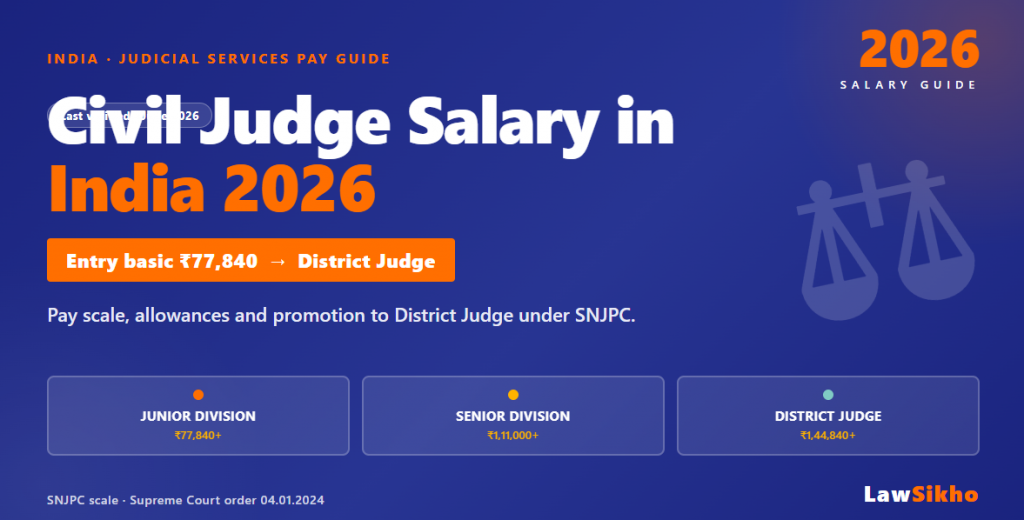
The current entry basic for a Civil Judge (Junior Division) is Rs 77,840 per month, with the full Junior Division band running from Rs 77,840 to Rs 1,36,520. That band is not a range across states. It is the spread you climb within the same rung as you put in years of service and earn annual increments. You enter at the floor of Rs 77,840 and rise toward the ceiling of Rs 1,36,520 over a career in that cadre, before any promotion even enters the picture.
These figures exist because of the order that opened this guide. The 4 January 2024 Supreme Court direction made the SNJPC scale enforceable reality, which is why a 2026 aspirant can treat Rs 77,840 as a floor rather than a coaching-page estimate. The number is uniform across the country at the basic-pay level, a point most state-specific pages quietly miss.
What does the basic alone actually tell you about your bank credit? Almost nothing. The basic is the seed figure on which DA, HRA and every other allowance are calculated, and it is also the figure from which your in-hand departs sharply once deductions kick in. Treating the basic as your salary is the single most common mistake aspirants make. We will work the full math in the gross-versus-in-hand section, but flag it here: Rs 77,840 is where the calculation starts, not where it ends.
The Rs 77,840 entry basic, explained
A common question on judiciary forums is why the entry basic sits at exactly Rs 77,840 and not a rounder number. The answer lies in how the SNJPC built the scale. It applied a uniform multiplier (2.81) to the previous judicial pay structure, which is what produced these specific, un-rounded figures rather than the neat slabs you see in private-sector pay bands. So the oddness of the number is itself a signal that it traces to a formula, not a guess.
The entry basic is also the same whether you join in Uttar Pradesh, Tamil Nadu or Assam. The SNJPC scale is national. What changes between states is the dearness allowance cycle and the house rent allowance class, both layered on top of this uniform base. Hold that distinction, because it is the source of most of the confusion in the state-wise pages.
JMFC and Civil Judge (Jr Div): same cadre, two names
Here is a naming trap that catches many aspirants. You will see “Civil Judge (Junior Division)” on one notification and “Judicial Magistrate First Class” (JMFC) on another, and assume they are two different posts with two different salaries. They are not. JMFC is the criminal-side designation of the same entry cadre. The civil judge handles civil suits; the same officer, wearing the magisterial hat, handles criminal matters as a JMFC.
In states like Madhya Pradesh, Karnataka and Rajasthan, the recruitment is often advertised as Civil Judge-cum-Judicial Magistrate First Class, folding both functions into one designation. The pay scale is identical because it is one cadre. If you are comparing a “JMFC salary” page against a “civil judge salary” page and they show different numbers, the difference is almost certainly stale data on one of them, not a real pay gap.
Correcting the stale Rs 27,700 figure you still see online
Are the Rs 27,700 salary figures floating around online outdated? Yes, completely. That number (a basic of roughly Rs 27,700 to Rs 44,770) belongs to the pre-SNJPC, Sixth Central Pay Commission-era judicial scale. It was the entry basic before the SNJPC scale took effect. Some thin state pages still carry it, occasionally in the same article that elsewhere quotes the current Rs 77,840, leaving readers staring at two contradictory numbers.
The mistake we see most often is an aspirant budgeting their life around the Rs 27,700 figure and concluding the judiciary does not pay enough early on. That figure is a fossil. Whenever you see a basic in the high twenties or low forties for a civil judge, treat the page as outdated and look for the SNJPC-era Rs 77,840 entry instead.
Before you can earn any of this, of course, you have to clear the eligibility gate, and that gate changed in 2025. Anyone planning a judiciary career should read up on the three-year practice rule that now governs civil judge eligibility, because the salary in this guide is what waits on the other side of that requirement.
The three-tier civil judge pay scale (Jr Div to Sr Div to District Judge)
Most aspirants picture the judiciary as one job with one salary. It is actually one cadre with three pay rungs, and the civil judge pay scale only makes sense once you see all three together. Where do you start, where can you climb, and what does each rung pay at the basic level? This is the data spine of the whole guide, so it is worth getting clean before layering on allowances and deductions.
The structure runs Civil Judge (Junior Division), then Civil Judge (Senior Division), then District Judge. Each is a band, not a single figure, because you draw annual increments as you serve within a rung. The three basic-pay bands under the SNJPC scale are the same nationwide; only the DA and HRA layered on top vary by state and city. Here is the matrix.
| Cadre / rung | Basic pay band (per month) | Indicative in-hand (approx) |
|---|---|---|
| Civil Judge (Junior Division) / JMFC | Rs 77,840 to Rs 1,36,520 | Rs 90,000 to Rs 1,15,000 |
| Civil Judge (Senior Division) | Rs 1,11,000 to Rs 1,63,030 | Rs 1,30,000 to Rs 1,55,000 |
| District Judge (entry-level HJS) | Rs 1,44,840 to Rs 1,94,660 | Rs 1,70,000 to Rs 2,10,000 |
Source: SNJPC scale; Supreme Court order dated 04.01.2024. In-hand figures are approximate and move with the DA cycle and state HRA class. Last verified: June 2026.
A point that trips people up: the band within each tier is not a state-to-state range. It is the increment span you travel inside that one rung over years of service. A fresh Junior Division judge starts at Rs 77,840 and can reach Rs 1,36,520 in the same post before promotion. So two civil judges in the same state, same rung, can sit at different points in the band purely because one has served longer.
Tier 1: Civil Judge (Junior Division) / JMFC
This is the entry rung, the one you reach by clearing the state judicial-services exam (the PCS-J in states like Uttar Pradesh, Punjab and Bihar). The basic band of Rs 77,840 to Rs 1,36,520 is where most aspirants will spend their first several years. It is also the rung where the gap between the headline basic and the actual in-hand is widest in proportional terms, because allowances and perks scale up as you rise.
Tier 2: Civil Judge (Senior Division)
What is the difference between Junior Division and Senior Division pay? It is a real step, not a cosmetic one. The Senior Division basic band runs from Rs 1,11,000 to Rs 1,63,030, so even the floor of Senior Division sits well above the floor of Junior Division. The Senior Division judge handles higher-value civil suits and carries greater administrative responsibility. The jump from Junior to Senior Division is the first material pay increase in a civil judge’s career, and it comes with the territory of seniority and competence rather than a separate exam in most states.
Tier 3: District Judge (entry-level Higher Judicial Service)
The top rung of this cadre is the District Judge, the entry grade of the Higher Judicial Service, with a basic band of Rs 1,44,840 to Rs 1,94,660. A serving District Judge can rise toward the upper reaches of this band with service. This is where the civil-judge cadre tops out, and where the pay genuinely compounds. For readers chasing the pay figures for High Court and Supreme Court judges, that is a separate pay structure altogether and sits outside this cadre; this guide stays on the civil-judge line from entry to District Judge, which is the ladder you actually climb from the PCS-J exam.
A pitfall worth naming: do not confuse Senior Division with District Judge. They are different rungs with a wide pay gap between them, and reaching the District Judge grade involves either promotion through merit and seniority or the direct-recruitment route, both covered later. Mixing up the two is how aspirants end up quoting the wrong basic when someone asks what they will earn.
Cadre / rung
Basic pay band
Indicative in-hand
Rung 1
Civil Judge (Junior Division) / JMFC₹77,840 – 1,36,520SNJPC basic; entry cadre
₹90,000 – 1,15,000approximate; varies by DA cycle & state HRA class
Rung 2
Civil Judge (Senior Division)₹1,11,000 – 1,63,030SNJPC basic; mid cadre
₹1,30,000 – 1,55,000approximate; derived from basic + DA spine
Rung 3
District Judge₹1,44,840 – 1,94,660SNJPC basic; senior-most cadre
₹1,70,000 – 2,10,000approximate; varies by DA cycle & state HRA class
Gross vs in-hand vs CTC: a civil judge’s real take-home
Here is the question that produces the most disappointment on a first salary slip: why is the amount credited so much lower than the basic plus allowances suggested? Gross-versus-in-hand confusion is rampant in the judiciary aspirant community, and the coaching pages rarely clear it up cleanly. So let us do the math out loud, with a sourced worked example, because the civil judge in-hand salary is the number that actually decides your monthly life.
Start with the entry basic of Rs 77,840. On top of that sits dearness allowance, currently running at approximately 44% of basic, which works out to roughly Rs 32,693. Add that to the basic and the gross moves to around Rs 1,13,033 before HRA and other allowances are factored for a given city. From that gross, deductions come out, and the credited in-hand for an entry-level Junior Division judge lands at roughly Rs 91,327. That is the number competitor pages either skip or get wrong.
| Step | Component | Amount (approx, per month) |
|---|---|---|
| 1 | Basic pay (entry, Jr Div) | Rs 77,840 |
| 2 | Add dearness allowance (~44% of basic) | + Rs 32,693 |
| 3 | Gross (before deductions) | ~Rs 1,13,033 |
| 4 | Less deductions (NPS, professional tax, etc.) | minus deductions |
| 5 | In-hand (credited) | ~Rs 91,327 |
The DA percentage here is time-sensitive. It revises roughly twice a year, so the exact gross and in-hand drift upward over time, which is precisely why “fixed” competitor numbers silently rot. Treat the 44% as a June 2026 snapshot, not a permanent constant.
The worked example: basic to DA to gross to in-hand
Why does this matter so much? Because the gap between Rs 77,840 (basic) and Rs 91,327 (in-hand) is the whole reason aspirants misjudge the job in both directions. Some assume in-hand will be far higher than basic because of “all the allowances,” and are shocked when deductions claw a chunk back. Others see the modest basic and assume the pay is thin, missing that DA and allowances lift the gross meaningfully above the basic. The truth sits between the two, and only the worked math gets you there.
What gets deducted from the gross
What deductions actually come out of a civil judge’s salary? For anyone who joined judicial service after 2004, the main one is the contribution to the National Pension System (NPS), a defined-contribution scheme that replaced the old defined-benefit pension for new government entrants. Professional tax (a small state levy) also comes out, along with any other state-specific deductions. The NPS contribution is the largest single deduction and the main reason the in-hand sits below the gross.
There is a downstream effect here that most guides miss entirely. Because gross-versus-in-hand confusion is so widespread, a page that actually teaches the deduction math earns a kind of trust that competitors forfeit by quoting a single inflated number. Aspirants remember the page that told them the truth about their first salary slip. That is the second-order payoff of in-hand reality literacy, and it is exactly the gap this section is built to fill.
Why DA makes your in-hand move every six months
Does dearness allowance really change the in-hand every six months? In effect, yes. DA is revised periodically (roughly twice a year) to track inflation, and because it is calculated as a percentage of basic, every revision nudges your gross and therefore your in-hand upward. Over a few years, that creep is not trivial. It is also why a salary figure quoted in 2024 is already understated by 2026, and why this guide carries a “last verified” date instead of pretending the number is frozen.
Allowances and perks: DA, HRA, sumptuary, housing and car
Few topics are oversold online quite like judicial perks. You will read that a civil judge gets a bungalow, a car, a driver and a domestic helper from day one. Some of that is true eventually; almost none of it is true on day one. So which civil judge allowances are real, which are SNJPC-fixed figures, and which arrive only later in the career? Let us separate the marketing from the entitlement.
The core allowances that make up a civil judge’s pay are these:
- Dearness allowance (DA), a percentage of basic revised roughly twice a year to track inflation.
- House rent allowance (HRA), which depends on the city class where you are posted.
- Sumptuary allowance, an SNJPC-fixed figure paid at the District Judge level.
- Medical allowance, fixed at Rs 3,000 per month for serving officers and Rs 4,000 per month for pensioners.
- Transport allowance, children education allowance, and risk allowance, with per-state amounts varying.
- Home-orderly (domestic help) allowance and House Building Advance, available subject to rules and seniority.
These figures were not invented by coaching centres. They were fixed by the same 4 January 2024 Supreme Court order that set the pay multiplier, which is why this section is the primary home for the allowance numbers in this guide. The figures were fixed in All India Judges Association v. Union of India, 2024 INSC 26. The sumptuary allowance of Rs 7,800 per month for District Judges (effective 01.01.2016) and the medical allowance figures both trace to that order.
DA and HRA: the big two
DA and HRA do the heavy lifting in lifting a civil judge’s gross above the basic. DA you already met in the in-hand math: roughly 44% of basic as of June 2026, revised periodically. HRA is the one that genuinely varies by posting, because it is pegged to the city class. A judge posted in a metro draws a higher HRA than one in a smaller town, which is a real reason two judges on the same basic can take home different amounts. If you are provided government accommodation, HRA is typically not paid on top, because the housing is the benefit in kind.
Sumptuary and medical allowances: the SNJPC-fixed figures
The sumptuary allowance (an entertainment-and-hospitality allowance reflecting the office a judge holds) is fixed at Rs 7,800 per month for District Judges, effective from 01.01.2016, under the SNJPC scheme the 2024 order upheld. Medical allowance is fixed at Rs 3,000 per month for serving officers and Rs 4,000 per month for pensioners. These are clean, sourced figures, and they are a useful tell: if a page quotes wildly different sumptuary or medical numbers, it is not working from the Supreme Court order.
Housing, car and home-orderly: what you get, and when
Do you get all the perks immediately, or only on promotion? This is where the online picture is most exaggerated. The substantial perks (an official car with a driver, larger official accommodation, a home orderly) typically arrive higher up the ladder, around the Additional District Judge and District Judge levels, not on day one as a fresh Junior Division judge. How long until a fresh civil judge gets a car? Realistically, not at entry. A new Junior Division judge may get official accommodation or HRA and the standard allowances, but the car-and-driver image belongs to the senior rungs.
The pitfall here is straightforward: do not budget your judiciary decision on the assumption of a bungalow and a car from the first posting. Those come with seniority. What you reliably get at entry is the SNJPC basic, DA, HRA (or accommodation), and the standard allowance set, which is genuinely solid, but it is not the senior-judge lifestyle that gets oversold on career pages.
State-wise civil judge salary: what actually varies
Why do different websites show different civil judge salaries for what is supposedly the same job? It is the question that sends aspirants in circles. One page says a UP civil judge earns one thing, another says a Delhi civil judge earns more, and the reader concludes the states pay wildly differently. The reality is narrower and more useful than that. So is a civil judge salary the same across all states, or not?
At the basic-pay level, it is the same. The SNJPC scale is national, so the entry basic of Rs 77,840 is uniform whether you serve in Uttar Pradesh, Madhya Pradesh, Rajasthan or Delhi. What varies sits on top of that uniform basic: the HRA city class (a metro posting draws more HRA than a small-town posting), the DA cycle timing as each state implements revisions, and a handful of state-specific perks and allowances. The base is national; the toppings are local.
| State (indicative) | HRA / city class | Indicative gross or in-hand | Note |
|---|---|---|---|
| Uttar Pradesh | Mixed (metro + smaller towns) | Approx, varies by posting | Large cadre; PCS-J entry |
| Madhya Pradesh | Mixed | Approx, varies by posting | Civil Judge-cum-JMFC designation |
| Rajasthan | Mixed | Approx, varies by posting | Civil Judge-cum-JMFC designation |
| Delhi | Higher (metro) | Higher HRA component | Metro HRA class lifts gross |
All figures here are approximate and vary by DA cycle and state HRA class. The basic pay is uniform nationally under SNJPC. Treat any single state’s gross as indicative, not as a national figure.
So which state pays civil judges the most in-hand? On a like-for-like basis, the differences come almost entirely from HRA class and the timing of DA revisions, not from a different basic. A metro posting such as Delhi tends to show a higher gross because of the higher HRA class, but that is a housing-cost adjustment, not a richer salary in real terms. An expert reading is that state-implementation lag on SNJPC matters more than people think: a state that is slower to operationalise the revised allowances and arrears can show lower current numbers purely because of administrative delay, not policy.
The pitfall to avoid is treating one state’s gross figure as the national civil judge salary. It is not. If a page quotes a single state’s in-hand and presents it as “the” civil judge salary in India, it is conflating a local HRA-and-DA snapshot with the uniform national basic. Anchor on the SNJPC basic; treat the state numbers as the variable layer on top.
The promotion ladder: pay at each rung and years to get there
Every competitor page lists the promotion ladder. Almost none of them prices it. They will tell you the rungs (Junior Division, Senior Division, District Judge) but never answer the question an aspirant actually has: what does my pay become at each rung, and how many years does it take to get there? That is the gap this section fills, and it is where the civil judge to district judge promotion story gets genuinely useful.
The progression works through a mix of merit-cum-seniority and, in many states, a Limited Departmental Competitive Examination (LDCE) channel that lets able officers move up faster than pure seniority would allow. Here is the ladder with both pay and time, which is the combination almost no coaching page presents together.
| Rung | Typical service to reach | Basic pay band | Indicative in-hand (approx) |
|---|---|---|---|
| Civil Judge (Junior Division) | Entry | Rs 77,840 to Rs 1,36,520 | Rs 90,000 to Rs 1,15,000 |
| Civil Judge (Senior Division) | ~5 to 7 years | Rs 1,11,000 to Rs 1,63,030 | Rs 1,30,000 to Rs 1,55,000 |
| District Judge | ~10 to 14 years (or direct recruit) | Rs 1,44,840 to Rs 1,94,660 | Rs 1,70,000 to Rs 2,10,000 |
Years to reach each rung are indicative and vary by state cadre strength, vacancies and the LDCE channel. In-hand figures move with the DA cycle.
Jr Div to Sr Div: years and the pay jump
The first promotion, from Junior Division to Senior Division, typically comes after several years of service (often in the range of five to seven, depending on the state’s cadre and vacancy position). The pay jump is real: the Senior Division floor of Rs 1,11,000 sits comfortably above the Junior Division floor. This is the first rung where an aspirant’s patience starts paying off in compounding terms rather than just annual increments within the same band.
Sr Div to District Judge: the big rung
The jump from Senior Division to District Judge is where pay materially compounds. The District Judge basic band of Rs 1,44,840 to Rs 1,94,660 represents the most significant step in the cadre, both in pay and in the perks that finally arrive (the car, the larger accommodation, the sumptuary allowance). How many years to become a District Judge from Junior Division? Through ordinary promotion, often somewhere in the range of ten to fourteen years of service, though the LDCE channel and the direct-recruitment route (covered next) can change that timeline considerably. Reaching this rung at all starts with clearing the entry exam, and aspirants who want a structured runway often work to a focused 12-month judiciary exam preparation plan before their first attempt.
Career-long earning: entry to retirement
What does a civil judge earn over a full career, from entry to retirement? Frame it as a curve, not a number. You start at the Rs 77,840 basic, climb the Junior Division band on increments, step up to Senior Division, and (for many) reach District Judge, all while DA revisions lift the in-hand at every stage. The career-long earning of a judicial officer is front-loaded for stability and back-loaded for compounding: the early years are solid and secure, and the later rungs are where the figure climbs steeply. That shape is the opposite of early private litigation, a contrast the worth-it section takes up directly.
Future outlook: DA creep and the AIJS debate
Two forward signals are worth watching. First, the in-hand will keep rising as DA revises roughly twice a year on the SNJPC base, so the numbers in this guide are likely to read low within a year or two (which is why the freshness date matters). Second, the long-discussed All India Judicial Service (AIJS), if it is ever enacted, would standardise entry and pay nationally and could reshape how the cadre is recruited and remunerated. Early signals suggest the AIJS debate is resurfacing, but practitioners expect any change to be gradual rather than sudden. Treat it as an emerging factor, not a settled reform.
Two routes to District Judge: promotion vs direct recruitment from the Bar
Here is a route that is poorly understood and yet matters enormously for pay, because it is the fastest way to the highest rung of the cadre. There are two ways to become a District Judge, not one, and they reach the same Rs 1,44,840-plus pay band by very different paths. So what are the two routes, and who should target which?
The first is internal promotion: you enter as a Civil Judge (Junior Division), serve, and climb through Senior Division to District Judge via merit-cum-seniority and the LDCE channel. The second is direct recruitment from the Bar: an advocate with the required years of practice competes directly for a District Judge vacancy without ever serving in the lower rungs. The Constitution reserves a slice of District Judge posts for this second route, which is why an experienced advocate can, in principle, enter the judiciary straight at the District Judge level.
Route 1: internal promotion from the Civil Judge cadre
The promotion route is the default path for someone who clears the PCS-J exam young. You build years of service, your pay climbs through the bands described above, and you reach District Judge through a combination of seniority and the competitive LDCE channel that rewards able officers with faster movement. The advantage is a secure, pensioned career from day one and a clear internal ladder. The trade-off is time: ordinary promotion to District Judge can take well over a decade.
Route 2: direct recruitment from the Bar (Article 233, 25% quota)
The direct-recruitment route is grounded in the Constitution itself. Under Article 233 of the Constitution of India, a person who has been an advocate for at least seven years is eligible for appointment as a District Judge, and roughly a quarter of District Judge posts are filled through this direct-recruitment-from-the-Bar quota. For a practising advocate with seven years at the Bar, this is the route that skips the entire lower-cadre climb and lands directly at the Rs 1,44,840-plus District Judge pay band. The strategic implication is significant: an experienced advocate weighing the bench against continued practice is really weighing this direct route, not the entry-level civil judge exam.
The 2020 position and the 2025 reopening
For years, the contested question was whether a serving judicial officer could also compete in this direct-recruitment quota, or whether it was reserved strictly for practising advocates. In 2020, the Supreme Court settled it one way: in Dheeraj Mor v. Hon’ble High Court of Delhi, AIR 2020 SC 1084, the court held that direct recruitment to District Judge under Article 233(2) is confined to practising advocates with the requisite years of practice, and that in-service judicial officers are not eligible for that quota. That closed the door on serving officers using the direct route to leapfrog the promotion ladder.
That position has now changed. On 9 October 2025, a five-judge Constitution Bench of the Supreme Court reopened the direct-recruitment channel for in-service officers in Rejanish K.V. v. K. Deepa, 2025 INSC 1208, expressly overruling the Dheeraj Mor line. The court held that a person who is or has been in judicial service, and who has an aggregate of seven years or more of experience as an advocate and/or a judicial officer, is eligible to be considered for direct recruitment as a District Judge or Additional District Judge under Article 233. It also fixed a uniform minimum age of 35 years for all candidates and directed states to amend their recruitment rules within three months. Can a serving judicial officer apply for direct recruitment to District Judge? After the 2025 ruling, yes, subject to the combined-experience and age conditions the court laid down. Because states are still amending their rules to align with the judgment, an aspirant should confirm the current notification in their state before acting on it.
Internal promotion from the Civil Judge cadre
Direct recruitment from the Bar
Why these are the numbers: SNJPC and the Supreme Court
Here is what no coaching page in this space does: tie the salary to the law that created it. Every competitor quotes the figures; none explains that they exist because of a pay commission report and a Supreme Court that enforced it. That gap is the whole reason this guide carries more authority than a salary table, so it is worth understanding where the SNJPC pay scale actually comes from.
The Second National Judicial Pay Commission (SNJPC) was the body tasked with revising judicial pay across the subordinate judiciary. It was constituted in 2017 (notified on 16 November 2017) under a retired Supreme Court judge, and it submitted its report on 4 February 2020. Its work produced the three-tier scale, the allowance structure, and the pay multiplier that together define what a civil judge earns today. Without the SNJPC, the numbers in this guide would not exist in this form.
What the SNJPC is and what it changed
What is the SNJPC and how did it change judicial pay? In short, it rebuilt the pay structure of the subordinate judiciary from the ground up, moving it off the older Sixth Central Pay Commission-era scale (the source of that stale Rs 27,700 basic) and onto a dedicated judicial scale with its own multiplier. The point of a separate judicial pay commission is constitutional: judges exercise sovereign judicial power and their pay is not meant to be a mechanical clone of administrative-service pay. The SNJPC scale is the practical expression of that principle.
The 2024 order: arrears, allowances, the 2.81 multiplier
The SNJPC’s recommendations did not become enforceable money until the Supreme Court acted. In its order dated 4 January 2024, the apex court accepted the SNJPC’s pay and allowance recommendations, upheld the uniform pay multiplier of 2.81, fixed the allowances (sumptuary, medical, transport, children education and others), and directed states and union territories to disburse arrears by 29 February 2024, in All India Judges Association v. Union of India, 2024 INSC 26. What did the court rule on judicial pay arrears in 2024? Exactly that: pay the revised scale and the back-dated arrears, on a deadline.
Why does the 2.81 multiplier matter? Because governments pushed to lower it, arguing judicial pay should be aligned more closely with administrative-service pay, and the court refused. It held the line at 2.81, reaffirming that judicial pay is determined on its own constitutional footing rather than pegged to the bureaucracy. That refusal is the reason the civil judge basic sits where it does and not lower. Are the arrears actually paid in every state? In principle yes, by the court’s deadline, though in practice state-implementation lag has meant some states moved faster than others, which is the realistic caveat behind the headline.
From the Shetty Commission to SNJPC: the 30-year line
None of this began in 2017. The line runs back through the First National Judicial Pay Commission (the Shetty Commission, which worked through the late 1990s) and further back to the early-1990s litigation in which judicial officers first established their claim to an independent pay-determination mechanism rather than being clubbed with the executive. The Shetty Commission created the first dedicated judicial pay structure; the SNJPC modernised it; the 2024 order enforced it. Three decades, two commissions, and a consistent constitutional thread: judicial pay stands on its own. (These commissions are historical context, best traced through the Department of Justice, rather than live case citations.)
Is it worth it? Civil judge pay vs IAS vs private practice
This is the question every aspirant actually asks once the numbers are clear: given the exam difficulty, is the civil judge salary worth it, and how does it stack up against the IAS or against private practice? Commercial honesty matters here, so this section gives a clear comparison and an actual verdict rather than hedging. How does a civil judge salary vs IAS comparison really shake out?
| Path | Entry pay (approx) | Trajectory | Perks | Trade-offs |
|---|---|---|---|---|
| Civil Judge (Jr Div) | Basic Rs 77,840; in-hand ~Rs 91,000 | Front-loaded stability, steep at District Judge | Allowances now; car/housing at senior rungs | Long promotion timeline; exam difficulty |
| IAS officer | Comparable entry pay band | Fast administrative rise, varied postings | Strong perks early (housing, staff) | High transfer churn; political interface |
| Private litigation | Low and variable early | High-variance; can be very high late | None institutional | Slow, uncertain early years |
| Assistant Public Prosecutor | Lower than judicial cadre | Modest progression | Standard government allowances | Lower ceiling than the bench |
Entry pay figures are approximate and move with DA and HRA. The table compares broad shapes, not exact parity.
Civil judge vs IAS: pay and perks reality
How does a civil judge’s pay compare to an IAS officer’s? At entry, the pay bands are broadly comparable, both being senior government scales. The IAS edge is in the breadth of perks and the speed of early administrative responsibility; the judiciary’s edge is independence and a focused judicial career. District judge vs IAS at senior levels is closer than aspirants assume, because the District Judge band (Rs 1,44,840 to Rs 1,94,660) is a senior scale in its own right. The honest difference is less about money and more about the nature of the work: administration versus adjudication.
Judiciary vs private litigation income
Is the judiciary worth it financially versus private litigation? It depends entirely on when you measure. The Indian litigation income curve is slow and uncertain early: a junior in independent practice may earn little for years before the practice matures. The judiciary front-loads stability: a Rs 91,000 in-hand from month one, pensioned security, and predictable increments. A successful senior advocate can eventually out-earn a judge by a wide margin, but the variance is enormous and the early years are lean. It helps to see how private-practice lawyer pay actually trends in India across practice areas before weighing it against the bench. For most aspirants, the judiciary trades a higher ceiling for a far higher floor.
Judiciary vs other state service and prosecutor pay
How does judicial pay compare to other state-service salaries and to a public prosecutor’s? The civil-judge cadre generally sits above the typical state Provincial Civil Service (executive) entry pay and well above an Assistant Public Prosecutor’s, reflecting the SNJPC scale and the 2.81 multiplier that lifts judicial pay above the administrative line. For someone choosing between a prosecutor role and the bench, the pay difference is real and compounds over a career, on top of the difference in role and authority.
The honest verdict
So, the verdict. For an aspirant who can clear the exam, the civil judge career offers a genuinely strong combination: a solid entry in-hand, a pensioned and secure trajectory, and a pay ladder that compounds materially at the District Judge rung. In our view, the judiciary is worth it for anyone who values stability and a focused judicial career over the high-variance upside of private practice, and the numbers back that up rather than relying on prestige alone. There is a second-order effect worth naming, too: because the Rs 77,840 entry basic widens the gap against early private-litigation income, the judiciary exam has only grown more competitive, which is exactly why structured preparation now matters more than raw effort.
Frequently asked questions
1. What is the salary of a civil judge in India in 2026? A Civil Judge (Junior Division) draws a basic pay of Rs 77,840 to Rs 1,36,520 per month under the SNJPC scale, with an in-hand of roughly Rs 90,000 to Rs 1,15,000 after DA, HRA and deductions. On promotion to District Judge, the basic rises to Rs 1,44,840 to Rs 1,94,660. The figures are uniform nationally at the basic level.
2. What is the in-hand salary of a civil judge (junior division)? The entry in-hand is approximately Rs 91,000 per month: a basic of Rs 77,840, plus DA of around 44% (roughly Rs 32,693) taking gross to about Rs 1,13,033, minus deductions such as the NPS contribution and professional tax. The exact in-hand shifts with each DA revision and the city’s HRA class.
3. What is the SNJPC and how did it change judicial pay? The Second National Judicial Pay Commission (constituted 2017, report February 2020) rebuilt the subordinate judiciary’s pay structure, replacing the older Sixth Pay Commission-era scale with a dedicated judicial scale and a 2.81 multiplier. The Supreme Court accepted its recommendations on 4 January 2024 and ordered states to pay the revised scale and arrears.
4. What is the sumptuary allowance for judges? The sumptuary allowance is an entertainment-and-hospitality allowance reflecting judicial office. Under the SNJPC scheme the Supreme Court upheld, it is fixed at Rs 7,800 per month for District Judges, effective from 1 January 2016. It is one of the allowances tied to the senior rung rather than the entry cadre.
5. What deductions are taken from a civil judge’s salary? For officers who joined after 2004, the largest deduction is the contribution to the National Pension System (NPS). Professional tax (a small state levy) and other state-specific deductions also apply. These deductions are the main reason the credited in-hand sits noticeably below the gross figure that allowances suggest.
6. Is civil judge salary the same across all states? At the basic-pay level, yes: the SNJPC scale is national, so the Rs 77,840 entry basic is uniform across states. What varies is the HRA city class, the timing of DA revisions, and some state-specific perks. A metro posting shows a higher gross mainly because of a higher HRA class, not a different basic.
7. What is the salary after promotion to District Judge? A District Judge draws a basic of Rs 1,44,840 to Rs 1,94,660 per month, with an in-hand of roughly Rs 1,70,000 to Rs 2,10,000 after DA and allowances. This is the entry grade of the Higher Judicial Service and the top rung of the civil-judge cadre, and it is where perks like an official car and larger accommodation typically arrive.
8. What are the two routes to become a District Judge? There are two: internal promotion from the Civil Judge cadre (through merit-cum-seniority and the LDCE channel), and direct recruitment from the Bar under Article 233 of the Constitution for advocates with at least seven years of practice. Roughly a quarter of District Judge posts are reserved for the direct-recruitment route.
9. What is direct recruitment of District Judges from the Bar? It is the constitutional route by which a practising advocate with seven years at the Bar can be appointed directly as a District Judge, without serving in the lower rungs. About 25% of District Judge posts are filled this way under Article 233. In October 2025, the Supreme Court held that in-service judicial officers with seven years’ combined experience as an advocate and/or judicial officer can also compete for this quota, overruling the earlier position that limited it to advocates.
10. What is the difference between gross, in-hand and CTC for a civil judge? Gross is basic plus all allowances before deductions (around Rs 1,13,033 at entry). In-hand is what is actually credited after deductions like NPS and professional tax (around Rs 91,327 at entry). CTC, a private-sector framing, is misleading for government jobs because pension and benefits do not map neatly to a “package” figure.
11. How does civil judge salary compare to an IAS officer’s? At entry, the pay bands are broadly comparable, both being senior government scales. The IAS offers wider perks and faster administrative responsibility early; the judiciary offers independence and a focused adjudicatory career. At senior levels, the District Judge band is closer to IAS pay than most aspirants assume, so the real difference is the nature of the work.
12. Which state pays civil judges the most in-hand? On a like-for-like basis, the differences come almost entirely from HRA class and DA timing, not from a different basic. A metro posting such as Delhi shows a higher gross because of a higher HRA class, but that reflects higher living costs rather than a richer salary. The basic pay itself is uniform nationally.
13. How does pre-SNJPC pay compare to post-SNJPC pay? The pre-SNJPC (Sixth Pay Commission-era) entry basic was roughly Rs 27,700 to Rs 44,770, the figure still floating around stale pages. The post-SNJPC entry basic is Rs 77,840. The jump reflects the 2.81 multiplier the SNJPC applied and the Supreme Court upheld, which is why the old number is now simply wrong for 2026.
14. What is a District Judge’s salary in India? A District Judge earns a basic of Rs 1,44,840 to Rs 1,94,660 per month under the SNJPC scale, rising toward the upper band with service, plus DA, sumptuary allowance (Rs 7,800), medical allowance and the senior-rung perks. The in-hand sits in the approximate range of Rs 1,70,000 to Rs 2,10,000, depending on posting and DA cycle.
15. Do civil judges get a pension after retirement? Judicial officers who joined after 2004 are generally under the National Pension System, a defined-contribution scheme, rather than the older defined-benefit pension. Pensioners also receive a fixed medical allowance (Rs 4,000 per month). The exact retirement benefit depends on the scheme applicable to the officer’s date of entry and the state’s rules.
16. How much salary increment does a civil judge get per year? A civil judge draws annual increments that move them up within their pay band over service years, which is how a Junior Division judge climbs from the Rs 77,840 floor toward the Rs 1,36,520 ceiling without changing rung. On top of increments, periodic DA revisions lift the in-hand roughly twice a year, so the credited amount rises both from increments and from DA creep.
References
Case Law
- All India Judges Association v. Union of India, 2024 INSC 26. Supreme Court of India, 4 January 2024; SC judgment PDF
- Dheeraj Mor v. Hon’ble High Court of Delhi, (2020) 7 SCC 401. AIR 2020 SC 1084; Supreme Court of India, 19 February 2020 (overruled by Rejanish K.V. v. K. Deepa, 2025)
- Rejanish K.V. v. K. Deepa, 2025 INSC 1208. 2025 SCC OnLine SC 2196; Supreme Court of India (5-judge Constitution Bench), 9 October 2025
Statutes
- Constitution of India, 1950: Article 233 (appointment of district judges)
Official sources
- Second National Judicial Pay Commission, Department of Justice: notified 16.11.2017 (Justice (Retd.) P. Venkatarama Reddi); report submitted 04.02.2020; pay matrix on a 2.81 multiplier. The First National Judicial Pay Commission (Shetty Commission, 1996 to 1999) is the predecessor referenced for historical context.
This article is for informational purposes only and does not constitute legal advice. For specific legal guidance, consult a qualified legal professional.




 Allow notifications