
Last verified: 2026-07-08
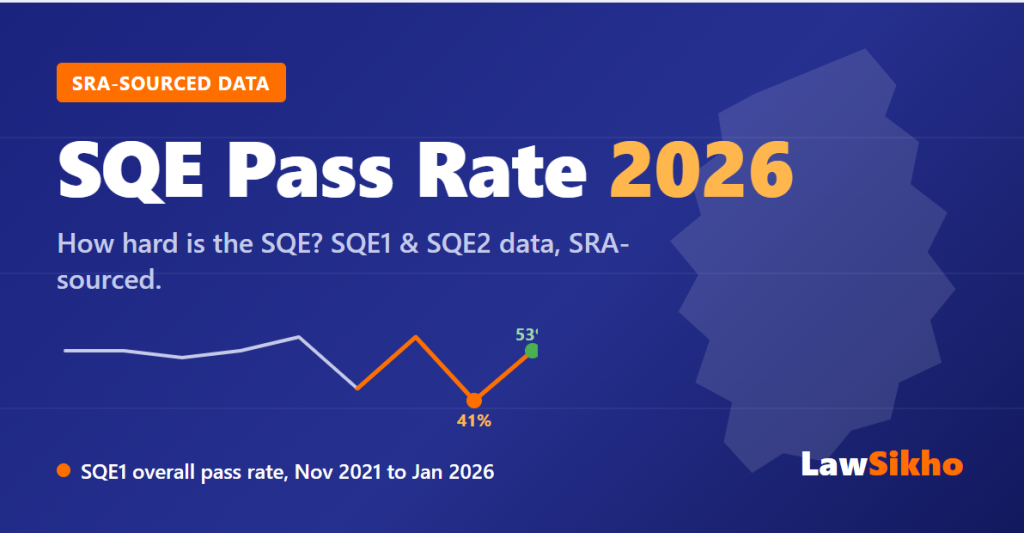
In July 2025, the SQE pass rate did something it had never done before. It fell to 41%. That was the overall SQE1 figure for the sitting, the lowest since the exam launched in November 2021, and it meant nearly six in ten candidates walked out of two five-hour papers with a fail. The number went out on the results date and, within days, it was a headline in the legal press.
The story most people told about that number was wrong, though. The obvious reading was that the exam had suddenly got harder, that the Solicitors Regulation Authority (SRA) had tightened the screws. That is not what happened. The pass standard on the SQE is fixed by a formal statistical method (Modified Angoff, which we’ll unpack later), so the bar didn’t move. What moved was the cohort. July 2025 carried the highest share of resitting candidates the exam had ever recorded, and the SRA’s own analysis judged that group weaker on the anchor questions it uses to compare sittings.
So the honest version reads differently. The exam is hard. And who sits it in any given window swings the headline by ten points or more. Both things are true at once, and almost no page explains that clearly, which is exactly why a reader who typed “how hard is the SQE” tends to leave more confused than they arrived.

Here’s what that reader usually wants and rarely gets in one place. Every official pass rate, SQE1 and SQE2, every sitting, sourced. A plain explanation of how the exam is actually scored, so the swings stop looking sinister. The resit number that quietly decides most candidates’ fate before they’ve even booked. And the question no UK page touches, because no UK page is written for this reader: how hard is the SQE for an Indian lawyer, or any foreign-qualified lawyer coming in on a common-law background?
That last one matters more than it looks. Roughly a third of the candidate pool now sits outside the traditional England-and-Wales law-graduate route, and the pass-rate data by ethnicity and first language shows a gap of around twenty points. If you trained in Indian law and you’re reading a BPP or ULaw difficulty page, you’re reading a page that assumes you already know English property practice and solicitors’ accounts. You don’t. Nobody does until they study it. That single blind spot explains a lot of the gap, and it’s fixable.
This is the page that puts the whole picture in one place. Every SRA-sourced number, the mechanics behind them, the resit cliff, and the layer built for lawyers qualifying into England and Wales from somewhere else.
The SQE is genuinely hard. SQE1 first-attempt pass rates have ranged from 46% to 60%, falling to a record 41% overall in July 2025, and resitters pass at under 10%. SQE2 runs higher, 69% to 84% first-attempt, only because its cohort has already survived SQE1. The SRA calls the SQE “more demanding than the LPC.”
The numbers below tell the full story. Jump to the master table for the raw data, or read straight through for how hard the SQE really is and why the figure swings the way it does.
SQE pass rates by sitting (2021 to 2026): the full official data
Start with the raw data, because everything else on this page is interpretation of it. If you only take one thing away, let it be the shape of these two tables, not any single sitting’s headline. A reader who fixates on the July 2025 figure alone will draw the wrong conclusion. A reader who sees the whole series sees a pattern that’s volatile at the edges and remarkably stable in the middle.
Why does the sourcing matter so much here? Because half the confusion in this topic comes from pages mixing up two different SRA series (a first-time component series and the headline overall series) and quoting them as if they’re the same. Every row below is drawn from the individual per-sitting statistical report for that window, which is the authoritative cut. Where the SRA’s aggregate “four years on” publication reports a differently-sliced number, we’ve flagged it rather than blended it.
SQE1 pass rates, every sitting
This is the spine. SQE1 is the multiple-choice stage (two papers of functioning legal knowledge, FLK1 and FLK2), and its pass rate is the number that drives every “how hard is the SQE” search. Read the overall column for the headline, and the first-attempt column for what a well-prepared first-timer actually faces.
| Sitting | Overall pass rate | First-attempt pass rate | Candidates | Source |
|---|---|---|---|---|
| November 2021 (first sitting) | 53% | n/a (all first attempts) | 1,073 | SRA SQE1 report, Nov 2021 |
| July 2022 | 53% | 55% | 1,829 | SRA SQE1 report, Jul 2022 |
| January 2023 | 51% | 54% | 3,031 | SRA SQE1 report, Jan 2023 |
| July 2023 | 53% | 56% | 3,475 | SRA SQE1 report, Jul 2023 |
| January 2024 | 56% | 59% | 6,061 | SRA SQE1 report, Jan 2024 |
| July 2024 | 44% | 48% | 5,006 | SRA SQE1 report, Jul 2024 |
| January 2025 | 56% | 60% | 6,782 | SRA SQE1 report, Jan 2025 |
| July 2025 | 41% (record low) | 46% | 5,851 | SRA SQE1 report, Jul 2025 |
| January 2026 | 53% | 58% | 7,863 | SRA SQE1 report, Jan 2026 |
Look at what the bold rows are doing. From January 2023 to January 2025, the overall figure sat in a tight 51% to 56% band. Then July 2024 dropped to 44%, recovered to 56% the next January, and dropped again to 41% in July 2025 before recovering to 53%. The recoveries aren’t luck. They’re what happens when the resitter concentration eases in the January sittings (more on that in the July-versus-January section). The first-attempt column tells the kinder story: a prepared first-timer has faced somewhere between 46% and 60% odds across the exam’s life, which is a very different picture from the scary 41% headline.
SQE2 pass rates, every sitting
SQE2 is the practical-skills stage: sixteen stations across written skills (legal writing, drafting, research, case and matter analysis) and oral skills (advocacy, client interview). Its pass rates run much higher, and the reason is structural, not because the paper is soft.
| Sitting | Overall pass rate | First-attempt pass rate | Candidates | Source |
|---|---|---|---|---|
| April 2022 (first sitting) | 77% | n/a (first sitting) | 726 | SRA SQE2 report, Apr 2022 |
| October 2022 | 71% | n/a | n/a | SRA SQE2 report, Oct 2022 (per-sitting figure cross-checked to independent SRA-data analysis) |
| April 2023 | 77% | n/a | n/a | SRA SQE2 report, Apr 2023 (per-sitting figure cross-checked to independent SRA-data analysis) |
| July 2023 | 79% | n/a | n/a | SRA SQE2 report, Jul 2023 (per-sitting figure cross-checked to independent SRA-data analysis) |
| October 2023 | 64% (lowest SQE2 sitting) | 69% | 642 | SRA SQE2 report, Oct 2023 |
| January 2024 | 73% | n/a | n/a | SRA SQE2 report, Jan 2024 (per-sitting figure cross-checked to independent SRA-data analysis) |
| April 2024 | 79% | n/a | n/a | SRA SQE2 report, Apr 2024 (per-sitting figure cross-checked to independent SRA-data analysis) |
| July 2024 | 74% | n/a | n/a | SRA SQE2 report, Jul 2024 (per-sitting figure cross-checked to independent SRA-data analysis) |
| October 2024 | 81% | n/a | n/a | SRA SQE2 report, Oct 2024 (per-sitting figure cross-checked to independent SRA-data analysis) |
| January 2025 | 75% | 77% | 1,134 | SRA SQE2 report, Jan 2025 |
| July 2025 | 76% | 79% | 959 | SRA SQE2 report, Jul 2025 |
| October 2025 | 78% | 79% | 1,342 | SRA SQE2 report, Oct 2025 |
| January 2026 | 80% | 79% | 1,141 | SRA SQE2 report, Jan 2026 |
The October 2023 dip to 64% has a specific cause worth remembering, because it’s the exception that proves the “cohort decides the number” rule. That sitting was transitional, and 34% of those sitting were already-qualified lawyers taking SQE2 under exemption arrangements. That group passed at only 49%, against 80% for the non-qualified candidates, and their weight pulled the whole sitting down. It wasn’t a harder paper. It was a different room.
The cumulative picture, four years on
Single sittings mislead. The cumulative figures, drawn from the SRA’s “SQE four years on: facts and figures” report published on 29 January 2026, give you the real base rate. Across all attempts, 19,281 candidates (66%) have now passed SQE1, and 10,718 (85%) have passed SQE2. More than 30,000 candidates have sat the exam across 50 countries in four years. That is the number that should anchor your expectations: over a full run, with all attempts counted, two in three clear SQE1 and roughly six in seven clear SQE2.
That “across 50 countries” line is the quiet headline for this blog’s audience. The SQE was built to be a global route into England-and-Wales practice, and it’s being used as one. India is one of its fastest-growing source markets, which is precisely why the domestic-only difficulty pages leave so much unanswered.
Is the SQE1 pass rate getting worse?
Short answer: no, not on the evidence. It’s volatile, which feels like decline if you only watch the low points. The honest read of the series is a stable core with two sharp dips.
Trace the history. The exam launched in November 2021 at 53%. It settled into a 51% to 56% band right through 2022, 2023 and into early 2024. Then came the first shock, July 2024 at 44%, which recovered to 56% by January 2025. Then the record low, July 2025 at 41%, which recovered to 53% by January 2026. Two down-spikes in a four-year run, both in July sittings, both followed by an immediate recovery, is not a declining trend. It’s a seasonal pattern layered on a flat baseline. Anyone telling you the SQE is “getting harder every year” is reading the dips and ignoring the recoveries.
So how hard is the SQE?
You’ve seen the numbers. Now the question the numbers exist to answer. When someone types “how hard is the SQE,” they’re not really asking for a percentage. They’re asking whether they can do it, what it’ll cost them in preparation, and whether the horror stories are fair. Let’s be honest about all three.
What the numbers actually tell you
Here’s the thing the raw figures hide. The overall SQE1 pass rate (the one that dropped to 41%) blends first-timers and resitters together, and resitters pass at under 10%, so the overall number is dragged down by a group most first-time readers aren’t in. If you’re preparing for a first attempt, the number that describes your world is the first-attempt rate: 46% to 60% across the exam’s history. That’s still hard. Roughly four to five in ten well-prepared first-timers don’t clear it in a single go. But it’s a coin-flip-plus challenge, not the near-impossible wall the 41% headline suggests.
SQE2 tells the opposite story and teaches the same lesson. Its first-attempt rates run high, 69% to 84%, but not because the practical skills stage is a formality. It’s because everyone sitting SQE2 has already passed SQE1. The population has been filtered. Compare the SQE1 and SQE2 headline rates without accounting for that filtering and you’ll conclude SQE2 is easy, which is the single most common analytical error on this topic. The real question isn’t “which stage has the higher number,” it’s “which stage is measured on a comparable cohort,” and the answer is neither, cleanly.
Why the SQE is hard: five reasons
Strip away the statistics and the difficulty comes down to five design choices, all deliberate:
- It’s closed-book. No statutes, no notes, no reference materials in the room. You carry the functioning legal knowledge in your head.
- There are no past papers and no feedback. The SRA doesn’t release real exam questions, and if you fail, you’re told your quintile, not what you got wrong.
- It tests application, not recall. SQE1 questions are single-best-answer problems set in a client scenario. Knowing the rule isn’t enough; you have to apply it under pressure.
- It’s a stamina exam. SQE1 is 360 multiple-choice questions across two papers of five hours and more each, sat on separate days.
- There’s a three-attempt cap. You get three shots at each assessment within a six-year window. Miss three times and you’re out of that route.
Which of these bites hardest? For most candidates it’s the third and the fifth working together: application under a hard cap. You can’t cram your way through, and you can’t afford to treat attempt one as a practice run.
Is it harder than the LPC? Harder than the US bar?
The SRA’s own position is that the SQE is “more demanding than the LPC,” the Legal Practice Course it replaced. That’s not marketing; it’s the regulator explaining why its pass rates sit lower than the LPC’s did. The LPC was course-based, with modular assessment and provider support baked in. The SQE is a centralised, closed-book, application-heavy exam with a hard cap. Different instrument, higher difficulty by design.
Against the US bar, the comparison is murkier and the honest answer is “differently hard.” A common sentiment among candidates who’ve faced both is that the SQE feels worse than a state bar exam, largely because of the no-feedback, no-past-papers regime and the closed-book format. We’d treat that as candidate perception rather than a measured fact, because the exams test different things on different scales. What’s fair to say is this: nobody who’s sat the SQE describes it as easy, and the ones who cleared it first time almost universally say the same thing about how they did it.
How the SQE is actually scored: pass marks, scaling and the Angoff method
Most difficulty pages quote the pass mark and move on. That’s a mistake, because the scoring method is the whole explanation for why the headline number swings while the exam stays the same. Understand the mechanics and the July 2025 panic dissolves.
The pass mark: scaled 300 out of 500 on each FLK
The SQE1 pass mark is a scaled score of 300 out of 500, and you need it on each of FLK1 and FLK2 separately. Pass one and fail the other, and you resit only the failed paper, which is a genuine relief valve most candidates don’t realise exists until they need it. The scaled score is not a raw percentage. Historically, the raw equivalent has sat around 53% to 57% correct, roughly 95 to 103 of the 180 questions on each paper, though the SRA doesn’t publish the exact raw cut for each sitting. So no, the pass mark is not “60%,” despite how often that figure gets repeated in forums. It’s a scaled 300, and the raw threshold moves slightly sitting to sitting to hold the standard constant.
Why scale at all? Because no two sets of 180 questions are exactly equal in difficulty. Scaling adjusts for the specific paper so that a scaled 300 means the same level of competence whether your paper ran slightly harder or slightly easier than the last one. That’s the point most people miss: the scaling exists to keep the standard fixed, not to move it.
360 questions, roughly 100 seconds each
Each FLK paper is 180 single-best-answer multiple-choice questions. Two papers means 360 questions total across SQE1, sat over two days of five hours and more each. Do the arithmetic on the clock and you get roughly 100 seconds per question, not the “30 seconds” figure that floats around some forums (that number appears to conflate a different assessment format and is worth ignoring). A hundred seconds sounds generous until you remember each question is a client scenario you have to read, parse and reason through to a single best answer, with four plausible distractors designed to catch the half-prepared.
Why pass rates swing but the standard stays the same
This is the myth-buster, so here’s the mechanism in full. The SQE sets its standard using the Modified Angoff method. Panels of recently qualified solicitors go through every question and estimate the probability that a “just competent” candidate would answer it correctly. Those estimates, aggregated, set the minimally-competent threshold for that paper. The SRA then applies a standard error of measurement before the Assessment Board confirms the cut score. The goalpost, in other words, is set by what a competent new solicitor should be able to do, and that definition doesn’t change between sittings.
So what makes the pass rate move? The cohort. If a given sitting is packed with resitters (who pass at under 10%) or a group that underperforms on the anchor questions used to calibrate across sittings, the pass rate falls even though the standard held firm. The SRA said exactly this about July 2025: the standard was constant, the cohort was weaker. Once you see that, “the exam got harder” stops being a coherent claim. What got harder was the average candidate in that particular room.
Quintiles, not raw marks
One more piece of the machinery. You don’t get a raw mark back. You get a quintile per FLK, Q1 (top 20%) down to Q5 (bottom 20%), and the pass mark typically sits near the Q3/Q4 boundary. That’s a deliberately blunt signal, and it’s part of why candidates find failure so frustrating: you learn roughly where you landed, not which topics sank you. It also means a lot of failures are close ones, clustered right at the boundary, which is a point we’ll come back to when we talk about how narrow the margin between pass and fail really is.
SQE1 vs SQE2 (and FLK1 vs FLK2): which is harder?
“Which is harder” is one of the most-searched SQE questions, and the answer has two levels: SQE1 versus SQE2, and within SQE1, FLK1 versus FLK2. Before the numbers make sense, it helps to be clear on how SQE1 and SQE2 are structured, because the two stages test completely different things.
Why SQE2 pass rates look higher
We touched on this, but it’s worth stating flatly because it’s the crux. SQE2’s pass rates look higher because its cohort is pre-filtered: only candidates who’ve already passed SQE1 sit it. You’re comparing a general population (SQE1) with a population that’s already cleared a hard gate (SQE2). Of course the second group passes at a higher rate. It says nothing about which stage is intrinsically harder.
The October 2023 SQE2 sitting is the tell. It dipped to 64%, the lowest SQE2 sitting on record, because it was a transitional window where 34% of candidates were already-qualified lawyers sitting under exemption arrangements. That subgroup passed at just 49%, against 80% for the non-qualified candidates. Same paper, wildly different outcomes by group, which is exactly the cohort effect that drives every swing on this exam. Miss that nuance, as most competitor pages do, and you’ll misread the whole SQE2 series.
FLK2 is the harder paper
Within SQE1, the data is consistent: FLK2 trails FLK1 almost every sitting. FLK2 covers property practice, litigation, wills and the administration of estates, trusts, and solicitors’ accounts. In January 2026, FLK1 passed at 62% against FLK2 at 57%. Back at the launch in November 2021, the gap was starker, 67% versus 54%. In July 2024’s low sitting, FLK1 was 55% and FLK2 50%.
| Sitting | FLK1 pass rate | FLK2 pass rate |
|---|---|---|
| November 2021 | 67% | 54% |
| January 2024 | 63% | 61% |
| July 2024 | 55% | 50% |
| January 2025 | 64% | 61% |
| January 2026 | 62% | 57% |
Source: SRA per-sitting SQE1 statistical reports.
Why does FLK2 bite harder? In practice, it’s the accounts and property content. Solicitors’ accounts is a rules-heavy, precision-dependent topic that rewards no partial credit, and property practice runs on England-and-Wales-specific procedure that few candidates encounter before they study for it. If you’re weighting your revision, FLK2 deserves the heavier hand.
Which SQE2 skill is hardest
SQE2 is graded holistically across its stations, so there’s no per-station pass mark, but the SRA does report mean scores by skill, and they reveal where candidates struggle. These are mean scores, not pass rates, an important distinction. Advocacy scores highest, around 75.6%, which surprises people who dread the oral stations. The lowest are legal drafting (around 64.2%) among the written skills and client interview with attendance note (around 64.6%) among the oral ones.
| SQE2 skill | Mean score | Note |
|---|---|---|
| Advocacy (oral) | ~75.6% | Highest-scoring station |
| Case and matter analysis | ~67.4% | Mid-range |
| Client interview + attendance note (oral) | ~64.6% | Hardest oral station |
| Legal drafting (written) | ~64.2% | Hardest written skill |
Source: SRA SQE2 skill-station reporting, as compiled in independent SRA-data analysis. These are mean scaled-station scores, not pass rates.
The lesson for candidates: don’t over-invest in advocacy prep because it feels scary. The marks say drafting and the client interview are where the ground is softest, and those are the skills a common-law academic background does least to prepare you for.
The resit cliff: why first-attempt preparation is everything
If there’s one number on this page that should change how you prepare, it isn’t 41% or 53%. It’s this: first-attempt SQE1 candidates pass at around 54%, but second-attempt candidates pass at just 9.9%, and third-attempt at 1.9%. SQE2 shows the same near-vertical drop, 79.6% first attempt, 4.6% second, 0.3% third. Almost nobody warns you about this before you book, and it’s the most decision-relevant statistic the SRA publishes.
Three attempts, and the cliff after attempt one
You get three attempts at each SQE assessment within a six-year window. That sounds forgiving until you read the pass rates by attempt from the SRA’s four-years-on data.
| Attempt | SQE1 pass rate | SQE2 pass rate |
|---|---|---|
| First attempt | 54.3% | 79.6% |
| Second attempt | 9.9% | 4.6% |
| Third attempt | 1.9% | 0.3% |
Source: SRA “SQE four years on: facts and figures” (29 January 2026).
Read that second row again. A candidate who fails SQE1 once and resits has a roughly one-in-ten chance of passing the second time. That’s not a small drop from the first-attempt rate; it’s a collapse. The three-attempt cap is real, but the practical truth is that most of your probability of ever qualifying is spent on attempt one. Blow the first attempt under-prepared, and the odds don’t reset to 54% for round two. They crater.
Why resitters fail, and what first-timers should learn from it
So why does the cliff exist? It’s counter-intuitive, because you’d expect a second attempt to go better with a sitting’s worth of experience behind you. The likeliest explanation is selection: the candidates who fail first time are disproportionately those who went in under-prepared, and a resit rarely fixes the underlying gap unless the preparation strategy changes fundamentally. The “I’ll just do the free SRA sample questions and wing it” approach quietly dies in this data. Under-prepared self-study candidates who fail once rarely recover, which is why structured preparation built around the England-and-Wales syllabus has shifted from a nice-to-have to something much closer to a necessity.
That’s not a sales pitch; it’s what the resit numbers describe. A common question in candidate forums is whether you can pass the SQE without a formal prep course. The honest answer: a small number of exceptionally disciplined self-studiers do, but the resit data suggests they’re the exception, and the cost of being wrong is another full exam fee plus a nine-in-ten chance of failing again. For anyone weighing that gamble, it’s worth looking at the real INR cost of the SQE before deciding a resit is an acceptable Plan B.
For readers who want the concrete version of “prepared properly,” a structured first-attempt SQE1 preparation plan maps the six months before a sitting so attempt one carries the weight it deserves.
Does the SQE compare to the QLTS on resits?
A recurring search is whether the SQE is harder than the QLTS, the Qualified Lawyers Transfer Scheme that used to be the transfer route for foreign-qualified lawyers. The QLTS is retired, so the comparison is mostly historical now, but it matters to older candidates weighing routes. The QLTS was narrower and, by reputation, more predictable in its assessment style. The SQE is broader, closed-book across more subjects, and carries this steep resit penalty the QLTS didn’t advertise. If you qualified abroad and remember the QLTS as the easier-sounding option, the SQE’s resit data is the clearest sign that the bar for a smooth first-time pass has risen.
Why July sittings underperform January
There’s a pattern in the SQE1 series that, once you see it, changes how you’d plan your own sitting. The July window consistently underperforms January. Both record lows (44% in July 2024, 41% in July 2025) landed in July. That’s not coincidence, and it’s not that summer papers are harder.
It’s the resitters
The mechanism is cohort composition. July sittings carry the heaviest concentration of resitters, because candidates who fail a January sitting funnel into the next July attempt. July 2025 recorded the highest resitter share the exam has seen, 19% of the overall cohort, rising to 23% in FLK1 and 26% in FLK2. Since resitters pass at under 10%, a July sitting loaded with them mathematically drags the headline down, even if every individual first-timer performs exactly as they would have in January. The paper didn’t change. The room did.
“Weaker cohort”: what the SRA actually said
The SRA’s own explanation for July 2025 was that the cohort underperformed on the common anchor questions it uses to calibrate difficulty across sittings. Read carelessly, “weaker cohort” sounds like the regulator blaming candidates. Read properly, it’s a technical statement: the anchor questions are the fixed reference points that let the SRA confirm the standard didn’t move, and this cohort scored lower on them. It’s the statistical fingerprint of a composition effect, not evidence of a harder paper. Same standard, different average candidate.
Actionable: sit in January if you can choose
So here’s the practical takeaway almost nobody gives you: if you can choose your sitting, choose January. The first-timer’s headline odds are simply better in the window with fewer resitters, and the data backs it across the exam’s whole life. There’s a second-order twist worth flagging, though. As this January advantage becomes common knowledge, more informed candidates will cluster into January sittings, which could gradually shift cohort composition and narrow the gap. For now, and for the next couple of sittings at least, January remains the smarter bet for a first attempt.
How hard is the SQE for Indian and foreign-qualified lawyers?
Here’s the layer no UK page writes, because no UK page is written for you. Four years of SQE data show a persistent gap of around twenty points between White candidates and Asian or Asian British candidates, and a similar gap between those who speak English as a first language and those who don’t. Much of that gap isn’t about ability. It’s about which body of law your education actually covered, and that’s a solvable problem if you name it honestly.
What the demographic data shows
The SRA publishes pass rates by ethnicity and first language, and the numbers are stark. In the January 2026 SQE1 sitting, White candidates passed at 67% while Asian or Asian British candidates passed at 47%, a gap of twenty points. By first language, English-first-language candidates passed at 62% against 46% for other-first-language candidates. SQE2 shows the same shape: in January 2026, White candidates passed at 88% and Asian or Asian British candidates at 66%. Every one of these figures comes from the SRA’s per-sitting statistical reports and the four-years-on aggregate.
| Group | SQE1 (Jan 2026) | SQE2 (Jan 2026) |
|---|---|---|
| White candidates | 67% | 88% |
| Asian / Asian British | 47% | 66% |
| English first language | 62% | 84% |
| Other first language | 46% | 61% |
Source: SRA SQE1 and SQE2 reports, January 2026; SRA four years on.
Many Indian candidates fall squarely in the Asian or Asian British band and the other-first-language band, which means both proxies point the same way. This isn’t a reason to be discouraged. It’s a reason to prepare differently from the domestic law graduate the standard prep pages assume you are.
Is there an “international candidate” pass rate?
The honest answer is that the SRA does not publish a standalone pass rate for international or overseas candidates. Anyone quoting you a precise “international pass rate” as an official figure is overstating what exists. What does exist is external commentary from prep providers reporting something in the region of 35% to 40% SQE1 for international lawyers, against the roughly 53% overall. Treat that as cross-validation, not gospel: it is not published or verified by the SRA, and it should not be presented as an official number. The reliable, SRA-sourced proxies remain the ethnicity and first-language gaps above, and they’re sobering enough on their own.
The common-law-overlap trap
Now the part that actually explains the gap, and it’s not what most people assume. An Indian legal education is a double-edged sword on the SQE. The good edge: contract and tort in India descend from the same common-law roots as England and Wales, so on parts of FLK1 you’ll recognise the terrain and move faster than a candidate seeing it fresh. The bad edge, and it’s the one that sinks people: that overlap breeds false confidence, and it lulls candidates into under-preparing the England-and-Wales-specific material where an Indian degree gives you nothing at all.
What’s genuinely new ground? Property practice under the English system. Solicitors’ accounts, which is rules-precise and unforgiving. English civil and criminal procedure, which differs from Indian procedure in ways that matter for single-best-answer questions. Wills and the administration of estates under English law. These sit disproportionately in FLK2, which is exactly why FLK2 is the harder paper and exactly where a common-law background helps you least. The candidates who trip here aren’t weak lawyers. They’re strong lawyers who over-trusted the overlap and studied the familiar 40% while skimping the unfamiliar 60%.
Do exemptions change the pass-rate maths?
For some experienced foreign lawyers, exemptions shift the picture. A candidate who qualifies for an SQE2 exemption, for instance, sits fewer components and therefore carries a different risk profile than someone doing the full route. That’s a double-edged thing again: fewer assessments to pass, but also fewer chances to offset a weak paper, and the transitional October 2023 data (where exempt qualified lawyers passed SQE2 at only 49%) is a caution against assuming experience translates automatically. Whether you’re eligible, and whether claiming an exemption actually helps your odds, depends on your specific qualifications. The detail is worth checking against SQE eligibility and exemptions for Indian lawyers before you assume an exemption is a shortcut.
Apprentices and reasonable-adjustment candidates
Two data points that counter common worries. First, apprentices are the best-performing route on the SQE, passing SQE1 at 70.5% and SQE2 at 92.9%, which tells you that sustained, structured, work-integrated preparation beats every other profile. That’s the closest thing the data offers to a formula: consistent, applied study over time. Second, for anyone anxious about disability or neurodivergence: candidates who declare a disability and receive reasonable adjustments perform at least as well as the overall cohort, and in the September 2024 to July 2025 window they scored slightly higher than average. The adjustment process works, and declaring what you need is not a disadvantage.
Does the prep provider change your odds? (BPP vs ULaw vs BARBRI vs QLTS)
“Which provider has the best pass rate” is a hardening commercial query, and it deserves an honest answer rather than a league table. The short version: provider rates exist, they aren’t directly comparable, and the logo matters less than what you do with the preparation.
The provider rates, with the caveat
Several providers publish their own pass rates. BPP reports around 83%, ULaw around 76%, BARBRI around 72%, and QLTS School around 94%. Here’s the catch: these are self-reported, measured on different cohorts, with no common denominator and no independent audit. A provider that attracts stronger candidates, or reports only students who completed the full course, will post a higher number without necessarily teaching better.
| Provider | Claimed pass rate | Caveat |
|---|---|---|
| QLTS School | ~94% | Self-reported; cohort composition not disclosed |
| BPP | ~83% | Self-reported; not a common denominator |
| ULaw | ~76% | Self-reported; varies by course and cohort |
| BARBRI | ~72% | Self-reported; different cohort mix |
Source: provider-published figures (self-reported, not SRA-audited; treat as directional only).
Read these as directional, not as a ranking. None of them is an SRA figure, and the differences between them tell you more about who enrols where than about which course is objectively best.
What actually moves your odds
What genuinely shifts your probability of passing isn’t the provider’s brand; it’s three things you control. First-attempt discipline: treating attempt one as the real one, because the resit cliff means it effectively is. Full coverage of the England-and-Wales syllabus, especially the FLK2 material a common-law background skips. And mock volume: sitting enough full, timed papers that the format holds no surprises. Can you do all that while working full-time? Many do, but candid providers describe it as 40-plus-hour-a-week study on top of a job for several months, so plan the calendar honestly.
Pass rate by prior route
The SRA’s route data lines up with everything above. Apprentices lead, as noted. Law-degree and GDL/PGDL candidates cluster around the overall averages. The transitional LPC-to-SQE candidates show more variance, tied to how much of the old course maps onto the new format. The pattern is consistent: the more your prior route drilled applied, jurisdiction-specific practice for England and Wales, the better you do. Which is also why an Indian LLB, strong as it is on common-law fundamentals, needs topping up on the jurisdiction-specific material rather than treated as sufficient on its own.
The criticism, the low pass rate and the SRA’s external review
The SQE has critics, and after July 2025 they got louder. A fair guide has to cover the grievances, because they’re part of “how hard is the SQE”: some of the difficulty is design, and some of it, candidates argue, is opacity.
The candidate grievances
Four complaints come up again and again. Candidates say the SRA’s sample questions feel noticeably easier than the real exam, so preparation misleads them about the true difficulty. They point out there are no past papers, unlike almost every other major professional exam, so you can’t practise on real material. They object that failure comes with zero substantive feedback, just a quintile, so you don’t learn what to fix. And many argue the closed-book format is unrealistic, since no practising solicitor works without reference materials. Are these fair? The feedback and past-paper complaints land hardest, in our view; the closed-book objection is weaker, since the format is testing whether the knowledge is genuinely functioning rather than looked-up.
The pass rate that triggered a review
The July 2025 record low did more than make headlines. It intensified pressure from the legal press and professional bodies to examine whether the assessment is working as intended, and the SRA confirmed it would appoint external assessment experts to review the SQE, with reporting expected during 2026. That review could touch assessment design, feedback policy, or the standard-setting method itself. It’s an early signal rather than a settled outcome, and it’s the reason this page carries a “last verified” date: when the review reports, the picture may shift, and we’ll update accordingly. For now, the mechanics described above are the live position.
How close is “close”? The borderline reality
One under-appreciated fact softens the scary headline. Because the pass mark sits near the Q3/Q4 quintile boundary, a large share of failures are near-misses, candidates who fell just short rather than candidates who were nowhere near. The margin between a pass and a fail is often thin, which cuts two ways. It’s encouraging, because a modest lift in preparation moves a lot of borderline candidates across the line. And it’s a warning, because on a thin margin, stamina lapses and careless application errors in the final questions of a five-hour paper are exactly what tip a near-pass into a fail. First-attempt preparation is what buys you the cushion.
SQE pass rates and difficulty: frequently asked questions
What is the SQE pass rate in 2026? For the January 2026 sitting, the overall SQE1 pass rate was 53% (58% first-attempt) and SQE2 was 80% (79% first-attempt). Cumulatively across four years, 66% of candidates have passed SQE1 and 85% have passed SQE2. Every figure is from the SRA’s per-sitting reports and its “four years on” publication.
What is the SQE1 pass rate? It varies by sitting. Overall SQE1 pass rates have ranged from a record low of 41% (July 2025) to 56% (January 2024 and 2025), sitting in a 51% to 56% band most of the time. First-attempt candidates pass at a higher rate, 46% to 60%, because the overall figure is dragged down by resitters.
What is the SQE2 pass rate? SQE2 pass rates run much higher than SQE1, between 64% and 81% overall depending on the sitting, and 69% to 84% first-attempt. The January 2026 sitting was 80% overall. The rates are high because only candidates who’ve already passed SQE1 sit SQE2, a pre-filtered, stronger population.
What is the SQE1 pass mark? The SQE1 pass mark is a scaled score of 300 out of 500 on each of FLK1 and FLK2 separately. It is not a raw 60%, despite that figure circulating in forums. The raw equivalent has historically sat around 53% to 57% correct, roughly 95 to 103 of 180 questions, though the SRA doesn’t publish the exact raw cut per sitting.
Why was the July 2025 SQE1 pass rate only 41%? Because that sitting carried the highest resitter share on record (19% overall), and resitters pass at under 10%. The SRA also found the cohort underperformed on its anchor questions. The pass standard is fixed by the Modified Angoff method, so the exam didn’t get harder; the cohort was weaker.
How many attempts do you get at the SQE? You get three attempts at each SQE assessment within a six-year window. The catch is the resit data: first-attempt SQE1 candidates pass at around 54%, but second-attempt candidates pass at only 9.9% and third-attempt at 1.9%. Most of your realistic chance of qualifying is concentrated in attempt one.
What happens if you fail the SQE three times? If you fail an SQE assessment three times, you cannot re-sit it and cannot qualify as a solicitor through the SQE using that assessment, subject to the SRA’s rules on the assessment window. This is why first-attempt preparation matters so much: the three-attempt cap combined with the resit cliff means under-preparing early has lasting consequences.
Can you pass one FLK and fail the other? Yes. SQE1 requires a scaled 300 on each of FLK1 and FLK2, assessed separately. If you pass one and fail the other, you keep the pass and resit only the failed paper. This is a genuine relief valve, and many candidates don’t realise it exists until they need it.
What is the resit pass rate for the SQE? For SQE1, second-attempt candidates pass at 9.9% and third-attempt at 1.9%, against roughly 54% first attempt. For SQE2, second attempt is 4.6% and third is 0.3%, against 79.6% first attempt. These are the SRA’s four-years-on figures, and they’re the strongest argument for getting attempt one right.
Is the SQE1 pass rate getting worse? Not on the evidence. It’s volatile, not declining. The overall rate held a 51% to 56% band from 2022 to early 2024, dipped sharply in July 2024 (44%) and July 2025 (41%), and recovered each time to 53% to 56%. Two July dips followed by recoveries is a seasonal pattern, not a downward trend.
How hard is the SQE really? Genuinely hard, but not the near-impossible exam the 41% headline implies. First-attempt SQE1 pass rates of 46% to 60% mean roughly half of prepared first-timers clear it in one go. The difficulty comes from closed-book format, no past papers, application-over-recall questions, two five-hour papers, and a three-attempt cap. The SRA calls it “more demanding than the LPC.”
Which is harder, SQE1 or SQE2? By pass rate, SQE1 looks harder because its overall rates are lower. But that’s a cohort artefact: SQE2 is only sat by candidates who’ve already passed SQE1, so its higher rates reflect a filtered population, not an easier assessment. SQE1’s multiple-choice application load and SQE2’s practical-skills stations test different things.
Is the SQE harder than the LPC? Yes, per the SRA’s own position that the SQE is “more demanding than the LPC.” The LPC was course-based with modular assessment and built-in provider support. The SQE is centralised, closed-book, application-heavy and capped at three attempts. It’s a different and harder instrument by design.
Does the SQE pass rate vary by provider? Providers publish their own rates (BPP around 83%, ULaw around 76%, BARBRI around 72%, QLTS School around 94%), but these are self-reported, measured on different cohorts, with no common denominator and no SRA audit. Treat them as directional, not a league table. What moves your odds most is first-attempt discipline and England-and-Wales-specific coverage, not the logo.
SQE1 vs SQE2 pass rate: why the gap? Because SQE2’s cohort is pre-filtered. Only candidates who’ve already cleared SQE1 sit SQE2, so its 69% to 84% first-attempt rates reflect a stronger, self-selected group. The gap says nothing about which stage is intrinsically harder; it reflects who is in each room.
How hard is the SQE for Indian lawyers? Harder than the overall figures suggest, on the SRA’s own demographic data. Asian or Asian British candidates passed SQE1 at 47% against 67% for White candidates in January 2026, and other-first-language candidates at 46% against 62%. Much of the gap traces to the England-and-Wales-specific material (property, accounts, English procedure) that an Indian degree doesn’t cover, which is fixable with the right preparation.
What is the SQE pass rate for international or overseas candidates? The SRA does not publish an official international or overseas pass rate. External prep-provider commentary suggests roughly 35% to 40% SQE1 for international lawyers, but that figure is cross-validation only and is not verified or published by the SRA. The reliable proxies are the SRA’s ethnicity (47% Asian) and first-language (46% other-language) SQE1 gaps.
Is the SQE worth it for an Indian-qualified lawyer? For lawyers who want to practise in England and Wales, it remains the route, and the pass rates are clearable with England-and-Wales-specific preparation. The honest calculus weighs the exam fees, the resit risk (under 10% on a second attempt), and the study time against the career payoff. The candidates for whom it works best are those who prepare for the jurisdiction-specific material rather than relying on common-law overlap. Compare the routes in this analysis of SQE vs AIBE for Indian lawyers.
When are SQE results published? SQE results are released on set dates after each sitting, typically a few months later, with SQE1 January-sitting results usually issued in the spring and July-sitting results in the autumn (July 2025 results, for example, were released on the SRA’s published results date). Check the SRA’s assessment calendar for the exact date for your sitting, as it varies.
References and official sources
Every pass-rate figure in this guide is drawn from the official sources below. Provider rates (BPP, ULaw, BARBRI, QLTS School) and the “international 35% to 40%” figure are cross-validation only, not published by the SRA, and are labelled as such in the body.
- SRA, “SQE four years on: facts and figures” (published 29 January 2026): cumulative pass rates, attainment gaps by ethnicity and first language, and pass-by-attempt data. Available at sra.org.uk/sra/research-publications/sqe-four-years-facts-figures/
- SRA and Kaplan, SQE1 per-sitting statistical reports (November 2021 to January 2026): per-sitting overall and first-attempt pass rates, plus FLK1 and FLK2 component splits. Available at sqe.sra.org.uk (results and statistics).
- SRA and Kaplan, SQE2 per-sitting statistical reports (April 2022 to January 2026): SQE2 overall and first-attempt pass rates and skill-level mean scores. Available at sqe.sra.org.uk (results and statistics).
- SRA, SQE Apprentice Performance Report (17 October 2025): apprenticeship-route pass rates for SQE1 and SQE2.
- SRA, standard-setting and assessment information: the Modified Angoff method, scaled scoring (300 out of 500), and quintile reporting. Available at sqe.sra.org.uk.
This article is for informational purposes only and does not constitute legal advice. For specific legal guidance, consult a qualified legal professional.



 Allow notifications