
Last verified: 30 June 2026
In September 2021 the Solicitors Regulation Authority switched on the SQE and quietly retired a qualification route that had run for decades. Two standardised, computer-based papers replaced a tangle of conversion courses and provider-specific exams. And for the first time, the regulator published a single document, the SQE1 assessment specification, that lists every subject the exam can test across its two papers, FLK1 and FLK2. If you’re trying to understand the SQE1 FLK1 and FLK2 subjects, that specification, not any coaching brochure, is the real map of what’s on the exam.
Here’s why that matters more for an Indian lawyer than for almost anyone else sitting the test.
Open the FLK1 list and the first things you see are Contract, Tort, Dispute Resolution. Comforting. You studied versions of all three for your LLB, and India shares its common-law roots with England and Wales, so the concepts feel like home turf. Then you turn to FLK2 and the ground shifts. Land Law built on a registered-title system you’ve never used. Trusts grounded in English equity. Wills and the Administration of Estates with Inheritance Tax rules that have no Indian equivalent. Solicitors Accounts governed by the SRA Accounts Rules. The subjects look familiar from the index. The rules underneath them often aren’t.

That gap, between what looks familiar and what actually is, is the single most expensive misjudgement an Indian candidate can make. It’s the reason two people with identical Indian law degrees can find wildly different parts of SQE1 hard. One spends weeks relearning English contract remedies they assumed they already knew. The other burns the same weeks on Land Law and never quite recovers the time. Neither read the specification closely enough to see where their training actually transferred and where it didn’t.
So this post does one job, and does it properly: it turns the SRA’s specification into a clean, subject-by-subject breakdown of FLK1 and FLK2. What sits in each paper. What each subject covers. The official per-subject weighting the SRA publishes in its blueprint. And, because no other page on the internet bothers to, a familiarity map that tells an Indian LLB holder which subjects are old friends in new clothes and which are genuinely foreign territory.
It won’t tell you how to revise (that’s a study-plan question, and there’s a dedicated guide for it). It won’t re-teach the broad SQE1-versus-SQE2 structure. It tells you what’s in the syllabus, accurately, with the India-specific lens that turns a flat subject list into something you can actually plan around. Think of it as the page you wish you’d read before you opened the spec for the first time.
What subjects are in FLK1 and FLK2? SQE1 has two papers. FLK1 covers Business Law and Practice, Dispute Resolution, Contract, Tort, the Legal System of England and Wales (including constitutional, administrative and assimilated EU law) and Legal Services. FLK2 covers Property Practice, Wills and Administration of Estates, Solicitors Accounts, Land Law, Trusts and criminal law. Ethics is tested across both.
That’s the headline. Here’s the same split as a side-by-side table, then the official weighting, then the depth.
Table 1: FLK1 subjects vs FLK2 subjects
| FLK1 subjects | FLK2 subjects |
|---|---|
| Business Law and Practice | Property Law and Practice |
| Dispute Resolution | Wills and the Administration of Estates |
| Contract Law | Solicitors Accounts (within Property and Wills) |
| Tort | Land Law |
| Legal System of England and Wales (Constitutional, Administrative and assimilated EU law) | Trusts Law |
| Legal Services | Criminal Liability |
| Criminal Law and Practice |
The rest of this breakdown takes each subject apart, attaches the official weighting, and maps the whole thing for an Indian lawyer.
SQE1 at a glance: FLK1 and FLK2 in one line
Before any subject breakdown makes sense, you need one fact to hang it on: SQE1 is not one exam. It’s two papers, and the subjects are split between them deliberately. Get that wrong and the weighting tables read like nonsense.
So, the one-line version. “FLK” stands for Functioning Legal Knowledge, and SQE1 tests it across two papers, FLK1 and FLK2. FLK1 is the business, commercial and litigation paper. FLK2 is the private-client, property and criminal paper. Each is sat as single-best-answer multiple-choice questions, where you pick the strongest of five options rather than write essays. If you want the full picture of how SQE1’s FLK1 and FLK2 fit into the wider SQE structure, including how SQE2 then tests your practical skills, that’s a separate guide; here we stay on the subjects.
The numbers that frame the subjects
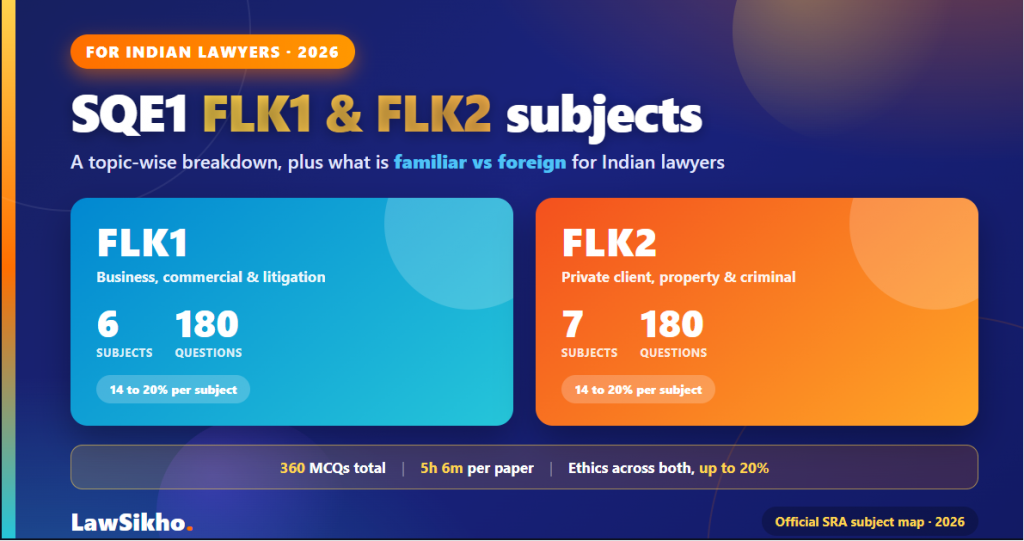
A handful of figures shape how the subjects are sampled, so they’re worth stating once. FLK1 contains 180 questions and FLK2 contains 180 questions, for 360 across the two papers. Each paper is sat in 5 hours 6 minutes, split across two sittings on assessment day. There’s no essay component and no choice of questions; every candidate answers the full bank.
Why does the count matter for a subjects post? Because 180 questions per paper is what makes the official weighting bands meaningful. When the SRA says a subject carries a 14 to 20 percent weighting, that band is applied to a large enough question set to be felt. A subject isn’t a token presence. It’s a real chunk of your score, which is exactly why knowing the subject list early changes how you’d approach the whole thing.
In practice, both papers must be passed for SQE1 as a whole. You can’t trade a strong FLK1 against a weak FLK2 beyond the assessment’s own compensatory rules, and the cost of resitting is real, so the subject spread on each paper deserves attention from day one. Indian candidates often underestimate this and treat the two papers as interchangeable halves. They aren’t. If you’re costing out the route, it’s worth knowing what sitting both FLK papers actually costs in INR before you commit, and who is eligible to sit these SQE1 papers from India in the first place.
Why September 2021 matters
Here’s a piece of history that explains the spec’s whole shape. When the SQE went live on 1 September 2021, it didn’t just replace the old route; it centralised the syllabus. Before that, different course providers taught and tested their own versions of the foundations. After it, there was one assessment specification, written by the regulator, naming every subject the assessment provider, Kaplan, can draw questions from.
That’s the quiet superpower of this exam. The syllabus isn’t a secret you reverse-engineer from past papers. It’s published. The 2022 to 2025 period saw the SRA refresh its sample-question sets and relabel “retained EU law” as “assimilated EU law,” but the subject structure has held remarkably stable since launch. So when you learn the FLK1 and FLK2 subjects today, you’re learning a list that has proven durable, not a moving target. And isn’t that exactly what you want before investing months of preparation?
FLK1 vs FLK2 subjects: the official map and weighting
Now that you know there are two papers, the obvious next question is which subject sits where, and how much each one counts. This is the section competitors get wrong most often, so accuracy here is the whole point.
The split is not random. FLK1 groups the subjects a newly-qualified solicitor uses on the commercial and contentious side of a firm: business, disputes, contract, tort, the legal system and legal services. FLK2 groups the private-client, property and criminal subjects, as Table 1 above set out. That grouping is what the weighting then sits on top of.
One crossover trips candidates up constantly, so it’s worth naming. “Is criminal in FLK1 or FLK2?” The answer is both, but in different forms. Civil and criminal litigation procedure sit inside Dispute Resolution on FLK1, while the substantive criminal subjects (Criminal Liability and Criminal Law and Practice) sit on FLK2. So the procedure of running a case lives with disputes in FLK1; the substantive criminal law and its own practice live in FLK2. Get that distinction straight early and the map stops feeling contradictory.
How the subjects are weighted
The SRA publishes per-subject weightings in Annex 4 of the SQE1 specification, often called the blueprint. And it publishes them as percentage bands, not fixed question counts, because the exact distribution can shift between sittings within those bands. That distinction is where a lot of online guides mislead readers. Anyone who tells you a subject is “exactly 30 questions” is converting a band into a count and presenting an estimate as gospel. Treat fixed counts as estimates only.
Table 2: Official SRA Annex 4 subject weighting
| Paper | Subject | Official weighting |
|---|---|---|
| FLK1 | Business Law and Practice | 14 to 20% |
| FLK1 | Dispute Resolution | 14 to 20% |
| FLK1 | Contract Law | 14 to 20% |
| FLK1 | Tort | 14 to 20% |
| FLK1 | Legal System (England and Wales, Constitutional and Admin, EU) | 14 to 20% |
| FLK1 | Legal Services | 12 to 16% |
| FLK2 | Property Law and Practice (incl. Solicitors Accounts) | 14 to 20% |
| FLK2 | Land Law | 14 to 20% |
| FLK2 | Wills and Administration of Estates (incl. Solicitors Accounts) | 14 to 20% |
| FLK2 | Trusts Law | 14 to 20% |
| FLK2 | Criminal Liability | 14 to 20% |
| FLK2 | Criminal Law and Practice | 14 to 20% |
| Both | Ethics and Professional Conduct (incl. money laundering) | Pervasive; up to 20% of questions |
What jumps out is how flat the distribution is. Almost every subject sits in the same 14 to 20 percent band, with Legal Services slightly lighter at 12 to 16 percent. There’s no single subject you can safely neglect because it “only carries a few marks.” That’s a deliberate design choice: the exam wants broad competence, not a candidate who has gamed three high-value topics.
Thirteen subjects, roughly 142 topics
A common figure floating around the SERP is “13 subjects, 142 topics, with 59 in FLK1 and 83 in FLK2.” Worth flagging clearly: that topic count is a third-party tally of the SRA specification, not a number the SRA puts in a headline. The specification breaks down to roughly that many topics depending on how you count, and FLK2 does carry the larger share. Use it as a sense of scale, not as an official statistic. The honest takeaway is that FLK2 is broader than FLK1 by topic spread, which feeds directly into the “which is harder” question later. A common worry candidates raise is whether the spec is bigger than the Indian bar syllabus; in raw subject breadth, it generally is.
The 6 FLK1 subjects, explained
You’ve seen the map. Now the detail. FLK1 carries six subjects, and each one rewards a different slice of a commercial solicitor’s knowledge. The trap for Indian candidates is assuming the familiar-sounding ones need no work; the English rules differ even where the concept is shared. Let’s take them in order.
Business Law and Practice
This is the corporate-and-commercial heart of FLK1. It covers business vehicles (sole trader, partnership, LLP and company), incorporation, corporate governance, directors’ and shareholders’ rights and duties, finance and security, and insolvency. It also folds in business taxation: income tax, capital gains tax, corporation tax, VAT and inheritance tax in a business context. For an Indian lawyer, the company-law concepts will feel broadly recognisable, but the tax content is English and has no Indian analogue you can lean on. That’s the part most underestimate.
Dispute Resolution
Dispute Resolution covers the full contentious lifecycle: arbitration, mediation and litigation, limitation periods, pre-action protocols, jurisdiction, issuing and serving proceedings, statements of case, interim applications, case management, evidence, disclosure, trial, costs, appeals and enforcement. The concepts mirror Indian civil litigation, but the procedural spine is the Civil Procedure Rules, not the Code of Civil Procedure. So while you’ll recognise the shape of a claim, the rules on service, disclosure and costs are genuinely different and must be relearned. In practice, candidates who assume “I’ve done litigation” often score worst here precisely because the false confidence stops them studying the CPR detail.
Contract Law
Contract covers offer and acceptance, consideration, formation, privity, express and implied terms, exemption clauses, vitiating factors such as misrepresentation and mistake, termination and remedies including damages and specific performance. This is the subject Indian candidates feel most at home with, and rightly so; the Indian Contract Act descends from the same common-law tradition. But the cases are English and a few rules diverge, so treat it as a refresh, not a skip. What experienced mentors notice is that overconfidence here costs marks on the edge cases (remoteness, penalty clauses) where English authority has moved.
Tort
Tort covers negligence, duty of care, breach, causation, defences, occupiers’ liability, product liability, nuisance and the rule in Rylands v Fletcher. Again, the structure of negligence will be familiar to anyone who studied Indian tort law, because both systems draw on the same English foundations. The difference is depth and currency: the SQE samples specific English doctrinal positions, so “I know negligence broadly” isn’t enough. You need the English rules as they currently stand.
Legal System of England and Wales, Constitutional and Administrative Law and assimilated EU Law
This is one subject, not three, and that bundling trips up several competitor pages. It covers the court hierarchy, precedent, statutory interpretation, constitutional law, separation of powers, judicial review, and the Human Rights Act 1998 with the ECHR. It also includes assimilated EU law, the post-Brexit relabelling of retained EU law. Here’s the correction that earns trust: “Public Law” is not a separate FLK1 subject, and any page listing it as standalone has mis-read the spec. For Indian lawyers, the constitutional and judicial-review concepts transfer at a high level, but the HRA 1998 and ECHR framework is foreign and needs building from scratch.
Legal Services
Legal Services covers SRA regulation, money laundering, financial services and the funding of legal services. And here’s a detail candidates frequently get backwards: the money-laundering questions sit in FLK1, within this Legal Services and business context, not in the criminal paper where instinct might place them. It’s a smaller subject by weighting (12 to 16 percent), but it’s heavily rules-based and entirely English-regulatory, so there’s nothing your Indian training pre-loads. Don’t let the lighter weighting fool you into ignoring it; the rules are precise and easily testable.
The 7 FLK2 subjects, explained
If FLK1 is where Indian candidates feel deceptively comfortable, FLK2 is where the real learning lives. Seven subjects, and the majority of them are built on English legal structures with no close Indian equivalent. This is the paper to respect. So what does each subject actually demand?
Property Law and Practice
Property Practice covers freehold and leasehold transactions (both residential and commercial), title investigation, pre-contract searches, exchange, completion, leases (grant, assignment, covenants and breach), security of tenure and property taxation. This is English conveyancing end to end, and conveyancing as practised in England and Wales bears little resemblance to Indian property transfer. The registered-title system, the search regime and the exchange-then-complete mechanism are all new ground for most Indian candidates. Budget accordingly.
Wills and the Administration of Estates
This subject covers will validity and interpretation, testate and intestate distribution, grants of representation, Inheritance Tax, estate administration, personal representatives’ duties and beneficiary rights. English succession law and Inheritance Tax are genuinely foreign to Indian-trained lawyers; India has no IHT and a different intestacy framework. The mechanics of obtaining a grant and administering an estate are specific and procedural, so this is a build-from-scratch subject for most. It rewards methodical learning over intuition.
Solicitors Accounts
Here’s the one that confuses people: Solicitors Accounts is not a standalone subject you sit on its own. It’s examined in the context of Property Law and Practice and Wills and Administration. It covers client money, ledgers and bank accounts, the SRA Accounts Rules, accounting entries, bills, accountants’ reports and record-keeping. Because it’s woven into the two transactional subjects, candidates sometimes skip it entirely, then lose marks they didn’t see coming. The SRA Accounts Rules are uniquely English-regulatory, so there’s no shortcut from prior experience.
Land Law
Land Law covers registered and unregistered land, freehold and leasehold estates, landlord and tenant, and co-ownership. This is often the single most alien subject for an Indian lawyer, because the English registered-and-unregistered land system, with its specific rules on interests, priorities and overriding interests, simply doesn’t map onto Indian property concepts. It’s conceptually dense and rules-heavy. Most candidates who report a “hardest subject” name this one.
Trusts Law
Trusts covers express and implied trusts, fiduciary relationships, trustees’ duties, powers and liability, and equitable remedies. English equity and the trust as a legal device are not part of standard Indian legal training in the same depth, so this is foreign territory for most. It’s also conceptually subtle, the kind of subject where surface familiarity hides genuine gaps. Treat it as new, even if the word “trust” feels familiar from Indian trust statutes; the English doctrine runs deeper and differently.
Criminal Liability
Criminal Liability covers the core principles of criminal liability applied to specified offences: assault, theft, criminal damage, homicide and fraud. The general principles (mens rea, actus reus, the structure of offences) will be recognisable to anyone who studied Indian criminal law, because the conceptual scaffolding is shared. But the offences are defined by English statute and case law, not the Indian Penal Code or the new Bharatiya Nyaya Sanhita, so the specifics must be relearned. Concept familiar, content foreign.
Criminal Law and Practice
This second criminal subject covers the procedural side: police-station procedure, bail, the magistrates’ court, evidence, trial, sentencing and appeals. English criminal procedure is its own world, from the role of the duty solicitor at the police station to the sentencing framework, and none of it carries over from Indian criminal procedure. It’s practical and detail-driven, the sort of subject you learn by working through the process step by step.
Where Ethics fits: pervasive, not a separate subject
Scan most competitor pages and you’ll find Ethics listed as if it were a thirteenth subject sitting in one paper. That’s wrong, and the error matters because it changes how you’d prepare. So where does Ethics actually live?
Ethics and Professional Conduct is examined across both FLK1 and FLK2. There is no standalone “Ethics” paper and no single subject slot for it. Instead, ethical and professional-conduct questions are seeded throughout the assessment, attached to the substantive subjects. A property question can carry an ethics dimension; so can a litigation question or a business question. You can’t revise ethics as a discrete block and tick it off, because it surfaces everywhere.
How pervasively?
The numbers make the point. Ethics and professional conduct, taken together with money-laundering questions, can make up up to 20 percent of the questions assessed. That’s a fifth of the exam, spread invisibly across both papers. For perspective, that’s a larger share than any single substantive subject’s weighting band tops out at. The lesson: you treat ethics as a layer over the whole syllabus, not a chapter you read once. And recall the earlier point that money-laundering questions specifically sit in FLK1, within the Legal Services and business context.
A correctness note worth keeping
While we’re correcting the record, here’s the other common error: the Legal System subject bundles constitutional, administrative and assimilated EU law together, so “Public Law” is not a separate FLK1 subject. If a study site lists Public Law as standalone or files Ethics under FLK2 as its own subject, it has misread the specification. These aren’t pedantic quibbles. Get the subject map wrong and you build a revision plan around a syllabus that doesn’t exist. Doesn’t it make sense to start from the regulator’s own structure rather than someone’s paraphrase of it?
Is FLK1 or FLK2 harder? A subject-content read
This is the question every forum eventually asks, and most answers are useless because they pretend there’s a universal answer. There isn’t. But you can reason about it properly from the subject content, which is more honest than a coin-flip “it depends.”
Why FLK2 feels heavier
On paper, FLK2 carries more: seven subjects against FLK1’s six, and the larger topic share (roughly 83 topics versus 59, on that third-party tally). More ground to cover usually means more to forget. So in pure breadth, FLK2 is the heavier paper for most candidates, and that’s a defensible general statement.
Difficulty tracks your training, not the paper
Here’s the part that actually matters, and it’s a second-order effect most guides miss. A subject’s difficulty for you is mostly a function of how far it sits from your prior training. For an Indian LLB holder, the FLK1 subjects (Contract, Tort, Dispute Resolution, criminal principles, constitutional concepts) sit closer to home, so FLK1 often feels more approachable than it does for a candidate from a non-law background. But FLK2’s English-equity, land and succession cluster sits far from Indian training, so FLK2 tends to be the harder paper for Indian candidates specifically. A UK graduate who did the GDL would draw a different hard-list entirely. Difficulty isn’t a property of the paper; it’s a relationship between the paper and you.
Which subjects get flagged as hardest
By content, the subjects candidates most often name as hardest are Land Law, Trusts and Business Law’s tax components, with Wills and Inheritance Tax close behind. Notice that these are overwhelmingly FLK2 subjects (plus FLK1’s tax), which is why FLK2 gets its tough reputation. Knowing which subjects are hard is the start; knowing what to do about it is a study-plan question, and there’s a dedicated guide on how to actually revise these subjects in a six-month plan. This post stays on the what, not the how.
The India familiarity map: which FLK1/FLK2 subjects are familiar vs foreign for Indian lawyers
This is the section no other page on the internet writes, and it’s the one that turns a flat subject list into a plan. India and England share common-law roots, which means an Indian lawyer arrives with real, uneven priors against the English syllabus. Some subjects you’ll recognise and relearn. Others you’ll build from nothing. Sorting them is the most valuable thing you can do before you start. So which is which?
Conceptually familiar: relearn the English rules
A cluster of subjects rests on foundations Indian law shares, so the concepts transfer even though the detail doesn’t. Contract Law, Tort, Criminal Liability, Dispute Resolution and the constitutional and administrative principles within the Legal System subject all fall here. You’ll recognise offer and acceptance, the structure of negligence, mens rea and actus reus, the shape of a civil claim, the idea of judicial review. What you can’t carry over are the English statutes, procedure and authorities: the Civil Procedure Rules rather than the Code of Civil Procedure, English sentencing rather than Indian, the HRA 1998 and ECHR rather than Part III of the Constitution. So treat these as “refresh and re-map,” not “skip.” The concept is a head start; the content still has to be learned.
Largely foreign territory: build from scratch
The other cluster has no comfortable Indian equivalent, and this is where Indian candidates report the steepest curve. Land Law (the English registered and unregistered land system), Trusts Law (English equity), Wills and the Administration of Estates with Inheritance Tax (English succession), Property Law and Practice (English conveyancing), Solicitors Accounts (the SRA Accounts Rules) and the business-taxation content within Business Law and Practice (English tax) all sit here. None of these maps cleanly onto Indian training. They’re not harder in some absolute sense; they’re just genuinely new, which means they demand real time rather than a confidence-fuelled skim. If you only internalise one thing from this post, make it this list.
What the map means for an Indian LLB holder
Put the two clusters together and a planning logic falls out on its own. Your prior training front-loads the FLK1 commercial-and-contentious subjects and the criminal-principles content, while leaving the FLK2 property, equity, succession and accounts cluster almost entirely to build. Early signals suggest Indian-lawyer interest in SQE qualification is rising, and as transitional LPC arrangements wind down toward 2032, more international candidates (Indians prominent among them) will sit these exact papers. That makes this familiarity map evergreen rather than a one-year snapshot. If you’re still weighing the route itself, it’s worth weighing the UK route against the Indian bar exam before committing to either syllabus.
How the SQE1 subjects connect to real solicitor practice
One last lens, because it explains why the subject list looks the way it does. The SQE1 subjects aren’t an academic wish-list. They’re a deliberate sample of what a newly-qualified solicitor in England and Wales actually does. Understanding that changes how you read the whole syllabus. Why does it matter what the spec is modelling?
Why the subject set mirrors a solicitor’s day
Look at the two papers side by side and you can almost see the firm. FLK1 is the commercial and litigation work: advising a business, running a dispute, drafting around a contract. FLK2 is the private-client and property work: a conveyance, a will and estate, a criminal defence. The subjects map onto desks. And because the exam tests Functioning Legal Knowledge, it samples application, not recall. The questions ask what you’d do for a client, not what a textbook says in the abstract. That’s the whole design philosophy in one phrase.
The applied bridge for Indian lawyers
Here’s the second-order point, and it ties the whole post together. The subjects an Indian lawyer has to build from scratch (English land, equity, succession, accounts) are precisely the applied, practice-facing subjects that reward hands-on skill over memorised doctrine. Demand for that kind of applied legal training is rising as more Indian lawyers attempt the SQE, which is why drafting-and-practice-oriented learning matters more here than rote study. The SQE rewards the lawyer who can apply, not just recite. That’s a useful thing to know before you start, because it tells you how to learn the foreign subjects: by doing, not just reading.
Frequently asked questions
1. What subjects are in FLK1? FLK1 covers six subjects: Business Law and Practice, Dispute Resolution, Contract Law, Tort, the Legal System of England and Wales (which bundles constitutional, administrative and assimilated EU law), and Legal Services. It’s the commercial, business and litigation paper of SQE1.
2. What subjects are in FLK2? FLK2 covers seven subjects: Property Law and Practice, Wills and the Administration of Estates, Land Law, Trusts Law, Criminal Liability, and Criminal Law and Practice, plus Solicitors Accounts examined within Property and Wills. It’s the private-client, property and criminal paper.
3. What does “Functioning Legal Knowledge” (FLK) mean? It’s the SRA’s term for legal knowledge a candidate can apply to realistic client situations, not just recall. SQE1 tests it through single-best-answer questions that ask what you’d advise or do, which is why the exam samples application rather than memory.
4. How many questions are in FLK1 and FLK2? FLK1 has 180 questions and FLK2 has 180 questions, for 360 in total. Each paper is sat in 5 hours 6 minutes, split across two sittings on the day, with no essays and no choice of questions.
5. Is Ethics a separate subject in SQE1? No. Ethics and Professional Conduct is examined pervasively across both FLK1 and FLK2, not as a standalone subject or paper. Ethical questions are attached to the substantive subjects throughout the assessment.
6. Which paper has the money-laundering questions? FLK1. Money-laundering questions sit within the Legal Services and business context of FLK1, not in the criminal subjects on FLK2, which surprises candidates who expect them on the criminal paper.
7. Is Solicitors Accounts a standalone subject? No. Solicitors Accounts is examined in the context of Property Law and Practice and Wills and the Administration of Estates. It covers client money, the SRA Accounts Rules, ledgers, bills and accountants’ reports, but you won’t sit it as a separate subject.
8. How many subjects and topics are in the SQE1 syllabus? There are 13 subjects across the two papers. A widely-cited third-party tally puts the topic count at roughly 142 (about 59 in FLK1 and 83 in FLK2), but that count is not an official SRA headline figure, so treat it as a sense of scale rather than a precise statistic.
9. What is the weighting of each subject in SQE1? The SRA’s Annex 4 blueprint sets most subjects in a 14 to 20 percent band, with Legal Services lighter at 12 to 16 percent. These are percentage bands, not fixed question counts, because the distribution can vary between sittings.
10. What is the difference between FLK1 and FLK2? FLK1 is the commercial and litigation paper (business, dispute resolution, contract, tort, legal system, legal services). FLK2 is the private-client, property and criminal paper (property, wills, land, trusts, criminal liability and practice). Both are 180-question single-best-answer papers, and both must be passed.
11. Is FLK1 or FLK2 harder? There’s no universal answer; difficulty depends on your background. FLK2 is broader (seven subjects and more topics), and for Indian-trained lawyers it tends to be harder because its land, equity and succession subjects sit furthest from Indian training.
12. Which SQE1 subject is the hardest? It’s candidate-dependent, but the subjects most often flagged as hardest are Land Law, Trusts, and the tax content within Business Law and Practice, with Wills and Inheritance Tax close behind. For Indian candidates specifically, Land Law is the most common answer.
13. Which SQE1 subjects are unfamiliar to Indian lawyers? Land Law, Trusts, Wills and the Administration of Estates with Inheritance Tax, Property Law and Practice (English conveyancing), Solicitors Accounts, and the business-taxation content all tend to be foreign territory for Indian-trained lawyers, because they rest on English structures with no close Indian equivalent.
14. Does an Indian LLB already cover any FLK1/FLK2 subjects? Partly. The concepts behind Contract, Tort, Criminal Liability, Dispute Resolution and constitutional and administrative law transfer, because India shares common-law roots. But the English statutes, procedure and case authorities don’t, so even the familiar subjects need relearning at the rule level.
Sources and last-verified note
Subject lists, the two-paper split, the 180-questions-per-paper format and the per-subject percentage bands are drawn from the SRA’s SQE1 assessment specification, including its FLK1 and FLK2 subject pages and Annex 4 (the blueprint), published at sqe.sra.org.uk. Kaplan is the SRA’s appointed assessment provider, writing questions sampled across that specification. The “roughly 142 topics (about 59 in FLK1, 83 in FLK2)” figure is a third-party tally of the spec, not an official SRA headline number, and is presented as an estimate. Last verified: June 2026. Always confirm against the current SRA specification before relying on these details, as the regulator updates sample sets and topic granularity periodically.
This article is for informational and educational purposes only and does not constitute legal advice or qualification advice. It is not affiliated with or endorsed by the Solicitors Regulation Authority or Kaplan. For decisions about sitting the SQE, verify the current SRA specification and consult a qualified adviser.




 Allow notifications