
Last verified: 2026-07-03
In September 2022, two corporate groups stood on a stage in Gujarat and signed a memorandum of understanding that was supposed to change India’s place in the global technology map. The Indian promoter group and the manufacturing partner announced a joint venture worth roughly US$19.5 billion, according to reporting by Business Standard and Forbes. The plan was a semiconductor and display fabrication plant costing around Rs 1.54 lakh crore. There was government fanfare, national headlines, and a sense that India had finally arrived at the chip-making table.
Then, roughly ten months later, it was gone.
In July 2023, the manufacturing partner walked away from the joint venture “by mutual agreement,” citing gaps the two sides could not bridge. No penalty. No forced performance. No court battle to compel the plant into existence. The single most-talked-about industrial commitment of the year simply dissolved, and the parties went their separate ways as if the signing ceremony had never happened.

How does a US$19.5 billion deal just vanish? That’s the question worth sitting with, because the answer is not scandal or fraud. It’s document design. The parties had signed an MoU, not a definitive, enforceable joint venture agreement. And an MoU, however grand the numbers printed on it, is usually a statement of intent rather than a binding promise to actually do the thing.
Here’s the uncomfortable truth most founders and even some junior lawyers miss. A signed MoU can feel like a done deal. It has parties, it has a purpose, it has signatures and often a photo-op. But feeling bound and being bound are two different things in Indian contract law. Courts don’t look at the confidence in the room on signing day. They look at whether the document satisfies the essentials of a contract and whether the parties actually intended to be legally tied.
That gap, between the ceremony and the enforceability, is where careers in commercial drafting are made or unmade. A lawyer who understands exactly when an MoU binds (and how to draft it so it binds only where you want it to) is worth a great deal more than one who fills in a template and hopes. The professionals who get this right are the ones companies call before the next big signing, not after the walkaway.
So before you draft one, you need the answer most people get wrong.
A memorandum of understanding is generally not legally binding in India. It becomes an enforceable contract only if it satisfies Section 10 of the Indian Contract Act, 1872: offer, acceptance, lawful consideration, capacity, free consent, and a clear intention to be legally bound. Indian courts look at substance and intent, not the “MoU” title.
That single principle drives everything that follows, from the clauses you include to the language you choose to whether you stamp it. This guide walks you through the law, the drafting, and the format, section by section, so you can produce an MoU that does exactly what you intend and nothing you don’t.
What is a memorandum of understanding (and why it matters)
Two parties want to work together, but neither is ready to sign a full contract. Maybe due diligence isn’t finished. Maybe board approvals are pending.
Maybe they simply want to record, in writing, that they’re serious before spending money on lawyers and diligence. That’s the moment an MoU exists to fill.
A memorandum of understanding is a written document that records a shared understanding between two or more parties about a proposed relationship, transaction, or collaboration. It sets out what the parties intend to do, on what broad terms, and how they’ll proceed toward a definitive arrangement. Think of it as the bridge between a handshake and a contract.
Why does it matter so much in practice? Because an MoU does real work even when it isn’t binding. It aligns expectations, creates a paper trail of good faith, signals commitment to investors or regulators, and gives each side a reference point when the definitive agreement is negotiated. For startups raising money, for companies entering joint ventures, for institutions collaborating on projects, the MoU is often the first document that exists.
Meaning and purpose of an MoU
The purpose of an MoU is to capture intent without prematurely locking the parties into obligations they aren’t ready to accept. It’s a commitment device that’s deliberately lighter than a contract. That lightness is a feature, not a bug: it lets deals move forward while the hard terms are still being worked out.
In practice, though, the purpose depends entirely on what the parties want. Some MoUs are meant to bind on day one. Others are meant to bind on nothing at all.
Most sit somewhere in between, binding on a few carve-out clauses while leaving the main deal open. The drafting job is to make that intention unmistakable, which is exactly where most MoUs go wrong.
Types of MoU
MoUs are usually classified along two axes. The first is how many parties are involved: a bilateral MoU is between two parties, while a multilateral MoU brings in three or more (common in consortium bids, multi-institution research, and government collaborations). The second axis is the one that actually matters legally: whether the MoU is binding or non-binding.
A non-binding MoU records intent but creates no enforceable obligation to complete the deal. A binding MoU, by contrast, meets the essentials of a contract and can be enforced like one, whatever the heading says. Most commercial MoUs are drafted as hybrid documents: non-binding on the transaction itself, but binding on specific clauses like confidentiality, exclusivity, and dispute resolution.
What are the advantages and disadvantages? On the plus side, an MoU is fast, flexible, low-commitment, and useful for signalling. On the downside, that same flexibility means it often provides little protection if the other side walks away, and a badly drafted one can accidentally bind you to a deal you thought was still open. A common question founders raise is whether an MoU is “worth anything” at all. It is, but only as much as its drafting makes it worth.
Is a memorandum of understanding legally binding in India?
This is the question that decides everything, and it’s the one most guides fumble. Get it wrong and you either rely on a document that won’t protect you, or you accidentally commit to something you meant to keep open. Neither is a comfortable place to be when money is on the table.
The default rule is straightforward. A memorandum of understanding is usually not legally binding in India. On its own, it typically records intention rather than creating enforceable rights.
The Supreme Court has made this plain: in Monnet Ispat and Energy Ltd. v. Union of India, (2012) 11 SCC 1, the Court treated an MoU with a State Government as not being a binding contract by itself, so it conferred no enforceable contractual right to the promised benefit absent the requisites of a valid contract. So the starting presumption, absent clear signals otherwise, is that an MoU won’t force either side to perform.
But (and this is the whole game) that’s only a default, not a fixed rule. Whether an MoU binds depends not on its title but on whether it satisfies the essentials of a contract and whether the parties intended to be legally bound. Indian courts have settled this decisively over the last several decades. The label “MoU” decides nothing.
Sec. 10 ICA and intention to create legal relations
An MoU becomes an enforceable contract when it meets the requirements of Section 10 of the Indian Contract Act, 1872. Under Section 10, an agreement is a contract if it’s made by the free consent of parties competent to contract, for a lawful consideration, with a lawful object, and is not expressly declared void. Strip that down and you get six working ingredients: offer, acceptance, lawful consideration, capacity, free consent, and lawful object.
Layered on top of Sec. 10 is a requirement Indian courts read into commercial dealings: the intention to create legal relations. Two friends who agree to meet for coffee have offer and acceptance, but no intention to be legally bound. Commercial parties are generally presumed to intend legal consequences, but an MoU can rebut that presumption with the right language. This is why “shall” and “subject to a definitive agreement” carry so much weight: they signal intent.
A closely related framework comes from the Supreme Court in K.K. Modi v. K.N. Modi, (1998) 3 SCC 573. That case sets out the attributes that must be present before parties are treated as having created a binding, enforceable arrangement (in that instance, a binding arbitration agreement rather than a mere expert determination): the parties must intend the arrangement to determine their rights, and the decision to submit to it must be intended to be enforceable in law.
The same lens applies when you ask whether an MoU was meant to be final or merely a step toward a later, formal contract. When the essential terms are settled and nothing material is left for future negotiation, a court is far more likely to find a binding arrangement.
There’s a useful older authority here too. In Kollipara Sriramulu v. T. Aswathanarayana, AIR 1968 SC 1028, the Supreme Court recognised that a concluded contract can exist even without a formally executed document, provided the essential terms are agreed and a formal document was not made a condition precedent.
That case draws the line between a concluded contract and an agreement merely to make a future contract. So the absence of a “final” document doesn’t automatically save you: if the terms are complete and intention is clear, you may be bound already.
Substance over form is now settled Indian doctrine, and it took decades to harden into the mainstream awareness it enjoys today. A line of authority stretching from Kollipara Sriramulu in 1968 through a series of Supreme Court rulings across the 2000s and into Monnet Ispat in 2012 has entrenched the rule that enforceability turns on intention and the Sec. 10 essentials, not on the document’s heading. What was once a lawyer’s nuance has become standard commercial-drafting knowledge. If you’re drafting an MoU in 2026 and still assume the word “MoU” protects you, you’re operating on a myth the courts buried a generation ago.
When an MoU does become a binding contract
So when does the line get crossed? An MoU tends to become binding when it contains definite, complete terms (parties, subject matter, price or consideration, timelines), when nothing essential is left “to be agreed later,” and when the language and conduct show the parties meant to be bound now rather than after a further document. Add consideration and capacity, and you have a contract wearing an MoU’s clothes.
Consider a practical scenario. A property seller in Delhi signs a document titled “MoU” that fixes the property, the price, the payment schedule, and an obligation to execute a sale deed, then takes an advance. If the seller later tries to back out claiming “it was only an MoU,” a court can, and often does, enforce it as a binding agreement to sell. The heading offers no shelter when the substance is a complete bargain.
What experienced practitioners know is that the danger runs both ways. Clients obsess over whether the MoU “locks in” the other side, while forgetting that the same words can lock them in too. The safest posture is to decide, clause by clause, what you want binding and what you want open, then draft each to say exactly that. Silence is the enemy: a document that’s silent on whether it’s binding invites a court to decide for you, based on the terms and conduct.
Is an oral MoU binding? It can be. Indian contract law recognises oral agreements, and an “understanding” reached orally can be enforceable if it meets Sec. 10 and there’s evidence of it. That said, proving the terms of an oral MoU is a nightmare, and some subject matter (such as transfers of interest in immovable property) needs writing and more. And what about an MoU without consideration? Generally unenforceable as a contract, because consideration is a Sec. 10 essential, subject to the narrow exceptions in Section 25 of the Indian Contract Act, 1872. So here’s the question to sit with: if a court would enforce your MoU whether or not you called it one, are you drafting it like a contract or like a wish?
Binding vs non-binding MoU: drafting the language and carve-outs
Here’s where the SERP full of MoU guides tends to stop being useful. Everyone repeats “shall means binding, should means non-binding.” Almost nobody shows you the actual clauses. That gap is the single most valuable thing this section fixes, because the drafting choices here are what separate a document that protects you from one that just looks official.
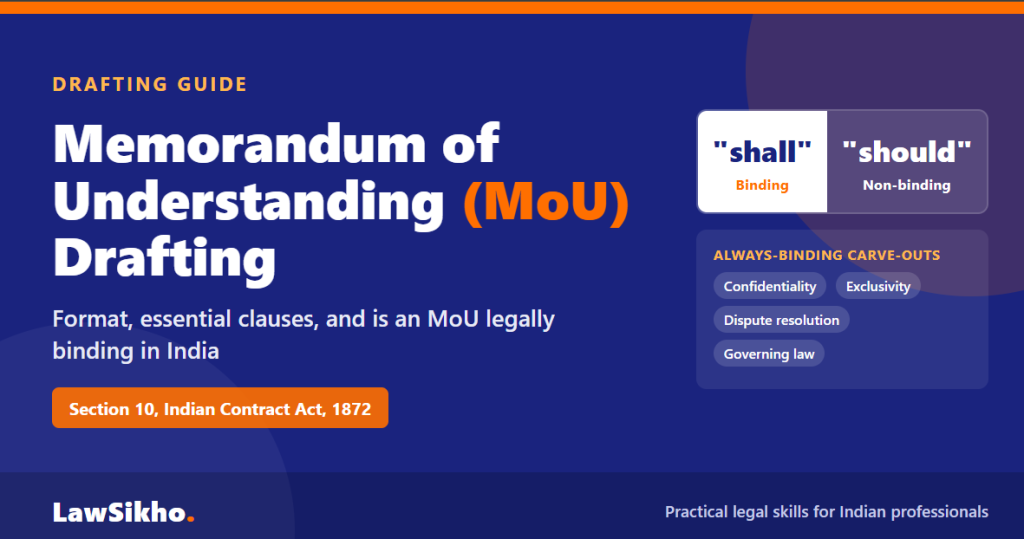
The starting point is the language cue. Word choice is the clearest signal of intent, and courts read it closely. The table below is the working cheat sheet practitioners keep in their heads.
| Drafting phrase | Signals | Effect |
|---|---|---|
| “shall”, “agrees to”, “undertakes”, “is obligated to” | Firm commitment | Binding intent; creates an enforceable obligation |
| “must”, “will be responsible for” | Firm commitment | Binding intent |
| “should”, “intends to”, “may”, “endeavours to” | Aspiration, not obligation | Non-binding intent |
| “subject to a definitive agreement”, “non-binding” | Deferral to a later contract | Non-binding intent; rebuts the presumption to be bound |
How do you make an MoU binding? You use committing language (“the parties shall”), you complete every essential term, you include consideration, and you state expressly that the parties intend to be legally bound. If you want the whole MoU to be enforceable, say so, and leave nothing material for “future agreement.” Ambiguity is what gets litigated.
How to make an MoU non-binding (the disclaimer clause)
Making an MoU non-binding is not about avoiding clear terms. It’s about adding an express, unambiguous disclaimer and using aspirational language for the deal itself. The workhorse clause reads something like this in substance: “This memorandum records the parties’ present intentions only and is not intended to create legally binding obligations, save for the clauses expressly stated to be binding below. Any binding commitment shall arise only upon execution of a definitive agreement.”
That “subject to contract” architecture is exactly what the Supreme Court respected in Dresser Rand S.A. v. Bindal Agro Chem Ltd., (2006) 1 SCC 751. There, the Court held that a letter of intent merely indicates a party’s intention to enter into a contract in future and does not necessarily amount to a binding, concluded contract, and that whether it does depends on the parties’ intention, read from the document as a whole. A clean non-binding declaration, paired with “subject to a definitive agreement” language, is the counterweight that keeps the main deal open.
And now the part almost every guide misses. Once you make the deal itself non-binding, the clauses you carve out as binding become the clauses that actually matter. In a “non-binding” MoU, nobody litigates the deal that never had to happen.
What gets litigated is the confidentiality that was breached, the exclusivity that was ignored, or the dispute-resolution clause someone tries to dodge. Drafting skill quietly shifts from boilerplate to carve-out engineering, and that’s where the real money and the real risk now sit.
Enforceable carve-outs that survive a non-binding MoU
Four carve-outs do the heavy lifting in most non-binding MoUs. Each should be drafted as expressly binding, with its own teeth, and each should be stated to survive termination or expiry of the MoU.
Confidentiality comes first. The parties will exchange sensitive information during negotiations, and you want that protected whether or not the deal closes. A well-drafted confidentiality carve-out defines confidential information, restricts its use to the proposed transaction, and survives for a fixed period after the MoU ends.
If you want the mechanics done properly, study how to draft a confidentiality clause that survives rather than lifting a generic paragraph. Can a confidentiality clause survive after a non-binding MoU ends? Yes, if it’s drafted as an independent, binding obligation with an express survival period. It doesn’t ride on the deal.
Exclusivity or standstill is the second. This binds the parties (usually the target or seller) not to negotiate with third parties for a defined window, giving you room to complete diligence without being gazumped. Dispute resolution is the third: an arbitration or jurisdiction clause that governs disputes about the binding parts of the MoU itself. Governing law is the fourth, fixing which law applies.
So what if the MoU stays silent on binding status? A question practitioners raise constantly, and the answer is that a court will decide for you, weighing the terms and conduct, which is precisely the uncertainty a clean disclaimer plus binding carve-outs eliminates.
Binding words
shall agrees to undertakes is obligated to mustNon-binding words
should intends to may endeavours to subject to a definitive agreementCarve-outs: always make these binding
- Confidentiality (with express survival period)
- Exclusivity / standstill
- Dispute resolution (seat, rules, arbitrators)
- Governing law
If binding
Enforceable as a contract if Sec. 10 is met.If non-binding
Deal is intent only; the binding carve-outs are the clauses that actually protect you.MoU vs LOI vs term sheet vs MoA vs NDA vs contract
Founders and juniors mix these up constantly, and the confusion is expensive. Use the wrong instrument and you either over-commit or under-protect. So here’s the single comparison table the top Indian search results don’t give you, across all the pre-contractual instruments in one place.
| Instrument | Binding status | Primary purpose | Deal stage | Consideration required | Typical use |
|---|---|---|---|---|---|
| MoU | Usually non-binding (except carve-outs) | Record shared intent and broad terms | Early to mid | Not usually | JVs, collaborations, partnerships |
| Letter of Intent (LOI) | Usually non-binding (except carve-outs) | One party signals intent to proceed | Early | Not usually | M&A, real estate, procurement |
| Term Sheet | Usually non-binding (except carve-outs) | List key commercial terms of a deal | Mid | Not usually | VC/PE funding, acquisitions |
| Memorandum of Association (MoA) | Binding (constitutional document) | Define a company’s objects and scope | Company incorporation | Not applicable | Registering a company |
| NDA | Binding | Protect confidential information | Any | Yes (mutual promises) | Any deal involving disclosure |
| Definitive Contract | Binding | Create final, enforceable obligations | Final | Yes | Closing the transaction |
MoU vs agreement and contract
What’s the difference between an MoU and an agreement or contract? Every contract is an agreement, but not every agreement is a contract, and an MoU sits awkwardly across that line. An agreement becomes a contract only when it satisfies Sec. 10 (consideration, capacity, free consent, lawful object) and is enforceable at law. A contract is a fully enforceable agreement; an MoU is usually a lighter, often non-binding record of intent that may or may not ripen into a contract. When should you use an MoU instead of a full contract? When you want to signal commitment and align on broad terms before you’re ready (or able) to accept binding obligations.
MoU vs MoA (Memorandum of Association)
This one trips people up purely because of the similar names. A Memorandum of Association (MoA) is a foundational constitutional document of a company, filed with the Registrar of Companies at incorporation, that defines the company’s name, objects, and scope of activities. It has nothing to do with a memorandum of understanding beyond the word “memorandum.” An MoU is a commercial document between parties; an MoA governs a company’s very existence. Mixing them up in a filing or a clause reference is an embarrassing but surprisingly common error.
Term sheets deserve a word too, because the MoU-versus-term-sheet question is common in funding rounds. A term sheet lists the key commercial terms of a specific deal (valuation, investment amount, liquidation preference, board rights), while an MoU is usually broader and more relational. Is a term sheet more binding than an MoU? Not inherently; both are typically non-binding except for carve-outs.
If you’re comparing the two in a startup context, the granular detail lives in the term sheet clauses in a startup funding round, which an MoU rarely reaches. And LOI or MoU, which comes first? Usually an LOI or MoU comes early, before the term sheet drills into numbers, though sequencing varies by deal.
As for the NDA, it differs from an MoU in scope: an NDA does one job (protect confidential information) and is binding, whereas an MoU covers the broader relationship and usually isn’t. A letter of comfort is softer still: it reassures a third party (often a lender) about a parent company’s stance without creating a firm guarantee. What’s the position on an international MoU between countries? Those operate under public international law and diplomatic practice, not the Indian Contract Act, and their “binding” quality is a matter of international relations rather than domestic contract enforceability.
| Instrument | Binding status | Primary purpose | Deal stage | Consideration required | Typical use |
|---|---|---|---|---|---|
| MoU | Usually non-binding (except carve-outs) | Record shared intent and broad terms | Early to mid | Not usually | JVs, collaborations, partnerships |
| Letter of Intent (LOI) | Usually non-binding (except carve-outs) | One party signals intent to proceed | Early | Not usually | M&A, real estate, procurement |
| Term Sheet | Usually non-binding (except carve-outs) | List key commercial terms of a deal | Mid | Not usually | VC/PE funding, acquisitions |
| Memorandum of Association (MoA) | Binding (constitutional document) | Define a company’s objects and scope | Company incorporation | Not applicable | Registering a company |
| NDA | Binding | Protect confidential information | Any | Yes (mutual promises) | Any deal involving disclosure |
| Definitive Contract | Binding | Create final, enforceable obligations | Final | Yes | Closing the transaction |
Essential clauses of an MoU (annotated clause library)
A template gives you clauses. It rarely tells you why each clause is worded the way it is, or which ones will actually be tested if things go wrong. This annotated library fixes that, because knowing the reason behind a clause is what lets you adapt it instead of blindly copying it.
Parties and capacity. Name each party in full, with entity type, registration details, and registered address. Confirm each signatory has authority to bind their entity. This isn’t a formality: capacity is a Sec. 10 essential, and an MoU signed by someone without authority may not bind the entity at all.
Recitals, purpose and scope. The recitals (the “whereas” clauses) explain the background and the parties’ intention. They’re your chance to frame the deal and, crucially, to signal whether the parties intend to be bound. Scope defines what the collaboration covers and, just as importantly, what it doesn’t.
Roles, obligations and consideration. Set out what each party will do. If the MoU is meant to be non-binding on the deal, use aspirational language here (“the parties intend to”). If any obligation is meant to bind, use “shall.” Consideration (if the MoU is to be binding) should be identified, even if nominal, because a contract needs it under Sec. 10.
Duration, validity and milestones. State when the MoU takes effect, how long it lasts, and any milestones or conditions. How long should an MoU be valid? Long enough to complete diligence and negotiate the definitive agreement (commonly three to twelve months), with an express expiry so it doesn’t linger indefinitely. An MoU with no end date is a loose thread that can be pulled years later.
Confidentiality, dispute-resolution and governing-law clauses
These are the clauses that get litigated, so they earn the most drafting care. Confidentiality should be a standalone, binding obligation with a defined scope, permitted-use limits, and an express survival period. Dispute resolution should specify the mechanism (arbitration is common for commercial MoUs), the seat, the number of arbitrators, and the language. Because the dispute-resolution carve-out is often the highest-value clause in the whole document, it’s worth learning how to draft a watertight arbitration clause properly rather than pasting a one-line “disputes shall be arbitrated” and hoping.
Governing law fixes which state’s or country’s law applies and, read together with the dispute-resolution clause, tells everyone where and how a fight gets resolved. What arbitration or dispute clause should an MoU have? At minimum, one that’s self-contained and binding even if the rest of the MoU isn’t, names the seat and rules, and survives termination. A vague dispute clause in an otherwise careful MoU is the drafting equivalent of a strong door with a broken lock.
Signatures, authorised signatory and witnesses
The execution block is where enforceability can quietly fail. Each party should sign through a person authorised to bind it (for a company, that usually means a board resolution or power of attorney backing the signatory). How should the MoU be signed and by whom? By the authorised signatory of each party, with name, designation, and (for entities) a reference to the authorising resolution.
Do witnesses need to sign an MoU? Not as a strict legal requirement for a simple MoU, but witness signatures add evidentiary weight and are advisable. They become important where the document touches immovable property or needs to be proved later.
What experienced practitioners know is that termination and exit clauses are underrated. A clean exit clause (notice period, consequences of termination, which clauses survive) prevents ugly arguments later. What termination clause should an MoU have? One that states how either party can exit, how much notice is required, and, critically, which obligations (confidentiality, dispute resolution) survive the exit. And the question worth asking on every clause is a simple one: if this deal collapsed tomorrow, would this wording protect me or expose me?
How to draft an MoU: step-by-step
Enough theory. Here’s the actual process, start to finish. Follow these eight steps and you’ll produce an MoU that’s structurally sound and legally aware, whether you’re writing it for two companies or two founders.
- Identify the parties and confirm signing authority.
- State the purpose and scope in the recitals.
- Define each party’s roles and obligations.
- Set the duration, milestones and validity period.
- Add carve-out clauses (confidentiality, exclusivity, dispute resolution, governing law).
- State the binding or non-binding intention expressly.
- Execute with authorised signatories and witnesses.
- Have a lawyer review before signing.
Step 1: identify the parties and confirm signing authority. Get the full legal names, entity types, and registration details of every party, and confirm that whoever signs can actually bind their organisation. For a company, that means checking the board resolution or authority document.
Step 2: state the purpose and scope in the recitals. Write recitals that explain the background and the deal’s purpose in plain terms. This is also where you begin signalling whether the parties intend to be legally bound.
Step 3: define each party’s roles and obligations. Spell out who does what. Match your verb choice to your intention: “shall” for anything binding, “intends to” or “may” for anything you want kept open.
Step 4: set the duration, milestones and validity period. Fix the effective date, the expiry, and any milestones toward the definitive agreement. Always include an end date so the MoU doesn’t outlive its usefulness.
Step 5: add carve-out clauses. Draft confidentiality, exclusivity or standstill, dispute resolution, and governing law as expressly binding clauses that survive the MoU. These are the provisions that will actually be enforced, so give them real teeth.
Step 6: state the binding or non-binding intention expressly. Add a clear declaration of what binds and what doesn’t. Never leave the document silent on this, because silence hands the decision to a court.
Step 7: execute with authorised signatories and witnesses. Have the authorised signatory of each party sign, ideally with witnesses, and reference the authorising resolutions. Consider stamping if the MoU carries consideration or touches property (covered below).
Step 8: have a lawyer review before signing. Do you need a lawyer to draft an MoU? Not legally, and simple MoUs are often self-drafted. But for anything with real money, property, or a binding intent, a lawyer’s review is cheap insurance against a clause that binds you the wrong way. What documents do you need to prepare an MoU? Typically the parties’ registration details, authority documents (board resolutions or POAs), the commercial terms agreed so far, and any prior LOI or term sheet. The mistake we see most often is treating step 8 as optional on a “small” MoU that later turns out to have been binding all along.
MoU format and annotated sample (with e-signing)
Knowing the clauses is one thing; laying them out in the right order is another. A clean format signals professionalism and makes the document easy to negotiate, so here’s the standard anatomy of an MoU in India, top to bottom.
A standard MoU format runs in this sequence. Title (“Memorandum of Understanding”). Date and place of execution. Parties (full names, entity types, addresses, described as “Party A” and “Party B” for the rest of the document). Recitals (the “whereas” clauses setting out background and purpose). Operative clauses (scope, roles and obligations, consideration, duration, confidentiality, exclusivity, dispute resolution, governing law, termination, binding-status declaration). Boilerplate (notices, amendments, entire understanding, counterparts). Execution block (signatures of authorised signatories, witnesses).
Annotated sample format walkthrough
Here’s what that actually looks like in a skeleton. The recital might read: “WHEREAS Party A is engaged in [business] and Party B is engaged in [business], and the parties wish to record their understanding regarding [purpose].” The binding-status clause might read: “This memorandum records the parties’ intentions and is non-binding, save for Clauses [X, Y, Z] (confidentiality, exclusivity, dispute resolution, governing law), which are binding and survive termination.” That single clause does more to protect you than the ten pages around it.
On format conventions, MoUs are typically prepared in Word for negotiation (tracked changes make redlining easy) and finalised as a PDF for signature. What’s the format of an MoU in India? There’s no statutory format; the structure above is convention, not law, which is exactly why drafting judgment matters more than any template. A sample or template between two parties should always be adapted to the specific deal, because a generic form rarely reflects your carve-out priorities.
E-signing, counterparts and the future of MoU drafting
E-signing is quietly reshaping how MoUs get executed, and drafting is starting to catch up. Electronic execution through Aadhaar e-Sign or a digital signature certificate (DSC) is rising fast, and MoUs increasingly need clauses addressing electronic execution, counterparts, and authentication, an area most competitor guides still ignore.
Early signals suggest the next shift is AI-assisted first drafts paired with lawyer-reviewed finals: template generators and language models can now produce a serviceable first cut of an MoU in minutes. Practitioners expect the durable professional value to move decisively toward enforceability judgement, deciding what should bind, engineering the carve-outs, and stress-testing the document against Sec. 10 and the case law, work that a generator can’t do. In other words, drafting the words is being commoditised; knowing which words bind is not.
Stamp duty, registration and notarisation of an MoU
Most MoU guides wave this away with “generally no stamp duty needed” and move on. That’s a shortcut that can cost you the document at the worst possible moment, so it’s worth getting right. The rules here are state-specific and consequence-heavy.
The table below maps the three triggers every drafter should check before signing.
| Trigger | Statute / Section | What it means for your MoU |
|---|---|---|
| Consideration or a monetary transaction recorded in the MoU | Indian Stamp Act, 1899 (and the applicable State stamp schedule) | Stamp duty may be payable; an unstamped or under-stamped instrument can be inadmissible in evidence until duty and penalty are paid |
| MoU that creates or transfers an interest in immovable property | Registration Act, 1908 | Registration may be compulsory; an unregistered document affecting immovable property may not be received as evidence of that transaction |
| Validity essentials (offer, acceptance, consideration, capacity) | Section 10 of the Indian Contract Act, 1872 | Determines whether the MoU is a contract at all, independent of stamping |
Does an MoU need to be stamped in India? It depends on the state and the content. A purely non-binding, no-consideration MoU often attracts little or no duty, but the moment your MoU records consideration or touches immovable property, you should check the relevant State stamp schedule (stamp duty is a State subject, so rates and rules differ across, say, Maharashtra, Karnataka, and Delhi). How much stamp duty is payable? There’s no single national figure; it turns on the State schedule and the nature of the instrument, which is why “generally nothing” is dangerous advice.
Consequences of an unstamped MoU (admissibility)
The real risk isn’t the duty; it’s admissibility. Under the Indian Stamp Act, 1899, an insufficiently stamped instrument can be held back from evidence until the deficit duty and penalty are paid. That means an under-stamped MoU can be inadmissible at the exact moment you need it to prove your case, which is a brutal way to learn the lesson. Is an unstamped MoU valid? It may still be a valid contract in substance, but its evidentiary use can be blocked until it’s regularised, so “valid but unusable in court” is the trap.
Does an MoU need to be registered or notarised?
Does an MoU need to be registered? Only where it creates or transfers an interest in immovable property, in which case the Registration Act, 1908 may make registration compulsory, and an unregistered document affecting immovable property can be barred from proving that transaction. A plain collaboration MoU usually doesn’t need registration.
Is a notarised MoU valid in court? Notarisation authenticates the signatures and adds evidentiary weight, but it doesn’t cure a stamping or registration defect, and it doesn’t turn a non-binding MoU into a binding one. For deeper practical context on the mechanics and pitfalls, the piece on the practical realities of stamp duty is worth a read. Does notarisation alone make an MoU enforceable? It doesn’t: enforceability still turns on Sec. 10 and intention, not the notary’s seal.
Enforceability in court and breach remedies
Suppose the relationship sours and you end up in court holding your MoU. What actually happens? The honest answer is “it depends on what the MoU is,” and that uncertainty is precisely why the drafting choices above matter so much. Let’s walk through what a court does with the document.
MoU as evidence versus MoU as a contract
Can an MoU be used as evidence in court? Yes. Even a non-binding MoU is admissible (assuming it’s properly stamped) and is often powerful corroborative evidence of what the parties intended, what was disclosed, and what was agreed.
But there’s a difference between an MoU as evidence and an MoU as an enforceable contract. As corroboration, it helps prove a story. As a contract, it creates obligations a court will enforce. Which one you’re holding depends on the drafting.
When the substance is a complete bargain, courts enforce the document as a contract regardless of the label. In Nanak Builders and Investors Pvt. Ltd. v. Vinod Kumar Alag, AIR 1991 Delhi 315, the Delhi High Court enforced a document that was drawn up only as a “receipt,” not a formal contract, as a binding agreement for sale because it contained all the essential ingredients of a contract and the consideration had been paid; the informal heading did not save the party trying to walk away. That’s the mirror image of the semiconductor-JV story: there, the label matched the loose substance and no one was bound; here, the substance was a real contract and the label was irrelevant.
The opposite pole is the “agreement to agree.” In Jyoti Brothers v. Shree Durga Mining Co., AIR 1956 Cal 280, the Calcutta High Court held that a contract to enter into a contract is not a valid contract at all. So an MoU that says, in effect, “we’ll agree the real terms later” gives a court nothing to enforce, because the essential terms were never settled. Bikram Kishore Parida v. Benudhar Jena, AIR 1976 Orissa 4 reflects the objective test that a court applies an outward, reasonable-person standard to decide whether the parties intended a contract, rather than relying on either side’s private belief.
Breach remedies, specific performance and backing out
What happens if one party breaches an MoU? It turns entirely on whether the breached term was binding. Breach of a binding carve-out (say, a confidentiality or exclusivity clause) can attract damages, and in appropriate cases an injunction. Breach of a non-binding “intention” gives the other side little, which is exactly why the semiconductor partner could exit “by mutual agreement” without consequence. Can an MoU be enforced through specific performance? Where the MoU is a concluded, enforceable contract (for example, a complete agreement to sell property), specific performance may be available under the Specific Relief Act, 1963, subject to its conditions; where the MoU is a mere agreement to agree, it generally is not.
Can I back out of an MoU? If the relevant terms are non-binding, usually yes, subject to any binding carve-outs and any liability for bad-faith conduct. Does an MoU expire automatically if no final contract is signed? If it has an express validity period, it lapses on expiry, and even without one, an MoU whose whole purpose was to lead to a definitive agreement can be treated as spent once that plainly isn’t happening. One test should guide your drafting above all: when a judge picks up your MoU, will its own words tell them what’s binding, or will they have to guess?
Sector-specific MoU drafting
An MoU for a startup founders’ arrangement and an MoU for a government project are not the same animal, even if they share a skeleton. The clauses that matter, and the risks that bite, change with the sector. No competitor segments this properly, so here’s the practical breakdown across the five most common contexts.
JV, M&A and startup founders’ MoUs
In a joint venture or acquisition, the MoU typically sets out the proposed structure, the parties’ contributions, exclusivity, and a roadmap to the definitive agreement, while staying non-binding on the deal itself. How do you draft an MoU for a JV or business partnership? Keep the transaction non-binding, but bind confidentiality and exclusivity hard, and map a clear path to the definitive contract, because the JV lives or dies on that later document. If you’re heading toward a joint venture, understanding how a joint venture agreement in India is structured tells you what the MoU is a bridge toward. For a startup founders’ MoU, the core content is equity split, roles, vesting, IP assignment, and what happens if a founder leaves; here you often want more of it to be binding, because founder disputes are brutal when the early understanding was vague.
Property and sale MoUs, divorce and family settlements
Property / sale MoUs. These are the ones most likely to be treated as binding contracts, because they usually contain complete terms (property, price, payment, an obligation to execute a sale deed) and often an advance. Draft with care: if you intend the MoU to be a binding agreement to sell, say so and consider stamping and registration; if you don’t, use clear “subject to a definitive sale deed” language. This is the category where an accidental binding MoU does the most damage.
Divorce and family-settlement MoUs. Is an MoU in a divorce or family settlement binding? A settlement recorded in an MoU can carry significant weight, and where it’s incorporated into a consent decree or a court order, it becomes enforceable through the court. But an out-of-court family MoU sits on the usual contract principles and can be contested, so the safer route is to have the settlement reflected in the decree. Sensitivity and precision matter more here than in any commercial MoU.
Government / PSU MoUs and promissory estoppel
Contracting with the State cuts both ways, and it’s the most misunderstood corner of MoU practice. On one hand, the government routinely signs “investment MoUs” at summits that are plainly non-binding intent. On the other, the State can be held to representations it makes, through the doctrine of promissory estoppel.
Can the government resile from an MoU it signed? Not always freely. In Jai Beverages Pvt. Ltd. v. State of Jammu & Kashmir (Supreme Court of India, 12 May 2006), the Supreme Court applied promissory estoppel against the State, holding that where a party acts on the State’s conscious decision recorded through an MoU (here, an investor who set up an industrial unit relying on promised incentives), the State cannot ignore its own decision and arbitrarily withdraw the benefit. So a government MoU or representation can bind the State even where a private MoU might not bind a private party. That asymmetry is the whole point.
And this is exactly why government drafting has quietly changed. Because promissory-estoppel exposure is real, State and PSU counsel now hard-wire explicit “non-binding, subject to approvals and budgetary provision” language into their MoUs, precisely to avoid being held to a summit-stage promise. That defensive habit flows downhill: anyone contracting with the State now has to read every government MoU for the approvals-and-budget carve-out, because that clause is often the difference between a promise you can rely on and one you can’t. The lesson for the private party is to check whether the State has reserved its way out before you spend money in reliance.
Common drafting mistakes and how MoUs fall apart
Most MoU disasters aren’t exotic. They’re the same handful of mistakes, repeated, and they’re entirely avoidable once you know what to look for. Here are the ones that sink deals and drafters alike.
The biggest is vague “agreement to agree” language. When an MoU leaves the essential terms “to be decided later,” it may be unenforceable precisely when you need it, because a court has nothing concrete to hold either side to. The semiconductor-JV walkaway is the cautionary echo: a headline MoU with no binding obligation to actually build the plant meant that when the parties fell out, there was nothing to enforce, and a US$19.5 billion ambition evaporated “by mutual agreement.” That wasn’t a failure of goodwill; it was the document working exactly as an intent-only MoU works.
The second mistake is being silent on binding status. An MoU that doesn’t say whether it’s binding forces a court to decide for you, based on terms and conduct, and you may not like the answer. The third is skipping the carve-outs, so that even the things you did want protected (confidentiality, exclusivity) aren’t. The fourth is relying on the title for protection.
What are the most common mistakes when drafting an MoU? In order: vague terms, silence on binding status, missing carve-outs, and trusting the heading.
Does calling it an “MoU” protect you from liability? No, and this is the single most important misconception to kill. Substance beats title every time in Indian law; if your document is a complete bargain with consideration and intent, a court will enforce it as a contract whatever you named it, and if it’s a bare agreement to agree, calling it a “contract” won’t save it either.
Why does a big, professionally advised MoU still fall apart? Founders and procurement teams ask this constantly, and the answer is usually that it was designed to be non-binding on the deal, and everyone forgot that “non-binding” means exactly that when someone wants out. Would titling this section’s warning any differently change the law? Not for a moment, which is precisely the point.
Converting an MoU into a definitive agreement
An MoU is a bridge, not a destination. The whole point of most commercial MoUs is to get the parties to a binding, definitive agreement, so knowing how to make that transition cleanly is the final skill in the set.
Can an MoU be converted into a formal contract later? Yes, and it usually should be. The mechanism is straightforward: the parties negotiate the full terms, then execute a definitive agreement (a JV agreement, a share purchase agreement, a sale deed) that expressly supersedes the MoU. The “definitive agreement to follow” language you built into the MoU is what sets up this handoff, which is why it belongs in the document from day one.
Which clauses carry over? Typically the binding carve-outs survive or get absorbed: confidentiality, exclusivity, dispute resolution, and governing law either continue in force or are re-stated (often expanded) in the definitive agreement. The commercial terms sketched in the MoU get fleshed out with the detail, conditions, representations, warranties, and indemnities that a real contract needs. The best practice is an express clause in the definitive agreement stating that it constitutes the entire agreement and supersedes the MoU, so there’s no argument later about which document controls. Do that, and the messy question of “but the MoU said X” never arises.
Frequently asked questions about MoUs
1. What is a memorandum of understanding? A memorandum of understanding is a written document that records a shared understanding between two or more parties about a proposed relationship or transaction. It sets out broad terms and intentions before a definitive contract is signed. Most MoUs are non-binding on the deal itself, though specific clauses can be made binding.
2. Is an MoU legally binding in India? Usually not. An MoU is generally treated as a record of intent rather than an enforceable contract. It becomes binding only if it satisfies Sec. 10 of the Indian Contract Act, 1872 and shows the parties intended to be legally bound. The title “MoU” doesn’t decide the question; the substance does.
3. Is an MoU enforceable in a court of law? It can be. If the MoU meets the essentials of a contract (consideration, capacity, free consent, lawful object) and reflects an intention to be bound, a court will enforce it like any contract. If it’s a mere “agreement to agree,” it generally won’t be enforceable. Enforceability depends on drafting, not the heading.
4. Do you need a lawyer to draft an MoU? Not as a legal requirement, and simple MoUs are often self-drafted. But for anything involving significant money, property, or an intent to bind, a lawyer’s review is strongly advisable. The risk of an accidentally binding (or accidentally useless) clause usually outweighs the cost of review.
5. How do you make an MoU legally binding? Use committing language (“the parties shall”), include all essential terms, provide consideration, and state expressly that the parties intend to be legally bound. Leave nothing material “to be agreed later.” Have authorised signatories execute it, and stamp it where the content requires.
6. How do you make an MoU non-binding? Add an express, unambiguous clause stating the MoU is not intended to create legally binding obligations except for specified clauses. Use aspirational language (“intends to,” “may”) for the deal itself, and add “subject to a definitive agreement” wording. Then carve out confidentiality, exclusivity, and dispute resolution as binding.
7. How long should an MoU be valid? Long enough to complete due diligence and negotiate the definitive agreement, commonly three to twelve months. Always include an express expiry date so the MoU doesn’t linger indefinitely. An open-ended MoU can be pulled up as a live document years later.
8. What arbitration or dispute clause should an MoU have? One that’s self-contained and binding even if the rest of the MoU isn’t, naming the seat, the rules, the number of arbitrators, and the language. It should survive termination of the MoU. Because it’s often the most litigated clause, it deserves careful, specific drafting rather than a one-line placeholder.
9. Can an MoU be converted into a formal contract later? Yes, and usually it should be. The parties negotiate the full terms and execute a definitive agreement that expressly supersedes the MoU. Binding carve-outs (confidentiality, exclusivity, dispute resolution) typically carry over or are re-stated in the final contract.
10. Does an MoU need to be stamped in India? It depends on the state and the content. A purely non-binding, no-consideration MoU often attracts little or no duty, but an MoU recording consideration or touching immovable property should be stamped per the applicable State stamp schedule. An under-stamped MoU can be inadmissible in evidence until the deficit duty and penalty are paid.
11. Does an MoU need to be registered? Only where it creates or transfers an interest in immovable property, in which case registration may be compulsory under the Registration Act, 1908. A plain collaboration or business MoU usually doesn’t need registration. An unregistered document affecting immovable property may be barred from proving that transaction.
12. Can an MoU be enforced through specific performance? Where the MoU is a concluded, enforceable contract (for example, a complete agreement to sell property), specific performance may be available under the Specific Relief Act, 1963, subject to its conditions. Where the MoU is a mere agreement to agree, specific performance generally isn’t available. It comes down to whether the MoU is truly a contract.
13. Can an MoU be used as evidence in court? Yes. A properly stamped MoU is admissible and is often strong corroborative evidence of the parties’ intentions and what was agreed or disclosed. Being admissible as evidence is different from being enforceable as a contract. One helps prove a story; the other creates obligations.
14. What happens if one party breaches an MoU? It depends on whether the breached term was binding. Breach of a binding carve-out (confidentiality, exclusivity) can attract damages and sometimes an injunction. Breach of a non-binding “intention” usually gives the other side little or no remedy, which is why non-binding MoUs offer limited protection on the deal itself.
15. What is the difference between an MoU and an agreement? Every contract is an agreement, but not every agreement is an enforceable contract. An MoU is usually a lighter, often non-binding record of intent, whereas an agreement that meets Sec. 10 becomes an enforceable contract. Whether a given MoU is “just an agreement” or a binding contract turns on its terms and the parties’ intention.
16. What is the difference between an MoU and a contract? A contract is a fully enforceable agreement that satisfies all Sec. 10 essentials and creates binding obligations. An MoU is typically a preliminary, often non-binding document recording intent, which may or may not ripen into a contract. The heading doesn’t control; a document titled “MoU” can be a contract if its substance qualifies.
17. What is the difference between an MoU and an MoA? A Memorandum of Association (MoA) is a company’s foundational constitutional document, filed at incorporation, defining its name, objects, and scope. A memorandum of understanding is a commercial document between parties recording a proposed relationship. They share only the word “memorandum” and serve completely different functions.
18. What is the difference between an MoU and an LOI? Both are usually non-binding preliminary documents, but a Letter of Intent (LOI) is typically issued by one party to signal its intention to proceed, while an MoU records a mutual understanding between the parties. In practice they overlap heavily, and either can contain binding carve-outs. The sequencing varies by deal, though an LOI or MoU usually comes before a detailed term sheet.
References
Case Law
- Bikram Kishore Parida v. Benudhar Jena, AIR 1976 Orissa 4 (Orissa High Court, 28 February 1975; also reported ILR (1975) Cut 553)
- Dresser Rand S.A. v. Bindal Agro Chem Ltd., (2006) 1 SCC 751 (Supreme Court of India; AIR 2006 SC 871)
- Jai Beverages Pvt. Ltd. v. State of Jammu & Kashmir (Supreme Court of India, 12 May 2006)
- Jyoti Brothers v. Shree Durga Mining Co., AIR 1956 Cal 280 (Calcutta High Court)
- K.K. Modi v. K.N. Modi, (1998) 3 SCC 573 (Supreme Court of India; AIR 1998 SC 1297)
- Kollipara Sriramulu v. T. Aswathanarayana, AIR 1968 SC 1028 (Supreme Court of India; (1968) 3 SCR 387)
- Monnet Ispat and Energy Ltd. v. Union of India, (2012) 11 SCC 1 (Supreme Court of India)
- Nanak Builders and Investors Pvt. Ltd. v. Vinod Kumar Alag, AIR 1991 Delhi 315 (Delhi High Court)
Statutes
- Indian Contract Act, 1872 (sections cited: 10, 25)
- Indian Stamp Act, 1899
- Registration Act, 1908
This article is for informational purposes only and does not constitute legal advice. For specific legal guidance, consult a qualified legal professional.





 Allow notifications